Abraham et al. Page 1 of 74
CLINICAL SUPERVISION WITH FEEDBACK MAKES PERFECT: AM I GETTING THE
FEEDBACK I NEED IN THE CLINICAL SKILLS LABORATORY?
Abraham R. M.* and Singaram V. S.
School of Clinical Medicine, Clinical and Professional Practice, College of Health Sciences, University of Kwa Zulu-Natal.
Received date: 17 September 2018 Revised date: 07 October 2018 Accepted date: 05 November 2018
INTRODUCTION
Feedback is considered an integral part of undergraduate medical education, and recognised by Harden & Laidlaw (2013) as one of the most crucial influences on effective learning and teaching. Formative assessment and feedback provides a learner with insight into their performance, helps them to reconstruct knowledge, change their performance for summative assessments and feel motivated for future learning (Eraut, 2006). Available research suggest that feedback is effective when provided soon after task performance; is presented in a manner sensitive to the students‟ learning style; clearly identifies strengths and weaknesses; has suggestions for improvement; is constructive, motivating and able to „feed-forward‟ (Hattie & Timperley, 2007). Regular performance feedback that aids learners to expand their potentials and professional development is
most effective (Cantillon & Sargent 2008). Student‟s value feedback and are aware of its importance to improve learning outcomes and a balanced and structured approach in providing feedback would be most effective to meet individual needs (Weinstein, 2014). The importance of feedback is also widely acknowledged by clinical teachers and although they believe they give regular and sufficient feedback, often this is not how learners perceive it (Cantillon & Sargeant, 2008). There are major concerns about the quality of feedback received by medical students around the world (Edgren et al. 2010).
Clinical skills training forms an important part of the undergraduate problem-based medical education curriculum during the early pre-clinical years. Clinical skills and clinical reasoning such as taking a patient history or performing a physical examination, analysing
Original Article www.wjahr.com
ISSN: 2457-0400 Volume: 2.
Issue: 6. Page N. 67-74
Year: 2018
WORLD JOURNAL OF ADVANCE
HEALTHCARE RESEARCH
Corresponding author: Abraham R. M.
School of Clinical Medicine, Clinical and Professional Practice, College of Health Sciences, University of Kwa Zulu-Natal.
ABSTRACT
Feedback to clinical learners about their performance is crucial to their development into competent clinicians yet clinicians who have little or no formal training for this aspect of their teaching role provide most feedback. Effective feedback of clinical skills is dependent on direct observation of task performed and several factors such as type, content, quality, timing, clarity, complexity and language used. Limited research in clinical training has focused on the multicultural medical students‟ perceptions of feedback and its‟ influence on the students‟ learning. Student‟s satisfaction with clinical teacher‟s feedback on their clinical performance received during directly observed clinical skills formative assessment session was evaluated. Questionnaire with both qualitative and quantitative items was administered to third year medical students. Quantitative data was statistically analysed and the qualitative data was thematically analysed. Response rate: 95% - students. Average scores for the items measured varied between 1.87 and 5 (1- negative to 5 - positive). Majority of the students reported that feedback informed them of their level of competence and learning needs, motivated them to improve on their skills and significantly improved their participation in patient-centred learning activities; however students were concerned about the lack of standard and structured assessment criteria and inconsistency in teachers‟ feedback. No statistical difference (p<0.05) was found between the mean ratings of the items based on demographic and academic differences. To standardise and enhance consistency of giving feedback by clinicians and establish a culture that supports feedback at all levels of clinical training.
and presenting this information involves various psychomotor and cognitive skills and behaviour which is acquired through repetitive and systematic training, and depends upon effective teaching, assessment and feedback (Association of American Medical Colleges, 2005). These skills are better demonstrated than described. Unfortunately the greatest deficiency reported widely is that direct observation and feedback to medical students‟ performing these skills rarely occurs during their clinical placement (Association of American Medical Colleges, 2012). Without feedback on observation, errors will go uncorrected, good performance is not reinforced and as a result clinical competence is achieved empirically or not at all (Weinstein, 2014). There is therefore an increased need for formative assessment methods that require observation and feedback. The feedback generated from the formative assessment during clinical skills training forms an integral part of the learning process to improve the learner‟s knowledge, skills and behavior, and ultimately plays a key role in guiding students in the attainment of their learning goals (Hattie & Timperley, 2007). Since giving feedback to learners on their clinical performance, whether reinforcing or corrective has been identified recurrently as a major approach to academic teaching and learning in clinical education and due to the potential of great variability in feedback delivery, it is important for medical schools to monitor clinical teachers feedback provided to students during their training. Hattie and Timperley (2007) mentioned that effective feedback to teachers means developing questions and activities that offer feedback on the effectiveness of their own teaching.
This study focuses on the multicultural medical students‟ responses to receiving feedback based on direct observation of student‟s clinical performance, the role feedback plays on students‟ learning and ultimately its impact on their clinical performance. Immediate feedback that is task specific tends to have the greatest impact on student behaviour (Hattie & Timperley, 2007). The study concentrates on the clinical teacher‟s feedback, both verbal and written, to students in the perspective of the clinical skills mini-logbook formative assessment in an undergraduate medical education programme. This research is designed to investigate the quantity, quality and type of assessment feedback students would prefer to receive as well as whether the students appreciate the value and uses of feedback provided in clinical skills as conducted in the clinical skills laboratory. Therefore the aim of the study was to assess the students response to feedback received during the directly observed clinical skills mini-logbook formative assessment sessions. The significance of this study is therefore to translate the findings into developing and improving the overall quality of students‟ learning by enhancing the effectiveness of the teachers‟ feedback to students.
MATERIALS AND METHODS Setting
The study was conducted at the clinical skills laboratory at the Nelson R Mandela School of Medicine (NRMSM), University of KwaZulu-Natal (UKZN), Durban, South Africa. The school follows a six-year undergraduate problem based curriculum where the first three pre-clinical years precedes the last three pre-clinical years and reflects a true integration of the basic sciences with the clinical disciplines, both vertically and horizontally in each learning unit during the first three years of medical training. Clinical skills forms a part of each of the modules during the pre-clinical years taught in the medical school skills laboratory using simulated patients and manikins before applying them on real patients in the clinical rotations at the hospital during the clinical years. The mini-logbook formative assessment session occurs at the end of each theme-based module, after the particular examination skill has been taught and demonstrated in small groups and the students have had enough time to practice the skills. During the mini-logbook session each student is given eight minutes to systematically demonstrate the examination skill on a simulated patient to a teacher/clinician. The teacher observes each student and rates the performance based on the minimum requirements for the skill to be deemed satisfactory at the third year MBChB level. Performances are rated immediately after the task as „inadequate‟, „satisfactory‟ or „exceeded expectation‟. Verbal and a written feedback were also provided.
Study design
This is mixed methods study adopting both quantitative and qualitative approaches in which a cross-sectional design was utilized. The study included the third year cohort of undergraduate medical students who have had exposure to the clinical skills mini-logbook formative assessment for more than a year. A questionnaire was developed and designed to explore the student‟s responses to the clinical skills assessment feedback received and their perceptions of the feedback process. The questionnaire was piloted with a few students to assess the adequacy and interpretation of the questions which resulted in minor modifications. The questionnaire included both closed and open-ended questions to obtain demographic data and perceptions of clinical skills formative assessment feedback. Responses were recorded on a five-point Likert scale, ranging from “strongly disagree” to “strongly agree”. “Agree” responses were regarded as positive, while “Disagree” responses were regarded as negative. Participants consented to their participation in the study
Data analysis
Analysis of variance (ANOVA) statistical tests were employed to ascertain specific age, gender, language, enrolment status and academic performance differences, among the different demographic groups. Confidence intervals (CIs) were set at 95%. The degree of statistical significance is denoted by the p value of less than 0.05. Construct validity of the instrument was assessed using confirmatory factor analysis to assess the adequacy of the underlying items in each of the different categories in the questionnaire. Qualitative data gathered from the students‟ responses to the open-ended questions were analysed (Krippendorff, 2004) and specific quotations were selected (with reference back to the complete, original response) to represent the identified themes and contextualize the quantitative data.
RESULTS
Participants enrolled in the study included the third year cohort of medical students.183 of the 193 registered students completed the questionnaire making the overall response rate 95%. This consisted of 115 (68%) females and 68 (37%) males with 96% of them between the ages of 18-25years. They included a diverse group of students in terms of multicultural, language and academic background.
Student’s response to Feedback received
To better understand and analyse students‟ experiences on the formative assessment feedback received in clinical skills, we asked them various questions relating to: general perceptions of the clinical skills mini-logbook formative assessment feedback, value of feedback received, preferences for feedback and suggestions to improve feedback in clinical skills. Quantitative analysis of responses showed the following findings that were then unpacked to provide a richer understanding through the qualitative data collected about their general perceptions of the feedback received and suggestions to improve the quality of feedback.
Nearly all the students (88%) were satisfied with the amount of feedback received:
“Clinical skills are the only organised pre-clinical year department in medical school that provides useful feedback to individual students. Keep it up.”
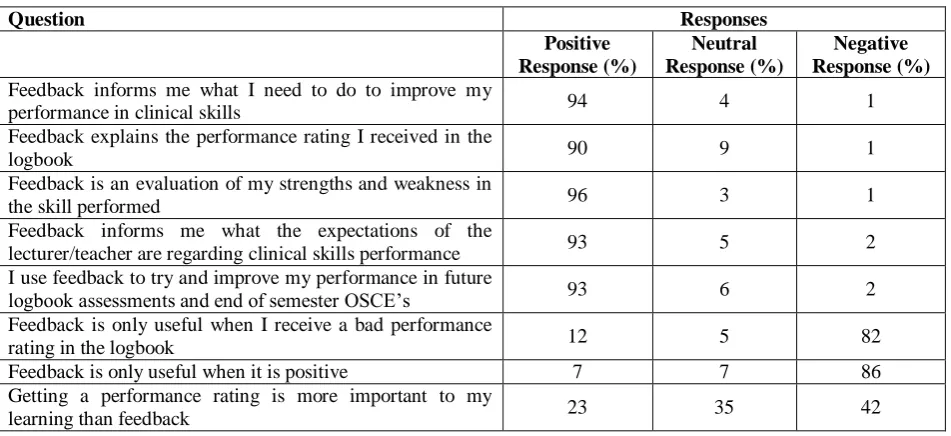
For the purpose of evaluating the effect of feedback on students‟ academic performance, the students‟ responses to the general perceptions and use of feedback received from the clinical teachers is indicated in Table 1.
Table 1: Impact of feedback on academic performance-clinical skills logbook assessment feedback.
Question Responses
Positive Response (%)
Neutral Response (%)
Negative Response (%)
Feedback informs me what I need to do to improve my
performance in clinical skills 94 4 1
Feedback explains the performance rating I received in the
logbook 90 9 1
Feedback is an evaluation of my strengths and weakness in
the skill performed 96 3 1
Feedback informs me what the expectations of the
lecturer/teacher are regarding clinical skills performance 93 5 2
I use feedback to try and improve my performance in future
logbook assessments and end of semester OSCE‟s 93 6 2
Feedback is only useful when I receive a bad performance
rating in the logbook 12 5 82
Feedback is only useful when it is positive 7 7 86
Getting a performance rating is more important to my
learning than feedback 23 35 42
There was a high degree of consistency as majority of students believed that the feedback received has had a positive impact on their learning and clinical skills performance. It informed them of what was needed to improve their performance (94%) and explained the performance rating they received (90%). They were satisfied that feedback was an evaluation of their strengths and weaknesses in clinical skills (96%), informed them of the teachers‟ expectations with regards to the skill performed (93%), was relevant to their goals as a student, was useful to feed-forward (93%), acceptable and well appreciated:
“I really appreciated the fact that we have logbook sessions before the actual exam as they are good preparation for upcoming OSCE exam. It helps me to see my weak points of which I have to work on before exams. The feedback provided did in helping better our technique and learn further”
“Teachers must give us feedback that is truly indicative of our performance. They must not focus only on the wrong things but also explain how we can improve the things that we did well.”
They further suggested ways to improve their feedback experience and demanded the need for feedback as a tool to gauge their knowledge. They were unhappy with the time it takes to receive summative assessment feedback in the clinical skills OSCE (objective structured clinical examination):
“We don‟t receive feedback for our OSCE‟s. I believe to improve we should be given this feedback as it is an addition of how much more work you need to put towards your clinical skills.”
Response to the evaluation of the students‟ value of feedback and personal motivation to learn following the clinical skills logbook assessment sessions is illustrated in Table 2.
Table 2: Impact of feedback on personal motivation to learn-clinical skills logbook assessment feedback.
Question Responses
Positive Response (%)
Neutral Response (%)
Negative Response (%)
Feedback is important to me 99 1 0
I always read the feedback on my logbook 98 1 1
I deserve feedback when I put a concerted effort into
practicing my clinical skills 96 3 1
When I receive substantial feedback I feel encouraged 92 7 1
Teachers who provide feedback care about what the students
generally think 78 15 6
Feedback motivates me to study 93 7 0
When I don‟t receive feedback I feel that the teacher does
not respect me 44 34 22
All the clinical skills teachers followed a similar criteria and
style of providing feedback 16 24 60
An important part of learning is being able to discuss the
subject with my lecturer/teacher 92 7 1
I learn more when my teacher focuses on what I did wrong 63 15 22
Students valued the feedback received and always ensured they read the feedback provided in the logbook (98%). They believed that they deserve getting feedback, especially after putting effort into practicing their clinical skills (96%) as it encourages (92%) and motivates them to study (93%). Students felt that teacher‟s feedback to them was a demonstration of their care about a students work (78%). However they raised an important issue with regards to teacher variability when delivering feedback (60%) and the need for more clarity when providing feedback. The criterion with which feedback is provided was of concern. Students linked the feedback variation to lack of use of standard and structured assessment criteria by the teachers. When prompted for recommendations to improve clinical skills logbook assessment feedback they suggested standardization and consistency of the feedback process:
“The feedback we receive from logbooks is very helpful. However I don‟t feel that all teachers follow a similar criteria and style. Some have their own criteria which might be higher than what a student knows hence most students don‟t receive good marks.”
“Logbook sessions are useful in assessing our skills. However I feel that teachers should use the same methods of testing to make things fair for all students”
“All the teachers differ in their approach to feedback, and some do not provide any comment. Just tick the rating. Some of the teachers give immediate responses on the skills executions in detail while others simply tell you where you are lacking and to go look it up.”
“The clinicians should be clear when they are rating. I sometimes find it difficult to see whether it‟s exceeding expectations or satisfactory. Sometimes feedback received is unclear and leaves more questions than clarity. Feedback should be clear at all times without any bias”
“Teachers must consider giving formal and fair feedback for every assessment. Assessment criteria must be available to students as a form of learning objectives and goals.”
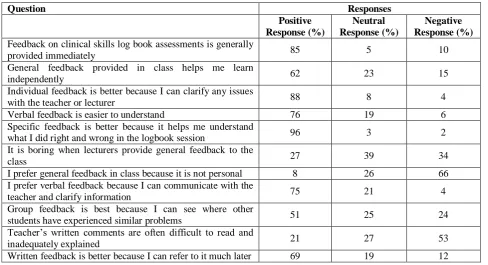
Table 3: Preferences for feedback: clinical skills logbook assessment feedback.
Question Responses
Positive Response (%)
Neutral Response (%)
Negative Response (%)
Feedback on clinical skills log book assessments is generally
provided immediately 85 5 10
General feedback provided in class helps me learn
independently 62 23 15
Individual feedback is better because I can clarify any issues
with the teacher or lecturer 88 8 4
Verbal feedback is easier to understand 76 19 6
Specific feedback is better because it helps me understand
what I did right and wrong in the logbook session 96 3 2
It is boring when lecturers provide general feedback to the
class 27 39 34
I prefer general feedback in class because it is not personal 8 26 66
I prefer verbal feedback because I can communicate with the
teacher and clarify information 75 21 4
Group feedback is best because I can see where other
students have experienced similar problems 51 25 24
Teacher‟s written comments are often difficult to read and
inadequately explained 21 27 53
Written feedback is better because I can refer to it much later 69 19 12
Students were satisfied with the timely delivery of clinical skills formative assessment feedback (85%):
“Feedback in clinical skills is done appropriately and it‟s always done on time immediately after the skill has been performed which is quite beneficial to the students.”
They did value some amount of general feedback (51%) as it gave them an idea about whether other students in the class experienced similar problems:
“A little more group feedback to judge where I am in the class and whether or not I am putting enough effort into my learning.”
They acknowledged that individual feedback (88%) was more personal and fitting because they could clarify any issues with the teachers and thought this was an important part of their learning:
It is always better for one-on-one feedback and/or small group feedback that focus on individual needs and allows students to interact with the facilitator easily, ask questions and clarifications when necessary.”
They preferred verbal feedback (75%) that was more specific to their work specifying the positives and negatives in the skill demonstrated:
“This is not a different method but more emphasis on a verbal individual feedback for me, it‟s more helpful than small or large group feedback because it focuses specifically on my performance and accounts not only for the things I got wrong but the things I got right and what I need to improve on.”
Students‟ attitudes towards written feedback were quite positive (69%), as they could refer to it even much later:
“Written feedback should be provided as we can refer to it much later.”
Suggestions to improve the quality of the written feedback were offered:
“Written feedback is much useful if it explains just briefly where the student needs to improve their skills and is not only a comment like just keep practising”.
DISCUSSION
Feedback on clinical skills competence is essential for effective student learning due to its significant impact upon learner development and progression (Hattie & Timperley, 2007). It closes the gap between students‟ actual and desired level of competence shaping and improving competence at a skill. Our results revealed students were satisfied with the amount of feedback received in clinical skills but were however concerned about the quality and inconsistency with which it was provided by the different teachers. Lack of effective feedback is considered a serious deficiency in medical education (Weinstein, 2014).
on their learning and clinical performance and hence their future practice (Eraut, 2006). They preferred a balanced feedback which was an evaluation of their strengths and weaknesses as it was essential for their growth as a student, helped boost their confidence and self-esteem, increased their motivation to study and provided them with some direction for learning which had a constructive impact on their subsequent clinical performance. This therefore highlights the importance of feedback to undergraduate medical students as a means to acquire basic clinical competence early on in medical education in order to adopt correct behaviours in approaching patients‟ problems during clerkship years.
Though there are a wide variety of feedback preferences our medical students preferred type of feedback was individual and verbal feedback as it was more personal affording them an opportunity to communicate with the teacher and clarify information, an important part of learning similar to a study by Parikh et al. (2001). Some amount of group feedback was also favoured (Parikh et al.‟s 2001) as it gave them an idea about whether other students in the class experienced similar problems. They had a positive attitude towards written feedback, as they could refer back to it later on. The reaction of students to general verses specific feedback on their clinical performance revealed that nearly all of the class preferred specific feedback on their work as it addressed distinct elements of their work and helped them to understand better what they did right and wrong. They found general comments about their work uninformative (Hounsell, 2006), however this must not be dismissed and students should be able to develop a meaningful conversation with the teacher and probe the actual details of the feedback by asking specific questions with regards the task performed (Dent, 2013).
The significance of feedback, although generally acknowledged by our students in this study indicated inconsistency in the delivery of feedback during clinical skills mini-logbook sessions. Some students were satisfied with the feedback they received, while others were dissatisfied as they identified significant differences in terms of quantity and quality of feedback provided by the different clinical skills teachers. The teacher variability when delivering feedback was attributed to the lack of use of standard and structured feedback assessment criteria. As stressed by Raftery (2008) our study participants recommended standardization of the feedback delivery process across the various clinical skills teachers to enhance consistency of the feedback practice and fair assessment, which would ultimately improve its efficiency and their learning experience. One reason that may explain the discounting of feedback by the students may be their unfamiliarity with the particular teacher that assessed them. Connecting with teachers, creates a positive and healthy environment, eases the feedback process and eliminates barriers to the use of feedback as a tool for self-improvement and development (Watling, 2012).
Though students appreciated the amount of feedback received their perceptions of the teachers‟ high variability and inconsistency in the quality of feedback delivered and its impact on an effective feedback process were highlighted. In a similar study Cantillon and Sargeant (2008) revealed that learners often do not feel they receive enough feedback and if they do, they feel that the process is not effective most of the time. Most teachers in this study provided feedback that reflects more general information of the students‟ performance without any structure and failed to focus on student‟s knowledge, attitude and behaviour which contradicts strategies to providing an effective feedback (Hattie and Timperley, 2007). Previous studies in diverse student populations suggest that cultural and linguistic differences between students can lead some to avoid actively participating. Hence, the cultural influences on student‟s participation in the logbook sessions cannot be overlooked (McLean et al., 2006). Feedback in our setting was only provided by the teachers but Nicol and Macfarlane Dick (2004) and Race (2008) in a similar study emphasised that feedback is not exclusively provided by teachers but can be produced by other sources such as peers, teachers and more so from self-assessment. With the shift in the medical education paradigm to a competency based curriculum in our setting, the importance of training our students to self-assess the different components of a specific task performed is crucial to identifying their weaknesses, improves their acceptance of feedback, leads to positive changes in behaviour and performance and ultimately enables them to practice as competent physicians (Wynia, 2010).
The results of this study raise important issues that need to be considered. However there are certain limitations. Implementation of feedback mechanisms depend on the level of the undergraduate programme as well as the type of activity assessed. This study was limited to the clinical skills logbook sessions in the third year of pre-clinical training, thus results could be difficult to generalise. There is the potential for recall bias as a result of an inability among some students to recognise feedback during the module. As an attempt to address this, data was collected from the students immediately after a clinical skills mini-logbook session. Various factors influence the learning environment hence we also included a second study of their teachers‟ perspectives of the feedback they provided to the students which will be reported in another study. This was an attempt to verify the perceptions investigated.
CONCLUSION
The survey presented students with an opportunity to reflect on the significance of feedback in their learning. Although the study results did demonstrate that feedback on students‟ clinical skills performance in the clinical skills formative logbook sessions was often forthcoming, when provided it lacked the requirements of an effective feedback due to the inconsistency in the way it was provided by the different teachers. This could fail to offer an essence of skills development and improvement of clinical performance. This further reiterates the need to address the critical challenges faced by the clinical teachers, medical education units and all hospital departments to strengthen and provide effective and structured feedback to medical students during their undergraduate medical training. The establishment of a culture that enhances feedback through all levels of academic discipline cannot be underestimated. The efficient delivery of feedback is a multifactorial process beginning with the preparation of the clinical teachers in providing feedback as well as preparing their students to receive effective feedback. The university will need to play a key role in the successful implementation of feedback across all departments by providing training and encouraging the participation of all clinical teachers to enrol in faculty enhancement workshops. Establishing an instructional system and revising our clinical skills mini-logbook to a more specific criterion-based structured feedback instrument to be used for the process of delivering feedback in the clinical skills department as well as extending it to all clinical disciplines in the different teaching hospital departments is recommended. It is suggested that the implementation of this system be closely monitored to ensure effectiveness. Hence, to reinforce the clinical skills curriculum and ensure uniform and consistent exposure to core competences, it is important that clinical skills teaching are accompanied with regular structured feedback and review sessions at the end of each teaching module.
ACKNOWLEDGEMENTS
University of KwaZulu Natal – University Capacity Development Programme through the Department of Higher Education - Initiative for funding received for this study. Moreover, the authors wish to thank the students and clinical supervisors who participated in this study for their time and willingness to share their experiences and insights.
Funding: No financial benefits have been received from any party related directly or indirectly to the subject of this article.
Conflict of interest: The authors declare that they have no conflict of interest.
Ethical approval: Ethical approval for the study was sought and obtained from Humanities and Social Sciences Research Ethics committee, University of KwaZulu-Natal (Reference no. HSS /0084/014M).
REFERENCES
1. Harden RM, Laidlaw JM. Be FAIR to students: Four principles that lead to more effective learning. Medical Teacher, International Journal of Education in the Health Sciences, 2013; 35: 27-31.
2. Eraut M. Feedback. Learning in Health and Social Care, 2006; 5(3): 111-118.
[http://dx.doi.org/10.1111/j.1473-6861.2006.00129.x]
3. Hattie JA, Timperley H. The power of feedback. Review of Educational Research, 2007; 77: 81-112. [http://dx.doi.org/10.3102/003465430298487] 4. Cantillon P, Sargeant J. Giving feedback in clinical
settings. British Medical Journal, 2008; 337: 1292-1294. [http://doi:10.1136/bmj.a1961]
5. Weinstein DF. Feedback in clinical education: untying the Gordian Knot. Acad Med, 2015; 90(5): 559-561.
[http://doi:10.1097/ACM.0000000000000559] 6. Edgren G1, Haffling AC, Jakobsson U, McAleer S,
Danielsen N. Comparing the educational
environment (as measured by DREEM – Dundee Ready Education Environment Measure) at two different stages of curriculum reform. Medical Teacher: An International Journal of Education in
the Health Sciences, 2010; 2: 233-238.
[http://dx.doi.org/10.3109/01421591003706282] 7. Association of American Medical Colleges.
Recommendations for Clinical Skills Curricula for
Undergraduate Medical Education, 2005.
[https://www.aamc.org/download/130608/data/clinic alskills_oct09.qxd.pdf.pdf.] (Accessed: 22 May 2014).
8. Association of American Medical Colleges Medical School Graduation Questionnaire (2012). All School Summary Report. 2014.
9. Krippendorff K. Content analysis; An Introduction to its Methodology (2nd Edition). Thousand Oaks,
CA: Sage Publications, 2004; 413.
[http://dx.doi.org/10.1177/1094428108324513] 10. Hounsell D. Towards making a more sustainable
feedback to students. In D. Boud and N. Falchikov (eds.) Rethinking Assessment in Higher Education. London: Routledge, 2007; 101-113.
11. Parikh A, McReelis K, Hodges B. Student feedback in problem based learning: A survey of 103 final year students across five Ontario medical schools.
Medical Education, 2001; 35: 632-636.
[http://dx.doi.org/10.1046/j.1365-2923.2001.00994.x]
12. Hounsell D, J. Hounsell V, McCuneJ. Enhancing guidance and feedback to students: Paper presented at the 3rd Biennial Northumbria/EARLI SIG Assessment Conference Northumbria, 30 August-1 September, 2006.
13. Dent J, Harden RM. New York: Elsevier Health Sciences. A practical guide for medical teachers, 4th ed. New York: Elsevier Health Sciences, 2013: 273-275.
14. [http://dx.doi.org/10.1136/pmj.78.916.125]
15. Raftery S. Feedback: An essential element of student learning in clinical practice. Nurse Education in Practice, 2008; 8: 405-411.
[http://dx.doi.org/10.1016/j.nepr.2008.02.003] 16. Watling C, Driessen E, van der Vleuten, CP,
Lingard. Learning from clinical work: the roles of learning cues and credibility judgements. Medical Education, 2012; 46(2): 192-200.
[http://dx.doi.org/10.1111/j.1365-2923.2012. 04126.x].
17. McLean M. Van Wyk JM, Peters-Futre EM, Higgins-Opitz SB. The small group in problem-based learning: more than a cognitive „learning‟ experience for first-year medical students in a diverse population. Medical Education, 2006; 28(4): 94-e103.
[https://doi.org/10.1080/01421590600726987]. 18. Nicol D, McFarlane Dick D. Rethinking formative
assessment in Higher Education; A theoretical model and seven principles of good feedback practice. The Higher Education 117 Academy SENLEF Project, 2004.
http://www.psy.gla.ac.uk/~steve/rap/docs/nicol.dmd. pdf. [Accessed: December 2013].
19. Race P. Compendium on feedback, 2008. http://phil-race.co.uk/?page_id=13. [Accessed: August 3 2014]. 20. Wynia M K. The role of professionalism and self-regulation in detecting impaired or incompetent
physicians. Journal of American Medical
Association, 2010; 304: 210–12. [https://doi: 10.1001/jama.2010.945].
21. Clynes M. An exploratory study of preceptors‟ views and experiences of providing feedback on clinical performance to post-registration student nurses (sick children‟s nursing). Unpublished Master‟s Thesis, University of Dublin, 2004.
22. Anderson PA. Giving feedback on clinical skills: Are we starving our young? Journal of Graduate
Medical Education, 2012; 4(2): 154–158.