Balance function control on the
background of vestibular stimulation in
athletes
Rina S. Kamahina
1, Andrey S. Nazarenko
2, Ehlmira Shamilevna Shamsuvaleeva
2,
Chulpan I. Nizamova
11Department of Biology and Biotechnology, Institute of Fundamental Medicine and Biology, Kazan Federal University, Russian Federation, 420008, Kazan, Kremlevskaya Str. 18, Russia, 2Volga Region State Academy of Physical Culture, Sport and Tourism, 420138, Kazan, Village of University Games, 35, Russian Federation
Abstract
Aim: In sports activities, the athlete faces the problem of maintaining the balance of the body against the background of physical and sensory fatigue. The sum of physical and sensory fatigue results in an overload of the athlete’s statokinetic system, which primarily leads to a decrease in vestibular stability and proprioceptive sensitivity, generation of muscle tension, changes in the central integration of sensory information, as well as to an impaired differentiation of fine movements, mismatch of regulation mechanisms, and speed of motor reactions. Materials and Methods: The body balance function was assessed using “Stabilan 01–2” stabilographic hardware–software complex (CJSC “OKB” “Ritm,” Russia) by analyzing the oscillation of the pressure center. Vestibular stimulation was performed with the help of the Barany chair (Russia). Results: The assessment of the body balance function in athletes and persons not engaged in sports was conducted before and after vestibular stimulation. According to the data of the stabilographic test, the balance function of the athletes engaged in cyclic, situational, and precision sports did not differ. Conclusion: At the same time, the most significant differences in the regulation of the balance between athletes of different specializations are manifested after vestibular stimulation. Individuals not engage in sports have a lower level of quality of maintaining balance, as compared with athletes, which significantly decreased under the influence of vestibular stimulation.
Key words: Athletes, body balance, sensory systems, stabilographic indicators, statokinetic stability, vestibular stimulation
Address for correspondence:
Rina S. Kamahina, Department of Biology and Biotechnology, Institute of Fundamental Medicine and Biology, Kazan Federal University, Russian Federation, 420008, Kazan, Kremlevskaya Str. 18, Russia.
E-mail: [email protected] Received: 14-06-2018
Revised: 23-06-2018 Accepted: 29-06-2018
INTRODUCTION
A
chain of complex functional systems of the organism that involve the visual, vestibular, and proprioceptive analyzers participates in the implementation of a human balance function. The information from the sensory analyzers about the change in the posture goes to the higher sections of the central nervous system (CNS), which process the obtained data and regulate the body position and ensuring its optimal balance, in the process of efference to the executive organs.[1]In sports activities, the athlete faces the problem of maintaining the balance of the body against the background of physical and sensory fatigue.[2-4] The sum of physical and sensory
fatigue results in an overload of the athlete’s statokinetic system, which primarily leads to a
decrease in vestibular stability and proprioceptive sensitivity, generation of muscle tension, changes in the central integration of sensory information, as well as to an impaired differentiation of fine movements, mismatch of regulation mechanisms, and speed of motor reactions.[5-7]
Many scientific papers show that athletes have a more perfect regulation of the balance function, both at rest and against
ORIGINAL
AR
physical fatigue, as compared with non-athletes.[8] However,
the subject of the features of the stabilographic parameters of the balance function after vestibular stimulation in athletes engaged in various sports remains poorly studied.
The objective of this research was to study the balance function of athletes and the degree of its change under the influence of vestibular stimulation.
RESEARCH ORGANIZATION AND
METHODS
The study involved 264 men, 214 of whom are actively engaged in sports and qualified from the first-class to the master of sports of the international class of Russia at minimum 8 years of sports experience. The group of cyclic sports included athletes, skiers, swimmers, and rowers. Situational sports were represented by sportsmen of game types and martial arts as follows: Football players, volleyball players, badminton players, basketball players, hockey players, tennis players and wrestlers, and the sports with stereotyped acyclic movements were skeet shooting (hereinafter - precision sports).
The control group consisted of students not engaged in sports (n = 50). All participants were practically healthy at the time of the examination.
The body balance function was assessed using “Stabilan 01–2” stabilographic hardware–software complex (CJSC “OKB” “Ritm,” Russia) by analyzing the oscillation of the pressure center (PC). During Romberg’s test, the participant stood barefoot on a stable platform with his eyes open (52 s) in the normal standing position on two legs, with hands down. The position of the feet was standard: Heels in, toes out (angle 30°). After Romberg’s test, the participant seated in the Barany chair (Russia) and made five rotations at 180°/s (1 turn in 2 s, Voyachek’s test, hereinafter - vestibular stimulation), then he stood on the stabilographic platform and again perform the Romberg’s test. To assess the effect of vestibular stimulation on the balance function in athletes and non-athletes, the stabilographic indicators obtained in the Romberg’s test were compared with those obtained after the vestibular test.
To analyze the balance function in the participants both before and after the vestibular test, the following stabilographic indices of the CD oscillations were used as follows: QX, mm - frontal scatter; QY, mm - sagittal scatter; R, mm - average scatter; VMean, mm/s - the average linear velocity of the PC oscillation; VS, mm2/s - statokinesigram
area change rate; SELLS, mm2 - statokinesigram confidence
ellipse area; and QEF, % - quality of the balance function. The statistical processing of data was carried out with the use of SPSS 20. The sample was tested for the distribution
pattern of values in the sample using the Kolmogorov– Smirnov test, the statistical significance of the differences between the samples was checked by using the Student’s t-test for multiple comparisons. The data in the text, tables, and figures are represented as the arithmetic mean and standard deviation. Differences were considered statistically significant at P < 0.05.
RESULTS
Indicators of the Balance Function in Athletes and Those Not Engage in Sports before Vestibular Stimulation (at Rest)
The majority of the stabilographic indicators of the balance function in athletes did not significantly differ in the Romberg’s test [Table 1].
The effectiveness of maintaining balance in individuals not engaged in sports is much lower in comparison with the athletes (P < 0.05–0.001), the rate of the PC oscillations is more expressed, which indicates a lower regulation level of the vertical posture.
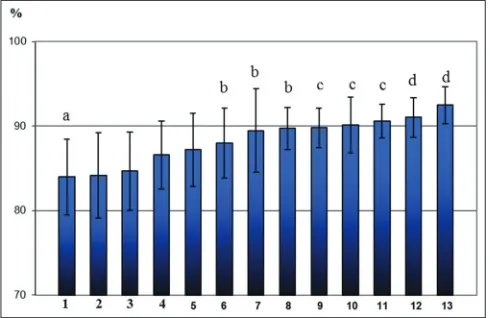
The integral indicator “QEF” has significant differences in the groups of athletes based on the specifics of sports activity [P < 0.05–0.01, Figure 1].
Indicators of the Balance Function in Athletes and those not Engage in Sports after Vestibular Stimulation
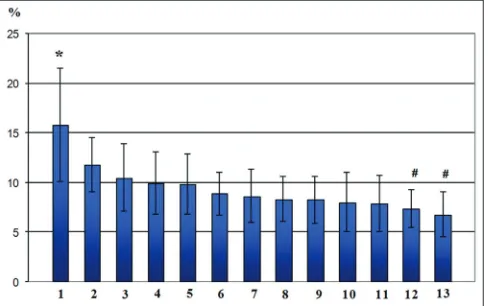
Under the influence of vestibular stimulation, the balance function decreased both in athletes and in control participants, which was manifested in increasing stabilographic parameters of the PC fluctuation [Table 1]. Consequently, the external stimuli in the form of a vestibular rotational load can be considered as disturbance and reduction factors of the level of statokinetic resistance of the organism, which, obviously, was the reason for the increase in stabilographic indicators and a decrease in the balance function. At the same time, the increase in the majority of the stabilographic indicators and a decrease in the integral index “QEF” was significantly higher in non-athletes than in non-athletes, which led to statistically significant differences in QY, VMean, VS, SELLS, and “QEF” (P < 0.05–0.001).
RESULTS AND DISCUSSION
Indicators of the Balance Function in Athletes and those not Engage in Sports before Vestibular Stimulation (at Rest)
the statokinesigram area are significantly greater, and the integral indicator “QEF” is significantly lower (P < 0.05– 0.01) than in those engaged in precision and situational sports [Table 1]. This feature of the athletes of precision and situational sports is associated with the specificity of motor activity, which is due to the slower rate of the PC oscillations and more perfect regulation of the balance function. At the same time, there is a point of view according
to which, the higher the velocity of the PC oscillations is, the worse the balance function is.[3,5,8] In turn, the integral
indicator “QEF,” which was significantly higher in the athletes (P < 0.05–0.01) than in non-athletes, is one of the important informational stabilographic indicators characterizing the function of human balance. The higher the value of this indicator is the lower the velocity of the human PC oscillations and the higher the ability to maintain balance are. The best result for this indicator was revealed in the athletes of precision and situational sports [Table 1]. The highest integral indicator “QEF” among the groups of athletes was revealed in hockey players and wrestlers, which was significantly higher (P < 0.05–0.001) than in runners, skiers, rowers, volleyball players, and football players. At the same time, the shooters, basketball, and badminton players have higher “QEF” values (P < 0.05– 0.001) than skiers, rowers, runners, and volleyball players. Moreover, the lowest “QEF” values were observed in skiers and rowers, which were significantly less (P < 0.05–0.001) than in football players, swimmers, tennis players, etc. Thus, the athletes show a higher level of maintaining their body balance in comparison with non-athletes. At the same time, the indicators of the balance function of athletes are largely connected with the nature of the movements in the selected sports.
Indicators of the Balance Function in Athletes and those not Engage in Sports After Vestibular Stimulation
A smaller increase in the stabilographic indicators of the PC oscillations after vestibular stimulation in athletes is associated with a higher vestibular stability, which is undoubtedly due to the effect of systematic training on their statokinetic system [Table 1]. At the same time,
Table 1: Stabilographic indicators of the balance function in the participants both before and after the vestibular
stimulation (Mean±SD)
Indicators Romberg’s test Change in the stabilographic indicators during Romberg’s test after the vestibular stimulation Non‑athletes Cyclic
sports sportsCyclic Situational sports Non‑athletes sportsCyclic Precision sports Situational sports
QX, mm 2.45±0.64 2.19±0.54 2.31±0.36 2.15±0.58 1.23±0.56 1.31±0.68 1.28±1.06 0.98±0.59
QY, mm 3.59±0.94 3.20±0.70 2.92±0.55 2.99±0.63 1.88±0.83 1.41±0.67 2.25±0.76 1.31±0.61
R, mm 4.23±1.16 3.95±0.90 3.39±0.69 4.02±0.82 4.15±1.44* 2.03±1.09 2.19±1.45 2.10±0.98 VMean, mm/s 7.54±1.67 7.37±2.08# 5.63±0.86 5.69±2.09 7.29±2.21* 4.53±2.19 6.13±1.39 3.40±1.55^ VS, mm2/s 9.42±3.14* 8.67±3.20# 6.66±1.63 7.10±2.41 11.12±3.93* 5.63±3.36 6.69±1.40 4.58±2.77^
SELLS, mm2 99.48±18.76* 77.65±19.98 66.93±9.46 70.96±16.13 151.16±49.14* 114.38±43.05 134.74±43.63+ 68.75±32.79^ QEF, % 83.97±4.49* 86.08±5.01# 90.59±2.00 89.85±3.54 −15.79±5.73* −8.93±4.33 −11.81±2.72+ −8.30±3.08
*The significance of differences between the athletes’ indicators of the stabilographic test before and after vestibular stimulation (P<0.05–0.001), #The significance of differences between the indicators of the athletes of situational and precision sports to vestibular stimulation (P<0.05–0.001); +The significance of the differences between the indicators of the athletes of cyclic and situational sports in the stabilographic test after vestibular stimulation (P<0.05–0.01); ^The significance of differences between the indicators of the athletes of cyclic and precision sports in the stabilographic test after vestibular stimulation (P<0.05–0.001). SD: Standard deviation
the effectiveness of the functional system of equilibrium regulation increases, which basically has more perfect, mostly compensatory, interactions between the visual, proprioceptive, vestibular sensory system and the CNS, and contributes to the growth of the statokinetic stability of the athlete. At the same time, the athletes, due to their higher excitation threshold of the vestibular apparatus receptors and the perfect statokinetic system, show less pronounced vegetative, somatic and sensory responses to vestibular stimulation in comparison with non-athletes, which generally leads to a lower increase in the stabilographic indicators of the balance function.[8,9]
Those engaged in situational sports have statistically lower degree of increase in VMean, VS, and SELLS after vestibular stimulation than the athletes engaged in cyclic and precision sports (р<0.05-0.01). A lower increase in the stabilographic indicators VMean, VS, and SELLS indicates lower velocity of the PC oscillations and reflects their ability to maintain equilibrium with a smaller foot area after the rotational load. However, the representatives of precision sports had a significantly greater increase in SELLS and a decrease in the integral indicator “QEF” after vestibular stimulation (P < 0.05–0.01) than the athletes of situational and cyclic sports. In our opinion, this is due to the fact that the athletes of situational sports undergo more diverse vestibular loads than those engaged in cyclical and precision sports, which forms a certain tolerance of the systems responsible for statokinetic resistance to such irritations. The vestibular analyzer in athletes of cyclic and especially precision sports is basically affected by more simple stimuli, which leads, on the contrary, to a low tolerance to a variety of vestibular loads. This assumption
is also supported by the change in “QEF” among the representatives of various sports, which were observed after vestibular stimulation [Figure 2].
CONCLUSION
Thus, our studies showed that the effectiveness of maintaining balance in individuals not engaged in sports is much lower in comparison with the athletes. There is also a lower tolerance of the statokinetic system to vestibular loads. In turn, the degree of change in stabilographic indicators under the influence of vestibular stimulation is significantly less expressed in athletes, which indicates a favorable effect of training on the functional stability of the statokinetic system to the distorting effects of the vestibular stimulation.
The differences in the quality of the balance function in the athletes of different sports are manifested under the influence of vestibular stimulation. It is noted that the statokinetic stability of athletes engaged in situational sports is significantly higher than that of the representatives of cyclic and precision sports.
ACKNOWLEDGMENTS
The work is performed according to the Russian Government Program of Competitive Growth of Kazan Federal University.
REFERENCES
1. Asseman FB, Caron O, Cremieux J. Are there specific conditions for which expertise in gymnastics could have an effect on postural control and performance? J Gait Posture 2008;27:76-81.
2. Demura S, Uchiyama M. Influence of anaerobic and aerobic exercises on the center of pressure during an upright posture. J Exerc Sci Fit 2009;17:39-47.
3. Melnikov AA, Savin AA, Emelyanova LV, Vikulov AD. Postural stability during static strain before and after a submaximal aerobic bicycle test in athletes. J Human Physiol 2012;38:176-81.
4. Nazarenko AS, Chinkin AS. Cardiovascular, motor, and sensory responses to vestibular stimulation in athletes of different specializations. Human Physiol 2011;37:726-32.
5. Nazarenko AS, Chinkin AS. Influence of vestibular irritation on stabilometric indicators of statokinetic stability of football players. Cent Eur J Sport Sci Med 2015;9:91-5.
6. Paillard T, Montoya R, Dupui Р. Postural adaptations specific to preferred throwing techniques practiced by Figure 2: Change in the integral indicator “balance function
competition-level judoists. J. Electromyogr Kinesiol 2007;17:241-4.
7. Pinsault N, Vuillerme N. Differential postural effects of plantar-flexor muscles fatigue under normal, altered and improved vestibular and neck somatosensory conditions. Exp Brain Res 2008;191:99-107.
8. Taylor JL, Gandevia SC. A comparison of central
aspects of fatigue in submaximal and maximal voluntary contractions. J Appl Physiol 2008;104:542-50.
9. Vuillerme N, Boisgontier M. Muscle fatigue degrades force sense at the ankle joint. Gait Posture 2008;28:521-4.