JIEM, 2015 – 8(5): 1409-1427 – Online ISSN: 2013-0953 – Print ISSN: 2013-8423 http://dx.doi.org/10.3926/jiem.1468
An Empirical Study on Stakeholder Management of Post-disaster
Reconstruction Based on Interpretation System
Jun Zhou, Hanzhao Wang
Central University of Finance and Economics (China)
[email protected], [email protected]
Received: April 2015
Accepted: October 2015
Abstract:
Purpose: Recently natural disasters frequently occur all over the world. However, the
stakeholder management of post-disaster reconstruction is often a neglected field because of
its particularity. This study investigates a model of stakeholder management for managers in
post-disaster reconstruction project.
Design/methodology/approach:
Based on the interpretation system model, this study
makes a deep analysis of the stakeholder management of post-disaster reconstruction with the
case of reconstruction project in Wenchuan.
Findings:
The results reveal that the managers should take divergent actions to collect data of
stakeholders in different situations. The discovering mode is suitable in a simple stakeholder
environment and the undirected viewing mode is suitable in a relatively complex environment.
Practical implications: This paper establishes a scientific archived management report of the
stakeholders in Wenchuan reconstruction project to provide the suggestions and the
experiences for the future projects
Keywords: post-disaster reconstruction, project management, stakeholder management, interpretation
system
1. Introduction
In recent years, natural disasters, such as earthquakes in Wenchuan, tsunami in Japan and other disasters frequently occur, which attract the eyes of the world. They cause the huge losses to mankind on their life and property. At the same time, because disasters cannot be fully predicted and avoided, there is a great difficulty in controlling and reducing the loss. Over the years, the world repeatedly suffered catastrophic, so the post-disaster reconstruction is a significant issue worth discussing. On one hand, it is necessary to make a standard of the reconstruction project’s process and determine if the project goals are achieved then put forward the concrete improvement opinion; On the other hand, discovering the reasons of the success about projects can provide experience for later project and make better use of resources. Thus post-disaster reconstruction has attracted many scholars to study it.
For post-disaster resources, Chang, Wilkinson, Potangaroa and Seville (2011) studied about resource management and methods of obtaining donor resources, paying attention to how to maximize the use of resources. In addition, Freeman (2004) studied how to allocate the post-disaster reconstruction financing to housing. Guarnacci and Guarnacci (2012) contributed to the management method of sustainable reconstruction with Indonesia as case.
Raju and Becker (2013) studied on the stakeholders of post-disaster reconstruction, found that the government orientation, information sharing network, cooperative target, and the contribution degree were the key factors of post-disaster reconstruction stakeholders. In 1963, the Standford Institute was first put forward the concept of “stakeholders”, which has achieved important practical applications in the management of urban construction. In recent years, with the rapid development of project management theory, studies for the project stakeholders have gradually increased: González-Benito and González-Benito (2010) gave six determinate factors of stakeholders environment in industry companies, which were size, internationalization, location of manufacturing activities, position in the supply chain, industrial sector, and managerial values and attitudes; And Ferrell, Gonzalez-Padron, Hult and Maignan. (2010) discussed the marketing strategies about each construct’s potential contribution, which are divided into market orientation and stakeholder orientation.
(KPIs) in perspective of various construction stakeholders, finding that the traditional measures of the iron triangle were no more applicable to measuring performance on large public sector development projects. In fact, due to the particularity and complexity in divergent post-disaster reconstruction projects, it is difficult to determine the stakeholder environment is analyzable (Orts & Strudler, 2002), but few scholars made researched in how to accurately understand and explain their stakeholder environment of post-disaster construction.
The interpretation system is adopted into stakeholder management of post-disaster reconstruction project in this paper. The application of interpretation system can bring many benefits: classifying two types of stakeholder environments, explaining how to decide the degree of intruding into the stakeholder environment to collect data and making project management team reach a consensus on stakeholder environment. Therefore, it can enable managers to make more suitable strategies for stakeholder management and provide management recommendations for the future reconstruction work.
2. Background of Interpretation System
Daft and Weick (1984) regarded the organization as interpretation system. The interpretation process is divided into three steps as shown in Figure 1. First, the managers will collect the information in the environment through private or formal method. And then, they analyze and explain the collected information, give these information meaning and identify the important part. Finally, based on the establishment of good explanation, they make decisions and take actions.
Figure 1. Three steps of interpretation system
interpretation system and introductions of their definition. Organization can be divided into these four modes, based on the interpretation behavior’s characteristics, including information collecting, information interpretation, and decision making three behaviors.
The undirected viewing mode The enacting mode
Constrained interpretation Informal data Looking for opportunities
Experimentation, testing Invent environment
Learn by doing
The conditioned viewing mode The discovering mode
Interpretation within traditional boundaries Passive information gathering
Passive detection Formal data
Formal search
Question surveys, data gathering Active detection
Table 1. The interpretation modes of organization (Daft & Weick, 1984)
The enacting mode refers to the organization has taken a positive strategy for the environment. In this mode, the project manager assumes that the environment is not able to be analyzed. This mode of organization obtains information by adopting new behaviors then observing their results. The information is mostly from private channels and strategies come from trial and error method. The discovering mode refers strong intervention strategies should be adopted into the environment. And managers should collect information especially in the environment able to be analyzed. This mode will form a formal interpretation and decision-making processes. The conditioned viewing mode refers to a passive strategy is taken for the environment. The environment can be analyzed in this mode, and information collection relies mainly on documents and reports. What’s more, the interpretation will not go beyond the traditional boundaries. In the undirected viewing mode, the organization will also take a passive strategy, but they do not depend on the objective and reliable data, because the environment is not considered analysis. Then the information from private channels will be paid attention to.
3. The Application of Interpretation System in Post-disaster Reconstruction Project
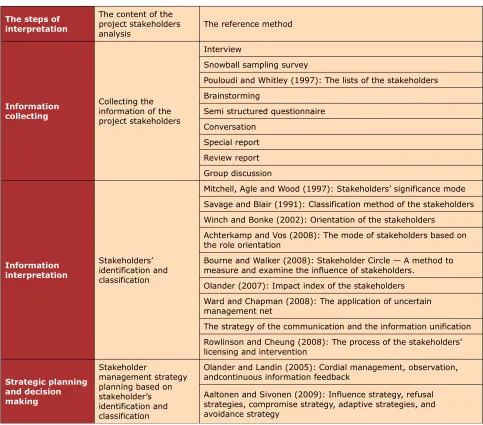
methods and tools used to collect the information of stakeholders, to identify the key stakeholders and then build stakeholder management strategy. From Crane and Ruebottom (2011), the stakeholder identification and classification is conducive to the project management team on the formation of the stakeholder environment consensus and then make decision more efficiently. Studies on the stakeholders can be mostly classified into the three steps of interpretation system in Table 2, and they can be used as the project managers’ references when analyzing the stakeholder environment.
The steps of interpretation
The content of the project stakeholders
analysis The reference method
Information collecting
Collecting the information of the project stakeholders
Interview
Snowball sampling survey
Pouloudi and Whitley (1997): The lists of the stakeholders Brainstorming
Semi structured questionnaire Conversation Special report Review report Group discussion Information interpretation Stakeholders’ identification and classification
Mitchell, Agle and Wood (1997): Stakeholders’ significance mode Savage and Blair (1991): Classification method of the stakeholders Winch and Bonke (2002): Orientation of the stakeholders
Achterkamp and Vos (2008): The mode of stakeholders based on the role orientation
Bourne and Walker (2008): Stakeholder Circle — A method to measure and examine the influence of stakeholders.
Olander (2007): Impact index of the stakeholders Ward and Chapman (2008): The application of uncertain management net
The strategy of the communication and the information unification Rowlinson and Cheung (2008): The process of the stakeholders’ licensing and intervention
Strategic planning and decision making
Stakeholder
management strategy planning based on stakeholder’s identification and classification
Olander and Landin (2005): Cordial management, observation, andcontinuous information feedback
Aaltonen and Sivonen (2009): Influence strategy, refusal strategies, compromise strategy, adaptive strategies, and avoidance strategy
Table 2. The process and the content of the interpretation system
data from stakeholder environment. The information from these two views can determine the stakeholder information collection degree and how accuracy in interpretation process.
The first important feature of stakeholder management mode is whether the stakeholder environment is analyzable. In the past research, scholars have many standards, modes and processes for the analysis of the stakeholders. They provided many detailed suggestions about the stakeholder analysis for project management. Obviously, most researchers’ studies are based on the same premise: stakeholder environment for project managers is able to be analyzed.
However, the researches of some scholars hold different opinions on the above premise. Floricel and Miller (2001) made a conclusion in the study of large project risk that stakeholder environment is in a constant state of change and full of uncontrollable factors. Achterkamp and Vos (2008) also confirmed the difficulties encountered by project managers in the identification of environmental stakeholders. In short, the complexity of the stakeholders’ environment has been confirmed by many studies. Therefore, for the situations of post-disaster reconstruction project, the traditional stakeholder environment analysis methods may not be suitable.
The other important feature of stakeholder management mode is the degree of the project managers intruding in stakeholders to collect information. Some of the enterprise with strict internal processes will forwardly, periodically collect external stakeholder environment data, and convert it into a standard file for management review decision. They are very actively involved in the stakeholders to collect data. On the contrary, some other companies passively accept the changes of stakeholder environment, and take temporary measures to the corresponding for these changes.
These two types of action respectively have its own merits. Active action may win the advantage for the enterprise, to avoid the sudden event caused by some stakeholders. Passive action may protect the projects in the strange external environment. Therefore, the action adopted for the stakeholders’ environment is also an important factor for the stakeholder management modes.
According to interpretation system, the manager should intrude into the stakeholder environment in divergent degree (active or passive) to suit different situations (analyzable or unanalyzable).
Based on interpretation system mode, the managers in this kind of situations should take passive actions. During data interpretation period, they create a reasonable interpretation to make sense for the strategy they will make in the next step, resulting in the interpretation shapes the environment. That means even the managers take active actions to collect data of stakeholders, the stakeholder environment is just built by their interpretation, which is formed by their past experiences and personality. It makes no sense by taking active actions but to waste time and money.
Thus, for complex stakeholder network in the post-disaster reconstruction project, the managers should choose Undirected Viewing Mode, namely take passive actions to collect data in unanalyzable stakeholder environment.
2. Some post-disaster reconstruction projects may have relatively simple stakeholders network. The relationship of each unit is good and the local residents get along well with the workers. So the managers can collect the accurate data of stakeholders and analyze the stakeholder environment smoothly.
Based on interpretation system mode, the managers in this kind of situations should take active actions. Active actions make managers get more information of stakeholder environment in data collection period. With more clear data, the managers can make optimal strategy for stakeholder management through accurate measurement and rational interpretation.
So the managers should choose Discovering Mode for relatively simple stakeholder network in the post-disaster reconstruction project, taking active actions to collect data in analyzable stakeholder environment.
Of course, the complexity of stakeholder net may change in different stages of reconstruction project. So in practice, managers should determine whether the stakeholder environment could be analyzed then choose suitable actions to collect data.
4. Case Study
4.1. Project Background and Investigation Method
environment, and discuss the feasibility to fast and effectively make stakeholder management strategies in the post-disaster reconstruction process.
In the selection of cases, it needs to have the representation. The project should be large, so that it can be related to enough range of stakeholder environment. This paper chooses a reconstruction project of Wenchuan as a case, a main form of urban and rural reconstruction implementation in China.
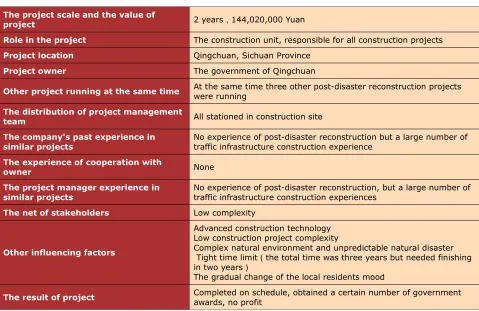
The data in this paper was gotten by interviews. The purpose of the interviews was to let us from the respondent points of view to understand that their ideas are how to form, and what is the reason in the operation of the project process. Through interviews, we can get full and detailed data for our research. Interviews were conducted in 2012. We talked face to face with the project manager to obtain their stakeholder analysis process of the project. The interview was divided into two parts. the first part was more than 60 minutes through recording and taking notes. Second part was a short time to pay a return visit, and the purpose was to confirm the first interview content, to prevent the deviation caused by memory fuzzy. The interview involved a number of questions such as “What important events had happened in the project?” “How did you deal with these events?” “How would you describe the relationship and atmosphere between project stakeholders?” “Whether a fixed process was used in the collection of relevant external stakeholder information?” These problems often required answering in detail by examples.
The project scale and the value of
project 2 years,144,020,000 Yuan
Role in the project The construction unit, responsible for all construction projects
Project location Qingchuan, Sichuan Province
Project owner The government of Qingchuan
Other project running at the same time At the same time three other post-disaster reconstruction projects were running
The distribution of project management
team All stationed in construction site
The company's past experience in
similar projects No experience of post-disaster reconstruction but a large number of traffic infrastructure construction experience
The experience of cooperation with
owner None
The project manager experience in
similar projects No experience of post-disaster reconstruction, but a large number of traffic infrastructure construction experiences
The net of stakeholders Low complexity
Other influencing factors
Advanced construction technology Low construction project complexity
Complex natural environment and unpredictable natural disaster Tight time limit(the total time was three years but needed finishing in two years)
The gradual change of the local residents mood
The result of project Completed on schedule, obtained a certain number of government awards, no profit
Table 3. Summary of the case information
The total investment amount of project was more than 100,000,000 Yuan. And this project was an important part the total Sichuan reconstruction project. In the process of construction and after completion, the project won the Chinese “Workers Vanguard” title and “Tianfu Cup” gold medal, meaning its project management mode had certain advance in post-disaster reconstruction. Therefore, the conclusion of this case analysis can be helpful in the future of the post-disaster reconstruction.
4.2. Analysis of Project Stakeholders
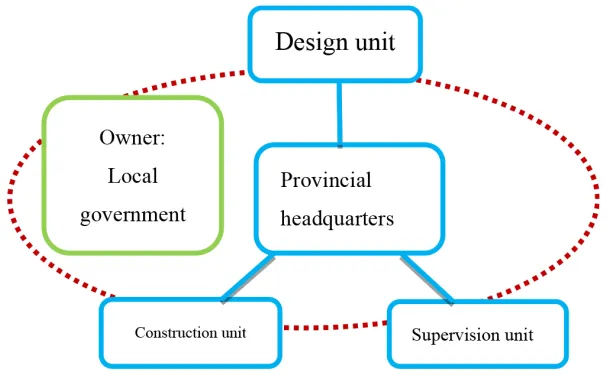
During the interview, we talked with the project managers to obtain sufficient and detailed information face to face. In fact, the respondents described a stakeholder environment sketch as shown in Figure 2.
Figure 2. Stakeholders in the project
As the most important external stakeholders, local residents provided for the construction workers the living conditions, at the same time also may become workers to join the reconstruction projects. The workers had also led to the development of local industries. This meant that the external stakeholders and project construction had close contact. So this reconstruction project could be determined as a relatively low complex stakeholder environment.
In this reconstruction project, however, project managers didn’t make formal analysis of stakeholders, and the official document didn’t keep the relevant project stakeholder information, this was because there were no formal regulations of stakeholder management process in the project. At the same time, the construction units also lacked the time in the post-disaster reconstruction for operating standard process of inspection and assessment as ordinary project. Therefore, in this case the stakeholder identification, classification and interpretation process can only be carried out in highly disordered, which brought difficulty to project management.
4.3. Analysis of Project Characteristics
state-owned enterprise, emphasizing the social benefit priority, it would complete the task regardless of the cost.
However, in order to ensure the project quality and guarantee the company social benefits, the company must increase the cost, causing its own economic benefit to reduce, almost no profit. Most of the private enterprises cannot afford the high cost because of the lack of financial support. They would withdraw from the project, resulting in construction project cannot be completed successfully. In the reconstruction period, due to the poor natural conditions , the raw material shortage and traffic inconvenience, large equipment and important material could not be successfully transported in; In addition, project omitted many programs in a temporary arrangement, such as the early exploration and so on.
In the construction process, aftershocks limited some construction methods, influencing the time to finish; what’s worse, other unexpected events happened a lot: almost fifty times aftershocks above four magnitudes and flooding, leading to a difficult construction. Both to ensure traffic flow and to pay attention to safety put forward the extremely strict requirements for construction units. In addition, the different living habits and work styles led the difficulty of the construction side and the local people in the process of cooperation. Involvement of local residents for the construction had also brought more or less trouble.
In the late of reconstruction, the resettlement, relocation arranged by local government involved the vital interests of local residents. The majority of people had resentment about it, causing some conflicts between the residents and the construction unit; in order to finish total project smoothly, the construction unit shortened construction period repeatedly, requiring higher workers and technique.
This project belongs to the “turnkey mode”, which means that the construction and management work of post-disaster reconstruction project belonged to the project department (from Zhejiang Province Traffic Engineering Group), and construction unit returned to government when finishing the project. In the construction process, the workers lived in the local rental house and part of the local labor force was also used in the project. At the same time, during the construction period of two years, the construction team greatly boosted the local service industry.
When it came to collect the knowledge of local residents, the project managers had the following statement:
We published newspaper named “Life Channel Report” at that time to collect their ideas, information
We not only helped local schools do some activities, such as celebrating Children's Day, but also to do some volunteer, to help us integrate into the local people. So when our houses were flooded or typhoon occurred, the local people let us live in their home. We tried not to disturb the local residents, while maintaining contact with them.
This way is not a regular management means, but a suitable means to adapt to the environment at the time. So it reflected the limited information, also did not have a completed analyze system. Therefore, the corresponding management decision was often random and could not effect for a long time.
Talking about difficulties of the lacking information, project managers had the following statement.
Because time was limited, material cost was considered improper and the traffic was inconvenience, costs of people, material and machine had increased a lot. In order to ensure the construction quality and the honor of group, the economic benefit of the construction was gone. We had no profit after the finishing the project.
Although the stakeholders in this case are relatively simple, if the construction side had well dealt with the mass work and early integrated into the local people, the operation would reduce a lot of unnecessary trouble, so as to reduce the cost and time of construction, finally increasing the interests of all units to the project.
4.4. Designing for Stakeholder Management Mode of the Post-disaster Reconstruction
management team actually believed that the project stakeholder environment was unanalyzable. Thus, they did not take the regular analysis process and only took the temporary response at the time of the incident. Daft and Weick (1984) called it undirected viewing mode, which meant to take the passive attitude to the environment changes, and environmental data couldn’t be collected accurately.
However, according to Daft and Weick (1984), undirected mode was more suitable for relatively complex stakeholder network. In this post-disaster reconstruction project, companies didn’t face competition from rival companies, the conflict of contractors’ interest distribution and other more complex stakeholder environment. The most important stakeholders were from the local government and residents in disaster areas. Therefore, based on above analyses, a more proactive stakeholder management mode will help to improve the post-disaster reconstruction project management level and efficiency, and it is from undirected viewing mode to discovering mode.
According to the above case analysis, the post-disaster reconstruction management mode of project stakeholders should be designed in the following three aspects.
4.4.1. Building Regular Data Collection System of Stakeholders
Past studies have shown that the data collection methods would directly determine the behavior patterns of subsequent data analysis and decision making. In this case, this conclusion has been confirmed: lacking of systematic data collection work led to the later analysis and management behavior uncertainty. That is to say, the company would just regard the events happening along stakeholders as an incident, resulting in the problems during project.
The core of the post-disaster reconstruction project is to realize its social benefit. Realization of this benefit is not only reflected in the amount of recovery data such as traffic, residential construction area and so on, but must take into account the specific needs of project stakeholder. Therefore, the project management needs to take measures to collect stakeholder information, understands their relationship and their attitudes to the project.
relationship between different groups of stakeholders, learn the scope and size of their influence on the project.
4.4.2. Identifying and Analyzing Stakeholders Via the Analysis Mode
In this case, the project management team didn’t use any analysis mode of stakeholders, so that the management of stakeholders leaked of the detailed analysis. In the stakeholder environment sketch (Figure 2) established by the interviewees, it’s just a simple classification according to the positions. The units could not know the inherent relation and effect size from it and then were difficult for decision. For the post-disaster reconstruction project’s stakeholders, the same position groups may have different demands. With the project staff as an example, in this case the staff included workers from the disaster area and workers from other provinces. Local workers would be more likely to receive external stakeholders (residents) effect compared with foreign workers. Therefore, the project management team was necessary to use stakeholder analysis tools for precise stakeholder classification and to analyze different stakeholder demands and their influence on the project.
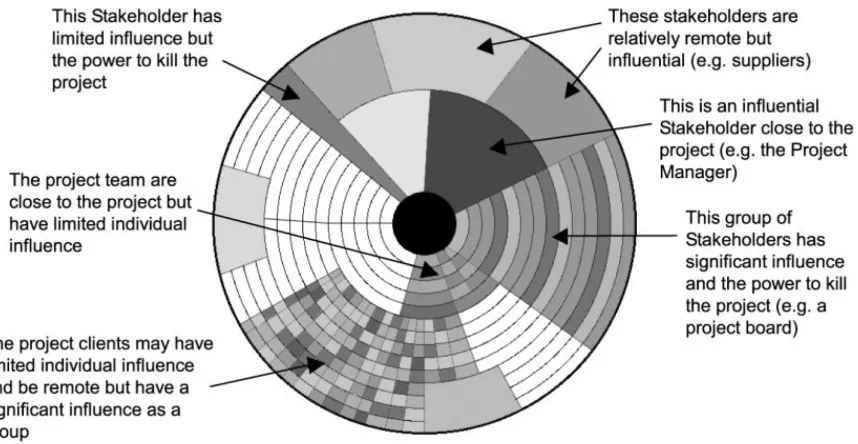
At present, scholars have developed many stakeholder analysis tools. These tools are partly made the summary in Table 2. Here, we use the stakeholder circle as an example, as shown in Figure 3. In stakeholders circle, each concentric circle radius represent the distance between the stakeholders and the project, collection of different blocks represents the homogeneous characteristics of stakeholders, such as that the stakeholders having same demands would form a closely linked blocks. The size of each block represents the scope of the stakeholder influence and the color depth of each block can represent the size of stakeholder influence.
Figure 3. Stakeholder Circle (Bourne & Walker, 2008)
4.4.3. Making Filed Report of the Stakeholders Management
The project manager's experience, skill and judgment were often regarded as the decisive factors in determining the project organization and behavior mode. Then Aaltonen and Sivonen (2009) introduced the influence of external stakeholders. It said that in some cases, project managers lack of enough background information to make decisions, thus external factors become a major factor in management behavior mode. Post-disaster reconstruction project cases clearly support this thesis. In the post-disaster reconstruction project, the project managers generally do not have experience in similar projects for reconstruction projects because of the great particularity of external conditions: its main stakeholders (victims) are not regarded as consumers in general, but their interests must be protected. Its organization and management structure is also different from the general project. The project management team is also influenced by the local government and the provincial reconstruction command. In addition, schedule management of post-disaster reconstruction is regarded as the first priority, extending beyond the general requirements. On the contrary, the importance of cost management is reduced. In this case, the external factors did influence the project organization behaviors, making the project team use undirected viewing mode to passively respond to the stakeholder environment change.
retaining files. The files should include the method, strategy and result of data collection, data interpretation and decision-making. It can make the reconstruction projects in the future get the experiences and lessons of the past, then ease the problem of the lacking project background information.
Via the above methods, the post-disaster reconstruction project in Wenchuan could transform from the traditional and inefficient undirected viewing mode to the more suitable discovering mode, leading to the improvement of the managers’ ability to make more suitable strategies for stakeholder management and the average satisfactory of the whole stakeholders in the project.
5. Conclusion
The past researches about stakeholder management are based on the same premise that the stakeholder environment is analyzable. Because of the complexity and particularity of post-disaster reconstruction project, however, we cannot determinate it is always analyzable in different situations. Thus the past stakeholder management modes are not suitable in post-disaster reconstruction project.
So project managers should take their actions based on the stakeholder environment. According to interpretation mode, in different situations, managers should intrude into stakeholder environment to collect data in divergent degree: in complex stakeholder environment, managers should choose undirected viewing mode, taking passive actions to collect data ; in simple stakeholder environment, managers should choose discovering mode,taking active actions to collect data.
In this paper, the managers of Wenchuan reconstruction project featured undirected viewing mode. Management in this category will not take systematic process to collect data of stakeholders and just make adaptive decisions temporarily according to the changes of stakeholder environment. The managers of this case collected data from communicating with government department and local residents, not from a regular way, resulting in the data was not been officially recorded. In fact, the management team actually thought stakeholder environment was not analyzable. Then they could not analyze the stakeholder accurately.
For transforming from undirected viewing mode to discovering mode, three proposals are put forward:
• Building regular data collection system of stakeholders
• Identifying and analyzing stakeholders via the analysis mode
• Making filed report of the stakeholder management
These three proposals could also be practiced in the future reconstruction projects having similar characteristics to this case.
Acknowledgements
We would like to thank the experts and reviewers in sustainable construction for their data provision and advice. This research project (Grant No. 71372192) was supported by National Natural Science Foundation of China.
References
Aaltonen, K., & Sivonen, R. (2009). Response strategies to stakeholder pressures in global projects. International Journal of Project Management, 27, 131-141.
http://dx.doi.org/10.1016/j.ijproman.2008.09.007
Achterkamp, M.C., & Vos, J.F.J. (2008). Investigating the use of the stakeholder notion in project management literature, a meta-analysis. International Journal of Project Management, 26(7), 749-757. http://dx.doi.org/10.1016/j.ijproman.2007.10.001
Bourne, L., & Walker, D.H.T. (2008). Project relationship management and the stakeholder circle™. International Journal of Managing Projects in Business, 1(1), 125-130.
http://dx.doi.org/10.1108/17538370810846450
Chang, Y., Wilkinson, S., Potangaroa, R., & Seville, E. (2011). Donor-driven resource procurement for post-disaster reconstruction: constraints and actions. Habitat International, 35(2), 199–205. http://dx.doi.org/10.1016/j.habitatint.2010.08.003
Crane, A., & Ruebottom, T. (2011). Stakeholder theory and social identity: rethinking stakeholder identification. Journal of Business Ethics, 102(1 Suppl.), 77-87.
http://dx.doi.org/10.2139/ssrn.1662437
Daft, R.L., & Weick, K.E. (1984). Toward a model of organizations as interpretation systems.
Ferrell, O.C., Gonzalez-Padron, T.L., Hult, G.T.M., & Maignan, I. (2010). From market orientation to stakeholder orientation. Journal of Public Policy & Marketing, 29(1), 93-96.
http://dx.doi.org/10.1509/jppm.29.1.93
Floricel, S., & Miller, R. (2001). Strategizing for anticipated risks and turbulence in large-scale engineering projects. International Journal of Project Management, 19(8), 445-455.
http://dx.doi.org/10.1016/S0263-7863(01)00047-3
Freeman, P.K. (2004). Allocation of post-disaster reconstruction financing to housing. Building Research & Information, 32(5), 427-437. http://dx.doi.org/10.1080/0961321042000221016
Guarnacci, U., & Guarnacci, U. (2012). Governance for sustainable reconstruction after disasters: lessons from nias, indonesia. Environmental Development, 2, 73-85.
http://dx.doi.org/10.1016/j.envdev.2012.03.010
González-Benito, J. & González-Benito, O. (2010). A study of determinant factors of stakeholder environmental pressure perceived by industrial companies. Business Strategy & the Environment, 19(3), 164-181. http://dx.doi.org/10.1002/bse.631
Mitchell, R.K., Agle, B.R., & Wood, D.J. (1997). Toward a theory of stakeholder identification and salience: defining the principle of who and what really counts. Academy of Management Review, 22(4), 853-886.
Olander, S. (2007). Stakeholder impact analysis in construction project management. Construction Management & Economics, 25(3), 277-287. http://dx.doi.org/10.1080/01446190600879125
Olander, S., & Landin, A. (2005). Evaluation of stakeholder influence in the implementation of construction projects. International Journal of Project Management, 23(4), 321-328.
http://dx.doi.org/10.1016/j.ijproman.2005.02.002
Orts, E.W., & Strudler, A. (2002). The ethical and environmental limits of stakeholder theory.
Business Ethics Quarterly, 12(2), 215-233. http://dx.doi.org/10.2307/3857811
Pouloudi, A., & Whitley, E. (1997). Stakeholder identification in inter-organizational systems: gaining insights for drug use management systems. European Journal of Information Systems, 6(1), 1-14.
Raju, E., & Becker, P. (2013). Multi-organisational coordination for disaster recovery: the story of post-tsunami tamil nadu, india. International Journal of Disaster Risk Reduction, 4, 82-91.
http://dx.doi.org/10.1016/j.ijdrr.2013.02.004
Rowlinson, S., & Cheung, Y.K.F. (2008). Stakeholder management through empowerment: modelling project success. Construction Management & Economics, 26(6), 611-623.
Savage, G.T., & Blair, J.D. (1991). Strategies for assessing and managing organizational stakeholders. Academy of Management Perspectives, 5(5), 61-75.
Toor, S.U.R., & Ogunlana, S.O. (2010). Beyond the “iron triangle”: stakeholder perception of key performance indicators (kpis) for large-scale public sector development projects.
International Journal of Project Management, 28, 228-236.
http://dx.doi.org/10.1016/j.ijproman.2009.05.005
Ward, S., & Chapman, C. (2008). Stakeholders and uncertainty management in projects.
Construction Management & Economics, 26(6), 563-577.
http://dx.doi.org/10.1080/01446190801998708
Winch, G.M., Bonke, S. (2002). Project stakeholder mapping: analyzing the interests of project stakeholders. In Slevin, D.P., Cleland, D.I., & Pinto, J.K. (Eds.). The frontiers of project
management research. Project Management Institute. 385-403.
Journal of Industrial Engineering and Management, 2015 (www.jiem.org)
Article's contents are provided on an Attribution-Non Commercial 3.0 Creative commons license. Readers are allowed to copy, distribute and communicate article's contents, provided the author's and Journal of Industrial Engineering and Management's names are included.