Issues
ISSN: 2146-4138
available at http: www.econjournals.com
International Journal of Economics and Financial Issues, 2016, 6(3), 926-932.
Effectiveness of Retraining as an Instrument for Solving the
Problem of Structural Unemployment in the Czech Republic
Pavel Stafek
1, Petra Sanova
1*, Zuzana Novotna
2, Adriana Laputkova
31Department of Trade and Accounting, Faculty of Economics and Management, Czech University of Life Sciences Prague, Czech
Republic, 2Department of Statistics, Faculty of Economics and Management, Czech University of Life Sciences Prague, Czech
Republic, 3Department of Languages, Faculty of Economics and Management, Czech University of Life Sciences Prague, Czech
Republic. *Email: [email protected]
ABSTRACT
The aim of this paper is to evaluate effectiveness of retraining as an instrument for solving the problem of structural unemployment in the Czech Republic
for the period of 2004-2011. Its partial aim is to determine indicators which assess retraining courses and to identify the degree of interdependence of individual parameters connected with retraining. The data were obtained from the Ministry of labour and social affairs and from the labour office of the Czech Republic. Based on these, indicators of efficiency and effectiveness of retraining courses were established. Furthermore, statistically important dependencies which influence the expenditures on retraining, the number of participants and success rate of retraining were investigated. The results
show a growing tendency for success of retraining courses. Using the proposed methodology, effectiveness of retraining courses was ascertained and the degree of interdependence of selected indicators was established. In conclusion, recommendations are formulated for stabilization of methodology
for collection of relevant data to ensure more precise examination in the future.
Keywords: Retraining, Active Employment Policy, Effectiveness, Unemployment, Expenditures
JEL Classifications: E23, M5, H5
1. INTRODUCTION
The current economic situation in the European Union has changed the type of unemployment in recent years. Structural unemployment is aggravated by cyclical unemployment ( Maitah and Urbankova, 2015).
Unemployment is characterized by serious socio-economic consequences both for a particular unemployed individual or for their family and for the country’s economy. The importance of the problem is connected with the global financial crisis which caused an increase in unemployment in many countries across the world (International Labour Organization, 2013).
In the Czech Republic, the total expenditures of national budgets on an average unemployed person are currently estimated at 109,615 CZK (Čadil et al., 2011) to 118,300 CZK annually (Elbona, 2006). The Czech and Moravian Confederation of Trade
Unions (ČMKOS, 2009) states that in 2009 the expenditures on an average unemployed person who was receiving unemployment benefits for 5 months reached 120,538 CZK and for 11 months even 254,194 CZK.
Enhancement of the effectiveness of active employment policy programmes is therefore the main political strategy for the Organization for Economic Cooperation and Development (OECD, 1994; OECD, 1996).
One of the key instruments used for tackling structural unemployment is retraining, which helps to adjust the supply structure on the labour market to the demand (Kaczor, 2013).
knowledge and practical skills as part of further professional education.
When establishing the content and the scope of each retraining course, the Labour Office of CR predominantly takes into consideration previous qualifications, the state of health, abilities and the experience of the person who should be retrained (Steinichová, 2010).
Specific options for basic methods to ensure retraining and the conditions in the Czech Republic are summarized in Table 1.
Over the last few years, evaluation of employment policy instruments has become the central theme in research of a number of countries, for example in Germany (Stephan and Pahnke, 2008a), France (Leigh, 1990), Great Britain, and also USA, Japan and Australia (Kluve, 2010). The target of this research is not only the disadvantaged groups of population (e.g. Wehman et al., 2016; Nord et al., 2016; Przybysz et al., 2002), but there are also issues connected with efficiency and effectiveness of employment policy instruments (Lubyova and Van Ours, 1999; Stephan and Pahnke, 2008b).
In the past, other authors have discussed establishing effectiveness of some of the employment policy instruments (Cavaco et al., 2009; Leigh, 1990). For example, when comparing the costs of various programmes for supporting employment in France, Leigh (1990) reached a conclusion that in terms of costs it is the retraining courses that are the most effective when searching for new employment. On the contrary, some authors (Gerfin and Lechner, 2002; Lechner et al., 2005) believe that the effects of the active employment policy instruments vary and in some cases might negatively influence staff employment. This is mentioned by Coles and Masters (2000) as well, who accentuate that policies addressing long-term unemployment are best directed towards prevention (for instance vacancy creation subsidies) rather than cure (for instance retraining subsidies).
In the Czech Republic, the impacts of unemployment have been addressed by for example Maitah and Urbankova (2015). Naturally, their objective was to chart the development of the basic indicators of a functioning economy, identify different types of unemployment in the Czech Republic using the Beveridge curve and, using the correlation analysis, statistically evaluate the relationship between the unemployment rate and the growth rate of real gross domestic product.
The objective of the paper is therefore to evaluate effectiveness of retraining in the period of 2004 -2011 as an instrument to solve the problem of structural unemployment in the Czech Republic. Its partial aim was to determine indicators which evaluate retraining and to identify the degree of interdependence between individual parameters in connection with retraining (the total expenditures on retraining, expenditures on a retrained person, the success rate of retraining and the number of retrained persons).
2. METHODOLOGY
Efficiency and effectiveness of retraining as an instrument for active employment policy can be determined by the ratio of successful retraining courses, that is whether they helped the job seeker return to the working process, and retraining inputs, that is expenditures on the supported person. The success rate should also be taken into account.
The input data for this paper were obtained from the Labour Office of the Czech Republic and the Ministry of Labour and Social Affairs of the Czech Republic for the period of 2004 - 2014. In order to present the data more precisely, the local currency was used, that is Czech crown.
Based on these data and using formula (1), the expenditures for the period 2004 - 2014 on a supported person in retraining were examined.
Expenditures on a supported person =
Total expenditures on retraining Number of persons supported in retraining
(1)
In the statistical data, except for the number of retrained persons, the Labour Office of CR also examines the number of job seekers who refused to participate in retraining, the number of job seekers who participated in retraining courses, and the number of persons who completed the retraining courses successfully or unsuccessfully. In this regard, an indicator (2) of retraining success rate was formulated as an instrument for active employment policy.
Success of retraining =
Number of successfully completed retraining courses Number of launched retraining courses
(2)
The number of launched retraining courses and the number of persons who completed the course successfully are available in
Table 1: Comparison of basic methods to ensure retraining
Retraining course Provided by the labour office Selected Staff
Designed for? Job seeker or candidate Job seeker or candidate Employee
Who provides it? Labour office Job seeker or candidate Employer
Is there a price limit? No Yes (50 thousand CZK over 3 years) No
Eligibility for unemployment
benefits when retraining? Yes (only a job seeker, 60% of net income) No (only retraining is covered) No (employee is eligible for remuneration from the employer)
Note Other expenses might be
covered, e.g., travelling Must be organized by an accredited institution, nevertheless, the Labour
Office might not approve it
No legal right to it; rather rare in practice
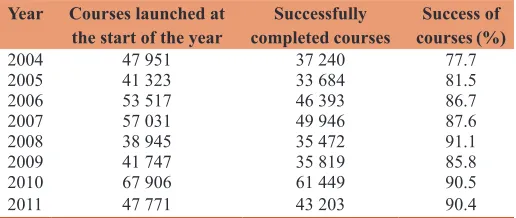
the national statistics “Job seekers in retraining throughout the CR,” however, only for the period of 2001 - 2011. Owing to this, the success rate of retraining courses has been calculated using formula (2) for the period starting in 2004 and ending in 2011.
In order to determine the effectiveness of retraining courses, it is necessary to quantify the number of persons who have successfully completed their retraining as well as the number of persons who re-entered work or commenced their entrepreneurial activity. When determining the effectiveness of retraining, it is vital to consider the time period during which the job seekers are observed. Due to logical continuity and in accordance with other AEP instruments, those retrained job seekers who are re-entering work or self-employment within 12 months after successful completion of a retraining course are monitored. The statistics “Job seekers after retraining“ contains data about the number of job seekers placed on the labour market within 3, from 3 to 6, from 6 to 9 and from 9 to 12 months after successful completion of retraining. The total number of those placed on the labour market within 12 months after successful completion of retraining is a simple sum of job seekers who have re-entered the labour market in individual periods of time. The effectiveness of retraining courses is then expressed using formula (3).
Effectiveness of retraining =
Number of persons placed on the labour market after retraining Number of retrained persons
(3) Subsequently, the degree of interdependence between individual parameters was investigated, namely between expenditures on retraining courses per year and expenditures on one retrained person, between successful retraining courses and expenditures on one retrained person and interdependence of the number of persons integrated into the retraining process and the total expenditures.
Firstly, normality was verified for selected variables. Normality is the basic assumption based on the classic data analysis that is on the tests for independence of the selected elements and on testing deviations. (Hebak et al., 2007). Normality of distribution X ~ N (µ, σ2) is fully determined by the median value and variance,
however two other characteristics are typical for it, connected with skewness and kurtosis (Svatošová and Kába, 2012; Střelec, 2014). Normality was tested using the Shapiro-Wilk test (Shapiro and Wilk, 1965).
W b
S
= 22 (4)
b a ei S n i eS i i
k
=
(
( − +)− ( ))
=
∑
11
(5)
S eSi
i n
2 2
1
= =
∑
(6)These tests are less sensitive to deviations from normality than diagnostic graphs. In spite of this, in order to further assess
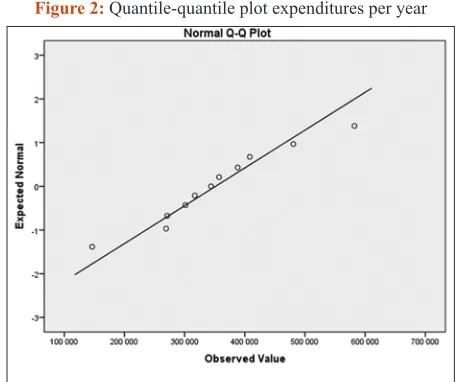
normality of data distribution, quantile-quantile (Q-Q) plots were constructed for this paper (Kába, Svatošová, 2012). These graphs are suitable tools used for determining whether the data originate from any known distribution (Hebak, 2007).
In order to verify normality of data distribution, the degree of interdependence was measured. Spearman’s rank correlation coefficient was chosen to measure interdependence between the variables. This correlation coefficient was selected due to the fact that normality of distribution had not been verified with all the variables.
Spearman’s correlation coefficient is a nonparametric characteristic. Similarly to Pearson’s correlation coefficient, the correlation coefficient for ordinal data which was derived from it can reach values from −1 to +1 (Seger et al., 1998). Unlike Pearson’s correlation coefficient, the use of Spearman’s correlation coefficient is not connected to the assumption of two-dimensional normality of the basic dataset nor to the assumption of linearity of regression (Kába, Svatošová, 2012).
The formula for measuring Spearman’s correlation coefficient:
rs D
n n i =
−
∑
61
2 2
( ) (7)
Where Di represents differences in the order of Rx and Ryvalues xi and yi with regard to other values of ordered selection according to size (Hendl, 2012).
3. RESULTS AND DISCUSSION
The Ministry of Labour and Social Affairs of the Czech Republic provided the data on the total expenditures of active employment policy allocated to retraining courses in individual years. Using formula 1, the proportion of the expenditures on retraining and the number of persons supported as part of their retraining formed the basis for measuring the average expenditures on one person integrated into retraining.
Table 2 implies that individual expenditures on one supported person in retraining differ significantly for individual years. This fact is caused by considerable differences in the expenditures allotted to individual types of completed retraining courses as well as the differences between prices of the same types of courses in individual regions. Therefore, average expenditures provided in a particular year calculated per person who started a retraining course is the year-on-year comparative criterion for retraining. In the long term, it can be understood from the table that average expenditures on one retrained person amount to approximately 7.5 thousand CZK.
At the same time it is assumed that in the long term it will be impossible to increase the success rate of retraining courses as there will always be a group of persons who will start but not complete their retraining. The Labour Office of CR further examines whether the retraining course was discontinued for serious reasons. If these reasons are not considered serious, this fact has an impact on continuation of the job seeker’s further registration with the Labour Office.
Effectiveness of retraining courses in individual years in the period between 2014 and 2011 is displayed in Table 4, using formula 3. In the long term, it might be concluded that effectiveness of retraining as one of the instruments for active employment policy oscillates at approximately 45%. Nearly a half of the persons who complete the retraining course successfully are placed on the labour market.
Regarding retraining courses, it is thus possible to quantify their effectiveness using the ratio of the persons placed after retraining to the total number of retrained persons. Unfortunately, due to the replacement of the information system supplier, some data
concerning retraining courses have been unavailable since 2012. In addition to this, according to MLSA the relevant data are also unavailable for the end of 2015, despite the fact that the Labour Office of CR returned to the original supplier of the information system after 1 January 2014. Therefore, the settings of the current information system used by the Labour Office of CR do not correspond with the requirements for monitoring the effectiveness of retraining courses.
Currently, it is also impossible to monitor effectiveness of individual types of retraining courses. It can therefore be recommended that the Labour Office of CR commence monitoring the number of persons who start retraining courses, the number of persons who complete their retraining successfully, and the number of persons who are placed on the labour market after completing a retraining course successfully, classified at least in regard to the most frequently organized types of retraining courses.
It is evident from Graph 1 that more than a half of the persons placed on the labour market after their successful completion of a retraining course, do so within 3 months of the completion of retraining. The graph further implies that the chance of being placed on the labour market decreases with the increase of the time period after successful completion of retraining.
The prolongation of the time period for placing the persons who have successfully completed their retraining course on the job market, as it is evident from Graph 1, is the result of the economic crisis as well as the reduction of vacancies related to it. Since the economic crisis is currently subsiding, the time period in which job seekers are placed on the labour market after their successful completion of retraining courses should be shortened.
In view of the above mentioned problem, using the current methodology for data collection, the labour offices are unable to quantify the effectiveness in more detail, for example taking into account individual types of retraining courses.
Table 2: Average expenditures on one person integrated into a retraining course between 2004 and 2014
Year Expenditures per year (K,
CZK)
Number of supported
persons
Expenditures on 1 retraining course/
person (in CZK)
2004 480 635 44 089 10 901 2005 408 250 38 438 10 621
2006 357 299 59 035 6 052
2007 269 288 57 031 4 722
2008 271 130 36 451 7 438
2009 388 131 39 831 9 744
2010 582 261 65 453 8 896
2011 316 933 45 521 6 962
2012 146 377 25 199 5 809
2013 301 385 41 438 7 273
2014 343 894 46 454 7 403
Source: Own processing based on information from MLSA (2015)
Table 3: Success rate of retraining courses from 2004 to 2011
Year Courses launched at
the start of the year completed coursesSuccessfully courses (%)Success of
2004 47 951 37 240 77.7
2005 41 323 33 684 81.5
2006 53 517 46 393 86.7
2007 57 031 49 946 87.6
2008 38 945 35 472 91.1
2009 41 747 35 819 85.8
2010 67 906 61 449 90.5
2011 47 771 43 203 90.4
Source: Own processing (2015)
Table 4: Development of effectiveness of retraining courses in CR from 2004 to 2011
Year 2004 2005 2006 2007 2008 2009 2010 2011 Effectiveness
of retraining 45.2 43.3 45.0 48.2 48.1 32.3 43.8 40.8
Source: Own processing (2015) Source: Own processing in SPSS 22 (2015)
However, it is possible to examine the degree of interdependence between individual parameters, namely between the expenditures on retraining per year and expenditures on the retrained person, and interdependence of the number of persons in the process of retraining and the total expenditures.
Firstly, the above mentioned parameters were tested as to whether they originate from normal distribution. Shapiro-Wilk test was used to test normality. This test is based on determining whether the points of the Q-Q plot significantly deviate from the regression line laid by these points. Using this testing statistic (Table 5) it was ascertained that the variables of expenditures per year and expenditures on the retrained person are normally distributed or the significant value (Significant) > α (0.05). However, using Q-Q plots (Figures 1 and 2), normality of distribution of these variables was not fully verified.
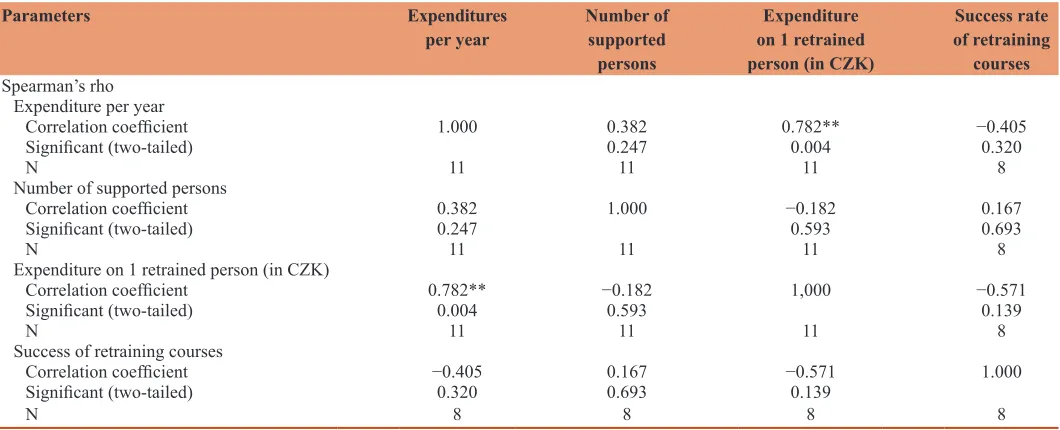
After testing normality of data distribution, the degree of interdependence between variables was examined. Based on the number of observations and failure of normality of distribution in all the selected variables (mainly according to Q-Q plot), Spearman’s correlation coefficient was used to examine the degree of interdependence. All the calculated correlation coefficients are presented in Table 6.
Using Spearman’s correlation coefficient, a higher direct degree of interdependence between expenditures per year and expenditures on the retrained person was discovered (r = 0.782).
The total expenditures are influenced by the expenditures on the retrained person at 61.152%. The total expenditures on retraining are thus influenced by other factors than direct expenditures on one retrained person, almost at 40%.
Furthermore, medium (average) indirect interdependence was ascertained (r = −0.571) between successful retraining and expenditures on one retrained person. It is valid that the more successful the retraining course is, the lower the expenditures on one retrained person are. The success rate of retraining influences expenditures on 1 retrained person only at 32.604%. The influence is moderate; nevertheless, the fact that the success rate of retraining oscillates at approximately 85% is a positive aspect and shows a growing tendency.
Naturally, it is essential to consider the limit caused by the fact that a number of retraining courses will not be completed by their participants. This is also connected with the findings that more than a half of the persons who are placed on the labour market after successful completion of a retraining course, do so within 3 months of completing their retraining. The longer the period after the completion of retraining, the lower is the chance to place the job seeker with completed retraining course on the labour market. It is therefore necessary not only to influence the retraining system so that its success rate is higher, but also to use instruments in order to utilize this 3-month period to stimulate activity of both the participant and the labour office in searching for placement after retraining.
The interdependence between the number of supported persons and expenditures per year is low, the correlation coefficient reached 0.382. This might be a reflection of the fact that some participants do not complete the course as well as the fact that the total costs of retraining are also influenced by other factors. These aspects should be addressed as part of further research.
As stated by (Maitah et al., 2016), it is important to seek methods for tackling unemployment and for achieving at least 70% Table 5: Shapiro-Wilk test
Variables Shapiro-Wilk
Statistic df Significant
Expenditures per year 0.930 8 0.515
Number of supported persons 0.899 8 0.282
Expenditures on 1 retrained
person (in CZK) 0.950 8 0.712
Success of retraining courses 0.891 8 0.241
Source: Own processing in SPSS 22 (2015)
Table 6: Correlation coefficients
Parameters Expenditures
per year Number of supported persons
Expenditure on 1 retrained person (in CZK)
Success rate of retraining
courses Spearman’s rho
Expenditure per year
Correlation coefficient 1.000 0.382 0.782** −0.405 Significant (two-tailed) 0.247 0.004 0.320
N 11 11 11 8
Number of supported persons
Correlation coefficient 0.382 1.000 −0.182 0.167 Significant (two-tailed) 0.247 0.593 0.693
N 11 11 11 8
Expenditure on 1 retrained person (in CZK)
Correlation coefficient 0.782** −0.182 1,000 −0.571 Significant (two-tailed) 0.004 0.593 0.139
N 11 11 11 8
Success of retraining courses
Correlation coefficient −0.405 0.167 −0.571 1.000 Significant (two-tailed) 0.320 0.693 0.139
N 8 8 8 8
employment rate in the Czech Republic. Retraining could be one of the instruments that can help to achieve this.
Nevertheless, it is vital to consider not only stabilization of methodology for data collection, which will enable monitoring of aspects, such as the success rate and effectiveness of retraining courses, but probably also the total system replacement. Inspiration in this regard may be drawn for example from France. As Toth et al. (2015) mentions, the area of active employment policy in France is slightly wider, focusing primarily on various financial contributions or tax relief. Even passive employment policy instruments do not differ. Minor differences can be seen in the fact that France, despite the changes, faces their support of specific groups of job seekers (young, elderly, underprivileged, etc.). France thus has instruments that are aimed directly at individual groups while in the Czech Republic they are mostly intended for the unemployed regardless of which group they belong to.
Consequently, a different approach to retraining might bring a different approach to the entire employment policy or to all public policies, in which monitoring of the effectiveness of their instruments is necessary.
4. CONCLUSION
Monitoring effectiveness of retraining courses is important due to the fact that effective or ineffective utilization of retraining directly influences the expenditures from national budgets and is influenced by public policy. The fact that the success rate oscillates at approximately 85% and shows a growing tendency is a positive aspect.
The efficiency of retraining has long-term improved. At the same time it can be assumed that it will stop improving long-term. This is due to the fact that in the near future it will reach its peak and it will no longer be possible to improve it. In the long term, the efficiency of retraining could be improved only at a local level or for specific types of retraining courses.
The effectiveness of retraining according to the proposed methodology oscillates at approximately 45%. In order to improve the effectiveness, it is necessary to pay attention to the period of 3 months after retraining, when the job seeker is most likely to be placed on the labour market. A stronger motivation and stimulation of not only the course participants but also of the labour offices is needed in order to fully utilize this period of time to find suitable placement after retraining.
In terms of identification of the degree of interdependence between selected indicators, the findings show that the total expenditures are influenced by the expenditures on 1 retrained person at 61.152%, the success rate of retraining influences the expenditures on 1 retrained person only at 32.604%. Only low interdependence was discovered between the number of supported persons and expenditures per year. In the future, it will therefore be necessary to focus on a more in-depth analysis of the factors that influence the total expenditures on retraining.
Recommendations can be also be stated at the level of the Ministry of Labour and Social Affairs of the Czech Republic in terms of setting stable methodology for collection of relevant data which would enable monitoring effectiveness of retraining not overall only, but also for individual courses. This would allow a more detailed analysis; subsequently, the results would be used for making decisions about a suitably designed portfolio of retraining courses, which could subsequently help to improve the effectiveness of retraining as an active instrument for employment policy in the Czech Republic. Replacement of the entire system which focuses on individual groups, as is in effect in France for example, is another issue.
5. ACKNOWLEDGMENTS
This paper was supported by the Internal Grant Agency [No. 20131021], Creating methodology of instruments in order to review effectiveness of using financial resources intended for retraining courses at the Faculty of Economics and Management, Czech University.
Source: Own processing based on input data from MLSA (2015)
Figure 1: Proportion of placed retrained persons in individual
categories (in %) between 2004 and 2011
Source: Own processing in SPSS 22 (2015)
REFERENCES
Čadil, J., Pavelka, T., Kaňková, E., Vorlíček, J. (2011), Odhad nákladů nezaměstnanosti z pohledu veřejných rozpočtů. (Unemployment cost Estimate from Public Budgets Perspective), Politická Ekonomie,
5, 618-637.
Cavaco, S., Fougere, D., Pouget, J. (2009), Estimating the Effect of
a Retraining Program on the Re-Employment Rate of Displaced
Workers. Bonn: IZA Discussion Paper No. 4227.
ČMKOS. (2009), Czech and Moravian Confederation of Trade
Unions. CMCTU on Unemployment. Prezentace z tiskové
Konference ČMKOS. Available from: http://www.cmkos.cz/archiv- dokumentu/1750-3/prezentace-z-tiskove-konference-k-tematu-kurzarbeit. [Last cited on 2015 Dec 15].
Coles, M., Masters, A. (2000), Retraining and long-term unemployment
in a model of unlearning by not doing. European Economic Review,
44(9), 1801-1822.
Elbona. (2006), State Expenditures on One Unemployed. Ministry of Labour and Social Affairs. Available from: http://www.portal.mpsv. cz/sz/politikazamest/vyzkumnestudie.
Gerfin, M., Lechner, M. (2002), Microeconometric evaluation of the
active labour market policy in Switzerland. Economic Journal, 112, 854-893.
Hebak, P., Hustopecky, J., Jarošová, E., Pecáková, I. (2007), Multidimensional Statistical Methods. 2. Přeprac. Vyd. Praha:
Informatorium. p3 Sv.
Hendl, J. (2012), Overview of Statistical Methods: Analysis and Data
Meta-Analysis. 4., Rozš. vyd. Praha: Portál. p734s.
International Labour Organization. (2013), World of Work Report 2013: Repairing the Economic and Social Fabric. Available from: http:// www.ilo.org/global/.
Kába, B., Svatošová, L. (2012), Statistical Instruments for Economic Research. Plzeň: Vydavatelství a nakladatelství Aleš Čeněk. p176s. Kaczor, P. (2013), Labour Market, Work Migration and Employment
Policy in CR after 2011. Praha: Oeconomica.
Kluve, J. (2010), The effectiveness of European active labor market programs. Labour Economics, 17(6), 904-918.
Lechner, M., Miquel, R., Wunsch, C. (2005), The Curse and Blessing of
Training the Unemployed in A Changing Economy: The Case of East
Germany after Unification. Bonn: IZA Discussion Paper No. 1684. Leigh, D.E. (1990), Does Training Work for Displaced Workers? A
Study of Existing Evidence. Michigan: W.E Upjohn Institute for
Employment Research.
Lubyova, M., Van Ours, J.C. (1999), Effects of active labor market
programs on the transition rate from unemployment into regular jobs in the Slovak Republic. Journal of Comparative Economics,
27(1), 90-112.
Maitah, M., Toth, D., Kuzmenko, E., Šréd, K., Řezbová, H., Šánová, P. (2016), Forecast of employment in Switzerland: The macroeconomic view. International Journal of Economics and Financial Issues, 6(1),
132-138.
Maitah, M., Urbánková, E. (2015), Economic performance and unemployment in the Czech Republic. Asian Social Science, 11(16), 240.
MLSA. (2015), Ministry of Labour and Social Affairs. Analyses of Labour Market from 2004 to 2014. Praha: Dostupné na. Available from: http://www.portal.mpsv.cz/sz/politikazamest/trh_prace.
Nord, D.K., Stancliffe, R.J., Nye-Lengerman, K., Hewitt, A.S. (2016),
Employment in the community for people with and without autism: A comparative analysis. Research in Autism Spectrum Disorders, 24, 11-16.
OECD. (1994), Organization for Economic Cooperation and Development. The OECD Jobs Study: Evidence and Explanations. Paris: OECD. OECD. (1996), Organization for Economic Cooperation and Development.
The OECD Jobs Study: Enhancing the Effectiveness of Active Labor Market Policies. Paris: OECD.
Przybysz, K., Dziechciarz, J.Z., Siedlecki, J. (2002), Statistical Analysis of
Youth Unemployment in Poland. Soziale und ökonomische Probleme
in der Großstadt. Armut und Arbeitlosigkeit. p129-142.
Seger, J., Hronová, S., Hindls, R. (1998), Statistics in Economy. Vyd. 1.
Praha: ETC Publishing. p636s.
Shapiro, S.S., Wilk, M.B. (1965), An analysis of variance test for normality (complete samples). Biometrika, 52(3 and 4), 591-611. Steinichová, L. (2010), Employment Act: Commentary. Praha: Wolters
Kluwer Česká Republika.
Stephan, G., Pahnke, A. (2008a), A pairwise comparison of the
effectiveness of selected active labour market programmes in
Germany. (No. 2008, 29), IAB Discussion Paper.
Stephan, G., Pahnke, A. (2008b), The Relative Effectiveness of Selected
Active Labour Market Programmes and the Common Suort Problem.
Bonn: IZA Discussion Paper No. 3767.
Střelec, L. (2014), Analysis of power of the classical and robust normality
tests against bimodal distribution. Acta Universitatis Agriculturae et
Silviculturae Mendelianae Brunensis, 57(6), 253-260.
Toth, D., Maitah, M., Hindi, H., Malec, K. (2015), Comparison of
employment policy and social management between france and the Czech Republic. International Business Management, 9, 1226-1233.
Urbankova, E., Maitah, M. (2015), The effect of education on
unemployment in the Czech Republic. International Business
Management, 9(6), 1285-1289.
Wehman, P., Brooke, V., Brooke, A.M., Ham, W., Schall, C.,
McDonough, J., Lau, S., Seward, H., Avellone, L. (2016), Employment