Study Based on AHP of Vendors’ Risk and Project Selection-Take Banking
Outsourcing for Example
Qu Chun-hong
School of Management
Shanghai University of Engineering Science
Shanghai 201600, China
Abstract
During the outsourcing process, there are two-way risks between the outsourcers and vendors. At the present stage, most of the literatures focus on the risk study of the outsourcers. From maintaining the interest of vendors in Service Outsourcing industry, this article thinks the vendors’ choose of access package projects plays a very important role in outsourcing vendors’ business operation and development. Firstly, through summarizing lots of literatures, we can identify the risk factors in undertaking the business, and establish a fairly complete risk indicator system. Then introduce the general principles and steps of AHP. Then select a few of the more important indicators and verify the feasibility of the model through specific cases. So that it can provide the basis for future contracting access package project risk assessment. Finally, make the final project selection decision.
Key words:
outsourcing, financial outsourcing,risk identification, AHP1. Introduction
Financial outsourcing refers to that the financial institutions entrust their parts of the transaction to outside agency or individuals. In recent years, there has been a new round of financial services outsourcing wave in developed countries in all industries, the financial outsourcing industry has only ranked second behind manufacturing, covering banking, insurance, securities, funds, investment and other financial institutions. And it relates to accounting and financial outsourcing if divided on the functions. Taking the most common bank outsourcing in financial outsourcing for an example, it includes disaster recovery centre, credit cards, PC equipment, application development, network systems operation and maintenance, project supervision, counseling centres and other services. Where there is a demand there is a supply. A variety of specialized services outsourcing companies have appeared in recent years. It can be seen from various outsourcing cases that the outsourcers are very cautious in the process of developing outsourcing strategy including the selection of service providers and decisions to outsourcing projects. Usually the outsourcers will establish their own risk assessment mechanisms which can be based on to make decisions of outsourcing projects or vendors. However, owing to during the outsourcing process, the relationship between the outsourcers and the vendors has been changed from previous support type and dependent to cooperative and strategic alliances, the vendors also bear same risks with outsourcers. It cannot be ignored and need given sufficient attention and alertness.
2. Analysis of Outsourcing Risks
2.1 Vendors’ Risk Identification in Outsourcing
Risk identification refers to a kind of process which can identify the nature of realistic and potential risks through perception, judgment or inductive modes, including perceiving risks and analyzing risks. Previously, lots of literatures which stand the point of outsourcers’ interest do quantity of research for risk factors, risk events and the risk of loss caused by events in outsourcing process. At present, there has been a small amount of literatures doing research relating to vendors’ risks and prevention.
As the provider of R & D results, the vendors also face a lot of risks, such as the loss of trade secrets, attribution of ownership, the core technology is copied, etc. Xianlan Zuo (2012) pointed out that the vendors’ five sources of risks: risks from the received projects, risks from outsourcers, risks from vendors, risks from the transaction process, risks from the outside environment. Changfeng Liao (2012) classifies the risks that the outsourcing enterprises have to undertake from the big environment to the enterprise individuals into environmental risk, decision-making risks, management risk, human resource risk. But in general the current research in this area is still lacking.
2.2 Access Package Projects Selection
The process of undertaking the business has two phases: strategic decision-making and the specific implementation. Strategic decision-making includes whether the enterprises are willing to provide the outsourcing services and what kind of business should been undertaken, this is the process of business selection. In most cases, the vendors are willing to provide services. However, due to a variety of uncertainties and internal and external environment in the service outsourcing process, the vendors may be ultimately damaged or get no profits. The loss here may be dominate, such as the company has not reach the expected profitability, or it may be hidden, for example, the customers are not satisfied with their services, so that the company’s reputation and image maybe damaged ,and adversely affect the company to undertake other business in the future. It is assumed that the vendors are willing to provide outsourcing services, and the key is to choose what kind of access package projects, so that the vendors can reduce the risk of contracting and maximize profits. In general, in order to raise obviously incomplete project quickly, the first step is to propose the unqualified access package projects according to some basic constraints: (such as legal restrictions, geographical restrictions, corporate reputation, etc.), so that we can reduce the subsequent selection process.
The framework presented in this article indicates that we have to make research in two aspects when judging whether the vendors should undertake the project. They are the nature of the project itself and the vendor’s own conditions. The nature of the project includes the project’s current development condition, the completeness of flow and activity, legal compliance, the specificity of acquired assets, the transaction frequency of project and the outsourcers’ credibility. In short, it is project risk. Next, the vendor’s own conditions include technical feasibility, expected maximum cost, minimal profits, staff composition, fixed asset size, project risk. The vendors decide whether to undertake this project according to the analysis of these two aspects. Actually, selection of projects is a multi-objective optimization problem for vendors. Obviously, the judgments of management costs, project benefits, technical feasibility, etc. are qualitative in vendors’ project selection, but the risk Identification is the result of many factors working together. So AHP is used twice in this article. At first, sort the project’s risk. Second, use AHP again on the basis of considering various favourable and unfavourable factors. The last, the project with higher evaluation is certainly more conducive to avoid the risk and make more profits for vendors. After these two stages, the vendors can make the final project selection decisions.
3. The Access Package Projects Selection Model
3.1AHP
AHP (Analytic Hierarchy Process referred) is a kind of decision-making method that decomposes the elements which is always associated with the decision into goals, guidelines, programs and other levels. Then objectively quantify the people’s subjective judgments using a certain scale, which can be based on for quantify the qualitative and quantitative analysis. The features of AHP can be concluded that we can use less quantitative information to make the thinking process of decision-making mathematical on the basis of the in-depth analysis of the essence, factors and their intrinsic relationship of complex decision problems. It is applicable to a quantitative, or a combination of qualitative and quantitative decision analysis: Especially suitable for the occasion where the decision-making results are difficult to directly and accurately to be measured. It is a very effective system analysis and scientific methods.
3.2 The Basic Steps
3.2.1 Establish a Hierarchical Model
Then, do a hierarchical cluster according to the interaction between the factors and the affiliation on all factors. Finally, form a multi-layered analysis structure model. The top only has one element, it represents the target that the decision-makers want to achieve; In general, the intermediate level indicates criteria, sub-criteria which represents a measure of whether the objectives to be achieved. The lowest level includes a variety of measures, decision-making, programs which to choose. Finally, the final problems have been transferred into the weight determining of the lowest level’s importance compared with the highest level or the scheduling problem of relative merits of the order.
3.2.2 Structure Judgment Matrix
After establishing the analytic hierarchy model, we need to compare the layers of elements pair wise and construct comparative judgment matrix. Judgment matrix represents the relative importance comparison of the hierarchy against the upper level. For “n” elements, we can get the pair wise Judgment matrixC(Cij)nn. Generally
speaking, the form is as follows:
nn n
n n
n n n k
C
C
C
C
C
C
C
C
C
C
C
C
C
C
C
B
...
...
...
...
...
...
...
...
...
2 1
2 22
21 2
1 12
11 1
2 1
Obviously, the matrix C has the following properties:
(1)Cij>0
(2)
1
(
i
j
)
C
C
ji
ij
(3)
C
ii
1
(
i
1
,
2
...,
n
)
Such matrix is called positive and negative matrix. In practical problems, in order to quantify the judgment matrix, we still use the one-nine scale method raised by the US operational research experts T.L.saaty. As shown below:
Table1: 1 - 9 scale method
Value Comparison of two indicators
1 the two elements “I” and” j” have equal importance
3 The element “i” is slightly more important than the element “j” 5 The element “i” is significantly more important than the element “j” 7 The element “i” is strongly more important than the element “j” 9
1/3 1/5 1/7 1/9
The element “i” is extremely more important than the element “j” The element “i” is slightly less important than the element “j” The element “I” is significantly less important than the element “j” The element “i” is strongly less important than the element “j” The element “i” is extremely less important than the element “j”
2,4,6,8,1/3,1/5,1/7,1/9 they represent the intermediate value corresponding the two stage above Reciprocal If the importance ratio of element "i" compared element "j" is aij, So the
importance ratio of element "j" compared element "i" is aji 1/aij,
3.2.3 Judgment Matrix’s Consistency Test
We can get the single sort weight value of level factors through corresponding eigenvector by solving the matrix’s maximum eigenvalue
max , that is to found the eigenvector which satisfiesVA
mazA
. In practical problems, the general judgment matrix are not completely consistent,and the eigenvalues of judgment matrix change correspondingly. Therefore, we introduce the other eigenvalues’ negative average value besides the maximumeigenvalue of the judgment matrix. That is
1
max
n
n
CI
(“n” refers to the number of criteria). The higher of theCI value, the greater the judgment matrix deviates from full consistency. The smaller of the CI value, the better of the judgment matrix’s full consistency. When the matrix has satisfactory consistency,
max is bigger than “n”, and the remaining eigenvalues are close to 0. Here are average random consistency index RI (Random index):Table2 : Random index (RI)
1 2 3 4 5 6 7 8 9
0.00 0.00 0.58 0.90 1.12 1.24 1.32 1.41 1.45
Calculate the Random Consistency Proportion (CR) by formula
RI
CI
CR
. When CR <0.1, we think thatjudgment matrix has satisfactory consistency. Otherwise, we need to amend the judgment matrix until it has satisfactory consistency.
4. Case Analysis
4.1 Financial Outsourcing Risk Assessment Based on AHP
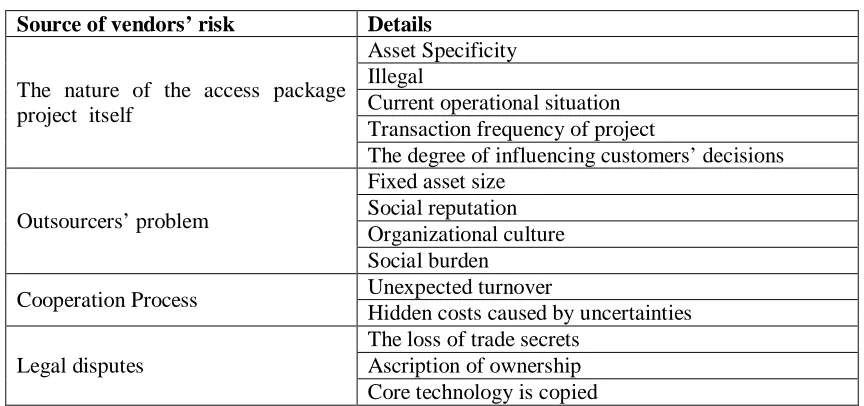
The goal we want to achieve in this stage is to sort the risk of access packages project. The vendor’s risk can be summed up as follows by inquiring literatures.
Table 3 : Vendors’ Risk summary
Source of vendors’ risk Details
The nature of the access package project itself
Asset Specificity Illegal
Current operational situation Transaction frequency of project
The degree of influencing customers’ decisions
Outsourcers’ problem
Fixed asset size Social reputation Organizational culture Social burden
Cooperation Process Unexpected turnover
Hidden costs caused by uncertainties
Legal disputes
The loss of trade secrets Ascription of ownership Core technology is copied
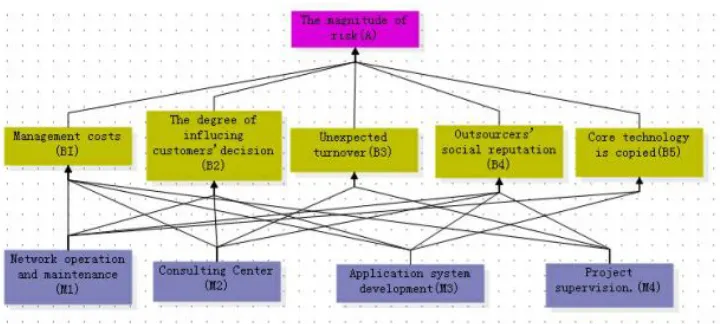
4.1.1 Construct The Hierarchy Chart.
Figure 1: Hierarchy chart.
4.1.2 Construct Judgment Matrix
Compare every level's factors pair wise according to the hierarchy chart above, and construct judgment matrix. The given judgment matrix here is determined by appropriate business departments after comparing every factor according to 1 - 9 scale method. For example, a certain department gives a judgment matrix B1, then
B
13 represents that” About management costs B1, the importance of network systems operation and maintenance (M1) compared the application development (M3)”. Here it can be interpreted that the risk degree of project M1 compared to project M2 in terms of cost management. The judgment matrix of criterion layer and index layer are as follows:
1
4
/
1
5
/
1
3
7
/
1
4
1
3
/
1
2
3
/
1
5
3
1
3
2
/
1
3
2
/
1
3
/
1
1
5
/
1
7
3
2
5
1
A
1
4
4
3
/
1
4
/
1
1
6
3
4
/
1
6
/
1
1
5
/
1
3
3
/
1
5
1
1
B
1 2 / 1 3 2 1 5 3 / 1 5 / 1 1 2 B
1
2
2
/
1
1
3
B
1
3
2
5
3
/
1
1
3
/
1
2
/
1
2
/
1
3
1
2
5
/
1
2
2
/
1
1
4
B
1
3
3
/
1
1
5
B
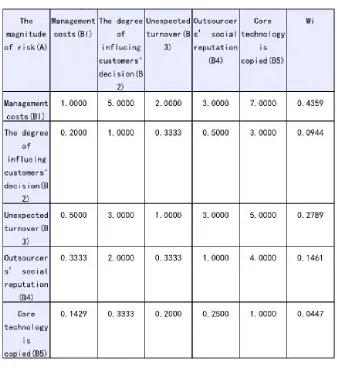
Figure 2: The result of Single-level sorting
Notice: This is no longer using the method described above and it is directly generated by a computer. Largest eigenvalue:
max
5
.
1335
Consistency index:
0
.
033375
1
5
5
max
CI
Random index: RI 1.12
The Random Consistency Proportion:
0
.
0298
0
.
1
RI
CI
CR
The results indicate the matrix “A” having satisfactory consistency. And the weight coefficient is A. W= (0.4359,0.0944,0.2789,0.1461,0.0447)
Similarly, we can get the weight coefficient set of second level.
B1: W= 0.2903,0.0587,0.4756,0.1754) CR=0.0947<0.1 B2: W= (0.1095,0.5816,0.3090) CR=0.0944<0.1 B3: W= (0.3333,0.6667) CR=0.0000<0.1 B4: W= (0.1351,0.2658,0.0912,0.5079) CR=0.0268<0.1 B5: W= (0.2500,0.7500) CR=0.0000<0.1
As can be seen, all results of single sort are smaller than 0.1(CR <0.1), considering the consistency of each judgment matrix are acceptable.
Figure 3: The final result
As we can seen from the above results, the risk of the four projects under the index B in descending order is M2, M3, M4, and M1. Project M2 has the highest risk. Correspondingly, it is the least important factor for selecting suitable project.
4.2 Choose Project on the Basis of AHP
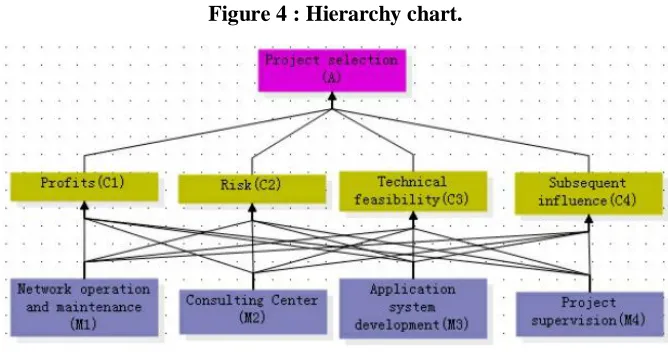
Combining the risk assessment that has been done above with the other factors, we make the final decision and determine if it is suitable or beneficial to undertake this project. As a vendor in outsourcing business, it is inevitable that they will choose those projects which have small risk, and their technology can be achieved. Also the projects' subsequent affect can bring them more profits. Here we select four indicators that are usually thought more important by experts: C1 Profits, C2 Risk, C3 Technical feasibility, C4 Subsequent influence. The projects are still the four mentioned above: M1 Network operation and maintenance, M2 Consulting Centre, M3 Application system development, M4 Project supervision. Now repeat the steps.
4.2.1 Construct the Hierarchy Chart.
Figure 4 : Hierarchy chart.
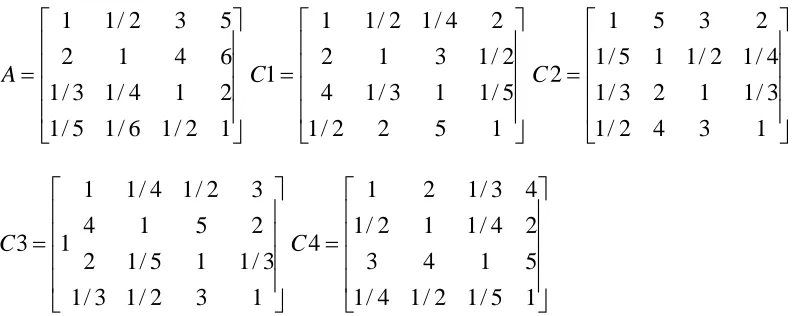
4.2.2 Construct Judgment Matrix
1
2
/
1
6
/
1
5
/
1
2
1
4
/
1
3
/
1
6
4
1
2
5
3
2
/
1
1
A
1
5
2
2
/
1
5
/
1
1
3
/
1
4
2
/
1
3
1
2
2
4
/
1
2
/
1
1
1
C
1
3
4
2
/
1
3
/
1
1
2
3
/
1
4
/
1
2
/
1
1
5
/
1
2
3
5
1
2
C
1
3
2
/
1
3
/
1
3
/
1
1
5
/
1
2
2
5
1
4
3
2
/
1
4
/
1
1
1
3
C
1
5
/
1
2
/
1
4
/
1
5
1
4
3
2
4
/
1
1
2
/
1
4
3
/
1
2
1
4
C
Notice: In general, the given of judgment matrix has a lot of subjectivity .Even the judgment matrix is given by experts; there are also many differences owing to the difference of company's practical issues. For example, the judgment matrixes may have big gap if the businesses or decision-makers have different attitudes to risk. The risk averters will put the risk first, and put profit and technology on second position. To the contrary, the risk lovers will put the profit first, and put risk second. Therefore, the judgment matrix must be given according to specific cases.
4.2.3 Consistency Check
Figure 5: The result of Single-level sorting
Largest eigenvalue:
max
4
.
0050
Consistency index:
0
.
00167
1
4
4
max
CI
Random index: RI 0.90
The Random Consistency Proportion:
0
.
0019
0
.
1
RI
CI
CR
The results indicate the matrix “A” having satisfactory consistency. And the weight coefficient is A. W=(0.3002,0.3666,0.1914,0.1418)
As can be seen, all results of single sort is smaller than 0.1(CR <0.1), considering the consistency of each judgment matrix are acceptable
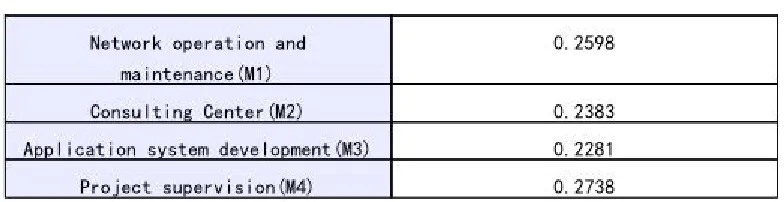
Figure 6: The final result
4.3 Result Analysis
From the view of total sorting results, the difference of the four projects' right weight is small. Project monitoring (M4)> Network Systems operation and maintenance (M1)> Advice Centre (M2)> Application Development (M3). The maximum weight of item 4 is only 0.00457 bigger than the minimum weight of item 3. But this result has been very important for Small medium enterprises, because of their resources and capabilities are very precious and limited compared to big enterprises.
Analyze the decision making ideas according to hierarchical sort.
For the four factors of level C, the right weight of subsequent influence is the lowest (0.1418), and the right weight of profits and risk are higher ( 0.3002 and 0.3666). It indicates that the decision maker pays greater attention to measure profits and risks. Meanwhile, the right weight of risk is higher than profit which indicates the decision -maker maybe a risk averter. This also proves the necessary to sort the risk of projects at first. As the most important factor, the right weight of management costs and unexpected turnover are very big among all factors of "Risk". Moreover, if we only consider from the two factors, the final decision is also to select Project 1 or Project 4. Thus, we can analyze the decision making ideas that the decision -maker pays greater attention to the Risks and Profits. And for specific factors, management costs and unexpected turnaround become the major consideration. Finally, the company makes the final decision: Project4 is the most preferred choice. Then the company can choose Project1, Project 2, and Project 3 successively.
5. Conclusions
This article is mainly to give an approach for vendors to choose the access package projects. Above all, identify the risk that the vendors have to bear in the process of financial outsourcing. And sort all the risks by AHP. Next, use AHP again to do quantitative research about access package projects on the basis of risk assessment. So it can provide a reference for vendors when they choose projects. In this way, the vendors can put limited resources and capabilities to projects with highest rate of return and minimum the cost and risk.
References
Jiadong Teng , Mengxia Zhu. Risk Evaluation analysis of IT outsourcing based on AHP[J]. China Management Informationization, 2013, 17:51-54.
Liu Jun. The research about vendor's legal risks and prevention of Intellectual Property[J]. Journal of East China Institute of Technology, 2012, 6:57-60.
Xianlan Zou. Risk and prevention of Chinese enterprises to undertake service outsourcing[J]. Northern Economic, 2012, 2:47-50.
Xiaofeng Hui, Xiaofeng Liu. The vendor's selection model and measures in outsourcing based on AHP[J]. Market Modernization,2008, 3:39-40.
Yafen Qi. Risk and Prevention of Financial Services Outsourcing[J]. ECONOMIC OUTLOOK THE BOHAI SEA, 2011, 4:32-35.