420
Copyright © 2011-15. Vandana Publications. All Rights Reserved.
Volume-5, Issue-2, April-2015
International Journal of Engineering and Management Research
Page Number: 420-424
Detection of Insider Attacks by Using Trust Value in Decentralized
Disruption-Tolerant Military Networks
Afeefa T1, Afsar P2 1,2
PG scholar, Department Of Computer Science and Engineering, MEA Engineering College, Perinthalmanna, INDIA
ABSTRACT
Disruption-tolerant network (DTN) technologies are becoming successful solutions that allow nodes to communicate with each other in these extreme networking environments. Some of the most challenging issues in this scenario are the enforcement of authorization policies and the policies update for secure data retrieval. The concept of attribute-based encryption (ABE) is a promising approach that fulfills the requirements for secure data retrieval in DTNs. So, in the existing system cipher text-policy attribute-based encryption (CP-ABE) is presented which provides a scalable way of encrypting data such that the encryptor defines the attribute set that the decryptor needs to possess in order to decrypt the cipher text. However, the problem of applying CP-ABE in decentralized DTNs introduces several security and privacy challenges with regard to the attribute revocation, key escrow, and coordination of attributes issued from different authorities. So, a secure data retrieval scheme is presented using CP-ABE for decentralized DTNs where multiple key authorities manage their attributes independently. But the drawback is updating attributes is not so efficient and high complexity. So, in the proposed system a new technique is introduced which is called Efficient Trust management system (ETMS) for reducing complexity and improving the security. Also, the geographical routing is used to find the location of the nodes. In this method, each node evaluates other nodes in the same subtask group while each subtask group leader (SGL) evaluates other SGLs and nodes in its subtask group. The peer-to- peer trust evaluation is periodically updated based on either direct observations or indirect observations. An experimental result shows that the proposed ETMS method achieves high efficiency and security and less complexity.
GeneralTerms---Attribute-based encryption(ABE), disruption-tolerant network(DTN), multiauthority, secure data retrieval.
I.
INTRODUCTION
Delay-tolerant networking (DTN) is an approach to computer network architecture that seeks to address the technical issues in heterogeneous networks that may lack perpetual network connectivity. It becoming prosperous
solutions that sanction nodes to communicate with each other in these extreme networking environments. In many military network scenarios, connections of wireless contrivances carried by soldiers may be ephemerally disconnected by jamming, environmental factors, and mobility, especially when they operate in truculent environments. Typically, when there is no terminus-to-end connection between a source and a destination pair, the messages from the source node may need to wait in the intermediate nodes for a substantial duration until the connection would be eventually established..
Many military applications require incremented auspice of confidential data including access control methods that are cryptographically enforced. The storage nodes are introduced in DTNs where data is stored or replicated such that only sanctioned mobile nodes can access the indispensable information expeditiously and efficiently. In many cases, it is desirable to provide differentiated access accommodations such that data access policies are defined over utilizer attributes or roles, which are managed by the key ascendant entities.
421
Copyright © 2011-15. Vandana Publications. All Rights Reserved.
may result in bottleneck during rekeying procedure or security degradation due to the windows of susceptibility if the precedent attribute key is not updated immediately.
In the proposed system, in order to detect the misbehaving nodes with less computation, an innovative technique is introduced which called Efficient Trust management system (ETMS) and using geographical is routing to identify the location of the nodes in the network. The geographical routing is also known as position-based routing or geometric routing is a technique to deliver a message to a node in a network over multiple hops by means of position information. Routing decisions are not based on network addresses and routing tables; instead, messages are routed towards a destination location. By using this the location information can be obtained.
II.
BACKGROUND
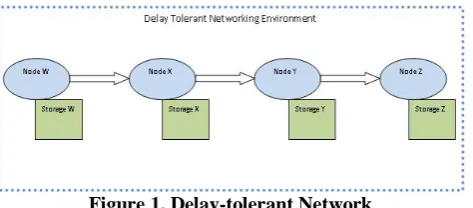
Delay-tolerant Network: Delay-tolerant networking (DTN) is an approach to computer network architecture that seeks to address the technical issues in heterogeneous networks that may lack continuous network connectivity. Examples of such networks are those operating in mobile or extreme terrestrial environments, or planned networks in space.
Recently, the term disruption-tolerant networking has gained currency in the United States due to support from
Figure 1. Delay-tolerant Network
Abbreviated as DTN,
DARPA, which has funded many DTN projects. Disruption may occur because of the limits of wireless radio range, sparsity of mobile nodes, energy resources, attack, and noise.
DisruptionTolerantNetworking is a networking architecture that is designed to provide communications in the most unstable and stressed environments, where the network
III.
RELATED WORK
would normally be subject to frequent and long lasting disruptions and high bit error rates that could severely degrade normal communications. It is an experimental protocol developed by the Delay & Disruption Tolerant Networking Research Group, which operates under the Internet Research Task Force
Junbeom Hur and Kyungtae [1]propose an attribute-predicated secure data retrieval scheme utilizing CP-ABE for decentralized DTNs. The proposed scheme features the following achievements. First, immediate attribute revocation enhances rearward/forward secrecy of
confidential data by reducing the windows of susceptibility. Second, encryptors can define a fine-grained access policy utilizing any monotone access structure under attributes issued from any culled set of ascendant entities. Third, the key escrow quandary is resolved by an escrow-free key issuing protocol that exploits the characteristic of the decentralized DTN architecture. The key issuing protocol engenders and issues utilizer secret keys by performing a secure two-party computation (2PC) protocol among the key ascendant entities with their own master secrets. The 2PC protocol deters the key ascendant entities from obtaining any master secret information of each other such that none of them could engender the whole set of utilizer keys alone. Thus, users are not required to plenarily trust the ascendant entities in order to bulwark their data to be shared. The data confidentiality and privacy can be cryptographically enforced against any curious key ascendant entities or data storage nodes in the proposed scheme.
Huang, Verma [2]] proposed scheme for dynamic environment, where establishing trust among conveyances is arduous. Solution is predicated on attribute predicated encryption (ABE) to construct an attribute predicated security policy enforcement (ASPE) framework. ASPE considers sundry road situations as attributes. These attributes are utilized as encryption keys to secure the transmitted data. ASPE is flexible in that it can dynamically change encryption keys depending on the VANET situations. Concurrently, ASPE naturally incorporates data access control policies on the transmitted data. ASPE provides an integrated solution to involve data access control, key management, security policy enforcement, and secure group formation in highly dynamic vehicular communication environments. Its contributions are in three-fold: (i) ASPE provides an architectural solution that enforces policy control in highly dynamic communication environments. The policies defined are predicated on vehicles’ circumventing situations and can be modified to achieve different security and privacy goals for VANETs. (ii) It show how ASPE policies can be elongated to perform subgroup vehicular communications with minimum communication and computation overhead. (iii) Present an optimization of ABE for vehicular networks, which avails ASPE run more efficiently.
422
Copyright © 2011-15. Vandana Publications. All Rights Reserved.
and disseminate such information to the regional key servers.
Luan Ibraimi, Milan Petkovic, and SvetlaNikov [4], application that elongates CP-ABE with instantaneous attribute revocation. Propose an incipient scheme for attribute revocation in CP-ABE called mediated Ciphertext-Policy Attribute-Predicated Encryption (mCP-ABE). The secret key is divided into two shares, one share for the mediator and the other for the users. To decrypt the data, the utilizer must contact the mediator to receive a decryption token. The mediator keeps an attribute revocation list (ARL) and relucts to issue the decryption token for revoked attributes. Without the token, the user cannot decrypt the ciphertext, therefore the attribute is implicitly revoked. The technique of splitting the attribute components of the secret key into two shares, and the technique of utilizing an identifier Iu for each utilizer, avails us to achieve the following attribute revocations: i) revoking an attribute from a single utilizer without affecting other users, and ii) revoking an attribute from the system where all users are affected.
Bethencourt, Sahai, Waters [5] proposed the system such that a user's private key will be associated with an arbitrary number of attributes expressed as strings. On the other hand, when a party encrypts a message in the system, they designate an associated access structure over attributes. A utilizer will only be able to decrypt a cipher text if that utilizer's attributes pass through the cipher text's access structure. At a mathematical level, access structures in this system are described by a monotonic access tree", where nodes of the access structure are composed of threshold gates and the leaves describe attributes. To note that AND gates can be constructed as n-of-n threshold gates and OR gates as 1-of-n threshold gates. Furthermore, handle more involute access controls such as numeric ranges by converting them to minute access trees. By using this method key revocation is difficult
IV.
PROPOSED SYSTEM
423
Copyright © 2011-15. Vandana Publications. All Rights Reserved.
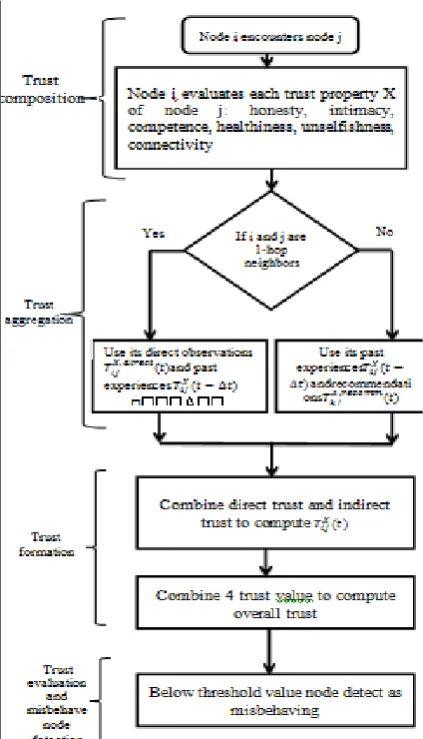
Figure 2. Flow chart of trust execution4.1 Peer-to-peer trust evaluation:
It maintains two peer-to-peer level of trust: node level and SGL level trust. Each node evaluates other nodes in the same subtask group while each SGL evaluates other SGLs and nodes in its subtask group. The peer-to-peer trust evaluation is periodically updated based on either direct observation or indirect observation. When two nodes are neighbors within radio range, they evaluate each other based on direct observations via snooping or overhearing. Each node sends its trust evaluation results toward other nodes in the same subtask group to its SGL.The commander performs trust evaluation toward all SGLs (commander-to- SGL) in the system. A SGL is responsible for misbehaving node detection for nodes in its subtask group, while the commander is responsible for misbehaving SGL detection for all SGL nodes in the system.
4.2 Trust aggregation and trust formation
Use both social trust components such as connectivity, intimacy, honesty and unselfishness, and QoS trust components such as competence, reliability and delivery ratio be considered. Let X denote a trust component selected and let denote node i’s assessment toward node j in trust property X at time t. Below we describe how trust aggregation
and trust propagation for peer-to-peer trust evaluation are conducted between two members in the same subtask group or two SGLs𝑇𝑇𝑖𝑖𝑖𝑖𝑋𝑋(𝑡𝑡). As illustrated in Figure 3 &4, when a trustor node (node i) evaluates a trustee node (node
j) at time t, it updates 𝑇𝑇𝑖𝑖𝑖𝑖𝑋𝑋(𝑡𝑡) as follows:
We use a design parameter 𝛼𝛼𝑥𝑥with 0 ≤𝛼𝛼𝑥𝑥≤1 to weight these two contributions and to consider trust decay over time for trust property X. A larger 𝛼𝛼𝑥𝑥means that trust evaluation will rely more on direct observations.Parameter𝑦𝑦𝑥𝑥define as follows:
𝛾𝛾𝑋𝑋= 𝛽𝛽𝑋𝑋𝑇𝑇𝑖𝑖𝑖𝑖(𝑡𝑡)
1 +𝛽𝛽𝑋𝑋𝑇𝑇 𝑖𝑖𝑖𝑖(𝑡𝑡)
The geographical routing is also known as position-based routing or geometric routing is a technique to deliver a message to a node in a network over multiple hops by means of position information. Routing decisions are not based on network addresses and routing tables; instead, messages are routed towards a destination location. By using this the location information can be obtained.
V.
RESULTS AND DISCUSSION
5.1 Description about network setup
424
Copyright © 2011-15. Vandana Publications. All Rights Reserved.
Input parameters are, Number of nodes
Number of nodes is defined as number of nodes is taken in the network setup.
5.2 Description of output parameter
Communication cost
The total communication cost includes the cipher text and rekeying messages for non-revoked users. It is measured in bits.
Communication overhead Overhead
Communication cost
Figure 5. Communication cost
The communication cost is shown in this graph. In the X-axis number of nodes is taken. Y-axis communication cost is taken. In the existing cipher text-policy attribute-based encryption method is used and the proposed method Efficient Trust management system (ETMS) is used. This graph clearly shows that the number of nodes is increases the communication cost is increases in existing methods. But in the proposed method, the communication cost is decreases.
Overhead
is any combination of excess or indirect computation time, memory, bandwidth, or other resources that are required to attain a particular goal.
5.3 Comparison graphs
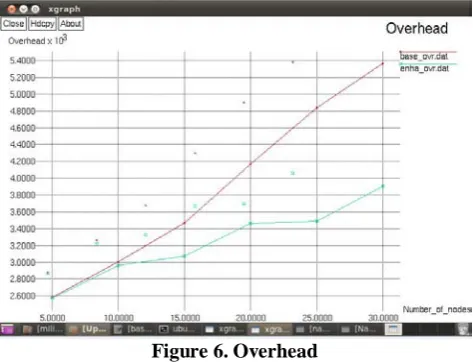
Figure 6. Overhead
The overhead is shown in this graph. In the X-axis number of nodes is taken. Y-axis overhead is taken. In the existing cipher text-policy attribute-based encryption
method is used and the proposed method Efficient Trust management system (ETMS) is used. This graph clearly shows that the number of nodes is increases the overhead is increases in existing methods. But in the proposed method, the overhead is decreases.
VI.
CONCLUSIONDTN technologies are becoming successful solutions in military applications that allow wireless devices to communicate with each other and access the confidential information reliably by exploiting external storage nodes. CP-ABE is a scalable cryptographic solution to the access control and secure data retrieval issues. In the existing system, an efficient and secure data retrieval method using CP-ABE is used for decentralized DTNs where multiple key authorities manage their attributes independently. The inherent key escrow problem is resolved such that the confidentiality of the stored data is guaranteed even under the hostile environment where key authorities might be compromised or not fully trusted. In addition, the fine-grained key revocation can be done for each attribute group. But the drawback in this method is less tradeoff between the computational complexity and security. So, in the proposed system Efficient Trust management system (ETMS) is introduced using geographical is routing to identify the location of the nodes in the network. This method canlearn from past experiences and adapt to changing environment conditions to maximize application performance and enhance operation agility.
VII.
ACKNOWLEDGMENT
The author would like to express her sincere thanks to HOD, project guide and staff in Computer Sciencedepartment, M E A Engineering College for many fruitful discussions and constructive suggestions during the preparation of this manuscript.
REFERENCES
[1]. HUR, JUNBEOM, AND KYUNGTAE KANG. "SECURE DATA RETRIEVAL FOR DECENTRALIZED DISRUPTION-TOLERANT MILITARY NETWORKS." IEEE/ACM
TRANSACTIONS ON NETWORKING (TON) 22.1 (2014): 16-26.
[2]. Huang, Dijiang, and Mayank Verma. "ASPE: attribute-based secure policy enforcement in vehicular ad hoc networks." Ad Hoc Networks 7.8 (2009): 1526-1535. [3]Roy, S., and M. Chuah. Secure data retrieval based on ciphertext policy attribute-based encryption (CP-ABE) system for the DTNs. Technical Report, 2009.
[4]. Ibraimi, Luan, et al. "Mediated ciphertext-policy attribute-based encryption and its application." Information Security Applications. Springer Berlin Heidelberg, 2009. 309-323