R E S E A R C H
Open Access
Direction of collaborative problem
solving-based STEM learning by learning analytics
approach
Li Chen
1*, Nobuyuki Yoshimatsu
2, Yoshiko Goda
3, Fumiya Okubo
4, Yuta Taniguchi
5, Misato Oi
6,
Shin
’
ichi Konomi
7, Atsushi Shimada
3, Hiroaki Ogata
8and Masanori Yamada
7* Correspondence:chenli@mark-lab. net
1Gradute School of
Human-Environment Studies, Kyushu University, 744 Motooka, Nishiku, Fukuoka 819-0395, Japan Full list of author information is available at the end of the article
Abstract
The purpose of this study was to explore the factors that might affect learning performance and collaborative problem solving (CPS) awareness in science, technology, engineering, and mathematics (STEM) education. We collected and analyzed data on important factors in STEM education, including learning strategy and learning behaviors, and examined their interrelationships with learning performance and CPS awareness, respectively. Multiple data sources, including learning tests, questionnaire feedback, and learning logs, were collected and examined following a learning analytics approach. Significant positive correlations were found for the learning behavior of using markers with learning performance and CPS awareness in group discussion, while significant negative correlations were found for some factors of STEM learning strategy and learning behaviors in pre-learning with some factors of CPS awareness. The results imply the importance of an efficient approach to using learning strategies and functional tools in STEM
education.
Keywords:STEM education, Collaborative problem solving, Learning strategy, Learning behavior, Learning analytics
Introduction
In the twenty-first century, international concern over science, technology, engineer-ing, and mathematics (STEM) education has increased. We currently face many global issues, including climate change, overpopulation and wellbeing, resource management, health, and biodiversity, that put great pressure on institutions involved in developing science and technology and that require continued development of STEM education (Gough, 2015; Thomas & Watters,2015). Considering the complexity and diversity of these issues and the great need for the ability to integrate knowledge and skills in sci-ence, technology, engineering, and mathematics to solve real problems (Newhouse, 2016), science learning seems to be a powerful way of thinking and understanding the basis of these issues (Thomas & Watters,2015).
According to Kelley and Knowles (2016), it is indicated that the foundation of STEM learning framework is the situated STEM learning, which is based on the situated cog-nition theory. Situated cogcog-nition theory emphasizes that learners’ knowledge is
constructed within the authentic activities and contexts (Brown, Collins, & Duguid, 1989; Lave & Wenger, 1991), and not only knowledge and skill itself, how knowledge and skill can be applied into the authentic contexts is also important (Kelley & Knowles,2016). Therefore, as one of the critical themes of STEM, acquiring knowledge and skills through solving problems with real-world scenarios is crucial in STEM learn-ing, for the reasons such as it helps students to prepare for real life, and solve life prob-lems and work probprob-lems, by using science, technology, engineering, and mathematics-related knowledge and skills (Holmlund, Lesseig, & Slavit,2018).
Moreover, situated cognition theory recognizes that not only the cognitive aspect but also the social aspect of learning activities are critical to the learning process. It is em-phasized the opinion that, rather than constructing knowledge on one’s own, people’s knowledge is constructed through socially communicating and interchanging with others (Lave & Wenger,1991). In situated STEM learning, it is considered that know-ledge is organized around ideas, concepts, or themes, and evolved through social dis-course, thus, as one of the key elements of situated learning, a community of practice is considered as the rope of all dimensions of STEM, which connects science inquiry, technological literacy, mathematical thinking, and engineering design (Kelley & Knowles, 2016). It is indicated that not only acquiring the knowledge and skills itself, but also the process of how to acquire them through the authentic contexts and the ex-change of ideas, and how to use them to solve authentic problems, which including both cognitive and social aspects, should be considered in STEM education.
Considering the integrative nature of STEM education, it has been indicated that col-laboration for problem solving provides some benefits, such as a more effective division of labor and the incorporation of differing perspectives, knowledge, and experiences (Organisation for Economic Cooperation and Development [OECD], 2017). In this re-gard, collaborative problem solving (CPS) is considered effective in STEM education, especially when dealing with real and complex problems, because of its coordinated na-ture (Hesse, Care, Buder, Sassenberg, & Griffin,2015).
According to Hesse et al. (2015), CPS is not a uniform but rather a complex and co-ordinated skill that comprises several sub-factors. In order to develop CPS skills in STEM education and improve learning effectiveness, it is important to identify the po-tential influential factors for learning performance and CPS awareness in STEM learning.
In many prior studies, learning behaviors have proved to be important indicators of students’learning performance (Hwang, Shadiev, Wang, & Huang,2012; Lowes, Lin, & Kinghorn, 2015) and individual learning awareness of instructional practice (Artino Jr. & Jones II,2012; Yamada et al.,2017). Since STEM learning allows students to combine theory and practice in real situations, it is necessary to explore the aspects of cognition and behaviors in STEM, including how students comprehend and apply integrated knowledge (Liu & Cavanaugh, 2011). Thus, we took learning behaviors into consider-ation as important factors that could affect the improvement of learning performance and cultivation of CPS awareness.
time constraints, limitations of equipment, and other issues. Therefore, we try to exam-ine students’ learning behaviors that reflect their individual thinking and investigate their influence on learning performance and CPS skills utilization.
In addition to learning behaviors, cognitive learning strategy is also considered a fac-tor affecting learning scores (Yamada et al., 2016). Since STEM education is an inte-grated learning approach (Kelley & Knowles, 2016; Lou, Liu, Shih, & Tseng,2011), it is important for both educators and students to understand the coherence, integration, and learning approaches of STEM so that they can apply an effective learning strategy in STEM teaching and learning. As indicators of learning behaviors, it is necessary to make sense of students’ cognitive learning strategies in STEM education, such as whether and how they use their learning strategies during STEM learning and when solving STEM problems (Griese, Lehmann, & Roesken-Winter,2015).
Based on insights from these prior studies and the needs they revealed for under-standing the factors that might affect learning performance and learning awareness, our study aimed to clarify the correlations of students’ learning performance and learning awareness with the variables of their learning strategy and learning behaviors to deter-mine the factors that might affect STEM CPS learning and provide an effective way for researchers and instructors to develop and instructional methods in STEM CPS education.
Literature review
Collaborative problem solving in STEM education
STEM includes scientific study, technology, engineering design, and mathematical analysis (Lou et al.,2011). STEM teaching is commonly conceptualized as a multidis-ciplinary approach that typically begins with a discipline or multidiscipline, on the basis of which instructors prepare problems for students to solve (Herro, Quigley, An-drews, & Delacruz, 2017). As one of the successful factors in STEM education, it is important not only to embed knowledge and skills in the curriculum but also to as-sess knowledge and skills in a real situation or problem-solving practice process and focus on the link of knowledge between the four STEM domains (Newhouse, 2016). STEM teaching allows students to examine and apply theories and knowledge to im-prove their problem-solving skills, as well as to integrate the comprehension and ap-plication of complicated knowledge in STEM areas (Lou et al.,2011).
In STEM education, situated learning is considered as the foundation of the integra-tion of four domains (Kelley & Knowles,2016), in which students can build an increas-ing rich understandincreas-ing of what they are learnincreas-ing, through applyincreas-ing knowledge and skills actively to the authentic situation, rather than just acquire them (Brown et al., 1989). Authentic activities is helpful for students to act meaningfully and purposefully, since by conducting authentic activities, students are provided with experience to rep-resent and describe the knowledge or concepts, and revise their understanding and ac-tions based on the experience and results (Brown et al., 1989). Based on the situated STEM learning, an engineering design approach provides the opportunity for students to build connections among STEM domains and apply science knowledge and inquiry in an authentic context. Students can construct new knowledge and enhance their learning through engineering practice and scientific inquiry (Kelley & Knowles, 2016). Students treat technology and engineering as cognitive tools, apply mathematical and scientific approaches to solve problems, generalize key concepts, and accumulate pro-cedural knowledge (Lou et al., 2011). Thus, students are expected to develop and use their integrated knowledge and cognitive skills such as problem-solving skill, through authentic contexts. Additionally, in light of the importance of the social aspect of STEM learning, Kelley and Knowles (2016) point out that a community of practice (Lave & Wenger,1991) is an important element in integrating the four STEM domains in situated learning, since students can construct their understanding by expressing and interpreting their thinking, and rich understanding by the exchange of the ideas and the communication and negotiation with others (Brown et al.,1989). Therefore, it is important to take not only social aspect into consideration in STEM learning.
According to the OECD (2017), collaboration for problem solving affords potential advantages over individual problem solving, including the fact that collaboration affords more effective division of labor; incorporation of information from group members with multiple perspectives, experiences, and sources of knowledge; and enhanced cre-ativity and quality of solutions through mutual feedback. Therefore, in order to im-prove integrated STEM learning, it is necessary to consider social and cognitive factors when tackling STEM challenges. In this regard, collaborative problem solving (CPS) is a promising area in STEM education because of its advantages in inculcating the un-derstanding of scientific knowledge and others’ideas, training in scientific investigation, and solving applied problems (Hesse et al., 2015; Hogan, 1999; Lin et al., 2015). Lin, Yu, Hsiao, Chang, and Chien (2018) compared the effectiveness of web-based CPS sys-tem and the classroom-based hands-on activities including the CPS scenarios from daily life, in order to develop students’ CPS skills in STEM learning. As their results, the virtual STEM learning environment was found to be more effective in the develop-ment of their CPS skills than traditional classroom-based hands-on activities, and the effectiveness of the system would be further enhanced with teacher’ involvement and guidance (Lin et al.,2018).
and how all sub-skills develop. Our previous study indicated that students’behavioral factors affect learning performance and CPS awareness (Chen et al., 2018). Therefore, in the present study, in order to improve the learning effectiveness of STEM CPS les-sons, we explored the relationships of learning effectiveness with learning behaviors and cognitive learning strategies to see how individual cognition and thinking affect CPS learning in order to determine the factors that might impact the improvement of knowledge and CPS awareness.
Learning analytics and online behaviors
Considering the social and cognitive domains of CPS, it is important to clarify how stu-dents engage in collaboration activities and how they act and think in individual and collaborative learning (Chen, L et al., 2018). In this regard, it is important to under-stand students’individual thinking behaviors and how to use learning strategies in indi-vidual and group learning. In light of the difficulty of collecting behavioral data during traditional face-to-face lectures, many studies have focused on educational data col-lected and analyzed technologically using a learning analytics approach.
According to Dunbar, Dingel, and Prat-Resina (2014), it is important to incorporate the educational data and analysis relevant to student learning into course and curricu-lum design, and they also indicated a need for methods and tools that curricucurricu-lum de-signers can use to explore data on instructional practices. In science education, the analytics and mining of educational data are useful in evaluating and improving educa-tional design (Monroy, Rangel, & Whitaker,2014). During the past decades, researches put efforts to explore the potential of analytics and data mining techniques and meth-odologies, to extract valuable and actionable information from large datasets. When ap-plied to education, these methodologies are referred to as learning analytics (LA) and educational data mining (EDM).
Although there are many similarities between LA and EDM, in general methods and procedures, including gathering, processing, reporting, and acting on machine-readable data in order to improve the educational environment, LA and EDM differ in many as-pects, such as origins, types of discovery, and adaption and personalization (Baker & Siemens,2014; Liñán & Pérez,2015). For example, origins of researches in EDM are re-lated to educational software and student modeling, and are more interested in auto-mated discovery, and look for the autoauto-mated adaptation for supporting learners, such as identifying learner’s need and automatically change to personalize learner’s experi-ence with the help of educational software. Whereas, LA researches are rooted in cur-riculum, outcome prediction, and systemic interventions, and are interested in human-led methods to explore the data for more interpretable and understandable models. Ra-ther than automated adaptation, researches of LA look for ways to inform and em-power instructors and learners, such as informing instructors or learners themselves concerning specific learners’learning situation and processes.
system but also the psychological data conducted by the survey. The methods of data collection and analysis were based on human-led methods according to the learning theories and the changing situations of the learning environment.
The purpose of the educational data analysis in this experiment is to clarify the rela-tionships between various factors and predict the potential factors which may influence learning outcomes, and then inform instructors and learners these results to help them understand their teaching or learning, and providing researchers and educators some implications in CPS-based STEM learning. Therefore, we adopted LA approach, rather than EDM approach, to achieve the above research purpose.
Learning analytics (LA) is an effective way of using academic data that allows us to understand and improve learning in various fields. For example, Bazelais, Lemay, and Doleck (2018) investigated the relationship between students’ prior achievement (high school average) with performance in a pre-university physics program by using data of 9877 students’ pre-university physics course. As the results, they found that prior high school performance achievement was a strong predictor of college physics course per-formance. In higher education, support of the technology makes it possible to collect LA data from new resources such as learning management systems (LMS). Through LMS, students’learning logs can be collected and data from them can be used to define learning behavior variables when conducting online learning, such as number of logins, pages accessed, and time spent in the system, which can show students’frequency and duration of participation (Morris, Finnegan, & Wu,2005). Moreover, some studies have found that certain types of online participation behaviors, such as“page hits,”are corre-lated with grades (Ramos & Yudko, 2008; Wang & Newlin,2000). By using an e-book system, students can use multiple functions of e-books such as going to the next page or previous page, adding bookmarks, underlining, annotations, and keyword searching, and all these log data can be collected by the system. Additionally, the system can also know when and for which course the e-book was used, which is very useful information in analyzing students’ learning activities (Ogata et al.,2015). Oi, Okubo, Shimada, Yin, and Ogata (2015) analyzed students’learning behaviors by collecting e-book logs before and after the main content learning in class to investigate the relationships of preview and review behaviors with academic achievement. Their findings indicate that preview-ing is more deeply relevant to academic achievement and assessment than reviewpreview-ing.
Although LA is considered an effective method to assess how online behaviors are as-sociated with learning performance in secondary education (Lowes et al., 2015), there are still fewer studies using LA data at the secondary education level than higher education.
academic year in biology courses in high school to show that certain variables could affect student academic achievement. For example, the time students spent in the LMS positively and significantly affected their final scores in biology courses. Lowes et al. (2015) also explored LMS data for one academic year to examine the link between in-course behaviors and in-course outcomes, concluding that the level of online behaviors as-sociated with attendance and interactivity showed a positive influence on final grades.
However, as it is difficult to conduct continuous online courses in secondary educa-tion due to time restriceduca-tions, limitaeduca-tions of equipment, and other issues, in our present study we collected students’learning logs during short-term online learning in order to revise and improve our next short-term design accordingly.
Based on the insights of previous studies, the present study aimed at exploring the re-lationships of learning performance and CPS awareness with STEM learning strategy and online learning behaviors in order to investigate potential influencing factors on the learning effectiveness of STEM CPS learning and find an effective method to im-prove STEM CPS learning.
Research questions
As one of the goals of STEM learning, learners are expected to acquire knowledge dur-ing the activities of solvdur-ing problems with authentic contexts, or apply them into au-thentic problems (Holmlund et al., 2018). In order to achieve this goal, it is important to understand how do learners acquire and construct related knowledge. The literature review cited above revealed that students’learning behaviors engaged in individual ac-tivities of learning materials, which were related to their scientific thinking, had influ-ence on learning performance and learning awareness. Therefore, in the present study, we try to examine the relationships between learning performance with learning behav-iors on how they read and understand scientific contents, and to find out what kind of learning behaviors should be recommended or paid attention during STEM learning. Meanwhile, in order to understand how to instruct students to use effective learning strategies to acquire knowledge, it is necessary to identify what kind of STEM learning strategies would have influence on learning performance.
Moreover, since this was not the first time students got touch in the learning for CO2-related knowledge and the form of group work, students might have different prior knowledge and CPS awareness, which would have influence on the final results. Therefore, considering the different scores of students’ test and CPS pre-questionnaire, it was not suitable to only consider the final results of learning perform-ance and CPS awareness. Therefore, as the first research question, the difference in pre-posttests and questionnaires was examined, and to find out the relationships be-tween the change in learning performance and CPS awareness, with learning behaviors and STEM learning strategies, to find out the potential factors that were related with the change in learning performance.
Moreover, in order to understand how students would conduct these behaviors, it is necessary to associate these learning behaviors with the learning strategies they used during the STEM learning. Then students and instructors could be provided with some suggestions on the learning behaviors which had relationships with the improvement in learning performance and CPS awareness, and how to encourage students to conduct these learning behaviors by using related learning strategies.
In this study, we set three research questions:
Research question 1: Which factors of STEM learning strategy and learning behaviors have relationships with the change in learning performance in STEM learning? Research question 2: Which factors of STEM learning strategy and learning behaviors have relationships with the change in CPS awareness in STEM learning?
Research question 3: What are the relationships between STEM learning strategy and learning behaviors in STEM learning?
Methods
Procedure of the instructional design
In this study, we designed a STEM CPS lesson based on the CPS framework proposed by Hesse et al. (2015). The theme of this STEM lesson is the same as the science lesson conducted in our prior study (Chen, Uemura, Goda, et al., 2018), which involved deter-mining the reason for the Limnic Eruption, a natural disaster that occurred in Cameroon.
In order to facilitate pre-learning and group discussion, as well as to collect and analyze the learning behaviors of participants and pre-learning and individual thinking behaviors during group work, we integrated a BookRoll system into our design.
The BookRoll system is used as an e-book reader system to store lecture materials such as slides or notes (Ogata et al.,2017). Students can access these learning materials both in class and at home, which makes it possible to collect the learning logs from when students prepare or review their lessons to understand their learning conditions. In addition, as students can use additional functions such as highlighting, annotating, and searching for key words, these learning logs can all be collected for further analysis and instruction improvement. The interface for BookRoll used in this study is pre-sented in Fig.1.
The instructional design of the SETM lessons are presented inAppendix 1.
In order to make the tasks proceed more smoothly, we designed five questions for students to discuss with each other. (1) Where was CO2from in Lake Nyos? (2) Where did more CO2dissolve and accumulate in the Lake Nyos, the surface or the bottom? Why? (3) According to the Wikipedia, there is about 90 million tons of CO2dissolved in the Lake Nyos (Wikipedia: Lake Nyos, Japanese version). How much pressure does it take for 90 million tons of CO2 to dissolve in Lake Nyos at 20 °C? (4) In summary, what is the mechanism of limnic eruptions? (5) Could Limnic Eruption possibly occur in Japan?
Fig. 1The BookRoll system interface of the Limnic Eruption lesson
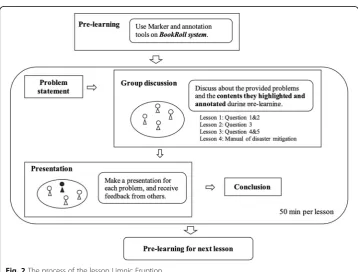
the first week, the teacher introduced the Limnic Eruption disaster, and explained the difficult contents according to what students highlighted (pre-learning). And after that, students worked on question 1 and 2 by searching and analyzing the information, and discussing with others about the questions. Students were asked to talk about the high-lights and annotations they added during pre-learning. Then, all groups would make a presentation about their conclusion and received feedback from the teacher and other students. During the second and the third week, students preformed pre-learning and group discussion in the same form, and worked on the questions 3~5. In the fourth week, students were asked to use the integrated knowledge and skills to design a man-ual of disaster mitigation and make a presentation to the whole class.
Design and procedure
This study was conducted in a tenth-grade science class at a private senior high school in Japan with the participation of 12 students. The period of this study was between November and December 2018 and included four lessons (50 min per lesson) over 4 weeks (one lesson per week). In addition to the teaching hours, students were also asked to read the provided learning materials on the BookRoll system, and to finish the assignments.
Before the lesson, students were required to take a Collaborative Problem Solving questionnaire (hereinafter, the “CPS Questionnaire”), which concerned their prior awareness of whether and how to use CPS skills in typical science classes as the pre-questionnaire, and a pre-test to check their prior knowledge. After the completion of the STEM lesson, students received the same CPS Questionnaire and a new STEM Learning Strategy Questionnaire (hereinafter, the “SLS Questionnaire”) as post-questionnaires. The CPS post-questionnaire was conducted to assess the change in stu-dents’ CPS awareness before and after the STEM lesson, while the SLS questionnaire checked the kind of learning strategy students used during the STEM lesson, and a post-test was also conducted to see whether their related knowledge had changed.
Data collection
In order to investigate factors that might affect the cultivation of CPS skills, we exam-ined the relationships between CPS awareness and learning performance, the STEM learning strategy (SLS) used, and the learning behaviors in learning scientific materials during individual pre-learning and collaborative work.
Therefore, we collected data from three tools: questionnaires, tests, learning logs, and the dialogue during group discussion. The CPS Questionnaire was designed with refer-ence to the CPS framework proposed by Hesse et al. (2015), which contains 17 items in total (seeAppendix 2). The CPS pre-postquestionnaires contain two dimensions, social skills and cognitive skills, and include five factors,Participation,Perspective Taking,
So-cial Regulation, Task Regulation, and Learning and Knowledge Building. These factors
reliability of Participation, Perspective Taking, Social Regulation, Task Regulation, and
Learning and Knowledge Building was 0.83, 0.79, 0.79, 0.71, 0.73 respectively), and
post-CPS Questionnaire was 0.79 (the reliability of each factor same as above was 0.78, 0.84, 0.75, 0.84, 0.74 respectively).
The SLS Questionnaire developed by Griese et al. (2015) was used as the post-questionnaire, concerning students’learning strategy during their STEM learning. The SLS Questionnaire contains nine factors, Organizing, Elaborating,Repeating,Effort,
At-tention,Time Management,Learning Environment,Peer Learning, andUsing References,
and includes 27 items (seeAppendix 3). We translated the SLS Questionnaire to Japa-nese and made minor changes to the items to make them more suitable for senior high school students. The overall Cronbach’sαvalue of SLS Questionnaire was 0.78 (the re-liability of Organizing, Elaborating, Repeating, Effort, Attention, Time Management,
Learning Environment, Peer Learning, and Using References was 0.86, 0.73, 0.78, 0.71,
0.82, 0.84, 0.88, 0.70, 0.71 respectively).
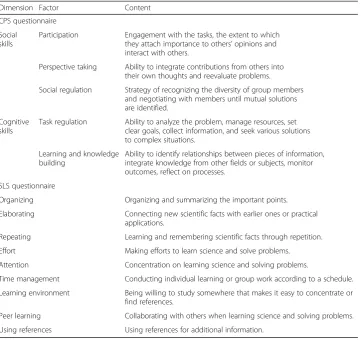
The contents of the CPS Questionnaire and SLS Questionnaire are shown in Table1. Both questionnaires were rated on a Likert scale from 1 to 5 (1. Strongly disagree; 2.
Slightly disagree; 3.Neither; 4.Slightly agree; and 5.Strongly agree). Free text space was
also provided on the post-questionnaire to collect students’ individual reflections and their impression of STEM lesson.
Table 1Contents of the CPS and SLS questionnaires
Dimension Factor Content
CPS questionnaire
Social skills
Participation Engagement with the tasks, the extent to which they attach importance to others’opinions and interact with others.
Perspective taking Ability to integrate contributions from others into their own thoughts and reevaluate problems.
Social regulation Strategy of recognizing the diversity of group members and negotiating with members until mutual solutions are identified.
Cognitive skills
Task regulation Ability to analyze the problem, manage resources, set clear goals, collect information, and seek various solutions to complex situations.
Learning and knowledge building
Ability to identify relationships between pieces of information, integrate knowledge from other fields or subjects, monitor outcomes, reflect on processes.
SLS questionnaire
Organizing Organizing and summarizing the important points.
Elaborating Connecting new scientific facts with earlier ones or practical applications.
Repeating Learning and remembering scientific facts through repetition.
Effort Making efforts to learn science and solve problems.
Attention Concentration on learning science and solving problems.
Time management Conducting individual learning or group work according to a schedule.
Learning environment Being willing to study somewhere that makes it easy to concentrate or find references.
Peer learning Collaborating with others when learning science and solving problems.
The pre-posttests contained the same ten questions on students’acquisition of CO2-related knowledge. The tests included seven conceptual multiple-choice questions con-cerning the nature (two questions) and solubility of CO2(five questions), one calcula-tion quescalcula-tion, and two applicacalcula-tion quescalcula-tions that required students to solve problems related to solubility of CO2 and disaster reduction consciousness. Thus, the results of the tests can reflect the change of students’ conceptual understanding of the CO2-re-lated problems, and the ability to transfer their knowledge to solve the problems. The conceptual questions were the same level as their final examination, and calculation question and application questions were more difficult than their final examination.
The learning logs of the operations students performed when reading and under-standing digital learning materials through BookRoll system were collected, yielding data on their frequency of turning to the next/previous page and adding/deleting markers, annotations. The learning logs both in-class and out-of-class were collected in this study.
Results and discussion
Research question 1: What factors of STEM learning strategy and learning behaviors have relationships with the change in learning performance in STEM learning?
Changes in learning performance
The pposttests consist of ten questions (worth ten full marks) about knowledge re-lated to CO2 and disaster reduction. Due to the small sample size of the study, we looked at histograms of students’pre-posttests with the normal curve superimpose, and histograms showed obviously not symmetric, moderate tailed distributions, which indi-cated apparent normal distributions of data. Therefore, we adopted non-parametric Wilcoxon rank test to assess the significance of the change of pre-posttests concerning students’changes of related knowledge.
As shown in Table2, the mean value improved from 3.42 (SD= 1.24) to 5.92 (SD= 1.51) at a significance value of 0.01, which shows statistically significant differences in students’learning performance during the STEM lesson.
In order to investigate whether learning strategy and learning behaviors of reading scientific materials had influence on learning performance, we used Spearman’s rank correlation coefficient to assess the correlations between learning performance from the data of tests on the one hand and learning strategy from the SLS Questionnaire and learning logs for the reading digital learning materials on the other.
Correlations between changes in learning performance and STEM learning strategy First, we analyzed the correlations between changes in learning performance and the SLS (see Table3); however, no correlation was found.
Table 2Wilcoxon signed-rank test results of pre-posttests
Test Mean SD Median |Z| Pvalue
Pretest 3.42 1.24 3.00 2.83** 0.01
Posttest 5.92 1.51 6.00
Lou et al. (2011) suggest that students should be guided efficiently to immersion in STEM learning. However, in this lesson, the instructor played the role of a facilitator who only controlled the flow of the lesson and provided advice or gave answers directly when necessary, indicating that efficient guidance for STEM learning is not enough in this instructional design.
As Kelley and Knowles (2016) pointed out, as an important factor in STEM educa-tion, both educators and learners should put emphasis on the integration of STEM sub-jects. In order to make the integrated approach more effective in conveying to students how STEM knowledge can be applied to real-world problems, it is necessary for stu-dents to think and understand the relevant ideas in the individual disciplines and multi-disciplinary integration (Kelley & Knowles,2016). However, the results of the stu-dents’ free text questionnaire suggests that they only focused on scientific or mathem-atical knowledge and on how to use it to solve a specific provided problem, rather than thinking of relevant ideas or integration. This is one possible reason why students’ STEM learning strategy failed to help them to improve their learning performance.
Correlations between changes in learning performance and learning behaviors
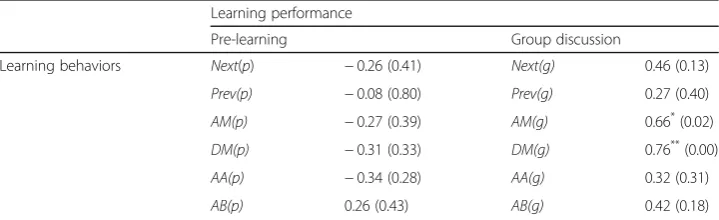
Regarding the correlations between changes in learning performance and the learning behaviors involved in reading digital learning materials, we divided learning behaviors into two parts, pre-learning and group discussion. The results are presented in Table4. During pre-learning, there was no correlation between changes in learning perform-ance and learning behaviors, and we consider the same reason to be involved here as Table 3Spearman’s rank correlation coefficients between learning performance and STEM learning strategy
Learning performance
STEM learning strategy Organizing −0.79 (0.10) Time management −0.44 (0.15)
Elaborating −0.49 (0.10) Learning environment 0.00 (0.10)
Repeating 0.03 (0.93) Peer learning −0.09 (0.78)
Effort 0.07 (0.83) Using references −0.47 (0.13)
Attention 0.14 (0.66)
ρ(Sig.);N= 12;**
p< 0.01;*
p< 0.05;†p< 0.1
Table 4Spearman’s rank correlation coefficients between learning performance and learning behaviors
Learning performance
Pre-learning Group discussion
Learning behaviors Next(p) −0.26 (0.41) Next(g) 0.46 (0.13)
Prev(p) −0.08 (0.80) Prev(g) 0.27 (0.40)
AM(p) −0.27 (0.39) AM(g) 0.66*(0.02)
DM(p) −0.31 (0.33) DM(g) 0.76**(0.00)
AA(p) −0.34 (0.28) AA(g) 0.32 (0.31)
AB(p) 0.26 (0.43) AB(g) 0.42 (0.18) ρ(Sig.);N= 12;**p< 0.01;*p< 0.05;†p< 0.1
above, the lack of understanding and thinking about STEM learning methods, as well as guidance from instructors in STEM learning.
Turning to learning behaviors in group discussion, this included students’operations when reading digital learning materials. Some functional tools such as markers, annota-tions indicate behaviors associated with students’ ways of thinking (for example, highlighting when they do not understand) and changes in their thinking (deleting markers when they change an idea). The results in Table 4 show that there was a moderate positive correlation between changes in learning performance and Add
Marker(ρ= 0.66,p< 0.05), and a strong positive correlation between changes in
learn-ing performance andDelete Marker(ρ= 0.76,p< 0.01).
Students frequently add or delete their markers during group discussions because they take others’contributions into mind when reconsidering problems (Chen, Uemura, Goda, et al.,2018), which was also confirmed by our classroom observation. The marker tool is ef-fective in facilitating students’ deeper processing and retrieval if instruction in thinking about what to mark and in questioning when re-reading is provided (Yue, Storm, Kornell, & Bjork,2015); otherwise, it may negatively affect performance on higher-level tasks that re-quire them to make inferences (Dunlosky, Rawson, Marsh, Nathan, & Willingham,2013).
In this STEM instructional design, students were required to highlight the context they did not understand in yellow and the important contexts in red before the lesson, and to discuss these contexts during the lesson. They were also asked to delete the markers if they change their ideas after the discussion. Since no correlation between changes in learning performance with marker-using behaviors was found during pre-learning but was found during group discussion, it can be inferred that marker-using behaviors could facilitate the integration of other contributions into their own thoughts and reconsidering the problems (Perspective taking). However, we have no observations supporting this. Thus, the dialogue analysis had been conducted to examine whether students had the behaviors of perspective taking during discussion.
Research question 2: What factors of STEM learning strategy and learning behaviors have relationships with the change in CPS awareness in STEM learning?
Changes in CPS awareness
As with the assessment of the pre-post questionnaires, we also checked histograms of stu-dents’ CPS pre-postquestionnaires with the normal curve superimpose, and found non-normal distributions of data. Therefore, a Wilcoxon signed-rank test was used to assess the significance of the change of CPS pre-postquestionnaires concerning students’awareness of whether and how to use CPS skills. The results are shown in Table5.
With respect to Social Skills,Perspective Takingwas increased from 13.25 (SD= 2.18) to 13.67 (SD= 1.37), whileParticipationdecreased from 12.17 (SD= 2.08) to 11.92 (SD= 1.88) andSocial Regulationdecreased from 12.17 (SD= 2.44) to 11.58 (SD= 2.19).
Concerning the Cognitive Skills, Task Regulation improved from 14.50 (SD= 3.40) to 15.08 (SD= 3.09), while Learning and Knowledge Building declined from 14.25 (SD= 2.70) to 13.75 (SD= 2.18). However, no statistically significant difference was found for any factor, indicating that CPS awareness had not improved through this STEM lesson.
problem,Planning and executing, andMonitoring and reflecting, as applied in our earl-ier studies (Chen, Uemura, Hao, et al., 2018). However, according to Hesse et al. (2015), the important points of the latter two CPS processes are understanding other
group members’statesfor Identifying the problem and understanding the group’s states
for Monitoring and reflecting. In light of these points, in earlier studies we used a
Moo-dle system to help students and the instructor to understand mutual states. However, in the present study, we only used the BookRoll system because we focused on the ef-fect of learning behaviors on CPS cultivation.
In order to determine factors that might affect the cultivation of CPS skills, we used Spearman’s rank correlation coefficient to assess the correlations of CPS awareness from the data of CPS Questionnaires with STEM learning strategy (SLS Questionnaire) and learning logs (reading digital learning materials).
Correlations between changes in CPS awareness and STEM learning strategy
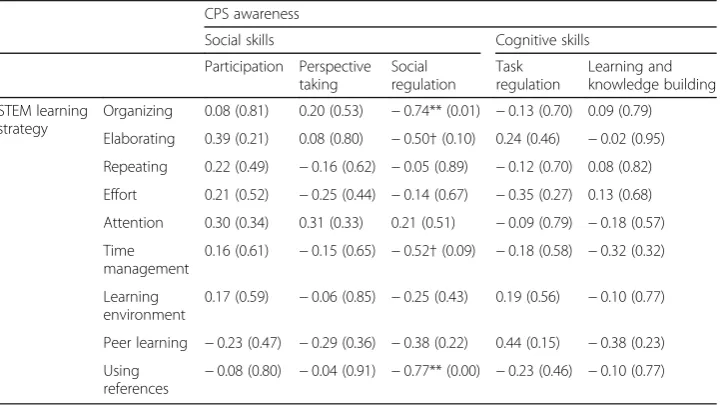
From the results in Table 6, we can see that there were strong negative correlations of
Social Regulation in CPS awareness with Organizing (ρ =−0.74, p < 0.01) and Using
References (ρ= −0.77, p< 0.01) in SLS, and moderate negative correlations of Social
Table 5Wilcoxon signed-rank test results for the CPS pre-postquestionnaires
Dimension Factor Mean (SD) Median |Z| P
value
Pre Post Pre Post
Social skills Participation 12.17 (2.08) 11.92 (1.88) 12.00 11.50 0.50 0.62
Perspective Taking 13.25 (2.18) 13.67 (1.37) 13.50 14.00 0.96 0.34
Social Regulation 12.17 (2.44) 11.58 (2.19) 12.00 12.00 0.47 0.64
Cognitive skills Task Regulation 14.50 (3.40) 15.08 (3.09) 13.50 14.00 0.82 0.41
Learning and Knowledge Building 14.25 (2.70) 13.75 (2.18) 14.00 13.00 0.99 0.32
N= 12
Table 6Spearman’s rank correlation coefficients between CPS awareness and STEM learning strategy
CPS awareness
Social skills Cognitive skills
Participation Perspective taking
Social regulation
Task regulation
Learning and knowledge building
STEM learning strategy
Organizing 0.08 (0.81) 0.20 (0.53) −0.74** (0.01) −0.13 (0.70) 0.09 (0.79)
Elaborating 0.39 (0.21) 0.08 (0.80) −0.50†(0.10) 0.24 (0.46) −0.02 (0.95)
Repeating 0.22 (0.49) −0.16 (0.62) −0.05 (0.89) −0.12 (0.70) 0.08 (0.82)
Effort 0.21 (0.52) −0.25 (0.44) −0.14 (0.67) −0.35 (0.27) 0.13 (0.68)
Attention 0.30 (0.34) 0.31 (0.33) 0.21 (0.51) −0.09 (0.79) −0.18 (0.57)
Time management
0.16 (0.61) −0.15 (0.65) −0.52†(0.09) −0.18 (0.58) −0.32 (0.32)
Learning environment
0.17 (0.59) −0.06 (0.85) −0.25 (0.43) 0.19 (0.56) −0.10 (0.77)
Peer learning −0.23 (0.47) −0.29 (0.36) −0.38 (0.22) 0.44 (0.15) −0.38 (0.23)
Using
references −
0.08 (0.80) −0.04 (0.91) −0.77** (0.00) −0.23 (0.46) −0.10 (0.77)
ρ(Sig.);N= 12;**
RegulationwithElaborating(ρ=−0.50,p< 0.1) andTime Management(ρ=−0.52, p
< 0.1) in SLS.
Since the Social Regulation factor refers to strategies recognizing the diversity of group members and negotiating with them, the point of this factor is communication with others. When conducting STEM education, it is necessary for STEM educators to provide students with multidisciplinary, multi-perspective viewpoints and a collabora-tive approach that links them with a broader community (Kelley & Knowles,2016; Ken-nedy & Odell, 2014). However, the SLS in this study focused on individual learning (except in the case of Peer Learning) and found that individual SLS negatively affected communication during group work. Furthermore, we did not provide training or guid-ance on how to learn integrated STEM subjects, so future research should consider how to guide students to master STEM learning well and integrate individual learning strategies, especially these four factors, efficiently into collaboration.
Correlations between changes in CPS awareness and learning behaviors
Next, we assess the correlations between CPS awareness and learning behaviors con-cerning how students read digital STEM learning materials. The results are presented in Table7.
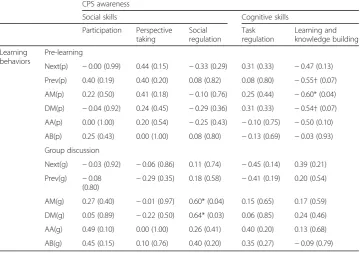
During pre-learning, moderate negative correlations were found for Learning and
Knowledge Building in CPS awareness withPrev(ρ=−0.55,p< 0.1),Add Marker(ρ=
−0.60,p< 0.05), andDelete Marker(ρ=−0.54,p< 0.1) of learning behaviors.
In an earlier study, we concluded that students’ behaviors of frequently changing pages or turning to the previous page imply a lack of familiarity with the learning con-tents and cause them difficulties in constructing knowledge. They added markers to
Table 7Spearman’s rank correlation coefficients between CPS awareness and learning behaviors
CPS awareness
Social skills Cognitive skills
Participation Perspective taking
Social regulation
Task regulation
Learning and knowledge building
Learning behaviors
Pre-learning
Next(p) −0.00 (0.99) 0.44 (0.15) −0.33 (0.29) 0.31 (0.33) −0.47 (0.13)
Prev(p) 0.40 (0.19) 0.40 (0.20) 0.08 (0.82) 0.08 (0.80) −0.55†(0.07)
AM(p) 0.22 (0.50) 0.41 (0.18) −0.10 (0.76) 0.25 (0.44) −0.60* (0.04)
DM(p) −0.04 (0.92) 0.24 (0.45) −0.29 (0.36) 0.31 (0.33) −0.54†(0.07)
AA(p) 0.00 (1.00) 0.20 (0.54) −0.25 (0.43) −0.10 (0.75) −0.50 (0.10)
AB(p) 0.25 (0.43) 0.00 (1.00) 0.08 (0.80) −0.13 (0.69) −0.03 (0.93)
Group discussion
Next(g) −0.03 (0.92) −0.06 (0.86) 0.11 (0.74) −0.45 (0.14) 0.39 (0.21)
Prev(g) −0.08
(0.80) −
0.29 (0.35) 0.18 (0.58) −0.41 (0.19) 0.20 (0.54)
AM(g) 0.27 (0.40) −0.01 (0.97) 0.60* (0.04) 0.15 (0.65) 0.17 (0.59)
DM(g) 0.05 (0.89) −0.22 (0.50) 0.64* (0.03) 0.06 (0.85) 0.24 (0.46)
AA(g) 0.49 (0.10) 0.00 (1.00) 0.26 (0.41) 0.40 (0.20) 0.13 (0.68)
AB(g) 0.45 (0.15) 0.10 (0.76) 0.40 (0.20) 0.35 (0.27) −0.09 (0.79)
ρ(Sig.);N= 12;*
what they thought was important or thought they understood and deleted markers when they changed ideas, from which it could also be inferred that they understood the contents poorly and thus changed their minds easily. However, the Add Marker logs we collected included both yellow (not understand) and red (important) highlights, meaning that we could not identify which part of their behaviors actually negatively af-fected their knowledge building.
In group discussions in STEM lessons, there were moderate positive correlations found between Social Regulation in CPS awareness and Add Marker (ρ = 0.60, p < 0.05) andDelete Marker(ρ= 0.64,p< 0.05) of learning behaviors.
During group discussion, we observed that when students discussed the problems as well as the contents they did not understand, they deleted the old markers when they accepted others’ opinions while adding new markers. Therefore, the behaviors of add-ing and deletadd-ing markers indicate they paid attention to communication and negoti-ation in group work, showing that the effective utiliznegoti-ation of the marker tool could facilitate the social regulation in STEM lessons. And students’behaviors of social regu-lation during discussion would be examined by dialogue analysis.
Research question 3: What are the relationships between STEM learning strategy and learning behaviors in STEM learning?
In this study, we used questionnaires to investigate how students used SLS but did not provide instruction or guidance in how to use STEM learning strategies efficiently. Therefore, we assessed the correlations between SLS and learning behaviors of reading scientific materials to find out how their learning strategy affected their actual learning behaviors, which could help our future instructional design in ways of using SLS.
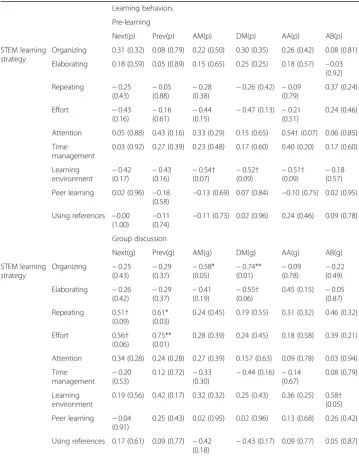
According to the results in Table 8, in students’ pre-learning, a moderate positive correlation was found betweenAttentionof SLS andAdd Annotationlearning behavior (ρ= 0.54, p< 0.1), while there were moderate negative correlations between Learning Environment of SLS andAdd Marker(ρ=−0.54,p< 0.1),Delete Marker(ρ=−0.52,p
< 0.1), andAdd Annotation(ρ=−0.51,p< 0.1).
Since students were required to take notes about the problems provided when they read the materials, it is understandable that annotation would help them to concentrate on the contents related to problems and solutions in STEM learning.
However, it would hurt their learning performance if students only took dictation word by word rather than taking notes with conceptual understanding and thinking (Mueller & Oppenheimer,2014).No guidance in using functional toolsseems to be one reason for the negative correlations between the use of the marker and annotation tools with students’ expected learning environment, where it is easy to concentrate and find references.
As for the group work, moderate positive correlations were shown between
Re-peating of STEM learning strategy and Next Page (ρ = 0.51, p < 0.1) and Previous
Page (ρ = 0.61, p < 0.05) of learning behaviors, of Effort strategy with Next Page
behavior (ρ = 0.56, p < 0.1), and of Learning Environment strategy with Add Book-mark (ρ = 0.58, p < 0.1), and a strong positive correlation between Effort and
Pre-vious Page (ρ= 0.75, p < 0.01).
On the other hand, there were moderate negative correlations found for Organizing
strategy with Add Marker behavior (ρ=−0.58, p< 0.05) and for Elaborating strategy
withDelete Markerbehavior (ρ=−0.55,p< 0.1), and a strong negative correlation
Besides guidance on how to use the functional tools of the BookRoll system, some learning strategies such as organizing/summarizing, elaborating/application, and repeat-ing should also be taught with efficient design under certain learnrepeat-ing conditions (Dun-losky et al.,2013).
Dialogue analysis
The Spearman’s rank correlation coefficient revealed significant positive correlations between the utilization of marker tool with changes in learning performance (RQ1) and CPS social regulation awareness (RQ2) both during the group discussion. In order to Table 8Spearman’s rank correlation coefficients between STEM learning strategy and learning behaviors
Learning behaviors
Pre-learning
Next(p) Prev(p) AM(p) DM(p) AA(p) AB(p)
STEM learning strategy
Organizing 0.31 (0.32) 0.08 (0.79) 0.22 (0.50) 0.30 (0.35) 0.26 (0.42) 0.08 (0.81)
Elaborating 0.18 (0.59) 0.05 (0.89) 0.15 (0.65) 0.25 (0.25) 0.18 (0.57) −0.03 (0.92)
Repeating −0.25
(0.43) −
0.05
(0.88) −
0.28
(0.38) −
0.26 (0.42) −0.09 (0.79)
0.37 (0.24)
Effort −0.43
(0.16) −
0.16
(0.61) −
0.44
(0.15) −
0.47 (0.13) −0.21 (0.51)
0.24 (0.46)
Attention 0.05 (0.88) 0.43 (0.16) 0.33 (0.29) 0.15 (0.65) 0.54†(0.07) 0.06 (0.85)
Time management
0.03 (0.92) 0.27 (0.39) 0.23 (0.48) 0.17 (0.60) 0.40 (0.20) 0.17 (0.60)
Learning environment − 0.42 (0.17) − 0.43 (0.16) − 0.54† (0.07) − 0.52† (0.09) − 0.51† (0.09) − 0.18 (0.57)
Peer learning 0.02 (0.96) −0.18
(0.58) −
0.13 (0.69) 0.07 (0.84) −0.10 (0.75) 0.02 (0.95)
Using references −0.00
(1.00) −
0.11
(0.74) −
0.11 (0.73) 0.02 (0.96) 0.24 (0.46) 0.09 (0.78)
Group discussion
Next(g) Prev(g) AM(g) DM(g) AA(g) AB(g)
STEM learning strategy
Organizing −0.25
(0.43) − 0.29 (0.37) − 0.58* (0.05) − 0.74** (0.01) − 0.09 (0.78) − 0.22 (0.49)
Elaborating −0.26
(0.42) − 0.29 (0.37) − 0.41 (0.19) − 0.55† (0.06)
0.45 (0.15) −0.05 (0.87)
Repeating 0.51† (0.09)
0.61* (0.03)
0.24 (0.45) 0.19 (0.55) 0.31 (0.32) 0.46 (0.32)
Effort 0.56†
(0.06)
0.75** (0.01)
0.28 (0.39) 0.24 (0.45) 0.18 (0.58) 0.39 (0.21)
Attention 0.34 (0.28) 0.24 (0.28) 0.27 (0.39) 0.157 (0.63) 0.09 (0.78) 0.03 (0.94)
Time
management −
0.20 (0.53)
0.12 (0.72) −0.33
(0.30) −
0.44 (0.16) −0.14 (0.67)
0.08 (0.79)
Learning environment
0.19 (0.56) 0.42 (0.17) 0.32 (0.32) 0.25 (0.43) 0.36 (0.25) 0.58† (0.05)
Peer learning −0.04 (0.91)
0.25 (0.43) 0.02 (0.95) 0.02 (0.96) 0.13 (0.68) 0.26 (0.42)
Using references 0.17 (0.61) 0.09 (0.77) −0.42
(0.18) −
0.43 (0.17) 0.09 (0.77) 0.05 (0.87)
investigate whether students had the behaviors of perspective taking and social regula-tion, dialogue analysis was conducted to understand how students displayed these skills.
We collected the dialogue data of all groups during the discussion and categorized dialogue thread in relation to perspective taking and social regulation factors with reference to the Hesse et al. (2015).
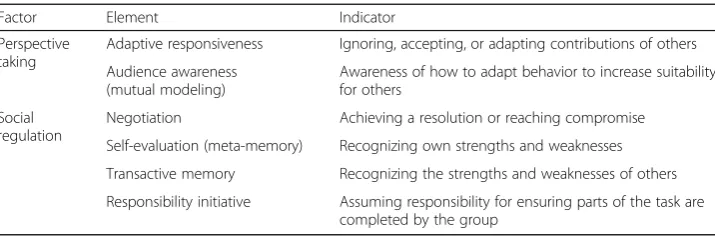
According to the CPS framework proposed by Hesse et al. (2015), there are two elements adaptive responsiveness and audience awareness (mutual modeling), in per-spective taking factor, and four elements in social regulation factor, which are negoti-ation, self-evaluation (meta-memory), transactive memory, and responsibility initiative. The elements and the indicators of perspective taking and social regulation were listed in Table9.
Perspective taking—adaptive responsiveness Example 1
95. Student 9 (S9): The change of the temperature has increased. 96. S7: You mean the temperature has increased?
97. S9: Because there is difference in the temperature (between two place). 98. S7: Yeah, yeah, yeah,I got it.
99. S9: In the lake.
100. S7: So difficult to accumulate (CO2)?
101. S9: Because water constantly circulates through. 102. S7: Yes, yes, yes.
(…)
118. S10: So back to the question, what about in Japan?
119. S9:See the beginning this chapter(of the learning materials on BookRoll system), there is huge feature in Cameroon, that is landslide. Especially in summer, it rains almost every day.
120. S10: Yeah, yeah, yeah.
121. S9: Landslides occur easily (in Cameroon), but landslides don’t occur often in Japan.
122. S10:Yes, that’s true.
Table 9Elements and indicators in perspective taking and social regulation
Factor Element Indicator
Perspective taking
Adaptive responsiveness Ignoring, accepting, or adapting contributions of others
Audience awareness (mutual modeling)
Awareness of how to adapt behavior to increase suitability for others
Social regulation
Negotiation Achieving a resolution or reaching compromise
Self-evaluation (meta-memory) Recognizing own strengths and weaknesses
Transactive memory Recognizing the strengths and weaknesses of others
Adaptive responsiveness includes the indicator “ignoring, accepting, or adapting con-tributions of others.” As shown in example 1, in Line 98, S7 used “I got it” to express his agreement with S9’s explanations, which means he has accepted other’s view-points, and reconsidered the problems (in Line 100). Similarly, in Line 122, S10 used “Yes, that’s true” to show his agreement with S9’s viewpoint. Since S9 pro-vided his explanations based on the learning materials on BookRoll system (in Line 119), it could be inferred that the S9 did have the behaviors of Adaptive
respon-siveness during the utilization of BookRoll system, which is consistent with the
findings of relationships between marker tool utilization with changes in learning performance (in RQ1).
Perspective taking—audience awareness (mutual modeling) Example 2
63. S4: Is Japan different from Cameroon? 64. S5: Of course different, like precipitation. 65. S6: Completely different.
66. S5: (3s)Look at this(the learning materials on BookRoll system), this is different from this, but in summer, precipitation is not that different.
67. S4: Yeah, I see.
68. S6: Because the Japan’s temperature is similar with Cameroon? Like June 69. S4: That’s true.
(…)
76. S6: As for Cameroon, where is its location? Around the sea?
77. S5: No, it isn’t. (15s) (Searching the information on the Internet).Here. 78. S4: Yeah, that’the point. The locations are different.
79. S5: And there is information of Cameroons’temperature here. 80. S4: Is Cameroon above the equator?
81. S6:About the location,(8s)look at the first page(of the learning materials). 82. S7: (20s) Yeah, I see. I think we should work on the problem now.
According to CPS framework, the indicator of Audience awareness (mutual
mod-eling) is “awareness of how to adapt behavior to increase suitability for others.” In
Example 2, when others had difficulties in understanding certain contents, some students chose to utilize the additional reference or information to explain the contents.
For example, in line 64 and 65, S5 and S6 answered S4’s question, but did not re-ceived any feedback, which means S4 did not accepted their answers well. So S5 waited for 3 s and chose to use learning materials to explain the question (in Line 66). And he also searched for additional information for S6’ question (in Line 77). It is indicated that he had adapted own behavior based on the feedback and understanding of recipient.
Social regulation—negotiation Example 3
25. S2: Usually, the water in that lake,doesn’t circulate. 26. S1:I think it does.
27. S2:No,it doesn’t. 28. S1:Why?
29. S2: The precipitation is high.
30. S1:That’s why I think it circulates. Because even the precipitation is low, the water would circulates in the lake.I understand what you are taking about, but it is strange that the water doesn’t circulate, even the precipitation is high.
The Example 3 showed a whole negotiation part during the group discussion around
“whether water circulates in the lake”issue.Negotiationwas conducted here in order to
“reaching compromise.”In Line 25~27, S1 and S2 expressed their opinions respectively. After that, S2 asked the reasons (in Line 28), and made comments on the difference be-tween their viewpoints, and proposed reasons to persuade S2 to achieve the agreement (in Line 30).
Although students’ behaviors of negotiation were found during CPS learning, it was not clarified whether their negotiation behaviors had relationship with the utilization of BookRoll tools.
Social regulation—self-evaluation (meta-memory) Example 4
10. S1: (Searching the information on the Internet) What about Cameroon…There is only English version, I am over.
(…)
17. S1: It is too terrible. 18: S3: About what? 19. S1: My English.
The Self-evalutionbehavior had not been executed often, and was be found in only
one group about the evalution on his English ability.
Social regulation—transactive memory
There was noTransactive memorybehavior found in all groups.
Social regulation—responsibility initiative Example 5
10. S1: (Searching the information on the Internet) What about Cameroon…(10s) There is only English version, I am over.
13. S1: (11s)It has be written here. (…)
46. S2:What about searching on the Internet? 47. S3: Good idea.
48. S1:Let’s search for the history of Cameroon on Wikipedia.
The indicator of Responsibility initiative is “assuming responsibility for ensuring parts of the task are completed by the group,” such as conducting activities and reporting to others, assuming group responsibility as one’s own responsibility. In Line 11 and 13, S1 had investigated certain information and reported it to other members. And in Line 46 and 48, S2 had proposed the activities which should be conducted by group members, S1 accepted that responsibility and taken it as his own responsibility. Moreover, the Responsibility initiative behavior was found dur-ing the utilization of BookRoll system (in Line 11), which was consistent with the results of RQ2 (relationship was found between marker tool utilization and CPS social regulation).
Conclusion
The purpose of this study was to investigate the effect of several variables, in-cluding students’ learning strategy for STEM and learning behaviors when reading scientific materials online, on their learning performance, and cultivation of CPS skills.
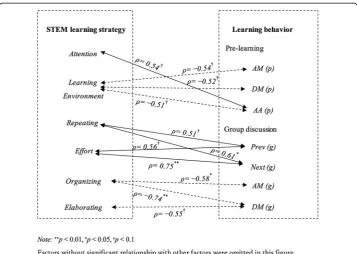
The results of this study showed that different SLS and learning behavior vari-ables would affect students’ learning performance and CPS awareness in different ways. We summarized the relationships between factors of this study with two figures.
As shown in Fig. 3, concerning changes in learning performance, the results implied that the frequency ofAdd and Delete Markerbehaviors in group discussion would have positive influence on students’learning scores. Since we only analyzed the correlations between certain variables, it can also be inferred that students whose learning perform-ance improved more showed a tendency to use marker tools more frequently. Both explanations indicate that marker tools can be used effectively in STEM learning per-formance improvement.
As for the CPS awareness, some factors of SLS, including Organizing,
Elaborat-ing, Time Management, and Using References, showed negative correlations with
Social Regulation of CPS social skills. Moreover, negative correlations were also
found between Learning and Knowledge Building of CPS cognitive skills and Add
and Delete Marker and Previous Page behaviors in students’ plearning. These
re-sults imply a deficiency in and necessity for guiding students in how to use STEM learning strategies or functional tools efficiently and integrate them into collabora-tive activities. The posicollabora-tive correlations found for Add and Delete Marker in group discussions with Social Regulation of CPS social skills also indicate the effectiveness of marker tools.
strategy andAdd Annotationbehaviors, and negative correlations betweenLearning
Envir-onmentstrategy and theAdd and Delete MarkerandAdd Annotationbehaviors.
In group discussion, there were positive correlations between Repeating and Effort
strategies and Next and Previous Page behaviors, respectively, while negative correla-tions were found for Organizing strategy with Add and Delete Marker behaviors and
for Elaborating strategy withDelete Marker behaviors. These results suggest the value
of teaching these SLSs using functional tools.
Based on the results above, we would give some suggestions for CPS STEM learning linked to the research questions. From the results of RQ1, when participating in collab-orative activities in STEM learning, marker tool is considered to be effective in STEM learning performance improvement, because of its advantages such as helping students focus on the discussion topic and integrating contributions from others into their own thoughts.
From the results of RQ2, certain factors in STEM learning strategy should be exe-cuted by individual, such as organizing, elaborating, time management, and using refer-ence. Besides, it is also suggested that marker tool is useful in students’ group work including communication and negotiation.
From the results of RQ3, although mark tool is shown to be useful in collabora-tive activities, it does not help students in knowledge building and knowledge or-ganizing and elaborating without detailed guidance about how to utilize such tool.
Limitations and future work
The first limitation of our study is the small number of participants; as mentioned above, only 12 senior high school students participated in the STEM lesson, which makes our study results hard to generalize. Thus, this study aims at providing the direc-tion to take the behavioral and strategical factors into consideradirec-tion in CPS-based STEM learning. In our future work, we should increase the sample size to gain a more generalizable conclusion, and provide the specific model for CPS-based STEM learning. Furthermore, it is also considered to use other statistical approach such as SEM or path analysis, to further explore cause-effect relationships between learning performance and CPS awareness with learning behaviors and learning strategies in STEM education.
Second, we have conducted two previous studies on instructional design for improv-ing CPS skills followimprov-ing CPS process; two previous studies both indicated that some of the factors in CPS awareness, however, not all experiments showed the same results in the improvement. As for the present study, although we designed this STEM lesson fol-lowing the same CPS process, the CPS process was not supported with technology as in our prior studies, which led to our finding no statistically significant differences in the improvements in all factors of CPS awareness. Therefore, considerations should be paid to the issue of how to support students’CPS learning, such as expand the sample size to gain more representative results and improve the future study, or supporting CPS process with some the help of technology.
Finally, as many results in the present study indicate, it is important to provide stu-dents with training or guidance in applying STEM learning strategies and functional tools, especially marker and annotation tools, which should also be taken into consider-ation in our future research.
Appendix 1
Instructional design of theLimnic EruptionSTEM lesson The description of the case
There is a crater lake named Lake Nyos in Cameroon. In 1986, massive amounts of dissolved CO2suddenly erupted from the bottom of the lake, causing a limnic eruption. The eruption led to the death by asphyxiation of around 1,700 people in a nearby vil-lage. There is still concern about such gas hazards recurring.
The purpose of the lesson
Investigating the mechanism (reason) of the limnic eruption and designing a manual of disaster mitigation, including knowledge of natural disasters, the relationship between the environment and human beings, and what to do when faced with such natural disasters.
Four STEM domains in this lesson
Science (S): Students need to understand CO2-related scientific knowledge, including the nature and generation process of CO2and the solubility of CO2, and use scientific knowledge and skills to solve the applied problems.
Engineering (E): Students are asked to design a manual of disaster mitigation in order to integrate their multidisciplinary knowledge and skills to problem-solving and improve their understanding of scientific and mathematical knowledge by practicing their application.
Mathematics (M): Students are required to use their mathematical knowledge and skills to perform the respective calculations in CO2-solubility-related problems and make a judgment as to whether the information provided by the Internet is correct.
Technology (T): Students are asked to use a M2B (Moodle, Mahara, and Bookroll) system to support individual pre-learning and group discussion and the Internet for formation retrieval. The use of technology and decision-making regarding Internet in-formation is expected to improve students’technological literacy.
Appendix 2
Table 10Items of the Collaborative Problem Solving (CPS) Questionnaire
Factor Item
Participation Q1: I was actively participating in the science lesson.
Q2: I was listening carefully when other students were speaking or making presentations.
Q3: I asked others for help when I met difficulty.
Perspective taking Q4: Collaborating with others is more effective in finding solutions than working by oneself.
Q5: It is important to receive help from others in problem solving. Q6: When facing unfamiliar problems, it is helpful to solve the problems by collaborating with others.
Social regulation Q7: During the science lesson, I can recognize my advantages and disadvantages in learning.
Q8: If my classmates have any problems, I have the duty to help them. Q9: It is necessary to negotiate with other members to reach an agreement on a problem solution.
Task regulation Q10: I knew the objectives of the lesson clearly.
Q11: It is important to analyze problems before solving them. Q12: I will investigate the information in order to solve the problems. Q13: It is not necessary to find multiple solutions for one problem.
Learning and knowledge building
Q14: In science lessons, it is often necessary to use knowledge from other subjects. Q15: If I am provided enough information, I can acquire new knowledge by myself. Q16: I can organize what I have learned after the lesson.
Abbreviation
CPS:Collaborative problem solving; LA: Learning analytics; LMS: Learning management system; SLS: STEM learning strategy; STEM: Science, technology, engineering, mathematics
Acknowledgments
This study is funded by Japan Society for the Promotion of Science(JSPS) (Grant Number: JP16H06304, JP16H03080, JP19H01716), and Cross-Ministerial Strategic Innovation Promotion Program from Cabinet Office.
Authors’contributions
LC and MY designed this research overall. LC and YG designed this instruction. YG contributed to modify the instructional design. NY is science teacher of the high school. He conducted the class. YG was engaged in considering the evaluation method of this study. FO, YT, AS, SK, HO developed and deployed the learning analytics platform. MO, YG, and MY advised the improvement of the instructional design from the viewpoint of cognitive science. MY supervised this research. All authors read and approved the final manuscript
Funding
This study is funded by Japan Society for the Promotion of Science(JSPS) (Grant Number: JP16H06304, JP16H03080, JP19H01716), and Cross-Ministerial Strategic Innovation Promotion Program from Cabinet Office.
Availability of data and materials
All data generated or analyzed during this study are included in this published article.
Competing interests
Drs. Ogata and Yamada received research grants from JSPS for this research project. Drs. Goda, Okubo, Taniguchi, Oi, Konomi, Shimada, and Yamada received research grants from JSPS for other research project. Drs. Ogata and Shimada received research grants from Cross-Ministerial Strategic Innovation Promotion Program from Cabinet Office. Ms. Li Chen and Mr. Yoshimatsu do not have any conflict on this research.
Author details
1
Gradute School of Human-Environment Studies, Kyushu University, 744 Motooka, Nishiku, Fukuoka 819-0395, Japan.
2Tomeikan Senior High School, Saga, Japan.3Research Center for Instructional Systems, Kumamoto University, Appendix 3
Table 11Items of the STEM Learning Strategy (SLS) Questionnaire
Factor Item
Organizing Q1: I compile short summaries of the most important contents as a mnemonic aid. Q2: I go over my notes and structure the most important points.
Q3: I compile a summary of the main ideas out of my notes, the script, or other sources.
Elaborating Q4: I think of practical applications of new concepts learned from science lessons. Q5: I try to relate new knowledge or theories to knowledge or theories I already know. Q6: I think of practical examples for certain curricular facts.
Repeating Q7: I imprint the subject matter from the lecture on my memory by repeating it. Q8: I read my notes several times in a row.
Q9: I commit rules, technical terms, or formulas to memory.
Effort Q10: Whenever I have planned a certain workload, I make an effort to master it. Q11: I make an effort even though the subject matter may not suit me well. Q12: I do not give up even though the problem is very difficult and complex.
Attention Q13: When learning science, I am lacking in concentration. Q14: I am easy to distract when learning science. Q15: My concentration does not last very long.
Time management Q16: I work on pre-learning according to a schedule. Q17: I fix the hours I spend on pre-learning in a schedule. Q18: We work on group work according to a schedule.
Learning environment
Q19: I want to learn science in a place that makes it easy to concentrate. Q20: I want to learn science in a place that makes it easy to find everything. Q21: When I learn science, I have the most important papers within reach.
Peer learning Q22: I work on tasks together with my peer students.
Q23: I take time to discuss the subject matter with other students. Q24: When I am not sure about something I ask a fellow student for advice.
Using references Q25: I search for explanatory material if certain facts are not completely clear.
Q26: I look for missing information from different sources, e.g., the Internet, textbooks, or journals.