94 International Journal of Recent Research and Applied Studies, Volume 1,Issue 3(24) August 2014
Correlations of Biomechanical Characteristics with Ball Speed in Penalty Corner Push-In
Effect of Aerobic and Aerobic Cross Training Programs on Pulmonary Function
Dr.P.Kulothungan
Assistant Professor, Department of Physical Education and Sports& Sciences, Annamalai University, Chidambaram, Tamil Nadu, India.
Received 6th August 2014, Accepted 30th August 2014
Abstract
The purpose of the study was to find out the effect of aerobic and aerobic cross training on pulmonary function. For this purpose of the study forty five subjects studying various course of bachelor degree at Vivekananda Arts and Science College, Villupuram, Tamil Nadu, India were selected at random as subjects in the age group of 19 – 24 years. They were divided into three equal groups, each group consisted of fifteen subjects, in this study consisted of two experimental variables aerobic training and aerobic cross training. The allotment of groups was done at random, thus Group-I aerobic training, Group-II aerobic cross training for three days per week for twelve weeks, Group-III acted as control. All the subjects were tested prior to and after the experimentation period. The collected data were statistically treated by using ANCOVA, and 0.05 level was fixed as a test the significance. When the obtained ‘F’ ratio was significant, Scheffe’s post hoc test was used to find out the significant paired mean differences. The results of the study revealed that there was a significant difference among aerobic training and aerobic cross training groups as compared to control group on forced vital capacity and forced expiratory volume one second. And also it was found that there was a significant improvement on forced vital capacity and forced expiratory volume one second due to aerobic training group as compared aerobic cross training group.
Keywords: Aerobic training, Aerobic cross training, Forced vital capacity, Forced expiratory volume one second and Spirometry.
© Copy Right, IJRRAS, 2014. All Rights Reserved.
Introduction
Sports training are a major part of the sports preparation process as it is a physical and educational process based on exercises to improve the physical preparation components necessary for achieving the highest possible level in sports, through various methods of training and various means of load formation and rest intervals. It concentrates on specific physical and psychological aspects in each sport (Szczepanowska et al., 1998). Training interruption has passive effects over training, especially in competitive sports that depend on muscular strength, flexibility, reaction speed, agility and power. Athletes in such sports may lose, in a very short period of time, a high percentage of their physical and technical adaptations that were built with regular training for prolonged periods of time (Rushall & Pyke , 1991).
Among the various methods of sports training, cross-training is relatively new. Some advocates of this type of training argued that it is the ideal and most plausible solution according to its inclusiveness and variance. Other thinks that it contradicts with the training specialty principle. But most authors agreed that it can be
Correspondence
Dr.P.Kulothungan,
E-mail:[email protected], Ph. +9198654 29632
used during the preparation and competition (transitive) phases to break the stillness of specific training programs as this type of training depends on various integrative activities that enables more mental relaxation. Cross- training is a type of training that includes various sports activities that can be planned to improve the physical level and other physiological variables through variety and decreasing injury risks in addition to excitement (Jermyn, 2001). It is a prolonged type of training that includes various sports activities that aim at increasing variation and decreasing injury risks while improving physical fitness components. This is done through using another sport, activity or training technique other than the main sport of the athlete to help him/her improving the main sport (Hassan, 2004). Sports activities vary in energy demands and the speed of using such energy like long-distance running and long-distance swimming that depend on aerobic power system. On the other hand, there are activities that depend on huge amounts of energy in very short durations that is they depend on anaerobic power system (Moran & McGlynn, 1997).
The pulmonary system or the respiratory system in healthy humans includes the airways, two lungs, and the respiratory muscles, such as the diaphragm, which together with the ribs attaches the lungs. The internal intercostals muscles and the external intercostals muscles also contribute during inspiration and expiration together
International
95 International Journal of Recent Research and Applied Studies, Volume 1,Issue 3(24) August 2014
with the diaphragm. The diaphragm is a large dome-shaped muscle and is the primary muscle involved in active inspiration (Guenette & Sheel, 2007). Spirometry is a helpful tool in clinical use, in detecting and follow up lung diseases in both healthy individuals and patients. It is used to determine how an individual inhales or exhales volumes of air as a function of time (Miller et al., 2005). The test measures first of all the rate at which the lung changes volume during forced breathing maneuvers. Different PF measures or lung capacities can then be measured during a spirometry maneuver, for instance forced vital capacity (FVC), which measures the total volume of air that can be exhaled during a maximal forced expiration effort. Forced expiratory volume in 1 s (FEV1) is the maximal volume of air exhaled during the first second of a forced expiration from a position of full inspiration, usually 75 % of FVC ≥80 % of predicted is accepted as the lower limit of normal values for FEV1 and FVC (Ruppel & Enright, 2012 ). Percentages of predicted (%) are reference values from large populations, based on the subjects‟ gender, age, height, and ethnic origin. The use of %of predicted values (% pred.) allows comparison with other studies, which may have a different balance of sex and age. The FEV1 ⁄FVC ratio expresses the percent of FVC that can be breathed out during the first second and is often reduced in asthmatic patients. The forced expiratory flow (FEF) in 25-75 % and 50 % of FVC (FEF25-75% and FEF50) is the average forced expiratory flow between 25% and 75% of the FVC, or percentage of FVC. It can be helpful in the diagnosis of an obstructive disease and can give information about airway resistance. A reduction of less than 60 percent of predicted values may confirm airway obstruction. Both FEF25-75 % and FEF50 is highly dependent on the validity of the FVC measurement and expiratory effort (Barreiro & Perillo, 2004).
Methodology
The purpose of the study was to analyze the effects of aerobic training and aerobic cross training on pulmonary function. To achieve the purpose of the study, forty five (N=45) male students studying various course of bachelor degree at Vivekananda Arts and Science College, Villupuram, Tamil Nadu, India were selected at random as subjects from a population of 200. The age of the subjects, ranged from 18 to 24 years. The selected subjects were medically and physically fit enough to undergo the aerobic training and aerobic cross training programme. The subjects were randomly divided into
three groups and each group comprised of fifteen (n=15) subjects. Group-I underwent aerobic training (running), group-II underwent aerobic cross training (swimming and cycling) and group–III acted as control. The group I underwent aerobic training programme and group II underwent aerobic cross training programme (swimming and cycling), for three days per week for twelve weeks, and Group III acted as control who did not participate any special training programmes. Forced vital capacity and forced expiratory volume one second was assessed in liters before and immediately after the training period, by digital spirometry.
Training Programme
The prescribed exercise program focused on one or more cardiovascular endurance activities. Traditionally, the activities prescribed most frequently for cross training have been walking, jogging, running, hiking, cycling and swimming. However in the present study only cycling and swimming were selected for cross training, aerobic training includes only running. The intensity of the exercise about how to appear is the most important factor. Evidence now suggests that a substantial training effect can be accomplished in by training at intensities of 45% or less of their aerobic capacities. For most, however, the appropriate intensity appears to be at a level of at least 60% of Vo2 max.
96 International Journal of Recent Research and Applied Studies, Volume 1,Issue 3(24) August 2014
Table I
Weeks
Aerobic Cross Training Aerobic Training
Cycling Swimming Running
Duration (minutes)
Distance
(mile) Set Rep
Distance (mts)
Recovery (sec)
Duration (minutes)
Distance (mts)
1-2 18.46 4 2 4 50 90 16 3200
3-4 19.66 4.5 2 5 50 90 20 4000
5-6 21.85 5 2 6 50 90 24 4800
7-8 24.03 5.5 2 7 50 90 28 5600
9-10 26.23 6 2 8 50 90 32 6400
11-12 28.40 6.5 2 9 50 90 36 7200
* Swimming set Recovery 5 min
** Work and recovery ratio was followed repetition METS
Cycling 4 mints 37 sec - 1 mile (1600 mts) Swimming 16.6 sec - 10 mts Running 8 mints - 1 mile (1600 mts)
Statistic Technique
All the subjects of three groups were tested on dependent variables at prior to and immediately after the training programme. The analysis of covariance (ANCOVA) was used to analyze the significant difference, if any among the groups. Since, three groups were compared, whenever the obtained „F‟ ratio for
adjusted post test was found to be significant, the Scheffe‟s test to find out the paired mean differences, if any. The .05 level of confidence was fixed as the level of significance to test the „F‟ ratio obtained by the analysis of covariance, which was considered as an appropriate and the results are presented below.
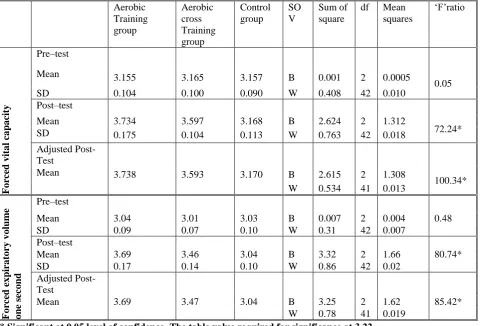
Table II. Analysis of covariance for pre and post test data on forced vital capacity and expiratory reserve volume one second of aerobic and aerobic cross training groups and control group
Aerobic Training group
Aerobic cross Training group
Control group
SO V
Sum of square
df Mean squares
„F‟ratio
F
o
rc
ed
v
it
a
l c
a
pa
cit
y
Pre–test
Mean 3.155 3.165 3.157 B 0.001 2 0.0005
0.05
SD 0.104 0.100 0.090 W 0.408 42 0.010
Post–test
Mean 3.734 3.597 3.168 B 2.624 2 1.312
72.24*
SD 0.175 0.104 0.113 W 0.763 42 0.018
Adjusted Post-Test
Mean 3.738 3.593 3.170 B 2.615 2 1.308
100.34* W 0.534 41 0.013
F
o
rc
ed
ex
pira
to
ry
v
o
lum
e
o
ne
sec
o
nd
Pre–test
Mean 3.04 3.01 3.03 B 0.007 2 0.004 0.48
SD 0.09 0.07 0.10 W 0.31 42 0.007
Post–test
Mean 3.69 3.46 3.04 B 3.32 2 1.66 80.74*
SD 0.17 0.14 0.10 W 0.86 42 0.02
Adjusted Post-Test
Mean 3.69 3.47 3.04 B 3.25 2 1.62 85.42*
W 0.78 41 0.019
97 International Journal of Recent Research and Applied Studies, Volume 1,Issue 3(24) August 2014
The adjusted post test mean values on vital capacity of aerobic cross training group, aerobic training group and control group were 3.738, 3.593 and 3.170 respectively. The obtained „F‟ ratio of 100.37 for adjusted post test scores was greater than the table value of 3.23 for df 2 and 41 required for significance at 0.05 level of confidence on vital capacity. The results of the study indicated that there was a significant difference between the adjusted post test means of aerobic training group, aerobic cross training group and control group on forced vital capacity.
The adjusted post test mean values on
expiratory reserve volume one second of aerobic cross training group, aerobic training group and control group were 3.69, 3.47 and 3.042 respectively. The obtained „F‟ ratio of 85.42 for adjusted post test scores was greater than the table value of 3.23 for df 2 and 41 required for significance at 0.05 level of confidence on expiratory reserve volume one second. The results of the study indicated that there was a significant difference between the adjusted post test means of aerobic training group, aerobic cross training group and control group on expiratory reserve volume one second.
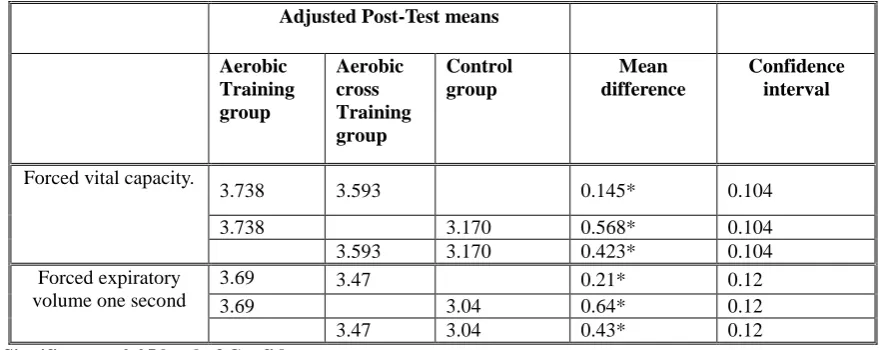
Table III. Scheffe‟s post hoc test for the adjusted post-test paired means difference on forced vital capacity and expiratory reserve volume one second
Adjusted Post-Test means
Aerobic Training group
Aerobic cross Training group
Control group
Mean difference
Confidence interval
Forced vital capacity.
3.738 3.593 0.145* 0.104
3.738 3.170 0.568* 0.104
3.593 3.170 0.423* 0.104 Forced expiratory
volume one second
3.69 3.47 0.21* 0.12
3.69 3.04 0.64* 0.12
3.47 3.04 0.43* 0.12
*Significant at 0.05 level of Confidence.
The table III shows that the adjusted post test paired mean differences on forced vital capacity and forced expiratory volume one second between aerobic training and aerobic cross training groups, aerobic training and control groups and aerobic cross training and control groups were 0.145, 0.568 and 0.423 for forced vital capacity and 0.21, 0.64 and 0.43for expiratory reserve volume one second respectively. Which are higher than the confidence interval of 0.104 required for significance at 0.05 level of confidence. It is inferred that the twelve weeks of aerobic cross training and aerobic training groups have significantly increased the forced vital capacity and forced expiratory volume one second between as compared to the control group. The result also reveals that the increase in forced vital capacity and forced expiratory volume one second between is significantly more for aerobic training group was higher than aerobic cross training group.
Discussion of study
The result of the present study showed significant increase in forced vital capacity and forced expiratory volume one second for both aerobic training and aerobic cross training as compared to control group. Whereas the increase was significantly higher for aerobic training as compared to cross training. Huang and
98 International Journal of Recent Research and Applied Studies, Volume 1,Issue 3(24) August 2014
from Pulmonary function test was conducted among healthy male (20-30 years) volunteers who were regular swimmers (n=51) and was compared with controls (n=51) who practiced athletic events but not swimming. Swimmers (23.52 ±1.87 years) were significantly younger than controls (24.39 ± 2.22 years) with 5.33±1.82 years of swimming practice. Swimmers exhibited increased VC, FVC, FEV1, PEFR, MEF25%, MEF50%, MEF25/75% than controls. Swimmers demonstrated a significant positive correlation between duration of swimming practice and airway caliber (FEV1, MEF25%, MEF50%, MEF25/75%), whereas, muscular efficiency (VC and PEFR) did not demonstrate any correlation. This demonstrates that, airway modulation takes place proportionately with duration of swimming practice. Contrary, muscle efficiency did not showed such behavior, thereby; a ceiling effect on skeletal muscle efficiency could be expected with prolonged duration of swimming practice (Deepali et al., 2014).
Conclusion
There was a significant increase in forced vital capacity and forced expiratory volume one second, for both aerobic training and aerobic cross training groups as compared to control group. There was a significant increase forced vital capacity and forced expiratory volume one second,for aerobic training group as compared to aerobic cross training group.
Reference
1. Armour J, Donnelly PM, Bye PT (1993). The large lungs of elite swimmers: an increased alveolar number? The European respiratory journal. 6(2):237-47.
2. Barreiro TJ, Perillo I.(2004). An approach to interpreting spirometry. American family physician.;69(5):1107-14.
3. Deepali A, Ravindra P.N, Shobha M.V, Pralay Mujumdar, Mandal M, (2014). Duration Of Swimming Practice Has Differential Effect On Airway Caliber And Muscular Efficiency. Int J Med Health Sci. 2014,Vol-3;Issue-2: 102-107.
4. Doherty M, Dimitriou L.(1997). Comparison of lung volume in Greek swimmers, land based athletes, and sedentary controls using algometric scaling. British journal of sports medicine.;31(4):337-41.
5. Farid R, Azad FJ, Atri AE, Rahimi MB, Khaledan A, Talaei-Khoei M, Ghafari J, Ghasemi R (2005). Effect of aerobic exercise training on pulmonary function and tolerance of activity in asthmatic patients. Iran J Allergy Asthma Immunol. 4(3):133-8.
6. Guenette JA, Sheel AW,(2007). Physiological consequences of a high work of breathing during heavy exercise in humans. Journal of science and
medicine in sport / Sports Medicine Australia. 10(6):341-50.
7. Hassan, Z.M., 2004. Cross-Training: A modern trend in sports training. The Egyptian Library, Alexandria, Egypt, pp: 13-113. (In Arabic).
8. Huang, G., and Osness, WH., (2005). “Changes in Pulmonary Function Response to a 10 Week Controlled Exercise Program in Sedentary Elderly Adults”, Percept Mot Skills, 100(2), 394–402. 9. Jack H. Wilmore and David L. Costill,(1994).
Physiology of sports and exercise, Human Kinetics, US,
10. Jermyn, K., (2001). Top 5 Reasons to Cross - train. www.trackcoach.com.
11. Kunzli N, Ackermann-Liebrich U, Keller R, Perruchoud AP, Schindler C, (1995). Variability of FVC and FEV1 due to technician, team, device and subject in an eight centre study: three quality control studies in SAPALDIA. Swiss Study on Air Pollution and Lung Disease in Adults. The European respiratory journal. 8(3):371-376.
12. Miller MR, Hankinson J, Brusasco V, Burgos F, Casaburi R, Coates A, (2005).Standardization of spirometry. The European respiratory journal. 26(2):319-38.
13. Moran, G.T. and G.H. McGlynn, (1997). Cross training for sports. Human Kinetics Books, San Francisco, 4: 10.
14. Ruppel GL, Enright PL(2012). Pulmonary function testing. Respiratory care. 57(1):165-75.
15. Rushall, B.S. and F.S. Pyke , (1991). Training for sports and fitness. Macmillan of Australia, Melbourne, Australia. pp: 80. Self-reported symptoms and exercise induced asthma in the elite athlete. Med Sci Sports Exerc, 33(2), 208−213. 16. Shaw, BS., and Shaw, I., (2011). “Pulmonary
function and abdominal and thoracic kinematic changes following aerobic and inspiratory resistive diaphragmatic breathing training in asthmatics”, Lung, Apr:189(2):131-9. Epub. Feb 12.
17. ShobhaRani Vedala NP, Abhay B Mane,(2013). Differences in Pulmonary Function Test among the Athletic and Sedentary Population. National Journal of Physiology, Pharmacy & Pharmacology. 3(2):118-23.
18. Szczepanowska, E., P. Unierzyski and T. Schefke, (1998). Training methods for improving tennis, ITF coaching review, 15:6.www.itf tennis.com.
Please cite this article as: Dr.P.Kulothungan. Effect of Aerobic and Aerobic Cross Training Programs on Pulmonary