teachers and university supervisors
Liliane Portelance
Josianne Caron
Stéphane Martineau
Université du Québec à Trois-Rivières Québec (Canada)
Abstract
Collaboration between student teacher trainers, the cooperating teacher, and the university supervisor, is directly connected with the sharing of respective knowledge (Gervais & Desrosiers, 2005). However, fruitful exchanges are not necessarily usual (Sanford & Hopper, 2000), which is considered the most detrimental factor in the student teacher training process (Kauffman, 1992). This paper presents some results of a study on the circulation of knowledge between the student trainers. Data was collected using audio recordings of conversations in the natural setting of secondary teacher internship. Identification and analysis of the predominant roles illustrated in their discourse reveal that interprofessional collaboration and collaborative dialog need specific competencies.
Keywords: student teacher trainers, interprofessional collaboration, collaborative dialog, collaborative dynamics
Liliane Portelance is a Full Professor with the Department of Educational Sciences at the Université du Québec à Trois-Rivières. Graduated in psychopedagogy at the University of Montreal, her research focuses on collaboration in education, in particular in the context of practical training for future teachers. Her research interests also include the training of teachers’ trainers. She is a researcher at the Centre de recherche interuniversitaire sur la formation et la profession enseignante (CRIFPE) and a member of the Laboratoire d’analyse du développement et de l’insertion
professionnels en éducation (LADIPE-UQTR). [email protected]
Josianne Caron is a Ph.D. student with the Department of Educational Sciences at the Université du Québec à Trois-Rivières and a student member of the Centre de recherche interuniversitaire sur la formation et la profession enseignante (CRIFPE). Her research focusses on practical training for future teachers, and in particular on the uses to be made of scientific knowledge by cooperating teachers. She has gained expertise in supporting a group of professionals in codevelopment. Her research interests also include the analysis of collaboration between the cooperating teacher and university supervisor.
Stéphane Martineau is Full Professor in the Educational Sciences Department of the Université du Québec à Trois-Rivières (UQTR), researcher at the Centre de recherche interuniversitaire sur la formation et la profession enseignante (CRIFPE) and member of the Laboratoire d’analyse du développement et de l’insertion professionnels en éducation (LADIPE-UQTR). His research interests include the analysis of teachers' work in sociological perspective, the foundations of education and qualitative methodologies.
In many countries, teacher training occurs alternately at the university and in the field. As with any alternating training, it requires a partnership between institutions. This partnership is the result of an agreement between institutions that share common goals and use their respective resources in a convergent manner (Landry, 1994). It also requires collaboration between the trainers; an authentic and interprofessional exchange of knowledge (Little, 1990). Compliance with these requirements is particularly essential for student teacher internships at the primary and secondary school levels. Indeed, these internships are the locus of interprofessional contact between school and university trainers. It is therefore not surprising that collaboration between cooperating teachers — who are the internship field trainers — and university supervisors has become a subject of interest for many researchers over the years (Rodgers, 2004; Sim, 2010; Van Zee, Lay & Roberts, 2003; Veal, 1998). For some, the expression of respective knowledge that fuels the discussion between the two trainers can be both challenging and rewarding for students (Gervais & Desrosiers, 2005). It is considered an integral part of student learning and a determining factor in the quality of training for future teachers. However, collaboration is not always demonstrated through the expression of respective knowledge (Sandford & Hopper, 2000).
In previous work, we analyzed the collaboration between cooperating teacher and student teacher in relation to knowledge sharing, educational consultation (Portelance & Caron, 2010), demonstrations of collaborative exchanges, and the nature of the exchanges (Portelance, 2011). In this paper, we will discuss collaboration between the two trainers with regard to the two-way flow of knowledge and relational dynamics. Does their discourse reflect sharing and co-elaboration, or even co-construction of knowledge? Results of research conducted in the natural setting of student teacher internships will be presented, preceded by a presentation of the research problematics, the concept of collaboration, and the methodology used. We will conclude with a discussion linking the results with the literature consulted.
The Importance of Collaboration for Student Teacher Trainers
The Quebec Government (Ministère de l’Éducation, 2001) prioritizes collaboration between the various stakeholders in education. In the context of teacher training, it cannot be developed without the involvement of university teaching staff and experienced practitioners. Regarding teacher training, collaboration between student teacher trainers is directly linked to the quality of training (Ediger, 2009; Pharand & Boudreault, 2011). The importance attached to collaboration affects the interprofessional relationship between the cooperating teacher and the university supervisor, who are called upon to share their knowledge through their discussions in a context that is sometimes unconducive to collaboration (Portelance, Martineau & Caron, 2013; Sim, 2010). In this paper, collaboration refers to a voluntary commitment, a shared approach toward a common goal, and an exchange of knowledge in a relationship of interdependence, trust, and authenticity (Cook & Friend, 1991; Dionne, 2005; Little, 1990).
Conversations between the cooperating teacher and the university supervisor do not necessarily give rise to debate. Moreover, if there is a debate and it is nourished by the cognitive conflicts normally associated with collaborative dialogue (Graham, 1999), we would detect a form of interdependence in knowledge sharing. In reality, the dynamics of knowledge sharing reflected in the verbal interactions of trainers depend on many aspects of their interprofessional collaboration. Our focus will be on relational aspects and, more specifically, on the roles of both partners as well as the dynamics of collaboration during discussions in the presence of the student teacher.
Harmonization of roles. Collaboration between the two student teacher trainers is based on their awareness of each other's roles, their knowledge of training contexts, and their acknowledgment of their partner's knowledge. The roles of the two student teacher trainers may depend on their status and the professional relationship they maintain. Although their roles are distinct, they are complementary in that the combination of their respective specific characteristics allows for consistency in student training. Inadequate representations of co-trainer roles can lead to divergent expectations of the student teacher. Such limitations can render the trainers’ respective interventions ineffective.
Researchers have already explored the relationships between cooperating teacher and supervisor (Borko & Mayfield, 1995; Campbell & Lott, 2010) and student teacher (Sudzina & Coolican, 1994), and how they affect student-teacher training (Johnson & Napper-Owen, 2011; Tung, 2000). Others have focused on the relationships between the triad composed of the student teacher and two trainers (Meegan, Dunning, Belton & Woods, 2013; Veal & Rickard, 1998) and their impacts (Kauffman, 1992). Some work focuses on the role of trainers and students teachers (Allen, Ambrosetti & Turner, 2013; Correa Molina, 2006; Campbell & Lott, 2010; Wong, 2011) and emphasizes the need for harmonization between the interventions of cooperating teachers and university supervisors (Couchara, 1997; Gervais & Desrosiers, 2005).
In a study on the collaborative dynamics within the dyad composed of cooperating teacher and student teacher (Portelance & Gervais, 2009), a categorization of roles emerged from an inductive approach of the data analysis. The new typology of roles was then used to analyze how cooperating teachers portray their role (Portelance, Gervais, Boisvert & David, 2012). This typology includes the following roles: informer, teacher, model, adviser, appraiser, and thought stimulator. Informers provide information about the class, the school, and the students. Teachers provide explanations. Advisers give their opinion, propose, and suggest. Models observe and then guide student teachers according to their way of doing things. Appraisers approve the ideas and actions of student teachers, reassure, make assessments, identify weaknesses, and evaluate. Thought stimulators encourage student teachers to think critically about their actions and to reflect based on solid arguments; they help student teachers formalize their action knowledge. According to the results obtained by Portelance, Gervais, Boisvert & David (2012), each role can be played in complementarity by the cooperating teacher and the university supervisor. The roles are emphasized by the expression of their respective knowledge.
Interprofessional Collaboration
Some researchers under various names and with various perspectives, have studied workplace collaboration. For example, Savoie-Zajc & Dionne (2001) focused on learning communities and equal partnerships, Gajda (2004) on educational consultation, Lessard (2005) on collective work, and Garcia & Marcel (2011) on work-sharing. In pre-service teacher training, discourse on collaboration is prominent. Indeed, collaboration has become inseparable from the professionalization of teaching, and collaborative practices are applied in all training environments. The following sections will examine the specifics of collaboration, the interdependence required for knowledge sharing, and the interprofessional relationships involved in the collaborative dialogue.
somewhat superficial informal social relations, whereas collaboration is more demanding (Savoie-Zajc & Dionne, 2001). Cooperating teachers and academic supervisors are clearly expected to surpass the stage of collegiality. Their responsibilities as student teacher trainers also require them to go beyond administrative coordination. Moreover, cooperation itself is less demanding; indeed, in a context of cooperation, the work is divided, and each person is responsible for part of the overall task (McEwan, 1997; Ofstedal & Dahlberg, 2009). Collaboration, however, requires more involvement. In collaborative work, each person carries out the tasks necessary to achieve objectives and is engaged in a collective effort and shared decision-making process to achieve a common goal (Cook & Friend, 1991). This is in line with what is legitimately expected of the two student teacher trainers. They must both be committed to assisting the student teacher in the development of his or her professional abilities and making joint decisions regarding the assessment of the student-teacher’s learning.
Interdependence and knowledge sharing. Collaboration is also characterized by interdependence, mainly through shared responsibility (Little, 1990), which causes the team to be more effective problem solvers. Included here are the student teacher’s issues with pedagogy, educational psychology, and ethics. Collaboration is also revealed in knowledge sharing, especially when collaboration occurs in a climate of trust and authenticity (Dionne, 2005). Collaboration between the cooperating teacher and supervisor is manifested during sharing, especially in conversations in the presence of the student teacher. It makes it possible to learn from others and can stimulate professional development (Borges & Lessard, 2007).
Portelance (2011), for whom knowledge is the fruit of dialogue and exchange, rightly points out that there can be no real collaboration without a true climate of dialogue between participants. Authentic and interprofessional exchanges of knowledge require the deconstruction and reconstruction of knowledge as well as participation in the co-construction of new knowledge. It cannot escape the questioning and confrontation of ideas through rational argument and pedagogical reasoning (Tardif & Gauthier, 1996), nor realignments and reframing (Martinand, 2002). These conditions inherent in knowledge sharing partially intersect with the ideas of Sim (2010), especially in his assertion that verbal interactions should stimulate reflection and critical thinking thus favoring the creation of learning tools and innovative projects.
Gilly, Fraisse & Roux (2001) studied verbal interactions and signs of collaborative dynamics. According to them, collaborative dialogue can be seen through acquiescent mode elaboration, co-construction, and confrontation. Acquiescent mode co-elaboration is when one partner develops an idea and proposes it to the other partner, who in turn accepts it. Acquiescence serves as a positive reinforcement of the idea. The individual may agree with the other person's idea but also build on and develop it. Co-construction takes place when both partners reinforce the other's idea, and interventions can bring the other to redirect their action or idea. Confrontation occurs when one partner doesn't agree with the other's proposition and results in an attempt to overcome the disagreement by defending his or her ideas. We thought we could find demonstrations of collaborative dialogue in the verbal interactions between both student teacher trainers. The dynamics of knowledge sharing can be seen in their verbal interactions within the framework of co-supervising the future teacher.
collaborative dialogue is materialized more readily in an egalitarian context, a professional relationship characterized by collaboration is also possible in an asymmetric professional relationship (Portelance, 2011).
Supervisors are sometimes viewed as all-powerful in comparison to cooperating teachers (Rodgers, 2004), and a hierarchical relationship may be the cause of tension between the two trainers (Veal & Rickard, 1998). Bullough & Draper (2004) revealed power relation struggles; Beck & Kosnick (2002) noted a large gap between the priorities of a university supervisor and cooperating teacher, which can be detrimental to the quality of their verbal exchanges. In the same vein, Van Zee,
Lay & Roberts (2003) found that the role of the cooperating teacher within the triad is secondary. Nevertheless, according to the findings of Campbell & Lott (2010), despite the constraints of an apparent lack of parity, it is possible to create within the triad an environment of collaboration that promotes professional development. Similar claims by Ofstedal & Dahlberg (2009) indicate that communication skills are a valuable resource. The majority of co-trainers prefer a relationship characterized by reciprocity because of its beneficial effects on student teacher training (Gervais, 2008). This form of collaboration, however, is more demanding for supervisors and cooperating teachers.
Methodological Elements
The aim of this study was to provide a comprehensive analysis of collaboration between cooperating teachers and supervisors. A qualitative interpretative strategy was used. The specific objectives were to examine the sense of competency of the two trainers regarding collaboration, and their adherence to current requirements for interprofessional collaboration; to identify the types of knowledge they share and co-construct; and to describe the dynamics of their collaboration. Through case studies, the results presented in this paper focus on the collaboration desired by both trainers, and the description of their collaborative dynamics.
During the 2013 and 2014 winter semesters, we solicited supervisors of undergraduate student teachers at the secondary level from the Université du Québec à Trois-Rivières. Three supervisors agreed to participate in the study. They then asked cooperating teachers and student teachers completing their internship to join them in a triad. Three supervisors, seven cooperating teachers, and seven student teachers, composing seven triads, constituted the data source. The cooperating teachers and student teachers worked in various schools across the province of Quebec in the regions of Lanaudière, Laurentides, Montérégie, Mauricie, and Centre-du-Québec. The student teachers taught subjects related to their specializations (French, Mathematics, Social Studies, or Science and Technology) at various secondary levels.
During the internship, researchers met with each member of the triad individually. Interviews lasted approximately one hour. Interviews with the cooperating teachers and the student teachers took place at the host school while interviews with the supervisors took place at the University. All participants’ comments were audio-recorded. Participants were asked to describe their adherence to the requirements for interprofessional collaboration, their knowledge of the expectations for student teacher trainers, their experiences, and their collaborative practices. In addition, data were collected from the audio recordings of conversations in which the cooperating teacher, supervisor, and student teacher participated in the absence of the researchers. These 45- to 60-minute conversations took place in the natural setting of student teacher internships at the host school during the last supervisory visit of the supervisor, following a teaching period of the student teacher in which the supervisor participated. This methodological approach led to conversational analysis — which although rare in these cases — is highly relevant to study the interaction of the different realities of the participants and how this is reflected in the verbal manifestations of the two supervisors.
on (Portelance, Gervais, Boisvert & David, 2012). To analyse the manifestations of collaborative dynamics, we used the categories of collaborative dialogue proposed by Gilly, Fraisse & Roux (2001), also presented in this text.
We used Weft QDA as qualitative analysis software. Intercoding between the researchers and research assistants allowed for clarification of the coding and agreement on the units of meaning (Mukamurera, Lacourse, & Couturier, 2006). One of the functions of conversational analysis is to break down the exchanges into small units and to reconstruct them (Sacks, 1995). Once identified, the units of meaning became components of collaborative dynamics. Partial summaries contributed to a deeper understanding of participants’ discourse and to organizing the presentation of results. We chose to present three case studies corresponding to three distinct triads in which the three supervisors participated respectively. We selected three triads with distinct collaborative dynamics to present various examples of roles and aspects of the dynamics of knowledge sharing. Limiting the number of cases presented enabled us to illustrate — using excerpts from interviews —, each case in context and to highlight the depth of analysis (Gagnon, 2012; Merriam & Tisdell, 2015). This would not have been possible with the presentation of a greater number of cases.
Presentation of Results
Results related to collaborative dynamics will be discussed using the three cases analyzed, namely Triads A, B, and C. The student teachers' comments were not analyzed, not because they were unimportant or irrelevant within the triads, but because our analysis focused on interprofessional collaboration between the two trainers. Many factors influence this collaboration, not the least of which is the student teacher, the third member of the triad.
Desired collaboration. During the interview, the trainers were invited to focus on their experiences and representations of collaboration with the other trainer. The comments of the three cooperating teachers intersected. The same can be said for the comments of the supervisors. Pseudonyms are used in the discussion for all research participants in order to provide anonymity. Cooperating teachers and supervisors adhered to the requirements of collaboration to ensure that the student teacher received the best possible training. Cooperating teachers have a positive perception of their ability to collaborate. Like all participating trainers, Andrée, a supervisor, stated:
“Listening and open-mindedness are my main strengths in collaboration.” She added: “My ability
to establish a productive dialogue and facilitate a triad meeting enables me to collaborate well.”
They want to collaborate because collaboration allows them to harmonize and increase the impact of their interventions on the student teacher.
Regarding supervisors, cooperating teacher Julien said: “They have probably supervised other
internships. They should be able, maybe, to give tips to help the student teacher. They can help me in terms of supervision.” Moreover, cooperating teachers and supervisors are unaware of what is expected of them and what is expected of the supervisor. In other words, they are unaware of the roles of the two student teacher trainers. The supervisors seemed more familiar with what is expected of them regarding interprofessional collaboration with the cooperating teachers. The cooperating teachers felt that for the most part, supervisors should initiate collaboration. For example, they expect to receive explanations from the supervisor regarding the student teacher’s training objectives, comments on difficulties, and suggestions for improvement. The importance of articulating theoretical and experiential knowledge as a condition for collaboration is mentioned only by the supervisors. Finally, none of them share their expectations of the co-trainer. In other words, knowledge of their partner’s expectations does not come up when discussing the desired interprofessional collaboration.
other says, elaborating on the other’s ideas, and emphasizing the other’s ideas and knowledge (Gilly, Fraisse & Roux, 2001). Analysis of the conversation does not reveal any co-construction of knowledge or confrontation of views. Names were changed to maintain confidentiality and anonymity.
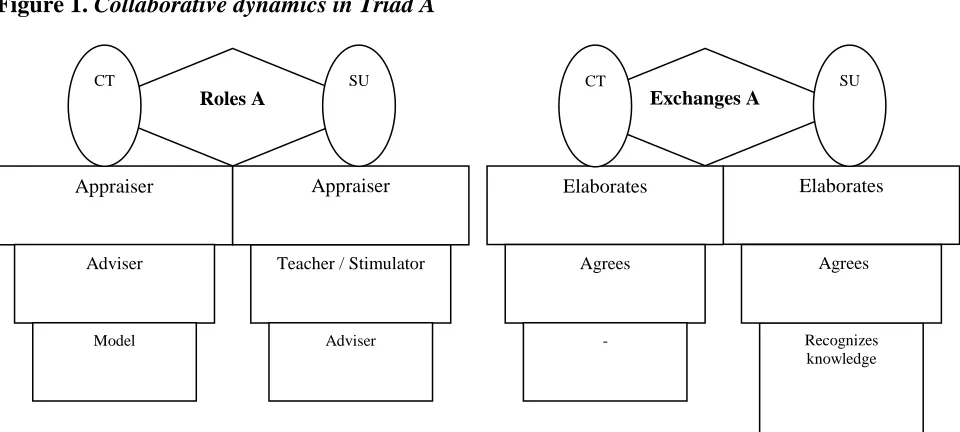
Case A. Triad A is composed as follows: the supervisor, Andrée, who taught at the secondary level prior to becoming a university professor in French Didactics; the cooperating teacher, Sandra, with 25 years of teaching experience; and the student teacher, Joëlle, who taught Secondary 5 French. Collaborative dynamics. Sandra, the cooperating teacher within the triad, mainly played the role of the appraiser. Her comments highlighted the strengths, progress, and achievements of the student teacher: “What I like about her is her ability to research, to get involved in what she’s doing.” Sandra also acted as an adviser, giving her opinion and making suggestions to the student teacher; and as a model, by explaining how she would proceed if she were the student teacher. In addition, throughout the entire conversation, Sandra elaborated on the supervisor’s comments. She also agreed with what the supervisor said.
Andrée, the supervisor, performed the role of the appraiser in the collaborative process by assessing the development of the student teacher’s professional competencies: “…I think you are capable of listening to students and making suggestions, but also of asking them questions so they can find out for themselves. That’s great.” Andrée also performed the role of teacher by expressing a considerable amount of knowledge, especially about didactics and psychopedagogy. In addition to providing advice based on her experience as a teacher, she stimulated thought by asking the student teacher questions. Finally, Andrée elaborated on Sandra’s comments, complementing them, adding to them, and continuing in the same vein. She also frequently agreed with the cooperating teacher’s statements. Finally, some of her comments suggest that she recognized the latter’s knowledge. The following diagram (Fig. 1) summarizes the above regarding the collaborative dynamics in Triad A.
Figure 1. Collaborative dynamics in Triad A
The analysis also indicated that the supervisor fulfilled her role as a leader within the triad. She structured the meeting by first reviewing the professional competencies of the student teacher. The cooperating teacher actively participated in the conversation and seemed comfortable sharing her opinion. The two trainers complemented each other well. In sum, Sandra and Andrée both played the role of appraiser of the student teacher’s professional development. The student teacher benefited from both of their advice: Andrée acted as a teacher by providing explanations based on rich knowledge, while Sandra acted more as a model. Since both trainers elaborated on the knowledge
Elaborates
Recognizes knowledge
Agrees
Roles A Exchanges A
Elaborates
Agrees
-
Appraiser
Adviser
Model
Teacher / Stimulator
Adviser
Appraiser
expressed by their partner, one can say that they significantly contributed to the student teacher's training through collaboration.
Case B. Triad B was composed as follows. The supervisor, Nicole, had worked as a primary school teacher and educational consultant at the secondary level, and was currently a university lecturer in learning assessment. The cooperating teacher, Julien, had 25 years of teaching experience. The student teacher, Mia, taught Secondary 3 History.
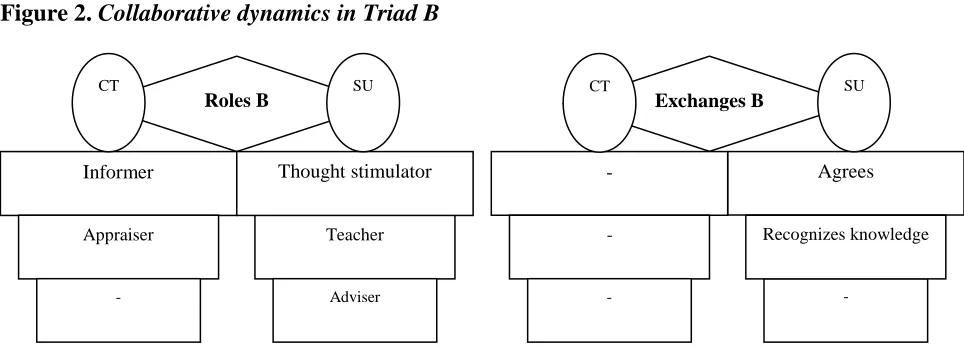
Collaborative dynamics. Though very reserved, the cooperating teacher in Triad B adopted the role of the informer in the triad’s conversation. For example, Julien provided information in response to the supervisor’s questions:
“There's a test at the end of the year, and a ministry exam in history.” The other predominant role of the cooperating teacher was that of the appraiser. He mentioned several strengths and weaknesses of the student teacher. For example, he said: “You realize yourself that some of your educational interventions must be modified. It is one of your strengths. You try to improve your teaching strategies. Don’t forget that if pupils talk all at once, you must intervene to maintain a good classroom environment”. We found a single passage illustrating elaboration of the supervisor’s ideas and no passages indicating that he agreed with her comments.
The supervisor contributed to collaboration mainly by stimulating thought and the development of the student-teacher regarding professional autonomy. Her numerous questions encouraged the student teacher’s reflection, for example: “Tell me, what motivated you to form teams composed of friends?” She later added: “Do you feel there are benefits to forming teams that way? What are the advantages and disadvantages?Were the discussions valid? Was it worthwhile?” Nicole acted as the teacher by sharing a considerable amount of theoretical and practical knowledge based on her extensive experience as a teacher. She also provided advice in a controlled way in order to stimulate the student teacher’s reflection in the training process. Through her comments, the supervisor sometimes agreed with the ideas of the cooperating teacher or recognized his knowledge. In the recorded conversation, Nicole greatly influenced the direction of the exchanges.
The following diagram (Fig. 2) shows the main results regarding the collaborative dynamics in Triad B.
Figure 2. Collaborative dynamics in Triad B
Moreover, the supervisor fulfilled her role as a leader within the triad. Nicole structured the meeting by asking the student teacher questions that stimulate thought, autonomy, and self-assessment. She asked the student teacher to justify her decisions and actions, thus encouraging her to make connections between theory and practice. The supervisor rarely asked the cooperating teacher for his point of view. She only asked questions to clarify the types of student learning assessments. The latter seemed self-effacing if not almost a spectator. In short, Julien and Nicole had separate roles.
Agrees
-
Recognizes knowledge
Roles B Exchanges B
-
-
-
Informer
Appraiser
-
Teacher
Adviser
Thought stimulator
Furthermore, since Julien said little, his contribution to the collaborative process was very limited. He did not respond to the attempts of the supervisor to encourage reflection through questions.
Case C. Triad C was composed as follows. The supervisor, Alice, had taught at the elementary and secondary levels and worked as an educational consultant; she was currently a university lecturer in French Didactics. The cooperating teacher, Marlène, had 25 years of teaching experience. The student teacher, Line, taught Secondary 4 Social Studies.
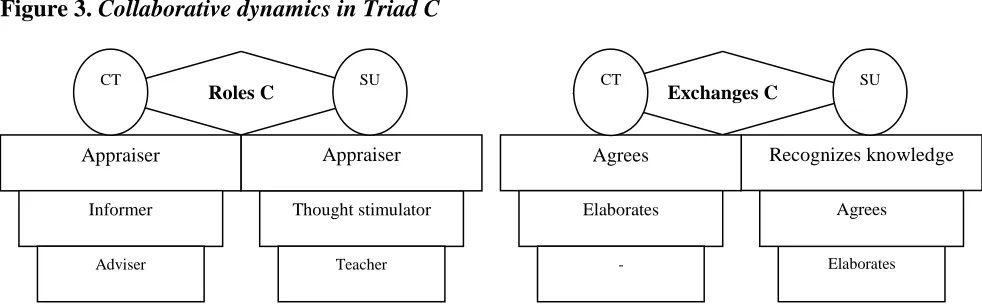
Collaborative dynamics. Marlène, the cooperating teacher, placed herself in the role of the appraiser. She emphasized the strengths and weaknesses of the student teacher by saying: “She [the student teacher] created the test herself for the evaluation. It went very well. However, the students’ results were a little high.” The cooperating teacher acted as the informer, especially concerning student learning assessment policies and methods. Finally, the cooperating teacher provided some advice based on her experience. During the conversation, she often agreed with the comments of the supervisor without providing additional information. She sometimes elaborated on the ideas of the supervisor.
The supervisor participated in the collaborative process through her role as an appraiser. She assessed the development of the student teacher’s professional competencies. This is illustrated by the following comment: “From what I can see so far, you're someone who plans her lessons quite well. Does planning influence classroom management?” We can see in this excerpt that the supervisor values the student teacher’s strengths while stimulating thought. She promotes student self-assessment of the development of professional skills: “What aspects of your teaching would you improve if you think back to the lesson you have just given?” The supervisor also adopted the role of teacher by citing the theoretical knowledge she acquired throughout her many years of teaching. During the triad meeting, the supervisor often emphasized Marlène’s knowledge, valuing her role and interventions as cooperating teacher: “Following what the student said, I'd like to hear what you have to say and how you perceive your trainee. You have witnessed things that I have not.”In other words, she invited the cooperating teacher to actively participate in the discussion. She also agreed with or elaborated on the latter’s comments.
The following diagram (Fig. 3) summarizes the above with regard to the collaborative dynamics in Triad C.
Figure 3. Collaborative dynamics in Triad C
The supervisor also fulfilled her role as a leader within the triad. She began the meeting with the student teacher’s self-assessment. She then asked the cooperating teacher for her opinion about the professional competencies of the student teacher that she had not been able to observe during the classroom observation period. Finally, she expressed her satisfaction with the development of the student teacher’s professional competencies, while stimulating thought and professional autonomy. The supervisor often highlighted the cooperating teacher's effectiveness regarding the student teacher’s training. In sum, both trainers primarily took on appraiser roles. Their other roles are distinct Recognizes knowledge
Elaborates
Agrees
Roles C Exchanges C
Agrees
Elaborates
-
Appraiser
Informer
Adviser
Thought stimulator
Teacher
Appraiser
yet complementary. When Alice stimulated thought through sustained questioning, Marlène participated in the exchange as informer and adviser. Marlène agreed with or briefly elaborated on Alice’s comments. The latter did likewise in an articulate and precise manner.
Discussion of Results
New and interesting findings emerged from our analysis of the data, allowing us to provide some answers to our initial questions. These findings focus on collaboration through knowledge sharing between cooperating teachers and university supervisors.
Our methodological choice to supplement the interview with conversations recorded during supervisory visits proved to be judicious. It provided access to the comments of student teacher trainers in the natural setting of student teacher internships. Based on data analysis, our observations allowed us to differentiate the roles of the two trainers in the triads in which they participated. However, both trainers show their willingness to collaborate. In fact, cooperating teachers — in their different roles of the appraiser, informer, and adviser — demonstrate that they want to share their knowledge with the supervisor. On the other hand, the supervisors also express their knowledge in the roles of thought stimulator, teacher, and the appraiser. Moreover, access to conversations made it possible for us to analyze the dynamics of knowledge sharing through collaborative dialog.
What about the actual collaboration between cooperating teacher and university supervisor? We observed that manifestations of interprofessional collaboration vary. We do not claim that the collaborative dynamics seen here are exhaustive. Furthermore, the dynamics identified are not necessarily more common than others.
Potentially productive exchanges in Triad A. The two trainers of Triad A attached considerable importance to pedagogical knowledge, more specifically to adapting instruction to the specific needs of students. The supervisor, Andrée, who specializes in French didactics, colored her comments with what she knows best: links between theory and practice. Sandra complemented the comments of the supervisor, who, in return, recognized the expertise of the cooperating teacher. Their verbal exchanges were connected in such a way as to convey messages to the student that were likely to support learning; the trainers had similar comments. In a joint approach, they seemed to interact productively. Although she spoke a great deal, taking the lead of the triad meeting, the supervisor did not impose her ideas on the cooperating teacher. The latter did not hesitate to verbalize her professional judgment and her thoughts. There was no sign of a hierarchical relationship (Baker, 2005) or a power relationship (Rodgers, 2004) in their conversation. One could detect their mutual trust, thus fostering the interdependence that characterizes true collaboration (Little, 1990).
Lack of complementary comments in Triad B. Although they felt they had the necessary characteristics for collaboration, Nicole, the supervisor, and Julien, the cooperating teacher, did not demonstrate their ability to establish an interprofessional collaboration that would enhance the training of the student teacher. The cooperating teacher said he was able to share his knowledge of the school environment yet expected the supervisor to share her knowledge about student teacher training. The supervisor claimed to be able to share her theoretical knowledge yet expected the cooperating teacher to share her personal thoughts.
A flattened hierarchy and some interdependence in Triad C. Marlène and Alice seemed to have the necessary profiles for interprofessional collaboration. The cooperating teacher said she had practical knowledge, and the supervisor said she had both theoretical and practical knowledge. During the supervisory meeting, the knowledge shared by the trainers was indeed distinct, but focused on the same objective, i.e., maintaining a good learning environment in the classroom. The supervisor verbalized her knowledge more. Both trainers mainly took on an appraiser role regarding the student teacher’s professional development. Otherwise, only the supervisor was a thought stimulator. While fulfilling a leadership role in the triad, Alice acknowledged the expertise of the cooperating teacher. She agreed with the ideas of her partner or elaborated on them. Although the cooperating teacher spoke less than the university supervisor, she seemed comfortable with verbalizing her thoughts, possibly encouraged by a supervisor keen on highlighting the contribution of her partner in the student teacher’s training. There was co-elaboration of knowledge.
Different approaches to collaboration. In sum, manifestations of interprofessional collaboration in verbal exchanges varied in relation to the dynamics of collaboration within the triads. As mentioned by Lesain-Delabarre (1998), a certain degree of inequality is apparent between the two trainers, particularly in Case B. Manifestations of collaboration as described by Cook & Friend (1991), Dionne (2005), and Little (1990) are more apparent in Cases A and C. Knowledge sharing occurred differently in Triads A and C. It was more apparent in the former, possibly due to the cooperating teacher’s “outspokenness”. In Triad C, manifestations of knowledge sharing may have relied on the supervisor’s inviting attitude to which the cooperating teacher responded through active participation. All three supervisors took on a leadership role within the triad, cognizant that such leadership is expected of the university supervisor. Their contribution to the collaborative process was specific: they stimulated thought and raised numerous questions. The cooperating teachers seemed less willing to initiate the reflection process that characterizes professional collaboration. Their contribution was primarily to corroborate the supervisor’s statements by adding their daily observations of the student teacher’s progress.
Trainers strive for a common goal yet play different roles. It appears that each of them intervenes in their way while pursuing this common goal: the trainee's progress in the development of professional skills. The distinctiveness and the diversity enrich our understanding of the collaboration between the two trainers in a context of knowledge sharing.
Conclusion
It would appear that the cooperating teachers and supervisors that took part in our study are committed to assisting the student teacher in the development of their professional abilities. Because of the required partnership between the university and the school, as well as the collaboration between the cooperating teacher and university supervisor, there is a desire for harmonisation. During their conversations, Dyads A and C clearly demonstrated acquiescent mode co-elaboration. Meanwhile, the trainers didn’t engage in collaborative dialogue as described by Gilly, Fraisse & Roux (2001) seeing as there seemed to be no co-construction of knowledge and clearly no contrasting points of view during the conversations.
According to our analysis of the data, the conversations recorded in the absence of the researchers in the natural setting of supervisory meetings indicate that the cooperating teachers expressed much less knowledge than the supervisors. In Triad B, the cooperating teacher appeared to be in a wait-and-see position. Nevertheless, it is noted that cooperating teachers have knowledge that differs from that of supervisors (Gervais & Desrosiers, 2005), that their knowledge is complementary and that there is no hierarchical status to each trainer’s knowledge (Campbell & Lott, 2010; Gervais, 2008; Ferrier-Kerr, 2009).
contrary, they are convinced of their ability to contribute to the collaborative process. The problem lies not in adherence to the requirements for collaboration but in the barriers to collaboration, among which are the barriers related to hierarchical tensions (Veal & Rickard, 1998), lack of time, and the different priorities of trainers (Sim, 2010). This study adds to the list of barriers already reported: lack of knowledge of the role of the student teacher co-trainer and failure to clarify each other’s expectations. It also broadens the description of the respective roles of the two trainers, articulated by Campbell and Lott (2010), by characterizing these roles according to knowledge expressed and collaborative dynamics within the triad, and revealing, for instance, that some cooperating teachers adopt a wait-and-see attitude. The study of interprofessional collaboration between the two student teacher trainers using another analytical framework would reveal other aspects of the dynamics of knowledge sharing.
References
Allen, J. M., Ambrosetti, A., & Turner, D. (2013). How school and University supervising staff perceive the pre-service teacher education practicum: A Comparative Study. Australian Journal of Teacher Education, 38(4), 107-128.
Baker, M. (2005, avril-juin). Cooperation: forms and processes in problem-solving situations that are designed for learning. Récupéré de http://ww.dsv.su.se/research/kogc/Kurser/Baker-kurs/BakerStock-Lecture4.pdf
Beck, C. & Kosnik, C. (2002). Professors and the practicum: Involvement of university faculty in preservice practicum supervision. Journal of Teacher Education, 53, 6-19.
Boies, I. (2012). L’apport de la collaboration à la persévérance professionnelle chez des enseignants
en insertion professionnelle (Mémoire de maitrise inédit). Université du Québec à Trois-Rivières.
Borges, C. & Lessard, C. (2007). Qu’arrive-t-il quand la collaboration enseignante devient une norme ? Dans J. F. Marcel, V. Dupriez, D. P. Bagnoud & M. Tardif (dir.), Coordonner, collaborer, coopérer. De nouvelles pratiques enseignantes (p. 61-74). Bruxelles, Belgique: De Boeck. Borko, H. & Mayfield, V. (1995). The roles of the cooperating teacher and the university supervisor
in learning to teach. Teaching & Teacher Education, 5, 501-518.
Bullough, R. & Draper, R. (2004) Making sense of a failed triad: Mentors, university supervi- sors, and positioning theory. Journal of Teacher Education, 55(5), 407–420.
Campbell, T & Lott, K. (2010). Triad dynamics: Investigating social forces, roles, and storylines.
Teaching Education, 21(4), 349-366.
Cook, L. & Friend, M. (1991). Principles for the practice of collaboration in schools. Preventing School Failures, 35(4), 6-9.
Correa Molina, E. (2006). Superviser un stagiaire : une question de ressources à mobiliser. Récupéré de http://www.inrp.fr/biennale/8biennale.
Couchara, C.A. (1997) The supervisory role of cooperating teachers: a study of critical incidents which influenced student teachers (Thèse de doctorat), University of Lehigh.
Dionne, L. (2005). L’acculturation collaborative des milieux scolaires par la création d’espaces de collaboration. Dans C. Gervais & L. Portelance (dir.), Les lieux et les modes de formalisation des savoirs professionnels en enseignement (p. 350-366). Sherbrooke, QC: Éditions du CRP. Ediger, M. (2009). Supervising the student teacher in public school. Education, 130 (2), 251-254. Ferrier-Kerr, J. L. (2009). Establishing professional relationships in practicum settings. Teaching and
Teacher Education, 25(6), 1-8.
Gagnon, Y-C. (2012). L'étude de cas comme méthode de recherche. Québec, QC: Presses de l'Université du Québec.
Gajda, R. (2004). Utilizing Collaboration Theory to Evaluate Strategic Alliances. American Journal of Evaluation, 25(1), 65-67.
Garcia, A. & Marcel, J.-F. (2011). Les pratiques de collaboration du professeur documentaliste de l’enseignement agricole public français. Dans L. Portelance, C. Borges & J. Pharand (dir.),
Gervais, C. (2008). Pour une formation des stagiaires en concertation: le rôle des superviseurs. Dans M. Boutet, J. Pharand & P. Boudreault (dir.), L'accompagnement concerté des stagiaires en enseignement (p. 92-107). Québec, QC: Presses de l'Université du Québec.
Gervais, C. & Desrosiers, P. (2005). Les visites de supervision: un contexte favorable aux interactions enrichissantes et à la mise en relation de savoirs? Dans C. Gervais & L. Portelance (dir.), Des savoirs au cœur de la profession enseignante: contextes de construction et modalités de partage (p. 389-410). Sherbrooke, QC: Éditions du CRP.
Gilly, M., Fraisse, J. & Roux, J.-P. (2001). Résolution de problèmes en dyades et progrès cognitifs chez des enfants de 11 à 13 ans : Dynamiques interactives et mécanismes socio-cognitifs. Dans A.-N. Perret-Clermont et M. Nicolet (dir.), Interagir et connaître : Enjeux et régulations sociales dans le développement cognitif (p. 79-101). Paris, France: L’Harmattan.
Graham, P. (1999). Powerful influences: a case of one student teacher renegotiating his perceptions of power relations. Teacher and Teacher Education, 15, 523-540.
Hamel, J. (1989). Pour la méthode de cas. Considérations méthodologiques et perspectives générales.
Anthropologie et Sociétés, 13(3), 59-72.
Johnson, I. L., & Napper-Owen, G. (2011). The importance of role perceptions in the student teaching triad. Physical Educator, 68(1), 44-56.
Kauffman, D. (1992). Supervision of Student Teachers. Récupéré de http://www.ericdigests.org/1992-4/student.htm
Landry, C. (1994). Émergence et développement du partenariat en Amérique du nord. Dans C. Landry et F. Serre (dir.), École et entreprise: vers quel partenariat? (p. 7-27). Québec, QC: Presses de l’Université du Québec.
Lesain-Delabarre, J.-M. (1998). La communication des institutions avec les familles : un enjeu pour l'adaptation et l'intégration scolaires. La nouvelle revue de l'AIS, 3, 62-80.
Lessard, C. (2005). La collaboration au travail: des finalités à débattre entre la formulation d’une norme professionnelle et le développement d’une pratique. Dans D. Biron, M. Cividini & J.-F. Desbiens (dir.), Les enseignants au temps des réformes (p.435-458). Québec, QC: Presses de l’Université Laval.
Little, J. W. (1990). The persistence of privacy: Autonomy and initiative in teacher’s professional relations. Teachers College Record, 91(4), 509-536.
Martinand, J. L. (2002, avril). Problématiser et reproblématiser en didactique. Récupéré de http://www.lirest.ens-cachan.fr/lettres/lettre53.html
Martineau, S. & Simard, D. (2011). Regard sur le dialogue comme condition de la collaboration en stage ou en accompagnement mentoral. Dans L. Portelance, C. Borges & J. Pharand (dir.), La collaboration dans le milieu de l’éducation: dimensions pratiques et perspectives théoriques
(p. 13-25).Québec, QC: Presses de l’Université du Québec.
McEwan, E. K. (1997). Leading your team to excellence: how to make quality decisions. Newbury Park, CA: Corwin Press.
Meegan, S., Dunning, C., Belton, S., & Woods, C. (2013). Teaching Practice: University Supervisors & apos; Experiences and Perceptions of a Cooperating Physical Education Teacher Education Programme. European Physical Education Review, 19(2), 199-214.
Merriam & Tisdell (2015). Qualitative Research: A Guide to design and implementation. San Francisco, CA : Jossey-Bass.
Mukamurera, J., Lacourse, F. & Couturier, Y. (2006). Des avancées en analyse qualitative : pour une transparence et une systématisation des pratiques. Recherches qualitatives, 26(1), 110-138. Ofstedal, K. & Dahlberg, K. (2009). Collaboration in student teaching: introducing the collaboration
self-assessment tool. Early Childhood Teacher Education, 30(1), 37-48.
Pharand, J. & Boudreault, P. (2011). Enseignants associés et superviseurs. Perceptions des uns à l'égard des autres et collaboration réciproque. Dans F. Guillemette et M. L'Hostie (dir.),
Favoriser la progression des stagiaires en enseignement (p. 121-139). Québec: Presses de l'Université du Québec.
Portelance, L., Martineau, S. & Caron, J. (2013, juin). Quelle adhésion à l’impératif de la
collaboration interprofessionnelle chez les deux formateurs du stagiaire en enseignement ?
Communication présentée au colloque international du CREN Les questions vives en éducation et formation : regards croisés France-Canada, Nantes, France.
Portelance, L., Gervais, C., Boisvert, G. & David, R. (2012, juin). Les représentations des enseignants associés quant à leurs rôles auprès des stagiaires: des facteurs de convergence et de divergence. Communication présentée au 17e congrès de l’Association mondiale en
sciences de l’éducation (AMSE), Reims, France.
Portelance, L. (2011). Une analyse des manifestations du dialogue collaboratif entre enseignant associé et stagiaire. Dans L. Portelance, C. Borges & J. Pharand (dir.), La collaboration dans le milieu de l’éducation: dimensions pratiques et perspectives théoriques (p. 27-43). Québec, QC: Presses de l’Université du Québec.
Portelance, L. & Caron, J. (2010). Les manifestations de l’apprentissage de la concertation pédagogique en stage. Dans L. M. Bélair, C. Lebel, N. Sorin & A. Roy (dir.), Évaluation et régulation des compétences professionnelles: entre référentiels et pratiques (p. 81-98). Ottawa, ON: Presses de l’Université d’Ottawa.
Portelance, L. & Gervais, C. (2009). Analysis of the dynamics of the sharing knowledge between cooperating teacher and teacher-in-training: The partners’ respective roles. US-China Education Review, 6(6), 71-80.
Portelance, L., Gervais, C., Lessard, M., Beaulieu, P. et collaborateurs (2008). La formation des enseignants associés et des superviseurs universitaires. Rapport de recherche. Cadre de référence. Déposé à la Table Ministère de l’éducation, du Loisir et du Sport – Universités (MÉLS-Universités). Québec.
Rodgers, J.-H. (2004). Scripted and Strategic Power Relations within Student Teaching Triad (Thèse de doctorat inédite). University of Pittsburgh.
Sacks H. (1995). Lectures on Conversation. Malden, MA : Blackwell Publishing.
Sanford, K. & Hopper, T. (2000). Mentoring, not monitoring: Mediating a whole-school model in supervising preservice teachers. Alberta Journal of Educational Research, 46(2), 149-166. Savoie-Zajc, L. & Dionne, L. (2001). Vers la mise en place d’une culture de formation continue dans
les milieux scolaires. Exploration conceptuelle et illustrations. Dans L. Lafortune, C. Deaudelin, P. A. Doudin & D. Martin (dir.), La formation continue, de la réflexion à l’action
(p. 139-164). Québec, QC: Presses de l'Université du Québec.
Sim, C. (2010). Sustaining Productive Collaboration between faculties and schools. Australian Journal of Teacher Education, 35(1), 518-528.
Tardif, M. & Gauthier, C. (1996). L’enseignant comme “acteur rationnel”: quelle rationalité, quel savoir, quel jugement ? Dans L. Paquay, M. Altet, É. Charlier & P. Perrenoud (dir.), Former des enseignants professionnels (p. 209-238). Bruxelles, Belgique: De Boeck.
Tung, H. C. (2000). Student Teaching Triads: Influence on the Development of Early Childhood Student Teacher (Dissertions and Theses). Colombia University.
Van Zee, E. H., Lay, D. & Roberts, D. (2003). Fostering collaborative inquiries by prospective and practicing elementary and middle school teachers. Science Education 87, 588-612.
Veal, M.-L. & Rickard, L. (1998). Cooperating teacher’s perspectives on the student teaching triad. Récupéré de http://jte.sagepub.com/content/49/2/108.refs