The Thirty-Third AAAI Conference on Artificial Intelligence (AAAI-19)
Deep Reinforcement Learning for
Green Security Games with Real-Time Information
Yufei Wang,
1Zheyuan Ryan Shi,
2Lantao Yu,
3Yi Wu,
4Rohit Singh,
5Lucas Joppa,
6Fei Fang
2 1Peking University,2Carnegie Mellon University,3Stanford University4University of California, Berkeley,5World Wild Fund for Nature,6Microsoft Research
[email protected],{ryanshi, feifang}@cmu.edu, [email protected] [email protected], [email protected], [email protected]
Abstract
Green Security Games (GSGs) have been proposed and ap-plied to optimize patrols conducted by law enforcement agen-cies in green security domains such as combating poach-ing, illegal logging and overfishing. However, real-time in-formation such as footprints and agents’ subsequent actions upon receiving the information, e.g., rangers following the footprints to chase the poacher, have been neglected in pre-vious work. To fill the gap, we first propose a new game model GSG-I which augments GSGs with sequential move-ment and the vital elemove-ment of real-time information. Second, we design a novel deep reinforcement learning-based algo-rithm, DeDOL, to compute a patrolling strategy that adapts to the real-time information against a best-responding attacker. DeDOL is built upon the double oracle framework and the policy-space response oracle, solving a restricted game and iteratively adding best response strategies to it through train-ing deep Q-networks. Explortrain-ing the game structure, DeDOL uses domain-specific heuristic strategies as initial strategies and constructs several local modes for efficient and paral-lelized training. To our knowledge, this is the first attempt to use Deep Q-Learning for security games.
Introduction
Security games (Tambe 2011) have been used for address-ing complex resource allocation and patrolladdress-ing problems in security and sustainability domains, with successful applica-tions in critical infrastructure protection, security inspection and traffic enforcement (Basilico, Gatti, and Amigoni 2009; Durkota et al. 2015; Yin, An, and Jain 2014; Rosenfeld and Kraus 2017). In particular, Green Security Games (GSG) have been proposed to model the strategic interaction be-tween law enforcement agencies (referred to as defenders) and their opponents (referred to as attackers) in green se-curity domains such as combating poaching, illegal log-ging and overfishing. Mathematical programming based al-gorithms are designed to compute the optimal defender strategy, which prescribes strategically randomized patrol routes for the defender (Fang, Stone, and Tambe 2015; Fang et al. 2016; Xu et al. 2017).
Despite the efforts, a key element, real-time information, existing widely in practice in green security domains, has
Copyright c⃝2019, Association for the Advancement of Artificial Intelligence (www.aaai.org). All rights reserved.
been neglected in previous game models, not to mention the agents’ subsequent actions upon receiving the information. For example, rangers can observe traces left by the poacher (e.g., footprints, tree marks) or learn of poacher’s location in real time from camera traps and conservation drones. A well-trained ranger would make use of the real-time infor-mation to adjust her patrol route. Indeed, there have been reports that rangers arrested the poachers after finding blood stains on the ground nearby (Maasailand Preservation Trust 2011). Similarly, a poacher may also observe the ranger’s action in real time and adjust his attack plan, and the rangers should be aware of such risk. Thus, the prescribed patrol plans in previous work have limited applicability in practice as they are not adaptive to observations during the patrol.
Our paper aims at filling the gap. First, we propose a new game model GSG-I which augments GSGs with the vi-tal element of real-time information and allows players to adjust their movements based on the received real-time formation. These features lead to significant complexity, in-evitably resulting in a large extensive-form game (EFG) with imperfect information.
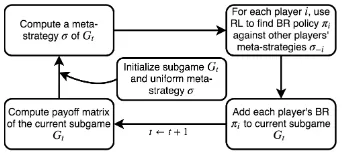
Figure 1: The PSRO framework
local modes, each corresponding to a specific entry point of the attacker, to reduce the complexity of the game environ-ment for efficient and parallelized training.
Finally, we provide extensive experimental results to demonstrate the effectiveness of our algorithm in GSG-I. We show that the DQN representation in DeDOL is able to approximate the best response given a fixed opponent. In small problems, we show that DeDOL achieves comparable performance as existing approaches for EFGs such as coun-terfactual regret (CFR) minimization. In large games where CFR becomes intractable, DeDOL can find much better de-fender strategies than other baseline strategies.
Preliminaries and Related Work
Stackelberg Security Games (SSG) and Green Security Games GSGs are a special class of SSG (Tambe 2011; Pita et al. 2008; Fang, Jiang, and Tambe 2013). In a GSG (Fang, Stone, and Tambe 2015; Basak et al. 2016), a defender and an attacker interact in an area discretized into a grid of targets. The defender strategically allocates a lim-ited number of patrol resources to patrol routes. The attacker chooses a target to attack. Each target is associated with re-ward and penalty for the defender and the attacker, repre-senting the payoff to them depending on whether the attack on the target is successful. Existing literature on GSGs and SSGs widely employs the solution concept of Strong Stack-elberg Equilibrium (SSE), where the defender commits to a strategy that maximizes her expected utility assuming the attacker observes her strategy and best responds to it.
When the game is zero-sum, common solution concepts such as Nash equilibrium (NE), SSE, Minimax, and Max-imin, coincide, and a DO framework (McMahan, Gordon, and Blum 2003) is commonly applied to solve the game ef-ficiently when the action space is large. DO is an iterative algorithm where in each iteration an NE is computed for a restricted game, in which each player only has a subset of pure strategies. Each player then adds a best response strategy against the opponent’s current NE strategy to the restricted game. DO terminates when each player’s best re-sponse strategy is already included in the restricted game. DO is guaranteed to converge to an NE of the original two-player zero-sum game.
Most of the literature on SSG have neglected real-time information, with only a few exceptions (Zhang et al. 2014) that are not designed for green security domains.
Extensive-form Games (EFG) EFGs capture the sequen-tial interaction between the players, and often presents more
computational challenges than normal-form games (Letch-ford and Conitzer 2010). Advanced algorithms for solv-ing large-scale two-player zero-sum EFGs with imper-fect information use counterfactual regret (CFR) minimiza-tion (Zinkevich et al. 2008), first-order methods (Kroer, Fa-rina, and Sandholm 2017), abstraction (Brown and Sand-holm 2017b; ˇCerm´ak, Boˇsansky, and Lisy 2017), or math-ematical programming-based approach enhanced with the DO framework (Bosansky et al. 2013). Despite the huge suc-cess in solving poker games whose game tree is wide but shallow (Brown and Sandholm 2017a; Moravˇc´ık et al. 2017; Bowling et al. 2015), these approaches are not applicable to GSG-I, as its game tree is prohibitively deep in contrast to poker games. For example, CFR requires traversing the full game tree in each iteration and will run out of memory on the large instances of GSG-I.
Deep RL and Multi-Agent RL Deep RL has recently been widely used in complex sequential decision-making, in both single agent and multi-agent settings (Oh et al. 2015; Leibo et al. 2017; Foerster et al. 2016). They have led to successful applications in Atari games (Mnih et al. 2015), Go (Silver et al. 2016), and continuous action con-trol (Mnih et al. 2016). An RL problem is usually for-mulated as a Markov Decision Process (MDP), compris-ing the state space S, action space A, transition prob-ability P, reward function r, and the discounting fac-tor γ. Q-learning (Watkins and Dayan 1992) is a popu-lar value-based RL methods for discrete action space. The Q-value of a state-action pair(s, a)under policy πis de-fined asQπ(st, at) = Es,a∼π[∑∞l=0γ
lr(s
t+l, at+l)|st, at]. DQN (Mnih et al. 2015) uses a deep neural networkQθto learn the optimalQ valueQ∗(s, a) = maxπQπ(s, a), by storing transitions {s, a, r, s′} in an off-line replay buffer and minimizing the following loss:
L(θ) =Es,a,r,s′[(Qθ(s, a)−(r+γmax a′ Q
˜ θ
(s′, a′))2] (1)
whereQθ˜is the target Q network whose parametersθ˜are periodically copied fromθto stabilize training. Besides Q-learning, Policy Gradient (Sutton et al. 2000) is another kind of popular RL method. It employs a parametric stochastic policyπθ, and updatesθby gradient ascent according to the following theorem:
∇θEπθ[r] =Es,a∼πθ[∇θlogπθ(a|s)·Q
πθ(s, a)] (2)
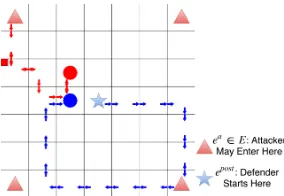
Figure 2: Illustration of GSG-I. The red dot and blue dot rep-resent the attacker and defender respectively. The red arrows and blue arrows represent their corresponding footprints. The red squares on the upper left corner of some cells rep-resent the attack tools placed by the attackers. Each player only observes the opponent’s footprint in their current cell.
Other Related Work Patrolling game is an EFG where a patroller moves on a graph and an attacker chooses a node to “penetrate” (Agmon, Kraus, and Kaminka 2008; Basilico, Gatti, and Amigoni 2009; Hor´ak and Pechoucek 2017). Our game model extends patrolling games by allowing multiple attacks and partial observability of traces of movement in real time for both the defender and attacker.
Green Security Game with Real-Time
Information
In this section, we introduce GSG-I, Green Security Game with Real-Time Information. As shown in Figure 2, the basic environment of GSG-I is a grid world, with each cell repre-senting a unique geographic area. The game has two players, the defender and the attacker. At the beginning of the inter-action, the attacker randomly chooses an entry pointeafrom a setEof entry points, while the defender always starts from the patrol postepost. The attacker starts with a limited num-ber of attack tools and uses them to set attacks at his desired locations. Such a game model is appropriate for a number of green security domains, e.g., rangers patrol in a conserva-tion area to prevent poaching by removing animal snares and arresting poachers. At each time step, the defender picks an action from her action spaceAd:{up, down, right, left, stand still}. Simultaneously, the attacker picks an action from his action spaceAa:{up, down, right, left, stand still} × {place attack tool, not place attack tool}.
Suppose an attack tool has been placed in a cell with coor-dinate(i, j). At each time step, the attack tool successfully launches an attack with probabilityPi,j. After a successful attack, the tool will be removed from the system. The de-fender tries to remove the attack tools prior to the attack and catch the attacker to stop him from placing more attack tools. She receives a positive rewardrtool
i,j when she removes an attack tool from cell (i, j), a positive reward rcatch on catching the attacker, and a negative rewardpattacki,j when an attack tool launches an attack at cell(i, j). The interaction ends either when the defender finds the attacker and all the attack tools, or when a maximum time step T is reached. The defender’s final payoff is the cumulative reward in the
game. The attacker receives (positive or negative) rewards corresponding to these events as well and in this paper we focus on zero-sum games.
As shown in Figure 2, both players leave footprints as they move around. There can be many other forms of real-time in-formation such as dropped belongings and local witnesses, yet for simplicity we use only footprints in this paper. In our game we assume both players have onlylocal observations. They only observe their opponent’s footprints in the current cell rather than the full grid, reflecting the fact that they often have a limited view of the environment due to the dense veg-etation, complex terrain, or formidable weather. We assume the players have unlimited memory and can keep a record of the observations since the beginning of each interaction.
Hence, we define a player’s pure strategy or policy in this game (we use policy and strategy interchangeably in this pa-per) as a deterministic mapping from his observation and action history to his action space. A player can employ a mixed policy, which is a probability distribution over the pure strategies.
Computing Optimal Patrol Strategy
It is nontrivial to find an optimal patrol strategy. Simple ac-tion rules such as following the footprints or escaping from the footprints may not be the best strategy as shown in ex-periments. We now introduce DeDOL, our algorithm de-signed for computing the optimal defender’s patrol strategy in zero-sum GSG-I. DeDOL builds upon the PSRO frame-work. Thus we will first introduce a DQN-based oracle for computing an approximate best response, and then introduce DeDOL, which uses the best response oracle as a subroutine.
Approximating Player’s Best Response
We first consider an easier scenario where either player is static, i.e. using a fixed and possibly randomized strategy. The player’s fixed strategy and the game dynamics of GSG-I then defines an MDP for the other player. We represent the other player’s policy by a neural network, and use reinforce-ment learning to find an empirically best response strategy. In this subsection we assume the defender is the learning player, as the method for the attacker is identical.
Due to the strong spatial patterns of GSG-I, we employ a convolutional neural network (CNN) to represent the de-fender policyπd(adt|sdt), which is a mapping from her state space to her action space. The input to the CNN is the de-fender’s statesd
t, represented by a 3-D tensor with the same width and height as the grid world and each channel encod-ing different features. Specifically, the first 8 channels are the binary encodings of the local attacker footprints ({four directions} × {entering or leaving}); the next 8 channels are similar encodings of the defender’s own footprints; the 17th channel is one-of-K encoding that indicates the defender’s current location; the 18th channel is the success probability of the attack tools of the grid world; the 19th channel is the normalized time step, which is the same for all cells.
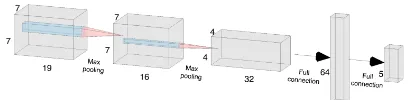
Figure 3: The defender’s neural network architecture for the 7×7grid.
is detailed in Appendix A1). The first hidden layer is a con-volutional layer with 16 filters of size4×4and strides1×1. The second layer is a convolutional layer with 32 filters of size2×2and strides2×2. Each hidden layer is followed by a
relunon-linear transformation and a max-pooling layer. The output layer is a fully-connected layer which transforms the hidden representation of the state to the final policy: each output dimension represents the Q-value of each action, and the neural network corresponds to a pure defender strategy where she takes the action with the highest Q-value.
We use Deep Q-learning (Mnih et al. 2015) to approxi-mate the best response with the above neural network. Due to the highly dynamic environment of GSG-I, the training of the vanilla version of DQN proved difficult, especially when the other player uses a randomized strategy. Therefore, we employ the double DQN methods (Van Hasselt, Guez, and Silver 2016) to improve the stability of training, and the loss L(θ)we minimize changes to:
Es,a,r,s′[(Qθ(s, a)−(r+γQθ˜(s′,arg max a′ Q
θ(s′, a′)))2]
Furthermore, we incorporate the dueling network architec-ture (Wang et al. 2016) upon double DQN for more effi-cient learning. We also implement the actor-critic algorithm (Konda and Tsitsiklis 2000) as an alternative to DQN, where
Qπθ(s, a)in Eq.2 is replaced byr+γVπθ(s)−Vπθ(s′)to
lower the variance. The neural network in Figure 3 then cor-responds to a stochastic policy where each dimension of the output layer represents the probability of choosing that ac-tion. We implement another CNN to approximate the state-valueVπθ(s)by changing the last output layer to be a scalar.
At last, we apply gradient clipping (Pascanu, Mikolov, and Bengio 2013) to deal with the gradient exploding issue.
This neural network-based representation does not cap-ture all defender strategies. However, the strong expressive-ness makes it a memory-efficient alternative, and we show later that we lose little using this compact representation.
The DeDOL Algorithm
Having deep RL as the players’ best response oracle lays the groundwork for finding the optimal defender strategy in GSG-I. In zero-sum GSG-I, the SSE strategy is also the NE strategy. The PSRO framework (Lanctot et al. 2017) (Fig-ure 1) can be applied to compute the NE strategy. A naive implementation of PSRO in GSG-I is as follows: we use a randomly initialized DQN as the initial strategy for each player. At each iteration, we first get the payoff matrix for
1
All appendices can be found at https://arxiv.org/abs/1811. 02483
the current strategies by simulation and compute the NE for the current game matrix. Then we fix the NE strategy for one player and calculate the best response strategy of an-other player with DQN, as detailed above. We add these best response strategies of each player to the current game if they are better than the existing strategies, and repeat the proce-dure until no better responses can be found for either player. However, as we will show in the experiment section, this naive implementation (referred to as Vanilla-PSRO through-out) does not perform well in practice due to the following limitations: 1) randomly initialized DQNs are rarely mean-ingful policies, and it takes several iterations for Vanilla-PSRO to evolve a reasonable set of strategies out of them. This problem is especially prominent as the training of DQN is very time-consuming. 2) The computed best response in Vanilla-PSRO tends to overfit to the specific NE strategy that it was trained against, and may not be robust against other opponent strategies in the complex GSG-I. 3) In GSG-I, the attacker could enter the grid world through multiple entry points. Using a single best response defender DQN to deal with all these possibilities makes the training rather difficult and the learned strategies sub-optimal.
Therefore, we propose DeDOL, which enhances Vanilla-PSRO by introducing three key elements as discussed below.
Initial Strategies for DO The problem with naive ini-tial strategies is that the best response against a highly ex-ploitable strategy could still be highly exex-ploitable itself. Thus, adding such a best response strategy to the strategy profile helps little. To alleviate this problem, we propose two lightweight yet effective domain-specific heuristic strategies as the initial strategies of DO.
For the attacker, we use a parameterized random walk policy. Suppose the current coordinate of the attacker is (m, n)and the maximum coordinate is(M, N). We can de-fine the average success probability for the updirection as
1 (m−1)·N
∑
0≤i<m,0≤j≤NPi,j, where Pi,j is the probabil-ity that an attack tool launches an attack successfully at cell (i, j). Similarly, we can define the average success proba-bility for all the other directions. For simplicity, we use an integerk ∈ {1, . . . ,5} to denote one of the five directions (the fifth “direction” is for the action “stand still”). This way, we can get an average success probability vectorP¯ ∈ R+5 (P¯5is the success probability of the current grid). Another important factor is the observed footprints. We use vectors
I ∈ {0,1}5 and O ∈ {0,1}5 to represent the footprints states, where each dimensionIk(orOk) is a binary variable, indicating whether or not there is an entering (or leaving) footprint from that direction (for the fifth “stand still” direc-tion,I5 =O5 = 0). Now we can define the parameterized heuristic policy for the attacker’s movement as
πa(aat =k|sat) =
exp(wp·P¯k+wi·Ik+wo·Ok)
∑
zexp(wp·P¯z+wi·Iz+wo·Oz)
(3)
wherewp,wiandwoare parameters for the average success probability, entering and leaving footprints, respectively.
of placing an attack tool in cell(m, n)as
ηa(bat = 1|s a t) =
exp(Pm,n/τ)
∑
i
∑
jexp(Pi,j/τ)
(4)
whereτis a temperature parameter.
The behavioral model as described above is boundedly rational, which is featured in real-world applications due to various constraints. We use this parameterized heuristic pol-icy as the initial attacker strategy in DeDOL with parameters set following advice from domain experts2.
For the defender’s initial strategy, we could use a similar, and even simpler parameterized heuristic policy, as her deci-sion only involves movement. However, here we propose to use another more effective policy, called random sweeping. In the beginning, the defender randomly chooses a direction to move in and heads towards the boundary. She then trav-els along the boundary until she finds any footprint from the attacker and follows the footprints. If there are multiple foot-prints at the same cell, she randomly chooses one to follow. This turns out to be a very strong strategy, as to defeat it, the attacker has to confuse the defender using his footprints.
Exploration and Termination The best response against the NE of a subgame Gt, N ash(Gt), may not general-ize well against other unexplored strategies in a complex game like GSG-I. In DeDOL, the fixed player instead uses a mixture ofN ash(Gt)andU nif(Gt), the uniform random strategy where the player chooses each strategy inGtwith equal probability. That is, with probability 1−αhe plays
N ash(Gt), and with probabilityαhe playsU nif(Gt). As a result, the trained DQN is an (approximate) best re-sponse to the NE strategy mixed with exploration, rather than the NE itself. Therefore we need to check in subroutine VALID (Algorithm 2) whether it is still a better response to the NE strategy than the existing strategies. This method is similar to the better response oracle introduced in (Jain, Conitzer, and Tambe 2013). If neither of the two player’s new strategies is a better response, we discard them and train against the NE strategies without exploration. The parent procedure Algorithm 1 terminates if we again find no bet-ter responses. Algorithm 1 may also bet-terminate for running a fixed number of iterations. Upon termination, we pick the defender NE strategy (possibly plus exploration) and the at-tacker’s best response which together give the highest de-fender’s expected utility.
Local Modes We refer to the algorithm introduced so far as DeDOL-S (Algorithm 1). Our main algorithm DeDOL, illustrated in Figure 4, uses DeDOL-S as a subroutine. We now conclude this section by introducing the key feature of DeDOL: local modes.
As it is challenging for a single defender DQN to ap-proximate best response against an attacker entering from different cells, we divide the original game (referred to as the global mode) into several local modes. In each mode the attacker has a fixed entry point. In DeDOL, we first run
2
We showed the experts the attacker behaviors with different parameter combinations using our designed GUI, and pick the one they think most reasonable.
Algorithm 1DeDOL-S
Require: Mode (local/global), attacker entry point (if local), ini-tial subgameG0, exploration rateα
1: foriterationtdo
2: Run simulations to obtain current game matrixGt.
3: N ash(Gt) = (σdt, σat),U nif(Gt) = (ρdt, ρat).
4: Train defender DQNfd
t against(1−α)σat +αρat.
5: Train attacker DQNftaagainst(1−α)σ d t +αρ
d t.
6: VALID(ftd, fta, Gt)
7: ifTERMINATE condition satisfiedthen
8: k∗ = arg maxk{def EU((1−α)σdk+αρ d k, f
a k), and
def EU(σdk, fka)if any were ever calculated}
9: return Defender optimal strategy from thek∗th iteration per above, current subgameGt
Algorithm 2VALID
Require: DQNsftd, f a
t, subgameGtwith NE(σdt, σ a t)
1: ifσat ·Gt(fa, ftd)≥σat ·Gt(fa, fkd),∀k < tthen
2: Defender best responseftdis valid, add toGt
3: ifσdt ·Gt(fd, fta)≥σtd·Gt(fd, fka),∀k < tthen
4: Attacker best responseftais valid, add toGt
5: ifneither of the above is truethen
6: Fixσa
t fromGt, train defender DQNftdagainst it.
7: Fixσd
t fromGt, train attacker DQNftaagainst it.
8: Do Lines 1-4 withftd,ftareplaced byftd,fta.
9: If neither ‘if’ is true again, signal TERMINATE
DeDOL-S in the local modes in parallel. After a few itera-tions, we combine the DQNs trained in all local modes to form a new subgame. Then, we start with this new subgame and run DeDOL-S in the global mode for more iterations.
When the attacker enters from the same location, both players (especially the defender) will face a more stable en-vironment and thus are able to learn better strategies more quickly. More importantly, these strategies serve as good building blocks for the equilibrium meta-strategy in the global mode, thus improving the strategy quality. In the fol-lowing section, we show that this approach performs better than several other variants.
Experiments
Figure 4: The DeDOL Algorithm
Figure 5: Expected utilities of different patroller strategies against a parameterized random walk poacher.
Xeon E5-2690 CPU, a Tesla K80 GPU, and a 56G RAM.
Best Response Approximation
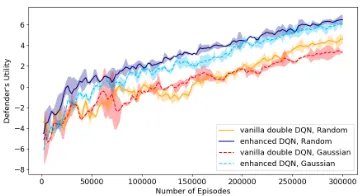
The ability to approximate a best response strategy against a fixed opponent is foundational to our algorithm. Therefore, we start by comparing the performance of several meth-ods against a parameterized heuristic poacher. We compare the random sweeping strategy, parameterized heuristic pa-troller with parameters set by grid search, the vanilla dou-ble DQN, the dueling doudou-ble DQN + gradient clipping (en-hanced DQN), and the actor-critic algorithm. We train both DQNs and actor-critic using Adam optimizer (Kingma and Ba 2015) with a learning rate of0.0001for300kepisodes. More detailed training parameters are provided in Appendix B. Figure 6 shows the learning curves of both DQNs. The actor-critic algorithm does not converge in our experiments. In the smaller3×3game with 4 time steps, we can com-pute the exact poacher best response given a patroller strat-egy (Bosansky et al. 2013) (details in Appendix F). How-ever, this method becomes intractable with just a5×5grid which has 25 time steps and over1020information sets.
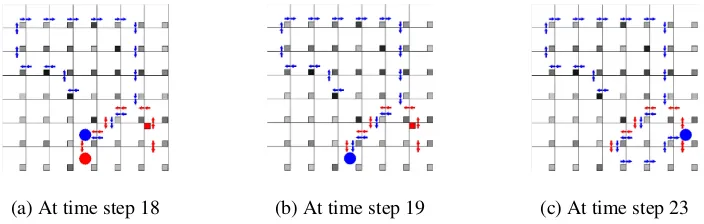
The results are summarized in Figure 5. The enhanced DQN patroller achieves the highest expected utility in all settings. Compared to the exact solution in the3×3game, the enhanced DQN is indeed a very good best response ap-proximation. Figure 7 shows the learned enhanced DQN strategy. The enhanced DQN patroller cleverly learns to first patrol towards the corner on a path of high animal densi-ties. She then moves along the boundary, and upon finding the poacher’s footprints, follows them to catch the poacher. After the poacher is caught, she induces from the observed footprints that the poacher should have entered from the
bot-Figure 6: The learning curves of patroller DQNs against pa-rameterized heuristic random walk poachers on7×7grids, averaged across four runs.
α 0 0.1 0.15 0.25 0.4
3×3Random 0.60 0.43 0.73 0.73 0.44 3×3Gaussian 0.12 0.39 0.64 0.37 0.04
Table 1: Patroller’s expected utility with different explo-ration rateαon the3×3grid using DeDOL (global only).
tom right corner. Hence she patrols that area and success-fully removes a snare there. A similar visualization for a trained poacher DQN against a random sweeping patroller is shown in Appendix D. We dropped the actor-critic algo-rithm in subsequent experiments as it performs poorly.
Small Games
Now we have shown that (enhanced) DQN can approximate a best response well, we move on to test the whole DeDOL algorithm. We first test it on a 3×3 grid. The game has4 time steps, and the attacker has3snares. The full game tree has roughly4.5×107nodes.
Before the main results, we tune the exploration rateα
by running 16 iterations in DeDOL-S global mode. Table 1 shows the highest patroller’s utility against an exact best response poacher with differentα. We setαto be 0.15 in the following as it achieves the best result in both map types. The defender’s utility withα = 0.15 is also much higher than withα= 0, showing that exploration is helpful.
(a) At time step 18 (b) At time step 19 (c) At time step 23
Figure 7: The learned patroller DQN strategy against a parameterized heuristic random walk poacher on a7×7random grid world. Here, the darkness of the square in each cell indicates the animal density.
Random Sweeping
Vanilla PSRO
DeDOL Pure Global Mode
DeDOL Local + Global Mode
DeDOL
Pure Local Mode CFR
3×3Random -0.04 0.65 (16) 0.73 (16) 0.85(10 + 2) 0.71 (20) 1.01(3500)
3×3Gaussian -0.09 0.52 (16) 0.75 (16) 0.86(10 + 2) 0.75(20) 1.05(3500)
5×5Random -1.91 -8.98 (4) -1.63 (4) -0.42 (4 + 1) -0.25(5)
-5×5Gaussian -1.16 -9.09 (4) -0.43 (4) 0.60(4 + 1) -2.41 (5)
-7×7Random -4.06 -10.65 (4) -2.00 (4) -0.54(3 + 1) -1.72(5)
-7×7Gaussian -4.25 -10.08 (4) -4.15 (4) -2.35(3 + 1) -2.62(5)
-Table 2: The highest patroller’s expected utility among all DO / CFR iterations. The numbers in the parentheses show the finished DO / CFR iterations within the given running time. The highest value among all algorithms are in bold. The detail values of the defender expected utility at each iteration of DeDOL are shown in Appendix E.
time. However, DeDOL needs much less memory as it only needs to store several neural networks, while the CFR algo-rithm has to store the whole huge game tree. The table also shows that all implementation versions of DeDOL outper-form Vanilla-PSRO, and have much higher utility than the random sweeping baseline. In addition, the local + global modes version achieves the best result in both map types, which proves its effectiveness. The local mode implementa-tion finishes more iteraimplementa-tions because the training of DQNs converges faster in its simpler environment.
Large Games
We also perform tests on large games with5×5and7×7 grid.5×5game has 25 time steps, and7×7game has 75 time steps. In both games, the attacker has 6 snares.
We still implement 3 versions of DeDOL as detailed in the previous subsection. The running time on5×5grid is 3 days, and 5 days on the7×7game. For the local + global version of DeDOL, we allocate 2 days for local mode on5×5, and 3 days on7×7. We report the performance of DeDOL in Table 2. As aforementioned, with even a5×5grid, there are over1050game states and1020information sets. Thus, CFR becomes intractable in terms of running time and memory usage, so is computing the exact best response. Therefore, in Table 2 the patroller’s expected utilities are calculated against their respective best response DQN poacher3.
We note that all versions of DeDOL significantly outper-form the Vanilla-PSRO and the random sweeping baseline.
3
Here, we train a separate DQN for a longer time than in a DO iteration. We also test against the poacher’s heuristic strategy and pick the better one, which is always the DQN in the experiments.
The Vanilla-PSRO performs extremely poor here because it starts with a poor randomly initialized DQN strategy, and strategies it evolved within the running time remain highly exploitable in large grids. This validates the effectiveness of using the more reasonable random sweeping/parameterized heuristic strategies as the initials in DeDOL. We also note DeDOL with local mode (either local + global retraining or pure local) achieves the highest defender’s utility in all set-tings. This validates our design that strategies obtained in lo-cal modes indeed serve as good building blocks to improve the strategy quality in the global mode.
Discussions and Future Directions
We end with some discussions and future directions. First, actor-critic performs poorly in GSG-I as it learns an aver-age of all possible sweeping routes. Second, training DQNs is time-consuming. Though we have shown promising util-ity improvements, approximating NE definitely needs more iterations. Third, the global best response of an NE strategy computed in one local mode may actually be in another local mode. To address this, we hope to find a method to automat-ically restrict the global best response being in the current mode, which we leave for future research. Another future direction is to consider maximum entropy Nash equilibria as the meta-strategy. Finally, DeDOL is proposed for zero-sum GSG-I, but we expect it can be adapted to general-zero-sum GSG-I, especially when the game is close to zero-sum.Acknowledgement
References
Agmon, N.; Kraus, S.; and Kaminka, G. A. 2008. Multi-robot perimeter patrol in adversarial settings. InICRA’08.
Basak, A.; Fang, F.; Nguyen, T. H.; and Kiekintveld, C. 2016. Combining graph contraction and strategy generation for green se-curity games. InGameSec’16.
Basilico, N.; Gatti, N.; and Amigoni, F. 2009. Leader-follower strategies for robotic patrolling in environments with arbitrary topologies. InAAMAS’09.
Bosansky, B.; Kiekintveld, C.; Lisy, V.; Cermak, J.; and Pechoucek, M. 2013. Double-oracle algorithm for computing an exact nash equilibrium in zero-sum extensive-form games.AAMAS’13. Bowling, M.; Burch, N.; Johanson, M.; and Tammelin, O. 2015. Heads-up limit hold’em poker is solved.Science.
Brown, N., and Sandholm, T. 2017a. Libratus: the superhuman ai for no-limit poker. InIJCAI’17.
Brown, N., and Sandholm, T. 2017b. Safe and nested subgame solving for imperfect-information games. InNIPS’17.
ˇ
Cerm´ak, J.; Boˇsansky, B.; and Lisy, V. 2017. An algorithm for constructing and solving imperfect recall abstractions of large extensive-form games. InIJCAI’17.
Durkota, K.; Lis`y, V.; Bosansk`y, B.; and Kiekintveld, C. 2015. Optimal network security hardening using attack graph games. In IJCAI’15.
Fang, F.; Nguyen, T. H.; Pickles, R.; Lam, W. Y.; Clements, G. R.; An, B.; Singh, A.; Tambe, M.; and Lemieux, A. 2016. Deploy-ing paws: Field optimization of the protection assistant for wildlife security. InAAAI’16.
Fang, F.; Jiang, A. X.; and Tambe, M. 2013. Optimal patrol strategy for protecting moving targets with multiple mobile resources. In AAMAS’13.
Fang, F.; Stone, P.; and Tambe, M. 2015. When security games go green: Designing defender strategies to prevent poaching and illegal fishing. InIJCAI’15.
Foerster, J.; Assael, I. A.; de Freitas, N.; and Whiteson, S. 2016. Learning to communicate with deep multi-agent reinforcement learning. InNIPS.
Hor´ak, K., and Pechoucek, M. 2017. Heuristic search value itera-tion for one-sided partially observable stochastic games.
Jain, M.; Conitzer, V.; and Tambe, M. 2013. Security scheduling for real-world networks. InAAMAS’13.
Kamra, N.; Gupta, U.; Fang, F.; Liu, Y.; and Tambe, M. 2018. Policy learning for continuous space security games using neural networks.
Kingma, D. P., and Ba, J. 2015. Adam: A method for stochastic optimization.ICLR’15.
Konda, V. R., and Tsitsiklis, J. N. 2000. Actor-critic algorithms. InNIPS’00.
Kroer, C.; Farina, G.; and Sandholm, T. 2017. Smoothing method for approximate extensive-form perfect equilibrium. InIJCAI’17. Lanctot, M.; Zambaldi, V.; Gruslys, A.; Lazaridou, A.; Perolat, J.; Silver, D.; and Graepel, T. 2017. A unified game-theoretic ap-proach to multiagent reinforcement learning. InNIPS’17. Leibo, J. Z.; Zambaldi, V.; Lanctot, M.; Marecki, J.; and Graepel, T. 2017. Multi-agent reinforcement learning in sequential social dilemmas. InAAMAS’17.
Letchford, J., and Conitzer, V. 2010. Computing optimal strategies to commit to in extensive-form games. InEC’10.
Maasailand Preservation Trust. 2011. Poacher arrested with game meat. https://mpttalk.wordpress.com/ 2011/05/11/poacher-arrested-with-game-meat/.
McMahan, H. B.; Gordon, G. J.; and Blum, A. 2003. Planning in the presence of cost functions controlled by an adversary. In ICML’03.
Mnih, V.; Kavukcuoglu, K.; Silver, D.; Rusu, A. A.; Veness, J.; Bellemare, M. G.; Graves, A.; Riedmiller, M.; Fidjeland, A. K.; Ostrovski, G.; et al. 2015. Human-level control through deep rein-forcement learning.Nature.
Mnih, V.; Badia, A. P.; Mirza, M.; Graves, A.; Lillicrap, T.; Harley, T.; Silver, D.; and Kavukcuoglu, K. 2016. Asynchronous methods for deep reinforcement learning. InICML’16.
Moravˇc´ık, M.; Schmid, M.; Burch, N.; Lis`y, V.; Morrill, D.; Bard, N.; Davis, T.; Waugh, K.; Johanson, M.; and Bowling, M. 2017. Deepstack: Expert-level artificial intelligence in heads-up no-limit poker.Science.
Oh, J.; Guo, X.; Lee, H.; Lewis, R. L.; and Singh, S. 2015. Action-conditional video prediction using deep networks in atari games. InNIPS’15.
Pascanu, R.; Mikolov, T.; and Bengio, Y. 2013. On the difficulty of training recurrent neural networks.ICML’13.
Pita, J.; Jain, M.; Marecki, J.; Ord´o˜nez, F.; Portway, C.; Tambe, M.; Western, C.; Paruchuri, P.; and Kraus, S. 2008. Deployed armor protection: the application of a game theoretic model for security at the los angeles international airport. InAAMAS’08.
Rosenfeld, A., and Kraus, S. 2017. When security games hit traf-fic: Optimal traffic enforcement under one sided uncertainty. In IJCAI’17.
Silver, D.; Huang, A.; Maddison, C. J.; Guez, A.; Sifre, L.; Van Den Driessche, G.; Schrittwieser, J.; Antonoglou, I.; Panneershel-vam, V.; Lanctot, M.; et al. 2016. Mastering the game of go with deep neural networks and tree search.Nature529(7587):484–489. Sutton, R. S.; McAllester, D. A.; Singh, S. P.; and Mansour, Y. 2000. Policy gradient methods for reinforcement learning with function approximation. InNIPS’00.
Tambe, M. 2011. Security and game theory: Algorithms.Deployed Systems, Lessons Learned.
Trejo, K. K.; Clempner, J. B.; and Poznyak, A. S. 2016. Adapt-ing strategies to dynamic environments in controllable stackelberg security games. InCDC’16.
Van Hasselt, H.; Guez, A.; and Silver, D. 2016. Deep reinforcement learning with double q-learning. InAAAI’16.
Wang, Z.; Schaul, T.; Hessel, M.; Van Hasselt, H.; Lanctot, M.; and De Freitas, N. 2016. Dueling network architectures for deep reinforcement learning.ICML’16.
Watkins, C. J., and Dayan, P. 1992. Q-learning.Machine learning 8(3-4):279–292.
Xu, H.; Ford, B.; Fang, F.; Dilkina, B.; Plumptre, A.; Tambe, M.; Driciru, M.; Wanyama, F.; Rwetsiba, A.; and Nsubaga, M. 2017. Optimal patrol planning for green security games with black-box attackers. InGameSec’17.
Yin, Y.; An, B.; and Jain, M. 2014. Game-theoretic resource allo-cation for protecting large public events. InAAAI’14.