www.adv-radio-sci.net/12/171/2014/ doi:10.5194/ars-12-171-2014
© Author(s) 2014. CC Attribution 3.0 License.
Fast near-field far-field transformation for phaseless and irregular
antenna measurement data
G. Schnattinger, C. Lopez, E. Kılıç, and T. F. Eibert
Lehrstuhl für Hochfrequenztechnik, Technische Universität München, Munich, Germany Correspondence to: G. Schnattinger ([email protected])
Received: 3 December 2013 – Revised: 20 January 2014 – Accepted: 29 January 2014 – Published: 10 November 2014
Abstract. The characterization of antenna radiation patterns by transformed near-field measurements requires accurate amplitude and phase data. This represents a problem since expensive measurement equipment is required, especially at millimeter and submillimeter wavelengths (Isernia et al., 1996). Amplitude-only antenna field measurements are the-oretically sufficient for the unique determination of antenna far-fields. Therefore, phaseless techniques are of special in-terest. However, the required field transformations are ex-tremely challenging, since they are nonlinear and strongly ill-posed.
In this work, the amplitude-only or phaseless near-field far-field transformation problem is formulated as a nonlinear optimization problem. The linear radiation operator within the nonlinear formulation is evaluated using the fast irregular antenna field transformation algorithm (FIAFTA). A hybrid solution procedure is described which combines a genetic algorithm with an iterative conjugate gradient (CG) search method. Numerical results prove the efficiency and flexibility of the formulation and it is shown that the algorithm remains stable when the noise level in the measurements is moderate. Nevertheless, regularization techniques might be beneficial to further improve the robustness of the algorithm.
1 Introduction
Near-field far-field transformations of antenna measure-ments with amplitude and phase data are well established (Yaghjian, 1986). The well-known methods for planar, cylin-drical and spherical measurements are widely employed in practical applications. These canonical transformation algo-rithms correspond to solving a linear equation system effi-ciently by applying the fast Fourier transform (FFT).
Many efforts have been spent to implement phaseless tech-niques, where only amplitude data is available. Formulating the problem in a general way leads to a nonlinear optimiza-tion problem in contrast to the linear one in case of available phase information. Initially, the cost functions were directly based on the amplitude errors in each measurement point. However, using the power mismatch by squaring the ampli-tudes results in a more favorable nonlinearity (Pierri et al., 1999).
Iterative algorithms with two different techniques have emerged to solve the optimization problem. The first scheme is based on two separate measurement planes, where the fields are alternately propagated from one measurement plane to another one while certain corrections are applied un-til the fields become stationary. This is referred to as plane-to-plane algorithm (Yaccarino and Rahmat-Samii, 1999). The second scheme is based on an iterative optimization ap-proach such as the Gauss-Newton or the conjugate gradi-ent (CG) method (Habashy and Abubakar, 2004; Capozzoli et al., 2009).
Since the solution space of phaseless transformation prob-lems is often populated with local optima (Isernia et al., 1996), the main challenge is to obtain the globally optimal solution. Much research has been performed on this topic and under certain conditions it is possible to guarantee con-vergence (Pierri et al., 1999). Global optimization strate-gies such as genetic algorithms have been applied to find the correct solution (Regue et al., 2001). Almost all results have been reported for the fast canonical transformation al-gorithms which usually limit the applicability to measure-ments on regular grids.
172 G. Schnattinger et al.: Antenna field transformation for phaseless and irregular measurements
based on multi-level fast multipole method (MLFMM) prin-ciples (Chew et al., 2001). It supports arbitrary measurement positions and orientations with full consideration of arbitrary probe characteristics. Since the antenna under test (AUT) can be decomposed using an octree structure, arbitrary informa-tion about the shape of the AUT can be included in the trans-formation as a priori knowledge (Schmidt and Eibert, 2012). Furthermore, it is possible to compute equivalent currents on a surface enclosing the AUT (Eibert et al., 2010). Another advantage is the inherent suppression of truncation errors (Schmidt and Eibert, 2010). Echo suppression techniques are also available to improve the performance in non-anechoic environments (Yinusa and Eibert, 2013). The accuracy typ-ically increases with the number of solver iterations, but in case of measurement uncertainties or errors the opposite can happen. Therefore, aborting the iterative solver after a few iterations can improve the results due to the regularization properties of the iterative procedure (Calvetti et al., 2002). In summary, FIAFTA is more flexible than other methods avail-able at present while its computational efficiency remains high. The topic of this paper is to utilize these advantages for improved transformations of phaseless near-field mea-surement data by using a CG method in combination with a genetic algorithm.
Section 2 briefly describes the principles of the classical FIAFTA. Section 3 introduces the phaseless inverse problem on top of this by formulating a nonlinear optimization prob-lem together with a suitable solution procedure. Numerical results are given in Sect. 4. Finally, conclusions are drawn in Sect. 5.
2 Principles of the Fast Irregular Antenna Field Trans-formation Algorithm (FIAFTA)
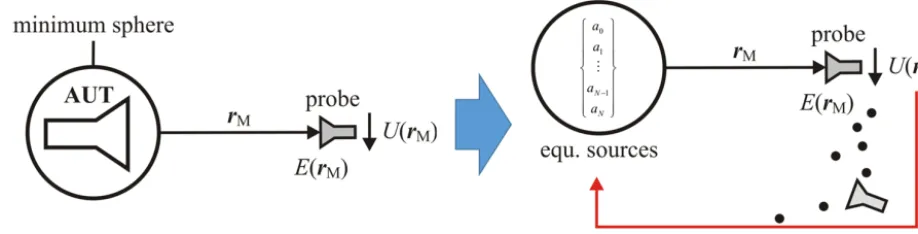
As mentioned in the introduction, FIAFTA can be applied to all kinds of amplitude and phase data. The general method is depicted in Fig. 1. The AUT is represented withNequivalent sources and then an inverse problem is formulated using the measurement data. Mathematically speaking this leads to the linear equation system
Ax=b, (1)
where b∈CM contains M complex-valued measurements with phase and amplitude information,x∈CNis the vector of coefficients which represents the equivalent sources and the matrix A∈CM×Ndefines the linear relationship between the unknowns and the right hand side. The unknownsxcan originate from an equivalent currents representation, a plane wave expansion or a spherical harmonics expansion.
The linear equation system in Eq. (1) is solved by apply-ing an iterative solver such as GMRES or CG to the normal equation
AHAx=AHb. (2)
This yields the minimum least squares solution minkAx−bk2
2. Typically, the residual attains very low values after a few solver iterations and the solution time is dominated by the matrix-vector products with A and its adjoint AH. For this reason, it is important to evaluate these products in a fast manner by employing the MLFMM methodology. Also, for the phaseless transformation ap-proach in the next section, it is assumed that the matrix A can be only evaluated through the matrix-vector products and the entries of the matrix A cannot be accessed directly.
3 Application of FIAFTA to phaseless near-field data 3.1 Problem formulation
In this section, the phaseless transformation problem will be formulated as a nonlinear optimization problem. Squaring the equation system in Eq. (1) on both sides yields
Ax◦(Ax)∗=c, (3)
where∗denotes the complex conjugate,◦is the element-wise
product between two vectors also referred to as Hadamard product andc=b◦b∗is the vector containing the squared measurement amplitudes. The nonlinear equation system in Eq. (3) can be converted into the nonlinear optimization problem
min x
Ax◦(Ax)
∗−
c 2
2. (4)
The measurement data must contain enough information, so that only a single solution will minimize the cost function. In contrast to the linear problem discussed before, the sampling density must be increased at least by a factor of 2 in every spatial dimension to compensate for the missing phase in-formation (Capozzoli et al., 2009). The final solution will be scaled by an arbitrary constant phase factor in comparison to the solution in Eq. (2), because the phaseless measurements do not provide information about the absolute value of the phase.
Figure 1. An inverse problem is defined by replacing the AUT by equivalent currents.
approaches. The iterative optimization approach will be ex-plained first. After that, a combined scheme based on a ge-netic algorithm will be introduced.
Iterative solvers for nonlinear optimization problems are presented in Habashy and Abubakar (2004). First, it is nec-essary to approximate the function locally using a Taylor-series expansion. Expanding a real cost function with respect to complex arguments requires either a formulation with sep-arated real and imaginary parts or with complex variables and their complex conjugates (Sorber et al., 2012). The lat-ter scheme is employed, because it is computationally more efficient.
By combining the independent variables and their complex conjugates into the vector
z=
x x∗
, (5)
the notation can be written more concisely. The cost function in Eq. (4) is referred to by the symbols
C (z)=1
2ke(z)k 2
2, e(z)=Ax◦(Ax)
∗−c
, (6)
where e is the vector of squared measurement errors. Ex-panding this expression by a Taylor series expansion of sec-ond order yields
C(z)≈C(zk)+g(zk)H1z+ 1 21z
HG(z
k)1z, (7) where1z=z−zkis the offset from the expansion pointzk,
g(zk)= ∂C (z)
∂z z
k
=J(zk)He(zk) (8)
is referred to as the gradient vector, J(zk)= ∂e(z)∂z z
k
is the Jacobian and G(zk)= ∂
2C(z) ∂z∂zH
z
k
is the Hessian. Straightfor-ward matrix algebra yields
J(zk)=(diag(Axk))∗A diag(Axk)A∗ (9)
for the Jacobian and G(zk)=
1 2J(zk)
HJ(z k)+
2
AHdiag(e(zk))A 0
0 ATdiag(e(zk))A∗
(10) for the Hessian (Habashy and Abubakar, 2004), where diag( )with a vector as argument represents a diagonal ma-trix. Further simplification is possible by inserting Eqs. (9) and (10) into Eq. (7). Some minor calculations lead to the more computationally efficient terms
g(zk)H1z=2e(zk)TRe (diag(Axk))∗A1x (11) and
1zHG(zk)1z=4
Re (diag(Axk))∗A1x 2 2+
21xHAHdiag(e(zk))A1x, (12) where1x=x−xkis the offset without the complex conju-gate.
In the following, the nonlinear CG approach with Polak-Ribière search directions is employed. It is an iterative gra-dient search method which requires an initial solution can-didatez0. The solution candidate is then iteratively refined by
zk+1=zk+γksk, (13)
wherezkis the previous solution candidate in thek-th itera-tion,sk is the search direction andγkis the step size scaling factor. The search directions are computed bys0= −g(z0) and
sk= −g(zk)+
g(zk)H(g(zk)−g(zk−1))
kg(zk−1)k2
sk−1, (14)
where this definition corresponds to the Polak-Ribière scheme. The expression
g(zk)= AHdiag(Axk)
∗
174 G. Schnattinger et al.: Antenna field transformation for phaseless and irregular measurements
Initialization of genetic algorithm by creating a population from random solutions incorporating all available a priori knowledge
Iterative optimization of each individual by conjugate
gradient method until termination criteria reached
Genetic selection process by evaluating value of cost function to only keep the
best individuals
Creation of new generation by mutation and recombination to obtain
natural diversity
Time limit has been reached or fitness of best
solution is suffi cient? yes
no
Figure 2. Flow chart of the combined optimization procedure based on a genetic algorithm and a CG method.
(a) Random configuration of Hertzian dipoles.
(b) Radiation pattern in thek-space domain.
Figure 3. Source configuration used as synthetic AUT for the
phase-less near-field far-field transformation.
refers to the gradient vector in iterationkand
γk= kskk
2 2 sHkG(zk)sk
(16) determines the scaling of the search direction in Eq. (13).
An iterative optimization approach converges rapidly to an extremal value of the cost function. However, the solution is often not desired since it is not equal to the globally
opti-mal solution. If an initial solution candidate can be provided which lies in the attraction region of the desired solution, the iterative algorithm computes the correct result. For exam-ple, consider a scenario where the measurement equipment provides accurate amplitude information but the phase infor-mation is erroneous due to small phase uncertainties. In this case, an approximate solution can be computed by the linear transformation using the inaccurate phase information and subsequently could be used to initialize the nonlinear trans-formation. The correct result will be obtained if the approx-imate solution belongs to the attraction region of the desired result which is the case if the phase errors are small enough. In order to achieve convergence to the globally optimal solu-tion, a global optimization scheme is required.
G. Schnattinger et al.: Antenna field transformation for phaseless and irregular measurements 175
Initialization of genetic algorithm by creating a population from random solutions incorporating all available a priori knowledge
Iterative optimization of each individual by conjugate
gradient method until termination criteria reached
Genetic selection process by evaluating value of cost function to only keep the
best individuals
Creation of new generation by mutation and recombination to obtain
natural diversity
Time limit has been reached or fitness of best
solution is sufficient? yes
no
Fig. 2: Flow chart of the combined optimization procedure based on a genetic algorithm and a CG method.
-5 0
5 x 10⁻³ -5
0 5
x 10-3 -5
0 5
x 10-3
x-Axis y-Axis
z
-Ax
is
(a) Random configuration of Hertzian dipoles.
(b) Radiation pattern in thek-space domain.
Fig. 3: Source configuration used as synthetic AUT for the phaseless near-field far-field transformation.
contrast to the other results, this solution is obtained very
345
rapidly and the the cost function has an extremely low value. This can only be explained by the fact that the cost function promotes undesirable solutions. Noisy measurement data in-fluences the cost function in a way that the desired solution
0 100 200 300
-20 -10 0
Eφ,θ= 90◦
amplitude in dB
0 100 200 300
-40 -30 -20 -10
φ in °
Eθ,θ= 90◦
amplitude in dB
0 100 200 300
-15 -10 -5
Eφ,φ= 0◦
0 100 200 300
-30 -20 -10
θ in °
Eθ,φ= 0◦
0 100 200 300
-18 -16 -14 -12 -10 -8
Eφ,φ= 90◦
0 100 200 300
-20 -15 -10 -5
θ in °
Eθ,φ= 90◦
Reference Transformed
Fig. 4: Comparison of reference far-field and transformed near-field data in various far-field cuts to check accuracy of classical FIAFTA including phase information.
(a) Iteration1 (b) Iteration2 (c) Iteration4
(d) Iteration9 (e) Iteration13 (f) Iteration15
Fig. 5: Phaseless transformation result after various iteration numbers. Reference is given in Fig. 3b.
does not correspond to the globally optimal solution
any-350
more. This is expected, where it should be kept in mind that 20dB noise level is of course a rather bad value.
Neverthe-Figure 4. Comparison of reference far-field and transformed
near-field data in various far-near-field cuts to check accuracy of classical FIAFTA including phase information.
extensive literature which is available on this topic (Regue et al., 2001).
4 Numerical results
4.1 Random configuration of Hertzian dipoles
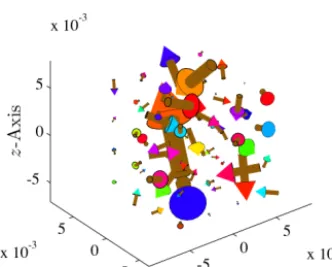
In this section, the combined optimization procedure using a genetic algorithm and the CG method will be applied to a synthetic example. A small scenario with random mea-surements is considered. The width of the AUT is set to λ/3 which is 1 cm at 10 GHz. The random dipole distribu-tion depicted in Fig. 3a is used to synthesize the AUT. Fig-ure 3b illustrates the resulting far-field pattern in thek-space domain. FIAFTA uses 180 spherically sampled plane wave coefficients to represent the unknown radiation characteris-tics in the transformation. To illustrate the capabilities of FIAFTA and its phaseless extension, 2014 measurements are simulated with a Hertzian dipole probe, where the individ-ual measurements are randomly distributed and oriented be-tween the two spheres with radius 6.5 cm and 13.5 cm. First, the FIAFTA algorithm is applied to solve the linear problem by exploiting the phase information of the measurements. The transformation result is compared to the reference pat-tern in Fig. 4 for the three different cutsθ=90◦,φ=0◦and φ=90◦ and for both polarizations. It can be observed that the linear transformation result precisely matches the refer-ence solution.
In the second approach, the phase of the measurements is discarded. The genetic algorithm is initialized with 6 random solutions. These random solutions are then optimized with the CG method. The solution with the best fitness is depicted in Fig. 5a. After this step, a selection process is applied where only the three best solutions are kept and seven new individ-uals are created. Now the CG method is applied to all indi-viduals and the process starts from the beginning. The best individual after a few selected iterations is shown in Fig. 5. In iteration 15, no visual difference to the reference pattern
(a) Iteration 1 (b) Iteration 2 (c) Iteration 4
(d) Iteration 9 (e) Iteration 13 (f) Iteration 15
Figure 5. Phaseless transformation result after various iteration
numbers. Reference is given in Fig. 3b.
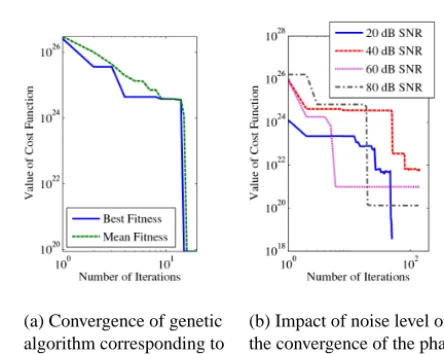
(a) Convergence of genetic (b) Impact of noise level on algorithm corresponding to the convergence of the phaseless the plots in Fig. 5. transformation algorithm.
Figure 6. Development of the fitness of the population in the genetic
algorithm over the complete runtime.
in Fig. 3b is notable. The gradual improvement of the best in-dividual over all iterations is visualized in Fig. 6a. The blue solid line represents the individual with the best fitness while the dashed line corresponds to the mean fitness of the respec-tive generation. In this example, the described optimization procedure takes about one minute.
176 G. Schnattinger et al.: Antenna field transformation for phaseless and irregular measurements
(a) 60 dB SNR (b) 40 dB SNR (c) 20 dB SNR
Figure 7. Impact of noise level on the final solution of the phaseless
transformation algorithm.
algorithm is depicted in Fig. 6 for each data set. For 60 dB and 80 dB SNR, the algorithm can find the correct solution. However, the noise increases the number of iterations re-quired to find the global optimum and the final value of the cost function increases, too. The final solution for 60 dB SNR is shown in Fig. 7a and no error is visible. When the level of noise is increased to 40 dB, the solution starts to deviate from the reference pattern as depicted in Fig. 7b. Figure 6 shows that also a larger number of iterations is required. Fur-ther increasing the noise level to 20 dB produces the pattern in Fig. 7c. In contrast to the other results, this solution is obtained very rapidly and the the cost function has an ex-tremely low value. This can only be explained by the fact that the cost function promotes undesirable solutions. Noisy measurement data influences the cost function in a way that the desired solution does not correspond to the globally op-timal solution anymore. This is expected, where it should be kept in mind that 20 dB noise level is of course a rather bad value. Nevertheless, the application of regularization princi-ples in the cost function might be desirable in the future in or-der to further improve the robustness. For example, it would be possible to penalize the amplitude of the solution vector or an error weighting matrix in the cost function might im-prove the situation. Moreover, it is always recommended to include as much information as possible about the AUT into the formulation.
In summary, it was shown that it is possible to retrieve an unknown far-field pattern from arbitrarily oriented and located near-field measurements without additional a priori knowledge by applying a nonlinear optimization approach on top of FIAFTA. By further refinement, the methodology will be applicable to larger problems.
4.2 Robustness analysis involving a single dipole source
The preceding example has revealed that the robustness of phaseless transformation approaches is an important issue. In the following, this insight should be underpinned by quanti-tative conclusions.
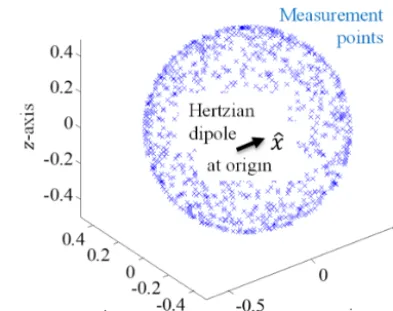
Since a quantitative analysis typically requires many sim-ulation runs, it is reasonable to choose a simple scenario for this purpose. The selected source configuration and its radia-tion characteristic is shown in Fig. 8. A single dipole situated at the origin is radiating in free space. Measurement data is
(a) Source surrounded by 1000 randomly located spherical measurements points.
(b) Radiation pattern in thek-space domain.
Figure 8. Source configuration consisting of anxˆ-oriented Hertzian dipole.
generated by randomly distributing 1000 field observations over a sphere with the radius 1.6λ.
In order to compare the performance of the phaseless transformation with the conventional approach incorporat-ing phase information, several transformation runs have been performend for different levels of measurement noise while varying the number of available measurements from 3 to 1000. The noise level ranging from−20 dB to 80 dB SNR is defined with respect to the mean energy of these measure-ments.
G. Schnattinger et al.: Antenna field transformation for phaseless and irregular measurements 177
(a) Source surrounded by 1000 randomly located
spherical measurements points.
Linear Transformation Nonlinear Transformation
3 6 12 30 200 1000
S
N
R
Measurements 3 6 12 30 200 1000
Large Medium Small
Error in radiation characteristic:
625, 2002. 425
Capozzoli, A., Curcio, C., D’Elia, G., and Liseno, A.: Phaseless Antenna Characterization by Effective Aperture Field and Data Representations, IEEE Trans. Antennas Propag., 57, 215–230, 2009.
Chew, W. C., Jin, J.-M., Michielssen, E., and Song, J.: Fast and 430
Efficient Algorithms in Computational Electromagnetics, Artech House, 2001.
Eibert, T. F., Ismatullah, Kaliyaperumal, E., and Schmidt, C. H.: Inverse Equivalent Surface Current Method with Hierarchical Higher Order Basis Functions, Full Probe Correction and Mul-435
tilevel Fast Multipole Acceleration (Invited Paper), Progress In Electromagnetics Research, 106, 377–394, 2010.
Habashy, T. M. and Abubakar, A.: A general framework for con-straint minimization for the inversion of electromagnetic mea-surements, Progress In Electromagnetics Research, 46, 265–312, 440
2004.
Isernia, T., Leone, G., and Pierri, R.: Radiation pattern evalua-tion from near-field intensities on planes, IEEE Trans. Antennas Propag., 44, 701–710, 1996.
Pierri, R., D’Elia, G., and Soldovieri, F.: A two probes scanning 445
phaseless near-field far-field transformation technique, IEEE Trans. Antennas Propag., 47, 792–802, 1999.
Qureshi, M. A., Schmidt, C. H., and Eibert, T. F.: Near-Field Er-lar
ro-etic al- radi-PCB 30,
nsfor-Planar
-of An- a -IL,
d Opti-nal
t
-Figure 9. Comparison of phaseless transformation approach and
conventional method incorporating phase information with respect to robustness issues regarding measurement noise and measurement redundancy.
reconstructed patterns. The categories ‘large’, ‘medium’ and ‘small’ represent the amount of visible distortion in compar-ison with the reference pattern in Fig. 8b. By comparing the statistics from the linear and nonlinear transformation ap-proach, the following conclusions are derived: To achieve comparable accuracy, the phaseless transformation approach requires five times more measurements, or alternatively, mea-surements which are 20 dB better with respect to the SNR. Be aware that these conclusions are not valid for larger scenar-ios, because the situation is expected to become worse due to local minimum problems. It will remain a topic of further research to find out how exactly the robustness is affected by the electrical size of the problem.
5 Conclusions
Conventional field transformation approaches are not able to process irregularly sampled measurement data without phase information. In order to overcome this limitation, a nonlinear optimization procedure is combined with the fast irregular antenna field transformation algorithm (FIAFTA). The resulting formulation is outstandingly efficient and flexible. However, the nonlinear optimization problem turns out to be very challenging. Good results were achieved using a hybrid solution procedure. It combines a genetic algorithm with an iterative conjugate gradient (CG) search method. Numerical results showed that the algorithm remains stable when the noise level is moderate. Nevertheless, regulariza-tion techniques might be beneficial to further improve the robustness of the algorithm.
Edited by: U. van Rienen
Reviewed by: two anonymous referees
References
Calvetti, D., Lewis, B., and Reichel, L.: On the Regularizing Prop-erties of the GMRES Method, Numer. Math., 91, 605–625, 2002. Capozzoli, A., Curcio, C., D’Elia, G., and Liseno, A.: Phaseless Antenna Characterization by Effective Aperture Field and Data Representations, IEEE Trans. Antennas Propag., 57, 215–230, doi:10.1109/TAP.2008.2009647, 2009.
Chew, W. C., Jin, J.-M., Michielssen, E., and Song, J.: Fast and Efficient Algorithms in Computational Electromagnetics, Artech House, 931 pp., 2001.
Eibert, T. F., Ismatullah, Kaliyaperumal, E., and Schmidt, C. H.: Inverse Equivalent Surface Current Method with Hierarchical Higher Order Basis Functions, Full Probe Correction and Mul-tilevel Fast Multipole Acceleration (Invited Paper), Prog. Elec-tromagn. Res., 106, 377–394, 2010.
Habashy, T. M. and Abubakar, A.: A General Framework for Con-straint Minimization for the Inversion of Electromagnetic Mea-surements, Prog. Electromagn. Res., 46, 265–312, 2004. Isernia, T., Leone, G., and Pierri, R.: Radiation Pattern Evaluation
from Near-Field Intensities on Planes, IEEE Trans. Antennas Propag., 44, 701–710, 1996.
Pierri, R., D’Elia, G., and Soldovieri, F.: A Two Probes Scanning Phaseless Near-Field Far-Field Transformation Technique, IEEE Trans. Antennas Propag., 47, 792–802, doi:10.1109/8.774132, 1999.
Qureshi, M. A., Schmidt, C. H., and Eibert, T. F.: Near-Field Error Analysis For Arbitrary Scanning Grids Using Fast Irregular An-tenna Field Transformation Algorithm, Prog. Electromagn. Res. B, 48, 192–220, 2013.
Regue, J.-R., Ribo, M., Garrell, J.-M., and Martin, A.: A Genetic Algorithm based Method for Source Identification and Far-Field Radiated Emissions Prediction from Near-Field Measurements for PCB Characterization, IEEE Trans. Antennas Propag., 43, 520–530, doi:10.1109/15.974631, 2001.
Schmidt, C. H. and Eibert, T. F.: Near-Field to Far-Field Transfor-mation utilising Multilevel Plane Wave Representation for Planar and Quasi-Planar Measurement Contours, IET Microw. Antenna. P., 4, 1829–1837, 2010.
Schmidt, C. H. and Eibert, T. F.: Sub Spectra Representation of An-tennas for Plane Wave Based Near-Field Far-Field Transforma-tion at Short Measurement Distances, IEEE Antennas and Prop-agation Society International Symposium (AP-S), Chicago, IL, USA, July 2012.
Sorber, L., Barel, M. V., and Lathauwer, L. D.: Unconstrained Opti-mization of Real Functions in Complex Variables, SIAM J. Op-timiz., 22, 879–898, 2012.
Yaccarino, R. and Rahmat-Samii, Y.: Phaseless Bi-Polar Pla-nar Nearfield Measurements and Diagnostics of Array Antennas, IEEE Trans. Antennas Propag., 47, 574–583, doi:10.1109/8.768794, 1999.
Yaghjian, A. D.: An Overview of Near-Field Antenna Measure-ments, IEEE Trans. Antennas Propag., 34, 30–45, 1986. Yinusa, K. and Eibert, T.: A Multi-Probe Antenna Measurement