R E S E A R C H
Open Access
A new iterative process for a hybrid pair of
generalized asymptotically nonexpansive
single-valued and generalized nonexpansive
multi-valued mappings in Banach spaces
Suthep Suantai
1and Withun Phuengrattana
2,3**Correspondence: [email protected] 2Department of Mathematics, Faculty of Science and Technology, Nakhon Pathom Rajabhat University, Nakhon Pathom, 73000, Thailand
3Research Center for Pure and Applied Mathematics, Research and Development Institute, Nakhon Pathom Rajabhat University, Nakhon Pathom, 73000, Thailand Full list of author information is available at the end of the article
Abstract
In this paper, we construct an iterative process involving a hybrid pair of a finite family of generalized asymptotically nonexpansive single-valued mappings and a finite family of generalized nonexpansive multi-valued mappings and prove weak and strong convergence theorems of the proposed iterative process in Banach spaces. Our main results extend and generalize many results in the literature.
MSC: 47H09; 47H10; 54H25; 54E40
Keywords: fixed point; generalized asymptotically nonexpansive mapping; nonexpansive mapping; Banach space
1 Introduction
Throughout this paper we denote byNthe set of all positive integers. LetXbe a Banach space and letDbe a nonempty subset ofX. LetCB(D) andKC(D) denote the families of nonempty, closed, and bounded subsets and nonempty, compact, and convex subsets ofD, respectively. TheHausdorff metriconCB(D) is defined by
H(A,B) =max
sup
x∈A
dist(x,B),sup
y∈B
dist(y,A) forA,B∈CB(D),
wheredist(x,D) =inf{x–y:y∈D} is the distance from a pointxto a subsetD. Let tbe a single-valued mapping ofDinto DandT be a multi-valued mapping ofDinto CB(D). The set of fixed points oftandT will be denoted byF(t) ={x∈D:x=tx}and F(T) ={x∈D:x∈Tx}, respectively. A pointxis called acommon fixed pointoftandT if x=tx∈Tx.
Definition . A single-valued mappingt:D→Dis said to begeneralized asymptotically nonexpansiveif there exist sequences{kn} ⊂[,∞) and{sn} ⊂[,∞) withlimn→∞kn= ,
limn→∞sn= such that
tnx–tny≤knx–y+sn,
for allx,y∈Dandn∈N.
In the case ofsn= , for alln∈N, a single-valued mappingtis calledan asymptotically
nonexpansive mapping. In particular, ifkn= andsn= , for alln∈N, a single-valued
mappingtreduce to anonexpansive mapping. The fixed point property for generalized asymptotically nonexpansive single-valued mappings can be found in []. The following example shows that the fixed point set of a generalized asymptotically nonexpansive map-ping is not necessarily closed; see also [].
Example .([]) Define a single-valued mappingt: [– ,
]→[–
,
] by
tx=
⎧ ⎪ ⎨ ⎪ ⎩
x, ifx∈[–, ),
, ifx= , x, ifx∈(,].
Thentis generalized asymptotically nonexpansive andF(t) = [–, ) which is not closed.
Definition . A multi-valued mappingT:D→CB(D) is said to be
(i) nonexpansiveifH(Tx,Ty)≤ x–y, for allx,y∈D;
(ii) quasi-nonexpansiveifF(T)=∅andH(Tx,Tp)≤ x–p, for allx∈Dandp∈F(T).
The study of fixed points for nonexpansive multi-valued mappings using the Hausdorff metric was initiated by Markin []. Different iterative processes have been used to approx-imate fixed points of nonexpansive and quasi-nonexpansive multi-valued mappings; in particular, Sastry and Babu [] considered Mann and Ishikawa iterates for a multi-valued mappingT with a fixed pointpand proved that these iterates converge to a fixed point q ofT under certain conditions. Moreover, they illustrated that the fixed point qmay be different fromp. Later in , Panyanak [] generalized results of Sastry and Babu [] to uniformly convex Banach spaces and proved a convergence theorem of Mann iter-ates for a mapping defined on a noncompact domain. In , Shahzad and Zegeye [] proved strong convergence theorems for the Ishikawa iteration scheme involving quasi-nonexpansive multi-valued mappings. They constructed an iterative process which re-moves the restriction ofT, namelyend-point condition,i.e.,Tp={p}for anyp∈F(T); see also [, ].
In , Garcia-Falsetet al.[] introduced a new condition on single-valued mappings, calledcondition(E), which is weaker than nonexpansiveness. Later, Abkar and Eslamian [] used a modified condition for multi-valued mappings as follows.
Definition . A multi-valued mappingT:D→CB(D) is said to satisfycondition(Eμ)
whereμ≥ if for eachx,y∈D,
dist(x,Ty)≤μdist(x,Tx) +x–y.
We say thatT satisfiescondition(E) wheneverTsatisfies (Eμ) for someμ≥.
Remark . From the above definitions, it is clear that ifTis nonexpansive, thenT
In , Sokhuma and Kaewkhao [] introduced the following iterative process for ap-proximating a common fixed point of a pair of a nonexpansive single-valued mappingt and a nonexpansive multi-valued mappingT:
yn= ( –αn)xn+αnzn,
xn+= ( –βn)xn+βntyn, n∈N,
(.)
wherex∈D,zn∈Txn, and <a≤αn,βn≤b< . They also proved a strong convergence
theorem for the iterative process (.) in uniformly convex Banach spaces.
In , Eslamian [] extended the results of [, ] in uniformly convex Banach spaces. He used the following iterative process for a pair of a finite family of asymptotically non-expansive single-valued mappings{ti}Ni=and a finite family of quasi-nonexpansive multi-valued mapping{Ti}Ni=:
yn=βn()xn+
N
i=β (i)
nzn(i),
xn+=αn()xn+
N
i=α (i)
ntinyn, n∈N,
(.)
wherex∈D,zn(i)∈Tixn, and{αn(i)},{βn(i)}are sequences in [, ] for alli= , , . . . ,Nsuch
thatNi=αn(i)=
N
i=β (i)
n = .
In this paper, motivated by the above results, we propose an iterative process for approx-imating a common fixed point of a pair of a finite family of generalized asymptotically non-expansive single-valued mappings and a finite family of quasi-nonnon-expansive multi-valued mappings and prove weak and strong convergence theorems of the proposed iterative pro-cess in Banach spaces.
2 Preliminaries
A Banach spaceXis calleduniformly convexif for eachε> there is aδ> such that forx,y∈Xwithx ≤,y ≤, andx–y ≥ε,x+y ≤( –δ) holds. The following result was proved by Xu [].
Proposition . Let X be a uniformly convex Banach space and let r> .Then there exists a strictly increasing,continuous,and convex function g: [,∞)→[,∞)with g() = such that
λx+ ( –λ)y≤λx+ ( –λ)y–λ( –λ)gx–y
for all x,y∈Br={z∈X:z ≤r}andλ∈[, ].
A Banach spaceXis said to satisfy theOpial property(see []) if it is given that whenever {xn}converges weakly tox∈X,
lim sup
n→∞ xn–x<lim supn→∞ xn–y
for eachy∈Xwithy=x. The examples of Banach spaces which satisfy the Opial property are Hilbert spaces and allLp[, π] with <p= fail to satisfy the Opial property.
Definition . (see []) LetF be a nonempty subset of a Banach spaceX and let{xn}
be a sequence inX. We say that{xn}is ofmonotone type (I) with respect to Fif there exist
sequences{δn}and{εn}of nonnegative real numbers such that
∞
n=δn<∞,
∞
n=εn<∞,
andxn+–p ≤( +δn)xn–p+εnfor alln∈Nandp∈F.
Proposition .(see []) Let F be a nonempty subset of a Banach space X and let{xn}be a
sequence in X.If{xn}is of monotone type(I)with respect to F andlim infn→∞dist(xn,F) = ,
thenlimn→∞xn=p for some p∈X satisfyingdist(p,F) = .In particular,if F is closed,then
p∈F.
Lemma .(see []) Let{an},{bn},and{cn}be sequences of nonnegative real numbers
satisfy
an+≤( +cn)an+bn, for all n∈N,
where∞n=bn<∞and
∞
n=cn<∞.Then:
(i) limn→∞anexists.
(ii) Iflim infn→∞an= ,thenlimn→∞an= .
Lemma .(see []) Let X be a uniformly convex Banach space,let{λn}be a sequence of
real numbers such that <a≤λn≤b< ,for all n∈N,and let{xn}and{yn}be sequences
of X satisfying,for some r≥, (i) lim supn→∞xn ≤r,
(ii) lim supn→∞yn ≤rand
(iii) limn→∞λnxn+ ( –λn)yn=r.
Thenlimn→∞xn–yn= .
Lemma .(see []) Let X be a Banach space which satisfies the Opial property and{xn}
be a sequence in X.Let u,v∈X be such thatlimn→∞xn–uandlimn→∞xn–vexist.If
{xni}and{xnj}are subsequences of{xn}which converge weakly to u and v,respectively,then u=v.
3 Main results
In this section, we prove weak and strong convergence theorems of the proposed iterative process in Banach spaces. We first note that if{ti}Ni=is a finite family of generalized asymp-totically nonexpansive single-valued mappings ofDinto itself, whereDis a nonempty con-vex subset of a Banach spaceX. Then we havetn
ix–tniy ≤k
(i)
nx–y+sn(i), for allx,y∈D
and all i= , , . . . ,N, where{kn(i)} ⊂[,∞) and {sn(i)} ⊂[,∞) with limn→∞kn(i)= and
limn→∞s(ni)= . Putkn=max≤i≤N{kn(i)}andsn=max≤i≤N{sn(i)}. It is clear thatlimn→∞kn=
andlimn→∞sn= and
tnix–tiny≤knx–y+sn
for allx,y∈D,i= , , . . . ,N, and alln∈N.
Lemma . Let D be a nonempty,closed,and convex subset of a Banach space X.Let{ti}Ni= be a finite family of generalized asymptotically nonexpansive single-valued mappings of D into itself with sequences{kn} ⊂[,∞)and{sn} ⊂[,∞)such that
∞
n=(kn– ) <∞and
∞
n=sn<∞.Let{Ti}Ni= be a finite family of quasi-nonexpansive multi-valued mappings of D into CB(D).Assume thatF=Ni=F(ti)∩
N
i=F(Ti)is nonempty closed and Tip={p}
for all p∈Fand i= , , . . . ,N.Let x∈D and the sequence{xn}be generated by
yn=βn()xn+
N
i=β (i)
nzn(i), zn(i)∈Tixn,
xn+=αn()xn+
N
i=α (i)
ntinyn, n∈N,
where{α(ni)}and{βn(i)}are sequences in[, ]for all i= , , . . . ,N such that
N
i=α (i)
n = and
N
i=β (i)
n = .Thenlimn→∞xn–pexists for all p∈F.
Proof Letp∈F, fori= , , . . . ,N, we have
xn+–p ≤αn()xn–p+ N
i=
α(ni)tinyn–p
≤αn()xn–p+ N
i=
α(ni)knyn–p+sn
=αn()xn–p+kn N
i=
α(ni)yn–p+sn N
i= α(ni)
≤αn()xn–p+kn N
i=
αn(i)yn–p+sn
≤αn()xn–p+kn N
i= αn(i)
βn()xn–p+ N
i=
βn(i)z(ni)–p
+sn
=
αn()+knβn() N
i= αn(i)
xn–p+kn N
i= αn(i)
N
i=
βn(i)zn(i)–p+sn
=
αn()+knβn() N
i= αn(i)
xn–p+kn N
i= αn(i)
N
i=
βn(i)distz(ni),Tip
+sn
≤
α()n +knβn() N
i= αn(i)
xn–p+kn N
i= αn(i)
N
i=
βn(i)H(Tixn,Tip) +sn
≤
α()n +knβn() N
i= αn(i)
xn–p+kn N
i= αn(i)
N
i=
βn(i)xn–p+sn
=
αn()+kn N
i= α(ni)
xn–p+sn
≤knxn–p+sn
= + (kn– )
xn–p+sn.
By Lemma .,∞n=(kn– ) <∞and
∞
n=sn<∞, we conclude thatlimn→∞xn–p
Theorem . Let D be a nonempty,closed,and convex subset of a Banach space X.Let {ti}Ni=be a finite family of generalized asymptotically nonexpansive single-valued mappings of D into itself with sequences{kn} ⊂[,∞)and{sn} ⊂[,∞)such that
∞
n=(kn– ) <∞
and∞n=sn<∞.Let{Ti}Ni=be a finite family of quasi-nonexpansive multi-valued map-pings of D into CB(D).Assume thatF=Ni=F(ti)∩
N
i=F(Ti)is nonempty closed and
Tip={p}for all p∈Fand i= , , . . . ,N.Let x∈D and the sequence{xn}be generated by
yn=βn()xn+
N
i=β (i)
nzn(i), zn(i)∈Tixn,
xn+=αn()xn+
N
i=α (i)
ntinyn, n∈N,
where{αn(i)} and{βn(i)} are sequences in[, ]for all i= , , . . . ,N such thatNi=α (i)
n =
andNi=βn(i)= .Then the sequence{xn}converges strongly to a point inFif and only if
lim infn→∞dist(xn,F) = .
Proof The necessity is obvious and thus we prove only the sufficiency. Suppose that
lim infn→∞dist(xn,F) = . In the proof of Lemma ., we see that the sequence {xn}is
of monotone type (I) with respect toF. It follows by Proposition . that{xn}converges
to a point inF.
The closedness ofF=Ni=F(ti)∩
N
i=F(Ti) can be dropped iftiis asymptotically
non-expansive for alli= , , . . . ,N. Then the following corollary is obtained directly from The-orem ..
Corollary . Let D be a nonempty, closed, and convex subset of a Banach space X. Let{ti}Ni= be a finite family of asymptotically nonexpansive single-valued mappings of D into itself with a sequence{kn} ⊂[,∞)such that
∞
n=(kn– ) <∞. Let{Ti}Ni= be a fi-nite family of quasi-nonexpansive multi-valued mappings of D into CB(D).Assume that
F=Ni=F(ti)∩
N
i=F(Ti)is nonempty and Tip={p}for all p∈Fand i= , , . . . ,N.Let
x∈D and the sequence{xn}be generated by
yn=βn()xn+
N
i=β (i)
nzn(i), zn(i)∈Tixn,
xn+=αn()xn+
N
i=α (i)
ntinyn, n∈N,
where{αn(i)} and{βn(i)} are sequences in[, ]for all i= , , . . . ,N such that
N
i=α (i)
n =
andNi=βn(i)= .Then the sequence{xn}converges strongly to a point inFif and only if
lim infn→∞dist(xn,F) = .
Recall that a mappingt:D→Dis calleduniformly L-Lipschitzianif there exists a con-stantL> such thattnx–tny ≤Lx–yfor allx,y∈Dandn∈N. Next, we prove a strong convergence theorem in a uniformly convex Banach space.
Lemma . Let D be a nonempty,closed,and convex subset of a uniformly convex Banach
space X.Let{ti}Ni=be a finite family of uniformly L-Lipschitzian and generalized asymptot-ically nonexpansive single-valued mappings of D into itself with sequences{kn} ⊂[,∞)
and {sn} ⊂[,∞) such that
∞
n=(kn– ) <∞ and
∞
F=Ni=F(ti)∩
N
i=F(Ti)is nonempty and Tip={p}for all p∈Fand i= , , . . . ,N.Let
x∈D and the sequence{xn}be generated by
yn=βn()xn+
N
i=β (i)
nzn(i), zn(i)∈Tixn,
xn+=αn()xn+Ni=α (i)
ntinyn, n∈N,
where{αn(i)}and{βn(i)}are sequences in[, ]for all i= , , . . . ,N such that <a≤αn(i),βn(i)≤
b< ,Ni=αn(i)= ,and
N
i=β (i)
n = .Then we have the following:
(i) limn→∞xn–zn(i)= for alli= , , . . . ,N;
(ii) limn→∞xn–tixn= for alli= , , . . . ,N.
Proof (i) By Lemma .,limn→∞xn–pexists. Putlimn→∞xn–p=c. By the definition
of{xn}, we have
tniyn–p≤knyn–p+sn
≤kn
βn()xn–p+ N
i=
βn(i)z(ni)–p
+sn
=knβn()xn–p+kn N
i=
βn(i)zn(i)–p+sn
=knβn()xn–p+kn N
i=
βn(i)distz(ni),Tip
+sn
≤knβn()xn–p+kn N
i=
βn(i)H(Tixn,Tip) +sn
≤knβn()xn–p+kn N
i=
βn(i)xn–p+sn
=kn
βn()+
N
i= βn(i)
xn–p+sn
=knxn–p+sn.
Then we have
lim sup
n→∞
tniyn–p≤lim sup n→∞
knyn–p+sn
≤lim sup
n→∞
knxn–p+sn
.
Bylimn→∞kn= andlimn→∞sn= , we have
lim sup
n→∞
tniyn–p≤lim sup
n→∞ yn–p ≤lim supn→∞ xn–p=c. (.) Since c=limn→∞xn+–p=limn→∞α()n (xn–p) +
N
i=α (i)
n(tniyn–p), it follows by
Lemma . that
lim
n→∞xn–t n
Consider
xn+–p ≤αn()xn–p+ N
i=
α(ni)tinyn–p
=
–
N
i= α(ni)
xn–p+ N
i=
α(ni)tinyn–p
≤
–
N
i= αn(i)
xn–p+ N
i=
αn(i)knyn–p+sn
.
This implies that
xn+–p–xn–p ≤ N
i=
αn(i)knyn–p–xn–p+sn
.
Therefore,
xn+–p–xn–p
bN +xn–p ≤
xn+–p–xn–p
N
i=α (i)
n
+xn–p
≤knyn–p+sn.
By (.), we obtain
c=lim inf
n→∞
x
n+–p–xn–p
bN +xn–p
≤lim inf
n→∞
knyn–p+sn
=lim inf
n→∞ yn–p ≤lim sup
n→∞ yn–p ≤c.
Thus,
c= lim
n→∞yn–p=nlim→∞
βn()(xn–p) +
N
i=
βn(i)z(ni)–p
.
Since
z(ni)–p=distz(ni),Tip
≤H(Tixn,Tip)≤ xn–p,
it implies that
lim sup
n→∞
z(ni)–p≤lim sup
n→∞ xn–p=c.
Hence, by Lemma ., we have
lim
n→∞xn–z
(i)
(ii) Sincetiis generalized asymptotically nonexpansive, for alli= , , . . . ,N, we get
tnixn–xn≤tinxn–tinyn+tniyn–xn≤knxn–yn+sn+tniyn–xn.
By the definition of{xn}, we haveyn–xn=
N
i=β (i)
n (z(ni)–xn). This implies that
tnixn–xn≤kn
N
i=
βn(i)z(ni)–xn+tinyn–xn+sn
≤knz(ni)–xn+tniyn–xn+sn.
Then, by (i) and (.), we get
lim
n→∞xn–t n
ixn= for alli= , , . . . ,N. (.)
Fori= , , . . . ,N, we have
xn–tixn ≤ xn–xn++xn+–tni+xn++tin+xn+–tni+xn+tin+xn–tixn
≤( +L)xn–xn++xn+–tin+xn++Ltnixn–xn
≤( +L)
N
i=
αn(i)xn–tniyn+xn+–tni+xn++Ltnixn–xn.
By (.) and (.), we conclude thatlimn→∞xn–tixn= for alli= , , . . . ,N. Theorem . Let D be a nonempty,compact,and convex subset of a uniformly convex Banach space X.Let{ti}Ni= be a finite family of uniformly L-Lipschitzian and generalized asymptotically nonexpansive single-valued mappings of D into itself with sequences{kn} ⊂
[,∞)and{sn} ⊂[,∞)such that
∞
n=(kn– ) <∞and
∞
n=sn<∞.Let{Ti}Ni=be a finite family of quasi-nonexpansive multi-valued mappings of D into CB(D)satisfying condition (E).Assume thatF=Ni=F(ti)∩
N
i=F(Ti)is nonempty and Tip={p}for all p∈Fand
i= , , . . . ,N.Let x∈D and the sequence{xn}be generated by
yn=βn()xn+Ni=β (i)
nzn(i), zn(i)∈Tixn,
xn+=αn()xn+
N
i=α (i)
ntinyn, n∈N,
where{αn(i)}and{βn(i)}are sequences in[, ]for all i= , , . . . ,N such that <a≤αn(i),βn(i)≤
b< ,Ni=αn(i)= ,and
N
i=β (i)
n = .Then the sequence{xn}converges strongly to a point
inF.
Proof By Lemma ., we have{xn}is bounded. SinceDis compact, there exists a
subse-quence{xnj}of{xn}converging strongly top∈D. By condition (E), there existsμ≥ such that fori= , , . . . ,N,
dist(p,Tip)≤ p–xnj+dist(xnj,Tip)
= xnj–p+μdist(xnj,Tixnj) ≤xnj–p+μxnj–z
(i)
nj.
Then, by Lemma .(i), we havep∈Tipfor alli= , , . . . ,N. Sop∈
N
i=F(Ti).
Sincetiis uniformlyL-Lipschitzian, for alli= , , . . . ,N, we have
tip–p ≤ tip–tixnj+tixnj–xnj+xnj–p ≤(L+ )xnj–p+tixnj–xnj.
By Lemma .(ii), it implies thattip=pfor alli= , , . . . ,N. Thus,p∈
N
i=F(ti).
There-fore,p∈F. Sincelimn→∞xn–pexists, we getlimn→∞xn–p=limj→∞xnj–p= . This shows that{xn}converges strongly to a point inF.
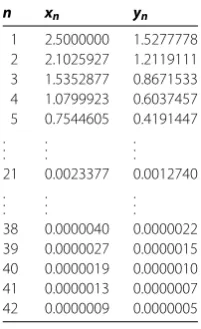
Next, we give a numerical example to support Theorem ..
Example . LetRbe the real line with the usual norm| · |and letD= [, ]. Define two single-valued mappingstandtonDas follows:
tx=sinx, tx=x.
Also we define two multi-valued mappingsTandTonDas follows:
Tx=
[,x], x= ;
{}, x= ; Tx=
x ,
x
.
Let{xn}and{yn}be generated by
yn=βn()xn+i=β (i)
nzn(i), zn(i)∈Tixn,
xn+=αn()xn+
i=α (i)
ntinyn, n∈N,
(.)
where αn() = n+n, αn()= n–n , α()n = n–n, βn() = n+n , βn()= n–n, βn()= n–n , for all
n∈N. Then the sequences{xn}and{yn}converge strongly to , where{}=
i=F(ti)∩
i=F(Ti).
Solution It is shown in[]that both tand tare generalized asymptotically nonexpan-sive single-valued mappings.Moreover,they are uniformly L-Lipschitzian mappings and
i=F(ti) ={}.It is easy to see that both Tand Tare quasi-nonexpansive multi-valued mappings satisfying condition(E)andi=F(Ti) ={}.Thus,
i=F(ti)∩
i=F(Ti) ={}.
For every n∈N,αn()=n+n,αn()=nn–,α()n =n–n,βn()=n+n ,βn()= n–n,βn()=n–n .
Then the sequences{αn()},{αn()},{α()n },{βn()},{βn()},and{βn()}satisfy all the conditions of
Theorem..Put zn()=xn and zn()=xn for all n∈N.Then the algorithm(.)becomes
yn= (+n)xn,
xn+= (+n–n)xn+ (nn–)tnyn, n∈N.
(.)
Table 1 The values of the sequences{xn}and{yn}in Example 3.6
n xn yn
1 2.5000000 1.5277778 2 2.1025927 1.2119111 3 1.5352877 0.8671533 4 1.0799923 0.6037457 5 0.7544605 0.4191447 .
. .
. . .
. . . 21 0.0023377 0.0012740 .
. .
. . .
. . . 38 0.0000040 0.0000022 39 0.0000027 0.0000015 40 0.0000019 0.0000010 41 0.0000013 0.0000007 42 0.0000009 0.0000005
Finally, we prove a weak convergence theorem in uniformly convex Banach spaces.
Theorem . Let D be a nonempty, closed, and convex subset of a uniformly convex Banach space X with the Opial property. Let {ti}Ni= be a finite family of uniformly L-Lipschitzian and generalized asymptotically nonexpansive single-valued mappings of D into itself with sequences{kn} ⊂[,∞)and{sn} ⊂[,∞)such that
∞
n=(kn– ) <∞and
∞
n=sn<∞.Let{Ti}Ni= be a finite family of quasi-nonexpansive multi-valued mappings of D into KC(D)satisfying the condition(E).Assume thatF=Ni=F(ti)∩
N
i=F(Ti)is
nonempty and Tip={p}for all p∈Fand i= , , . . . ,N.Let x∈D and the sequence{xn}
be generated by
yn=βn()xn+
N
i=β (i)
nzn(i), zn(i)∈Tixn,
xn+=αn()xn+
N
i=α (i)
ntinyn, n∈N,
where{αn(i)}and{βn(i)}are sequences in[, ]for all i= , , . . . ,N such that <a≤αn(i),βn(i)≤
b< ,Ni=αn(i)= ,and
N
i=β (i)
n = .Then the sequence{xn}converges weakly to a point
inF.
Proof By Lemma .,{xn}is bounded. SinceXis uniformly convex, there exists a
subse-quence{xnj}of{xn}converging weakly top∈D. By Lemma ., we havelimj→∞xnj– z(nij)= andlimj→∞xnj–tixnj= for alli= , , . . . ,N. We will show thatp∈F. Since Tpis compact, for allj∈N, we can choosewnj∈Tpsuch thatxnj–wnj=dist(xnj,Tp) and the sequence{wnj}has a convergent subsequence{wnk}withlimk→∞wnk=w∈Tp. By condition (E), we have
dist(xnk,Tp)≤μdist(xnk,Txnk) +xnk–p. Then we have
xnk–w ≤ xnk–wnk+wnk–w
=dist(xnk,Tp) +wnk–w
≤μdist(xnk,Txnk) +xnk–p+wnk–w ≤μxnk–z
(i)
This implies that
lim sup
k→∞ xnk–w ≤
lim sup
k→∞ xnk–p.
From the Opial property, we havep=w∈Tp. Similarly, it can be shown thatp∈Tipfor
alli= , . . . ,N. Thus,p∈Ni=F(Ti).
Next, by mathematical induction, we can prove that, fori= , , . . . ,N,
lim
j→∞
xnj–t
m
i xnj= for eachm∈N. (.)
Indeed, it is obvious that the conclusion it true form= . Suppose the conclusion holds form≥. Sincetiis uniformlyL-Lipschitzian, we have
xnj–t
m+
i xnj≤xnj–t
m
i xnj+t
m i xnj–t
m+
i xnj ≤xnj–t
m
i xnj+Lxnj–tixnj.
This shows thatlimj→∞xnj–t
m+
i xnj= for alli= , , . . . ,N. Hence, (.) holds. From (.), we have for eachx∈D,m∈Nandi= , , . . . ,N,
lim sup
j→∞ xnj–x=lim supj→∞
timxnj–x. (.)
Sincetiis generalized asymptotically nonexpansive, we get
lim sup
j→∞
tmi xn–timp≤lim sup j→∞
kmxnj–p+sm
.
Then we have
lim sup
m→∞
lim sup
j→∞
tmi xnj–t
m
i p≤lim sup j→∞
xnj–p. (.)
By Proposition ., we have
xnj–
p+tmi p
=
(xnj–p) +
xnj–t
m i p
≤
xnj–p +
xnj–t
m i p
–
gp–t
m i p.
It implies that
lim sup
j→∞
xnj–
p+tm i p
≤
lim supj→∞ xnj–p +
lim supj→∞
xn
j–t
m i p
–
gp–t
m
i p. (.)
By the Opial property and{xnj}converging weakly top, we obtain
lim sup
j→∞ xnj–p
≤lim sup
j→∞
xnj–
p+tm i p
Then, by (.), we have
gp–tmp≤lim sup
j→∞
xnj–t
m i p
– lim sup
j→∞ xnj–p
. (.)
It implies by (.), (.), and (.) that
lim sup
m→∞
gp–timp≤lim sup
m→∞
lim sup
j→∞
xnj–t
m i p
– lim sup
j→∞ xnj–p
≤.
This shows thatlimm→∞g(p–tmi p) = for alli= , , . . . ,N. Then the properties ofg
yieldlimm→∞p–tm
i p= for alli= , , . . . ,N. So we have
tip–p ≤tip–tim+p+tim+p–p
≤Lp–timp+tim+p–p→ asm→ ∞.
This implies thattip=pfor alli= , , . . . ,N. Thus,p∈
N
i=F(ti).
Hence, we obtainp∈F.
Finally, we show that{xn}converges weakly top. To show this, suppose not. Then there
exists a subsequence{xnl}of{xn}such that{xnl}converges weakly toq∈Dandq=p. By the same method as given above, we can prove thatq∈F. By Lemma .,limn→∞xn–p
andlimn→∞xn–qexist. It follows by Lemma . thatq=p. Thus,{xn}converges weakly
to a point inF.
Remark . Theorem . extends and generalizes the results of Sokhuma and Kaewkhao [] to a pair of a finite family of generalized asymptotically nonexpansive single-valued mappings and a finite family of quasi-nonexpansive multi-valued mappings satisfying con-dition (E). Theorems . and . extend and generalize the results of Eslamian [] and Eslamian and Abkar [] to a pair of a finite family of generalized asymptotically nonex-pansive single-valued mappings and a finite family of quasi-nonexnonex-pansive multi-valued mappings satisfying condition (E).
Competing interests
The authors declare that they have no competing interests.
Authors’ contributions
All authors contributed equally to the writing of this paper. All authors read and approved the final manuscript.
Author details
1Department of Mathematics, Faculty of Science, Chiang Mai University, Chiang Mai, 50200, Thailand.2Department of Mathematics, Faculty of Science and Technology, Nakhon Pathom Rajabhat University, Nakhon Pathom, 73000, Thailand. 3Research Center for Pure and Applied Mathematics, Research and Development Institute, Nakhon Pathom Rajabhat University, Nakhon Pathom, 73000, Thailand.
Acknowledgements
This paper was supported by the Thailand Research Fund under the project RTA5780007.
Received: 21 January 2015 Accepted: 1 April 2015 References
2. Saejung, S, Suantai, S, Yotkaew, P: A note on “Common Fixed Point of Multistep Noor Iteration with Errors for a Finite Family of Generalized Asymptotically Quasi-Nonexpansive Mapping”. Abstr. Appl. Anal.2009, Article ID 283461 (2009) 3. Markin, JT: Continuous dependence of fixed point sets. Proc. Am. Math. Soc.38, 545-547 (1973)
4. Sastry, KPR, Babu, GVR: Convergence of Ishikawa iterates for a multivalued mapping with a fixed point. Czechoslov. Math. J.55, 817-826 (2005)
5. Panyanak, B: Mann and Ishikawa iterative processes for multivalued mappings in Banach spaces. Comput. Math. Appl. 54, 872-877 (2007)
6. Shahzad, N, Zegeye, H: On Mann and Ishikawa iteration schemes for multi-valued maps in Banach spaces. Nonlinear Anal.71, 838-844 (2009)
7. Khan, SH, Yildirim, I: Fixed points of multivalued nonexpansive mappings in Banach spaces. Fixed Point Theory Appl. 2012, Article ID 73 (2012)
8. Khan, SH, Abbas, M, Ali, S: Fixed points of multivalued quasi-nonexpansive mappings using a faster iterative process. Acta Math. Sin. Engl. Ser.30(7), 1231-1241 (2014)
9. Garcia-Falset, J, Llorens-Fuster, E, Suzuki, T: Fixed point theory for a class of generalized nonexpansive mappings. J. Math. Anal. Appl.375, 185-195 (2011)
10. Abkar, A, Eslamian, M: Common fixed point results in CAT(0) spaces. Nonlinear Anal.74, 1835-1840 (2011) 11. Sokhuma, K, Kaewkhao, A: Ishikawa iterative process for a pair of single-valued and multivalued nonexpansive
mappings in Banach spaces. Fixed Point Theory Appl.2011, Article ID 618767 (2011)
12. Eslamian, M: Weak and strong convergence theorems of iterative process for two finite families of mappings. Sci. Bull. “Politeh.” Univ. Buchar., Ser. A, Appl. Math. Phys.75(4), 81-90 (2013)
13. Eslamian, M, Abkar, A: One-step iterative process for a finite family of multivalued mappings. Math. Comput. Model. 54, 105-111 (2011)
14. Xu, HK: Inequalities in Banach spaces with applications. Nonlinear Anal.16, 1127-1138 (1991)
15. Opial, Z: Weak convergence of the sequence of successive approximations for nonexpansive mappings. Bull. Am. Math. Soc.73, 595-597 (1967)
16. Xu, HK: Another control condition in an iterative method for nonexpansive mappings. Bull. Aust. Math. Soc.65, 109-113 (2002)
17. Schu, J: Weak and strong convergence of fixed points of asymptotically nonexpansive mappings. Bull. Aust. Math. Soc.43, 153-159 (1991)
18. Suantai, S: Weak and strong convergence criteria of Noor iterations for asymptotically nonexpansive mappings. J. Math. Anal. Appl.311, 506-517 (2005)