Amirkabir University of Technology (Tehran Polytechnic)
Vol. 46, No. 2, Fall 2014, pp. 57- 63
Amirkabir International Journal of Science& Research (Electrical & Electronics Engineering)
AIJ-EEE) )
Adaptive Simplified Model Predictive Control with Tuning
Considerations
A.S.Ashtari
1and
A. Khaki Sedigh
2٭1-MSc. Student, APAC Research Group, Industrial Control Center of Excellence, K.N.Toosi University of Technology, Tehran, Iran 2-Professor, APAC Research Group, Industrial Control Center of Excellence, K.N.Toosi University of Technology, Tehran, Iran
ABSTRACT
Model predictive controller is widely used in industrial plants. Uncertainty is one of the critical issues in real
systems. In this paper, the direct adaptive Simplified Model Predictive Control (SMPC) is proposed for
unknown or time varying plants with uncertainties. By estimating the plant step response in each sample, the
controller is designed and the controller coefficients are directly calculated. The proposed method is
validated via simulations for both slow and fast time varying systems. Simulation results indicate the
controller ability for tracking references in the presence of plant’s time varying parameters. In addition, an
analytical tuning method for adjusting prediction horizon is proposed based on optimization of the objective
function. It leads to a simple formula including the model parameters, and an indirect adaptive controller can
be designed based on the analytical formula. Simulation results indicate a better performance for the tuned
controller. Finally, experimental tests are performed to show the effectiveness of the proposed
methodologies
.
KEYWORDS
1-INTRODUCTION
Model Predictive Control (MPC) methods are widely used in industrial plants [1-3]. Dynamic Matrix Control (DMC) is a well-established method in Advanced Process Controllers (APC) [2]. This is due to the simple DMC implementation for stable industrial plants [4]. DMC employs methods for solving a constrained optimization problem such as the Quadratic Programming techniques (QP). As computational requirements can be high, simplified model predictive controller (SMPC) strategy was proposed that simplifies the calculations by considering only one coincidence point in the future. Control laws were proposed by minimizing the predicted error at a single coincidence point, steps ahead [5–7]. The control performance of SMPC has been successfully demonstrated in an industrial plant in [6]. It is shown in [8] that for many industrial applications, SMPC has a close performance to DMC.
The model accuracy has a key role in MPC design, but model uncertainties are always present in real applications that can decrease the system performance [9]. To cope with model uncertainties, adaptive MPC methods are proposed. Adaptive MPC strategies are in a relatively early stage of development in spite of deep achievements of MPC [10]. To handle uncertainties it is possible to update the model parameters based on the measurement data or to use switching adaptive MPC strategies. In switching adaptive MPC method, adaptation is done by switching between different models. An example of this method is introduced in [11]. A brief survey of adaptive MPC can be found in [10].
SMPC provides a closed loop performance that is close to DMC with less computational burden. Therefore, SMPC can be a practical solution to many industrial control problems. Moreover to cope with model uncertainties, adaption strategies are added to the SMPC design methods to give effective closed loop control. Direct adaptive SMPC and indirect adaptive SMPC are proposed. Tuning controller parameters are also vital for a desired closed loop system performance [12], hence an analytical tuning method for tuning SMPC prediction step is proposed, which can be employed in an indirect adaptive control strategy.
In section 2, the SMPC fundamentals based on DMC are briefly reviewed. Then, adaptive SMPC algorithm for directly achieving control signal parameters is proposed. In section 3, an analytical tuning method for tuning prediction step is developed and finally simulation results and practical implementations for validating the proposed controller are given in section 4.
2-DIRECT ADAPTIVE SMPC
2-1 SMPC FORMULATION BASED ON DMC
Formulation of SMPC based on DMC uses the step response of the system for prediction. The step response of a system can be described as follows [4]
(1) ( ) ∑
( )
Where is the sampled output value of the system for the step input in the sample. ( ) is the control effort
and ( ) ( ) ( ). The predicted output
value along the finite horizon in one point steps ahead, can be described as
(2)
̂( ) ( ) ( )
Where ( ) is the free response of the system, and is given by
(3)
( ) ( ) ∑(
) ( )
And is the real system output value, is the model horizon which is selected by for . The objective function for following one point steps ahead and penalizing control effort, is considered as follows
(4)
( ( ) ̂( )) ( )
Where is the penalized coefficient for the control effort. In order to obtain ( ), minimizing the objective function with ( ) leads to
(5)
( ) ( ( ) ( ) ∑ ( ) ( )) ( )
2-2 DIRECT ADAPTIVE SMPC FORMULATION
The main idea for designing the direct adaptive SMPC, is applying a predictive model identifier and using the identified parameters directly to obtain the control law. As the real output value is not available in future, the past data is used for approximation of the current output. By using (2) predicting current output from past data leads to
(6)
̂( ) ( ) ( )
∑(
) ( )
Parameter vector and the regressor vector ( ) are defined as
(7)
[ ( ) ( ) ( )]
( )
[ ( ) ( ) ( )]
(8)
̂( ) ( ) ( )
Considering ̂( ) ( ) and using the Recursive Least Squares (RLS) identification method, can be identified. Parameter vector and the regressor vector ( ) are defined as
(9)
[ ( ) ( ) ( )]
( )
[ ( ) ( ) ( ) ( )]
By using (9), control law (5) can be simply written as
(10) ( )
( ) ( )
Comparing (7) and (9), the control law (10) in terms of identified predictive model parameters is given by
(11)
( ) ( ( )( ) ) ( ) [ ( )
( ) ]
3- ANALYTIC TUNING METHOD FOR PREDICTION STEP
In order to obtain ( ), the objective function is minimized by ( ). The main idea for tuning prediction step is minimizing the objective function by the prediction step ( ). In each sample, control law is achieved by (5) and then the objective function is minimized by prediction step to get the optimal for the next sample. The estimated First Order Plus Dead Time (FOPDT) model of the system is defined as
(12)
( ) ( )
( )
And the corresponding discrete time model with sampling time is given by
(13)
( ) ( )
Where
and the model dead time is an integer
multiple of the sampling time ( ). Unit step response coefficients of an FOPDT model (12) in terms of the discrete time model parameters (13) are given by
(14)
{
( )
Thus, the objective function (4) by using (14) can be written as (15) ( ( ) ( ) ( ) ( ) ∑ ( ) ( ) ( ) ∑ ( )) ( )
As (15) is derivable from parameter , minimizing the objective function by prediction step leads to
(16) ( ( ) ( ) ( ) ( ) ∑ ( ) ( ) ( ) ∑ ( )) ( ( ) ( ) ∑ ( ) ( ) ∑ ( ) ( ))
Assuming zero value for equation (16) leads to
(17) ( ) ( ) ( ) ( ) ∑ ( ) ( ) ( ) ∑ ( )
And several mathematical manipulations yield
(18)
( ) ( ) (∑ ( ) ∑ ( )) ( )
( ( ) ∑ ( ))
(19)
( )
( )
Since must be an integer number, analytical tuning formula result is rounded with constraint . If then is considered as If then is considered equal to the previous tuned prediction step. 4- SIMULATION AND EXPERIMENTAL
RESULTS
4-1 SIMULATION RESULTS
In this section, simulation results are used to demonstrate the effectiveness of the proposed adaptive SMPC ability for tracking time varying systems. In such cases, simple SMPC fails in tracking these signals. Simulation 1 is done to validate the controller performance for slow time-varying systems while simulation 2 validates the proposed method for fast time-varying systems. Simulation 3 verifies the proposed tuning method.
Simulation 1(slow time-varying system): Consider the following plant
(20)
Where change slowly from 5 to 10 and 1 to 10, respectively. For designing adaptive SMPC, only an estimation of delay value is needed and is considered 5.
are respectively considered as 200,200,100,0.1
. Adaptive SMPC implementation result is illustrated in fig 1. It is clearly observed in fig 1 that the controller can track the reference signals for the slow time-varying system
.
Fig. 1. Closed loop response for slow time varing system G1
Simulation 2 (Abrupt plant changes): Consider the following plant
(21)
The plant changes immediately in the second to
the following plant
(22)
( )
( )( )
Estimation of the delay value is considered 5.
are respectively defined 70,70,30,0.1.
Simulation result is shown in fig 2. It represents the ability of the proposed controller to track the reference signal for abrupt plant changes.
Simulation 3 (Tuning method): Consider the following plant
(23)
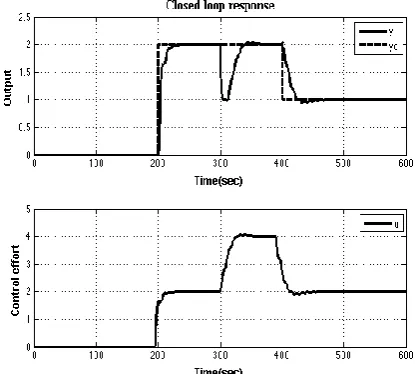
are respectively defined as 100,1. Fig 3 shows the results of an arbitrary tuned parameter ( ) and Fig 4 illustrates the results obtained with the tuned parameter (start from and tuned in each sample).
It is clearly observed that with the tuned prediction step, the overshoot and control effort become lower.
Fig. 3. Closed loop response without prediction step tuning
Fig. 4. Closed loop response with tuned prediction step
4-2 EXPERIMENTAL RESULTS
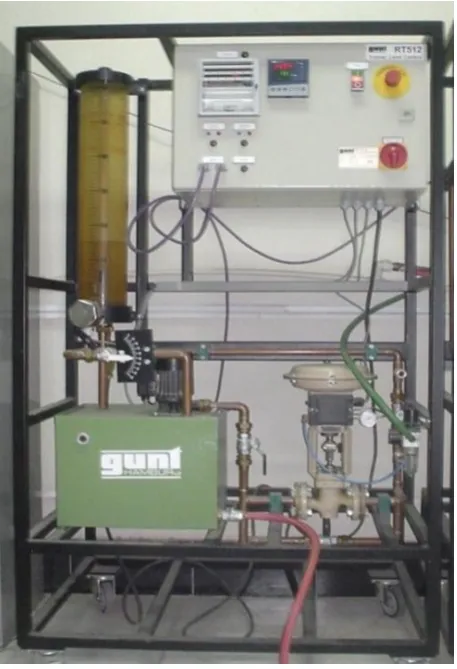
In this section, the proposed adaptive controller is implemented to a lab-scale water tank system. The system is shown in fig 5. The structure of the plant is introduced in [13]. The control goal is adjusting the water level to a desired value. Flow of the pumped water in tank for controlling water level is controlled by a control valve. The controller applies appropriate command to the control valve.
Implementation of adaptive SMPC
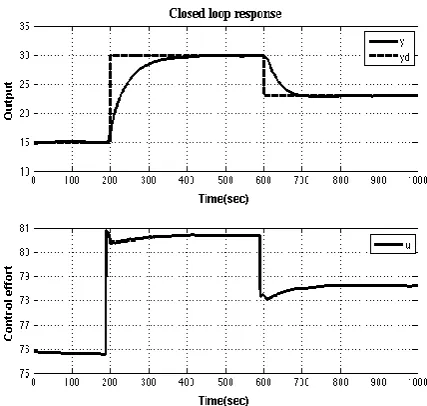
A delay value for the system is estimated ( ) and then controller is implemented. are respectively defined as 120,120,100. Implementation result of the adaptive SMPC is shown in fig 6. It’s obvious in fig 6 that the controller can track reference
Implementation of SMPC with tuning prediction step
System is estimated with an FOPDT model for the level range from 15 to 30. Estimated model is given by
(24)
( )
are respectively defined as 100,1. Fig 7 indicates the results of implementation with an arbitrary tuned parameter ( ) and figure 6 illustrates the results obtained with the tuned parameter (start from and tuned in each sample).
It is clearly observed that with the tuned prediction step, the overshoot and control effort become lower and the settling time is the same.
Fig. 6. Adaptive SMPC Implementation result for level control process
Fig. 7. SMPC Implementation result for level control process without prediction step tuning
Fig. 8. SMPC Implementation result for level control process with tuned prediction step
5- CONCLUSIONS
Direct adaptive SMPC is proposed for unknown or time-varying systems. The proposed controller ability for tracking reference inputs is indicated in the presence of time varying parameters and uncertainties. Using FOPDT as the system model, an analytical tuning method for tuning SMPC is obtained based on an optimization objective function with controller parameters. Simulation and experimental results demonstrate the effectiveness of the proposed controller in comparison with simple SMPC.
REFERENCES
[1] Richalet, J. (1993). Industrial applications of model based predictive control. Automatica, 29(5), 1251-1274.
[2] Qin, S. J., & Badgwell, T. A. (2003). A survey of industrial model predictive control technology. Control engineering practice, 11(7), 733-764.
[3] Morari, M., & Lee, J. H. (1999). Model predictive control: past, present and future. Computers & Chemical Engineering, 23(4), 667-682.
[4] Cutler, C. R., & Ramaker, B. L. (1980, August). Dynamic matrix control-a computer control algorithm. In Proceedings of the joint automatic control conference (Vol. 1, pp. Wp5-B). Piscataway, NJ: American Automatic Control Council.
[5] Gupta, Y. P. (1993). A simplified predictive control approach for handling constraints through linear programming. Computers in industry, 21(3), 255-265.
[6] Abou-Jeyab, R. A., Gupta, Y. P., Gervais, J. R., Branchi, P. A., & Woo, S. S. (2001). Constrained multivariable control of a distillation column using a simplified model predictive control algorithm. Journal of Process Control, 11(5), 509-517.
[7] Abou-Jeyab, R. A., & Gupta, Y. P. (2001). Constrained multivariable control of fluidized catalytic cracking process using linear programming. Chemical Engineering Research and Design, 79(3), 274-282.
[8] Gupta, Y. P. (1993). Characteristic equations and robust stability of a simplified predictive control algorithm. The Canadian Journal of Chemical Engineering, 71(4), 617-624.
[9] Fukushima, H., Kim, T. H., & Sugie, T. (2007). Adaptive model predictive control for a class of constrained linear systems based on the comparison model. Automatica, 43(2), 301-308.
[11] Kim, J. S., Yoon, T. W., Shim, H., & Seo, J. H. (2008). Switching adaptive output feedback model predictive control for a class of input-constrained linear plants. IET Control Theory & Applications, 2(7), 573-582.
[12] Bagheri, P., Khaki Sedigh, A. (2013). Analytical approach to tuning of model predictive control for first-order plus dead time models. IET Control Theory & Applications, 7(14), 1806-1817.
[13] Bagheri, P., Khaki-Sedigh, A. (2010). An ANOVA Based Analytical Dynamic Matrix Controller Tuning
Procedure for FOPDT Models. Amirkabir