Coherent Control of Quantum Entropy via Quantum
Interference in a Four-Level Atomic System
M. Sahrai, B. Arzhang,
*H. Seifoory, and P. Navaeipour
Research Institute for Applied Physics and Astronomy, University of Tabriz, Tabriz, Islamic Republic of Iran
Received: 10 January 2013 / Revised: 6 May 2013 / Accepted: 24 June 2013
Abstract
The time evaluation of quantum entropy in a four-level double-
type atomic
system is theoretically investigated. Quantum entanglement of the atom and its
spontaneous emission fields is then discussed via quantum entropy. It is found
that the degree of entanglement can be increased by the quantum interference
induced by spontaneous emission. The phase dependence of the atom-field
entanglement is also presented.
Keywords: Quantum entanglement; Quantum entropy; Quantum interference; Spontaneous emission
* Corresponding author, Tel.: +98(937)2646019, Fax: +98(381)3385072, E-mail: [email protected]
Introduction
Quantum correlation between different parts of a system leads to an important quantum phenomenon known as entanglement. A system consisting two components is said to be entangled if its quantum states cannot be described by a simple product of the quantum states of the two components [1]. The measurement on one of them gives information about the other component. Entanglement allows to reach a much closer relationship than is possible in classical physics. For a bicomponent system in a pure state, the reduced quantum entropy is the best tool for accurate measure of entanglement between two components [2-4].
The system is inseparable in such state, and each component does not have properties independent of the other component. The higher reduced quantum entropy, the higher degree of entanglement. In bicomponent systems, the entanglement can be established between two particles or between the particle and the field. The Einstein-Podolsky-Rosen (EPR) state [5] is an interesting example of two-particle components
entanglement which can be used in secure quantum communication [6]. Quantum entanglement can also be generated in a system with multipule components [7]. Entanglement plays an essential role in quantum information processing such as quantum computing [8], quantum teleportation [9], quantum cryptography [10], and quantum communication [11].
fields was theoretically discussed in two different three-level configurations, i.e. type and V-type [14]. Fang et al. [15] investigated the effect of coherent superposition of the atomic level on the entanglement of a type three level atom and its spontaneous emission fields. It is shown that the atom-photon entanglement can be controlled by the initial coherent condition of the atomic levels. Phase control of the entanglement has also been proposed by Malinovsky et al. [16].
Atomic coherence and quantum interference, on the other hand, are the basic mechanisms for controlling the optical properties of the medium. Over the past few years, much attention has been devoted to the effects of quantum interference between multiple atomic transitions pathways and its applications for controlling the coherent phenomena such as electromagnetically induced transparency (EIT) [17]. In fact, the discovery of EIT has opened up a new route to control the optical properties of atom-photon coherent interaction [18]. It is also shown that the spontaneous emission can be used to produce atomic coherence as long as there exist two closely-lying levels with non-orthogonal dipole in an atomic system. Atomic coherence based on spontaneous emission is usually referred to as vacuum-induced coherence or spontaneously generated coherence
(SGC)[19]. Quantum interference induced by
spontaneous emission, however, can modify the response of atomic system to the applied fields [20].
Now, intriguing question arises that what is the effect of quantum interference on the atom-photon entanglement. It would be interesting to increase the degree of atom-photon entanglement via quantum interference arising among decay channels. In fact, quantum interference induced by spontaneous emission has recently been employed to coherent control of quantum entropy which can turn in quantum entanglement. The effect of quantum interference on the entanglement of a driven V-type three-level atom and its spontaneous emission fields has recently been discussed. It is predicted that in the absence of quantum interference the atom and its spontaneous emission fields are always entangled. However, in the presence of quantum interference the atom-photon entanglement will depend on the atomic parameters [21].
In this paper, the effect of quantum interference on entanglement of a coherently driven four-level double-Ʌ
type atom and its spontaneous emission fields is investigated. The time evolution of the reduced atomic entropy is proposed to reach the entanglement of the atom and its spontaneous emission fields. The effect of coupling laser fields on entanglement of the atom and
its spontaneous emission fields is then discussed. It is found that the entanglement of the atom and its spontaneous emission fields strongly depends on the quantum interference induced by spontaneous emission. In addition, we find that the quantum entropy (and also the atom-photon entanglement) becomes phase depen-dent when the interference parameter is switched on.
Materials and Methods
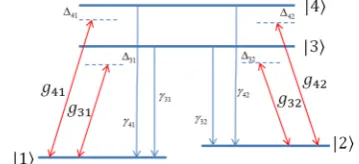
Consider a four-level atomic system in a double-Ʌ
configuration as depicted in Fig. 1. The scheme is consisting two metastable lower levels 1 , 2 , and two
excited levels 3 , 4 . The electric-dipole allowed
transitions 1 3 , 2 3 , and 2 4 are
driven by three coherent strong laser fields, respectively. The corresponding Rabi-frequencies are denoted by g31 E31.31/
, g32 E32.32/
and
42 42 42. /
g E . The other transition 1 4 is
driven by a weak coherent field, where its Rabi-frequency is given by g41E41.41/. Here, ij
are
the corresponding atomic dipole moments, while Eij
denotes the amplitude of coherent laser fields. The spontaneous decay rates from level i
i {3, 4}
to the level j
j{1, 2}
are denoted by 2ji.The dynamics of the system is described by the density matrix equation of motion
[ , ] ,
i H
(1)
where H is the interaction Hamiltonian of atom and
fields. The term represents the decay processes,
where is the liouvillian operator acting on the
density matrix . The density matrix elements in
rotating frame and rotating wave approximation are given by:
11 31 31 31 13 41 41 41 14
13 33 14 44
22 32 32 32 23 42 42 42 24
23 33 24 44
*
12 32 31 12 31 32 32 13
*
41 42 42 14 12 12
1 31 32 33
2 2 ,
2 2 ,
( )
2(
ig ig ig ig
ig ig ig ig
i ig ig
ig ig
2 41 42 44
33 31 31 32 32 31 13
32 23 3 33
13 31 13 31 33 11 32 12
41 43 13 13
14 32 31 42 14 41 44 11
42 12 31 34 14 14
23 ) , 2 , ( ) , ( ) ( ) , i e
ig ig ig
ig
i ig ig
ig i ig ig ig
32 23 32 33 22 31 21
42 43 23 23
24 42 42 42 44 22 41 21
32 34 24 24
34 42 32 34 31 14 32 24
41 31 42 32 34 34
44 11 22 33
( ) , ( ) , ( ) , 1 ,
i ig ig
ig
i ig ig
ig
i ig ig
ig ig (2)
where ij ij j are the laser field detuning. Here ij i j
denote the frequency deference between level i and level j , and j is the frequency of coupling fields. We have further defined j 1j 2j, and our chosen level scheme implies 120.
(2 2 ) / 2( {1, 2}
ij i j i
and j{3, 4}) are the damping rate of the coherences on transitions i j .
The term (2 1 31 32 33) (2 2 41 42 44) in Eqs. 2 represents the quantum interference resulting from the cross coupling between spontaneous emission paths
3 1and 3 2 ( 4 1 and 4 2 ). Note that in a V- type three- level system only for nearly degenerate upper levels the effect of quantum interference could be appeared in equations. However,
for a given type system only for nearly degenerate lower- levels the effect of SGC become significant, and for large lower energy level separation it may be dropped [22, 23]. In a double type atomic system considered here, two extra coherence terms (SGC)
appear between the lower levels due to the spontaneous decay from the upper levels to the nearly degenerate lower levels. The deriving laser fields coupled to this coherence allow additional path for the transitions from the upper levels to the lower levels and thus accounts for the interference effects in the coherence terms given by Eqs. 2. The parameters 1 and 2 denote the alignment of the two dipole moments, which define as
31 32
1 1
31 32
.
( cos )
.
41 42
2 2
41 42
.
( cos )
.
. Here,
ij
represents the electric dipole moment, 1( )2 is the
angle between the two induced dipole moments
31 32
(4142). According to their definition, the
alignment factor takes the value 1 for parallel dipole moments, −1 for antiparallel, and 0 for orthogonal. Maximal coherence corresponds to parallel or antiparallel dipole moments, while zero coherence corresponds to orthogonal dipole moments. These two extremes of maximal and minimal coherence deserve special attention. However, intermediate values on the
[−1, 1] internal are also possible. In a real experiment the parameter 1 2 can be determined by the intensity of applied fields. In fact, the coefficient η depends on angle between two electric dipole moments, which can be controlled by the intensity of applied fields. Eqs (2) show that the relative phase appear in equation only through 1 and 2. In fact, if we use
3
1 2 4
41 41 , 42 42 , 31 31 32 32 ,
i
i i i
g g e g g e g g e and g g e and redefining the atomic variables in equations (2) as
3
1 2 4
41 41 , 42 42 , 31 31 , 32 32
i
i i i
e e e e
,
4 3 ( ) 12 12
i
e
and
4 3 2 1
( ) ( ), we obtain equations for the reduced density matrix elements ij. The equations are identical to equations (2), except that
1
and 2 replaced by 1 1
i e
and 2 2
i e
with ( 4 3)[24]. Therefore, for a nearly degenerate lower levels the effect of SGC should be taken into account, thus the system becomes completely phase dependent.
reduced-density operators by
( ) ( I ln I), ( , )
i i i i
S t Tr i a f . (3)
The entropy of a general two-component quantum system are linked by a remarkable theorem presented by Araki and Lieb [25], which states
( ) ( ) ( ) ( ),
a f af a f
S t S t S S t S t (4)
where { I ln I}
af i i
S Tr is the total entropy of the atom-spontaneous emission fields system. We assume that the atom and the vacuum fields are initially in a disentangled pure state, so the total entropy Saf of the atom-spontaneous emission fields system is zero. One immediate consequence of inequality (4) is
( ) ( )
a f
S t S t . Consequently, we only need to calculate the atomic quantum entropy S ta( ) to discuss the entanglement of the atom and fields. We can also express the Ʌ-type four-level atomic quantum entropy in terms of the eigenvalues aj( )t of reduced atomic
density operator by
4
1
( ) ( ) ( ) ln( ( ))
a f aj aj
i
S t S t t t
. (5)Now, we discuss the atom-photon entanglement only by the atomic quantum entropy S ta( ) given by equation (3) and (5).
Results and Discussion
In this section, we numerically calculate the entanglement between the atom and its spontaneous emission fields via equations (2) and (3). The evaluation of the quantum entropy is employed to determining the quantum entanglement of the atom and its spontaneous emission fields. In particular, the effect of quantum interference due to the spontaneous emission, i.e. SGC, on entanglement of the atom and its spontaneous emission fields is then discussed. We assume that the atomic system is initially in superposition of upper levels 3 and 4 . In addition, we choose
31 32 41 42
and all figures are plotted in unit of . Quantum entropy S ta
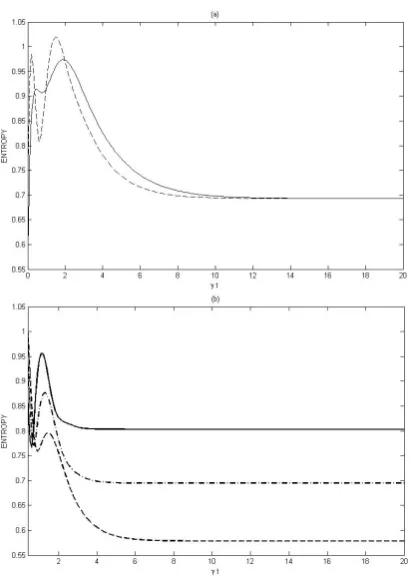
versus normalized time t is displayed in Fig. 2. From Fig. 2a, we observe that for g41g420(solid) and g31g320(dashed)the quantum entropy increases and finally reaches to a constant value at the steady state as normalized time increases. In fact, for g41g420 (or g31g32 0) the medium converts to a three level Ʌ-type atomic
Figure 2. The time evolution of the atomic quantum entropy
as a function of normalized time t. The intensity of applied
fields are (a)g321.5 g310.01 , g41g420(solid line),
41 42 1.5 31 32 0
g g and g g (dashed line), and (b)
41 42 32 0.9
g g g (dashed line), 1.2 (dashed-dotted line),
1.5 (solid line), and g310.01 . Other parameters are
41 42 31 32 1
, and 0, 31 32 42 0.
Figure 3. The effect of quantum interference induced by spontaneous emission on quantum entropy. (a) The parameters
are g41g42g321.5, g310.01, 0
(dashed-dotted), 0.5(dashed), 1(solid). Other parameters are
41 42 31 32 1
system, and the results are in a good agreement with the obtained results of ref. [15]. The effect of intensity of coupling fields on quantum entropy is displayed in Fig. 2b. In this case the degree of entanglement of the atom and its spontaneous emission fields depends on the intensity of coupling laser fields. Physically, strong coupling fields create strong atomic coherence that leads to strong correlation between the atom and fields. This may explain the enhancement of entropy by the intensity of coupling laser fields.
It is well known that atomic coherence and quantum interference are the basic mechanisms for controlling the optical properties of the medium. On the other hand, atomic coherence induced by spontaneous emission, i.e. SGC, substantially changes the correlation between the atom and fields. Here, we investigate the effect of quantum interference induced by spontaneous emission, i.e. SGC, on behavior of the quantum entropy in Fig. 3. We observe that the quantum entropy increase by
increasing the quantum interference parameter . So,
for 1 21 the degree of entanglement of the
atom and its spontaneous emission fields is larger than
1 2 0
. In fact, the four-level double-Ʌ type atom and its spontaneous emission fields are strongly entangled due to the quantum interference induced by spontaneous emission fields.
Now, we propose the effect of the relative phase of applied fields on entanglement between the atom and its spontaneous emission fields. It has already been shown that the Ʌ -type three-level atomic system with SGC is completely phase dependent, and phase appears in
equations through parameter [20]. So, the
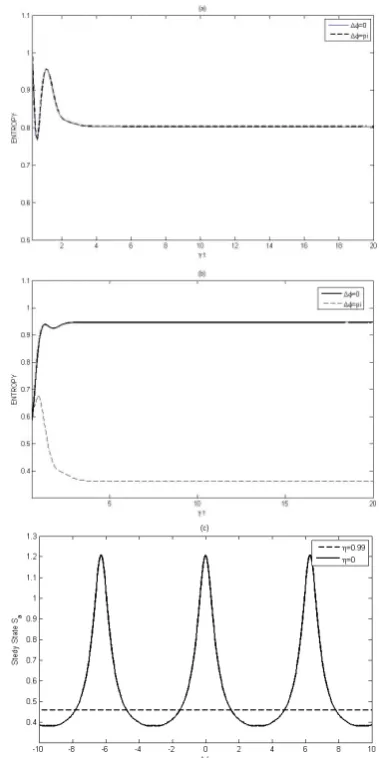
entanglement between the atom and its spontaneous emission fields should depend on the relative phase of applied fields. The phase variation of the entanglement for different values of quantum interference is shown in Fig. 4. In the absence of quantum interference, i.e.0
, the entanglement of the atom and the fields is phase independent Fig. 4a, while for 1 the entanglement substantially changes by changing the relative phase of applied fields (Fig. 4b). The phase variation of the quantum entropy is also displayed in Fig. 4c. We observe that for even multiples of , the atom and the fields are strongly entangled, while for odd multiples of
the degree of entanglement of the atom and
spontaneous emission fields is substantially reduced. Physically, the change of phase difference between applied fields may change the direction of the dipole
moments; thus it changes parameter . The parameter
may directly affect in the quantum entropies, which
implies the entanglement of the atom and its
Figure 4. The steady state atomic quantum entropy as a
function of normalized time γt for (a) η=0, Δφ=0 (solid line)
and Δφ=π (dashed line), and for (b) η=1, Δφ=0 (solid line) and
Δφ=π (dashed line). (c) The venation of steady state quantum
entropy versus relative phase Δφ for η=1 (solid line), and η=0
(dashed line). Other parameters are same as Fig. 2.
Figure 5. The steady state atomic quantum entropy as a
function of as a function of Δ31 for η=0.99.
spontaneous emission fields. Frequently detuning has an important role in creation the entanglement between atom and its spontaneous emission fields. The steady state entropy S ta( ) as a function of 31 is displayed in Fig. 5. It can be realized that the degree of entanglement between the atom and its spontaneous emission fields are substantially decrease for 31 0. However, around
zero detuning the atom and the fields are strongly entangled.
References
1.Bennett, C.H. DiVincenzo, D.P. Smolin, J.A. Wootters,
W.K. Mixed-state entanglement and quantum error
correction. Phys. Rev. A, 54: 3824–3851 (1996).
2.Bennett, C.H. Bernstein, H.J. Popescu, S. Schumacher, B.
Concentrating partial entanglement by local operations.
Phys. Rev. A, 53: 2046–2052(1996).
3.Phoenix, S.J.D. Knight, P.L. Fluctuations and entropy in
models of quantum optical resonance. Ann. Phys. (NY).
186: 381–386 (1988).
4.Phoenix, S.J.D. Knight, P.L. Establishment of an
entangled atom-field state in the Jaynes-Cummings model.
Phys. Rev. A. 44: 6023–6027 (1991).
5.Einstein, A. Podolsky, A.B. Rosen, N. Can
Quantum-Mechanical Description of Physical Reality Be Considered
Complete?. Phys. Rev.47: 777–780 (1935).
6.Bennett, C.H. Brassard, G. Quantum Cryptography, In
Proceedings of the IEEE International Conference on Computers, Systems, and Signal Processing. Bangalore, India, 10–12 December; 175–179 (1984).
7.Fox, M. Quantum Optics: An Introduction, 1st ed.; Oxford
University Press: New York, NY, USA, 221–230 (2006).
8.Benenti, G. Casati, G. Strini, G. Principles of Quantum
Computation and Information. World Scientific Publishing Company: Singapore, Volume 1 (2004).
9.Bennett, C.H. Brassard, G. Crepeau, C. Jozsa, R. Peres, A.
Wootters, W.K. Phys. Rev. Lett. 70: 1895–1899 (1993).
10.Ekert, A.K. Quantum cryptography based on Bell’s
theorem. Phys. Rev. Lett.67: 661–663 (1991).
11.Bouwmeester, D. Pan, J-W. Mattle, K. Eibl, M.;
Weinfurter, H. Zeilinger, A. Experimental Quantum
Teleportation. Nature, 390: 575–579 (1997).
12.Abdalla, M.S. Abdel-Aty, M. Obada, A.S.F. Entropy and
entanglement of time dependent two-mode
Jaynes-Cummings model. Phys. A, 326: 203–219 (2003).
13.Huang ,Ch. Tang, Li. Kong, F. Fang, J. Zhou M. Entropy
evolution of field interacting with V-type three-level atom
via intensity-dependent coupling. Physica A. 368: 25–30
(2006).
14.Mortezapour, A. Abedi, M. Mahmoudi, M. Khajehpour,
M.R.H. Phase-controlled atom-photon entanglement in a three-level V-type atomic system via spontaneously
generated coherence. J. Phys. B: At. Mol. Opt. Phys. 44:
085501–085506 (2011).
15.Mao-Fa Fang , Shi-Yao Zhu. Entanglement between a Λ
-type three-level atom and its spontaneous emission fields.
Physica A. 369: 475–483 (2006).
16.Malinovsky, V.S. Sola, I.R. Quantum Phase Control of
Entanglement. Phys. Rev. Lett. 93: 190502–190507
(2004).
17.Boller, K.J. Imamolu, A. Harris, S.E. Observation of
electromagnetically induced transparency. Phys. Rev. Lett.
66: 2593–2596 (1991).
18.Field, J.E.; Hahn, K.H.; Harris, S.E. Observation of
electromagnetically induced transparency in collisionally
broadened lead vapor. Phys. Rev. Lett. 67: 3062–3065
(1991).
19.Javanainen. Effect of State Superpositions Created by
Spontaneous Emission on Laser-Driven Transitions. J.
Europhys. Lett. 17: 407–412 (1992).
20.Mahmoudi, M. Sahrai, M; Tajalli, H. The effects of the
incoherent pumping field on the phase control of group
velocity. J. Phys. B: At. Mol. Opt. Phys. 39: 1825–1835
(2006).
21.Roshan Entezar, S. Disentanglement of atom-photon via
quantum interference in driven three-level atoms. Opt.
Commun.282: 1171–1174 (2009).
22.Li. Y and Xiao. M. Transient properties of an
electromagnetically induced transparency in three-level
atoms. Opt. Lett. 20:1489–1491 (1995).
23.Huang. H, Zhu. S.Y and Zubairy. M. S. Two-time
intensity correlation in a driven three-level system. Phys.
Rev. A. 53: 1834–1839 (1996).
24.Olga Kocharovskaya, Paul Mandel. Amplification without
inversion: The double-Λ scheme. Phys. Rev. A. 42: 523–
527 (1990).
25.Araki. M, Lieb. E. Entropy inequalities. Commun. Math.