EFFECT OF MICRONUTRIENTS FOLIAR APPLICATION ON YIELD AND QUALITY OF MAIZE
Muhammad Tahir* and Neelam Yasin*
Micronutrients have globally proven importantance in agriculture. The deficiency of micronutrients is an expected trend among cereal crops which confines yield and nutritional value of grains. A field trial was laid out to evaluate the effect of micronutrients on yield and quality of maize in randomized complete block design (RCBD) at Agronomic Research Area, University of Agriculture, Faisalabad . The treatments comprised of no micronutrient application (control), water spray and foliar application of micronutrients mixture @ 250, 500, 750, 1000, 1250 and 1500 ml ha at stem elongation stage of maize. All micronutrients treatments significantly improved plant height, cob length, number of grains rows cob , cob weight, 1000-grain weight, grain yield, biological yield, harvest index, grain protein and grain oil contents. However, micronutrients application at stem elongation stage showed non-significant effect on plant papulation and number of cobs plant . Therefore, for attaining maximum yield of maize, it is suggested that 250 ml ha at stem elongation stage of maize should be used.
-1
-1
-1
-1
Maize; Micronutrients; Stem Elongation; Yield; Yield Components; Oil Contents; Pakistan.
ABSTRACT:-Key Words:
INTRODUCTION
Maize ( L.) is the most important and high yielding cereal crop in the world. Regarding produ-ction it ranks first worldwide, while in Pakistan, it ranks third after wheat and rice. Maize is cross pollinated annual crop belonging to family Poaceae. Its grain comprises starch (72%), protein (10%), fiber (5.8%), edible oil (4.8%), sugar (3.0%) and several important minerals and vitamins (Farhad et al., 2009). Aver-age yield of maize is about 3.49 t ha and average annual grain produ-ction is about 3.26 mt in Pakistan. Maize fulfills the demand of rapidly increasing population, in the form of food, feed, fodder and as raw material for industry (Tahir et al., 2009). The
Zea mays
-1
yield potential of rice maize system is about 40-65%, and to meet the future food demands, it is necessary to increase the yield potential up to 70-80% (Cassman et al., 2002). It is important to adopt improved package of production technology for better production of maize. Its Micronutri-ents have globally proven importance in agriculture. Plants require a balan-ced dose of micronutrients (Fe, Zn, Cu and Mn) at cellular and systematic level for achieving their maximum yield (Puig and Penarruba, 2009). The micronutrients (iron, zinc, copper, molybdenum, boron, manganese and chlorine) are basic ingredients for the growth and development of plants and they are consumed in lower quantity as compared to nitrogen, phosphorus and potassium. The
*
Corresponding author:
micronutrients such as iron, zinc and manganese play an important role in the corn nutrition as compared to other elements (Zarabimafi and Pour, 2014).
Among micronutrients, copper, zinc and boron looked more deficient for the productivity and growth of the plants. Ambak et al. (2015) suggested that micronutrients deficiency dra-matically decreased the yield of barley and rice. Wide range of nutrients deficiency occurs in field due to in-tensive crop rotation and imbalanced fertilizer used (Ghaffari et al., 2011). Micronutrients play an active role in the plant metabolism process star-ting from cell wall development to respiration, photosynthesis, choloro-phyll formation, enzyme activity, nitrogen fixation and reduction (Adihkary et al., 2010). Yield and grain production increased due to proper use of micronutrients (John-son et al., 2005). Balanced plant nutrition with the application of micronutrients can decrease the expense of costly fungicides and pesticides (Rivera et al., 2003). Micronutrients availability to plants is significantly affected by the soil fertility (Aref, 2012) as soil pH affects the copper, zinc and manganese accessibility. The yield, quality and macronutrients use efficiency was improved up to 50% by supplying plants with micronutrients, either through soil application, foliar appli-cation, or seed treatment (Ghaffari et al., 2011). Foliar applied fertilizer is a valuable tool in agric-ulture. Aref et al. (2011) found that the effectiveness of foliar application is 6 to 20 times more as compared to soil application. Recent study has shown that foliar application of micronutrients (Fe, Zn and Mn) significantly increased the yield of crop (Bahrani and Pourreza,
2014). Holloway et al. (2006) reported that Zn and Mn were 40-60% more effective when applied as a separate fluid than coated granules or blended fertilizer when banded.
Therefore, the present study was conducted to evaluate the effect of foliar application of micronutrients on yield and quality of maize under prevailing conditions of Faisalabad, Pakistan.
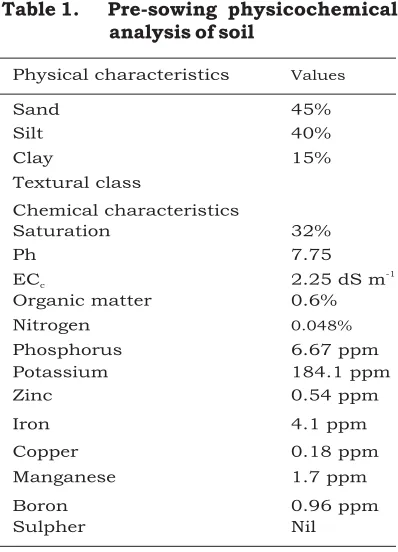
A field trial was laid out to evalu-ate the effect of micronutrients on growth, yield and quality parameters of maize crop at Agronomic Research Area, University of Agric-ulture, Faisalabad (a semi-arid area, 31.26˚N latitude 73.06°E longitude, 184.4 m above sea level), Pakistan during spring 2014,. The experiment was done in 6 m × 3 m plot size with three replications arranged in randomized complete block design (RCBD). Soil sampling was done before sowing of crop, according to method used by Chapman and Pratt (1978). The pre sowing physicochemical analysis of the soil was ascertained (Table 1).
Seed bed was prepared for maize by using 3-4 ploughing and 1-2 plan-king (planplan-king was done to crush the hard clods to smoothen the soil sur-face and to compact the soil lightly). Soil was leveled by using laser land leveler. Maize was sown during 1 week of March 2014. The maize hybrid Monsanto DK-9108 was used as test crop. Sowing was done by using dibbling method with row to row distance of 75 cm and plant to plant distance 15 cm was main-tained. Seed rate used was 25 kg ha . Recommended doses of Nitrogen (N), Phosphorus (P) and Potassium (K)
MATERIALS AND METHOD
st
fertilizers were applied @ 247-171-124 kg ha using urea, diamonium phosphate and sulphate of potash as the sources. Half dose of N and whole of P and K were applied at the time of sowing while the remaining nitrogen was applied in splits. Irrigation was applied at critical growth stages; first irrigation after one week of germ-ination, then next irrigation after
-1
eight days interval till silking, then three to five days interval till grain formation by keeping it in mind of the rain fall and no moisture stress after silking stage. Weather data (tempera-ture, relative humidity and rainfall) during crop season was also obtained (Figure. 1).
All other agronomic practices were kept normal. Micropower was used as a source of micronutrients. It is solution of micronutrients (Zn 4.7%, B 1.0%, Fe 2%, Mn 2.0% and Cu 0.3%). Different concentrations of micropower were added in 247 l ha of water. The experiment comprised the following treatments: T = Control (No spray), T = Water spray, T = 250 ml ha , T = 500 ml ha , T = 750 ml ha , T = 1000 ml ha , T = 1250 ml ha , T = 1500 ml ha . It was sprayed with the help of hand sprayer at stem elongation stage. Crop was harvested at maturity on June 18, 2014. Twenty plants were selected as a sample to estimate the morphological char-acters and seed oil and protein contents. Crude oil in seed was determined according to AOAC (1995). Seed protein was determined according to Kjeldhal method (Bremner, 1964). The data was
-1
-1 -1 -1
-1 -1
-1
1
2 3
4 5
6 7 8
Figure 1. Weekly maximum and minimum temperature, relative humidity and rainfall during crop season
Weeks after sowing 14
12 10 8 6 4 2 0
RAIN
115 29 12 210 24 7 21
115 29 12 210 24 7 21
Weeks after sowing R.H.
100
80
60
40
20
0
115 29 122 10 24 7 21
Weeks after sowing
TMAX TMIN
0 50 60
40
30
20
10
TEMPERATURE
(
C)
o
Physical characteristics Values
Sand 45%
Silt 40%
Clay 15%
Textural class
Chemical characteristics
Saturation 32%
Ph 7.75
ECc 2.25 dS m
-1
Organic matter 0.6%
Nitrogen 0.048%
Phosphorus 6.67 ppm
Potassium 184.1 ppm
Zinc 0.54 ppm
Iron 4.1 ppm
Copper 0.18 ppm
Manganese 1.7 ppm
Boron 0.96 ppm
Sulpher Nil
collected on various yield and quality parameters and it was statistically analyzed by using Fisher's analysis of variance technique (Steel et al., 1997) and least significant difference (LSD) test at 5% probability was applied to test significance among treatment's means.
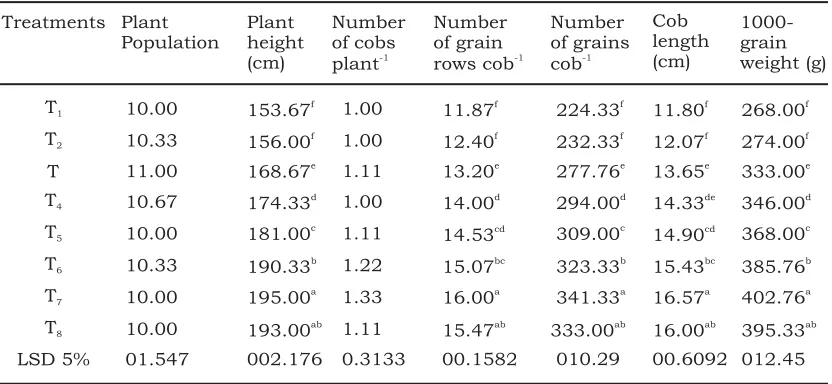
The levels of micronutrients affected significantly the plant height, number of cobs plant , number of grain rows cob , number of grains cob , 1000 grain-weight, biological yield, grain yield. Results showed that foliar application of micronutrients had no significant effect on plant population because thinning and gap filling was practiced to maintain the plant population. Plant height is an indication of growth and development factors, it takes part in grain yield as more green area more will be the photosynthetic activity. Maximum plant height (195 cm) was recorded when micronutrients was sprayed @ 1250 ml ha at stem elongation stage (Table.2). It was statistically at par with 1500 ml ha of micronutrients application (193 cm). While control showed the minimum plant height of maize (153.67 cm) which was statisti-cally at par with water spray (156 cm). The improvement of plant height might be due to foliar application of micronutrients at right time, right proportion and right method. Ghaffari et al. (2011) reported that foliar application of micronutrients improved the length of the plant.
The foliar application of micron-utrients had no effect on number of cobs per plant. Maize genotype is the second yield contributing factor, they concluded that number of cobs per
RESULTS AND DISCUSSION
-1
-1
-1
-1
-1
plant were significantly affected by genotypic variation (Barlog and Frckowiak-Pawlak, 2008; Harris et al., 2007).
The number of grain rows per cob is an important yield contributing parameter. The foliar application of micronutrients @ 1250 ml ha resul-ted in maximum number of grain rows (16) which was statistically at par with application@ 1500 ml ha producing 15.47rows. The minimum numbers of grain rows were recorded in control and water spray treatment (11.87 and 12.40, respectively). The maximum number of grains (341.33) were recorded when micronutrients sprayed @ 1250 ml ha . It was statis-tically at par with 1500 ml ha of micronutrients application (333). While minimum number of grains (224.33 and 232.33, respectively) was recorded in control and water sprayed treatment. Cob length is most impor-tant yield component. Greater the length of cob more would be the number of grains as a result higher the grain yield. Highest cob length (16.57 cm) was recorded when micronutrients sprayed @ 1250 ml ha which was statistically at par with 1500 ml ha of micronutrients application (16cm). While lowest cob length was recorded in control and water sprayed (11.80 cm and 12.07 cm, respectively). The foliar appli-cation of micronutrients improved the yield and yield contrib-uting parameters (Ghazvineh and Yousefi, 2012; Ghaffari et al., 2011; Yaseen et al., 2010). Micronu-trients plays an important role in metabolic functions of plants from cell wall development to respiration, photosynthesis, cholo-rophyll formation, enzyme activity and nitrogen fixation and reduction (Adhikary et al., 2010). The increase
-1
-1
-1
-1
-1
in number of grains per cob might be due to foliar application of micronu-trients mixture by increasing enzym-es activity, disease renzym-esistance, pollen.
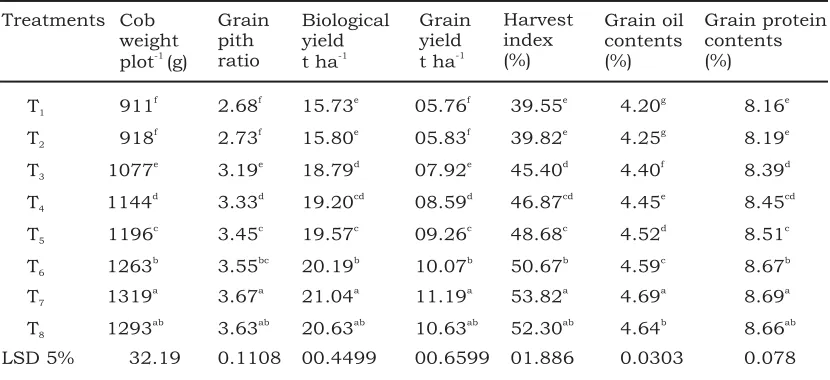
Results showed that foliar appli-cation of micronutrients significantly improved the 1000- grain weight of maize (Table 2). Maximum 1000-grain weight (402.76 g) was recorded when micronutrients sprayed @ 1250 ml ha . It was statistically at par with 1500 ml ha of micronutrients application (395.33 g). Minimum 100-grain weight was recorded in control and water sprayed (268 g and 274 g, respectively). Data revealed that cob weight per plot and grain pith ratio significantly affected by foliar application of micronutrients (Table 3). The maximum cob weight per plot (1319 g) was recorded when micronutrients sprayed @ 1250 ml ha . It was statistically at par with 1500 ml ha of micronutrients appli-cation (1293 g). Minimum cob weight per plot was recorded in control and water sprayed (911 g and 918 g). The maximum grain pith ratio (3.67) was
-1
-1
-1
-1
recorded when micronutrients spray-ed @ 1250 ml ha . It was statistically at par with 1500 ml ha of micronu-trients application (3.63). Minimum grain pith ratio was recorded in control and water sprayed (2.68and 2.73, respectively). The increase in cob weight might be due to foliar app-lication of micronutrients because micronutrients are involved in plant growth, biochemical and physio-logical processes (Salem and El-Ghizawy, 2012). The foliar appli-cation of micronutrients improved the grain pith ratio of maize due to combined effect of micronutrients in proper quantity and applied at proper time and method. Which enhanced reprodu-ctive growth and ultimately grain yield.
The maximum grain yield (11.19 t ha ) when micronutrients sprayed @ 1250 ml ha which was statistically at par with 1500 ml ha of micronu-trients application (10.63 t ha ). Minimum grain yield was recorded in control and water sprayed (5.76 t ha and 5.83 t ha , respectively).
Maxim--1
-1
-1
-1
-1
-1
-1
-1
Table 2. Effect of foliar application of micronutrients levels on yield and yield components of maize
Treatments Plant Population
Plant height (cm)
Number of cobs
plant-1
Number of grain
rows cob-1
Number of grains
cob-1
Cob length (cm)
1000-grain weight (g)
T1 10.00 153.67
f
1.00 11.87f
224.33f
11.80f
268.00f
T2 10.33 156.00
f
1.00 12.40f
232.33f
12.07f
274.00f
T 11.00 168.67e
1.11 13.20e
277.76e
13.65e
333.00e
T4 10.67 174.33
d
1.00 14.00d
294.00d
14.33de
346.00d
T5 10.00 181.00
c
1.11 14.53cd
309.00c
14.90cd
368.00c
T6 10.33 190.33
b 1.22
15.07bc
323.33b
15.43bc
385.76b
T7 10.00 195.00
a
1.33 16.00a
341.33a
16.57a
402.76a
T8 10.00 193.00
ab
1.11 15.47ab
333.00ab
16.00ab
395.33ab
LSD 5% 01.547 002.176 0.3133 00.1582 010.29 00.6092 012.45
um biological yield (21.04 t ha ) and harvest index (53.82%) was recorded when micronutrients applied @ 1250 ml ha which was statistically at par with 1500 ml ha of micronutrients spray (10.63 t ha ). While minimum biological yield and harvest index was recorded in control and water sprayed (Table 3). This results are in line with the findings of Safyan et al. (2012) who reported that foliar application of iron and zinc increased the carbo-hydrates, starch, indole acetic acid and protein in grain of maize. This will improve the yield of maize. The appli-cation of micronutrients combina-tions gave the highest biological yield as grain yield was also influenced which might be attributed to the additional availability of nutrients (Ali et al., 2008; Tabrizi et al., 2009). Ghaffari et al. (2011) reported that harvest index was increased by the application of micronutrients.
Grain oil and protein contents are an important quality parameters of maize. These are significantly affected by foliar application of
micronut--1
-1
-1
-1
rients (Table 3). Maximum grain oil contents (4.69%) were recorded when micronutrients sprayed @ 1250 ml ha . While minimum grain oil conte-nts were recorded in control and water sprayed (4.20% and 4.25%, respectively). Maximum protein contents (8.69%) were recorded when micronutrients sprayed @ 1250 ml ha which was statistically at par with 1500 ml ha of micronutrients application (8.66%). While minimum grain protein contents were recorded in control and water sprayed (8.16% and 8.19%, respectively). These results are in line with findings of Zarabimafi and Pour (2014) who reported that foliar application of micronutrients increased the seed protein content of maize. Ghaffari et al. (2011) reported that foliar appl-ication of micronutrients improved the grain oil contents of maize. The control and water spray treatments statistically showed same results regarding yield, yield contributing parameters and quality related parameters because only water spray
-1
-1
-1
Table 3. Effect of foliar application of micronutrients levels on yield and yield components of maize.
Treatments Cob weight
plot (g)-1
Grain pith ratio
Biological yield
t ha-1
Grain yield
t ha-1
Harvest index (%)
Grain oil contents (%)
Grain protein contents (%)
T1 911
f
2.68f
15.73e
05.76f
39.55e
4.20g
8.16e
T2 918
f
2.73f
15.80e
05.83f
39.82e
4.25g
8.19e
T3 1077
e
3.19e
18.79d
07.92e
45.40d
4.40f
8.39d
T4 1144
d
3.33d
19.20cd
08.59d
46.87cd
4.45e
8.45cd
T5 1196
c
3.45c
19.57c
09.26c
48.68c
4.52d
8.51c
T6 1263
b
3.55bc
20.19b
10.07b
50.67b
4.59c
8.67b
T7 1319
a
3.67a
21.04a
11.19a
53.82a
4.69a
8.69a
T8 1293
ab
3.63ab
20.63ab
10.63ab
52.30ab
4.64b
8.66ab
LSD 5% 32.19 0.1108 00.4499 00.6599 01.886 0.0303 0.078
might not be beneficial for optimum growth of the plant.
It is therefore, concluded that the foliar application of micronutrients positively affected all the studied characters of maize. However, foliar application of zinc @ 1250 ml ha at stem elongation stage of maize is the most suitable and beneficial to increase the production potential of maize under the agro ecological conditions of Faisalabad, Pakistan.
AOAC. 1995. Association of official analytical chemists. Official methods of analysis, 16 ed. AOAC International, Washin-gton, D. C. USA.
Adhikary, B. H., J. Shrestha and B. R. Baral. 2010. Effects of micro-nutrients on growth and produc-tivity of maize in acidic soil. Intern. Res. J. Appl. Sci. 1:8-15. Ali, S., A.R. Khan, G. Mairaj, M. Fida
and S. Bibi. 2008. Assessment of different crop nutrient m a n a g e -ment for yield improve-ment. Aus. J. Crop Sci. 2:150-157.
Ambak, K. and T. Tadano. 2015. Effect of micronutrient applic-ation on the growth and occur-ance of sterility in barley and rice in a Malaysian deep peat soil. Soil Sci. Plant Nutri. 37:715-724. Aref, F. 2011. Influence of zinc and
boron nutrition on copper, mang-anese and iron concentrations in maize leaf. Aus. J. Basic and Appl. Sci. 5:52-62.
Arif, F. 2012. Manganese, iron and copper contents in leaves of maize plants ( L.) grown with different boron and zinc micronutrients. Afr. J. Biot. 11:896-903.
Bahrani, A. and J. Pourreza. 2014.
-1
th
LITERATURE CITED
Zea mays
Effects of micronutrients on seed yield and oil content of
L. cv. Talayeh. Bangla-desh J. Bot. 43:231-233.
Barlog, P. and Frckowiak-Pawlak. 2008. Effect of mineral fertiliz-ation on yield of maize cultivars differing in maturity scale. Acta Sci. Pol. Agricultura 7:5-17. Bremner, J.M. 1964. Organic forms of
nitrogen. In: C.A. Black. et al. (eds.). Methods of soil analysis, Part-2. Amer. Soc. Agron., Inc., madison, Wisconsin. 9:1235-1255.
Cassman, K.G., A. D. Dobermann and D.T. Walters. 2002. N-use efficiency, and N management. J. Human Health . 31:132-140. Chapman, H.D., and R.F. Pratt. 1978.
Methods analysis for soil, plant and water. Univ. of California Div. Agric. Sci .p. 16-38
Farhad, W., M. F. Saleem, M. A. Cheema and H. M. Hammad. 2009. Effect of poultry manures levels on the productivity of spr-ing maize ( L.). J. Ani-mal Plant Sci. 19:122- 125. Ghaffari, A., A. Ali, M. Tahir, M.
Waseem, M. Ayub, A. Iqbal and A.U. Mohsin. 2011. Influence o f integrated nutrients on growth, yield and quality of maize (
L.). J. Plant ScI. 2:63-69. Ghazvineh, S. and M. Yousefi. 2012.
Study the effect of micronutrient application on yield and yield components of maize. J. Agric. Environ. Sci. 12:144-147.
Holloway, R., D. Brace, I. Richter, M. McLaughlin, G. Hettiarachchi and R. Armstrong. 2006. Micro-nutrient availability improved with fluids. Fluid J. 3:15-18. Hossain, M. B., T. L. Kumar and S.
Ahmad. 2001. Effect of zinc, boron and molybdenum appli-Brassica napus
Zea mays
cation on the yield and nutrient uptake by BRRI Dhan 30. J. Bio. Sci. 1:698-700.
Johnson, S.E., J.G. Lauren, R.M. Welch and J.M. Duxbury. 2005. A comparison of the effects of micronutrient seed priming and soil fertilization on the mineral nutrition of chickpea (
) , l e n t i l (
), rice ( ) and
wheat ( ) in
Nepal. Exp. Agric. 41:427-448. Puig, S., and L. Penerruba. 2009.
Placing metal micronutrients in context: transport and distri-bution in plants. Plant Biol. 12:299-306.
Rivera, J. A., C. Hotz, T.G. Lez G. Guerra. 2003. The effect of micro-nutrient deficiencies on child growth. Am. Soc. Nutr. Sci. 133:4010-4020. Safyan, N., M. R. Naderid arbagh
shahi and B. Bahari. 2012. The effect of microelements spraying on growth, qualitative and quantitative grain corn in Iran. Intern. Res. J. Appl. Basic Sci. 3:2780-2784.
Salem, H. M and N. K. B. El-Gizawy. 2012. Importance of micronu-trients and its application methods for improving maize (
Cicer
a r i e n t i n u m L e n s
culinaris Oryza sativa
Triticum aestivum
Zea -Cossı ´o, L. Neufeld and A.
mays
Zea mays
L.) yield grow in clayey soil. American-Eurasian J. Agric. Environ. Sci. 12:954-959.
Steel, R. G. D., J. H. Torrie and D.A. Dickey. 1997. Principles and pro-cedures of statistics a bio-metri-cal approach. McGraw Hill Book Co., Inc. New York. 3:400-428. Tabrizi, E. F.M., M. Yarnia, M.B.
Khorshidi and V. Ahmadzadeh. 2009. Effects of micro-nutrients and their application method on yield, crop growth rate (CGR) and net assimilation rate (NAR) of corn. J. Food Agri. Environ. 7: 611-615.
Tahir, M., N. Fiaz, M. A. Nadeem, F. Khalid and M. Ali. 2009. Effect of different chelated zinc sources on growth and yield of maize (
L.). Soil and Environ. 28:179-183.
Yaseen, A. A., E. A. A. bou El-Nour and S. Shedeed. 2010. Response of wheat to foliar spray with urea and micro-nutrients. J. Amer. Sci. 6:14-22.
Zarabimafi, F. and O. S. Pour. 2014. Effects of micro-nutrients foliar application on physiological traits and grain yield of sweet corn under water stress condi-tions. J. Acad. Appl. Stud. 4:40-55.
(Received August 2015 and Accepted Decembar 2016)
S.No Author Name Contribution to the paper
1. Dr. Muhammad Tahir Concived the idea, Overall management of the article Technical
input at every step
2. NeelamYasin Wrote Abstract, Methodology, Did SPSS Analysis, Data
Collection, Result and Discussion, Introduction References