Module 4
Circular Functions
What this module is about
This module will teach you about graphical representation of trigonometric functions how this function behave when plotted in a rectangular coordinate system and what shape will it be form. You will also learn to define and find the values of the six trigonometric functions of an acute angle which is in the standard position.
What are you expected to learn
This module is designed for you to :
1. Describe the properties of sine and cosine function 2. Draw the graph of sine and cosine function
3. Define the six trigonometric functions of an angle in standard position whose terminal point is not on the unit circle
4. Find the values of six trigonometric functions of an angle , given some conditions.
How much do you know
Given the following functions, identify the amplitude of :
1. y = 2 cos x 2. y = ¾ sin x 3. y = -2 sin 3/2 x
Given the following functions, determine the period of:
4. y = 2 cos ½ x 5. y = 4 sin 2/3 x 6. y = sin 1/5 x
Given the figure, find the values of the radius and the six trigonometric functions.
12
-5
8. r =
9. Sin A =
10. Cos A =
11. Tan A =
12. Cot A =
13. Csc A =
14. Sec A=
Find the values of the other five trigonometric function for /S if Tan S = -6/8, Sin S < 0
15. r =
16. Sin S =
17. Cos S =
18. Cot S =
19. Csc S =
What you will do
Lesson 1
Describe the properties of Sine and Cosine functions
Two properties of Sine and Cosine functions are amplitude and a period of a function. The function in the form of y = a sin bx, the amplitude is a of the function which is the maximum point of the graph and the period is 2/b where the graph repeat the cycle.
Example : Determine the amplitude and the period of the given function:
1. y = 3 sin 2x Solution:
a = 3; b = 2
a. amplitude is a = / a / = /3/ = 3 b. period is P = 2/b
= 2 /2 =
2. y = ½ cos x Solution:
a = ½; b = 1
a. amplitude is a = /a/ = /1/2 / = ½ b. period is P = 2 /b
= 2/1 = 2
3. y = -3 sin 4x Solution:
a = -3; b = 4
a. amplitude is a = /a / = /-3/ = 3 b. period is P = 2/ b
= 2/ 4 = /2
4. y = cos 4x Solution: a = 1; b = 4
a. amplitude is a = /a / = /1/ = 1 b. period is P = 2/b
= 2/4 = /2
a = -2/3; b = 1
a. amplitude is a = /a/ = /-2/3/ = 2/3 b. period is P = 2/b
= 2/1 = 2
Try this out
A. Determine the amplitude of the following functions. 1. y = 3 sin x
2. y = 2 sin 1/2x 3. y = 3/2 cos 2x 4. y = -2 c0s 2x 5. y = cos 4 x 6. y = 2 sin 2x 7. y = ½ sin x 8. y = ¾ sin ½ x 9. y = -4 sin 3x 10. y = -2 sin 3/2 x
B. Determine the period of the following functions. 1. y = 6 sin 2/3x
2. y = 5 sinx 3. y = 4 sin 1/2x 4. y = -1/2 cos 3/4x 5. y = 3 cos 1/2x 6. y = cos 3x 7. y = -3 sin 2/3x 8. y = -6 sin 2x 9. y = 2 sin 1/5x 10. y = sin 4x
Lesson 2
Draw the graph of Sine and Cosine functions where 0< A <2
To graph the sine or cosine function as y = sin x, where x represents the abscissa or the x-coordinate of a point while y represents the ordinate or the y-coordinate of a point. Start by constructing table of values assigning values of x a set of real numbers or angles in degrees and then solve for y. Then mark these points on the rectangular coordinate system following the table of values and connect forming a smooth curve.
Example 1: Construct table of values and draw the graph of y = sin x , 0 < x < 2.
Solution:
a = 1; b = 1
a. amplitude is a = /a/ = /1/ = 1 b. period is P = 2/b = 2/1 = 2
Table of values
x 0 /4 /2 3/4 5/4 3/2 7/4 2
Y 0 2/2 1 2/2 0 -2/2 -1 -2/2 0
The graph of Y = sin x
0 3 2
2 2
Example 2: Construct table of values and draw the graph of y = cos x , 0 < x < 2.
Table of values
x 0 /4 /2 3/4 5/4 3/2 7/4 2
Y 1 2/2 0 2/2 -1 -2/2 0 2/2 1
Graph of y = cos x
0 3 2
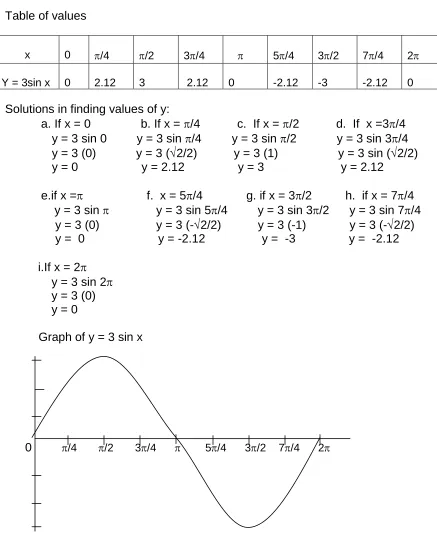
Example 3: Construct table of values and draw the graph of y = 3 sin x , where o < x < 2
Solution: a = 3; b = 1
[image:6.612.85.522.148.685.2]a. amplitude is a = /a/ = /3/ = 3 b. period is P = 2/b = 2/1 = 2
Table of values
x 0 /4 /2 3/4 5/4 3/2 7/4 2
Y = 3sin x 0 2.12 3 2.12 0 -2.12 -3 -2.12 0
Solutions in finding values of y:
a. If x = 0 b. If x = /4 c. If x = /2 d. If x =3/4 y = 3 sin 0 y = 3 sin /4 y = 3 sin /2 y = 3 sin 3/4 y = 3 (0) y = 3 (2/2) y = 3 (1) y = 3 sin (2/2) y = 0 y = 2.12 y = 3 y = 2.12
e.if x = f. x = 5/4 g. if x = 3/2 h. if x = 7/4 y = 3 sin y = 3 sin 5/4 y = 3 sin 3/2 y = 3 sin 7/4 y = 3 (0) y = 3 (-2/2) y = 3 (-1) y = 3 (-2/2) y = 0 y = -2.12 y = -3 y = -2.12
i.If x = 2 y = 3 sin 2 y = 3 (0) y = 0
Graph of y = 3 sin x
0 /4 /2 3/4 5/4 3/2 7/4 2
compared to the graph of y = sin x in example 1 but their period remain the same.
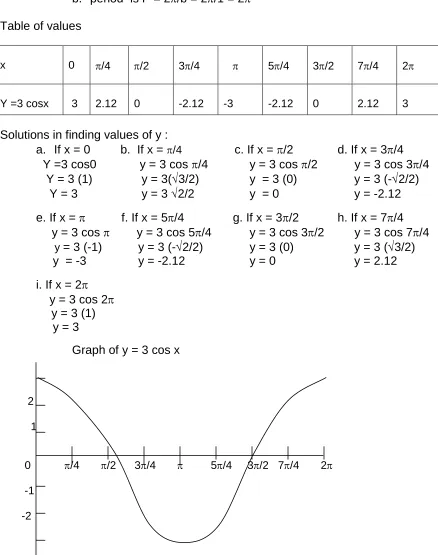
Example 4: y = 3 cos x , 0< x < 2 Solution:
A = 3 ; b= 1
[image:7.612.90.528.178.733.2]a. amplitude is a = /a/ = /3/ = 3 b. period is P = 2/b = 2/1 = 2
Table of values
x 0 /4 /2 3/4 5/4 3/2 7/4 2
Y =3 cosx 3 2.12 0 -2.12 -3 -2.12 0 2.12 3
Solutions in finding values of y :
a. If x = 0 b. If x = /4 c. If x = /2 d. If x = 3/4 Y =3 cos0 y = 3 cos /4 y = 3 cos /2 y = 3 cos 3/4 Y = 3 (1) y = 3(3/2) y = 3 (0) y = 3 (-2/2) Y = 3 y = 3 2/2 y = 0 y = -2.12
e. If x = f. If x = 5/4 g. If x = 3/2 h. If x = 7/4 y = 3 cos y = 3 cos 5/4 y = 3 cos 3/2 y = 3 cos 7/4
y = 3 (-1) y = 3 (-2/2) y = 3 (0) y = 3 (3/2) y = -3 y = -2.12 y = 0 y = 2.12
i. If x = 2 y = 3 cos 2
y = 3 (1) y = 3
Graph of y = 3 cos x
2
1
0 /4 /2 3/4 5/4 3/2 7/4 2
-1
- 3
Looking at the graph the amplitude shifted 3 units as compared to the graph of y = cos x but their period remained
unchanged.
Try this out
1. Construct the table of values and draw the graph of y = ½ cos x, where 0 < x < 2
Table of values
Graph of y = ½ cos x
/4 /2 3/4 5/4 3/2 7/4 2
2. Construct the table of values and draw the graph of y = 4 sin ½ x, where 0 x 2.
Table of values
x 0 /4 /2 3/4 5/4 3/2 7/4 2
y = ½ cos x
x 0 /3 /2 2/3 4/3 3/2 5/3 2
Graph of y = 4 sin ½ x
/3 /2 2/3 4/3 3/2 5/3 2
3. Construct the table of values and draw the graph of y = 2/3 cos x, where 0 x 2.
Table of values
Graphs of y = 2 cos 1/2 x
.5
.5 /3 /2 2/3 4/3 3/2 5/3 2
4. Construct the table of values and draw the graph of y = 2 cos 1/2x, where 0 < x < 2.
x 0 /3 /2 2/3 4/3 3/2 5/3 2
Table of values
Graph of y = 2 cos ½ x
0 /3 /2 2/3 4/3 3/2 5/3 2
5. Construct the table of values and draw the graph of y = 3/4 sin 1/2x, where 0 < x < 2
Table of values
Graph of y = ¾ sin ½ x
0 /3 /2 2/3 4/3 3/2 5/3 2
x 0 /4 /2 3/4 5/4 3/2 7/4 2
y = 2/3 cos x
x 0 /3 /2 3/3 4/3 3/2 5/3 2
Lesson 3
Define the six trigonometric function of an angle in standard position where the terminal point is not on the unit circle.
Recall trigonometric functions of unit circle as: Sin A = y
Cos A = x Tan A = y/x
The three other functions are: Secant of A : Sec A = 1/x Cosecant of A : Csc A = 1/y
Cotangent of A : Csc A = x/y Unit circle
The trigonometric functions of /A if the terminal side of A is not within the unit circle , the function are defined as:
Sin A = y/r Cos A = x/r Tan A = y/x Sec A = r/x Csc A = r/y Cot A = x/y
Example !: Find the ratios of the functions of /A in standard position if coordinates of P(5,12) lies on its terminal side.
Solution:
x = 5 ; y = 12
r = y = 12
A x = 5
You need to find r :
Using Pythagorean Theorem
= 169 r = 13
The ratio of the functions are : Sin A = y/r = 12/13 Cos A = x/r = 5/13 Tan A = y/x = 12/5 Sec A = r/x = 13/5 Csc A = r/y = 13/12 Cot A = x/y = 5/12
Example 2: If P(-4,5) find the values of radius and six trigonometric function for angle A .
Solution: x = -4 ; y = 3 Figure
y = 3 r
x = -4
You need to find r:
By Pythagorean Theorem
r = x2 + y2 = -42 + 32 = 16 + 9
= 25 r = 5
The ratio of six functions are: Sin A =y/r = 3/5
Cos A = x/r = -4/5 Tan A = y/x = 5/-4 Cot A = x/y = -4/5 Csc A = r/y = 5/3 Sec A = r/x = 5/-4
Solution: x = -1 ; y = -7 Figure:
x =-1
y = -7 r
Solve for r:
By Pythagorean Theorem
r = x2 + y2
= -12 + -72
= 1 + 49
= 50
= (25)(2)
r = 5 2
The ratios of the six functions are: Sin A = y/r = -7
5 2
= -7 (5 2) (5 2) (5 2)
= -7 2 10
Cos A = y/r = -1 5 2
= -1 ((5 2) (5 2) (5 2)
= - 2 10
-1
= 7
Sec A = r/x = 5 2 -1 = -5 2
Csc A = r /y = 5 2 -7
Coy A = x/y = -1 -7 = 1 7
Example 4: If P(8,-10) find the values of radius and six trigonometric function for angle A .
.
Solution: x = 8 ; y = -10
Figure:
X = 8
r y = -10
Solve for r:
Using Pythagorean Theorem
r = x2 + y2
= 82 +( -10) 2 = 64 + 100
= 164
= (4)(41)
r = 2 41
The ratios of six functions are: Sin A = y/r = -10
= -10 (2 41) rationalize (2 41) (2 41)
= 10 (2 41) 4(41)
= - 5 41 4
Cos A = x/r = 8 2 41
= 8 (2 41)
( 2 41)(2 41) rationalize
= 8(2 41) 4(41)
= 4 41 41
Tan A = y/x = 8 -10
= -4/5
Sec A = r/x = 2 41 8 = 41 4
Csc A = r/y = 2 41 -10
= - 41 5
Try this out:
Sketch the figure then find the value of r and six trigonometric functions given are the coordinates of the terminal point:
1. (-5, 7) Draw the figure Find:
r =
b. Cos A = e. Sec A =
c. Tan A = f. Cot A =
2. (-8, -15) Draw the figure. Find :
r =
a. Sin A = d. Csc A =
b. Cos A = e. Sec A =
c. Tan A = f. Cot A =
3. (24, - 7) Draw the figure Find:
r =
a. Sin B = d. Csc B =
b. Cos B = e. Sec B =
c. Tan B = d. Cot B =
4. (2, 3) Find:
r= Draw the figure
a. Sin A = d. Csc A =
b. Cos A = e. Sec A =
c. Tan A = f. Cot A =
5. (-9, 40)
Find: Draw the figure r =
a. Sin A = d. Csc A =
b. Cos A = e. Sec A =
Lesson 4
Find the values of six trigonometric functions for /A given some conditions
You can determine five other trigonometric functions if one function is given.
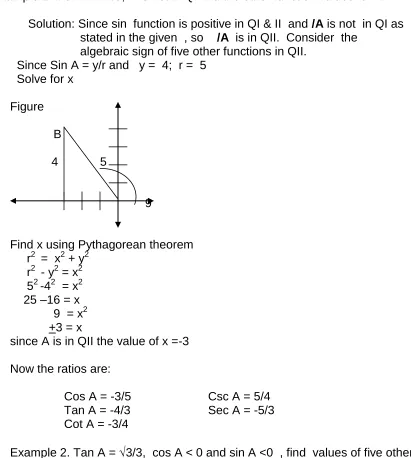
Example 1. if sin A = 4/5, A is not in QI find the other function values for A.
Solution: Since sin function is positive in QI & II and /A is not in QI as stated in the given , so /A is in QII. Consider the
algebraic sign of five other functions in QII. Since Sin A = y/r and y = 4; r = 5
Solve for x
Figure
B
4 5
9
Find x using Pythagorean theorem r2 = x2 + y2
r2 - y2 = x2 52 -42 = x2 25 –16 = x 9 = x2 +3 = x
since A is in QII the value of x =-3
Now the ratios are:
Cos A = -3/5 Csc A = 5/4 Tan A = -4/3 Sec A = -5/3 Cot A = -3/4
[image:17.612.98.509.221.679.2]Solution: Terminal point lies in quadrant III. Let us consider the algebraic sign of the function in QIII. Tan and Cot are the only positive function while the rest are negative .
Tan A = y/x
y = -3 ; x = -3
Figure
X = -3
-3 = y
Solve for r:
By Pythagorean theorem r2 = x2 + y2
r2 = - 32 +(-3)2 r2 = 9 + 3 r2 = 12 r = 23
The function ratios are:
1. Sin A = - ½ 4. Sec A = -23/3 2. Cos A = - 3/2 5. Cot A = 3
3.Csc A = -2
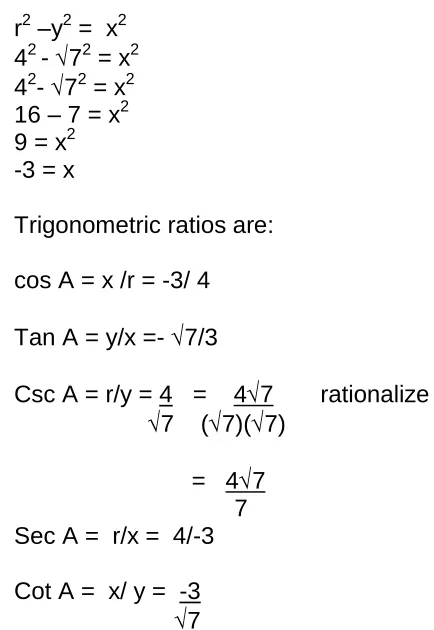
Example 3: If sin A = 7/4 , and /2 < A < . Find the values of five other trigonometric functions for A.
Solution: Sin A = 7/4 and we define sin A = y/r
y = 7; r = 4 and A lies in QII , sin A and csc A are positive while five other function are negative.
.
Figure
r=4 y =7
x
r2 –y2 = x2 42 - 72 = x2 42- 72 = x2 16 – 7 = x2
9 = x2 -3 = x
Trigonometric ratios are:
cos A = x /r = -3/ 4
Tan A = y/x =- 7/3
Csc A = r/y = 4 = 47 rationalize 7 (7)(7)
= 47 7 Sec A = r/x = 4/-3
Cot A = x/ y = -3 7
Example 4: If Sec B = 8/3 and 0 < B < 90, find the other function values for B.
Solution: Since sec B and cos B are reciprocals cos B = 3/8
We define cos B = x/r, so x = 3 ; r = 8; B lies in QI, all the functions have positive sign.
Figure
8
X =3
You need to solve for y r2 = x2 + y2
r2 – x2 = y2 82 – 32 = y2 64 - 9 = y2
[image:19.612.83.300.65.380.2]55 = y
Trigonometric ratios are:
Sin B = y/r = 55/8
Tan B = y/x = 55/3
Csc B = r/y = 8 = 855 rationalize 55 (55)(55)
= 855 55
Cot B = x/y = 3 = 355 rationalize 55 (55)(55)
= 355 55
Try this out
A. Find the value of each of the remaining functions of the acute angle A :
1.If Cos A = 5/13 and Sin A < 0
Find: Figure
y =
a. Sin A = d. Csc A =
b. Tan A = e. Cot A =
c. Sec A =
2. IF Sin A = 3/4 and /2 < A < Figure
Find:
x =
a Cos A = d. Sec A =
b. Tan A = e. Cot A =
c. Csc A =
3. If Sin A = 2/3 and cos A > 0 Figure Find: .
a. Cos A = d. Csc A =
b. Tan A = e. CoT A =
c. Sec A =
4. If Cos A = -22/3 and Tan A > 0 Figure Find:
y =
a. Sin A = d. Sec A =
b. Tan A = e. Cot A =
c. Csc A =
5. If Tan A = -3/4 ,270 < A< 360 Figure Find:
r =
a. Sin A = d. Csc A =
b. Cos A = e. Sec A =
c. Cot A =
What have you learned
Given the following function, identify the amplitude of:
1. y = ½ cos x 2. y = 4 cos x 3. y = sin 4x
Determine the period of the following functions.
4. y = 3 sin x
5. y = cos x
6. y = 4 sin 4x
Given the figure, find the value of r and the six trigonometric functions.
-7 A
-24 r
8.r =
9. sin A =
10. Cos A =
11. Tan A =
12. Cot A =
13 .Csc A =
14.sec A =
Sketch the figure, find the values of r and 5 other trigonometric functions for /C if Tan C = -4/3 and Sin C > 0.
15. r =
16. sin C =
17. Cos C =
18. Cot C=
19. Sec C =
Answer key
How much do you know
1. y =2 2. y = ¾ 3. y = -2 4. 4 5. 3 6. 10
7. sol: y = 4 sin ½(5/3) y = 4 sin 5/6 y = 4(½) y =2 8. r = 13
9. sin A = 12/13 10. Cos A = -5/13 11. Cot A = -5/12 12. Csc A = 13/12 13. Tan A = -12/5 14. Sec A = -13/5 15. r = 10
16. Sin k = -3/5 17. Cos S = 4/5 18. Cot S= -4/3 19. Csc S = -13/12 20. Sec S = 5/4
Try this out
Lesson 1 A.
1. amplitude : 3 2. amplitude 2 3. amplitude: 3/2 4. amplitude: 2 5 amplitude: 1 6. amplitude: 2 7. amplitude: ½ 8. amplitude: ¾ 9. amplitude: 4 10. amplitude: 2
B.
4. Period: 8/3 5. Period : 4 6. Period : 2/3 7 Period : 3 8. Period: 9. Period: 10 10. Period: /2
Lesson 2.
1. Table of values
x 0 /4 /2 3/4 5/4 3/2 7/4 2
Y =1/2 cos x .5 .4 0 -.4 -.5 -.4 0 .4 .5 Solution:
a. If x = 0 b. If x = /4 c. If x = /2 d. If x = 3/4 y = ½ cos 0 y = ½ cos /4 y = ½ cos /2 y = ½ cos 3/4 y = ½ (1) y = ½ (2/2) y = ½ (0) y = ½ (-2/2) y = .5 y = .4 y = 0 y = -.4
e. If x = f. If x = 5/4 g. If x = 3/2 h. If x = 7/4 y = ½ cos y = ½ cos 5/4 y = ½ cos 3/2 y = ½ cos 7/4 y = ½ (-1) y = ½ (-2/2) y = ½ ( 0) y = ½ (2/2) y = -.5 y = -.4 y = 0 y = .4
i. If x = 2 y = ½ cos 2 y = ½ (1) y = .5
Graph of y = ½ cos x
/4 /2 3/4 5/4 3/2 7/4 2
Table of Values:
Solution:
a. If x = 0 b. If x = /3 c. If x = /2 y = 4 sin ½(0) y = 4 sin ½ (/3) y = 4 sin ½ (/2) y = 4 sin 0 y = 4 sin (/6) y = 4 sin (/4) y = 4 (0) y = 4 (1/2) y = 4 (2/2) y = 0 y = 2 y = 2.83
a. If x = 2/3 e. If x = f. If x = 4/3 y = 4 sin ½(2/3) y = 4sin ½() y = 4 sin ½(4/3) y = 4 sin /3 y = 4(1) y = 4 sin 4/6 y = 4(3/2) y = 4 y = 4 sin 2/3
y = 23 = 3.46 y = 3.46
g. If x = 3/2 h. If x = 5/3 i. If x = 2
y = 4 sin ½ (3/2) y = 4 sin ½ (5/3) y = 4 sin ½(2) y = 4 sin 3/4 y = 4(5/6) y = 4 sin y = 4 (-2/2) y = 4(½) y = 4(0)
y = 2.83 y = 2 y = 0
Graph of y = 4 sin ½ x
/3 /2 2/3 4/3 3/2 5/3 2
3. y = 2/3 cos x, where 0 x 2
Table of values:
x 0 /3 /2 2/3 4/3 3/2 5/3 2
Solution:
a. If x = 0 b. If x = /4 c. If x = /2 d. If x = 3/4 y = 2/3 cos 0 y = 2/3 cos /4 y = 2/3 cos /2 y = 2/3 cos 3/4 y = 2/3 (1) y = 2/3 (2/2) y = 2/3 (0) y = 2/3 (-2/2) y = .7 y = .47 y = 0 y = -.47
f.) If x = g. If x = 5/4 h. If x = 3/2 i. If x = 7/4
y = 2/3 cos y = 2/3 cos 5/4 y = 2/3 cos 3/2 y = 2/3 cos 7/4 y = 2/3 (-1) y = 2/3 (-2/2) y = 2/3 (0) y = 2/3 (2/2) y = -.7 y = -.47 y = 0 y = .47
j. If x = 2 y = 2/3 cos 2 y = 2/3 (1) y = .7
Graphs of y = 2/3 cos x
.5
.5 /4 /2 3/4 5/4 3/2 7/2 2
4.y = 2 cos 1/2x where 0 < x < 2
Table of values:
x 0 /4 /2 3/4 5/4 3/2 7/4 2
y = 2/3 cos x .7 .47 0 -.47 -.7 -.47 0 .47 .7
x 0 /3 /2 2/3 4/3 3/2 5/3 2
Solution:
a. x = 0 b. x = /3 c. x = /2 d. x = 2/3
y = 2 cos ½(0) y = 2 cos ½(/3) y = 2 cos ½(/2) y = 2 cos ½(2/3) y = 2 Cos 0 y = 2 cos /6 y = 2 cos /4 y = 2 cos 2/6 y = 2(1) y = 2(3/2) y = 2(2/2) y = 2 cos /3 y = 2 y = 3 y = 2 y = 2(½)
y = 1
e. x = f. x = 4/3 g. x = 3/2 h. x = 5/3
y = 2 cos ½() y = 2 cos ½(4/3) y = 2 cos ½(3/2) y = 2 cos ½(5/3) y = 2 cos /2 y = 2 cos 4/6 y = 2 cos 3/4 y = 2 cos 5/6
y = 2(0) y = 2 cos 2/3 y = 2(2/2) y = 2(3/2) y = 0 y = 2(½) y = -2 y = -3
y = 1 i. x = 2
y = 2 cos ½(2) y = 2 cos y = 2(-1) y = -2
5. y = ¾ sin ½ x
Table of values
Solution:
a. x = 0 b. x = /3 c. x = /2 d. x = 2/3
y = ¾ sin ½(0) y = ¾ sin ½(/3) y = ¾ sin ½(/2) y = ¾ sin ½(2/3) y = ¾ sin 0 y = ¾ sin /6 y = ¾ sin /4 y = ¾ sin /3 y = ¾(0) y = ¾(½) y = ¾(2/2) y = ¾(3/2) y = 0 y = 3/8 y = 32/8 y = 33/8
e. x = f. x = 4/3 g. x = 3/2 h. x = 5/3
y = ¾ sin ½() y = ¾ sin ½(4/3) y = ¾ sin ½(3/2) y = ¾ sin ½(5/3) y = ¾ sin /2 y = ¾ sin 2/3 y = ¾ sin 3/4 y = ¾ sin 5/6 y = ¾(1) y = ¾(3/2) y = ¾(2/2) y = ¾(½) y = ¾ y = 33/8 y = 32/8 y = 3/8
i. x = 2
y = ¾ sin ½(2) y = ¾ sin y = ¾(0) y = 0
x 0 /3 /2 2/3 4/3 3/2 5/3 2
Lesson 3
Try this out:
1. (-5, 7)
Figure
7 r
-5
Solve for r
By Pythagorean Theorem
r2 = (x) 2 + (y)2 = (5) 2 + (7) 2
= 25 + 49 r = 74
a. Sin A = 774 c. Tan A = -7/5 e. Cot A = -5/7 74
b. Cos A = 574 d. Sec A = 74 f. Csc A = 74 74 5 7
2. (-8, -15)
Solve for r
By Pythagorean Theorem: -8 r2 = (x) 2 + (y) 2
= (-8) 2 + (-15) 2 = 64 + 225 -15 = 289 r = 17
Sin A = -15/17 Csc A = -17/15
Cos A = -8/17 Sec A = -17/8
Tan A = 15/8 Cot A = 8/15 2. (24, - 7)
figure
By Pythagorean Theorem: 24 r2 = x2 + y2
= (24) 2 + (-7) 2 -7 = 576 + 49
r = 25
Sin B = -7/25 Csc B = -25/7 Cos B = 24/25 Sec B = 25/24 Tan B = -7/24 Cot B = -24/7
3. (2, 3)
Figure Solve for r
By Pythagorean theorem: r2 = x2 +y2
3 = 22 + 32
= 4 + 9
2 = 13
r = 13
Sin A = 313/13 Csc A = 13/ Cos A = 213/13 Sec A = 13/2 Tan A = 3/2 Cot A = 2/3
4. (-9, 40)
Figure
Solve for r
By Pythagorean Theorem
40 r2 = x2 + y2
= (-9) 2 + (40) 2 = 81 + 1600
-9 = 1681
r = 41
Sin A = 40/41 Csc A = 41/40 Cos A = -9/41 Sec A = -41/9 Tan A = 40/-9 Cot A = -9/40
Lesson 3
1. Cos A = 5/13, If A is in Q IV
Sol: In Q IV the only positive functions are cos A and sec A .
Sketch: By Pythagorean Theorem x2 + y2 = r2
a. Sin = -12/13 d. Csc A = -13/12 b. Tan A = -12/5 e. Cot A = - 5/12
c. Sec A = 13/5
2. Sin A = 3/4, If A is in Q II
Sol: In Q II sin A and CSC A are positive and the rest of the functions are negative.
By Pythagorean Theorem
x2 + y2 = r2 3 4 x2 = r2 – y2
x2 = 42 – (3) 2 x2 = 16 – 3
x = + 13 , since A is in QII x = -13
a. Cos A = - 13/4 d. Sec A = -413/13 b. Tan A = - 39/13 e. Cot A = -39/3 c. CsC A = - 43/3
3. Sin A = 2/3, Where A is in Q I
Sol: Since A is in Q I, all the functions are positive.
3 2
By Pythagorean Theorem
x2 + y2 = r2
x2 = (3)2 – (2)2
x2 = 9 – 4
x2 = 5
x = +5 but A is in Q I then x =+5
a. Cos A = 5/3 d. Csc A = 3/2 b. Tan A = 25/5 e. CoT A = 5/2 c. Sec A = 35/5
Sol: since a is in QIII, tan and cot are the only positive and the rest are negative.
-22
3
By Pythagorean theorem x2 + y2 = r2 y2 = (3) 2 – (22) 2
= 9 – 8 y = 1
a. Sin A = -1/3 d. Sec A = 22/3
a. Tan A = 2/4 e. Cot A = 22
b. Csc A = -3
5. Tan A = -3/4, A is in QIV
Sol: Since A is in QIV, cos and sec are the only positive and the rest are negative.
By Pythagorean Theorem 3
r2 = x2 + y2 -4 r2 = (4) 2 + (-3)2
= 16 + 9 = 25 r = 5
a. Sin A = -3/5 d. Csc A = -5/3
b. Cos A = 4/5 e. Sec A = -5/4
c. Cot A = -4/3
Post Test
7. y = 0
8. r = 25
9. Sin A = -24/25 10. Cos A = -7/25 11. Tan A = 24/7 12. Csc A = -25/24 13. Sec A = -25/7 14. Cot A = 7/24 15. r = 5