in the population sciences published by the Max Planck Institute for Demographic Research Konrad-Zuse Str. 1, D-18057 Rostock · GERMANY www.demographic-research.org
DEMOGRAPHIC RESEARCH
VOLUME 19, ARTICLE 29, PAGES 1145-1178
PUBLISHED 01 JULY 2008
http://www.demographic-research.org/Volumes/Vol19/29/ DOI: 10.4054/DemRes.2008.19.29
Research Article
Ukraine:
On the border between old and new
in uncertain times
Brienna Perelli-Harris
This publication is part of Special Collection 7: Childbearing Trends and Policies in Europe (http://www.demographic-research.org/special/7/)
© 2008 Perelli-Harris.
1 Introduction 1146
2 Demographic analysis 1147
2.1 The population of Ukraine 1147
2.2 Period total fertility rates and the decline to ‘lowest-low fertility’ 1147
2.3 Cohort total fertility 1153
2.4 Childlessness 1154
3 Determinants of fertility 1154
3.1 Education 1154
3.2 Region and ethnicity 1157
4 Proximate determinants of childbearing 1157
4.1 Marriage 1157
4.2 Non-marital childbearing 1158
4.3 Contraception 1160
4.4 Desired fertility 1161
5 Explanations towards very low fertility in Ukraine 1161
5.1 Economic uncertainty 1162
5.2 Social anomie and societal-level stress 1163
5.3 Ideational change 1164
5.4 Unequal gender relations 1165
6 Family policy 1167
7 Other influential factors 1169
7.1 The changing relationship between parental leave and second births 1170
7.2 Lack of housing 1170
7.3 Intergenerational support 1171
7.4 Stress, poor health lifestyles, and marital quality 1172
8 Conclusion 1173
9 Acknowledgements 1174
Ukraine:
On the border between old and new in uncertain times
Brienna Perelli-Harris 1
Abstract
This chapter provides an overview of the demographic situation in Ukraine, including explanations for the decline to very low fertility and changes in family policy. Drawing on official statistics, survey data, and focus group interviews, the analysis shows that the country’s decline to lowest-low fertility is primarily due to the postponement of or the reduction in second births, as opposed to the postponement of first births. The chapter includes a discussion on the link between low fertility and changing marriage patterns, contraceptive prevalence, and abortion. The author then reviews the evidence for the leading explanations of fertility decline in Ukraine, including economic uncertainty, social anomie, the Second Demographic Transition, and unequal gender relations. In addition, the author proposes unexplored factors that may lead to fertility limitation, such as the increasing difficulty of combining work and childrearing, insufficient housing, changes in intergenerational support, and the deterioration of health lifestyles and marital relations.
1. Introduction
Ukraine, which means “border” in Russian and Ukrainian, is wedged between Europe and Russia – geographically, politically, ideationally, and demographically. The country is physically located on the western border of the former Soviet Union, and with the addition of Poland, Slovakia, and Hungary to the European Union, Ukraine now abuts the E.U. Politically, the alliance of the country swings between democracy of the West and dependence on Russia. Its people alternate between embracing new, individualistic, Western-oriented values and maintaining conventional, Soviet-dominated ideology. Economically, Ukraine vacillates between capitalist reform and socialist standards, teetering between the brink of crisis and the threshold of recovery. Demographically, Ukraine is adopting new types of family formation, while still adhering to conservative gender roles and traditional childbearing norms, such as early childbearing.
This chapter discusses demographic developments in Ukraine as it balances between old and new, East and West. Using official data and the Ukrainian Longitudinal Monitoring Survey (ULMS), I first present an in-depth analysis of change in fertility over time and then explain the extent to which Ukraine differs from other very low fertility countries, especially in regard to the timing of first births and the postponement of or reduction in second births. There follows an analysis of changes in the proximate determinants of childbearing, including increases in non-marital births and cohabitation, and changes in contraceptive use and abortion. Next, I outline common explanations of very low fertility in this region and discuss supporting evidence. This is followed by an explanation of the expansion of family policy over the past two decades as well as the faults in the system. Finally, I suggest alternative explanations for the decline in fertility, including changes in the relationship between female labor-force participation and childbearing, the lack of affordable housing, changes in intergenerational support flows, and increases in household disruption.
response rate of 66% (KIIS 2003). I also refer to focus group research, which I with the help of assistants conducted in the summers of 2002, 2003, and 2006. Each focus group interviewed eight to ten individuals; fifteen interviews were conducted with women and seven were held with men. The groups were prompted to discuss family life, children, and marital and childbearing decisions. Participants were recruited by handing out flyers and approaching pedestrians in front of metro stations. The respondents varied in income, education, and region. While their responses are not representative of the country as a whole, they provide insights into attitudes toward the quantity and timing of fertility and yield background information used to generate hypotheses and guide the interpretation of quantitative analyses.
2. Demographic analysis
2.1 The population of Ukraine
The territory of Ukraine spans an area larger than France, and its population is one of the largest in Europe. The population is rapidly shrinking, however, resulting in what many have called a demographic crisis (Steshenko 2001, Chuiko 2001). Since Ukraine gained independence in 1991, death rates in the country have been higher than birth rates, causing a loss in population of up to 373,000 people per year. Within 13 years, its population declined by 5.3 million, from a high of 52.2 million in 1993 to 46.9 million in 2006 (Derzhkomstat 2006). Although emigration played a role – approximately 1.2 million people left Ukraine during this period, a figure that represents 23% of the total decline (Derzhkomstat 2006) – the largest decline was due to low fertility.
2.2 Period total fertility rates and the decline to ‘lowest-low fertility’
Ukraine experienced the first demographic transition well after most countries in Western Europe; its fertility did not begin to decline until the 20th century, and then it fell from a total fertility rate (TFR) of 5.2 in the 1920s to 1.99 in 1988-89 (Steshenko 2001). The majority of the decline during this period was due to a limitation of higher parity births; the young age pattern and the universality of childbearing changed very little. From the 1960s through the 1980s, the TFR remained stable around 2.0.
country, with a TFR under 1.3. While recent data suggests that some recovery has occurred, the Ukrainian TFR was still only 1.2 in 2005.
Figure 1: Period total fertility rates, 1960–2005
0.0 0.5 1.0 1.5 2.0 2.5
1960 1965 1970 1975 1980 1985 1990 1995 2000 2005
Year
T
o
ta
l
F
e
rt
ili
ty
R
a
te
Official TFR
ULMS Moving averages
Source: Ukrainian Statistical Agency, 2006. The Ukrainian Longitudinal Monitoring Survey, 2003.
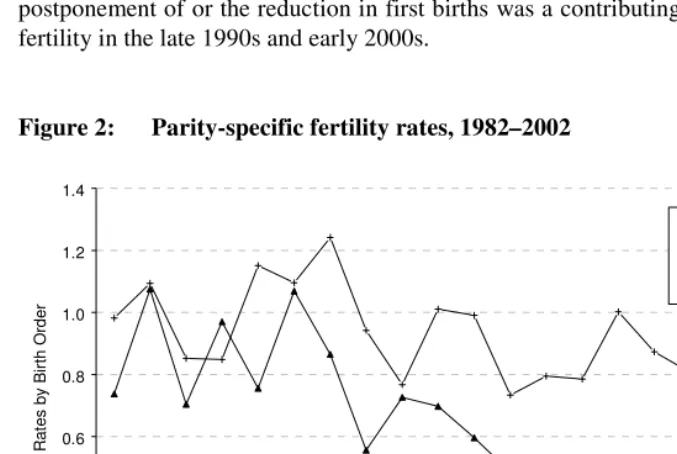
Figure 2 and Table 1 show a crude approximation of fertility rates by parity, based on the ULMS. According to Figure 2, first birth rates oscillated between 1.0 and 0.8 births per woman until 1997 and then started to decline. This indicates that very little postponement or reduction in first births occurred until the late 1990s, but was a significant contributor to lowest-low fertility thereafter. Second birth rates started to decline much earlier, even before Ukraine gained independence. Figure 2 shows that they were slightly higher than 1 birth per woman in 1987, but then declined rapidly in the early 1990s and fluctuated between 0.4 and 0.5 throughout the rest of the decade. Third and higher fertility rates remained very low throughout the entire period, rarely reaching 0.3 births and with a moving average between 0.1 and 0.2 in the 1990s. The figure provides evidence that the postponement of or the reduction in second births was the primary cause of the initial decline to lowest-low fertility in Ukraine, and that the postponement of or the reduction in first births was a contributing factor to lowest-low fertility in the late 1990s and early 2000s.
Figure 2: Parity-specific fertility rates, 1982–2002
0.0 0.2 0.4 0.6 0.8 1.0 1.2 1.4
1982 1984 1986 1988 1990 1992 1994 1996 1998 2000 2002 Year
F
e
rt
ili
ty
R
a
te
s
b
y
B
ir
th
O
rd
e
r
ULMS TFR1 ULMS TFR2 ULMS TFR3 ULMS TFR4+
Table 1: Total fertility rates by parity and three year moving averages, 1982–2002
TFR1 TFR2 TFR3 TFR4+ MA1 MA2 MA3 MA4+
1982 0.98 0.74 0.17 0.05
1983 1.09 1.08 0.30 0.06 0.98 0.84 0.23 0.07 1984 0.85 0.70 0.22 0.11 0.93 0.92 0.23 0.10 1985 0.85 0.97 0.17 0.14 0.95 0.81 0.20 0.13 1986 1.15 0.76 0.21 0.14 1.03 0.93 0.20 0.11 1987 1.10 1.07 0.23 0.04 1.16 0.90 0.21 0.08 1988 1.24 0.87 0.18 0.06 1.09 0.83 0.17 0.07 1989 0.94 0.56 0.10 0.10 0.98 0.72 0.13 0.11 1990 0.77 0.73 0.12 0.18 0.91 0.66 0.10 0.12 1991 1.01 0.70 0.09 0.07 0.92 0.67 0.12 0.10 1992 0.99 0.60 0.15 0.04 0.91 0.59 0.13 0.06 1993 0.73 0.49 0.14 0.08 0.84 0.49 0.13 0.06 1994 0.80 0.39 0.09 0.07 0.77 0.45 0.11 0.07 1995 0.79 0.46 0.09 0.06 0.86 0.43 0.10 0.06 1996 1.00 0.44 0.13 0.05 0.89 0.47 0.09 0.05 1997 0.87 0.50 0.04 0.04 0.89 0.42 0.07 0.04 1998 0.81 0.33 0.05 0.03 0.84 0.42 0.06 0.03 1999 0.85 0.43 0.09 0.01 0.81 0.36 0.06 0.01 2000 0.78 0.33 0.05 0.00 0.76 0.42 0.09 0.01 2001 0.67 0.50 0.12 0.03 0.71 0.42 0.09 0.03 2002 0.68 0.43 0.09 0.06
Change 1989 to 1995 (in %) –12 –40 –23 –45
Change 1995 to 2001 (in %) –17 –2 –10 –50 Change 1989 to 2001 (in %) –28 –42 –31 –72
Source: Ukrainian Longitudinal Monitoring Survey, 2003.
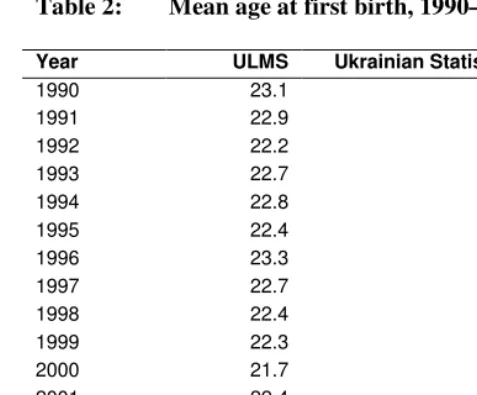
Table 2: Mean age at first birth, 1990–2005
Year ULMS Ukrainian Statistical Agency
1990 23.1
1991 22.9
1992 22.2
1993 22.7
1994 22.8
1995 22.4 22.2
1996 23.3 22.2
1997 22.7 22.3
1998 22.4 22.2
1999 22.3 22.7
2000 21.7 22.8
2001 22.4
2002 22.4
2003 2004
2005 23.5
Source: ULMS, 2003; Ukrainian Statistical Agency, 2006.
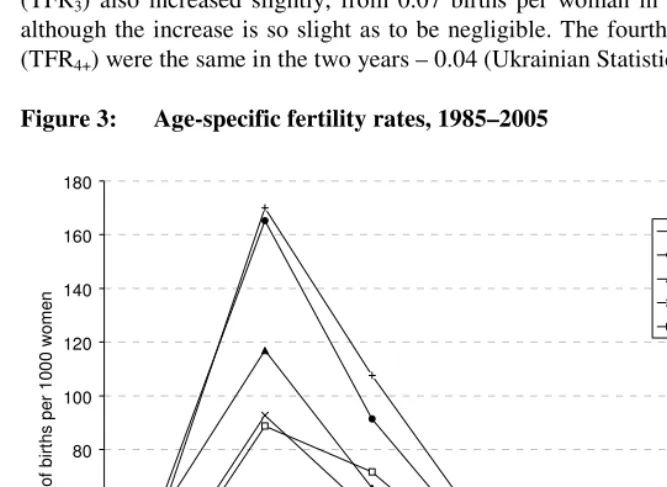
Nonetheless, the age pattern of childbearing does seem to be slowly shifting to a later pattern. Figure 3 shows the distribution of age-specific fertility rates over the past 20 years. Up to 2000, the shape of the curves consistently peaked around age 20-24, with a reduction in the total number of births for each consecutive time period. The sharp peaks generally indicate that nearly all women gave birth to their first child while in their early 20s, and all-parity childbearing decreased after age 25. In 2005, the curve started to flatten out, with an increase in births in the 25-29 age group. It is difficult to know from Figure 3 whether the increase in births in this age group is due to recuperated second births or the realization of delayed first births. Parity-specific fertility rates, however, suggest that both processes took place. Ukraine’s fertility rate for first births (TFR1) in 2005 was 0.71, up from 0.65 in 2000. The second birth fertility
rate (TFR2) in 2005 stood at 0.38, compared to 0.32 in 2000. The third birth fertility rate
(TFR3) also increased slightly, from 0.07 births per woman in 2000 to 0.08 in 2005,
although the increase is so slight as to be negligible. The fourth and higher birth rates (TFR4+) were the same in the two years – 0.04 (Ukrainian Statistical Agency, 2006).
Figure 3: Age-specific fertility rates, 1985–2005
0 20 40 60 80 100 120 140 160 180
to 20 20-24 25-29 30-34 35-39 40-44 45+
Age group N u m b e r o f b ir th s p e r 1 0 0 0 w o m e n 1985 TFR=2.02 1990 TFR=1.89 1995 TFR=1.38 2000 TFR=1.09 2005 TFR=1.21
2.3 Cohort total fertility
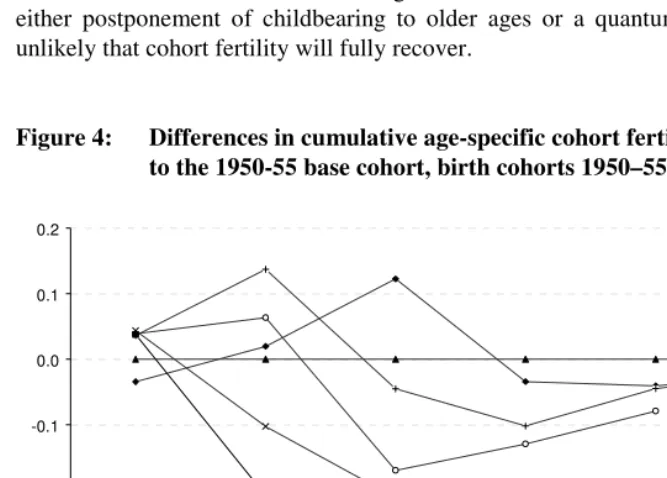
With such rapid decline in period total fertility, it is difficult to know at this time whether cohort total fertility rates will mirror period total fertility rates or whether some recuperation will occur. Rough estimates based on the ULMS indicate that cohort fertility will continue to decline. Figure 5 presents differences in age-specific cohort fertility rates, using the 1950 cohort as a base. I have combined five year cohorts in order to increase the numbers on which the estimates are based. The 1950-54 cohorts had a total completed fertility rate around 1.9, which was relatively stable through to the 1960-64 cohorts. In comparison, the 1965-69 cohorts had a completed fertility of only 1.6 births per woman, although these cohorts were only 34-38 years old at the time of survey. By age 29, the 1970-74 cohorts had borne approximately 21% fewer children than the 1950 cohort. The cumulative fertility of the 1975-79 cohort by age 24 in 2003 was also 21% lower than in 1950. Again, this indicates that cohorts are experiencing either postponement of childbearing to older ages or a quantum decline. Thus, it is unlikely that cohort fertility will fully recover.
Figure 4: Differences in cumulative age-specific cohort fertility rates compared to the 1950-55 base cohort, birth cohorts 1950–55 to 1975–1979
-0.5 -0.4 -0.3 -0.2 -0.1 0.0 0.1 0.2
15-19 20-24 25-29 30-34 35-39 40+
1950-55 (TFCR=1.9) 1955-59 (TFCR=1.9) 1960-64 (TFCR=1.9) 1965-69 (TFCR=1.6) 1970-74
1975-79
2.4 Childlessness
In contrast to the pattern found in the countries of Western Europe, childbearing in Ukraine has remained nearly universal. According to the ULMS, only 4% of the 1960-64 birth cohorts and 7% of the 1965-69 birth cohorts remained childless in 2003. Among women from the 1970-74 cohorts, aged 29-33 at the time of survey, only 13% remained childless. Thus, while childlessness may be increasing somewhat, it is unlikely that Ukrainian women will experience the high levels of childlessness found in other low fertility countries in the near future. Because at least some primary infertility exists in all societies, the low level of childlessness in Ukraine indicates that voluntary childlessness must be very low. This universal pattern of fertility provides further evidence that Ukraine has achieved very low fertility through a different path than Western and Central European countries (Perelli-Harris 2005), although sustained levels of very low fertility may be due to increasing childlessness.
3. Determinants of fertility
3.1 Education
Ukraine has a highly educated population. An analysis of the ULMS shows that in 2002, 25% of women aged above 30 had less than a high school education, 19% had graduated from high school, 40% had vocational or professional training, and 16% had completed a Bachelor’s degree or above. As is the case in most societies, completed fertility levels differ by education. However, only recently has the timing of childbearing started to change dramatically by level of education. Within the past decade, more highly educated women have begun to postpone first births, while women with less than college education have maintained the previous age pattern of fertility (Perelli-Harris, forthcoming). During the period of rapid social change following Ukraine’s independence, the relationship between education and the initiation of childbearing reversed: once school enrollment and marriage are controlled for, the more highly educated women changed from having significantly higher first birth rates before independence to lower first birth rates after independence. The general population, however, has experienced very little delay in the entrance into motherhood.
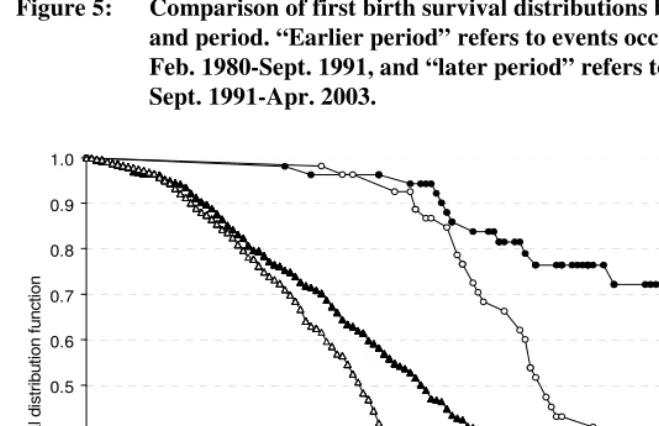
study, see Perelli-Harris, forthcoming). The curves for lower education start to diverge around 30 months (19.5 years), indicating that women with lower education in the earlier period had slightly lower (although statistically insignificant) first birth rates than their counterparts in the later period. The difference between the earlier and later period curves for higher education, however, is much wider. After having delayed childbearing due to school enrolment, more highly educated women in the earlier period experienced a very steep increase in first birth rates and nearly caught up with their less educated counterparts. In the later period, the distribution for more highly educated women curves outwards, indicating a significant delay. This change in relationship signifies a new process of reproductive decision-making for more highly educated women. Only time will tell whether these women are innovators in the postponement of childbearing, with the rest of the population following their lead, or whether entrenched social norms will maintain the overall early pattern of first births.
Figure 5: Comparison of first birth survival distributions by education and period. “Earlier period” refers to events occurring
Feb. 1980-Sept. 1991, and “later period” refers to events occurring Sept. 1991-Apr. 2003.
0.0 0.1 0.2 0.3 0.4 0.5 0.6 0.7 0.8 0.9 1.0
17 18 19 20 21 22 23 24 25 26 27 28 29
Age since respondent turned 17
S u rv iv a l d is tr ib u ti o n f u n c ti o n
Later period, higher educ. Earlier period, higher educ. Later period, lower educ. Earlier period, lower educ.
Second birth rates, on the other hand, have declined in a similar manner for women with all levels of education (Perelli-Harris, forthcoming). Unlike the reversal that occurred for first births, there has been no reversal in the effects of education on second birth rates. Figure 5 shows that second birth rates for women with all levels of education were higher in the earlier period than they were in the later period. Although more highly educated women in the later period experienced lower birth rates than in the earlier period, the relationship between education and second birth rates did not change. These results suggest that education itself has not been a primary factor in the postponement or elimination of second births; women of all educational levels have refrained from additional childbearing. Further possible explanations for the decline in second births will be discussed below.
Figure 6: Comparison of second birth survival distributions by education and period. “Earlier period” refers to events occurring
Feb. 1980-Sept. 1991, and “later period” refers to events occurring Sept. 1991-Apr. 2003.
0.0 0.1 0.2 0.3 0.4 0.5 0.6 0.7 0.8 0.9 1.0
0 20 40 60 80 100 120 140
Duration in months since first birth
S
u
rv
iv
a
l
d
is
tr
ib
u
ti
o
n
f
u
n
c
ti
o
n
Later period, higher educ. Earlier period, higher educ. Later period, lower educ. Earlier period, lower educ.
3.2 Region and ethnicity
Fertility in Ukraine differs significantly by region and to some degree by ethnicity. According to 2000 official data, the TFR was 1.4 births per woman in Western Ukraine, 1.1 in Central Ukraine and 1.0 in Eastern Ukraine. Some of this difference is attributable to urban-rural differences; the majority of the population in the East lives in cities, while western Ukraine is largely rural. Yet the regions differ in other ways, e.g., in their orientation towards family life and national identity. Focus group respondents from all regions thought that the western region of the country followed a more traditional, religious, and nationalistic family orientation, while they perceived that the eastern part of the country remained under the influence of Soviet ideology. Political attitudes, public opinion, and electoral behavior are consistently found to be associated with regional differences (Kubicek 2000, Birch 2000, Barrington 2002, Arel 1995). The regions also followed different economic trajectories. Eastern Ukraine is more industrialized than the other regions, specializing in coal mining and heavy industry, and following political independence from the Soviet Union, much of this region became economically depressed. Central Ukraine, called the breadbasket of the Soviet Union, has been dominated by agriculture, food processing, and light industry. Western Ukraine historically has been primarily engaged in agricultural production, but its productivity lagged behind other regions (Birch 2000); following the break up of the Soviet Union, this region began to orient itself towards the West, with many inhabitants temporarily migrating abroad for work. Thus, each region has faced different challenges during the post-Soviet period, challenges that may result in a variety of family-formation responses and need to be analyzed further.
4. Proximate determinants of childbearing
4.1 Marriage
whether more people are remaining without partners, or whether couples are choosing to cohabit instead of marry. The ULMS data, however, indicates that at least part of this decline is due to first marriage postponement; the mean age at first marriage increased over the past decade by about one year to 22.7 for women and to 25.8 for men. Postponement of marriage usually means that there is a corresponding delay in childbearing.
Unlike with first births, the relationship between education and marriage did not reverse after Ukraine’s independence (Perelli-Harris, forthcoming). Instead, marriage rates fell for all women regardless of their level of education. In fact, once school enrolment is controlled for, women with higher levels of education had higher first marriage rates both before and after Ukrainian independence. This relationship probably indicates that more highly educated women are in higher demand on the marriage market and that they had greater resources – e.g., the potential to secure a job – with which to marry.
Compared to other countries in Europe, cohabitation is not very widespread in Ukraine. According to the 2003 ULMS, only 5% of the respondents reported currently living in an ‘unregistered’ marriage (the term used in the ULMS to refer to cohabitation) at the time of survey. This percentage does not increase dramatically for younger cohorts; only 7% of the 1970-74 and a mere 8% of the 1975-79 cohorts reported being in an ‘unregistered’ marriage. Because of the high level of commitment implied by the term ‘unregistered marriage’, the term may not capture all cohabiting relationships. Couples in romantic relationships may be living together without considering themselves to be in an ‘unregistered’ marriage. Focus group discussions revealed that other terms, such as ‘civil union’ or ‘living together’, may capture the increase in cohabitation more accurately. More research needs to be conducted to determine the meaning of cohabitation in Ukraine and how widespread cohabitation is.
4.2 Non-marital childbearing
Figure 7: Distribution of non-marital births, 1990-2005; in percentage
0 5 10 15 20 25
1990 1991 1992 1993 1994 1995 1996 1997 1998 1999 2000 2001 2002 2003 2004 2005
Source:Ukrainian Statistical Agency, 2006.
4.3 Contraception
The use of modern methods of contraception, such as oral contraceptives, condoms, and IUDs, is a relatively new phenomenon in Ukraine. Before the disintegration of the Soviet Union, couples relied on either traditional methods such as withdrawal and periodic abstinence, or abortion. Recently, contraceptive prevalence has increased and abortion rates have declined. According to the 1999 Ukrainian Reproductive Health Survey (URHS), modern contraceptive prevalence increased by 7% from 1994 to 1999 (KIIS 2001). In 1999, overall contraceptive use among women within a registered or unregistered marriage was 68%. The use of modern methods of contraception, however, is much lower; only 38% of women used them, while 30% used either periodic abstinence or withdrawal (KIIS 2001). Women in union who employed a modern method either used IUDs (19%) or condoms (14%). Only 3% of women relied on oral contraceptives. The level of modern contraceptive prevalence is low relative to other countries in the region, e.g., 53% of women in Russia used modern contraceptives, 50% in Moldova and 55% in Kazakhstan (Seltzer et al. 2003). The discontinuation of modern contraceptive use and contraceptive failure rates are much higher in Ukraine than they are in other regions, especially for oral contraceptives (Seltzer et al. 2003). This leads to many unintended pregnancies – both mistimed and unwanted – a majority of which are terminated, increasing the risk of medical complications and poor reproductive health.
Given the relatively low level of modern contraceptive prevalence and high failure rates, it is not surprising that abortion rates are still high relative to international standards. According to official statistics, the official abortion rate declined from 1990 to 2002, from 70 to 22 abortions per 1000 women of childbearing age, but the accuracy of these statistics is questionable. According to the URHS, the abortion rate in 1999 was 54 abortions per 1000 women of childbearing age, which is higher by about 30% than the official statistics (KIIS 2001). The latter missed abortions performed outside of the public health system, due to underreporting and other reasons (Seltzer et al. 2003). According to the URHS report, induced abortion is a common procedure no matter what measure is used. For example, 43% of the respondents ever had an induced abortion. Also, the total induced abortion rate (the mean number of lifetime abortions per woman based on current age-specific abortion rates) was about 1.6 abortions per woman in the two years before the interview.
widely available, women can begin to delay childbearing. More highly educated women have greater knowledge of and access to other forms of contraception (KIIS 2001). Therefore, the spread of contraception enables women to control the timing of their pregnancies, with more highly educated women changing their behavior first.
4.4 Desired fertility
Survey data on desired fertility supports the assertion that childbearing in Ukraine is nearly universal, and that on average, Ukrainians desire to have two children. For example, according to the ULMS only 3% of women under age 45 reported at the time of the survey that they did not want children, indicating that most women desire at least one child. A slightly greater number of men intend to remain childless: 5% reported they wanted zero children. The mean number of desired children for both men and women under age 45 was 2.0. Of the female respondents, 66% desired to have two children, 15% wanted one, and 16% wanted more than two. Of the male respondents, 64% desired to have two children, 16% wanted one, and 16% expressed preference for more than two. The ULMS also asked respondents what their preferred number of children would be if they could start their adult life over again under ideal economic conditions. The mean number of children rose to 2.3 for both men and women, suggesting that childbearing preferences and behavior have been depressed by the current economic situation.
5. Explanations towards very low fertility in Ukraine
5.1 Economic uncertainty
Economic uncertainty caused by economic crisis or depression is one of the leading explanations for lowest-low fertility (Kohler et al. 2002, Macura 2004). According to this argument, macro-level economic instability leads to financial uncertainty on the individual level, delaying union formation and childbearing in early adulthood in favor of continued residence in the parental household and the pursuit of higher education and job stability. In some societies, economic uncertainty is less likely to delay entry into parenthood, but may lead to the delay or elimination of higher-parity births, as parents realize they can not afford to have more children (Philipov 2002, Perelli-Harris 2005). The hypotheses predicting the negative association between labor market crises and fertility emerge from micro-economic fertility theory. Economic or ‘demand’ theories of fertility posit a cost-benefit framework of analysis, in which parents maximize utility by balancing decisions about consumption with income and resources (Becker 1991, Easterlin and Crimmins 1985). In such a model, children are considered one of the trade-offs; they use up psychological, financial, and time resources that parents would otherwise spend elsewhere. According to this perspective, in times of labor market crisis when individuals experience involuntary job loss or face the prospect of job loss, the strains on income or potential income should lead couples to forego or delay childbearing.
After the dissolution of the Soviet Union, Ukraine experienced a grave economic crisis, leading to individual level economic uncertainty. Between 1991 and 1998, Ukraine failed to experience a single year of economic growth; the country’s percent change in GDP was consistently negative. As a result, the GDP per capita declined by 60% and unemployment rates rose to at least 12%. The proportion of the population living below the poverty line increased, and 45.2% lived on less than one dollar a day in 1999 (UNDP Ukraine 2002:14-37). Since 2000, the macro-economic situation has improved dramatically, with GDP growth rates surpassing neighboring EU countries. In 2004, Ukraine’s GDP growth stood at 12%, one of the fastest rates in the world (Ministry of Economy of Ukraine 2005). At least some of this economic growth has contributed to a rising standard of living and declining poverty; real population income was 72% higher in 2004 than in 1999, and the overall ratio of average income to the poverty line increased by 80% from 2000 to 2004 (Ministry of Economy of Ukraine 2005). It is questionable, however, how much these improvements have reduced overall economic uncertainty on the individual level.
once macro-economic conditions improved. More importantly, studies of the relationship between fertility and economic uncertainty on the individual level have been inconclusive. For example, no consistent relationship between men’s or women’s unemployment and fertility has been found in Ukraine (Perelli-Harris, forthcoming) or in Russia (Perelli-Harris 2006a, Kohler and Kohler 2002). Income has had only a minimal effect, quickly becoming insignificant with the inclusion of other factors such as education (Perelli-Harris 2006a). Other attempts to operationalize economic uncertainty through subjective measures, such as concerns about job loss, have had inconclusive results (Kohler and Kohler 2002). Thus, conventional microeconomic factors such as formal employment in the labor force and income do not appear to constitute the most important factors in the decline to very low fertility.
5.2 Social anomie and societal-level stress
The collapse of the Soviet Union and the turmoil of the 1990s has had a broader impact on the Ukrainian society than simply causing financial hardship. The disintegration of the Soviet Union has led to rapid social change, resulting in the reorganization of society and the transformation of values and expectations. This instability has led to social anomie, or a breakdown in social norms (Durkheim 1984 [1893]). The negative change has caused individuals to feel they have lost control over their lives, resulting in high levels of stress and anxiety (Dooley et al. 1996, Fenwick and Tausig 1994). Psychological studies have shown that stressful conditions can lead to a host of negative outcomes, such as poor health (Schneiderman et al. 2005), depression (Hammen 2005), and poor health behaviors (Schneidermann et al. 2005). In Ukraine, stressful conditions are said to have resulted in lower life expectancy (UNDP 2004), high levels of distress and anxiety (Kohn et al. 2002), and low levels of self-reported health (Gilmore, McKee, and Rose 2002).
postponement or avoidance of childbearing is not only a response to individual financial concerns, but also a psychological reaction to anomic conditions.
Perelli-Harris (2006a) found that in Russia, subjective well-being and participation in informal work can act as buffers to the anomic conditions leading to very low fertility. Both factors provide people with the means to cope with economic and social uncertainty; subjective well-being is a psychological resource that helps people to maintain a positive attitude, while participation in informal work indicates an ability to act regardless of labor market insecurity. Both subjective well-being and informal work are significantly related to wanting and having additional children. Although the factors are not directly related, they can be seen as indicators of the willingness to take on additional responsibilities, including childbearing and rearing. The study shows that psychological factors are more important to the limitation of childbearing than purely economic factors, lending support to the anomie explanation of fertility decline. The evidence in the study applies to Russia, but similar influences most likely play a role in additional childbearing in Ukraine as well.
5.3 Ideational change
Fertility decline in Ukraine may also be due to changes in values and belief systems. With the breakup of the Soviet Union, Ukraine has been flooded with external influences that may be changing priorities, behaviors, and the way people think. Some demographers argue that Ukraine is on the verge of the Second Demographic Transition, purported to have occurred in some Western European countries in the 1960s and 1970s (Van de Kaa 1987, Lesthaeghe and Surkyn 2002). The Second Demographic Transition theory argues that changes in family structures, including declines in fertility, later ages at first marriage and birth, and increases in cohabitation and non-marital childbearing occur concomitantly with a reorientation towards autonomy, secularization, and self-interest (Surkyn and Lesthaeghe 2004). According to the theory2, individuals, and in particular women, re-prioritize career and self-actualization over family and childbearing. Some demographers argue that Russia is on the threshold of SDT, part of the evolutionary trend towards the ‘Western’ model of family formation, although with a unique Russian twist (Vishnevsky 1996, Gerber and Berman 2005, Zakharov 2006). They posit that the shift constitutes part of the natural
2 Some argue that the term ‘Second Demographic Transition’ (and indeed the ‘First Demographic Transition’)
process of modernization, a process that has always been met with some degree of resistance in Russia (Vishnevsky 1996).
Proponents of the Second Demographic Transition point to the rapid change in demographic trends in Russia as evidence that the SDT is occurring. For example, Zakharov and Ivanova (1996) interpret trends such as the decrease in the number of abortions, the increase in non-marital childbearing, and the decline in the number of births in the 15-19 age group as signs that Russia is on the verge of the SDT. Gerber and Berman (2008) conclude that the rapid decline in marriage in post-Soviet Russia is due to normative change rather than economic conditions. Few studies, however, have been able to show that these trends are due to an actual shift in values. Using the World Values Surveys, Lesthaeghe and Surkyn (2002) provide evidence that cohabitation and divorce in Eastern Europe are associated with more ‘non-conformist’ values, but they are not able to show the magnitude of this trend or its change over time. In fact, the new trends may be the result of economic or cultural factors that have little to do with a shift towards SDT. As mentioned above, non-marital childbearing in Ukraine is associated with incomplete high-school education rather than higher education (Perelli-Harris, forthcoming), possibly due to impoverished conditions rather than a Scandinavian-type shift towards cohabitation. Therefore, further research is needed to show how ideational change is impacting family behavior, with subtle attention paid to the Ukrainian context.
5.4 Unequal gender relations
The gender equity explanation argues that different levels of support for women have resulted in variation in fertility (Chesnais 1998; McDonald 2000). In very low fertility countries, such as Italy and Spain, women have made major gains in terms of equality in the educational system and the labor force, but have not achieved similar levels of equality within the home. Women are provided with little domestic childcare or state childrearing support and must decide whether to limit their childbearing or reduce their career aspirations. In Northern European countries, on the other hand, women receive more assistance from their partners and from governmental resources, including subsidized childcare and maternity leave. As a result, these countries have maintained fertility levels closer to replacement (McDonald 2000).
the labor force. Some fields, such as medicine and education, came to be dominated by women. Yet despite the constitutional proclamation that men and women are equal, genuine equality never materialized in the Soviet Union. State policies excluded women from night shifts and hazardous labor (Dudwick et al. 2002), and women primarily held jobs in the semi-skilled professional sector or they held low-skilled jobs (Brainerd 2000). The result was “not so much an equalization as a feminization of the lower levels of the vocational hierarchy: women occupied the worst-paid and least prestigious jobs and were poorly represented on the higher rungs of the vocational ladder.” (Kon 1995).
Now, the situation of inequality is not helped by the unstable economy and high unemployment rates. According to the focus group respondents, the current economic conditions have provided few opportunities for career development. Female focus group respondents spoke of discrimination in hiring, especially for women who may become pregnant or have young children. Either because they face discrimination or by personal choice, post-Soviet women still rarely participate in senior management or highly visible political positions (Sperling 2000). Official statistics reflect this disparity: female unemployment stands at 14%, compared to 10% for male unemployment, and the wage differential for men and women is 36% (UNDP 2002a). It is not surprising, therefore, that women express little interest in pursuing a long-term, self-actualizing career in such an environment, although as the economy improves, women may begin to re-orient themselves towards professional development.
Within the domestic sphere, traditional gender roles have largely been maintained. Both male and female focus group respondents spoke of the husband’s responsibility to financially support his family, and the wife’s natural concern for child care, cooking and cleaning, and other household duties (Perelli-Harris 2005). These attitudes, however, rarely result in a breadwinner family model, especially in today’s uncertain labor market. Only in elite circles can families afford for the woman to stay at home permanently (Sperling 2000). Instead, women usually take on the ‘double burden’ of employment outside the home combined with domestic responsibilities. Anecdotal evidence suggests that women often work full-time and then continue to be busy around the house long into the evening, while husbandsrelax.
economic uncertainty, anomie, or changing values, must be exacerbating the situation, making the difficulty of combining work and childbearing more acute.
6. Family policy
Ironically, Ukraine has one of the most generous but least effective family policies in the world. Much of the generosity of the system arose during the socialist era, when the Soviet state proclaimed that women were equal to men and attempted to incorporate them into the labor force. As a result, state-sponsored maternity leave and childcare facilities allowed women to combine work and childbearing, leading to female labor-force participation rates that were nearly the same as those for men (Gerber and Mayorova 2006). The Soviet state was also concerned about the decline in fertility to replacement level, which became evident in the 1970s (Zakharov 2006). In an attempt to address this problem, the Soviet state enacted concrete measures in 1982 with the goal of raising fertility. Mothers in Ukraine who had worked more than a year or who had interrupted their work in order to study received partially paid leave, – 35 rubles per month at that time -- to look after a child through the first year These women also had the right to additional unpaid leave for an extra half a year without interruption of social security benefits. In 1990, pregnancy and birth leave at full pay was expanded to 70 days before birth and 56 days after birth (special circumstances allowed for 70 days postpartum leave). The period of paid maternity leave at minimum wage was expanded to one and a half years, with a payment of 70 rubles.
Nonetheless, focus group discussions conducted in 2003 revealed that many Ukrainian women expect the government to provide support for families and childbearing (Perelli-Harris 2003). Most respondents believed they were entitled to three years of maternity leave with state support. Some respondents expressed the opinion that the government was responsible for the low fertility rate, not only because of economic mismanagement, but also because of a lack of financial support for families with children. Some respondents complained that maternity leave benefits were barely enough to buy a packet of Pampers, much less provide them with the necessities for raising a child. These attitudes reveal an underlying expectation of state support, which is an attitude commonly held in socialist societies.
After the dissolution of the Soviet Union, the condition of childcare facilities also deteriorated substantially. State-subsidized childcare facilities declined by a third after 1990 (UNDP Ukraine 2003). While some of the facilities closed due to declining birth rates, many were affected by budget cuts and the transformation of the workplace from state-run to private. For example, many rural daycare centers once operated by collective farms closed down due to restructuring and privatization (Nikolaenko 2006). Although some private daycare centers arose to take the place of public facilities, they were often expensive. As a result, families now have to decide whether to provide childcare themselves or rely on relatives, often grandmothers.
In April of 2005, the Ukrainian government increased child assistance dramatically. New mothers now receive a one-time payment of 3,384 hryvna ($677) following the birth of a child, and 5114 hryvnia ($1023) to be paid throughout the course of the next year. The total sum of 8500 hryvnia is a substantial amount in a country where the average monthly wage is about 760 hryvnia per month ($152) (Ministry of Economy of Ukraine 2005). In addition, for three years after the birth of a child, women receive maternity payments based on household income, but not less than 90 hryvnia per month ($18). This amount changes at least once a year, depending on the state budget.
Although the latest data from the Ukrainian statistical bureau already shows a slight increase in births compared to previous years, demographers in Ukraine question whether the assistance will actually raise fertility in the long-run (Steshenko 2005, Levchuk 2006). Because the payments are restricted to 12 months after childbirth, they provide little support for childcare before pre-school or raising the child afterwards. They are not specifically directed towards second and higher-order births, the elimination of which is primarily responsible for the sharp decline in fertility. The payments also do little to address larger socio-economic problems, such as low living standards, insufficient wages, or expensive housing. Steshenko (2005) speculates that encouraging the growth of small and medium-size businesses would be more effective in increasing fertility than paying families directly. Levchuk (2006) suggests that government-subsidized housing loans would do more to encourage larger families. Some Ukrainians also worry that this assistance will only be used by people with lesser means, thus stimulating fertility only among the lesser educated population.
In conclusion, Ukraine’s family policy now appears to be one of the most generous in the world, entailing a one-time payment of $1700 plus three years of paid maternity leave. However, in reality, the irregularities of payment, the low level of parental leave benefits, insufficient support throughout the period of childrearing, and neglect of childcare facilities all dilute the policy’s effectiveness. And, considering that living conditions generally are poor and that government action is ineffective in other spheres of life, it is questionable whether these policies will have much of an impact on reproductive decision-making. This amount will be enough to stimulate fertility for some couples – especially given the expectation of state support in terms of childrearing – but it is unlikely that the new policies by themselves will be able to reverse the population decline.
7. Other influential factors
7.1 The changing relationship between parental leave and second births
An analysis of the ULMS indicates that the relationship between parental leave and fertility changed after Ukraine gained independence (Perelli-Harris, 2006b). Compared to Soviet women, post-Soviet women on parental leave had second children at higher rates than women not on parental leave. This change in relationship indicates that the childbearing behavior of working and non-working women diverged. The divergence may be due to a number of factors. First, the dissolution of the Soviet Union weakened work requirements; women who wanted to stay at home to raise children were now able to do so. Second, rapid social change led to an increase in the diversity of norms regarding work and childbearing, allowing underlying beliefs about gender roles to become expressed in more conservative behavior, such as remaining on parental leave and having a second child. Third, the deterioration of economic conditions changed the opportunity costs of childbearing. After Ukraine gained independence, working women became less likely to disrupt employment with pregnancy and childrearing as they feared dismissal from their job; inadequate anti-discrimination legislation and weak enforcement of women’s rights did little to protect them from layoffs (Dudwick et al. 2002). Job uncertainty of the husband led working women to avoid job disruption in order to ensure household income stability. The decline in childcare facilities made it even more difficult to combine the roles of worker and mother. Then again, women who desired to have more children may have found the opportunity costs of returning to work too high. If available jobs were incompatible with childrearing, e.g., in that they did not offer part-time work or flexible working hours, family-oriented women may have decided to stay on maternity leave. These women may have compressed their birth interval to fulfill their fertility intentions. In conclusion, the changing relationship between parental leave and fertility reveals an emerging behavioral trend that requires a new way of theorizing about the decline to very low fertility.
7.2 Lack of housing
may feel that sharing a one or two-bedroom apartment with their parents and two children is unfeasible.
During the Soviet era, families also had to cope with limited housing space. Urban apartments were often very small and it was not uncommon for families to share communal space or live in dormitories. Now, many of these housing conditions have improved; e.g., communal living is rare. However, changing attitudes and expectations lead couples to place a greater emphasis on housing when making childbearing decisions. The same ideational change that is shifting priorities towards individualism, the career, or material goods may also influence space requirements. In addition, access to home-ownership has become more difficult. Before the disintegration of the Soviet Union, couples applied for housing and received an apartment within a few years. In the late 1980s, the birth of a child qualified families for larger apartments. After Ukraine gained independence, however, the housing market was privatized and moving into a new residence required a significant outlay of cash or an inheritance. Loans continue to have exorbitantly high interest rates and require large down-payments. Thus, upward mobility in the housing market is limited and many young couples doubt that they will ever be able to afford their own home. This situation creates a serious impediment to additional childbearing.
7.3 Intergenerational support
Given the historical interdependence and co-residence of multiple generations in Ukraine (Coale 1992), it is important to study the role of grandparents in fertility timing and decline. Russia and Ukraine have a long-standing practice of intergenerational wealth flows from older to younger generations (Buckley 2001). Parents and grandparents often help young couples when they have financial problems, for example, by providing housing or supplying produce from the village. Grandmothers frequently provide childcare assistance, sometimes on a regular basis, thus allowing mothers to return to work. The parental resources help to maintain an early age of childbearing – young couples can negotiate economic constraints with the support of older generations (Perelli-Harris 2005). However, because this support usually takes the form of housing, childcare services, or goods, parents may still face cash shortfalls for expenses and decide to limit additional childbearing.
for childcare assistance, the deteriorating health of the elderly population may be influencing childbearing decision-making. Since the disintegration of the Soviet Union, mortality and morbidity has been increasing, resulting in lower life expectancy and increased disabilities among the retired population (Steshenko 2000). The uncertain health of the older generations puts pressure on women of childbearing age to have children earlier, i.e. at a time when parents can still provide financial support and childcare assistance (Gabriel 2005). Such pressures may also contribute to fertility limitation, since couples now have fewer resources to assist with childrearing.
7.4 Stress, poor health lifestyles, and marital quality
Although social anomie is one of the leading explanations of fertility decline in Eastern Europe and the Soviet Union, few studies have investigated the relationship between fertility and a broad array of indicators of anomie, such as stress, risky behaviors, poor health, alcoholism, and poor marital quality. As discussed above, Perelli-Harris (2006a) found an association between fertility and subjective well-being in Russia; Philipov, Speder, and Billari (2005) investigated the relationship between psychological well-being, disorientation, and birth intentions in Bulgaria and Hungary. These studies, however, focus on relatively simple psychological indicators, as opposed to the specific mechanisms that may be causing the low levels of well-being. More sophisticated measures of stress are needed to help locate the source of the psychological discontent and disentangle the relative influence of stressful life events versus personality type.
Poor health lifestyles, which have been one of the leading causes of mortality in the former Soviet Union (Cockerham 2002), may be discouraging mothers from having additional children. After Ukraine gained independence, male mortality from accidents, poisonings, and trauma increased drastically (Steshenko 2000). The increase in risky behavior not only resulted in an increase in deaths, it also affected home life and household stability. Alcoholism in particular took a toll on the family (Gabriel 2005). Alcoholism in Ukraine has been incredibly high; according to the 2002 Ukrainian World Mental Health survey, the rate of alcoholism in Ukraine was higher than in any other European country with a comparable survey (Bromet et al. 2005). Alcoholism has been particularly prevalent among men of working age, when men are expected to be engaged in childrearing (Bromet et al. 2005). Alcoholism often results in negative behaviors that threaten the family, such as despondency, violent outbreaks, or abuse. Such behaviors may be negatively impacting the decision to have more children.
high level of marital dissolution most likely limits additional childbearing, especially if the dissolution occured early in marriage (although completed fertility occurring before divorce may have no effect on total fertility, and remarriages may actually lead to additional childbearing). Regardless of actual marital dissolution, however, poor marital quality and marital uncertainty may be discouraging women from having additional children. Research conducted in the United States shows that couples in unstable marriages have fewer children than couples in stable marriages (Myers 1997). People may think having children saves marriages, but it rarely does so. Thus, the deterioration of spousal relations is a major factor behind fertility decline in Ukraine.
8. Conclusion
The decline to very low fertility in Ukraine has been a complex process with no single explanation. Macro-level social and economic change has clearly led to a new form of childbearing decision-making, but the specific causes of the new practices are still unknown. The two primary explanations for fertility decline in Ukraine – economic uncertainty and the Second Demographic Transition – lack the support of micro-level evidence. No study has found a direct relationship between fertility and economic indicators such as unemployment or income. Likewise, little research has been conducted showing an association between shifting values and fertility decline. Nonetheless, economic uncertainty may be operating through other unmeasured mechanisms, such as inadequate housing or pressure to support elderly parents, and some strata of the population may be experiencing the SDT. For example, more highly educated women have experienced a reversal in childbearing behavior and are now leading the postponement of childbearing within marriage. This most likely indicates that these women are undergoing substantial ideational change (Perelli-Harris, forthcoming). Thus, economic uncertainty and ideational change are probable explanations, but require further research.
morbidity and decreases in fertility calls for further investigation; both may be stemming from the same destructive behaviors, and ultimately social anomie.
It is important to bear in mind that multiple trends in behavior have been emerging simultaneously, but not necessarily due to the same social forces. While some strata of the population may be postponing or eliminating higher parity births as a result of changing values and belief structures, others may be adopting more conservative behaviors that accord with their concept of distinct gender roles (Perelli-Harris 2006b). The rise in cohabitation and non-marital childbearing may be the result of increased gender equality and of the rejection of official institutions (as in the Scandinavian countries) or it may be due to impoverished conditions and the inability to afford marriage. Thus, rather than assuming that all individuals are on the way to becoming more autonomous, self-interested, and career-oriented, it is prudent to recognize the heterogeneity in the population.
Finally, family policies may have a substantial impact on childbearing decision-making, especially now that child allowance has been raised to 8500 hryvnia. It will be interesting to observe whether this amount actually stimulates childbearing and to which segments of the population this applies. The extent of the policies’ effect in the long run, however, is questionable, since they do not address other pressing needs of the population. Affordable housing, decent wages, a functional government, a belief in progress, and hope for the future are all necessary to change attitudes towards childbearing and halt the drastic decline of Ukraine’s population.
9. Acknowledgements
References
Arel, D. 1995. Language policies in independent Ukraine: towards one or two state languages?,
Nationalities Papers 23:597–622.
Barrington, L. W. 2002. Examining rival theories of demographic influences on political support: the power of regional, ethnic, and linguistic divisions in Ukraine, European Journal of Political Research 41:455–491.
Becker, G. 1991. A Treatise on the Family. Cambridge, Mass.: Harvard University Press. Birch, S. 2000. Interpreting the regional effect in Ukrainian politics, Europe-Asia Studies
52:1017–1041.
Brainerd, E. 2000. Women in transition: changes in gender wage differentials in Eastern Europe and the Former Soviet Union, Industrial and Labor Relations Review 54:138–162. Bromet, E., S. F. Gluzman, V. I. Paniotto, C. P. M. Webb, N. L. Tintle, V. Zakhozha, J. M.
Havenaar, Z. Gutkovich, S. Kostyuchenko, and J. E. Schwartz. 2005. Epidemiology of psychiatric and alcohol disorders in Ukraine: findings from the Ukraine World Mental Health Survey, Social Psychiatry and Psychiatric Epidemiology 40:681–690.
Buckley, C. 2001. Family Matters: intergenerational wealth transfers and survival networks, Conference paper, in C. Buckley (Ed.), From Red to Gray: Aging in the Russian Federation. Austin: University of Texas.
Chemerys, A., A. Lipentsev, O. Muzychuk, and V. Tsypuk. 2002. The Ukrainian social protection system and the methods of governance, in K. Tausz (Ed.), Impact of Decentralization on Social Policy. Budapest: Local Government and Policy Reform Initiative, pp: 199–304.
Chesnais, J.-C. 1998. Below-replacement fertility in the European Union (EU-15): facts and policies, 1960–1997, Review of Population and Social Policy 7:83–101.
Chuiko, L. 2001. Chapter 5, in V. Steshenko (Ed.), Demohrafichna Kriza v Ukraini
(Demographic Crisis in Ukraine). Kyiv: National Academy of Science of Ukraine, Institute of Economics, pp: 223–297.
Coale, A. J. 1992. Age of entry into marriage and the date of the initiation of voluntary birth control, Demography 29:333–341.
Cockerham, W. C., M. C. Snead, and D. F. DeWaal. 2002. Health lifestyles in Russia and the socialist heritage, Journal of Health and Social Behavior 43:42–55.
Derzhkomstat, State Statistical Committe of Ukraine. 2001. Naselenie Ukraini 2000: Demohrafichni shorichnik. (Population of Ukraine 2000: Demographic yearbook). Kyiv. Derzhkomstat, State Statistical Committe of Ukraine. 2006. Population. Kyiv.
Dooley, D., J. Fielding, and L. Levi. 1996. Health and unemployment, Annual Review of Public Health 17:449–65.
Dudwick, N., R. Srinivasan, and J. Braithwaite. 2002. Ukraine: Gender Review. ECSSD: The World Bank.
Durkheim, E. 1984 [1893]. The Division of Labour in Society. London: Macmillan.
Easterlin, R., and E. Crimmins. 1985. Theoretical framework, in The Fertility Revolution: A Supply-Demand Analysis. University of Chicago Press, Chicago, Il., pp: 21–31.
Gabriel, C. 2005. Our nation is dying - interpreting patterns of childbearing in post-Soviet Russia, In C. B. Douglass (Ed.), Barren States: The Population Implosion in Europe. Berg Publishers, Oxford, pp. 13–92.
Gerber, T., and D. Berman. 2008. Economic crisis or Second Demographic Transition? Trends and correlates of union formation in Russia, 1985–2001. Unpublished manuscript, Department of Sociology, University of Wisconsin.
Gerber, T. and O. Mayorova. 2006. Dynamic gender differences in a post-Socialist labor market: Russia, 1991–1997, Social Forces. 84: 2047–2075.
Gilmore, A. B., M. McKee, and R. Rose. 2002. Determinants of and inequalities in self-perceived health in Ukraine, Social Science and Medicine 55:2177–2188.
Gurina, L.. 2005. Detorozhdenie: khlopotno, no preyatno. Kak eto vse rabotaet (Childbearing: Troublesome but welcome. How it all works). Obozrevatel. Kyiv.
Hammen, C. 2005. Stress and depression. Annual Review of Clinical Psychology 1: 293–319. Heleniak, T. 1995. Economic transition and demographic change in Russia, 1989–1995,
Post-Soviet Geography 36:446–58.
KIIS. 2001. 1999 Ukraine Reproductive Health Survey: Final Report. Kiev: Kiev International Institute of Sociology, US Centers for Disease Control and Prevention, and USAID. KIIS, Kyiv International Institute of Sociology. 2003. Ukrainian Longitudinal Monitoring Survey
Technical Report. Kyiv: KIIS.
Kohler, H.-P., and I. Kohler. 2002a. Fertility decline in Russia after 1990: the role of economic uncertainty and labor market crises, European Journal of Population 18: 233–262. Kohler, H.-P., F. C. Billari, and J. A. Ortega. 2002b. The emergence of lowest-low fertility in
Europe during the 1990s, Population and Development Review 28:641–680.
Kohn, M., W. Zaborowski, K. Janicka, V. Khmelko, B. W. Mach, V. Paniotto, K. M. Slomczynski, C. Heyman, and B. Podobnik. 2002. Structural location and personality during the transformation of Poland and Ukraine, Social Psychology Quarterly 65:364– 385.
Kon, I. S.. 1995. The Sexual Revolution in Russia: From the age of the czars to today. New York: The Free Press.
Kubicek, P. 2000. Regional polarisation in Ukraine: public opinion, voting and legislative behavior, Europe-Asia Studies 52:273–294.
Lesthaeghe, R. and J. Surkyn. 2002. New forms of household formation in Central and Eastern Europe: are they related to newly emerging value orientations? Brussels, Belgium: Interface Demography (SOCO) Vrije Universiteit Brussel.
Levchuk, N. 2006. Discussion with the Deputy Director. National Academy of Sciences of Ukraine, Institute of Demography. Kyiv.
Macura, M. 2004. The reasons for Eastern Europe's low fertility: discussion of paper Explanations of the fertility crisis in modern societies: a search for commonalities by John Caldwell and Thomas Schindlmayr, Population Studies 58:77–92.
McDonald, P. 2000. Gender equity in theories of fertility transition, Population and Development Review 26:427–439.
Ministry of Economy of Ukraine. 2005. Ukraine Millennium Development Goals. Kyiv: "Dija" Publishing House.
Mulder, C. H., and F. C. Billari. 2006. Lowest-low fertility and home-ownership regimes. European Population Conference. Liverpool, UK.
Nikolaenko, S. M. 2006. Presentation by the Minister of education and science at a session of the Parliament of Ukraine. The condition of rural education. Kyiv.
Palomba, R. 2001. Postponement in family formation in Italy, within the southern European context, in IUSSP Seminar on International Perspectives on Low Fertility: Trends, Theories and Policies. Tokyo, Japan.
Perelli-Harris, B. 2003. Focus Group Transcripts 2002-2003. University of Michigan, Ann Arbor, MI.
Perelli-Harris, B. 2005. The path to lowest-low fertility in Ukraine, Population Studies 59:55–70. Perelli-Harris, B. 2006a. The influence of informal work and subjective well-being on
childbearing in post-Soviet Russia, Population and Development Review. 32: 729–753. Perelli-Harris, B. Forthcoming. The changing effect of education on family formation during at
period of rapid social change: the case of post-Soviet Ukraine. Social Forces.
Perelli-Harris, B. 2006b. The changing relationship between parental leave and fertility in Ukraine, in European Population Conference. Liverpool, UK.
Philipov, D. 2002. Fertility in times of discontinuous social change: the case of Central and Eastern Europe. Rostock, Germany: Max Planck Institute for Demographic Research Working Paper. http://www.demogr.mpg.de/papers/working/wp-2002-024.pdf
Philipov, D, Z. Speder, and F. C. Billari. 2005. Now or Later? Fertility intentions in Bulgaria and Hungary and the Impact of Anomie and Social Capital. Vienna Institute of Demography Working Paper 08/2005. Vienna: Vienna Institute of Demography, Austrian Academy of Sciences.
Rindfuss, R. R., S. P. Morgan, and K. Offutt. 1996. Education and the changing age pattern of American fertility: 1963–1989, Demography 33:277–290.
Schneiderman, N., G. Ironson, and S. D. Siegel. 2005. Stress and health: Psychological, behavioral, and biological determinants, Annual Review of Clinical Psychology 1: 607– 628.
Seltzer, J., P. Bryan, P. Senlet, and K. O'Hanley. 2003. Assessment of reproductive and maternal health in Ukraine. Washington, D.C.: The Population Technical Assistance Project. Sobotka, T., Šťastná, A., Zeman, K., Hamplová, D., and Kantorová, V. 2008. Czech Republic:
A rapid transformation of fertility and family behaviour after the collapse of state socialism, Demographic Research 19(14). http://www.demographic-research.org/ Volumes/Vol19/14/
Sperling, V. 2000. The "new" sexism: images of Russian women during the transition, In M G. Field and J. L. Twigg (Eds.), Russia's Torn Safety Nets: Health and Social Welfare during the Transition. New York: St. Martin's Press, pp. 173–189.
Steshenko, V. 2000. Demographic situation in Ukraine in the transition period, In T. Kucera, O. Kucerova, O. Opara and E. Schaich (Eds.), New Demographic Faces of Europe. Berlin: Springer, pp. 347–369.
Steshenko, V. 2001. Demohrafichna kriza v Ukraini. (Demographic crisis in Ukraine). Kyiv: National Academy of Science of Ukraine, Institute of Economics.
Steshenko, V. 2005. Eksperiment co mnogimi neizvestnimi. Mozhno li "perelomit'" krizisnuyu demographicheskuyu situatsiu pri pomoshi povisheniya viplat na novorozhdennix?