DEMOGRAPHIC RESEARCH
VOLUME 32, ARTICLE 11, PAGES 341–368
PUBLISHED 3 FEBRUARY 2015
http://www.demographic-research.org/Volumes/Vol32/11/ DOI: 10.4054/DemRes.2015.32.11
Research Article
Trust, responsibility, and freedom: Focus-group
research on contemporary patterns of union
formation in Russia
Olga Isupova
This publication is part of the Special Collection on “Focus on Partnerships: Discourses on cohabitation and marriage throughout Europe and Australia,” organized by Guest Editors Brienna Perelli-Harris and Laura Bernardi.
© 2015 Olga Isupova.
This open-access work is published under the terms of the Creative Commons Attribution NonCommercial License 2.0 Germany, which permits use, reproduction & distribution in any medium for non-commercial purposes, provided the original author(s) and source are given credit.
1 Introduction 342
2 Historical trends in law and the practice of cohabitation and non-marital childbearing
343
3 Theoretical framework 346
3.1 The second demographic transition, economic uncertainty, and the pattern of disadvantage
346
3.2 Social anomie 347
3.3 Trust 348
4 Methodology 348
5 Findings 350
5.1 Responsibility 352
5.2 Fidelity and freedom 353
5.3 Trust 355
5.4 Religion and three stages of union formation 359
6 Conclusion and discussion 360
7 Acknowledgements 363
Trust, responsibility, and freedom: Focus-group research on
contemporary patterns of union formation in Russia
1Olga Isupova2
Abstract
BACKGROUND
While some studies directly address the issue of changes in union formation in Russia and Eastern Europe, few have focused on attitudes and norms regarding marriage and cohabitation. In Russia cohabitation has risen sharply in the last decades, but recently its level has stabilized and even decreased slightly.
OBJECTIVE
We intend to highlight gender and educational differences in perceptions of the advantages and disadvantages of cohabitation vs. marriage.
METHODS
We conducted 8 focus groups in Moscow in January 2012 (4 with men, 4 with women, half with higher educated participants and half with lower educated participants). RESULTS
Participants claimed that trust between men and women underlies preferences for marriage or cohabitation. Participants‟ religious beliefs form a „three stages of union‟ theory: cohabitation in the beginning, civil marriage later when trust has developed, and finally a church wedding when trust is established. In union formation the participants‟ ideals are the values of responsibility, freedom, fidelity, and trust. The level of trust is highest for proponents of marriage and ideational cohabitors. People without a strong preference for a certain type of union have the lowest level of interpersonal trust. CONCLUSIONS
In a society that currently can be considered anomic, interpersonal trust was found to be the most important factor underlying expressed ideals in choice of union type. It takes different forms for adherents of marriage (“trust with closed eyes”) and adherents of cohabitation (“trust with open eyes”).
1 Support from the Basic Research Program of the National Research University, Higher School of
Economics is gratefully acknowledged.
2
1. Introduction
While some studies directly address the issue of changes in union formation in Eastern Europe, including Russia (Harris and Gerber 2011; Hoem et al. 2009; Perelli-Harris and Isupova 2012), few have focused specifically on attitudes and norms regarding marriage and cohabitation. Cohabitation has increased significantly in Russia during the last few decades .According to the census, the share of couples cohabiting increased from 9.8% in 2002 to 13.2% in 2010 (All-Russian Census 2002, 2010). Another study in 2004 found that around 25.7% of the total of partnered respondents had never married their current partners (N=7645) (GGS 2004). Nonmarital childbearing also became more common, with 30% of births occurring outside of marriage in 2005, although by 2011 this had gradually decreased to 24.6% (Zakharov 2011). This figure is not as high as in other countries in Eastern Europe and the former Soviet Union (e.g., 57.4% of births to cohabitors in 2012 in Bulgaria, and 58.4% in Estonia, Demoscope Weekly, 2013), but is still remarkable considering that in previous decades childbearing within marriage was nearly universal in Russia. Indeed, about half of the increase in nonmarital fertility has been to cohabiting couples (Zakharov 2011), suggesting that cohabitation has become a new part of the family formation process in Russia.
In Russia there is very little understanding of how people talk about cohabitation and marriage: the meanings attached to these types of behavior are unclear. This makes explanation of recent fluctuations in nonmarital fertility very difficult. In our view, greater insight is needed into the nature of cohabitation and how people discuss it. Thus, in this study we use focus group research to explore discourses on cohabitation and marriage. Focus group methodology allows us to reveal social norms and attitudes and discourses regarding marriage and cohabitation, and to see how people interact when discussing cohabitation. Our main research questions concerned the meaning of cohabitation for people choosing (or not choosing) this union arrangement; differences between marriage, cohabitation, and simply dating; advantages and disadvantages of cohabitation and marriage; reasons for the increase and decrease in the number of people living together without marrying; and culturally specific patterns behind cohabitation in Russia.
explicating these findings, we present a brief historical review of Russian policy changes in this domain.
2. Historical trends in law and the practice of cohabitation and
non-marital childbearing
Throughout the 20th century in Russia the relationship between „traditional‟ and „modern‟ attitudes towards cohabitation and nonmarital childbearing in both law and practice was dynamic and varied depending on the epoch. Consequently, it is difficult to know what the word “tradition” means in Russia. In 1918 all children, regardless of whether they were born within marriage or out of wedlock, were considered equal before the law, and marriage was secularized. From 1926 cohabiting couples were regarded as equal to those who went through the formal civil marriage procedure (Goldman 1993). From the middle of the 1940s (Family legislation of 1944) until the 1960s, however, marriage legislation became more conservative and the status of marriage was privileged. Initially, children of unmarried mothers were prohibited from having any legal relationship with their fathers; however this changed in 1969 when unmarried fathers and mothers were allowed to register their children together, providing them with the same rights as children of married parents. In addition, from 1968 until the collapse of the Soviet Union in 1989, married couples received extra housing benefits; for example, they could have a room to themselves in a student hostel or receive a free flat. In the 1960s to the 1980s divorce was relatively easy to obtain, and most men and women married at least once in their lives. Despite the predominance of formal marriage, however, the 1926−39 period when cohabitation was tolerated remained in the cultural memory.
By the 1980s some flexibility or diversification of norms in union formation was already starting to develop in Soviet Russia, although at that time there was also a religious renaissance. Sexual and family norms changed and sexual freedom started to emerge in the 1980s and 1990s (Kon 2009). However this new tolerance mainly affected pre-marital behavior: sexual fidelity and the high value of a long-term marriage persisted, especially for women (Tiomkina 2008).
at a level slightly above 10%. However, nonmarital fertility began to steadily rise at the beginning of the 1980s (Figure 1), even before the collapse of the Soviet Union, later becoming stable again at levels above 27%.
Figure 1: Percent of extramarital births in Russia 1960−2005
Source: http://demoscope.ru/weekly/app/app4013.php accessed 29th of April 2014.
The absolute number of nonmarital births has been relatively stable since the mid-2000s. However, the share has decreased because of the increase in the absolute number of marital births. One of the many factors behind the decrease might be the somewhat controversial social policy3 of “maternity capital” which, hypothetically, might persuade some already married couples to have additional children, while not having a similar effect on cohabitors. Other reasons might include the rise of conservative values in some parts of society, women wanting more male support in a difficult economic
3 The “maternity capital” policy consists of the payment of a lump sum of money to all parents who have a
situation, or the delay of marriage (Zakharov et al. 2013). Causes for this relative decline warrant further study but are not the focus here. Interestingly, in 2011 the absolute number of nonmarital births registered by both father and mother increased by 3.3%, while the increase for marital births was much lower. This category is believed to be primarily associated with childbearing by cohabiting couples. At the same time the number of births registered only by the mother dropped significantly, by 4.1% (Zakharov et al. 2013). For 2011 overall, 11.5% of all births were to cohabiting couples. In the 1990s almost all Russians experienced economic uncertainty resulting from the transition to a market economy and the accompanying socio-economic crisis (Kukhterin 2000; Ashwin et al. 2000; Kiblitskaya 2000a, 2000b; Ashwin 2006; Goncharova, Isupova, Omelchenko, and Yaroshenko 2006). Income and employment became insecure, and initially social ties among family members and other individuals strengthened (Kukhterin 2000; Goncharova, Isupova, Omelchenko, and Yaroshenko 2006). However, such ties often proved weak and temporary, since everyone had to struggle for his or her own income security and many people gradually became less inclined to share resources with the less successful (Kukhterin 2000; Kiblitskaya 2000a, 2000b; Ashwin 2006). The newly formed private sector in the Russian economy was unstable at first, and there were few social guarantees of any kind.
Figure 2: Percent of births outside of marriage by type of registration, 2005−2011 (blue – overall extramarital fertility, red – registered by mother only)
Source: Zakharov et al. 2013; http://demoscope.ru/weekly/knigi/ns_r10_11/akrobat/glava7.pdf, p. 308, (based on unpublished data collected by Russian State Staticstic Agency, http://www.gks.ru/).
situation required new types of behavior according to new „rules.‟ For many people this meant endlessly exercising their adaptive abilities to ever-changing situations in all areas of life. Researchers found that Russian women use all available means to protect themselves against possible social, economic, and family crises (Rotkirch and Kesseli 2012). Russian women act as if their situation could change for the worse very suddenly and want to ensure that at any point in their lives they can manage as single parents or sole providers. This behavior presupposes weak union ties, whether marriage or cohabitation is involved, with low trust in guarantees of support from a former partner should the union break apart.
3. Theoretical framework
There are several competing theories that aim to explain the growing rates of cohabitation in various countries. We will now consider the most influential theories that are also relevant to the current Russian situation.
3.1 The second demographic transition, economic uncertainty, and the pattern of disadvantage
Economic uncertainty in relation to cohabitation is conceptualized by the theory of the pattern of disadvantage (POD). According to this theory, as discussed by Perelli-Harris and Gerber (2011) and McLanahan (2004), cohabitation is not associated with the most educated and elite non-conformist groups, but is instead characteristic of the poorer, less educated, and disadvantaged parts of the population. These groups might not be able to find suitable marriage partners and/or might not be desirable marriage partners due to low human capital, insecure income, and lifestyles perceived as negative (substance abuse, criminality, etc.).
3.2 Social anomie
Another possible explanation for the rise in cohabitation is increasing anomie and the attendant rejection of normative institutions. According to Merton (1966), an acute disjunction between culturally determined goals and the means offered by society to achieve them results in an anomic society. This disharmony causes rejection of norms and distrust in institutions at the micro-level. Anomie pushes decision-making in all important life events from the rational to the irrational, spontaneous, or automatic. This could cause an increasing preference for cohabitation over marriage, because the former, unlike the latter, is often “slid into” rather than specifically “decided upon” (Stanley et al. 2006). Thus, cohabitation might become more prevalent in insecure times. While the theory of the pattern of disadvantage focuses on social strata and individuals within a given society, anomie can affect the whole society.
3.3 Trust
When society is in a state of anomie, or close to it, individuals begin to have difficulty trusting one another. Trust is usually described as belief in the honesty, fairness, or benevolence of another party. Though they are interrelated, generalized trust4 (i.e., trust in individuals outside one‟s own family that one does not know) differs from trust in institutions. Russia as a whole experienced a drastic decrease in generalized trust, as measured by the World Values Survey (WVS) (Belianin and Zinchenko 2010). The average number of respondents who answered “yes” to the question of whether they could trust most people decreased from 37.5% in 1990 (N = 1818) to 23.7% in 1999 (N = 2416). This number later changed marginally and was only 27.8% in 2011 (N=2500). Changes in generalized trust in a given society are rare, which makes the recent significant decline in Russia all the more striking. Likewise, in Russia trust in institutions, with the exception of the Church and the Army (Belianin and Zinchenko 2010), has also decreased significantly over the last two decades.
While studies on cohabitation and trust are rare, demographers have done research on trust in relation to other demographic factors such as childbearing (Aassve et al. 2012). We argue that, at least in the Russian context, after taking into consideration various theoretical frameworks for cohabitation, the concept of trust might help to fill some of the remaining gaps in our understanding of the process of union formation.
4. Methodology
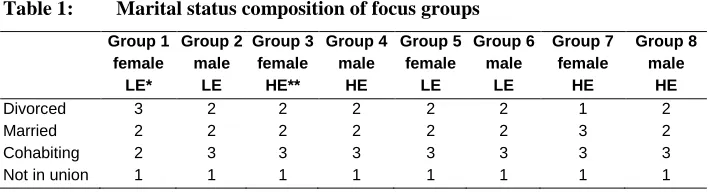
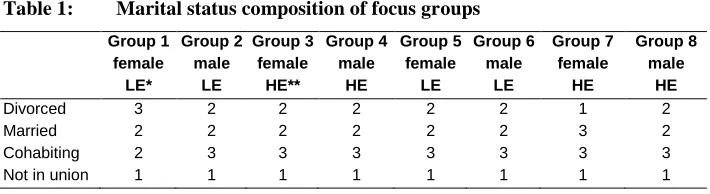
In total, 8 focus groups were conducted in Moscow, Russia in January 2012: 4 with men only, and 4 with women only. In each group there were eight 25 to 40-year-old participants. 2 male groups and 2 female groups consisted of people with at least a Bachelor‟s degree; all the others in the remaining 4 groups (2 male and 2 female) had a lower educational level: high school, technical school, technical college, etc. More than 3 participants in each group had children younger than 10 years. Each group included 23 cohabiting persons; 23 married persons; 1-3 divorced or separated (previously cohabiting) persons who were currently neither married nor cohabiting, and 1 person who had never married or cohabited5. This group composition stimulated a clash of opinions as the participants freely discussed their values and attitudes, readily arguing about them with people of differing views. It seems to be characteristic of Russians at this historical juncture to communicate without fear of offending others or of being
4 Generalized trust is usually defined as the feeling that another person whom one does not personally know
will treat you in the same way as you would treat yourself in their place.
5
offended themselves: arguing freely is their usual style of communication, and this is true even among the more educated. Apparently the participants enjoyed the experience: after each group discussion they thanked the moderator for an enjoyable and interesting time. The author‟s feeling is that the participants fully expressed themselves, since they enjoy a situation where opinions clash.
The discussion guide was standardized across all groups that took part in this project (Perelli-Harris et al. 2014). At the beginning of each discussion, the participants were asked to narrate their experiences of union formation. This also facilitated an open and free discussion on the underlying values of marriage and cohabitation. All the discussions were then transcribed in full and analyzed. The main method of text analysis was qualitative hermeneutic text analysis; i.e., interpretation and understanding of social events by analyzing their meanings. The central principle of hermeneutics is that it is only possible to grasp the meaning of an action or statement within the context of the discourse or world-view from which it originates. This form of analysis can be understood as the qualitative study of texts (including those generated through focus-group interviews) when they are closely read, analyzed, and interpreted. Our main aim in this analysis was to distinguish themes that were particularly important to the participants, without concentrating too much on the formal side of their discussion. The discussion as such was seen not as a group of separate messages but as a coherent flow in which meanings were constructed that were relevant and important to the group participants and to the topic of their discussion (Lindlof and Taylor 2002: 45; Routio 2007; Kincella 2006). The end result is an interpretation of the meanings under construction during the discussion.
The actual analytic work contrasted codes by theme; mainly across groups since it was not always easy to distinguish who in a group said what, but also among individuals where possible. However, because the group dynamic influences what is said in focus groups, it seemed more appropriate to attribute statements to the group as a whole than to individuals. Since the groups were separated by gender and education level, it was easy to attribute opinions to a man or a woman of either higher or lower education. Attribution of any sentence according to marital status was often possible by judging the content, since individuals often talked about their own experiences.
Using this data, we of course cannot generalize for Russia as a whole. Moscow is the largest city in Russia, with a population of 12,108,257 (2014)6. The cost of living is much higher in Moscow than in the other parts of Russia, as are average salaries. Housing is especially expensive, making it virtually impossible for many city dwellers to buy a flat, even with a mortgage. There is also an acute transportation problem, with
6 Moscow State Statistic Committee (2014). Otsenka chislennosti naseleniya Moskvy na 1 yanvaria 2014
continuous traffic jams and very busy public transport. On the one hand, Moscow city center offers pleasant modern lifestyle options with plenty of cultural attractions, affordable cafes, parks, and now even cheap public bikes and free open sports areas. Moscow‟s inhabitants tend to be more westernized in terms of lifestyle and income level than people from other Russian regions, with the exception of Saint Petersburg. On the other hand, the transportation problems, living costs, and competition for its abundant opportunities make life in this city fast and exhausting. In spite of these problems, Moscow is attractive to youth from other Russian regions and is a trendsetter in terms of lifestyle. In 2011, 20.9% of children in Moscow were born outside marriage, which is close to the average percentage for Russia as a whole (24.6%). Nonetheless, regional differences in other places could result in different views and opinions on marriage and cohabitation.
Table 1: Marital status composition of focus groups
Group 1 female LE* Group 2 male LE Group 3 female HE** Group 4 male HE Group 5 female LE Group 6 male LE Group 7 female HE Group 8 male HE
Divorced 3 2 2 2 2 2 1 2
Married 2 2 2 2 2 2 3 2
Cohabiting 2 3 3 3 3 3 3 3
Not in union 1 1 1 1 1 1 1 1
* lower education ** higher education
5. Findings
According to the focus group respondents, traditional, normative, and romantic reasons for marriage have weakened over the last few decades, as has social pressure. A theme that arose repeatedly in most of the groups suggests that marriage is no longer necessary. One respondent quips:
Love? But you can always simply live together if you love each other. And no one would pressure you to marry. (repeatedly mentioned throughout all groups)
Soon, I will probably marry my girlfriend, since I found out that at my work they give one free plane ticket a year to go on holiday to married people only. (Man, Group 4)
However, the individual norms of different people and different social settings vary: for some, marriage is aspirational and very important; for others the same is true about cohabitation; and for many others the distinction between the two is less important and their behavior depends on the situation. Those who prefer marriage see it as the more solid and responsible relationship:
I can much more easily leave a cohabiting union than a marriage; there is something like a lock there. (Man, low educated, Group 2)
Marriage means that you really promise mutual help and support for each other. (Woman, low educated, Group 5)
For these participants, marriage is a „higher quality‟ relationship:
Marriage means that you really chose to be with this man and he regards you highly. (Woman, low educated, Group 1)
Some participants (especially less-educated men) find marriage to be a more selective relationship:
Marriage, this is really about a woman of my dreams, and meanwhile I can cohabit. (Man, low educated, Group 2)
Accordingly, marriage is also perceived as a more committed relationship, a union between people who value each other more than those who simply cohabit. This view emerged among both more- and less-educated men and women, although perhaps somewhat more so among the less-educated women who, in general, attributed more significance to their conjugal union, maybe because a career is less important to them.
open. This minority could be named „ideational cohabitors‟ and were currently in cohabiting relationships. They claimed to not need any kind of wedding or wedding feast at any point in their conjugal life.
Below, we elaborate on four main themes − responsibility, fidelity and freedom, trust, and three stages of union formation − that emerged from the focus group discussions and provide us with deeper insight into the reasons behind the patterns of union formation.
5.1 Responsibility
Responsibility was strongly associated with marriage, mainly by men (especially the less-educated). Men, and some female group participants, stressed the importance of responsibility to the formation of traditional male identity. A strong belief that only a married man is “real,” mature, and fully adult was expressed (mainly by men), and also the view that only a responsible man ought to be married (predominantly by women).
Without responsibility [in marriage] a man is an animal, this [responsibility] is what I am created for. (Especially strong among Group 2 men, who were low educated)
Women confessed that typically they do not want to marry men who have problems with alcoholism or do not earn enough, though they will cohabit with them and even have children with them. Only less-educated women openly stated this, maybe because they often do not have a better choice of available partner.
I am now in a third union, and in all my unions my partners just did not earn enough. I try to persuade my current partner to earn more, in order for me to agree to marry him. And I am always open to a union with another man who would earn more. Money is important for me. (Woman, cohabiting, with a child from a previous cohabiting union, low educated, Group 5)
This resonated with the other participants; however, one woman stated that she preferred to be married anyway, since she believed marriage to be more stable. Another mentioned that for her being married was an issue of pride as a woman – that only as a married woman could she feel decent.
Lower educated men spoke about this too:
According to the traditional Soviet belief, which originated when there was a scarcity of men, marriage is something needed by women only. There is some evidence for the persistence of this belief in the fact that some women said that they pressured their partners to marry them. For less-educated women, marriage still has a symbolic status-associated meaning; however, this concept is strongly linked to their view that the man is going to be more responsible in an official marriage than in cohabitation.
I wanted to be married very much. Because I had a feeling that everyone thought: ‘What kind of a woman is she, she is giving birth to everyone’s children, and no one even asks her to marry him!’ (Woman, Group 5, low educated)
When we were marrying after I directly pressed my husband so stubbornly, he was so upset he was crying tears during the wedding ceremony. (Woman, low educated, Group 5)
Other participants in these two groups commented that they would not pressure men that much since this could spoil the relationship afterwards, and that although being married provides a woman with some status and is associated with expectations of higher responsibility on the part of male partner, it also creates more practical problems with parental rights after divorce.
The focus groups show, however, that there are many reasons that might prompt men to be married. This was expressed by the men themselves. Marriage helps to „anchor‟ them in a life with responsibilities (providing them with a reason to resist alcoholism and to pursue a stable job with a decent salary), and it helps to give them a higher status in the work hierarchy.
Not all men in the groups comment on this, possibly because the issue of marriage as a life anchor was not easy for them to discuss.
5.2 Fidelity and freedom
Fidelity, which for some participants implied “property,” is another aspect of responsibility. However, concern about this presupposes lower levels of interpersonal trust. During group discussions, men (especially the less educated) expressed expectations of having power over their wives as an integral part of their overall picture of having responsibility for a family. As they said, their exclusive sexual rights to this woman are important to them.
someone else‟s “property.” “Property” is associated, on the one hand, with sexual jealousy in both men and women, and on the other, with the need for security or protection.
Participants said that by marrying, men often want to show other men that they had sole possession of their wife.
This is MY woman, and no one else can touch her. (Man, low educated, Group 2)
Equally, women stated that by marriage they want to demonstrate that they are the sexual partner of this one man only and are protected by him from the sexual claims of other men. The group discussions showed that women‟s claims of sexual exclusivity over their men are also important, but less so than the very strong need of men for their women to remain faithful and the strong female need for protection. The whole issue of sexual property and sexual protection was discussed almost exclusively by less-educated men and women:
No, I prefer marriage; I need a sign that there is only one man who can touch me. And of course, he can touch only me, I would not tolerate any lovers, but the first part is more important. (Woman, low educated, Group 5)
In all cases the issue of “property” concerned marriage and was criticized by “ideological” cohabitants and many other participants:
A person cannot be someone else’s property anyway, and sexual fidelity should be voluntary. (Man, highly educated, Group 8)
And this leads to the issue of freedom. Freedom is important for both male and female “ideological” cohabitants, in terms of both their own and their partner‟s freedom:
People stay together only as long as they want to, there should be no external pressure, only on this condition may a couple be happy. (mentioned in several groups by both men and women, predominantly highly educated participants)
I prefer cohabitation since in this case I have more rights to look around, to have affairs with other women. Men can understand me. (Man, low educated, Group 6)
Another important aspect for women is the freedom not to have to work hard in the household for a man and all of his family. This freedom is associated with cohabitation and not with marriage and is stressed mainly by less-educated women. When the decision to marry is being made they often consider the additional burden of household responsibilities, which, in their view, marriage presupposes. This might even make them less willing to marry, even if all other aspects of the relationship are satisfactory.
5.3 Trust
Some participants expressed their belief in formal guarantees and associate these with marriage, an official procedure with witnesses. They think that the wedding is a manifestation of their trust in each other:
By marrying, I show everyone that I trust my wife and I trust myself that our union is something serious, intended to last. (Man, highly educated, Group 4)
Others argue that cohabitation is proof of their mutual trust in each other: their trust is so great that no formal guarantees of responsibility or commitment and no external constraints or bonds are needed.
You can put me in the midst of a stadium full of millions of people, and all of them will say: ‘Go marry!’ and I will do exactly the opposite. Because I strongly believe that there should be trust in each other which works better in the absence of any external pressure. (Woman, highly educated, Group 3)
On the other hand some participants said that marriage is an additional factor that helps preserve a relationship at critical points when the trust between partners is insufficient:
Some people stated that they do not believe in the possibility of mutual trust and elaborate various strategies for dealing with a partner to protect themselves against possible or even imaginary violations of trust. In the life stories the participants narrated there are examples of them manipulating different resources (property, salary, closer emotional links with children, etc.) in their strategies for union formation. Men argue with their female partners over the quality of the domestic work and childrearing that the latter provide. In one example the man, who had financial control, thought the woman was a bad mother and housewife and forced her out of the home, keeping their child. Other men in this group said that this would be impossible for them, as children were more emotionally connected to their mothers, and women manipulated this. Women often mentioned trying to persuade men to earn more money by refusing to marry them until they did, or refusing to marry a man poorer then themselves because they might lose part of their own wealth (a flat, for example) in the case of divorce.
Accordingly, these people claimed to opt more often for cohabitation than marriage. This is probably caused not only by insufficient trust in their partners but also, to some extent, by their lack of trust in the state, which is characteristic of many Russians. In their view, marriage is associated with state registration and is therefore related to the state „domain‟.
I am now in a third union. In the first two I was married. So after my first husband, I received a flat as my property; but my second husband got this flat as his property after our divorce; the third time, I decided not to marry and just to cohabit. (Woman, low educated, Group 5)
State registration of marriage is not seen as something that provides real guarantees. They believe that the legal system does not work well: alimony is often insufficient or not paid at all, and state benefits are also insufficient.
In the case of union dissolution, everything depends on how well a woman and a man can make a private agreement about child subsistence money. Alimony, in our country, does not work anyway. (Repeatedly mentioned in all groups)
All this was discussed by less-educated women particularly readily and openly, maybe because reliable and socially attractive men are not often available to them as partners, and so due to their specific position in the marriage market their attitude is rational and pragmatic.
Russians and so their view of it is idealistic, and only a minority are familiar with the disadvantages of the religious organization of life.
Many respondents see cohabitation as a stage of life or an arrangement without a strong commitment, at least not yet. Accordingly, cohabitation is more desirable when partners are younger or feel that their current partner is not their first choice. Otherwise, marriage is preferred. Generally, the participants felt that the need to marry arises in most women by the age of 35, and not later than 40 in men:
I never minded that we were cohabiting rather than married, even after our child was born, until I turned 35. I do not know why, but I felt it was already improper to not be married at this age. (Woman, highly educated, Group 3)
I think sometimes that I am close to 40 now, so it is time already to do something and arrange something with some woman, in order to have a child for me. (Man, low educated, Group 2)
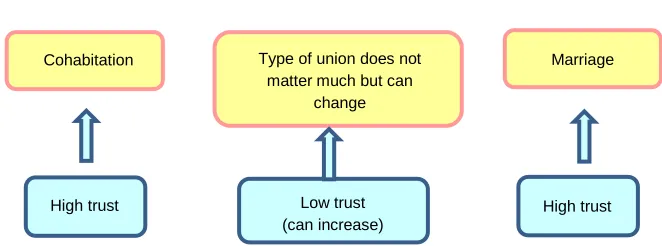
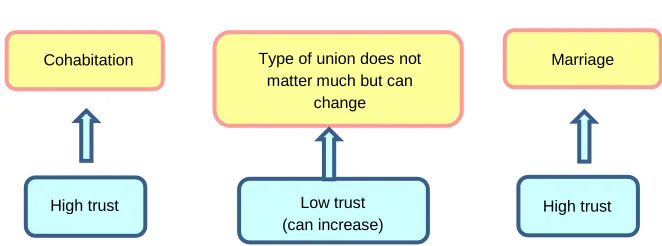
Figure 3: Level of trust and the type of union
On the whole, it seems that a high level of trust is characteristic of two polar-opposite groups of participants: those who have consciously chosen cohabitation and those who have consciously chosen marriage. The majority of participants in between expressed lower levels of trust in each other and confessed to manipulating resources in order to coerce a partner either to marry or to cohabit. However, in their case the level of trust can increase over time, and they said they could show this by first marrying, and later having a church wedding. On the whole, trust seems to play a key role in union development in all of these cases.
However, according to what was said in the focus groups, trust seems to be more related to the values associated with the different types of union rather than with the union type as such. The idea of forming a couple is valued by participants with both high and low levels of trust, but those with a lower level of trust have a more practical attitude toward the union and their partners.
Trust assumes very different forms in ideational marriage and ideational cohabitation. Those who prefer marriage speak about having no need for a trial cohabitation period, and about trusting a partner with one‟s life and property without any doubts or the need to prove anything. Their decision to do this is holistic and simultaneous, based on strong feelings and strong moral attitudes. It can be called “trust with closed eyes”.
Those who prefer cohabitation speak about the desire to give freedom to the partner as a gift. They express trust in terms of not asking their partner where and with who s/he is at any specific moment. They claim to generally trust the good intentions of their partners to stay in the union, but both parties are free to leave at any time. Here, trust means a lack of constant control. This can be called “trust with open eyes,” since they can imagine infidelity and other attributes of moral flexibility in themselves and in their partner, but choose to trust anyway.
Cohabitation Type of union does not Marriage
matter much but can change
High trust Low trust High trust
5.4 Religion and three stages of union formation
Some participants mention religion as part of the “external” pressures influencing their decisions concerning union status:
For me, religion is important, but we ought to taste our relationship first; therefore we are now marrying after cohabiting for two years, and we also plan to have a church wedding, but later, not now. (Woman, low educated, Group 1)
In the “three stages theory” of conjugal union development the first stage is cohabitation, the trial period of a relationship. The second stage is the official registration of the marriage, when commitment and responsibility grow. The third stage is the church wedding, when commitment becomes virtually absolute. Several years can pass between each of the three events. Religion (typically Orthodox Christianity) plays a role for more than half the focus group participants, of both genders. This does not necessarily indicate true and deep belief, since Orthodox teaching does not prescribe this kind of sequencing in the process of union registration; this „lay theory‟ may even signify a somewhat instrumental usage of religion.
When people cohabit, it means they are open to other relationships starting at any moment; when they marry, they somehow say that for the present moment they are really committed to live with that person. When they have a church wedding, they are so confident in their choice that they are sure that they will always be committed to this person only. (Man, highly educated, Group 4)
This view is unusual in Christianity because the religious marriage, which according to the Church is the only true union, follows the civil marriage rather than occurring simultaneously. Thus the Russian development of a three-stage process is contradictory, since in Orthodox Christianity all three events are supposed to happen simultaneously.
giving promises that both partners will uphold. According to the participants, state registration means they can change their minds in the future, since the idea of possible divorce is incorporated in the concept of civil marriage, while in religious marriage divorce is believed to be impossible or exceptional.
Those who prefer to marry straight away seem to be more deeply religious, while ideational cohabitants were more likely to express atheistic views. For the latter both state and religious marriages are equally unacceptable.
Finally, it is important to mention that in Russia a state marriage traditionally involves a wedding feast, so the need for a marriage festivity can be satisfied with just state registration. Later on, when having a church wedding, the couple might have an additional celebration. Several participants mentioned the desire to have a second celebration as leading to another marriage ceremony later in life. However, a wedding feast was only important to a minority of participants, while the issue of trust was meaningful to everyone.
Figure 4: Three stages of union formation
6. Conclusion and discussion
Both the Second Demographic Transition and the Pattern of Disadvantage concept seem relevant in the Russian context. Some cohabitors have socio-economic characteristics that prevent them from marrying, as the POD concept suggests: they have poor marital prospects because they have little education and no financial resources. For others, the decision to cohabit is based on an ideational choice. Some less-educated people who have rational reasons for cohabiting rather than marrying can also be considered ideological cohabitors. The STD concept, with its emphasis on individual values and freedom, might well explain opposition to the strict norms of
Cohabitation
(Several years later) State registration
traditional families such as having to serve a husband and his family, or avoiding the situation where a husband determines his child‟s education.
However, the Russian experience cannot be completely explained by these two theories. The cultural memory of a high tolerance of cohabitation in the 1920s and early 1930s followed by a marriage „renaissance‟ lasting until the 1980s to some extent influences current Russian specifics in union formation. The significant family policy fluctuations of the last two decades could also play a role. At some point single-mother benefits could have discouraged some couples from marrying, while later the introduction of “maternity capital” may have motivated people to marry.
The analysis of our focus group results demonstrates that currently the choice between marriage and cohabitation is strongly related to trust and other norms and values that ultimately are also related to trust. In Russia, interpersonal trust as well as trust in government and its institutions is low (Belianin and Zinchenko 2010; Magun and Rudnev 2010). This may result in a growing number of cohabiting couples, despite the state encouraging marriage by, for example, providing no legal protection for cohabitors, especially in terms of adjudicating property disputes if a cohabiting relationship breaks down. Thus the concept of anomie, when the norms of the past seem irrelevant to large parts of the population and new, definite, and commonly shared norms have not been established, leading to individual isolation and confusion, seems to shed more light on the situation than the theories of the POD and STD.
Due to the specific history of religion in Russia, “tradition” is comprised of many contradictory views and attitudes. The “three stage theory” described above is one of the most striking manifestations of this development, since it demonstrates a new usage of religion, different from the Orthodox norms that prescribe that the initiation of a sexual relationship, state marriage, and a church wedding should take place at the same time. The Orthodox norms depict people‟s ideals, and not necessarily their real behavior. Regarding the main theme of this paper, it is important to stress that the three-stage theory does not concern the two polar-opposite groups of ideational cohabitants and ideational married people. It describes those who are in between, who initially have a low level of trust but still want to form a couple. They believe that their trust will increase as time passes, and when this happens they can and probably will marry their cohabiting partners.
We believe that these specific processes of union formation are related to the deep socio-economic changes that took place in Russia in the 1990s, which resulted in low trust and anomie. Cohabitation and non-marital childbearing increased during this period (Perelli-Harris and Gerber 2011; Philipov et al. 2005). In an anomic society, many people are not guided by norms, as they claim and believe themselves to be, but by the systematic attainment of goals in the context of a changing world which no longer assumes any clear norms (Merton 1966). Other people in the same society, however, maintain their values even if this is not to their immediate profit. In our research some adherents of both marriage and cohabitation expressed a high level of trust in their partners perhaps because trust is more important to them. For the others their immediate goal attainment trumps moral values and they are prepared to be more flexible in the area of behavioral ethics. Therefore, their level of trust, even of their partners, is low, and they are quite comfortable manipulating their partners in various ways. In fact, our two most interesting findings were that the level of trust is highest not only among those who marry straight away but also among those who choose to remain in cohabiting relationships. The picture of low trust among the majority and high trust among the minority corresponds well with the evidence for diminished levels of trust among Russians in the 1990s (Belianin and Zinchenko 2010; Magun and Rudnev 2010).
7. Acknowledgments
References
Aassve, A., Billari, F., and Pessin, L. (2012). Trust and Fertility Dynamics. Carlo F. Dondena Centre for Research on Social Dynamics (Working Paper No. 55). http://www.dondena.unibocconi.it/wp November 2012.
All-Russian, Census (2002). Vozrastno-polovoi sostav I sostoyanie v brake. http://www.perepis2002.ru/index.html?id=31.
All-Russian, Census (2010). Federalnaya sluzhba gosudarstvennoi statistiki. Itogi Vserossiiskoi perepisi naseleniya 2010 goda. Vozrastno-polovoi sostav I sostoyanie v brake 2. http://www.gks.ru/free_doc/new_site/perepis2010/ croc/perepis_itogi1612.htm.
Ashwin, S. (ed.) (2000). Gender, State and Society in Soviet and Post-Soviet Russia. London, New York: Routledge.
Ashwin, S. (ed.) (2006). Adapting to Russia's New Labour Market: Gender and Employment Behaviour. Abingdon, New York: Routledge (Routledge Curzon Contemporary Russia and Eastern Europe Series 5). doi:10.4324/9780 203313138.
Belianin, A.V. and Zinchenko, V.P. (2010). Doverie v ekonomike i obshestvennoizhizni. Moscow: Liberalnaya missia fund.
Bondarskaya, G. (1999). Izmeneniye demograficheskogo povedeniya rossiiskih semei za 100 let. Mir Rossii N4: 58−70.
Demoscope Weekly (2013). Extramarital Childbearing in Developed Countries [electronic resource]. http://demoscope.ru/weekly/app/app4013.php.
GGS (2004). http://www.socpol.ru/eng/research_projects/proj12.shtml.
Goldman, W.Z. (1993). Women, the State and Revolution: Soviet family policy and social life, 1917−1936. Cambridge University Press. doi:10.1017/CBO978 0511665158.
Hoem, J.M., Jasilioniene, A., Kostova, D., and Muresan, C. (2009). Traces of the Second Demographic Transition in Selected Countries in Central and Eastern Europe: Union Formation as a Demographic Manifestation. European Journal of Population 25: 123−156. doi:10.1007/s10680-009-9177-y.
Kiblitskaya, M. (2000a). “Once We Were Kings”: Male Experiences of Loss of Status at Work in Post-Communist Russia. In: Ashwin, S. (ed.). Gender, State and Society in Soviet and Post-Soviet Russia. Routledge: 90−104.
Kiblitskaya, M. (2000b). Russia‟s Female Breadwinners: the Changing Subjective Experience. In: Ashwin S. (ed.). Gender, State and Society in Soviet and Post-Soviet Russia. Routledge: 55−70.
Kincella, E.A. (2006). Hermeneutics and Critical Hermeneutics: Exploring Possibilities Within the Art of Interpretation. Forum: Qualitative Social Research 7(3). Kon, I. (2009). Muzhchina v meniaushemsia mire. Moscow: Vremia.
Kukhterin, S. (2000). Fathers and Patriarchs in Communist and Post-Communist Russia. In: Ashwin, S. (ed.). Gender, State and Society in Soviet and Post-Soviet Russia. Routledge: 71−90.
Lesthaeghe, R. (2010). The Unfolding Story of the Second Demographic Transition. Population and Development Review 36(2): 211–251. doi:10.1111/j.1728-445 7.2010.00328.x.
Lindlof, T.R. and Taylor, B.C. (2002). Qualitative Communication Research Methods. Thousand Oaks, CA: Sage.
Magun, V.S. and Rudnev, M.G. (2010). Bazovye tsennosti rossian v evropeiskom kontekste. Obshestvennye nauki i sovremennost 2010(3). http://www.isras.ru/ files/File/Publication/Bazov_zennosti_St1_Magun_Rudnev.pdf.
McLanahan, S. (2004). Diverging destinies: How children are faring under the second demographic transition. Demography 41(4): 607−627. doi:10.1353/dem.2004. 0033.
Merton, R. (1966). Social Theory and Social Structure. New York: Free Press.
Perelli-Harris, B. (2006). The Influence of Informal Work and Subjective Well-Being on Childbearing in Post-Soviet Russia. Population and Development Review 32(4): 729−753. doi:10.1111/(ISSN)1728-4457.
Perelli-Harris, B. and Gerber, T.P. (2011). Nonmarital Childbearing in Russia: Second Demographic Transition or Pattern of Disadvantage? Demography 48(1): 317−342. doi:10.1007/s13524-010-0001-4.
Perelli-Harris, B. and Isupova, O. (2012). Cohabitation, Legal Policies, and Cultural Systems: Divergence across Post-Soviet Space. Paper presented at the EPS 2012 conference in Stockholm. http://epc2012.princeton.edu/papers/120650.
Perelli-Harris, B., Mynarska, M., Berrington, A., Berghammer, C., Evans, A., Isupova, O., Keizer, R., Klaerner, A., Lappegård, T., and Vignoli, D. (2014). Towards a new understanding of cohabitation: Insights from focus group research across Europe and Australia. Demographic Research 31(34): 1043−1078. doi:10.4054/DemRes.2014.31.34.
Philipov, D., Spéder, Z., and Billari, F.C. (2005). Now or Later? Fertility Intentions in Bulgaria and Hungary and the Impact of Anomie and Social Capital. Vienna Institute of Demography (Working Papers 08/2005).
Rotkirch, A. and Kesseli, K. (2012). Two Children Puts You in the Zone of Social Misery: Childbearing and Risk Perception among Russian Women. In: Carlbäck, H., Gradskova, Y., and Kravchenko, Z. (eds.). And They Lived Happily Ever After: Norms and Everyday Practices of Family and Parenthood in Russia and Central Europe. Budapest, New York: Central European University Press: 161.
Routio, P. (2007). Finding Information in Texts. Arteology, the science of products and professions. http://www2.uiah.fi/projects/metodi/140.htm.
Stanley, S.M., Rhoades, G.K., and Markman, H.J. (2006). Sliding Versus Deciding: Inertia and the Premarital Cohabitation Effect. Family Relations 55: 499–509. doi:10.1111/j.1741-3729.2006.00418.x.
Surkyn, J. and Lesthaeghe, R. (2004). Value Orientations and the Second Demographic Transition (SDT) in Northern, Western, and Southern Europe: An Update. Demographic Research Special Collection 3(3): 45−86. doi:10.4054/DemRes. 2004.S3.3.
Thornton, A. and Philipov, D. (2009). Sweeping changes in marriage, cohabitation and childbearing in Central and Eastern Europe: New insights from the developmental idealism framework. European Journal of Population 25(2): 123−156. doi:10.1007/s10680-009-9181-2.
Van de Kaa, D.J. (2001). Postmodern fertility preferences: from changing value orientation to new behavior. Population and Development Review 27: 290−331. Zabaev, I., Pavlenko, E., Pavlutkin, I., and Yemelianov, N. (2012). Semia i
detorozhdenie v Rossii. Izdatelstvo Pravoslavnogo Sviato-Tikhonovskogo Universiteta. Moscow: Kategorii roditelskogo soznaniya.
Zakharov, S. (2011). Ergei, Rost chisla rozhdeniy v Rossii zakonchilsia? [electronic resource] demoscope.ru/weekly/2011/0453/demoscope0453.pdf.
Trust, responsibility, and freedom: Focus-group research on
contemporary patterns of union formation in Russia
1Olga Isupova2
Abstract
BACKGROUND
While some studies directly address the issue of changes in union formation in Russia and Eastern Europe, few have focused on attitudes and norms regarding marriage and cohabitation. In Russia cohabitation has risen sharply in the last decades, but recently its level has stabilized and even decreased slightly.
OBJECTIVE
We intend to highlight gender and educational differences in perceptions of the advantages and disadvantages of cohabitation vs. marriage.
METHODS
We conducted 8 focus groups in Moscow in January 2012 (4 with men, 4 with women, half with higher educated participants and half with lower educated participants). RESULTS
Participants claimed that trust between men and women underlies preferences for marriage or cohabitation. Participants‟ religious beliefs form a „three stages of union‟ theory: cohabitation in the beginning, civil marriage later when trust has developed, and finally a church wedding when trust is established. In union formation the participants‟ ideals are the values of responsibility, freedom, fidelity, and trust. The level of trust is highest for proponents of marriage and ideational cohabitors. People without a strong preference for a certain type of union have the lowest level of interpersonal trust. CONCLUSIONS
In a society that currently can be considered anomic, interpersonal trust was found to be the most important factor underlying expressed ideals in choice of union type. It takes different forms for adherents of marriage (“trust with closed eyes”) and adherents of cohabitation (“trust with open eyes”).
1 Support from the Basic Research Program of the National Research University, Higher School of
Economics is gratefully acknowledged.
2
1. Introduction
While some studies directly address the issue of changes in union formation in Eastern Europe, including Russia (Harris and Gerber 2011; Hoem et al. 2009; Perelli-Harris and Isupova 2012), few have focused specifically on attitudes and norms regarding marriage and cohabitation. Cohabitation has increased significantly in Russia during the last few decades .According to the census, the share of couples cohabiting increased from 9.8% in 2002 to 13.2% in 2010 (All-Russian Census 2002, 2010). Another study in 2004 found that around 25.7% of the total of partnered respondents had never married their current partners (N=7645) (GGS 2004). Nonmarital childbearing also became more common, with 30% of births occurring outside of marriage in 2005, although by 2011 this had gradually decreased to 24.6% (Zakharov 2011). This figure is not as high as in other countries in Eastern Europe and the former Soviet Union (e.g., 57.4% of births to cohabitors in 2012 in Bulgaria, and 58.4% in Estonia, Demoscope Weekly, 2013), but is still remarkable considering that in previous decades childbearing within marriage was nearly universal in Russia. Indeed, about half of the increase in nonmarital fertility has been to cohabiting couples (Zakharov 2011), suggesting that cohabitation has become a new part of the family formation process in Russia.
In Russia there is very little understanding of how people talk about cohabitation and marriage: the meanings attached to these types of behavior are unclear. This makes explanation of recent fluctuations in nonmarital fertility very difficult. In our view, greater insight is needed into the nature of cohabitation and how people discuss it. Thus, in this study we use focus group research to explore discourses on cohabitation and marriage. Focus group methodology allows us to reveal social norms and attitudes and discourses regarding marriage and cohabitation, and to see how people interact when discussing cohabitation. Our main research questions concerned the meaning of cohabitation for people choosing (or not choosing) this union arrangement; differences between marriage, cohabitation, and simply dating; advantages and disadvantages of cohabitation and marriage; reasons for the increase and decrease in the number of people living together without marrying; and culturally specific patterns behind cohabitation in Russia.
explicating these findings, we present a brief historical review of Russian policy changes in this domain.
2. Historical trends in law and the practice of cohabitation and
non-marital childbearing
Throughout the 20th century in Russia the relationship between „traditional‟ and „modern‟ attitudes towards cohabitation and nonmarital childbearing in both law and practice was dynamic and varied depending on the epoch. Consequently, it is difficult to know what the word “tradition” means in Russia. In 1918 all children, regardless of whether they were born within marriage or out of wedlock, were considered equal before the law, and marriage was secularized. From 1926 cohabiting couples were regarded as equal to those who went through the formal civil marriage procedure (Goldman 1993). From the middle of the 1940s (Family legislation of 1944) until the 1960s, however, marriage legislation became more conservative and the status of marriage was privileged. Initially, children of unmarried mothers were prohibited from having any legal relationship with their fathers; however this changed in 1969 when unmarried fathers and mothers were allowed to register their children together, providing them with the same rights as children of married parents. In addition, from 1968 until the collapse of the Soviet Union in 1989, married couples received extra housing benefits; for example, they could have a room to themselves in a student hostel or receive a free flat. In the 1960s to the 1980s divorce was relatively easy to obtain, and most men and women married at least once in their lives. Despite the predominance of formal marriage, however, the 1926−39 period when cohabitation was tolerated remained in the cultural memory.
By the 1980s some flexibility or diversification of norms in union formation was already starting to develop in Soviet Russia, although at that time there was also a religious renaissance. Sexual and family norms changed and sexual freedom started to emerge in the 1980s and 1990s (Kon 2009). However this new tolerance mainly affected pre-marital behavior: sexual fidelity and the high value of a long-term marriage persisted, especially for women (Tiomkina 2008).
at a level slightly above 10%. However, nonmarital fertility began to steadily rise at the beginning of the 1980s (Figure 1), even before the collapse of the Soviet Union, later becoming stable again at levels above 27%.
Figure 1: Percent of extramarital births in Russia 1960−2005
Source: http://demoscope.ru/weekly/app/app4013.php accessed 29th of April 2014.
The absolute number of nonmarital births has been relatively stable since the mid-2000s. However, the share has decreased because of the increase in the absolute number of marital births. One of the many factors behind the decrease might be the somewhat controversial social policy3 of “maternity capital” which, hypothetically, might persuade some already married couples to have additional children, while not having a similar effect on cohabitors. Other reasons might include the rise of conservative values in some parts of society, women wanting more male support in a difficult economic
3 The “maternity capital” policy consists of the payment of a lump sum of money to all parents who have a
situation, or the delay of marriage (Zakharov et al. 2013). Causes for this relative decline warrant further study but are not the focus here. Interestingly, in 2011 the absolute number of nonmarital births registered by both father and mother increased by 3.3%, while the increase for marital births was much lower. This category is believed to be primarily associated with childbearing by cohabiting couples. At the same time the number of births registered only by the mother dropped significantly, by 4.1% (Zakharov et al. 2013). For 2011 overall, 11.5% of all births were to cohabiting couples. In the 1990s almost all Russians experienced economic uncertainty resulting from the transition to a market economy and the accompanying socio-economic crisis (Kukhterin 2000; Ashwin et al. 2000; Kiblitskaya 2000a, 2000b; Ashwin 2006; Goncharova, Isupova, Omelchenko, and Yaroshenko 2006). Income and employment became insecure, and initially social ties among family members and other individuals strengthened (Kukhterin 2000; Goncharova, Isupova, Omelchenko, and Yaroshenko 2006). However, such ties often proved weak and temporary, since everyone had to struggle for his or her own income security and many people gradually became less inclined to share resources with the less successful (Kukhterin 2000; Kiblitskaya 2000a, 2000b; Ashwin 2006). The newly formed private sector in the Russian economy was unstable at first, and there were few social guarantees of any kind.
Figure 2: Percent of births outside of marriage by type of registration, 2005−2011 (blue – overall extramarital fertility, red – registered by mother only)
Source: Zakharov et al. 2013; http://demoscope.ru/weekly/knigi/ns_r10_11/akrobat/glava7.pdf, p. 308, (based on unpublished data collected by Russian State Staticstic Agency, http://www.gks.ru/).
situation required new types of behavior according to new „rules.‟ For many people this meant endlessly exercising their adaptive abilities to ever-changing situations in all areas of life. Researchers found that Russian women use all available means to protect themselves against possible social, economic, and family crises (Rotkirch and Kesseli 2012). Russian women act as if their situation could change for the worse very suddenly and want to ensure that at any point in their lives they can manage as single parents or sole providers. This behavior presupposes weak union ties, whether marriage or cohabitation is involved, with low trust in guarantees of support from a former partner should the union break apart.
3. Theoretical framework
There are several competing theories that aim to explain the growing rates of cohabitation in various countries. We will now consider the most influential theories that are also relevant to the current Russian situation.
3.1 The second demographic transition, economic uncertainty, and the pattern of disadvantage
Economic uncertainty in relation to cohabitation is conceptualized by the theory of the pattern of disadvantage (POD). According to this theory, as discussed by Perelli-Harris and Gerber (2011) and McLanahan (2004), cohabitation is not associated with the most educated and elite non-conformist groups, but is instead characteristic of the poorer, less educated, and disadvantaged parts of the population. These groups might not be able to find suitable marriage partners and/or might not be desirable marriage partners due to low human capital, insecure income, and lifestyles perceived as negative (substance abuse, criminality, etc.).
3.2 Social anomie
Another possible explanation for the rise in cohabitation is increasing anomie and the attendant rejection of normative institutions. According to Merton (1966), an acute disjunction between culturally determined goals and the means offered by society to achieve them results in an anomic society. This disharmony causes rejection of norms and distrust in institutions at the micro-level. Anomie pushes decision-making in all important life events from the rational to the irrational, spontaneous, or automatic. This could cause an increasing preference for cohabitation over marriage, because the former, unlike the latter, is often “slid into” rather than specifically “decided upon” (Stanley et al. 2006). Thus, cohabitation might become more prevalent in insecure times. While the theory of the pattern of disadvantage focuses on social strata and individuals within a given society, anomie can affect the whole society.
3.3 Trust
When society is in a state of anomie, or close to it, individuals begin to have difficulty trusting one another. Trust is usually described as belief in the honesty, fairness, or benevolence of another party. Though they are interrelated, generalized trust4 (i.e., trust in individuals outside one‟s own family that one does not know) differs from trust in institutions. Russia as a whole experienced a drastic decrease in generalized trust, as measured by the World Values Survey (WVS) (Belianin and Zinchenko 2010). The average number of respondents who answered “yes” to the question of whether they could trust most people decreased from 37.5% in 1990 (N = 1818) to 23.7% in 1999 (N = 2416). This number later changed marginally and was only 27.8% in 2011 (N=2500). Changes in generalized trust in a given society are rare, which makes the recent significant decline in Russia all the more striking. Likewise, in Russia trust in institutions, with the exception of the Church and the Army (Belianin and Zinchenko 2010), has also decreased significantly over the last two decades.
While studies on cohabitation and trust are rare, demographers have done research on trust in relation to other demographic factors such as childbearing (Aassve et al. 2012). We argue that, at least in the Russian context, after taking into consideration various theoretical frameworks for cohabitation, the concept of trust might help to fill some of the remaining gaps in our understanding of the process of union formation.
4. Methodology
In total, 8 focus groups were conducted in Moscow, Russia in January 2012: 4 with men only, and 4 with women only. In each group there were eight 25 to 40-year-old participants. 2 male groups and 2 female groups consisted of people with at least a Bachelor‟s degree; all the others in the remaining 4 groups (2 male and 2 female) had a lower educational level: high school, technical school, technical college, etc. More than 3 participants in each group had children younger than 10 years. Each group included 23 cohabiting persons; 23 married persons; 1-3 divorced or separated (previously cohabiting) persons who were currently neither married nor cohabiting, and 1 person who had never married or cohabited5. This group composition stimulated a clash of opinions as the participants freely discussed their values and attitudes, readily arguing about them with people of differing views. It seems to be characteristic of Russians at this historical juncture to communicate without fear of offending others or of being
4 Generalized trust is usually defined as the feeling that another person whom one does not personally know
will treat you in the same way as you would treat yourself in their place.
5