Downloaded from ht
tp://www.jr
i.ir
Original Article
J Reprod Infertil. 2018;19(1):26-31
Performing IUI Simultaneously with hCG Administration Does Not Compromise
Pregnancy Rate: A Retrospective Cohort Study
Patsama Vichinsartvichai, Khanitta Traipak, Chirawattana Manolertthewan
- Infertility Unit, Department of Obstetrics and Gynecology, Vajira Hospital, Faculty of Medicine, Navamindradhiraj University, Bangkok, Thailand
Abstract
Background: The probability of conception occurs before ovulation in natural cycle,
thus performing IUI before ovulation should not compromise the pregnancy out-comes.
Methods: A retrospective cohort study was conducted at a university hospital during
2007 to 2015. The ovarian stimulation and monitoring were performed as usual. The total of 29 preovulatory IUI, and 221 postovulatory IUI couples were recruited. In postovulatory IUI, 5,000 IU of hCG was injected when dominant follicle reached 17 mm. The IUI was performed 36 to 40 hr afterward. In preovulatory IUI, hCG was in-jected and IUI was performed simultaneously when the dominant follicle reached the size. Data were compared using independent sample t test and Fisher’s exact test. A p-value of <0.05 was considered statistically significant.
Results: The characteristics of both groups were comparable. The cumulative
bio-chemical, clinical, and live birth rates were not different between prevulatory and postovulatory IUI groups (10.3% vs. 16.3%; p=0.407, 10.3% vs. 12.2%; p=0.77 and 10.3% vs. 11.3%; p=0.877, respectively).
Conclusion: Performing IUI simultaneously with hCG administration does not
com-promise pregnancy rate.
Keywords: Artificial insemination, Postovulatory IUI, Pregnancy rate, Preovulatory IUI,
Timing of hCG.
To cite this article: Vichinsartvichai P, Traipak K, Manolertthewan C. Performing IUI
Sim-ultaneously with hCG Administration Does Not Compromise Pregnancy Rate: A Retrospec-tive Cohort Study. J Reprod Infertil. 2018;19(1):26-31.
Introduction
lthough success rate for intrauterine insemi-nation (IUI) is relatively low (1) (around 10% per cycle), IUI is generally considered as the primary modality for infertility treatment. It involves mild ovarian stimulation or natural cycle and processed sperm insemination. The prognos-tic factors for success rate depend on women age (1), processed total motile sperm (1, 2), endome-trium thickness (1), and number of dominant fol-licles (3).
Conventionally, human chorionic gonadotropin (hCG) is administered when dominant follicles are reached on ultrasonography. The IUI is then scheduled 36-40 hr afterward. However, the prob ability of conception occurs only during five days
before and ends on the day of ovulation in natural cycle (4). Hence, the necessity of scheduled IUI after ovulation has been challenged. It is hypothe-sized that IUI can be scheduled on the same day as the dominant follicle achieves on ultrasonogra-phy without compromising the pregnancy out-come (5-10). The limitation of previous studies is the lack of powerful sample size to tell the differ-ence among each treatment arm. The pooled data of the published studies might overcome this limi-tation (5-8, 10-13).
The aims of the present study were to compare thepregnancyoutcomesbetweenpreovulatoryand postovulatory IUI to study the pregnancy out-comes between such timing of hCG and IUI.
* Corresponding Author:
Patsama Vichinsartvichai, Infertility Unit,
Department of Obstetrics and Gynecology, Faculty of Medicine Vajira Hospital, Navamindradhiraj University, 681 Samsen rd., Dusit, Bangkok 10300, Thailand
E-mail:
Received: May 20, 2017
Downloaded from ht
tp://www.jr
i.ir
J Reprod Infertil, Vol 19, No 1, Jan-Mar 2018 27
Vichinsartvichai P, et al.
JRI
Methods
Study design and participants: The retrospective cohort study was carried out at the infertility clin-ic in a tertiary-care university hospital. The study was conducted in accordance to the ethical princi-ples of the Declaration of Helsinki, and the Vajira Institutional Review Board approved the study protocol.
All data were collected from IUI cycles between October 2007 to October 2015, after excluding the couples that were diagnosed with severe male fac-tor infertility and bilateral tubal obstruction. To-tally, 29 preovulatory IUI, and 221 postovulatory IUI couples were recruited. The patients were di-agnosed with endometriosis, or endometrial polyp by laparoscopic or hysteroscopic surgery with his-topathologic confirmation.
Ovarian stimulation: In each IUI cycle, ovarian stimulation was performed either by clomiphene citrate (CC) alone(Ovinum, Biolab, Samutrprakarn, Thailand),gonadotrophinalone(Menopur,Ferring, Saint-Prex, Switzerland), or combination of CC and gonadotrophin, based on physician’s discre-tion starting on the 3rd to 5th day of menstrual cycle. The growth of follicles and endometrial response were monitored by transvaginal ultraso-nography on cycle days 9 to 14.
Timing of hCG injection: The standard protocol in our unit had been to inject 5,000 IU of hCG (Pregnyl, MSD, New Jersey, USA) when at least one dominant follicle reached 17 mm in mean di-ameter. The IUI was performed 36 to 40 hr after hCG administration. During October 2007 to De-cember 2014, all patients were treated according to the standard protocol (postovulatory group). From January 2015, hCG was administered and IUI was performed on the same day when at least one dominant follicle reached 17 mm in mean di-ameter (preovulatory group).
Sperm preparation and IUI procedure: The semen samples were collected by masturbation following an abstinence of 3-5 days and then left to be lique-fied in the 37°C incubator for 30 min. A droplet of undiluted semen was analyzed according to 5th editionofWHO laboratorymanual (14).After se-men analysis, the samples were centrifuged at 300 g for 15 min in a 45% and 90% Sil-Select-STOCK sperm preparation medium (FertiPro, Beernem, Belgium). The supernatant was discarded and the pellet was washed twice in sperm washing medi-um (FertiCult Beernem, Belgimedi-um) at 250 g in 5
min in each washing. The prepared sperm was kept in the 37°C incubator until used.
The prepared sperm was inseminated into the uterus through the cervix using an in-house com-pile soft IUI catheter.
Patient follow: Two weeks after the IUI proce-dure, the urine pregnancy test (UPT) was done. In case of positive UPT, a serum level of β-hCG is often determined for the confirmation of biochem-ical pregnancy. For the clinbiochem-ical pregnancy, the vaginal sonography was performed every 2 weeks after the positive pregnancy result to inspect the gestational sac and fetal heart beat activity until gestational age of 12 weeks.
Statistical analysis: All data were analyzed by SPSS software (version 22.0). Data were present-ed as mean±standard deviation (SD), number (%), or percentage (95% confidence interval, CI), as appropriate. Data comparisons were analyzed us-ing independent sample t test for continuous data and χ2 or Fisher’s exact test as appropriate for
cat-egorical data. The binary logistic regression anal-ysis adjusted for duration of infertility, number of dominant follicles, endometrium thickness, and total motile sperm count were used to compare the pregnancy rates among preovulatory and postovu-latory IUI group. A p-value of <0.05 was consid-ered statistically significant.
Results
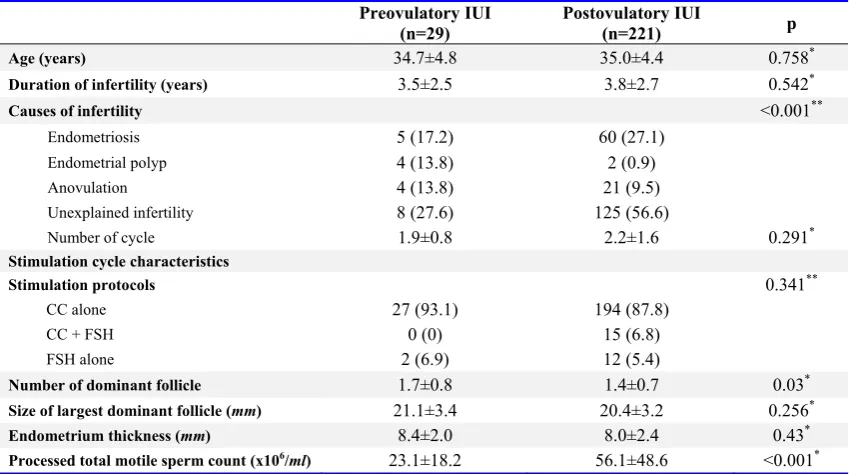
Between October 2007 and December 2014, there were 466 IUI cycles from 221 couples who underwent IUI after 36-40 hr of hCG injection (postovulatory group) while between January 2015 and October 2015, there were 54 IUI cycles from 29 couples who underwent IUI on the same day of hCG injection (preovulatory group). The baseline characteristics of both groups were com-parable (Table 1). The average women age was 35 years, and mean duration of infertility was 3.5±2.5 years in preovulatory group and 3.8±2.7 years in postovulatory group, respectively. The major eti-ologies of infertility were unexplained, endome-triosis, and anovulation, respectively. No mild male factor infertility was observed. Most of the cycles were stimulated with clomiphene citrate alone. However, mean total motile sperm count afterspermpreparationinpostovulatoryIUIgroup was significantly higher than preovulatory IUI group (56106/ml versus 23106/ml, respectively,
Downloaded from ht
tp://www.jr
i.ir
28 J Reprod Infertil, Vol 19, No 1, Jan-Mar 2018
Preovulatory IUI does not Compromise Pregnancy Rate
JRI
Pregnancy outcomes: The pregnancy outcomes
were displayed in table 2. The biochemical preg-nancy rates were comparable among both groups (10.3%, 95% CI 1.0-22.0, and 16.3%, 95% CI 11.0-21.0, p=0.587 in preovulatory IUI, and post-ovulatoryIUIgroup,respectively).These biochem-ical pregnancies resulted in 3 live-births in pre-ovulatory IUI group (10.3%, 95% CI 1.0-22.0), and 25 live-births in postovulatory IUI group (11.3%, 95% CI 7.0–16.0). The live-birth rates among both group were not different (p=1.000). There was no miscarriage in preovulatory IUI group while there were 11 miscarriages in post-ovulatory IUI group (5.0%, 95% CI 2.0-8.0, p= 0.622). The binary logistic regression was applied to adjust for the effect of duration of infertility, number of dominant follicles, endometrium thick-ness, and total motile sperm count to the pregnan-cy outcomes among both IUI group as represented
in table 3. There was no significant effect of tim-ing of IUI to the pregnancy results.
Discussion
The concept of performing IUI after expected ovulation (36-40 hr after hCG administration) has been challenged for decades. Performing IUI be-fore expected time of ovulation (preovulatory IUI)
Table 1. Baseline characteristics of preovulatory and postovulatory IUI groups. Data are presented as mean±
standard deviation or number (%)
Preovulatory IUI
(n=29) Postovulatory IUI (n=221) p
Age (years) 34.7±4.8 35.0±4.4 0.758*
Duration of infertility (years) 3.5±2.5 3.8±2.7 0.542*
Causes of infertility <0.001**
Endometriosis 5 (17.2) 60 (27.1)
Endometrial polyp 4 (13.8) 2 (0.9)
Anovulation 4 (13.8) 21 (9.5)
Unexplained infertility 8 (27.6) 125 (56.6)
Number of cycle 1.9±0.8 2.2±1.6 0.291*
Stimulation cycle characteristics
Stimulation protocols 0.341**
CC alone 27 (93.1) 194 (87.8)
CC + FSH 0 (0) 15 (6.8)
FSH alone 2 (6.9) 12 (5.4)
Number of dominant follicle 1.7±0.8 1.4±0.7 0.03*
Size of largest dominant follicle (mm) 21.1±3.4 20.4±3.2 0.256*
Endometrium thickness (mm) 8.4±2.0 8.0±2.4 0.43*
Processed total motile sperm count (x106/ml) 23.1±18.2 56.1±48.6 <0.001*
* Data were analyzed using independent sample t-test; ** Data were analyzed using the χ2 test; IUI: intrauterine insemination;
CC: Clomiphene citrate; FSH: Follicle stimulating hormone
Table 2. Comparison of pregnancy rate per couple with different timing in hCG injection.
Data are presented as number (%)
Preovulatory IUI (n=29)
Postovulatory IUI
(n=221) p*
Biochemical pregnancy rate 3 (10.3) 36 (16.3) 0.587
Clinical pregnancy rate 3 (10.3) 27 (12.2) 1.000
Live birth rate 3 (10.3) 25 (11.3) 1.000
Miscarriage rate 0 (0) 11 (5.0) 0.622
* Data were analyzed using the Fisher’s exact test; IUI: intrauterine insemination
Table 3. Binary logistic regression analysis of pregnancy rate per
couple among preovulatory and postovulatory IUI group (Postovulatory IUI is the reference group)
Adjusted OR
(95% CI)* p
Biochemical pregnancy rate 0.539 (0.144-2.024) 0.360
Clinical pregnancy rate 0.804 (0.208-3.107) 0.752
Live birth rate 0.796 (0.205-3.096) 0.742
Downloaded from ht
tp://www.jr
i.ir
J Reprod Infertil, Vol 19, No 1, Jan-Mar 2018 29
Vichinsartvichai P, et al.
JRI
should not decrease the pregnancy rate or even increase the chance of pregnancy according to many reasons. Firstly, the ovulation occurs 24-56 hr after LH surges (median 36 hr) in natural cy-cles (15). On the other hand, the ovulation pre-vails 36-48 hr after hCG administration (16, 17). However, the premature LH surges occur in stim-ulated IUI cycle (18), which contributes to spon-taneous ovulation about 24 hr after the surges (19). The conventional postovulatory IUI might be too late if premature LH surges occurred while preovulatory IUI still makes fertilization possible. Secondly, the cycle fecundability in natural cycle is maximum when the intercourse takes place be-tween two days before ovulation, and the day of ovulation (4).
In our data set, biochemical pregnancy rate and clinical pregnancy rate in preovulatory IUI were lower than those in postovulatory IUI but not sig-nificantly different (10.3% versus 16.3%, p=0.407, and 10.3% versus 12.2%, p=0.77, respectively). The live-birth rate was not different among both groups (10.3% versus 11.3%, p=0.877, in preovul-atory, and postovulatory IUI, respectively) ac-cording to higher miscarriage rate in postovulato-ry IUI (0.0% versus 5.0%, p=0.219, in preovul-atory, and postovulatory IUI, respectively).
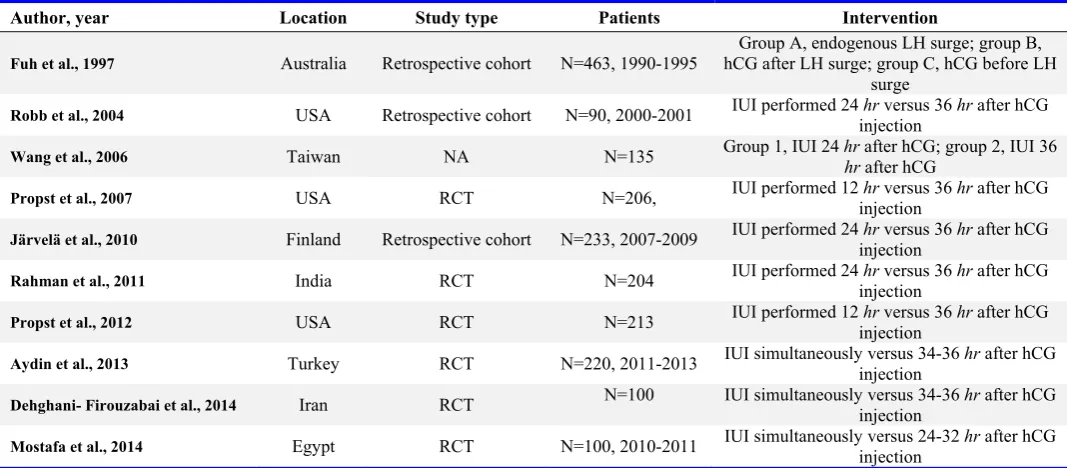
The characteristics of relevant publications were summarized in table 4. Fuh et al.’s investigated the time-related manner between spontaneous
en-dogenous luteinizing hormone surge, hCG admin-istration, and pregnancy rates in IUI cycles (20). Propst et al. (2012) used the same data set as Propst et al. (2007) did which might consequently deviate from the data in the previous studies.
From our study, unexplained infertility was the major cause of infertility in postovulatory IUI group while it was only about one fourth in preovulatory IUI (56.6% versus 27.6%, respec-tively). From previous studies, they found that spontaneous pregnancy rates in these patients were high up to 15% in one year, and might be up to 35% in two years (22). These might explain the reason for better biochemical and clinical preg-nancy rates in our postovulatory IUI group. How-ever, the duration of infertility in our patients was higher than 3 years in both groups, which was a poor prognostic predictor for fecundability (23). Furthermore, invasive investigations such as di-agnostic hysteroscopy and didi-agnostic laparoscopy were not performed in every patient. The com-bined diagnostic surgeries can reveal the con-cealed pelvic pathology in 50% of unexplained infertility patients (24).
The pregnancy rate in IUI treatment improves with an increased processed total motile sperm count (1, 2, 25). It can predict clinical pregnancy rate better than sperm chromatin dispersion test (26) with the threshold concentration of 10106/ml (27). Processed total motile sperm count in our
Table 4. Overview and characteristics of studies discussing IUI and timing of hCG administration
Author, year Location Study type Patients Intervention
Fuh et al., 1997 Australia Retrospective cohort N=463, 1990-1995 hCG after LH surge; group C, hCG before LH Group A, endogenous LH surge; group B, surge
Robb et al., 2004 USA Retrospective cohort N=90, 2000-2001 IUI performed 24 injection hr versus 36 hr after hCG
Wang et al., 2006 Taiwan NA N=135 Group 1, IUI 24 hrhr after hCG; group 2, IUI 36 after hCG
Propst et al., 2007 USA RCT N=206, IUI performed 12 injection hr versus 36 hr after hCG
Järvelä et al., 2010 Finland Retrospective cohort N=233, 2007-2009 IUI performed 24 injection hr versus 36 hr after hCG
Rahman et al., 2011 India RCT N=204 IUI performed 24 injection hr versus 36 hr after hCG
Propst et al., 2012 USA RCT N=213 IUI performed 12 injection hr versus 36 hr after hCG
Aydin et al., 2013 Turkey RCT N=220, 2011-2013 IUI simultaneously versus 34-36 injection hr after hCG
Dehghani- Firouzabai et al., 2014 Iran RCT N=100 IUI simultaneously versus 34-36 injection hr after hCG
Mostafa et al., 2014 Egypt RCT N=100, 2010-2011 IUI simultaneously versus 24-32 injection hr after hCG
Downloaded from ht
tp://www.jr
i.ir
30 J Reprod Infertil, Vol 19, No 1, Jan-Mar 2018
Preovulatory IUI does not Compromise Pregnancy Rate
JRI
study is higher than the threshold in both groups but significantly higher in postovulatory IUI (23.1
106 versus 56.1106/ml, p<0.001 in preovulatory
IUI, and postovulatory IUI, respectively). These also explain the higher biochemical, and clinical pregnancy rate in postovulatory IUI but not live-birth rate.
The higher miscarriage rate in postovulatory IUI than preovulatory IUI in our data can be explained by our hypothesis that premature LH surges oc-curredmorefrequentlyinpostovulatoryIUIgroup. These findings are also in line with previous stud-ies that higher LH concentration at the time of maximum follicular growth was associated with lower conception, and may contribute to higher early pregnancy loss in PCOS patients (28). Un-fortunately, the direct correlation of premature LH surges and adverse pregnancy outcomes has not been explored. It was postulated that premature LH surges may give rise to the sequence of events that leads to pregnancy loss. First, it stimulates premature cumulus expansion, premature initia-tion of oocyte meiosis, and postmature oocyte at the time of fertilization (21). The postmature oo-cytes are found to have lower rate of normal ferti-lization, lower cleavage rate, and more than 1 pro-nuclear or propro-nuclear asynchrony (29). Second, premature progesterone secretion that appears af-ter premature ovulation results in advanced endo-metrial dating, endometrium-embryo asynchrony and change in implantation window (21). Thus, more abnormal embryos and poor endometrium receptivity affect the pregnancy loss.
Our study has some limitations. Firstly, the ret-rospective nature of the study limits the variables that could be analyzed such as hormone monitor-ing, and the unmatched sample size among both groups. Secondly, the heterogeneity among each included study existed such as the timing of IUI after hCG administration in preovulatory IUI group which varied from simultaneously with IUI, 12 hr, and 24 hr. The outcome measures also var-ied among each study. Thus, these discrepancies made it difficult to perform a meta-analysis.
Conclusion
ItseemspreovulatoryIUIgivescomparable preg-nancy outcomes as postovulatory IUI. Performing IUI on the same day as hCG injection has numer-ous benefits. For patients, the lower number of clinic visits, and flexible time of hCG injection contribute to less stress, and more flexible treat-ment cycle. For the clinic, this protocol provides a
flexible schedule for sperm preparation and IUI. However, a larger study with enough power to detect the live-birth rate difference with our pro-tocol should be performed.
Conflict of Interest
Financial support: none; Conflict of interest/fi-nancial disclosure: none.
References
1. Vichinsartvichai P, Siriphadung S, Traipak K,
Pro-mrungrueng P, Manolertthewan C, Ratchanon S. The influence of women age and successfulness of intrauterine insemination (IUI) cycles. J Med Assoc Thai. 2015;98(9):833-8.
2. Merviel P, Heraud MH, Grenier N, Lourdel E,
San-guinet P, Copin H. Predictive factors for pregnancy after intrauterine insemination (IUI): an analysis of 1038 cycles and a review of the literature. Fertil Steril. 2010;93(1):79-88.
3. Azantee YW, Murad ZA, Roszaman R, Hayati MY,
Norsina MA. Associated factors affecting the suc-cessful pregnancy rate of intrauterine insemination at International Islamic University Malaysia (IIUM) Fertility Centre. Med J Malaysia. 2011;66(3):195-8.
4. Wilcox AJ, Weinberg CR, Baird DD. Timing of
sexual intercourse in relation to ovulation. Effects on the probability of conception, survival of the pregnancy, and sex of the baby. N Engl J Med. 1995;333(23):1517-21.
5. Aydin Y, Hassa H, Oge T, Tokgoz VY. A
random-ized study of simultaneous hCG administration with intrauterine insemination in stimulated cycles. Eur J Obstet Gynecol Reprod Biol. 2013;170(2):444-8.
6. Dehghani-Firouzabai R, Aflatoonian A, Davar R,
Farid-Mojtahedi M. A comparison of pregnancy rate before and after the administration of HCG in intra-uterine insemination. Arch Gynecol Obstet. 2014; 289(2):429-32.
7. Järvelä IY, Tapanainen JS, Martikainen H.
Im-proved pregnancy rate with administration of hCG after intrauterine insemination: a pilot study. Reprod Biol Endocrinol. 2010;8:18.
8. Mostafa MS, El Huseiny AM, Soliman BS,
Mo-hammed MM. Effect of postponing hCG injection after intrauterine insemination on pregnancy rate. Middle East Fertil Soc J. 2014;19(3):183-6.
9. Propst AM, Thoppil JJ, Groll JM, Frattarelli JL,
Ro-binson RD, Retzloff MG. A single pre-ovulatory IUI at 12 hours after hCG trigger is comparable to a tra-ditional IUI at 36 hours. Fertil Steril. 2012;98(3): S85-S6.
10. Propst AM, Thoppil JJ, Groll JM, Frattarelli JL,
ovu-Downloaded from ht
tp://www.jr
i.ir
J Reprod Infertil, Vol 19, No 1, Jan-Mar 2018 31
Vichinsartvichai P, et al.
JRI
latory intrauterine insemination in controlled ovar-ian hyperstimulation cycles. Fertil Steril. 2007;88 (Supplement 1):S172-S3.
11. Robb PA, Robins JC, Thomas MA. Timing of hCG
administration does not affect pregnancy rates in couples undergoing intrauterine insemination using clomiphene citrate. J Natl Med Assoc. 2004;96 (11):1431-3.
12. Wang YC, Chang YC, Chen IC, Cnien HH, Wu
GJ. Comparison of timing of IUI in ovarian stimu-lated cycles. Arch Androl. 2006;52(5):371-4.
13. Rahman SM, Karmakar D, Malhotra N, Kumar S.
Timing of intrauterine insemination: an attempt to unravel the enigma. Arch Gynecol Obstet. 2011; 284(4):1023-7.
14. World Health Organization. WHO laboratory
man-ual for the examination and processing of human
semen.5thed.Geneva:WorldHealthOrganization;
2010. 341 p.
15. [No authors listed]. Temporal relationships
be-tween ovulation and defined changes in the con-centration of plasma estradiol-17 beta, luteinizing hormone, follicle-stimulating hormone, and pro-gesterone. I. Probit analysis. World Health Organi-zation, Task Force on Methods for the Determina-tion of the Fertile Period, Special Programme of Research, Development and Research Training in Human Reproduction. Am J Obstet Gynecol. 1980; 138(4):383-90.
16. Edwards RG, Steptoe PC. Control of human
ovula-tion, fertilization and implantation. Proc R Soc Med. 1974;67(9):932-6.
17. Testart J, Frydman R. Minimum time lapse
be-tween luteinizing hormone surge or human chori-onic gonadotropin administration and follicular rupture. Fertil Steril. 1982;37(1):50-3.
18. Cantineau AE, Cohlen BJ; Dutch IUI Study Group.
The prevalence and influence of luteinizing hor-mone surges in stimulated cycles combined with intrauterine insemination during a prospective co-hort study. Fertil Steril. 2007;88(1):107-12.
19. Martinez AR, Bernardus RE, Kucharska D,
Schoe-maker J. Urinary luteinizing hormone testing and prediction of ovulation in spontaneous, clomiphene
citrateandhumanmenopausal
gonadotropin-stimu-lated cycles. A clinical evaluation. Acta Endocrinol (Copenh). 1991;124(4):357-63.
20. Fuh KW, Wang X, Tai A, Wong I, Norman RJ.
Intrauterine insemination: effect of the temporal re-lationship between the luteinizing hormone surge, human chorionic gonadotrophin administration and insemination on pregnancy rates. Hum Reprod. 1997;12(10):2162-6.
21. Shoham Z, Jacobs HS, Insler V. Luteinizing
hor-mone: its role, mechanism of action, and detri-mental effects when hypersecreted during the fol-licular phase. Fertil Steril. 1993;59(6):1153-61.
22. Isaksson R, Tiitinen A. Obstetric outcome in
pa-tients with unexplained infertility: comparison of treatment-related and spontaneous pregnancies. Acta Obstet Gynecol Scand. 1998;77(8):849-53.
23. Gelbaya TA, Potdar N, Jeve YB, Nardo LG.
Defi-nition and epidemiology of unexplained infertility. Obstet Gynecol Surv. 2014;69(2):109-15.
24. De Cicco S, Tagliaferri V, Selvaggi L, Romualdi
D, Di Florio C, Immediata V, et al. Expectant
man-agement may reduce overtreatment in women af-fected by unexplained infertility confirmed by
di-agnosticlaparoscopy.ArchGynecolObstet.2017;
295(2):427-33.
25. Dong Fl, Sun Yp, Su Yc, Guo Yh, Hu Ll, Wang F.
Relationship between processed total motile sperm count of husband or donor semen and pregnancy outcome following intrauterine insemination. Syst Biol Reprod Med. 2011;57(5):251-5.
26. Vandekerckhove FW, De Croo I, Gerris J, Vanden
Abbeel E, De Sutter P. Sperm Chromatin Disper-sion Test before Sperm Preparation Is Predictive of Clinical Pregnancy in Cases of Unexplained Infer-tility Treated with Intrauterine Insemination and Induction with Clomiphene Citrate. Front Med (Lausanne). 2016;3:63.
27. Miller DC, Hollenbeck BK, Smith GD, Randolph
JF, Christman GM, Smith YR, et al. Processed to-tal motile sperm count correlates with pregnancy outcome after intrauterine insemination. Urology. 2002;60(3):497-501.
28. Homburg R, Armar NA, Eshel A, Adams J, Jacobs
HS. Influence of serum luteinising hormone con-centrations on ovulation, conception, and early pregnancy loss in polycystic ovary syndrome. BMJ. 1988;297(6655):1024-6.