Location Management in GSM
Jui Tharwal
U.G Students Department of Electronics and Telecommunication Engineering, Smt. Kashibai Navale College of Engineering, Pune, Maharashtra, IndiaReena Patil
U.G Students Department of Electronics and Telecommunication Engineering, Smt. Kashibai Navale College of Engineering, Pune, Maharashtra, IndiaBilwa Upadhye
U.G Students Department of Electronics and Telecommunication Engineering,Smt. Kashibai Navale College of Engineering, Pune, Maharashtra, India
Priyanka Bongale
U.G Students Department of Electronics and Telecommunication Engineering, Smt. Kashibai Navale College of Engineering,Pune, Maharashtra, India
Mahesh Navale
Asst. Prof. E &TC Department of Electronics and Telecommunication Engineering, Smt. Kashibai Navale College of Engineering,Pune, Maharashtra, India
Abstract –When mobile user is moving from one cell to another cell, Base Station (BS) changes. During the transfer from one BS to another, many times the signal strength gets affected. In the proposed paper, it is tried to improve the signal strength during this change, so as to avoid call drops during handoff and to improve call efficiency. Handoff is the process of changing the channel associated with the current base station and allocates a channel associated with the neighboring base station while a call is in progress. In the proposed paper, the algorithm is developed for increasing the efficiency of vertical handoff and to improve the quality of service (QoS). The vertical handover algorithm is implemented in MATLAB simulation environment. MATLAB GUI is used to develop the cellular structure for front end. Our proposed approach provides better performance and reduces the complexity of VHO.
Keywords–VHO, QoS, Matlab-GUI, BS, Call Drop.
I. I
NTRODUCTIONThe public switched telephone network (PSTN) is the conglomeration of the circuit switched telephone networks providing infrastructure and services for public telecommunication. The PSTN consists of fibre optic cables, telephone lines, transmission links, cellular networks and satellites all interconnected by switching centres. The operation of the PSTN is according to the standards of ITU-T. (International Telecom Union –
Telecommunication).
In earlier days, a single high power antenna was used to provide coverage for a large geographical area. Although this system provided good coverage, it resulted in a large antenna size and also frequency reuse could not be achieved. So the large geographical area was divided into smaller units called as cells. Each cell has a base station (BS) providing coverage to the respective cell. Each base station is assigned with a fraction of total number of available channels for a complete system. Neighbouring base stations are assigned different groups of channels so that interference between adjacent base stations is avoided. The same group of channels can be assigned to the base stations which are at a distance large enough so that the co-channel interference is within the tolerable limits. This concept is known as frequency reuse or frequency planning.
Handoff:
Mobility is the important feature of a wireless cellular communication system.II. B
ACKGROUND OFH
ANDOFFContinuous service is achieved by supporting handoff from one cell to another. Handoff is classified broadly into two categories:
1. Hard Handoff 2. Soft Handoff
Hard handoff is also known as ‘Break before Make’ as
the connection with the earlier base station is terminated before establishing connection with the new base station. This results in increased probability of call drops.
Soft handoff is also known as ‘Make before Break’ as
the new connection is established before the termination of previous connection.
Handoff decision:
The decision-making process of handoff may be centralized or decentralized [5]. The handoff decisions can be classified into:
1. Network controlled: In a network-controlled handoff protocol, the network makes a handoff decision based on the measurements of the MSs at a number of BSs. Network controlled handoff is used in first-generation analog systems such as AMPS (advanced mobile phone system).
2. Mobile assisted handoff: In a mobile-assisted handoff process, the MS makes measurements and the network makes the decision. This type of handoff decision is used in the circuit-switched GSM (global system mobile).
3. Mobile controlled handoff: In mobile-controlled handoff, each MS is completely in control of the handoff process.
Handoff initiation:
Handoff initiation is the process of deciding when to request a handoff.
There are 4 different methods for handoff initiation [5]:
1) Relative signal strength
Copyright © 2014 IJECCE, All right reserved Fig.2.1. Handoff Initiation
2) Relative signal strength with threshold
This method allows a MS to hand off only if the current signal is sufficiently weak (less than threshold) and the other is the stronger of the two.
3)
Relative signal strength with hysteresis
This scheme allows a user to hand off only if the new BS is sufficiently stronger (by a hysteresis margin) than the current one.
4) Relative signal strength with hysteresis and
threshold
This scheme hands a MS over to a new BS only if the current signal level drops below a threshold and the target BS is stronger than the current one by a given hysteresis margin.
III. L
ITERATURES
URVEYA. Vertical handover:
Vertical Handoff is the process of automatic switching from one communication technology to another in order to maintain communication. For instance, a node might be able to use both high speed wireless LAN and a cellular technology for internet access. Wireless LAN facilitates higher speeds while cellular technology provides large coverage. In horizontal handoff, the handoff is initiated based on the received signal strength (RSS) at the cell boundaries and on the call rate of call drop. Vertical handoff is more complex as it involves switching between different technologies like UMTS, wireless LAN, etc by comparing them. The parameters to be considered include RSS, user preference, network conditions, application types, cost, etc.
In [1], technique to provide worldwide seamless mobility across heterogeneous wireless networks is introduced. In this paper, end-to-end quality of service (QOS) is improved so as to enable users to specify their personal preferences. A method is designed using cross-layer architecture that provides context-awareness, efficient handoff and mobility control in various wireless networks. In cross-layer architecture, transport layer and application layer are vertically linked so as to establish vertical mobility with context-awareness (tramcar).Tramcar is developed for variety of different network technologies with different characteristics. It has the ability of adapting to changing environment and
unpredictable traffic conditions. Tramcar architecture periodically collects various host parameters and network information as inputs and implements the best handover strategy. The strategy selection is done based on network condition and user defined policies making tramcar context-aware. A cross-layer frame-work combines the advantages of both application layer and transport layer which are user interaction and multi-homing respectively. For multi-homing and to support seamless handover Stream Control Transmission protocol (SCTP) is used in transport layer. The proposed system in [1] has two major components: Connection Manager (CM) and Handover Manager (HM).
Connection Manager (CM):
It operates in transport layer and manages mobile host connectivity through SCTP. When mobile host moves across different networks its IP address may change resulting in connection breakdown. For example, suppose MH having IP addressIP1 is communicating with a server that uses the MH’s IP
address to communicate and identify the host. When the MH enters into a new network, a new IP address IP2 will get assigned to it. Due to which several problems may arise: when the MH uses IP address IP2 for sending packets to the server, that server cannot recognise the sender and hence does not accept the packet. Similarly, when the server sends a packet to the MH, it will use the old IP address IP1 due to which the packet will not be delivered. Tramcar uses multi-homing to solve all these problems. Multi-homing supports the host to use multiple IP address. It permits an association between two end points to traverse through heterogeneous network.
Handoff Manager (HM): It is responsible for providing mobility and location management. It initiates handoff
decisions and has importance in increasing tramcar’s
intelligence. Tramcar determines which network should be chosen for data transfer based on handoff decision parameters such as: Cost of Service(C), security(S), Power consumption (P), Network Conditions (D), Network Performance (F).
B. Hasswa algorithm
The success of a vertical handover (VHO) is defined by the ratio of the number of successful handover to the total number of handover initiated. Such a success depends on the gap between the handoff triggering point and signal link loss point at which the communication breaks up.
The Hasswa et al. algorithm [1] which is a traditional algorithm explained in figure 3.1
C. Omar Algorithm
Finally, selected RAT is based on rules and preferences of operators in the destination network. In the alternative case[3], the session will take the same path of imperative session if it is due to user profile. Otherwise there is no need of list of priorities step because the RAT is selected on behalf of user selection[3]. Therefore the session will be rejected from the first time when SoR are not available for user selection session. This is depicted in Figure 3.2.
Fig.3.1. Hasswa et al. VHD heuristic algorithm.
IV. P
ROPOSEDA
LGORITHMProposed algorithm is based on Omar’s seamless
vertical handover algorithm. It takes a VHO call and performs operation on that call and takes handover decision. If the handover is not possible then it rejects the call.
The Procedure is described through the VHO phases: initiation, decision and execution. Three VHO scenarios are considered to be in the source network and destination network: UMTS to Wi-Fi, Wi-Fi to WiMAX and WiMAX to UMTS.
1) Initiation phase
In this phase, the node will search entire network and initiate the values of all network parameters and also set the minimum user criteria. VHO will trigger imperatively e.g. RSS or/and alternatively based on the user preferences such as low cost, low latency, high data-rate, high security etc.
2) Decision phase
In this phase, handover will take decision based on the user performance and must maintain the minimum RSS requirement. Both imperative and alternative call decisions will be taken by comparing the user performances. If first RAT does not satisfy the user criteria with RSS value then
it will jump to the next RAT. If any RAT does not satisfy the requirements, the call will be rejected and wait for the next call. If a call comes and there is no need of call then the call is invalid.
Fig.3.2. Omar et al. Algorithm.
3) Execution phase
In this phase, the user equipment will receive optimum RAT to start its authentication with the target network and obtain Care of Address (CoA) from dynamically host control protocol (DHCP). After that update/Acknowledge binding message notifies the home agent (HA) about new CoA to start send/receive data buffering and continuing the session within target network.
Algorithm:
Step 1: Search all network and initiate all network parameters (RSS, Cost, Latency, Data rate, Security). Set the min_rss, max_cost, max_latency, min_datarate, min_security.
Step 2: Check the current RSS value. If RSS value is less than min_rss value go to Step 5.
Step 3: Check user criteria (Cost, Latency, Data rate, Security) if any of them is in satisfactory level than go to step 8.
Step 4: Invalid Call, go to Step 12.
Copyright © 2014 IJECCE, All right reserved Step 6: If sufficient of resource (SoR) available go to step
11.
Step 7: No changes of RAT go to step 12.
Step 8: Compare all user (Cost, Latency, Data rate, Security) criteria of all RATs.
Step 9: If sufficient of resource (SoR) available go to step 11.
Step 10: No changes of RAT go to step 12. Step 11: Select the satisfied RAT.
Step 12: Reject the session.
V. E
XPERIMENTALR
ESULTSProposed VHO procedure is primarily based on MIH to execute it, same as Omar et al. algorithm [2]. However,
first it Checks the current RSS value and depending on the RSS value it introduces the definition of VHO type and gives priority to imperative sessions over alternative sessions. So the success rate of this algorithm is more than the Hasswa et al. [1] algorithm and average time required for VHO call is less than Omar et al. algorithm [2]. It achieves less failure of connection due to using the optimum RATs.
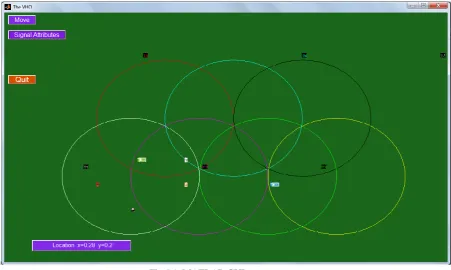
The algorithm is implemented using MATLAB and the results are generated in MATLAB GUI.
The result table below shows network parameters such as signal strength, voice quality, traffic, bandwidth utility, network latency, congestion, path loss, signal-to-noise ratio(SNR), Bit error rate(BER) used for handoff initiation.
Fig.5.1. MATLAB GUI output screen
Table 5.1: MATLAB Simulation Results of Strength Calculation Cell
Name
Signal Strength
Voice Quality Traffic BW_Util N/W latency
Congestion Path loss
SNR BER
T1 90.57919371 0.233238076 4 80 0 0 0 0 0
T2 12.69868163 0.12 4 80 0 0 0 0 0
T3 91.33758561 0.233238076 3 60 0 0 0 0 0
T4 63.23592462 0.41761226 4 80 0 0 0 0 0
T5 9.7540405 0.335261092 4 80 0 0 0 0 0
T6 27.84982189 0.335261092 5 100 0 0 0 0 0
T7 54.68815192 0.438634244 6 120 0 0 0 0 0
VI. C
ONCLUSIONThe vertical handoff is an essential component for wireless network due to switching of mobile users amongst heterogeneous network. The proposed algorithm has better performance, less complexity, reduced time and
R
EFERENCES[1] Ahmed Hasswa, Nidal Nasser and Hossam Hassanein ,
“Tramcar: A context-aware cross-layer architecture for next generationheterogeneous wireless networks.” 1-4244-0355-3/06 IEEE.
[2] Omar Khattab and Omar Alani, “ Improvements to seamless vertical handover between mobile WiMAX, Wi-Fi and 3GPP
through MIH.” 978-1-902560-26-7 2012
[3] Zekri M, Jouaber B, Zeghlache D, “Context aware vertical handover decision making in heterogeneous wireless networks.”
IEEE pp. 764-768, 10-14 Oct. 2010.
[4] Song W, Jong-Moon Chung, Daeyoung Lee, Chaegwon Lim, Sungho Choi, Taesum Yeoum, “Improvements to seamless vertical handover between mobile WiMAX and 3GPP UTRAN through the evolved packet-core.”IEEE vol-47,no. 4, pp. 66-73, April 2009.
[5] Qing-An Zeng And Dharma P. Agrawal, “Handoff in Wireless
Mobile Networks” Department of Electrical Engineering and Computer Science, University of Cincinnati.
[6] Taaghol P, Salkintzis A, Iyer J, “SeamlessIntegration Of Mobile WIMAX In 3GPP Networks.” Communication magazine, IEEE,
vol.46, no. 10, pp.74-85, Oct 2008.
[7] Mika Ylianttila, “Vertical Handoff And Mobility- System
Architecture And Transition Analysis.” Doctoral Thesis,
Department Of Electrical And Information Engineering, University Of Oulu, Finland. ACTA Univ. Oul. C220, 2005. [8] Isabella Cerutti_, Filippo Meucci_, Piero Castoldi_, And Laura
Pierucci, “An Adaptive Cross-Layer Strategy For
Qos-Guaranteed Links In 4G Networks.” IEEE 978-1-4244-2324-8/ 2008.
[9] Leandro Bento Sena Marques and Shusaburo Motoyama
”Vertical Handoff Algorithms with QoS Guarantee for 4G
Networks” IEEE 978-1-4244-4388-8/2009.
[10] A. M. Miyim, Mahamod Ismail, Rosdiadee Nordin, Gita