ISSN 1392–124X (print), ISSN 2335–884X (online) INFORMATION TECHNOLOGY AND CONTROL, 2014, T. 43, Nr. 4
Design of Pairing-Based Proxy Signcryption System
Model for Online Proxy Auctions
Chien-Lung Hsu
Department of Information Management Chang Gung University
No. 259 Wen-Hwa 1st Road, Kwei-Shan Tao-Yuan, Taiwan, 333, R.O.C.
Yu-Hao Chuang
Department of Industrial Design Chang Gung University
No. 259 Wen-Hwa 1st Road, Kwei-Shan Tao-Yuan, Taiwan, 333, R.O.C. e-mail: [email protected]
Pei-Ling Tsai
Chunghwa Telecom Laboratories
Ltd. No.99, Dianyan Rd., Yangmei City, Taoyuan County 32601, Taiwan
Atif Alamri
College of Computer and Information Sciences, Research Chair of Pervasive and Mobile Computing King Saud University, Riyadh, KSA
Sk Md Mizanur Rahman
College of Computer and Information Sciences King Saud University, Riyadh, KSA
http://dx.doi.org/10.5755/j01.itc.43.4.6348
Abstract. In recent years, the online auction of consumers’ goods is an increasingly popular selling channel. To copy with this tendency, the bidders’ convenience and security have to be considered. Some online auctions (such as eBay or Amazon) introduced a proxy bidding strategy that the bidder can decide a maximum bid and delegate his authority to a legal agent to automatically outbid other competitors for the last winner. In this paper, we identify some practical issues in the current bidding strategies and propose a system model of a pairing-based proxy signcryption which includes two cryptographic schemes; further, we apply the proposed schemes to the online proxy auction system for comparing two authorized online proxy auction policies (agents anonymity setting and agents accountability setting) with different applications of short message and long message. Also, we discuss some critical security issues under the online proxy auctions.
1. Introduction
In the areas of computer communications and electronic transactions, how to transmit data in a con-fidential and authenticated way has become increa-singly important. Traditional cryptosystems usually adopt a two-step approach to reach confidentiality, integrity, authentication, and non-repudiation. The two-step approach is: the sender first generates a signature for a message, and then encrypts both the signature and the message to get a ciphertext, which is subsequently sent to the receiver; the receiver must decrypt the ciphertext before obtaining the signature and the message, and then check the validity of the signature. This approach results in higher computation cost and communication overhead. In 1997, at CRYPTO’97 conference, Zheng [28] introduced a pri-mitive that he called signcryption. The idea of the signcryption scheme is to combine the functionality of encryption and signature schemes, which has been proved to be more efficient than the traditional scheme.
In addition, the ability of delegation (or proxy) is an issue as it is necessary for the organization to remain normal operation [9,27]. For example, some-one may need an agent when he is away during official business hours or on vocation. The proxy signcryption primitive was first proposed by Gamage, Leiwo, and Zheng [7] in 1999. Their scheme can efficiently achieve the combined functionalities of proxy signature scheme and encryption scheme. Since then, several research works on proxy signcryption have been published [11,14,15,24].
The concept of self-certified public key system was first introduced by Girault [16] at EUROCRYPT’91 conference to resolve the public key verification problems. That is, the public key for each user is generated by the certification authority (CA), while the corresponding private key is only known to the user. The user can use his private key to verify the self-certified public key issued by the CA, and thus no extra certificate is required. In addition, the verifica-tion of the public key can be accomplished with the subsequent cryptographic application in a single step to save computation effort. Because the public key ve-rification with the self-certified public key system is more efficient in saving the communicational cost and the computational effort as compared to the identity-based and the certificate-identity-based public key systems, more scholars invest their time to design and analyze of the self-certified public key system successively [3,8,9,22,23,29,30].
Based on the cryptographic system from pairings, a bilinear map eˆ is defined with the properties of the
bilinear, non-degenerate, and computable. Because of superior security of the pairing-based system over the elliptic curve cryptosystem (ECC)–based system, we would like to design a self-certified public key system from pairings. Making a comprehensive survey of pro-xy signcryption from pairings, we find that only the
identity-based [1,17,18,21,25] and certificate-based [18] proxy signcryption schemes have been discussed; the self-certified based proxy signcryption schemes from pairings have not been proposed yet. According to the advantages of the self-certified public key system described above, we design two self-certified proxy signcryption schemes based on the difficulty of pairings.
In addition, two realistic cases should be concer-ned in a proxy signcrypted message: short message and long message. To deal with the practical situa-tions, we design message recovery scheme to fulfill the demand of short message, such as an identity field to be signcrypted, whereas a scheme with appendix is proposed to respond the requirement of long message such as a document to be signcrypted. Moreover, the proxy signer may expect a design of signcrypted message with anonymity or non-anonymity. To meet with the requirements, we provide anonymous and non-anonymous functionalities to be chosen by the proxy signer in the proposed proxy signcryption schemes. In the next section, we introduce the system model for the proposed proxy signcryption schemes.
2. System models
Elaborating on the merits of elliptic curve cryptography and self-certified public key systems, we first propose a system model of a self-certified public key system from pairings. Realization of the self-certified public key system is proposed in Section 3. We further consider the following practical issues to propose a system model of a proxy signcryption system based on self-certified public key systems from pairings:
(i) Length of the signed messages: Digital signature
schemes are generally divided into two categories, signature schemes with message recovery and those with appendix. The former can gain better performance in terms of communicational costs and computational complexities but the signed messages are limited to a predefined fixed length. To enhance the security for such schemes, a secure redundancy mechanism is required. The length of signed messages is unlimited in the signature scheme with appendix. Hence, such schemes are suitable for some applications with long messages. Properties of both schemes are all considered in the proposed system. That is, we can consider the application scenario to determine adopting signature with message or that with appendix. (ii) User anonymity or user accountability: The
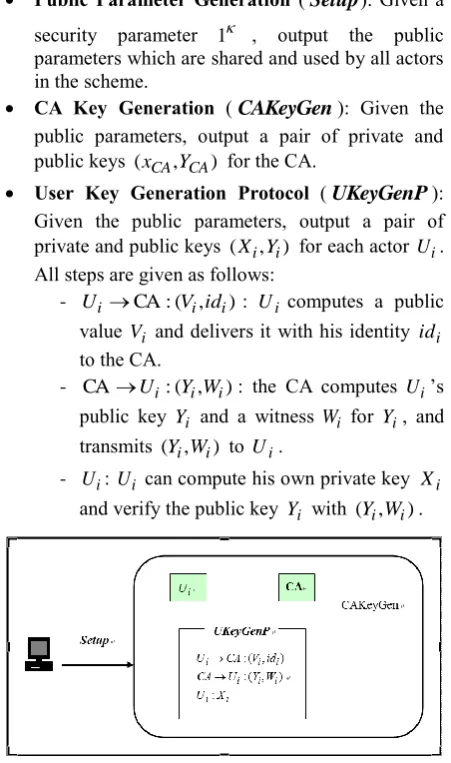
The model of the self-certified public key system mainly describes how the private/ public key pair of a user Ui is generated with the CA (see Fig. 1). We define the following algorithms in supporting the subsequent proposed proxy signcryption models.
Public Parameter Generation (Setup): Given a
security parameter 1 , output the public
parameters which are shared and used by all actors in the scheme.
CA Key Generation (CAKeyGen): Given the
public parameters, output a pair of private and public keys (xCA,YCA) for the CA.
User Key Generation Protocol (UKeyGenP):
Given the public parameters, output a pair of private and public keys (Xi,Yi) for each actor Ui. All steps are given as follows:
- UiCA:(Vi,idi): Ui computes a public value Vi and delivers it with his identity idi to the CA.
- CAUi:(Yi,Wi): the CA computes Ui’s
public key Yi and a witness Wi for Yi, and transmits (Yi,Wi) to Ui.
- Ui: Ui can compute his own private key Xi and verify the public key Yi with (Yi,Wi).
Figure 1. The model of the self-certified public key system
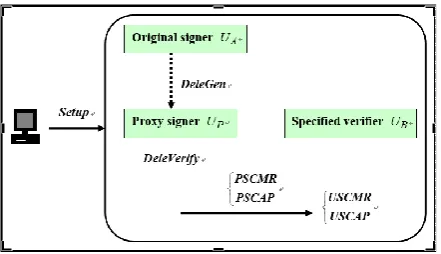
What is more, the model of the proxy signcryption scheme consists of an original signer UA, a proxy signer UP, and a specified verifier UB. Through the delegation procedure of this model, it allows UP to generate a proxy signcrypted message, which can only be unsigncrypted by UB , on behalf of UA (see
Fig. 2). DeleGen is first performed by UA to authorize his signing power to UP. After performing
DeleVerify and confirming the delegation is valid,
P
U can execute PSCMR or PSCAP to signcrypt
on behalf of UA to UB depending on suitable
demand. Then UB can unsigncrypt through the corresponding USCMR or USCAP. The algorithms
are defined below.
Delegation Generation ( DeleGen): Given the
public parameters, the original signer’s private key
A
X , the CA’s public key YCA, and a warrant mw, which describes the relative rights and information of the original signer and proxy signer, a valid period of time, and so on, output the authorization
) , ,
( U mw , where
is the proxy share and U isa computed value.
Delegation Verification (DeleVerify): Given the
public parameters, the authorization (,U,mw) ,
the original signer’s public key YA and identity
A
id , and the CA’s public key YCA, output true if
) , ,
( U mw is correct or false otherwise.
Proxy Signcrypt with Message Recovery (PSCMR):
Given the public parameters, the authorization
) , ,
( U mw , the proxy signer’s private key XP, the specified verifier’s public key YB and identity
B
id , the CA’s public key YCA, a message m with
additional specified redundancy, and a system variable flag, which means anonymity when
A
flag , and non- anonymity when flagNA, output the proxy signcrypted message PSM_MR.
Unsigncrypt with Message Recovery (USCMR ):
Given the public parameters, the proxy signcrypted message PSM_MR, the specified verifier’s pri-vate key XB, the CA’s public key YCA, the
origi-nal signer’s public key YA and identity idA, the proxy signer’s public key YP and identity idP, the delegation information (U,mw), and a system
variable flag, output the message
m
and check the redundancy. Proxy Signcrypt with Appendix ( PSCAP ):
Given the public parameters, the authorization
) , ,
( U mw , the proxy signer’s private key XP, the specified verifier’s public key YB and identity
B
id , the CA’s public key YCA, a message m, and
a system variable flag , output the proxy signcrypted message PSM_AP.
Unsigncrypt with Appendix (USCAP ): Given
the public parameters, the proxy signcrypted me-ssage PSM_AP, the specified verifier’s private key XB, the CA’s public key YCA, the original signer’s public key YA and identity idA, the proxy signer’s public key YP and identity idP, the delegation information (U,mw), and a system
variable flag, output true if PSM_AP is a valid proxy signcryption for message m or false
Figure 2. The model of the proxy signcryption scheme
3. The proposed self-certified public key
system from pairings
Our concrete construction of the self- certified public key system from pairings is defined as follows.
Setup: Select a security parameter 1 that defines
the length of a large prime q. Generate a bilinear
map eˆ:G1G1G2, where G1 is a cyclic addi-tive group generated by P, whose order is q, and
2
G is a cyclic multiplicative group of the same order q. Four cryptographic hash functions are
defined: * * *
} 1 , 0 {
: Zq Zq
H , H1:{0,1}*G1,
* * 1
2:G {0,1} Zq
H , and H3:G2Zq*.
Hereafter, the system publishes the public parameters (G1,G2,P, q,eˆ,H, H1,H2,H3).
CAKeyGen: Given (G1,G2,P,q,eˆ,H,H1, H2,H3),
choose *
q R
CA Z
x as the CA’s private key. The corresponding public key is computed as
P x
YCA CA .
UKeyGenP: Given (G1,G2,P,q,eˆ,H,H1, H2,H3),
perform the following operations:
- UiCA:(Vi,idi) : Ui chooses vi
*
q RZ
and computes the Vi as
P id v H
Vi ( i|| i) (1)
where || denotes the string concatenation operator, and sends (idi,Vi) to the CA.
- CAUi:(Yi,Wi): the CA computes Ui’s
public key YiViniP, where niR Z*q , and generates the witness of the public key as
) || (
( 2 i i
CA i
i nY H Y id
W 1)xCAYi. Then the
CA submits (Yi,Wi) to Ui.
- Ui can derive his private key Xi as
CA i i i
i W H v id Y
X ( || ) (2)
and then verify the authenticity of Yi by testing if eˆ(Xi,P) ˆ( , )H2(Yi||idi)
CA i Y
Y e
.
4. The proposed self-certified proxy
signcryp-tion schemes
In this section, the concrete construction of our proposed self-certified proxy signcryption schemes is discussed. There are three algorithms, Setup , CAKeyGen, and UKeyGenP, which are defined in
Section 3. The approaches are illustrated in the following:
DeleGen: Given (G1,G2,P,q,eˆ,H,H1,H2, H3),
the original signer UA performs the following steps:
- Pick uRZ*q and compute UuP.
- Generate a warrant mw, which describes the
relative rights and information of the original signer and proxy signer, a valid period of time, etc. Note that it doesn’t contain any information about the proxy signer in the anonymous applications.
- Compute the proxy share as follows:
. )
|| (
2 mw U XA uYCA
H
σ
- Transmit (,U,mw) to the proxy signer UP through a secure channel.
DeleVerify: Given (G1,G2,P,q,eˆ,H,H1, H2,H3), the proxy signer UP performs the following steps:
- Calculate eˆ(σ,P)
) , ( ˆ )
, (
ˆ 2( || ) 2( || )
CA id
Y H U m H CA
AY eU Y
Y
e w A A
to check the validity of the delegation.
- Perform PSCMR or PSCAP depending on
different requirement if it’s true.
PSCMR: Given (G1,G2,P,q,eˆ,H,H1, H2,H3),
the proxy signer UP performs the following steps: - Set the proxy signing key as , if
A
flag ; otherwise, set it as σ
σ X U m
H2( w|| ) P , if flagNA.
- Choose a message
m
, which contains an additional specified redundancy.- Pick
d
,
w
RZ
q*.
- Compute
), (mod )) , ( ˆ
( 1
3 edY P q
H m
r CA
S dYCArσ,
wP
C
1
, and)
)
,
(
ˆ
(
( || )3 2
2YBidB H CA B
Y
wY
e
H
r
c
).
(mod
q
(3)- Send the proxy signcrypted message
) , , , , (
_MR C1 c2 SU mw
PSM to a specified
USCMR: After receiving PSM_MR(C1,c2,S, )
,mw
U , the specified verifier UB executes
USCMR to check the validity of PSM_MR. Given (G1,G2,P,q,eˆ,H,H1,H2,H3), the
speci-fied verifier UB performs the following steps: - Calculate
) ))(mod , ( ˆ ( 1 3
2 H e X C q
c
r B (4)
- If flagA , recover the message by the equation r CA Y U e P S e H r
m 3(ˆ( , )ˆ( , )
). )(mod )
, (
ˆY Y 2( || ) 2( || ) q
e rH mwU H YAidA
CA
A
If
NA
flag , recover the message by the equation ). (mod ) ) , ( ˆ ) , ( ˆ ) ) , ( ˆ ) , ( ˆ ( ) || ( ) || ( ) || ( ) || ( 3 2 2 2 2 q Y Y e Y Y e Y U e P S e H r m P P w A A w id Y H U m H r CA P id Y H U m H r CA A r CA
- Check the redundancy by analyzing whether
) , , , , (
_MR C1 c2 SU mw
PSM is a valid
pro-xy signcrypted message for m or not.
PSCAP: Given (G1,G2,P,q,eˆ,H,H1,H2, H3),
the proxy signerUP performs the following steps: - Set the proxy signing key as , if
A
flag ; otherwise, set it as σH2 σ
X U
mw|| ) P
( , if flagNA.
- Choose a message
m
.- Pick dRZq*.
- Compute RdP , SdYCAH2(R||
, )σ
m ˆ( , )H2(YB||idB)
CA BY
dY e
k , and
) || (S m E
c k , where Ek() is an ideal
symmetric key encryption algorithm.
- Send the proxy signcrypted message
) , , , (
_AP RcU mw
PSM to a specified
verifier UB via a public channel.
USCAP : Upon receiving PSM_AP
(
R
,
c
,
U
,
)
w
m the specified verifier UB executes USCAP.
Given (G1,G2,P,q,eˆ, H,H1,H2,H3), the
speci-fied verifier UB performs the following steps:
- Calculate
k
e
ˆ
(
X
B,
R
)
(5)and get the signcrypted message by the equation S||mDk(c), where Dk() is an
ideal symmetric decryption algorithm corresponding to Ek().
- If flagA , verify the proxy signcrypted message by the following equation:
). (mod ) ) , ( ˆ ) , ( ˆ ) , ( ˆ ) , ( ˆ ) || ( ) || ( ) || ( ) || ( 2 2 2 2 q Y Y e Y R e Y U e P S e m R H id Y H U m H CA A CA m R H CA A A
w
IfflagNA, verify the proxy signcrypted messa-ge by the following equation:
). (mod ) ) , ( ˆ ) ) , ( ˆ ) , ( ˆ ) , ( ˆ ) , ( ˆ ) || ( ) || ( ) || ( ) || ( ) || ( ) || ( ) || ( 2 2 2 2 2 2 2 q Y Y e Y Y e Y R e Y U e P S e m R H id Y H U m H CA P m R H id Y H U m H CA A CA m R H CA P P w A A w
If the output of the above equation is true, the proxy signcrypted message is valid; otherwise, it is invalid.
5. Analysis and discussions
We prove the correctness of our schemes in Section 5.1 and give security analysis in Section 5.2. In Section 5.3, we discuss the main contribution of the proposed schemes.
5.1. Correctness
The correctness of our schemes is verified as follows:
For the UKeyGenP algorithm,
. ) , ( ˆ ) , ) 1 ) || ( ( ( ˆ ) , ) 1 ) || ( ( ) || ( ( ˆ ) , ) || ( ) 1 ) || ( ( ( ˆ ) , ) || ( ( ˆ ) , ( ˆ ) || ( 2 2 2
2Yiidi
H CA i CA i i i i CA i i i i i i CA i i i CA i i CA i CA i i i i Y Y e Y Y id Y H Y e Y Y id Y H P id v H P n e P Y id v H Y x id Y H Y n e P Y id v H W e P X e
For the DeleVerify algorithm,
). , ( ˆ ) , ( ˆ ) , ( ˆ ) , ( ˆ ) , ( ˆ ) || ( ) || ( ) || ( 2 2 2 CA id Y H U m H CA A CA U m H A Y U e Y Y e P uY e P X e P σ e A A w w
For the USCMR algorithm,
- H3(eˆ(XB,C1))H3(eˆ(XB,P)w)
). ) , ( ˆ ( ( || )
3 e wYBYCA H2YBidB
H
- If flagA,
). )(mod ) , ( ˆ ) , ( ˆ ) , ( ˆ ( ) ) , ( ˆ ) , ( ˆ ( )) , ( ˆ ( ) || ( ) || ( 3 3 3 2 2 q Y Y e Y U e P S e H r P e P S e H r P dY e H r m A A wU H Y id
m H r CA A r CA r CA
). )(mod ) , ( ˆ ) ) , ( ˆ ) , ( ˆ ) , ( ˆ ( ) ) , ) || ( ( ˆ ) , ( ˆ ( )) , ( ˆ ( ) || ( ) || ( ) || ( ) || ( 3 2 3 3 2 2 2 2 q Y Y e Y Y e Y U e P S e H r P σ X U m H e P S e H r P dY e H r m P P w A A w id Y H U m H r CA P id Y H U m H r CA A r CA r P w CA
For the USCAP algorithm,
-keˆ(XB,R)eˆ(XB,P)d
. )
, (
ˆ H2(YB,idB) CA
B Y
dY e
- If flagA,
). ) , ( ˆ ) , ( ˆ ) , ( ˆ ) , ( ˆ ) , ( ˆ ) , ( ˆ ) || ( ) || ( ) || ( ) || ( ) || ( 2 2 2 2 2 m R H id Y H U m H CA A CA m R H CA m R H CA A A w Y Y e Y R e Y U e P σ e P dY e P S e
If flagNA,
). ) , ( ˆ ) ) , ( ˆ ) , ( ˆ ) , ( ˆ ) , ) || ( ( ˆ ) , ( ˆ ) , ( ˆ ) || ( ) || ( ) || ( ) || ( ) || ( ) || ( ) || ( ) || ( 2 2 2 2 2 2 2 2 2 m R H id Y H U m H CA P m R H id Y H U m H CA A CA m R H CA m R H P w CA P P w A A w Y Y e Y Y e Y R e Y U e P σ X U m H e P dY e P S e
5.2 Security analysis
The security analysis of the proposed self-certified proxy signcryption schemes is proved as follows:
- Valid public key generation:
According to the operation CAUi: (Yi,Wi),
for any adversary, he cannot forge a legal public key
i
Y and a witness Wi without knowing the CA’s private key xCA. Because the public key Yi of Ui is cooperatively generated by the CA and Ui.
- Private key confidentiality:
According to Eqs. (1) and (2), it is s infeasible to compute H(vi||idi) from Vi. The security is based on the ECDLP (Elliptic Curve Discrete Logarithm Problem). Hence, no one except Ui can compute the private key Xi.
- Ciphertext confidentiality:
The proxy signcrypted message from UP to UB
is confidential against an adversary A. If
A
wants to recover the signcrypted message from PSM_MR, he must compute r first. Hence, in Eq. (3), A should know the random numberw
, and in Eq. (4) A should know the private key XB. If A wants to acquire the secret information from PSM_AP, hemust know the private key XB to compute the session key k in Eq. (5).
- Unforgeability:
If an adversaryAattempts to forge a valid proxy signcryption for the specified verifier by arbitrarily choosing a message m, he should choose random numbers d and w to compute r, S, C1, and c2 in PSCMR. Simultaneously, these parameters must
satisfy to perform the unsigncrypted procedures in
USCMR . Consider the other scenario in PSCAP ,
the adversary Amust randomly choose d and cal-culate R, S, k, and c to satisfy the unsigncrypted procedures in USCAP. However, we find out that the
adversaryAcannot forge a valid proxy signcryption without knowing the proxy share and the private key XP (in the non-anonymous way) to forge.
- Verifiability:
For the USCMR and USCAP algorithms, the verifier can be convinced of the original signer’s agreement on the delegation authority for generating a signcryption because a valid proxy signcryption verification must contain the original signer’s public key YA and identifier idA.
- Secret key’s dependence:
For the DeleGen, PSCMR and PSCAP
algorithms, the proxy signing key
is computed from the original signer’s private key XA.- Non-repudiation:
Due to the trustiness assumption in the anonymous way, here we discuss the non-anonymous way. The proxy signer must generate a valid proxy signcryption with his private key Xp and the proxy share . Thus once the proxy signer generated a proxy signcryption, he cannot deny what he had done.
- Forward security:
For an adversaryAin the USCMR,he require the knowledge of H3(eˆ(wYB, )H2(YB||idB))
CA
Y . However,
it is difficult for A to get w from r since it is difficult to invert the bilinear mapping. Further, it is also infeasible to derive w from C1 for the ECDLP. In addition, for an adversary
A
in the USCAP herequires the knowledge of ˆ( , )H2(YB||idB).
CA B Y dY e
Similarly, it is difficult to invert the bilinear mapping for computing d, and to derive d from R for the ECDLP. What is more, even if YCA, H2(R||m), and
5.3. Main contribution
Elaborating on the merits of signcryption schemes, proxy signature schemes, which enable self-certified public key systems and pairing-based cryptosystems, we adopt the delegation with warrants to propose two pairing-based proxy signcryption schemes with self-certified public key cryptosystems in this paper. The key features of the proposed signcryption schemes are listed below.
(i) Efficiency: A proxy signer can generate a signcryption to achieve the functionality of encryption and signature schemes simultaneously.
(ii) Private key confidentiality: All private keys cannot be compromised by the adversaries during signing or verifying the proxy message signcrypted procedures.
(iii) Ciphertext confidentiality: No one can acquire the information from a proxy signcrypted message except the designated verifier.
(iv) Unforgeability: No one can generate a valid proxy signcryption except the designated proxy signer.
(v) Verifiability: All verifiers can be convinced that the proxy signer has the original signer’s agreement on the delegated authority for generating a signcryption.
(vi) Secret key’s dependence: The proxy signing key is computed from the original signer’s private key.
In addition, the proposed proxy signcryption schemes can grant the proxy signer to generate a signcryption with short message or long message and to choose the functionality of anonymity or non-anonymity. We also demonstrate that our proposed schemes are more secure and suitable for handling practical cases (e.g. online auction as depicted in Section 6) than previous studies [1,17,18,21,25] in the following aspects.
(i) Higher security: The proposed schemes are pairing-based cryptosystems that can provide superior security protections than ECC-based systems. Even without using certificates, the proposed schemes can also avoid against the active and impersonation attacks.
(ii) Low computation and communication costs: The proposed schemes are beneficial in computing and communicating costs since they need no extra certificates to validate public keys.
(iii) Accountability: The proxy signer can choose the functionality of non- anonymity to achieve the accountability since the valid proxy signcryption can only be generated by the proxy signer.
(iv) Anonymity: The proxy signer can choose the functionality of anonymity to protect his privacy and security, thus the proxy signer’s identity is anonymous to the verifier.
(v) Short message or long message: The proposed schemes provide two approaches of message recovery [12] and appendix [13] to satisfy the different applications of short message and long message, respectively.
6. Implementation
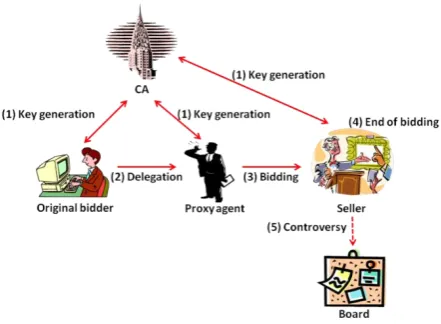
In recent years, with the development of E-commerce over Internet, many enterprises sell their products to different regions and countries [4,10,27]. Internet has increased the sale of various products or services via auction mechanisms that each bidder can bid on the products or services by this way. Security and privacy problems related to online auctions have been recognized as the key of information system research and have been published in some journals since 2000 [5,6,19,20]. In this paper, we discuss a particular bidding package procedure with desirable properties that is so-called proxy auction, in which each bidder can delegate authority to their respective agents. The agent can submit package bids on behalf of the original bidder to bid the products or services over Internet. We consider that the scenario is suitable to use our proposed proxy signcryption schemes to deal. Detail procedures are described in the following (see Fig. 3).
In Fig. 3, four entities are involved in proxy auction systems: a certification authority (CA), an original bidder, an agent, and a seller. Responsibility of the CA is to setup all system parameters and per-form key management tasks. An original bidder can delegate authority to an agent for his auction. The agent can submit the bidding to the seller on behalf of the original bidder. The seller will announce the auc-tion results on the aucauc-tion board. There are six phases of the proposed proxy auction system: the Setup, the Key generation, the Delegation, the Bidding, the End of bidding, and the Controversy phases. In Setup phase, all system parameters will be determined by performing Setup algorithm. In Key generation phase, keys of all entities involved in the system will be determined by performing CAkeyGen and UkeyGenP
Figure 3. The procedures of proxy auction
Setup: All public parameters are generated by
Setup algorithm and shared with each participant.
Key generation:
- CA key generation: The CA can perform
CAkeyGen algorithm to generate a pair of private and public keys for each participant. - Actor key generation: Bidders, agents, and
sellers can perform UkeyGenP algorithm to generate their key pairs (private and public keys) with the CA.
Note that all public keys need no certificates to check the validity. Validities of the public keys are implicitly verified in signature verification.
Delegation: The bidder can perform DeleGen
algorithm to delegate authority to his respective agent. Then the agent can perform DeleVerify
algorithm to check the validity of a delegation.
Bidding: If the delegation is valid, the agent can perform PSCMR or PACAP algorithms to generate bid packages on behalf of the original bidder to place bids for the products or services over Internet. All bid packages are encrypted, and thus any information is not revealed.
End of bidding: The seller can perform USCMR
or USCAP algorithms to decrypt each bid package and verify its validity. Then he decides the winning bidder.
Controversy: If there is a controversy over the bidding, the seller can publish all bid packages after the bidding action. Since each bid package includes the signature of the original bidder, the original bidder cannot deny his creation of a bid package even if the bid package is generated by the agent.
7. Conclusions
We have proposed a model of a proxy signcryption system and two self-certified proxy signcryption schemes from pairings, which possess the advantages of both self-certified public key systems and the proxy signcryption schemes. One is with message recovery and the other is with appendix. From practical
considerations, the former is suitable for the applications with short messages and the latter is for those with long messages. Furthermore, we consider user anonymity or user accountability to allow the proxy signer signcrypted messages anonymously or non- anonymously on behalf of the original signer for a designated verifier. The proposed schemes have higher security and gain better performance in communicational costs and computational complexities. Finally, we apply the proposed schemes to a proxy auction system.
Acknowledgement
We would like to thank anonymous referees for their valuable suggestions. We thank Healthy Aging Research Center (HARC) of Chang Gung University for excellent technical assistance. This work was supported in part by the Chang Gung University Grant CMRPD3D0041 and in part by National Science Council under the grant NARPD3D0071. The authors would also like to extend their sincere appreciation to the Deanship of Scientific Research at King Saud University for its funding of this research through the Research Group Project no RGP- VPP-258.
References
[1] B. Libert, J. Quisquater. New Identity Based Sign-cryption Schemes from Pairings. In: Proceedings of IEEE Information Theory Workshop, 2003, pp. 155-158.
[2] C. C. Lee, T. C. Lin, S. F. Tzeng, M. S. Hwang. Generalization of Proxy Signature Based on Factori-zation. International Journal of Innovative Computing, Information and Control, 2011, Vol. 7, No. 3, 1039-1054.
[3] C. L. Hsu, T. S. Wu. Efficient proxy signature schemes using self-certified public keys. Applied Mathematics and Computation, 2004, Vol. 152, No. 3, 807-820.
[4] C. L. Yang, R. H. Huang. Key success factors for online auctions: Analysis of auctions of fashion clothing. Expert Systems with Applications, 2011, Vol. 38, No. 6, 7774-7783.
[5] C. Li, S. Chawla, U. Rajan, K. Sycara. Mechanism design for coalition formation and cost sharing in group-buying markets. Electronic Commerce Research and Applications, 2004, Vol. 3, No. 4, 341-354. [6] E. J. Pinker, A. Seidmann, Y. Vakrat. Managing
on-line auctions: Current business and research issues.
Management Science, 2003, Vol. 48, No. 10, 1457-1485.
[7] G. Gamage, J. Leiwo, Y. Zheng. An efficient scheme for secure message transmission using proxy-signcryption. In: Proceedings of the 22nd Australasian Computer Science Conference, 1999, pp. 420-431. [8] H. K. Yang, J. H. Choi, Y. H. Ann. Self-certified
identity information using the minimum knowledge.
IEEE TENCON: Digital Signature Processing Application, 1996, pp. 641-647.
Conferen-ce on Communications and Multimedia Security, 1997, pp. 102-116.
[10] H. Xiong, Z. Chen, F. Li. Bidder-anonymous English auction protocol based on revocable ring signature.
Expert Systems with Applications, 2012, Vol. 39, No. 8, 7062-7066.
[11] H. Y. Lin, T. S. Wu, S. K. Huang, Y. S. Yeh. Efficient proxy signcryption scheme with provable CCA and CMA security. Computers and Mathematics with Applications, 2010, Vol. 60, No. 7, 1850-1858. [12] ISO/IEC 9796, Information technology – security
techniques – digital signature scheme given message recovery, 1991.
[13] ISO/IEC 14888-3, Information technology–security techniques–digital signature with appendix–part 3: certificate-based mechanisms, International Organiza-tion for StandardizaOrganiza-tion, 1998.
[14] J. G. Li, J. Z. Li, Z. F. Cao, Y. C. Zhang. Conver-tible proxy signcryption scheme. Journal of Harbin Institute of Technology, 2004, Vol. 11, No. 2, 209-213. [15] L. Chen, J. M. Lee. Improved identity-based sign-cryption. Public Key Cryptography (PKC’2005), Lecture Notes in Computer Science, 2005, Vol. 3386, 362-379.
[16] M. Girault. Self-certified public key. Advances in Cryptology (EUROCRY PT’91), 1991, 491-497. [17] M. Wang, H. Li, Z. Liu. Efficient identity based
proxy-signcryption schemes with forward security and public verifiability. In: Proceedings of the 3rd International Conference on Networking and Mobile Computing (ICCNMC’2005), 2005, pp. 982-991. [18] Q. Wang, Z. Cao. Two proxy signcryption schemes
from bilinear parings. In: Proceedings of the 4th International Conference on Cryptology and Network Security (CANS 2005), 2005, pp. 161-171.
[19] R. Bapna, P. Goes, A. Gupta. Analysis and design of business-to-consumer online auctions. Management Science, 2003, Vol. 49, No. 1, 85-101.
[20] R. J. Kauffman, E. Walden. Economics and electro-nic commerce: Survey and directions for research.
International Journal of Electronic Commerce, 2001, Vol. 5, No. 4, 5-116.
[21] S. S. M. Chow, S. M. Yiu, L. K. Hui, K. P. Chow. Efficient forward and provable secure id-based sign-cryption scheme with public verifiability and public ciphertext authenticity. In: International Conference on Information Security and Cryptology (ICISC’2003), Lecture Notes in Computer Science, 2003, Vol. 2971, pp. 352-369.
[22] S. Saeednia. Identity-based and self-certified key-exchange protocols. In: Proceedings of the 2nd AustralasianConference on Information Security and privacy (ACISP’97), 1997, pp. 303-313.
[23] W. J. Tsaur. Several security schemes constructed using ECC-based self-certified public key cryptosys-tems. Applied Mathematics and Computation, 2005, Vol. 168, No. 1, 447-464.
[24] X. Boyen. Multipurpose identity-based signcryption: a Swiss army knife for identity-based cryptography. Ad-vances in Cryptology (CRYPTO’2003), Lecture Notes in Computer Science, 2003, Vol. 2729, pp. 382-398. [25] X. Li, K. Chen. Identity based proxy-signcryption
scheme from pairings. In: Proceedings of 2004 IEEE International Conference on Services Computing,
2004, pp. 494-497.
[26] X. Wang, K. S. Chin, H. Yin. Design of optimal double auction mechanism with multi-objectives.
Expert Systems with Applications, 2011, Vol. 38, No. 11, 13749-13756.
[27] Y. C. Chen, C. L. Liu, G. Horng, K. C. Chen. A Pro-vably Secure Certificateless Proxy Signature Scheme.
International Journal of Innovative Computing, Information and Control, 2011, Vol. 7, No. 9, 5557-5569.
[28] Y. Zheng. Digital signcryption or how to achieve cost (signature & encryption) << cost (signature)+cost (encryption). Advanced in Cryptology (CRYPTO’97), Lecture Notes in Computer Science, 1997, Vol. 1294, pp. 165-179.
[29] Z. Shao. Self-certified signature scheme from pairings.
The Journal of Systems & Software, 2007, Vol. 80, No. 3, 388-395.
[30] Z. Shao. Security of self-certified signatures. Informa-tion Processing Letters, 2009, Vol. 109, No. 20, 1147-1150.