The University of San Francisco
USF Scholarship: a digital repository @ Gleeson Library |
Geschke Center
Master's Theses
Theses, Dissertations, Capstones and Projects
7-7-1997
A Study of the Perceptions of Leaders in the
California Animal Welfare and Control Fields
Regarding the "No-Kill" Philosophy
Marcia Mayeda
University of San Francisco
Follow this and additional works at:
https://repository.usfca.edu/thes
This Thesis is brought to you for free and open access by the Theses, Dissertations, Capstones and Projects at USF Scholarship: a digital repository @ Gleeson Library | Geschke Center. It has been accepted for inclusion in Master's Theses by an authorized administrator of USF Scholarship: a digital repository @ Gleeson Library | Geschke Center. For more information, please [email protected].
Recommended Citation
Mayeda, Marcia, "A Study of the Perceptions of Leaders in the California Animal Welfare and Control Fields Regarding the "No-Kill" Philosophy" (1997).Master's Theses. 1136.
The author of this thesis has agreed to make available
to the University community and the public a copy of this dissertation project.
Unauthorized reproduction of any portion of this dissertation is prohibited.
The quality of this reproduction is
contingent upon the quality of the original copy submitted
.
University of San Francisco Gleeson Library/Geschke Center
2130 Fulton Street
A Study of the Perceptions of Leaders in the California Animal Welfare and Control Fields
Regarding the "No-Kill" Philosophy
This Thesis written by
Marcia Mayeda
This Thesis written under the guidelines of the Faculty Advisory Committee, and approved by all its members, has been accepted in partial fulfillment of the requirements for the degree of:
Master ofNonprofit Administration
at the
University of San Francisco
Research Committee:
A Study of the Perceptions of Leaders in the California Animal Welfare and Control Fields
Regarding the "No-Kill" Philosophy
A THESIS SUBMITTED
by
/
Marcia' Mayeda
In Partial Fulfillment of the Requirements
for the Degree of
Master of
Nonprofit Administration
The University of San Francisco
LD
l/(~i
• i..l {, ~·,
.;s
;~,; .· ,) ) "( )!', I 1 CC-f {_. ~ •
.!"". /• .') ' l
Table of Contents
Lli},/ '
Abstract ... .iv
Vita Auctoris ... v
List ofTables ... vi
List of Appendices ... vii
Chapter One: Introduction ... 1
Chapter Two: Review of Related Literature ... 12
Chapter Three: Methodology ... 23
Chapter Four: Results ... 29
Chapter Five: Summary and Conclusions ... 65
Abstract
This study explores whether the beliefs, attitudes, and policy practices of California animal
welfare and control leaders are accurately reflected and in accord with position statements
encountered in the animal welfare literature regarding the no-kill philosophy. Key issues
examined include responsibility for animal control, mission fulfillment, quality of life for
sheltered animals, public expectations of animal welfare and control agencies, financial
impacts of various policy options, terminology in current usage, and future trends. Study
findings demonstrate that the literature is not an accurate reflection ofleaders' perceptions.
Rather, the findings suggest that there is in actuality far less disagreement between
open-door and no-kill animal agency leaders regarding no-kill policy issues than there is
between proponents of these issues writing in animal control and welfare publications.
Results suggest, contrary to the literature, that it is possible for leaders of these differing
philosophies to partner together in addressing the animal welfare issues in their
Name
Date ofBirth:
High School:
Graduated:
Baccalaureate Degree:
College:
Graduated:
Vita Auctoris
Marcia Mayeda
November 8, 1964
Highland Park High School Highland Park, Illinois
1982
Bachelor of Science Degree
Western Illinois University Macomb, Illinois
Table 1
Table 2
Table 3
Table 4
Table 5
Table 6
Table 7
Table 8
Table 9
Table 10
Table 11
Table 12
Table 13
Table 14
Table 15
List ofTables
Frequency Distribution for Type of Agencies Responding to Survey
Frequency Distribution for Animal Control Contract Types
Type of Agency Perceived to Be Best Responsible for Animal Control
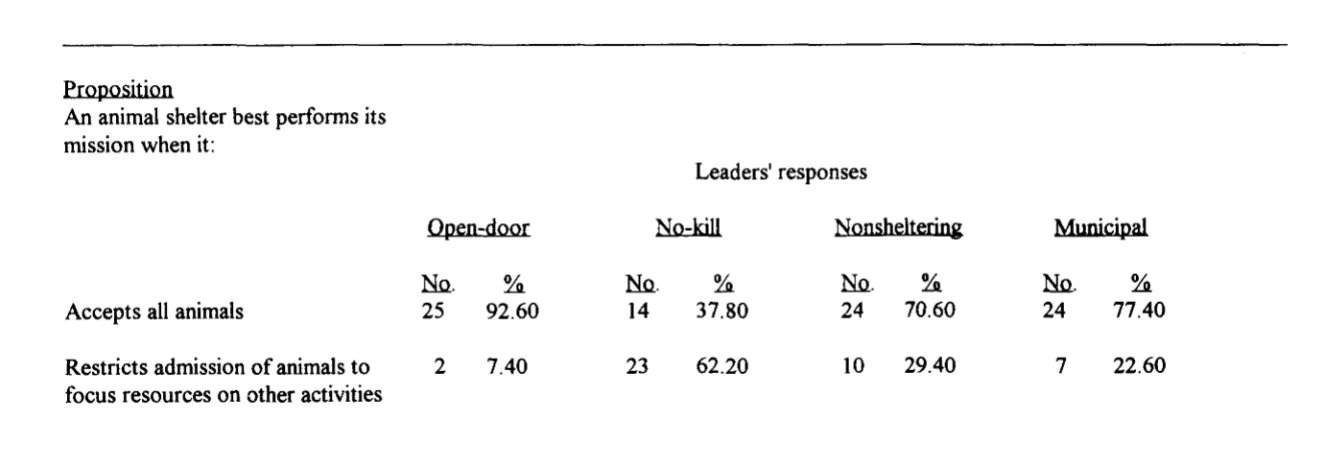
Perceived Mission Fulfillment for Open-Door and No-Kill Philosophies
Perceived Community Service Level for Open-Door and No-Kill Philosophies
Perceived Suitability of Admission Policies
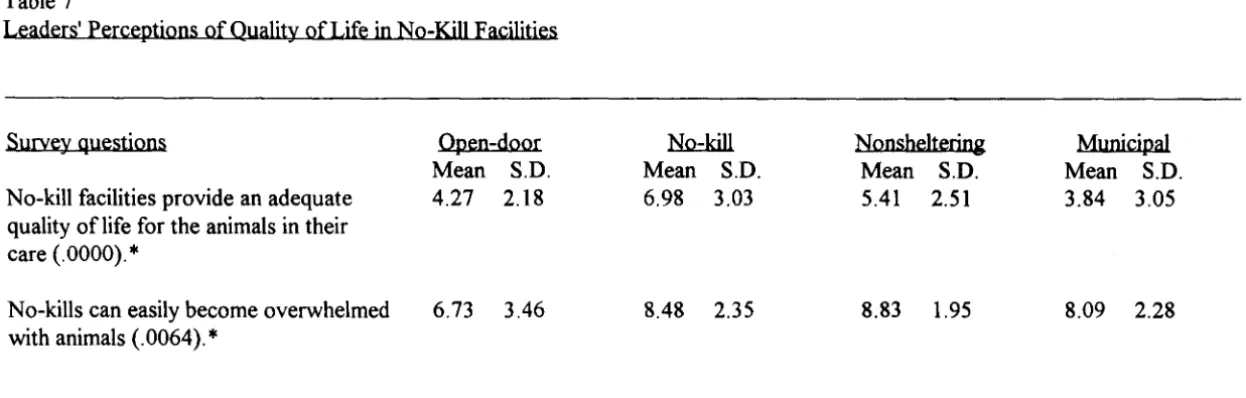
Leaders' Perceptions of Quality ofLife in No-Kill Facilities
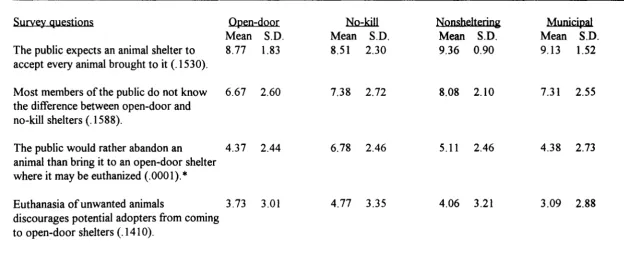
Leaders' Perceptions ofPublic Expectations of Their Agencies
Perceived Financial Impact of Animal Control Contracts
Perceived Financial Impact ofNo-Kill Solicitations
Perceived Suitability of Terms
Perceived Future for California Animal Welfare and Control Regarding the No-Kill Philosophy
Which Type of Organization Would the Respondents Rather Work for?
Responding Organizations' Plans to Become No-Kill Within the Next Five Years
List of Appendices
Appendix A... Survey Questionnaire
Appendix B... Cover Letter
Appendix C... Instructions to Survey Respondents
Chapter One
This study investigated the degree of controversy among leaders in the California animal welfare and control fields regarding the no-kill philosophy. Perceptions of these leaders were compared to determine the extent of their differences on the no-kill policy issue, and whether these differences are as strong as the literature suggests. Creative solutions based on these findings are proposed in the conclusion section of this thesis.
Background of the Issue
For decades, animal welfare organizations have played valuable roles in our society by protecting animals from abandonment, abuse, and neglect. These nonprofit organizations began in the late 1800s largely to protest abuses of carriage horses, but quickly expanded their concern to animals of all species. Today, they provide a myriad of services intended to advocate for animals in their communities.
Humane societies or societies for the prevention of cruelty to animals (SPCAs) often operate shelters for lost or abandoned animals, reunite lost animals with their owners, find new homes for abandoned animals, provide low-cost pet sterilization programs, conduct education programs promoting kindness to animals, investigate cases of animal cruelty and abuse, and may provide animal control or sheltering services through contracts with municipal governments.
Humane societies provide animal control-related services for a number of reasons. Their contracts with municipalities in providing full or partial animal control services, or sheltering for the stray animals impounded by the municipal agency's officers, offer steady funding. It is not uncommon for these contracts to compose a major portion of a
nonprofit animal welfare agency's annual budget. Examples of such services include impounding stray animals, enforcing animal control laws, investigating reports of animal abuse, removing dead animals from public property, responding to animal-related emergencies, and enforcing animal licensing requirements.
In addition, it is usually more cost-effective for a municipality to contract with a nonprofit humane society for services rather than perform them itself The labor costs alone allow for a significant savings, and nonprofits have a greater ability than
Many humane societies also bring a sense of mission to a field that was traditionally looked upon by municipal agencies as a low priority in the civic system. Animal control was often seen by municipalities as a public service, not an animal service. Consequently, when these duties were performed by the municipality, attention was focused more on public safety and rabies control rather than on adoption of homeless animals.
The perception that low-quality animal care was provided by municipal agencies years ago caused many humane societies to assume these functions themselves. Humane
societies believed that, by performing animal control themselves, they were following their mission by helping animals more than the municipal agencies did. Their missions usually emphasized animal care, cruelty investigations, and strong adoption programs over public safety. Consequently, for nearly 60 years, most nonprofit animal welfare agencies have been providing animal control and/or sheltering services for the municipal areas that they serve.
By providing these municipal services, however, nonprofit animal shelters have
suffered image and financial problems. Employing animal control officers to facilitate the animal control service, many animal shelters are viewed as the "police" by the constituents of their communities.
The shelters also often are mistaken to be municipal agencies instead of nonprofit organizations. This causes fund-raising problems, as donors believe that their taxes are paying for the operations of the animal shelter and, therefore, may not make personal contributions. Donors may also feel they should not be subsidizing activities they believe are the government's responsibility.
Nevertheless, the largest public relations issue these animal shelters face is the euthanasia of unwanted animals. Although most successful nonprofit animal welfare agencies have regular and loyal donors who support them in their mission, the majority of the general populace focus negatively on the humane societies' role in the euthanasia of unwanted animals. Many citizens are unwilling to contribute to shelters that perform euthanasia, and may be unwilling to visit the shelter to adopt an animal because they know that not all animals they see will find homes.
time and money to rehabilitate them.
Another reason for euthanasia is the fact there are more unwanted animals than there are homes to care for them. When an animal shelter does not restrict admission of animals, it must perform euthanasia to make room for the new arrivals. Animal shelters that do not restrict admission of animals are called "traditional" or "open-door" shelters. The term "traditional" refers to the fact that performing euthanasia has been a
consequence of animal sheltering for as long as humane societies have existed. The term "open-door" is a more recent term used to describe the philosophy of such shelters-that they do not turn away any animal.
The euthanasia of unwanted animals has always been a cause of concern among people who care about animals. These people have attempted to reduce the numbers of
unwanted animals by promoting the sterilization of pets, responsible pet ownership, and by discouraging the breeding of more animals. Until recently, the role of a community's animal shelter has remained largely as described above. This, however, is beginning to change.
The concept of "no-kill" nonprofit animal welfare organizations is gaining more attention in the animal welfare field. No-kill shelters are normally defined as nonprofit animal welfare agencies where animals are offered for adoption, and continue to be sheltered until they are adopted into a new home. By definition, euthanasia is not performed at these facilities (or it happens very infrequently). Consequently, it is not uncommon for an animal to be at such a facility for a number of months, sometimes even years, before the institution finds it a home.
No-kill agencies are generally selective about the animals that they accept into their facilities. Obviously, animals deemed unadoptable by the agency are not accepted because the agency will find it extremely difficult, if not impossible, to find these animals new homes. Animals that are sick, ill, have poor temperaments, or suffer from some similar disability are often declined for admittance.
Usually a no-kill agency fills up quickly and has no room to accept more unwanted animals, even if it would be able to find them homes. In some cases, these animals are then taken by the owner to a local "open-door" animal shelter, which takes in all animals regardless of their condition.
For the purposes of this study, "sanctuaries" are not included in the concept of no-kill agencies. Sanctuaries are places where unwanted/homeless animals are placed for the remainder of their lives, with no intention of offering these animals for adoption. In addition "collectors" are not included in this definition. A collector is an individual who
amasses a large number of animals, often because he or she does not want to see the animals euthanized. The collector maintains the animals as a private individual instead of an established organization.
The line between collectors and no-kills can certainly blur, as some collectors refer to themselves as no-kill organizations. For the purpose of this paper, however, collectors are individuals, not agencies, and are not included in the definition of no-kill organizations.
No-kill agencies began appearing about 15 years ago in response to the growing public concern over the euthanasia of unwanted animals. These organizations were often started by groups of individuals as alternatives to open-door shelters. They began in response to the media campaigns against pet overpopulation launched by many open-door animal shelters. These campaigns were often graphic, depicting barrels of dead animals in the hopes of shocking the public into becoming more responsible pet owners. The theory was that if the general public was confronted with these images, they would sterilize their pets to prevent more unwanted animals from being born and consequently euthanized.
Instead, this publicity caused people to view the humane societies in a negative light. Concerned people began to form small groups to formulate alternatives to the traditional sheltering model. Initially, these no-kill groups were small and non-influential. They were considered to be a "fringe" element by more traditional animal welfare workers. The general industry opinion at that time was that these organizations could not survive or succeed because they would rapidly fill up with animals, and the cost of maintaining populations of animals for extended periods of time would be prohibitive. In the
beginning, these small organizations lacked the sophistication in fund-raising, marketing, and management to truly promote their organizations and establish them as viable entities.
Nevertheless, no-kill agencies were inspired by their mission and public opinion opposing euthanasia. This encouragement caused the no-kill community to grow into professional, established entities. The no-kill philosophy was adopted at some open-door agencies. Several larger, traditional nonprofit animal welfare agencies have adopted the no-kill philosophy. The first annual no-kill conference of people interested in this issue, hosted by Doing Things For Animals, Inc. (DTFA), occurred in 1995. The 1996 national conference of DTF A was cosponsored by the American Humane Association, a national animal welfare organization.
Statement of the Issue
The debate which appears to be at hand revolves around which philosophy animal welfare and control leaders feel is the correct belieffor their agencies to follow. Open-door leaders have been highly critical of the no-kill philosophy, for many reasons. The public now challenges open-door leaders to explain why their organizations euthanize animals, when no-kill shelters are able to avoid it. The competition for the fund-raising dollar is another source of concern for open-door leaders, who find it difficult to compete with no-kill appeals that promise that those organizations will not euthanize animals. Many open-door leaders also feel that the quality of life for animals in no-kill facilities is substandard and inhumane.
No-kill leaders have just as many disagreements with the open-door philosophy. They view these agencies as betraying the animals that they are supposed to serve. They believe that the term "euthanasia" is not a suitable term to describe the killing of unwanted
animals, and instead refer to it as murder. Open-door leaders are just as unhappy with the term "no-kill" because they believe that it paints them in an unfair light, as "kill" agencies. Proponents of the two philosophies also disagree on who should bear responsibility for animal control-private or municipal agencies. The public's expectation of animal shelters and the financial impact of either philosophy are other areas of debate. ·
These are all positions put forth in the literature written on this subject. These
writings, by both open-door and no-kill proponents, would seem to indicate that there is a vast chasm between the two philosophies. Most articles promoting one philosophy over the other contain very strong and often offensive language which criticizes the beliefs of the opposing faction. In reading these publications, one would imagine that there could never be a melding of philosophies, or even agreement about certain key points.
However, actions taken by some leaders of nonprofit open-door organizations
contradict the open-door position as presented in these writings. This discrepancy raises the question whether the literature is a true reflection of the perceptions of leaders in this field. Their actions, and a beginning interest in dialogue among proponents of each philosophy, may mean that there may not be as much disagreement between the two positions as the literature suggests.
Normative Definitions ofRelevant Variables
Animal control contract: A legal, written document between a municipality and a humane society, in which the humane society agrees to provide full or partial animal control and sheltering services in exchange for a fee.
Animal control services: Services to manage the impact of unattended animals on public safety, health, and welfare. Such services include enforcing animal control laws, investigating reports of animal abuse, removing dead animals from public property, responding to animal-related emergencies, and enforcing animal licensing requirements.
Animal sheltering services: Services provided by a humane society or SPCA that involve providing care and sheltering for animals on behalf of the municipality of that area.
Animal welfare organization: A nonprofit organization dedicated to advocating for animals on their behalf
Euthanasia: The act of causing death painlessly. In an open-door animal shelter, animals are euthanized because they are sick, injured, behaviorally unsuitable for adoption, too old, too young, or there is not enough space in the shelter.
Financial impact: The budgetary consequence of a decision or action. In this study, the financial impact of adopting either a no-kill or open-door philosophy is examined.
Future: The prospect ofwhat is to come; the eventual destiny of the organization. This study will examine whether leaders plan to change their organization's philosophies in the future.
Humane society or SPCA: These terms are used interchangeably to denote nonprofit animal welfare organizations that operate shelters for lost or abandoned animals, reunite lost animals with their owners, and attempt to find new homes for abandoned animals. In addition, such agencies may provide low-cost pet sterilization programs, conduct
education programs promoting kindness to animals, investigate cases of animal cruelty and abuse, and may provide animal control services through contracts with municipal
Leader: The highest-ranking employee of an organization, such as executive director, chief executive officer, or president.
Mission: A nonprofit agency's purpose and reason for existence. In this study, mission speaks to how a leader defines his/her agency's role in the community.
No-kill shelter: A humane society that normally restricts admission of animals to only those that it will be able to find homes for. Euthanasia is not performed at these facilities, or it is performed infrequently as a measure of last resort.
Open-door or traditional shelter: These terms are used interchangeably. A humane society that does not restrict admission of animals, and consequently must perform euthanasia.
Perceptions: An opinion or judgment reflecting one's belief This study examines the perceptions of leaders regarding the no-kill philosophy.
Public expectation: What the constituents ofthe community served by a humane society consider to be proper or necessary services and actions by that agency.
Quality oflife: The degree of humane existence for an animal in an animal shelter. In this study, quality oflife consists ofhousing, food, medical attention, socialization, exercise and rest.
Suitable: An acceptable state of affairs. This study explores what leaders believe to the best terms used to describe certain aspects of animal welfare.
Specification of the Research Questions
The proposition that guided this study was that there would be fewer differences between the perceptions of leaders of no-kill and open-door philosophies than were indicated in the literature. These relatively concurring perceptions would indicate that leaders of open-door shelters may actually agree with some or all of the no-kill
philosophy. It was also anticipated that the perceptions of leaders of no-kill organizations would not be as negative with regard to open-door sheltering as the literature suggests.
open-door philosophies suggested that leaders' work locations, whether at a no-kill or an open-door organization, would not necessarily make a difference in how they would perceive the open-door/no-kill issue. The arguments of the no-kill movement, coupled with the perceived improvements in service delivery by municipal animal control agencies, have encouraged leaders of nonprofit open-door agencies to consider returning animal control duties to municipalities, and to re-examine their agencies' role in the euthanasia of society's animals.
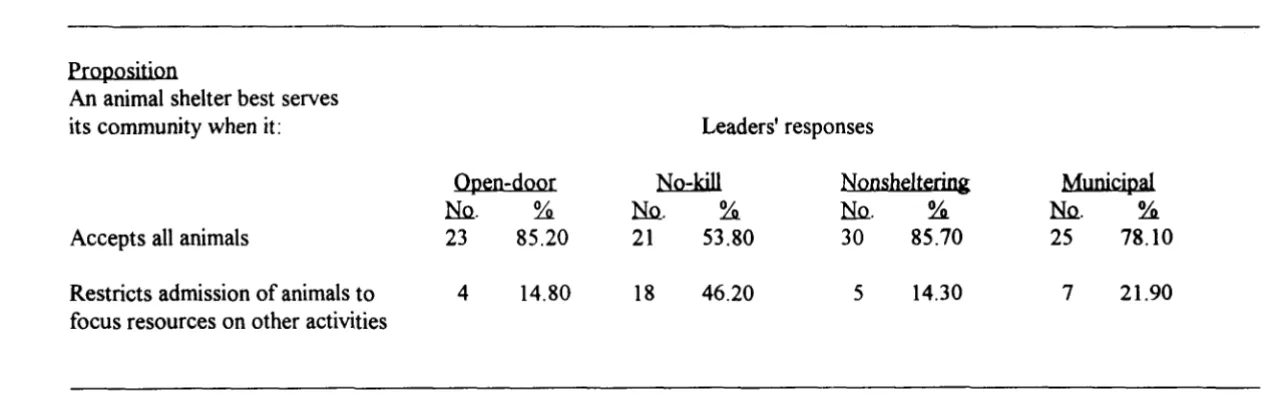
The no-kill philosophy states that animal control is best left to municipal agencies, making government responsible for society's unwanted animals. No-kill advocates believe that an animal shelter should only accept animals that will be adopted. The resources saved from caring for and euthanizing unadoptable animals should be used for other animal-related activities. The open-door philosophy counters that a humane society does not fulfill its mission if it selectively admits animals, and then houses them for unacceptably long (in their opinion) periods oftime.
This study identifies seven key differences between the two philosophies and examined each case. To test the extent of the open-door/no-kill debate, animal welfare and control leaders were asked to share their perceptions regarding the following questions:
Which type of agency do leaders perceive should be responsible for animal control? One question explored in this study was leaders' perceptions of which type of agency (nonprofit or municipal) should be responsible for animal control. The no-kill position is that nonprofits should not be performing this work. The traditional position among many open-door animal welfare leaders has been one in which they believe they are best suited for performing animal control and sheltering services, because they feel municipal agencies will not stress animal welfare as much as their agencies do. Many humane societies
currently provide animal control and sheltering services under contract for their respective municipalities. If the leaders of such humane societies perceive that the no-kill position is correct, they may decide to relinquish their agency's contracts.
Which philosophy do leaders perceive as best performing its mission? Although relinquishing animal control and sheltering contracts is a necessary step toward becoming a no-kill shelter, it does not mean that the agency will make the philosophical transition. Leaders of open-door humane societies may believe that it is not their agency's
contradicts their organization's mission.
Which philosophy do leaders perceive provides the best quality of life for the animals? One topic of intense debate throughout the literature is the quality of life for animals in no-kill facilities. Since animals are housed in no-no-kill shelters until they are adopted, they may be there for a number of months. The open-door literature states that this extended confinement is inhumane for the animals. It also suggests that no-kills are often overcrowded, unsanitary, and prone to disease. This study explored how leaders perceived the quality of life for animals in no-kill facilities, to determine whether they would be willing or reluctant to adopt the no-kill philosophy.
What do leaders perceive as the public's expectation of animal shelters? Despite leaders' personal beliefs about which is the best philosophy, they may not implement it if they perceive the public to be opposed to such a change. On the other hand, perhaps they would be willing to change philosophies if they believed that their organization would receive stronger public support. Since nonprofit animal welfare organizations largely exist to fulfill a societal need, public support of their organizational philosophy is crucial. This study explored what leaders believe to be the public's expectation of their agencies.
What do leaders perceive as the financial impact of each philosophy? It is highly unlikely that a leader would adopt a certain philosophy at the risk of bankrupting the agency. On the other hand, ifleaders believe that one philosophy has clear advantages over another in attracting resources, they may be encouraged to adopt that position. Additionally, the open-door literature has charged that no-kill proponents are really
motivated by a perceived greater ease in attracting donations. If open-door leaders believe this is true, they may be ethically unwilling to adopt a no-kill philosophy.
Do leaders perceive the terms used to describe this issue as suitable? One of the main arguments currently proposed in the open-door literature is that the term "no-kill" unfairly labels the activities of their shelters. By contrast, if one philosophy can call itself "no-kill," then the other is subsequently referred to as "kill." Additionally, the no-kill literature has stated a dislike for the term "euthanasia" to describe the killing of unwanted animals. This study measured whether there was truly a strong disagreement about the use of these terms, and also explored what other terms might be used instead.
What
do leaders believe to be the future for California animal welfare and control regarding the no-kill philosophy? Some open-door agencies have either changed or announced plans to change their organizations' policies from open-door to no-kill. This study examined whether other leaders share similar plans. Perceived board support for the idea was one factor in evaluating leaders' responses. Also, leaders' philosophicalcurrently working under, and their future plans to change were explored. Finally, the willingness of respondents to reach consensus with their counterparts holding different philosophies was investigated to determine how likely these leaders would be to set aside their differences.
Importance of the Study
The open-door/no-kill subject is of great interest and debate in the animal welfare and control fields. No-kill organizations are gaining strength and momentum, and may exert increasingly strong influence in shaping the philosophies that other animal welfare leaders adopt for their agencies. If leaders of open-door organizations adopt some or all of the no-kill philosophy, their agencies' roles in their communities may significantly change.
This study explored whether leaders believe the no-kill strategy is a viable option, suitable for any animal welfare agency to adopt, or a limited option suitable only for a select number of animal welfare agencies that meet certain criteria. These agency leaders' views concerning the viability of the no-kill option can provide guidance for agencies that are debating which strategy to adopt.
This study also illuminates areas of concern that should be explored before a leader promotes a new philosophy within the organization. Such concerns include the financial impact of adopting either philosophy, the quality oflife for animals housed at no-kill facilities, the ethics of restrictive admission policies, and responsibility for performance of animal control services.
The issues explored in this study are emotionally charged and difficult to discuss unless they are researched impartially. People often have an emotional investment in their perceptions. Leaders supporting either philosophy may be personally disliked by those from the other camp. Egos and personality differences cloud the issues. One goal ofthis study was to find ways for both philosophies to reach some common ground. The findings arrived at by studying this issue impartially can, it is hoped, help generate productive dialogue between groups holding differing views.
Limitations of the Study
Animal welfare and control workers are notoriously overworked and have little time to respond to surveys. Although the survey instrument was designed for ease of completion, some leaders were reluctant to take even that small amount of time to complete it.
telephone databases were used to call the agencies directly, to confirm names and addresses of the leaders. However, not all agencies had telephones or returned their messages. In the case of the USF database, which was compiled by IRS 990 filings, agencies that had an outside preparer file their returns had that preparer listed as the contact for the agency.
The sampling procedure used to identify participants excluded some leaders from being approached. Those municipal agencies of smaller populations (cities with less than
100,000 residents, and counties with less than 200,000 residents), and nonprofit
organizations that have not filed an IRS 990 form since 1993 were not solicited for their opinion. Although this selection criteria (more fully discussed in Chapter Three) was chosen to include those leaders most likely to be familiar with this issue, it may still have omitted some leaders who could offer opinions.
Relying on the opinions of leaders may be somewhat slanted because each person may have a vested interest in his or her organization's mission. On the other hand, the
differences in leader opinions may be more general, affecting all agencies equally.
By registering opinions, respondents may demonstrate their belief that there is a cause and effect relationship between two variables when, in fact, the effect is caused by a third, unrelated variable.
Differences in the amount of community support received by each organization may also have influenced the responses ofleaders. Levels of this type ofbias are difficult to interpret.
Another limitation is the fact that people's perceptions are inherently biased by what they can see. Perceptions are not facts and should not be construed as such. This is an emotional topic of debate, and personal feelings can cloud objective judgment.
Chapter Two
No-Kill Literature
The no-kill debate has been the subject of many articles in industry publications over the last decade. The debate started when no-kill organizations, or their proponents, began challenging the role that traditional animal shelters were playing in their communities. No-kill proponents wrote strong statements regarding the traditional open-door shelters' roles in euthanasia.
No-kill proponents suggested that traditional animal shelters had institutionalized euthanasia, and by practicing and accepting it, allowed it to grow and become a routine event that no longer merited concern. They stated that traditional animal shelters had become apathetic about euthanizing mass numbers of animals for population control measures. By not taking an aggressive enough stance against euthanasia, no-kill proponents claimed, traditional open-door shelters contributed to or even worsened the problem (Duvin, 1989; Forel, 1993; Pardue, 1988). A fairly representative statement of this perception is presented by Curley (1991):
Today's shelters act for all the world like landfills for living refuse, politely reminding people not to litter while gathering up with some zeal all the dogs and cats within reach. Most puzzling is the silent conviction with which they go about this unpleasant work, failing to notify an apathetic public that pets are not disposable. County dumps do a better job of admonishing a wasteful citizenry. (p. 24)
Most open-door shelters refer to euthanasia as a "necessary evil" or use some similar phrase to point out that they do not cause the pet overpopulation problem - irresponsible pet owners do. The no-kill argument, at presented by Duvin (1990, 1992) is that this thinking has led to a complacent mind-set regarding euthanasia.
Countless millions of precious beings have died - and continue to die - because for decades our movement has swept away their bodies in deadly silence. Something is terribly wrong, not just with shelters, but the entire movement - a movement able to live comfortable with the knowledge that we kill our closest companions without even waging a ferocious public battle for them. (Duvin, 1990, p. 53)
a failure to attract foster parents?" (Greanville, 1990, p. 44). He and other no-kill proponents call upon open-door shelters to stop euthanizing animals and find other solutions to deal with the pet overpopulation crisis.
The language used by no-kill activists has often been confrontational and has incited anger among open-door shelter proponents. No-kill activists have referred to open-door shelters as "slaughterhouses" and "landfills for living refuse." They have denounced euthanasia as "murder" and a "holocaust," and employees of open-door shelters as "ignorant," "obsolete," "complacent," and "uninspired."
Open-Door Response
As one might imagine, vocabulary such as this has offended and angered many in the door field. Open-door advocates have stated that attacking the employees of open-door organizations will not resolve the problem of euthanasia of unwanted animals. They argue that euthanasia is the only available option for addressing the pet overpopulation crisis at this time, and is being performed by people deeply concerned about this problem (Mullen, 1990; Stuart, 1990; Troiano, 1990; White, Wright, & Newkirk, 1990).
Some open-door proponents have regarded members of the no-kill community as unrealistic, naive animal activists who do not have the direct experience of running shelters and euthanizing unwanted animals that they do. They characterize no-kill proponents as theorists who speak without any experiential basis for their ideas, who do not understand the reality of dealing with unwanted animals (Fox, 1988; Fakkema, 1987; Arluke, 1991 ).
Open-door advocates also cite a list of concerns they have about the no-kill
movement. For many reasons, open-door shelter proponents believe that no-kill agencies not only fail to provide an adequate solution to the pet overpopulation problem, but in fact do harm to the animals and the animal welfare movement.
Admission Policies
Open-door proponents believe that no-kill shelters are not true havens or shelters for animals because of their restrictive admittance policies. Open-door people feel that theirs are the true animal shelters because they accept all animals, regardless of an animal's condition or temperament {Arnold, 1995).
of shelter. They argue that euthanasia is a kinder fate for an animal than being turned away by a no-kill shelter, to face starvation, disease, and abuse. Those concerned about options other than euthanasia for unwanted animals tell stories rife with incidents of neglect, starvation, and cruelty.
This argument that euthanasia is a regrettable necessity is presented in the following passage:
For a shelter to be a true haven for lost or unwanted animals and provide a
comprehensive service to the public, its doors must be open to all animals. A shelter that turns away an animal being surrendered, or asks someone to keep the animal until space opens up at the facility, risks losing that animal to abandonment or some other cruel fate. Similarly, a shelter that cannot accept an animal found running at large or rescued in a cruelty case is not acting in the animals' best interests . . . . Euthanasia of shelter animals to make room for others is a tragic necessity that prevents animal suffering. ("Seven Basic Policies," 1996, p. 13)
Ken White, currently the executive director of the Arizona Humane Society, has referred to no-kills as ". . . tumaways, contending that they take in only the most adoptable animals and leave the dirty work ofkilling to others" (Clifton, 1995, p. 16).
No-kill shelters are often described as being "selectively humane" because they choose which animals they will accept, and those they will not (Donald, 1991). They are also said to displace the problem of pet overpopulation, because the unadoptable animals they tum away are merely taken to an open-door shelter in the area and euthanized anyway, or else they are turned loose to fend for themselves (Fox, 1988; Kay, 1991; "No Room," 1981).
Arluke's 1991 study of open-door shelter workers summarized the open-door perceptions of no-kill shelter staff This report described the open-door workers'
bewilderment at how their no-kill counterparts could turn away animals, knowing that the animals would be euthanized elsewhere (Arluke, 1991).
Quality of Life
Room," 1981; Wright, 1978; American Humane Association, 1996; Arluke, 1991; Grunow, 1985; "The Quality ofLife," 1981). McNall (1996) states the position that no-kill shelters are inherently inhumane in this way:
"No kill" shelters allow some pets to spend years, or even their entire lives, in
confinement waiting for adoption. If you interact with our shelter animals, it becomes obvious that they crave the companionship of one person or family - the security of a home. There is no way any agency can provide this optimum quality of life to
hundreds of homeless animals over the very long-term . . . . Companion animals are social animals, needing human company. Depriving them of this for months on end is not in the best interest of the animal. (p. 2)
Open-door advocates also cite instances in which unacceptable quality of life in no-kill shelters means not merely insufficient physical contact but criminal cases of neglect and abuse. Without the proper controls, no-kills can become overrun with animals, they state. When this happens, the no-kill staff is unable to provide adequate care to the animals in its shelter. Accumulation of filth, starvation, disease, and other maladies have haunted no-kills, which began with good intentions but have often wound up in the court system facing criminal charges of animal abuse ("Ann Fields," 1995; Nielsen, 1987; Clark, 1994).
One no-kill advocate urging no-kill shelters to perform their mission properly, said, "There are no set standards for no-kill sheltering ... cost-cutting measures can quickly escalate into inadequate care ... instead of lifetime havens to nurture homeless companion animals, they become filthy, disease-ridden deathtraps" (Kay, 1991, pp. 41-42).
Fund-raising Strategies
Open-door proponents have openly questioned the motives of opponents who support adoption of a no-kill policy. Many open-door advocates believe that the no-kill movement is really just a strategy to raise more money from a public largely uneducated about the pet overpopulation problem. No-kills lead the public to believe that euthanasia is unnecessary, open-door critics claim, and prey on the kind hearts of people who do not want to see animals killed (Lapham, 1996; Salisbury, 1996; "Animal Control and Rescue," 1996).
Others suggest that shelters have a financial incentive to become no-kill, especially if they do not perform animal control services. This is because euthanasia is unpopular with the public, and potential contributors are more likely to donate to a shelter that does not euthanize animals (Clifton, 1994).
donations went to actual animal care and housing. These cases have done great damage to the reputation of no-kills among the animal welfare community ("Woofs & Growls,"
1996).
However, there are legitimate no-kill shelters that discuss their no-kill policy in
mailings, explaining why potential donors should give to their organizations. Donors will often ask leaders of open-door shelters why their shelter must euthanize, since some other organization that they are receiving mailings from is able to avoid it. The open-door shelters feel as though they are always on the defensive. They find it difficult to explain the difference between open-door and no-kill, and to justify why their organization should receive that donor's contribution. Many voice sentiments similar to the one stated below:
What ofthe animal shelters that advertise in fund-raising brochures that they never put animals "to sleep"? These shelters certainly have great appeal for kind-hearted but unrealistic animal lovers. While they are probably telling the truth and may work hard at placing pets in homes, these shelters do great injustice to the SPCAs by making those groups out to be the bad guys. . .. It is wrong for a shelter to publicize and capitalize on a no-kill policy, utilizing the good intentions of uninformed donors to perpetuate itself while other shelters, that bear the brunt of the burden, continue to go unhelped. (Curtis, 1982, p. 46)
Misleading the Public
Both open-door and no-kill proponents believe that the other side is misleading the public about the pet overpopulation problem. Open-door proponents believe that no-kills mislead the public about this issue by giving the public a sense of complacency about the lack of homes available for unwanted animals. By leading the public to believe that they are able to find homes for all animals, some open-door leaders feel that no-kill shelters tell the public that spaying and neutering, and other activities that go with responsible pet ownership, are unnecessary.
We don't have to show people barrels of dead animals because we don't have barrels of dead animals. We show people animals who are going to be going home. People aren't afraid to come in here, they're not going to be made sad. (Clifton, 1995, p. 17) No-kill proponents also believe open-door shelters encourage abandonment of animals, because people are unwilling to bring strays or their own pets to a facility where the animals may ultimately be euthanized. The result, no-kill proponents assert, is that more animals are abandoned, thereby increasing injury, disease, starvation, or other cruel fates that await animals that are left to fend for themselves ("San Francisco Adopts," 1994; Messina, 1993; Dorschner, 1992).
One open-door advocate recognized this dilemma and characterized it in the following statement:
One of the most difficult problems we face in this issue is that we end up trying to sell death over life. Convincing people that it is in the best interest of their animal to kill it is next to impossible in a society that condemns killing. Do we really expect people to accept that their animal is better off dead than alive? (Donald, 1991, p. 6)
Terminology
Terminology has been a sore point for both the no-kill and open-door communities. No-kill proponents prefer the term "kill" rather than "euthanasia." They use similar words, such as "slaughter" and "murder," to describe the same thing. The editors of The
Animals' Voice magazine made this argument when they stated, "Atrocities are not less
atrocities when they occur in animal shelters, either, and are done in the name of mercy. Murder is murder." ("The Animals' Voice," 1990, p. 52).
In defining "euthanasia," one no-kill advocate wrote:
The vast majority of these animals are not suffering from any painful or terminal affliction when they are killed-hence, such killing cannot be thought of as
"euthanasia" in the way that we apply that term to humans. Their lives are taken not out of mercy, but out of convenience. (Pardue, 1988, p. 44)
"Defensiveness" ofthe Open-Door Community
Responses from the traditional shelter community to statements made by no-kill advocates are seen as defensive and closed-minded by no-kill challengers, who believe the open-door community is refusing to heed their ideas and proposals to look for new solutions addressing animal sheltering needs in our society (Foran, J. & Forel, E., 1994; "In the Name ofMercy," 1990; McFarland, 1992). The no-kill proponents often cite arguments similar to that proposed by Ed Duvin:
It is always educational to see our major organizations blindly clinging to the status quo, utilizing every means at their disposal to avoid sober introspection. They are the architects of the present shelter system and reflexively defend their territory, however, it's that very defensiveness that leads to the process of institutionalizing failure,
substituting well-rehearsed excuses for creative solutions. With their limited tolerance for "outsiders" who have the temerity to raise questions about their performance, they resort to a "bunker mentality" -often missing both the positions and intent oftheir critics. (Duvin, 1990, p. 10)
Animal Control Issues
The central theme of this debate-that the euthanasia of unwanted animals is a means of population control-is intricately entwined with animal control services. Many humane societies have become the animal control providers for the communities that they serve. One obligation of animal control is to impound all stray or unwanted animals.
Consequently, these agencies must be open-door shelters. Open-door facilities often begin as an alternative to the municipal animal shelter in town, to provide what they believed to be a better solution for the animals and the community.
Open-door facilities began assuming responsibility for animal control years ago when humane societies originally founded to prevent cruelty to animals decided that it was better to assume animal control responsibilities rather than witness the poor conditions of municipal dog "pounds." Stories abound about the horrendous conditions in the early animal pounds in this country. It was not uncommon for dogcatchers to drown, club, strangle, shoot, suffocate, or use other means of extermination to kill excess animals in their municipalities. The housing conditions were inhumane as well, and little or no efforts were made to find these animals new homes (Duvin, 1992; Widerman, 1983).
As a result, humane societies changed from being outside animal advocates to
role of animal protector became meshed with animal policing activities, not of the human offenders but the animals themselves. This dichotomy has led many to question the role that humane societies should be playing in their communities, particularly the issue of who should bear the responsibility ofeuthanizing unwanted animals (Granberry, 1993; Duvin, 1992; "Prepare for Post-Pet Overpopulation," 1995).
In describing the consequences of this decision, Ed Duvin said, "Humane Societies made the tragic mistake of moving from compassionate oversight of animal control agencies to directly operating the majority of kill shelters, thereby tacitly putting their stamp of approval on killing as a population control measure" (Duvin, 1990, p. 53).
No-kill advocates urge humane societies to return the function of animal control to the municipal communities that require it. They believe that by having taxpayers pay the price for irresponsible pet ownership and overpopulation of animals, more public attention will be focused on resolving the issue. This will also eliminate the confusion of serving two missions-animal protection as well as human protection. No-kill advocates believe that one agency cannot do both well.
In addition, many humane societies have performed their municipal animal control services at a financial loss to their agency. They have subsidized these functions with donations from the public. This is money that could have gone to low-cost sterilization or education programs, say no-kill proponents, and should be spent on more proactive means of addressing pet overpopulation (Duvin, 1992).
In Milwaukee, Wisconsin, the Wisconsin Humane Society (WHS) has stopped providing animal control services for that city. The executive director, Victoria Wellens, summarized their reason for doing so:
Over the years, WHS has saved Milwaukee County taxpayers millions of dollars, but our animal control contracts have consistently underfunded the animal control services we provide. As a result, we have been forced to use private contributions to
underwrite publicly mandated services, leading to an inadequate reserve fund for building a much-needed new facility. The time has come to separate the government-mandated and funded animal control services from the privately supported animal welfare, adoption, outreach, and education service ofWHS. (Clifton, 1996, p. 9) The Washington Humane Society in Washington, D.C. experienced similar problems.
contracts at one point, but the city's response for animal control and sheltering was so poor that the shelter resigned itself to performing the services as a loss ("Dogs' Day," 1996; Yoffee, 1983; Lewis, 1994; "Pounding the Beat," 1995; "Animal Link," 1996; "Washington Humane Back in D.C.," 1996).
A number of open-door shelters choose to provide animal control and sheltering services because they believe they can provide the best care for the animals, while stressing strong adoption programs and other activities that improve the lives of the animals in their communities. Some open-door shelters have no choice: They ~
municipal agencies, and their very reason for existence is to provide animal control functions. Such municipal agencies are not generally charitable institutions, but they face the same challenges as nonprofit, open-door shelters: They must euthanize animals, and they face financial problems as well (Martin, 1996; Granberry, 1993).
New Trends
As a result of such funding problems, some nonprofit animal shelters with animal controVsheltering contracts have handed these functions back to municipal governments. Although this is a relatively new trend, successful transitions, as in San Francisco, Calif, have shown that it is possible. The San Francisco SPCA provided animal control and sheltering services for 84 ofthe 101 years it has been in existence. In 1989, the SFSPCA returned this responsibility to the City of San Francisco. By returning the responsibility for animal control back to the municipalities, nonprofit animal shelters have been able to discontinue subsidizing city services and refocus their resources more proactively on animal issues.
By discontinuing their participation in animal control services, some open-door animal shelters are redefining their mission. Although operators of animal shelters once believed that they needed to be the providers of animal control and sheltering because municipal agencies would not do it well, they don't necessarily believe this any more. Most
municipal animal control agencies have improved dramatically from the old stereotypical "pound," and provide proper care for the animals in their shelters. Many even have their own sterilization programs, and conduct active adoption programs as well.
animals. Richard Avanzino, president of the San Francisco SPCA, states:
In 1989, after 101 years, the SFSPCA returned the animal control contract to the city. We've worked very hard since then to regain the trust of the community that we are not going to kill animals. We're getting the people to bring those animals in so that we can neuter them, put them up for adoption, and end this cycle of abandonment,
uncontrolled breeding, and killing. (Clifton, 1995, p. 16)
Some suggest that the ideal model for a community is for a municipal animal control agency to provide the animal control and sheltering of stray animals, while the local humane society becomes a no-kill shelter and divorces itself from the euthanasia of animals. By doing this, it is felt that the community will be more willing to support the humane society, and that the society will then have more resources with which to operate. These resources can even be used to assist the municipal animal control agency with adoption, education, or cruelty investigation programs (Nash, 1995).
The American Society for the Prevention of Cruelty to Animals (ASPCA), the oldest and largest animal shelter in the nation, ceased providing animal control services to New York City and became a no-kill shelter on January 1, 1995. The Wisconsin Humane Society in Milwaukee discontinued their animal control services as well. These changes in large, established organizations signal a new trend emerging.
This movement has also attracted many grass roots organizations that are finding individual ways to reduce the incidence of animal euthanasia in their communities. In Southern California, the cities ofMission Viejo, San Clemente, Irvine, Dana Point, Laguna Beach, Seal Beach, and Huntington Beach have city-owned, no-kill shelters. Volunteers help to run the shelters and adopt pets through foster homes (Messina, 1993).
The Los Angeles Times reported on November 14, 1993, about three private animal
adoption agencies-the Lange Foundation, the Amanda Foundation, and the Friends of Animals Foundation-that either temporarily adopt animals out of shelters to find them permanent homes, or accept such animals before they are brought to shelters. These organizations are attempting to alleviate the burden of animal shelters by taking some of the unwanted animals themselves (Timnick, 1993).
The thinking is that potential owners will flock to an upscale shelter for the ambiance, the way shoppers do to marble-floored department stores with tuxedo-clad classical pianists . . .. The Pasadena complex is only part of a nationwide movement toward kinder, gentler animal centers. (p. B7)
Chapter Three
Subjects/Respondents
The survey subjects for this study were chosen based on several criteria. The first criterion was that the respondents lead an animal welfare or animal control organization within the state of California. Leaders were identified as the highest ranking officer of the organization, such as executive director, board president (if there is no staff), or other such designation. Whatever the actual title, these were the persons ultimately responsible for their agencies' activities and direction. Only the leaders of these organizations were surveyed, on the assumption they are likely to have better insights into the open-door/no-kill controversy than lower-ranking employees. In addition, they have stronger influence than lower placed employees in determining whether their agencies will ultimately adopt a different operating philosophy. Also, it is highly likely that leaders recruit staff of similar philosophy. Surveying staff as well as the leaders would likely have been redundant, and could have resulted in larger organizations skewing the research results due to their greater representative number of employees who would have been surveyed.
Each organization whose leader was selected for the study was required to be either a municipal agency or a 50l(c)(3) organization. The 50l(c)(3) requirement was because some private individuals call themselves "no-kill organizations" in describing their individual volunteer work. They may find lost animals and place them in new homes through ads in the newspaper or other such avenues. They are not, however, part of an organization or operating a bona fide animal shelter. Such individuals are unlikely to act as change agents or industry leaders in promoting a certain philosophy. The 50l(c)(3) status requirement for the organizations represented by the survey subjects ensured that only leaders of true organizations were selected.
The four types of agencies that leaders were selected from were: open-door humane society, no-kill humane society, municipal animal control organization, or nonsheltering animal welfare organization. These categories contain nearly every type of organization in California involved with the issue of unwanted companion animals.
would likely improve chances that a no-kill facility would be successful there. In addition, although nonsheltering animal welfare organizations do not provide care or housing of unwanted animals, they are as involved in the pet overpopulation issue as those
organizations that do. The leaders of these organizations can easily serve as proponents of either philosophy and can influence the opinions of others.
The subjects were chosen by their membership or listing in one of two directories. Leaders of municipal animal control organizations were identified by the membership list of the California Animal Control Directors Association (CACDA). Only those agencies that serve a minimum city population of 100,000 or county population of200,000 were surveyed. This was because many smaller cities and counties operate their animal control activities as a subsection of another municipal agency, such as public works or
maintenance. Such smaller agencies are unlikely to have a level of understanding concerning this topic sufficient to offer meaningful data.
Leaders of both no-kill and open-door, nonprofit animal welfare organizations were identified through a search of the California Nonprofit Database. This database is administered by the Institute for Nonprofit Management at the University of San Francisco. It is the most comprehensive single source of information on California's nonprofit sector. The search parameters were animal welfare organizations with 501(c)(3) status that filed an IRS Form 990 for Fiscal Year 1993 or later. This parameter was chosen to include only those organizations that have been large enough and active enough to have filed a recent return, as the Internal Revenue Service requires annual returns only for organizations who receive $25,000 or more per year. Those organizations that have not filed prior to 1993 were considered to be not sufficiently active to be involved with this issue, and would not be likely to supply meaningful data.
Some of the respondents were listed on both the CACDA and the California Nonprofit Database lists. These two lists were cross-referenced to prevent the same individual from being surveyed twice. For those names that were repeated, a review of their type of organization was performed. They were then listed under the one category most representative of their type of organization. For example, a leader of a nonprofit open-door organization identified on the CACDA list was considered first a leader of a nonprofit organization, and his/her response was included in the responses in that category.
Research Design
The research was conducted by a mailed questionnaire sent to the leaders of291 California animal welfare/control organizations identified by the above parameters. A census was conducted of this population.
In the questionnaire, respondents provided data indicating the type of organization for which they work. The categories available for selection were nonprofit open-door animal shelter, nonprofit no-kill animal shelter, nonprofit nonsheltering animal welfare
organization, and municipal animal control agency. A space was provided to describe an "other" classification if these did not adequately describe a leader's organization. This information made it possible to interpret the results in the context of which type of organization the leader works for. It also enabled comparisons to be made between the philosophies of leaders of the different types of organizations.
Due to the large number of participants identified, a mailed questionnaire was used, because personal interviews with this number of subjects would not have been feasible. The research was designed to provide a descriptive, cross-sectional study of the attitudes of individual leaders of animal welfare and control organizations. The questionnaire measured leaders' perceptions about the effect the no-kill movement is having on the traditional animal sheltering model in the context of the research questions proposed in this study.
Instrumentation
The questionnaire was used to solicit responses from the research subjects and was designed to ensure ease of completion. To this end, narrative responses were avoided. Instead, respondents were asked to mark the response category that best represented their opinion. In two questions, respondents were asked to suggest an alternative term to describe "open-door" or "no-kill."
Issues for study were those identified as main themes in the literature review. Questions raised in the questionnaire related back to these issues.
Subjects were asked to indicate their level of agreement with statements that describe certain philosophies within the animal welfare/control field, using an interval scale of 0 to
10 (0= no agreement, 1 0= full agreement). These statements focused on the effect that no-kill organizations are having on the animal welfare field, the role of the animal shelter in the community, and who should bear the responsibility for animal control in the community.
Department of Animal Care and Control. The drafts were then pretested on five middle-to-upper management staff of an animal welfare organization. This questionnaire is presented as Appendix A.
Procedures
Each agency selected by the criteria described above that had a business telephone was first telephoned to ensure the information provided by the CACDA and California
Nonprofit Database lists was correct. The address and name of the leader of that organization were verified, as well as the open-door/no-kill status of the organization. Any necessary corrections were made to the survey respondent database.
The survey was mailed to the subjects when as much information as possible was confirmed. The survey also included a letter explaining the nature of the project and requesting the subject's participation (Appendix B), and instructions for completing the survey (Appendix C). A self-addressed, stamped, number 10, first-class envelope was enclosed for returning the survey.
After two weeks, those respondents who had not yet returned a survey were mailed a reminder letter, asking them to complete and return the survey promptly. A telephone number to request a replacement survey was included. This letter is presented as Appendix D.
Two weeks following the reminder letter mailing, those subjects who had not returned their surveys and had listed telephone numbers were telephoned. They were asked one final time to complete the survey. Two final weeks were allowed to receive these surveys. At the end of this period, analysis of data began.
Operational Definitions ofReleyant Variables
Normative definitions of relevant variables were derived from the responses given to the survey questions.
Animal control contract: Respondents of nonprofit organizations were asked if their agency has a contract to perform animal control or sheltering services with their
municipality. This variable was measured by question 42, which asked if respondents have such a contract, and if so, what kind.
Animal sheltering services: This was measured by question 42, which asked the leaders if their organizations perform animal sheltering services.
Animal welfare organization: This was measured by question 43, which asked each leader to identify which type of organization that they work for.
Euthanasia: Leaders' perceptions of the definition of euthanasia were measured by questions 30 and 31.
Financial impact: Financial Impact was operationalized through questions 7 - 16 and 25. These questions measured leaders' perceptions of various ways that the no-kill or open-door philosophies impact an organization's ability to attract resources.
Future: Questions 24, 27- 29 and 38- 41 measured leaders' perceptions ofthe probable future for their organizations. These questions measured what philosophy the leaders believe will be most likely for their organization to adhere to.
Humane Society or SPCA: Question 43 recorded which type of agency the survey respondents work for.
Leader: Leader was measured in question 44, in which the respondent stated their job title.
Mission: How the leaders defined "mission" was measured in questions 1 - 6, 18, 22, and 37. These questions measured leaders' perceptions of what an animal welfare agency's mission should be.
No-kill shelters: No-kill shelters were operationalized in questions 39 and 43, in which the respondents stated whether they work for a no-kill organization. These questions measured the number of no-kill respondents.
Perceptions: Perceptions were measured on the ordinal scale used by the respondents to indicate their level of agreement with the survey questions.
Public expectation: Leaders' perceptions of public expectation were measured in questions 17, 19- 21, and 36. These questions measured leaders' perceptions ofwhat their constituents expect of their organizations.
Quality oflife: Leaders' perceptions of quality oflife for sheltered animals were measured in questions 23 and 26, which asked respondents to state their level of agreement with those questions.
Suitable: The suitability of survey terms was measured by leaders' responses to questions 30 through 35.
Treatment of Data
The data were analyzed quantitatively to identify what the perceptions were of leaders in the animal welfare field, regarding the research questions proposed in Chapter One. In addition, the responses of leaders of nonprofit open-door, nonprofit no-kill, nonprofit nonsheltering, and municipal animal control agencies were compared to determine whether differences of perception exist between the four groups. ANOVA (Analysis of Variance) measures were used to measure the significance of differences between groups.
Interval data were gathered to describe the perceptions of leaders regarding the no-kill philosophy's effect on the research questions discussed in Chapter One. Subjects' levels of agreement with the various questionnaire statements were compared with policy positions identified in the literature. Standard measures-mean, frequency, and standard
Chapter Four
This chapter presents the results of the data collected. A demographic profile of the respondents is presented, as well as a discussion of the findings regarding the research questions presented in Chapter One. Differences between groups are analyzed to determine the degree of similarity in perceptions among leaders of different types of animal control and welfare organizations.
Demographic Profile
Based on the parameters chosen to define the survey population, 291 agencies were identified as meeting the population criteria. Surveys were sent to the leaders of these 291 agencies. Twenty-two surveys were returned as undeliverable; one agency was incorrectly identified as meeting the selection parameters; five respondents refused to complete the survey when the researcher contacted them; and two agencies had closed. Of the revised population of261 agencies, 143 returned surveys, for a 55-percent response rate.
The agencies the respondents worked or volunteered for belonged to one of the four categories stated in question 43 of the survey: nonprofit open-door animal shelter, nonprofit no-kill animal shelter, nonprofit nonsheltering animal welfare organization, or municipal animal control agency.
As
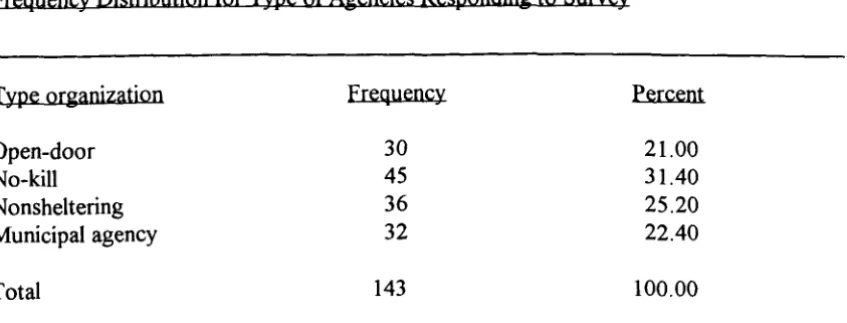
outlined in Table 1, the pattern of survey responses was relatively evenly distributed: nonprofit no-kill animal shelters (31.5%); nonprofit nonshelteringorganizations (25.2%); municipal animal control organizations (22.4%); and nonprofit open-door organizations (21.0%).
Table 1
Frequency Distribution for Type of Agencies Responding to Survey
Type organization Frequency Percent
Open-door 30 21.00
No-kill 45 31.40
Nonsheltering 36 25.20
Municipal agency 32 22.40
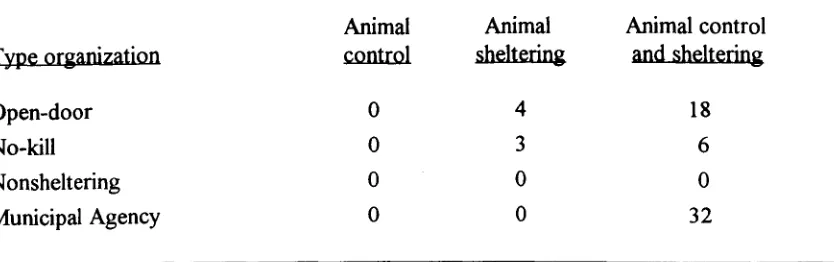
Frequency distributions were calculated to determine how many of these organizations had contracts for performing animal control and/or sheltering functions. Table 2 illustrates the responses. As expected, all of the municipal agencies (N=32) reported that they perform animal control and sheltering. Additionally, none of the nonprofit nonsheltering organizations (N=34) performed either of these functions.
Less expected was the response from the nonprofit no-kill organizations. While the vast majority (80%) did not have animal control/sheltering contracts, nine leaders reported that their agencies performed animal control or sheltering. Of these nine
responses, three reported they had contracts to perform animal sheltering, and six reported that they had contracts to perform both animal control and sheltering. The apparent contradiction (discussed in Chapter Two) of a no-kill shelter performing animal control and sheltering is a new phenomenon that would make an interesting topic for future research.
Ofthe responding nonprofit open-door shelters, 73.33% had contracts to perform animal control and/or sheltering. Of these 22 agencies with contracts, 18 had contracts to perform both animal control and sheltering. Four agencies had contracts to perform sheltering only.
Table 2
Frequency Distribution for Animal Control Contract I~
Animal Animal Animal control Type organization control sheltering and sheltering
Open-door 0 4 18
No-kill 0 3 6
N onsheltering 0 0 0