Neural Network Priority Use of BTS for
Optimizing Telecommunications in Indonesia
T. H. F. Harumy, Lubis Akhyar, and Iqbal Muhammad
Computer Science, University Pembangunan Pancabudi, Medan, Indonesia Email: [email protected], [email protected], [email protected]Abstract—Artificial Neural Network Backpropogation is used to measure the Utilization Priority of BTS (Base Transceiver Station) to Optimize Telecommunication in 3T Disadvantaged, Outermost, Inside Areas based on 7 variables that are dujikan namely Population Density / thousand, User / User, Climate / Geography (Air temperature, rainfall, altitude), Environment, Culture / Community Attitudes, Cost of manufacture / billion, service range. By using Backpropogation method finally found the best architectural pattern yatu architecture 7 - 7 - 1 from 3 architecture which have been tested. MSE obtained for Trainning of 0.0001000609 and MSE testing of 0,0027164812 and Epoch obtained is 2164 From the pattern is then predicted telecommunication network users in 2017 that is equal to 317.912.790 million soul, and from the variables that become input the measurement was obtained that the polewali mandar village variable is the priority village of installation of BTS (Base Transceiver Station) with value 0.9298 next is South Nias district with value 0.9242, West Nias 0.9055, Sorong 0.8860, and Sorong jaya 0.8569.
Index Terms—
I. INTRODUCTION
Currently, people who use communication technology is very high, it is by using gadgets such as mobile phones, smartphones, laptops that use 2G, 3G and 4G signals, in addition. The infrastructure has an important role to the social economic development Like BPS data in 2015 mobile phone users in Indonesia are 338,948,340 users. However, many of these users only revolve around the village areas - villages located on the island of Java and Sumatra. The value is inversely proportional to the user in the area or 3T villages (left behind, outer and deepest). This is due to
The poor signal in those villages when viewed from the density of the 3T villagers has a high enough value. Whereasif viewed from the potential of 3T village in Indonesia is 82,353 villages. At this time the telecommunication providers are still reluctant to build BTS in 3T area because of the high financing, there are still many terrain that can not be reached well, the culture of the community is still less friendly with the
Manuscript received May 16, 2018; revised September 18, 2018.
construction of towers and so forth. This makes the development uneven, so that a good signal can only be felt and enjoyed by the citizens who are in urban areas alone it has been strengthened by Law No. 32 of 2004
On Regional Autonomy where the Act is expected to open the space for the happening of the distribution of social development in all regions which is considered left behind especially 3T area. Currently the government is trying to accelerate it. Targeted government villages are a business with marginal potential for telecommunication operators due to their relatively remote position. Currently fund is managed by BP3TI. The duties and functions of BP3TI are to provide the provision and management of telecommunication and informatics financing related to the implementation of Universal Service Obligation.
At Development Backpropogation Algorithm applied very much for the world Health, Economics, agriculture and others [1]-[3]. Artificial Neural Network is an artificial representation of the human brain that always tries to simulate the learning process in the human brain. One area where ANN can be applied is the field of forecasting or prediction and forecasting techniques or predictions used are Backpropogation. Prediction techniques are used for planning processes and decision-making processes. The prediction tries to estimate what happens in the future. Therefore, it is necessary to conduct a study, test analysis on the utilization of BTS in 3T area, in terms of community acceptance, utilization / placement of BTS to improve efficiency, effectiveness which will be the solution for the government. After the author describes and understands the background of the problem, then the author then formulates the problem as follows is how is the public acceptance of the utilization of USO BTS in the 3T region And How to Optimize Utilization / placement of BTS for the improvement of people's welfare.
II. PREDICT USING NEURAL NETWORKS
According Back propagation or backpropagation is one of the most widely used learning / training of supervised learning. This method is one of the most excellent methods of dealing with the problem of recognizing complex patterns. In the back propagation network, each unit in the input layer is connected to each unit in the hidden layer.
village
A. Architecture ANN
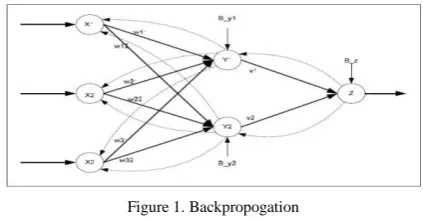
The Artificial Neural Network architecture used in this case is the backpropagation algorithm network, which consists of: a. The input layer with 9 nodes is (x1, x2, x3, x4, x5, x6, x7, x8, x9). The hidden layer with the number of vertices specified by the user is one node or one hidden with two neurons i.e. (y1, y2). Output layer with 1 node is prediction accuracy Value added a product [2], [4]-[6]. (Fig. 1)
Figure 1. Backpropogation
Network architecture can be seen as in Fig. 2 below:
Figure 2. Backpropagation network architecture
Artificial Neural Network Model Modeling System for Optimization of BTS At the time of input data (input) we have got, then can be done to designing Artificial Neural Network modeling system which will be able to be used to determine and recognize pattern in predicting village becoming priority of installation of BTS for telecommunication optimization In Area 3T. In this case the parameters to be used based on 7 variable factors that influence the installation of BTS for telecommunication optimization in 3T area. Data input comes from Primary Data derived from Questionnaire and wawandacar and Secondary Data derived from data BPS and Kominfo Year 2016.
B. Input Material Input Variables
After the variable is determined later if the input data can be recognized by the network then can be processed using Matlab application then the data must be changed first into the form of matrix or numeric. The seven variable factors which affects the priority of installing the USO BTS in 3T Village in the form of X1, X2, X3, X4, X5, X6, X7, where:
X1: Population Density / thousand / Soul X2: User / User (Soul)
X3: Climate / Geography (Air temperature, rainfall, altitude)
X4: Environment
X5: Culture / Attitude Society X6: Cost manufacturing cost / billions X7: service range
C. ANN Model Modeling System for Optimization of USO BTS
At the time of input data (input) we have got, then it can be done to designing Artificial Neural Network modeling system which will be used to determine and recognize the pattern in predicting the villages becoming the priority of installation of BTS USO for telecommunication optimization in 3T area. In this case the parameters to be used based on 7 variable factors that influence the installation of BTS USO for telecommunication optimization in 3T area. Data input comes from Primary Data derived from Questionnaire and wawandacar and Secondary Data derived from data BPS and Kominfo Year 2016.
D. Input and Target Data
Method of collecting data Methods of data collection in this study are:
Observation
Observation is to see directly the spaciousness of the way officers in installing one BTS.
Interview
Interviews were conducted by interviewing in related to BTS
Questionnaire
The questionnaire was conducted by distributing the questionnaire to the sample area.
E. Data Analysis Method
For data input values and target variables are replaced with values obtained based on data already obtained from BPS owners and questionnaires from 5 districts in Indonesia namely West Nias, south nias, Polewali mandar, Sorong and sorong jaya. For Input to be trained, the table data is converted into a 7x30 matrix A, a 7x25 matrix B, a 7x20 C matrix and the remaining data used for testing with a matrix D measuring 7x15, matrix E measuring 7x10. The desired output (target) is the prediction of the most potential village for the installation of the USO BTS. Next is the result of the measurement of the variable villages with the highest level of influence on the optimization of telecommunication improvement in 3T village (left behind, outer and in the fore).
F. Artificial Neural Network Model Modeling System for Optimization of USO BTS
interview and Secondary Data derived from data BPS and Kominfo Year 2016.The desired output (target) is the prediction of the most potential village for the installation of the USO BTS. Next is the result of the measurement of the variable villages with the highest level of influence on the optimization of telecommunication improvement in 3T village (left behind, outer and in the fore).
III. DISCUSSION
After 3 Aritektur in train and tested the architecture, 7-7-1,7-5-3-1, 7-9-1, got the best architecture is 7-7-1 with Epoch 2164 After awakening weight, Next step conducted trainning with parameters - parameters as follows:
Activation Function to Hidden Layer: Tansig Activation Function to Output Layer
Logsig Type of Trainning
Traingd Number of Hidden Layer Neurons: 7 Learning rate: 0.1
Maximum Error Limit: 0,0001 Limit Show: 1000
Maximum Epoch Limit: 100000 Momentum: 0.8
The next step is to input Parameter used in Matlab namely:
>> net.trainParam.epochs = 100000; >> net.trainParam.goal = 0,0001; >> net.trainParam.Lr = 0.1; >> net.trainParam.show = 1000; >> net.trainParam.mc = 0.8;
If it has been determined then the parameters of the data in the train until the epoch is found with a goal that has been determined as follows:
>> net = train (net, PP, TTT)
After the Train process is Completed. Then check the error and Actual Output:
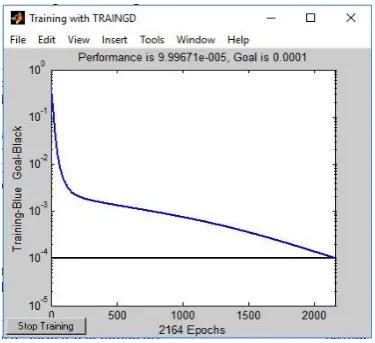
>> [a, Pf, Af, e, Perf] = sim (net, PPP, [], [], TTT) After the iteration, the minimum error is found in epoch 2164. Results Data Trainning with Model 7-7-1 can be seen in Fig. 3 Performance Results Data Pattern 7 -7-1 Achieve Goal
Figure 3. Performance results data pattern 7-7-1 achieve goal
A. Testing Data with Model Architecture 7-7-1 (7 Neuron)
Trainning with architecture model pattern 7-7-1 with 7 neuron, then continued with testing with data testing as many as 30 sample BTS USO number 1 to 30,
>> a = sim (net, PPP)
>> [a, Pf, Af, e, Perf] = sim (net, PPP, [], [], TT) The results of testing 30 data testing with 7-7-1 testing patterns. The results of testing data can be seen in Table I is the result of testing with 30 data testing with the pattern of testing 7-7-1.
TABLEI. COMPARISON OF EPOCH,MSE Model 7-7-1 7-5-3-1 7-9-1
Epoch 2164 133781 161238
MSE
Trainning 0,0001000609 0,0001000673 0,0000999804
Level of
Truth 25/30 16/20 18/15 Percentage
of Accuracy MSE Testing Level of Truth
Percentage of accuracy
82,5% 53% 72%
0,0027164812 0,0283494123 0,0634438186
5/5 9/15 10/20
32 % 30% 28,5%
B. Results Predicted Users of Telecommunication Networks in 3T Village
After the best pattern of five architecture that is, 7-7-1, 7-5-3-7-7-1, 7-9-1 which have been trained and tested has been obtained that is 7-7-1 pattern with trainning accuracy level 82,5%. The next step is to predict the number of users of the telecommunications network, especially in the 3T area from 2010 to 2015 data. So from the prediction results obtained the following results:
After the best pattern of five architecture that is, 7-7-1, 7-5-3-7-7-1, 7-9-1 which have been trained and tested has been obtained that is 7-7-1 pattern with trainning accuracy level 82,5%. The next step is to predict the number of users of the telecommunications network, especially in the 3T area from 2010 to 2015 data. So from the prediction results obtained the following results:
Year 2017 = 0, 9004 (338.948.340 - 211. 200.297) + 211 200 297 = 317912790
where:
xi = number of users 2017 y = Network output results 0.9004
xmin = Data with a minimum value of 211 200 297 xmax = Data with a maximum value of 338,948,340
So with the overall data above can be predicted bahwiksinya prediction of 2017 telecommunications network usage is 317912790 user.
Next is Nias Selatan, western Nias, Sorong and Sorong jaya. Sensitivity in all variables the results show high enough. Therefore, the iteration of learning process is stopped because all the variables show the sensitivity and the influence that is high enough. So with the overall data above can be predicted prediction of 2017 telecommunications network usage is 317912790 user. So with the overall data above can be predicted that the prediction of 2017 telecommunications network usage is 317912790 user.
TABLEII. RESULTS OF RECURRENT ITERATIVE SENSITIVITY ANALYSIS
The sensitivity of all variables shows considerable results so that the learning iteration process is stopped. From the output that has been obtained then the results of backpropgation data processing of the five villages sampled Polewali Mandar village is a village that must be a priority for the installation of BTS USO. Next is Nias Selatan, western Nias, Sorong and Sorong jaya. Sensitivity In all variables the results show high enough. Therefore, the iteration of learning process is stopped because all the variables show the sensitivity and the influence that is high enough. Telecommunication network with the following conclusions:
Public acceptance of USO BTS utilization plan in 3T area is well-rated and very good with the result of questionnaire for Polewali Mandar that is 4.06, Nias Selatan 4.05 that is, West Nias is 3.67, Sorong is 4.67, Sorong jaya is 4.78. Optimizing the utilization / placement of BTS USO in 3T area for the improvement of people's welfare is from 7 variables that dujikan namely Population Density / thousand, User / User, Climate / Geography (Air temperature, Rainfall, altitude), Environment, Culture/ The cost of manufacture/ billions, the extent of service states that polewali mandar. the village which is the priority of the most important BTS utilization followed by South Nias, West Nias, Sorong and Sorong Jaya villages,so that this result
IV. CONCLUSION
Test results obtained by the author with Artificial Neural Network Backpropagation method in predicting the villages that become the priority of installation of BTS for optimization of telecommunication network utilization with the following conclusion:
1. Public acceptance of BTS utilization plan in 3T area is well-rated and very good with the result of questionnaire for Polewali Mandar that is 4.06, Nias Selatan 4.05 that is, West Nias is 3.67, Sorong is 4.67, Sorong jaya is 4.78.
2. Optimizing the utilization / placement of BTS in 3T area for the improvement of people's welfare is from 7 variables that dujikan namely Population Density / thousand, User / User, Climate / Geography (Air temperature, Rainfall, altitude), Environment, Culture / The cost of manufacture / billions, the extent of service states that polewali mandar is the village which is the priority of the most important BTS utilization followed by South Nias, West Nias, Sorong and Sorong Jaya villages, so that this result can be considered for BP3TI to take the regional decisions that become priority.
ACKNOWLEDGMENT
Our thanks to ACM SIGCHI for allowing us to modify templates they had developed.
REFFRENCES
[1] R. Amardeep, “Training feed forward neural network with backpropogation algorithm,” Int. J. Eng. Comput. Sci., 2017. [2] N. E. Ross, C. J. Pritchard, D. M. Rubin, and A. G. Dusé,
“Automated image processing method for the diagnosis and classification of malaria on thin blood smears,” Med. Biol. Eng.
Comput., 2006.
[3] Y. Singh, P. K. Bhatia, and O. Sangwan, “ANN model for predicting software function point metric,” ACM SIGSOFT Softw.
Eng. Notes, 2009.
[4] D. Kriesel, A Brief Introduction to Neural Networks, Springer Berlin Heidelberg, 2007.
[5] A. Wimatra, D. Nasution, T. H. F. Harumy, and Sunardi, “Backpropagation model for BIDIKMISI recipients,”
Internetworking Indones. J., vol. 8, no. 2, 2016.
[6] D. Nasution, T. H. F. Harumy, E. Haryanto, F. Fachrizal, Julham, and A. Turnip, “A classification method for prediction of qualitative properties of multivariate EEG-P300 signals,” in Proc. International Conference on Automation, Cognitive Science, Optics, Micro Electro-Mechanical System, and Information
Technology, 2016.
Henny Febriana Harumy was born in Banda Aceh Indonesia, February 19, 1988. She is a Computer magister from UPI YPTK Padang Indonesia in Information Technology in 2014 and earned her Bachelor Degree in Pancabudi University of Medan Indonesia in computer system in 2010. She currently is a lecturer at Pancabudi Development University, the field of research conducted is the Field of Artificial Intelligent, Machine Learning, Neural Network. Currently she is undergoing PhD Education at the University of Science Malaysia.
Akhyar Lubis was born in Bah Bulian, Indonesia, in 1983. He received the S.Kom. degree in computer science from Universitas Pembangunan Panca Budi, Medan, Indonesia, in 2006. He obtained M.Kom from Universitas Amikom, Yogyakarta, Indonesia. In 2008, He started to join the Faculty of Engineering, Universitas Pembangunan Panca Budi, as a Lecturer, and in 2016 became a Cisco Trainer. He has taught many networking students. He has always had many contributions in journal events, as an IT supervisor at PT. Suriatama Mahkota Kencana 2005-2007, and also PT PIM 2007-2009.