H
UNIVAC
90/70
System Description
SPE~y~L
-,r
L.JNIVAC
COMPUTER SYSTEMS
System
This document contains the latest information available at the time of publication. However, Sperry Univac reserves the right to modify or revise its contents. To ensure that you have the most recent information, contact your local Sperry Univac representative.
UN IVAC is a registered trademark of the Sperry Rand Corporation.
Other trademarks of the Sperry Rand Corporation include:
FASTRAND
UNISCOPE
UNISERVO
PAGEWRITER
CONTENTS
CONTENTS
1.
INTRODUCTION
2.
SYSTEM DESCRIPTION
3
2.1.
HIGHLIGHTS3
2.2.
SYSTEM HARDWARE COMPONENTS4
2.2.1.
Processor 72.2.2.
I/O Channels 72.2.2.1.
Standard Interface Adapter (SIA) 72.2.3.
Commun ications 72.2.3.1.
Communication I ntelligence Channel (CIC 72.2.3.2.
Data Communications Subsystem (DCS)8
2.3.
SOFTWARE FEATURES8
2.3.1.
Supervisor8
2.3.1.1.
Multijobbing/Multitasking8
.2.3.1.2.
Rollout/Rollin8
2.3.2.
Data Management10
2.3.3.
Job Control10
2.3.3.1.
System File Catalog10
2.3.3.2.
Automatic Scheduling10
2.3.4.
Other Featu res12
3.
CENTRAL HARDWARE
13
3.1.
GENERAL13
3.2.
PROCESSOR13
3.2.1.
Arithmetic Hardware14
3.2.1.1.
Register Stack14
3.2.1.2.
Fixed-Point Arithmetic15
3.2.1.3.
Floating-Point Arithmetic16
3.2.1.4.
Decimal Arithmetic16
3.2.1.5.
Logical Operations17
3.2.2.
Input/Output17
3.2.2.1.
Selector Channels18
3.2.2.2.
Multiplexer Channel18
3.2.3.
Processor Modes18
3.2.5. Interrupt Processing Control 19
3.2.6. I nstruction Repertoire 22
3.2.6.1. Instruction Types 22
3.2.6.2. Nonprivileged I nstruction Set 25
3.2.6.3. Privileged I nstruction Set 25
3.2.6.4. Indirect Addressing 25
3.2.6.5. Address Relocation 26
3.3. MAl N STORAGE 26
3.3.1. Information Positioning 27
3.3.2. Low Order Storage 28
3.3.3. Storage Protection 28
3.3.4. Program Relocation Registers 28
3.4. SYSTEM CONSOLE 28
4.
PERIPHERAL EQUIPMENT
304.1. GENERAL 30
4.2. DISC SUBSYSTEMS 31
4.2.1. UNIVAC 8411 Disc Subsystem 33
4.2.2. UNIVAC 8414 Disc Subsystem 33
4.2.3. UNIVAC 8424 Disc Subsystem 33
4.2.4. UN IV AC 8440 Disc Subsystem 34
4.3. UNISERVO MAGNETIC TAPE SUBSYSTEMS 34
4.3.1. UNISERVO VI-C Magnetic Tape Subsystem 35
4.3.2. UNISERVO 12/16 Magnetic Tape Subsystem 35
4.3.2.1. UN ISE RVO 12 Magnetic Tape Unit 36
4.3.2.2. UNISERVO 16 Magnetic Tape Unit 37
4.3.3. UNISERVO 20 Magnetic Tape Subsystem 38
4.4. CARD READER SUBSYSTEMS 38
4.4.1. UNIVAC 0711 Card Reader Subsystem 39
4.4.2. UN IV AC 0716 Card Reader Subsystem 39
4.5. PRINTER SUBSYSTEMS 40
4.5.1. UNIVAC 0768-00/01 Printer Subsystem 41
4.5.2. UNIVAC 0768-02/03 Printer Subsystem 41
4.5.3. UNIVAC 0770 Printer Subsystem 43
4.6. UNIVAC 0604 CARD PUNCH SUBSYSTEM 43
4.7. UNIVAC 0920 PAPER TAPE SUBSYSTEM 44
4.8. UNIVAC 2703 OPTICAL DOCUMENT READER 46
4.9. UNISCOPE 100 DISPLAY TERMINAL 47
4.10. UNIVAC 9200/9200 11/9300/9300 11/9400 SYSTEMS 47
5.
COMMUNICATIONS
495.1. GENERAL 49
5.2. DATA COMMUNICATIONS SUBSYSTEM (DCS) 49
5.2.1. Line Terminal Controller 50
5.2.2. Line Terminal 50
5.2.3. Communications Interface 50
5.2.4. Asynchronous Timing Assembly 50
5.3. COMMUNICATION INTELLIGENCE CHANNEL (CIC) 50
5.3.1. Benefits 51
5.3.2. Capability 51
5.3.3. Redundancy 52
5.4. REMOTE TERMINALS 52
5.4.1. TELETYPE EQUIPMENT 53
5.4.2. UNISCOPE 100 Display Terminal 53
5.4.3. UNIVAC DCT 500 Data Communications Terminal 54
5.4.4. UNIVAC DCT 1000 Data Communications Terminal 55
5.4.4.1. Data Buffers 56
5.4.4.2. Poll ing System 57
5.4.5. UNIVAC DCT 2000 Data Communications Terminal 57
5.4.6. UNIVAC 1004 or 1005 Subsystem 59
5.4.7. UNIVAC 9000 Series Systems 60
6.
OPERATING SYSTEM (OS/7)
616.1. GENERAL 61
6.2. SUPERVISOR 62
6.2.1. Physical I nput/Output Control System 63
6.2.2. Resource Allocation 63
6.2.3. T ask Control 64
6.2.4. Timer and Day Clock Services 64
6.2.5. Program Management 64
6.2.6. System Console Management 65
6.2.6.1. Input From Operator 65
6.2.6.2. Output to Operator 67
6.2.6.3. Message Display Management 67
6.2.7. File Services 68
6.2.8. Program Error Handling 68
6.2.9. Subroutine Linkage Table 69
6.2.10. Spooling Operations 69
6.2.11. Operating Environment Recovery 71
6.2.11.1. Physical I DCS Services 71
6.2.11.2. Checkpoint 71
6.2.12. Diagnostic/Debugging Aids 71
6.2.12.1. Trace Mode Support 71
6.2.12.2. Monitor Mode Support 71
6.2.12.3. Snapshot Display of Main Storage 72
6.2.12.4. Main Storage Dumps 72
6.2.12.5. Standard Systems Error Message Interface 72
6.2.12.6. Error Response to User Programs 72
6.3.
JOB CONTROL72
6.3.1.
System File Catalog74
6.3.2.
Job Entry74
6.3.3.
Job Management75
6.3.4.
Job Termination77
6.3.5.
Job Accounting77
6.3.6.
Device Assignment78
6.3.7.
Automatic Volume Recognition79
6.4.
DATA MANAGEMENT79
6.4.1.
Logical 10CS Modules79
6.4.2.
Transient Routines79
6.4.3.
User Interface79
6.4.3.1.
File Definition79
6.4.3.2.
File Processing79
6.4.4.
File Format Processing81
6.4.5.
File Table Completion81
6.4.6.
Access Methods81
6.4.6.1.
Sequential Access Method (SAM)81
6.4.6.2.
Direct Access Method (DAM)82
6.4.6.3.
Indexed·Sequential Access Method (ISAM)82
6.4.6.4.
System I ntegrated Access Methods (SIAM)82
6.4.7.
Standard Direct Access VTOC Service83
6.4.8.
Reconstruction and Recovery Procedures83
6.5.
DATA COMMUNICATIONS84
6.5.1.
Physical I/O Control System84
6.5.2.
Message Control Program84
6.5.3.
Message Processing Program86
6.5.4.
Remote Job Entry87
6.5.5.
Network Definition87
6.5.6.
User Own Code87
6.5.7.
Error Checking and Message Recovery87
6.5.8.
Multiple Message Processing Programs87
6.6.
LANGUAGE PROCESSORS88
6.6.1.
COBOL88
6.6.2.
FORTRAN89
6.6.3.
Assembler89
6.6.4.
Report Program Generator (RPG)90
6.7.
PROGRAM PROCESSORS91
6.7.1.
Linkage Editor91
6.7.2.
Library Services93
6.8.
UTI L1TY AND SERVICE PROGRAMS93
6.8.1.
Sort/Merge93
6.8.1.1.
Facilities Utilization94
6.8.1.2.
User Control95
6.8.2.
Data Utility95
6.8.3.
Miscellaneous Utilities95
6.9. 6.9.1. 6.9.2. 6.9.3. 6.10. 6.11. 6.11.1. 6.11.2. 6.12. 6.13. 6.13.1. 6.13.2. 6.13.3. 6.14. 6.15.
APPENDIXES
DIAGNOSTIC PROGRAMS Error LoggingTest Scheduling
Special Diagnostic Features
APPLICATION PROGRAMS
INFORMATION MANAGEMENT SYSTEM I nteractive Use
Application Program Support
EMULATION CAPABILITIES
MANAGEMENT CONTROL SYSTEM Planning and Scheduling
Cost Control Reports
MATHEMATICAL PROGRAMMING SYSTEM
DATABASE MANAGEMENT SYSTEM
A.
UNIVAC 90/70 SYSTEM INSTRUCTIONS
B.
I/O CHANNEL ASSIGNMENT
C.
ASCII AND EBCDIC CHARTS
FIGURES
1-1. UN I VAC 90/70 System
2-1. High I ights of UN I V AC 90/70 System Hardware and Software 2-2. UN I V AC 90/70 System Hardware
2-3. UNIVAC 90/70 Operating System (OS/7) 2-4. Job Flow
3-1. Basic Instruction Formats (Object Code Form) 3-2. UNIVAC 90/70 System Console
6-1. Main Storage Compaction by Rollout/Rollin (Moving Only)
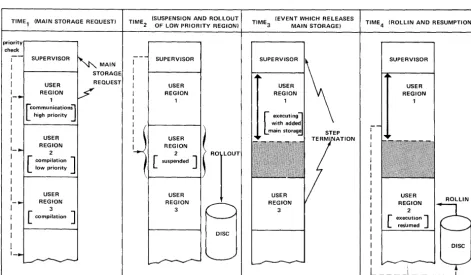
6-2. Use of Rollout/Rollin to Satisfy High·Priority Main Storage Requests 6-3. System Console Message Management
6-4. Spooling Operations
6-5. Concurrent Job Control Streams
6-6. Information Flow - OS/7 Cataloged Job Control Procedures 6-7. OS/7 Data Management
6-8. General Message Flow - Data Communications 6-9. Program Preparation
6-10. OS/7 I nformation Management System (I MS/90)
TABLES
3-1.
Symbols Used to Describe Operand Formats5-1.
UNIVAC OCT 2000 Field-Installable Options24
I. INTRODUCTION
The UNIVAC
90/70
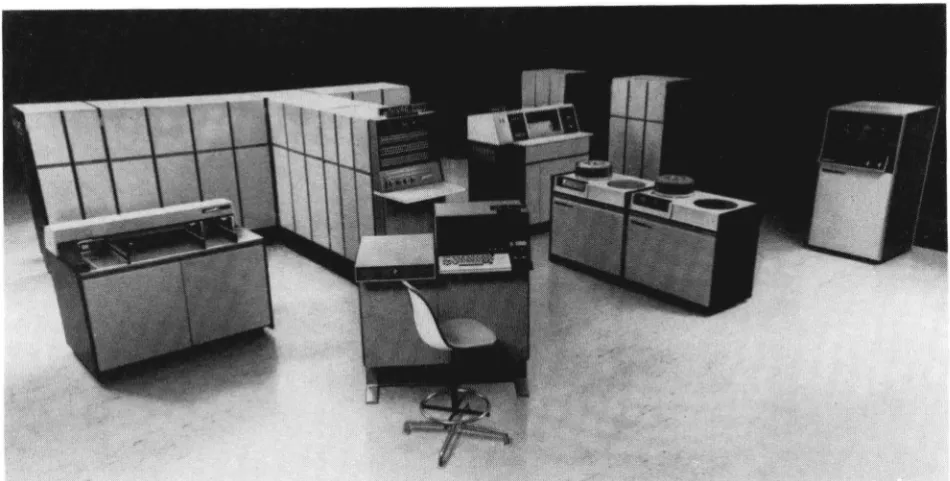
System, shown in Figure1-1,
is the latest and most powerful member of the UN IVAC Series90
computer family. It is a general purpose, disc-oriented computer designed to function in many different data processing environments with equal operating efficiency.
The UNIVAC
90/70
System includes dynamic program relocatability, the Operating System Storage Facility (OSSFI. and the Communications Intelligence Channel (CIC). Two operating systems are available,05/4,
an enhanced version of the UNIVAC9400
~OS, and05/7,
specifically designed to fully utilize the modern hardware of the UNIVAC90/70
System. Up to14
user programs may be concurrently executed while each is guaranteed its integrity by hardware storage protectio-n. Another significant feature is the ease of transition from an IBM*
360/00S
to a UNIVAC90/70
System.The modular design of the UN IVAC
90/70
System, coupled with its high-speed main storage and I/O architecture provides a dependable base for future extensions. Changes in business demands, applications, programming techniques, system configuration, or new terminal devices can be readi Iy incorporated into existing UN IV AC90/60
Systems. This architecture extends the usefulness of the initial planning, programming, and operational procedures of a system.
Figure 1-1. UNIVAC 90/70 System
Flexible software generation procedures allow the user to construct an operating system tailored to his particular needs. System performance is dependent upon the available hardware and the operating system options selected.
2. SYSTEM DESCRIPTION
2.1. HIGHLIGHTS
The UNIVAC 90/70 System consists fo central hardware components and a wide range of peripheral subsystems; including extensive data communications capabilities. Also, software support is provided by two operating systems:
• OS/4
A versatile mUlti-jobbing operating system patterned after the UN IVAC 9400 disc operating system. This system is designed for smaller configurations and for those users not requiring the extended capabilities provided by OS/7.
• OS/7
A more sophisticated multi-tasking system with extended capabilities to meet the needs of larger configurations and more complex processing environments.
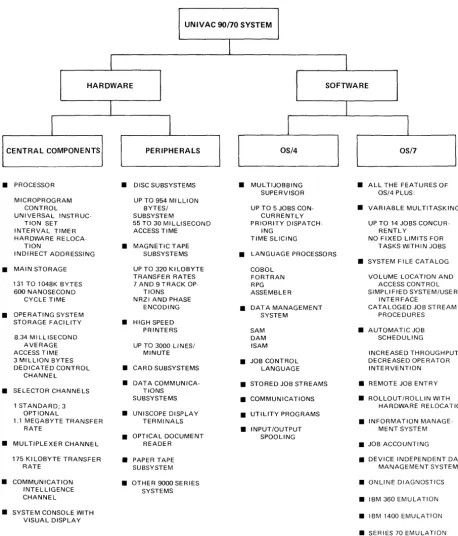
The highlights of the UNIVAC 90/70 System are shown in Figure
2-1.
A detailed description of the hardware and software components in the UNIVAC 90/70 System is given in the following sections of this document.UNIVAC 90/70 SYSTEM
I
I
I
HARDWARE SOFTWARE
I
I
I
I
I
I
CENTRAL COMPONENTS PERIPHERALS OS/4 OS/7
•
PROCESSOR•
DISC SUBSYSTEMS•
MULTIJOBBING•
ALL THE FEATURES OF SUPERVISOR OS/4 PLUS: MICROPROGRAM UP TO 954 MI LLiONCONTROL BYTES/ UP TO 5 JOBS CON-
•
VARIABLE MULTITASKINGUNIVERSAL INSTRUC- SUBSYSTEM CURRENTLY
TION SET 55 TO 30 MILLISECOND PRIORITY DISPATCH- UP TO 14 JOBS
CONCUR-INTERVAL TIMER ACCESS TIME ING RENTLY
HARDWARE RELOCA- TIME SLICING NO FIXED LIMITS FOR
TION
•
MAGNETIC TAPE TASKS WITHIN JOBSINDIRECT ADDRESSING SUBSYSTEMS
•
LANGUAGE PROCESSORS•
SYSTEM FILE CATALOG•
MAIN STORAGE UP TO 320 KILOBYTE COBOLTRANSFER RATES FORTRAN VOLUME LOCATION AND 131 TO 1048K BYTES 7 AND 9 TRACK OP- RPG ACCESS CONTROL
600 NANOSECOND TIONS ASSEMBLER SIMPLIFIED SYSTEM/USER
CYCLE TIME NRZI AND PHASE INTERFACE
ENCODING
•
DATA MANAGEMENT CATALOGED JOB STREAM•
OPERATING SYSTEM SYSTEM PROCEDURESSTORAGE FACILITY
•
HIGH SPEEDPRINTERS SAM
•
AUTOMATIC JOB8.34 MI LLiSECOND DAM SCHEDULING
AVERAGE UP TO 3000 LI N ES/ ISAM
ACCESS TIME MINUTE INCREASED THROUGHPUT
3 MILLION BYTES
•
JOB CONTROL DECREASED OPERATORDEDICATED CONTROL
•
CARD SUBSYSTEMS LANGUAGE INTERVENTION CHANNEL•
DATA COMMUNICA-•
STORED JOB STREAMS•
REMOTE JOB ENTRY•
SELECTOR CHANNELS TIONSSUBSYSTEMS
•
COMMUNICATIONS•
ROLLOUT/ROLLIN WITH1 STANDARD; 3 HARDWARE RELOCATION
OPTIONAL
•
UNISCOPE DISPLAY•
UTILITY PROGRAMS1.1 MEGABYTE TRANSFER TERMINALS
•
INFORMATIONMANAGE-RATE
•
INPUT/OUTPUT MENT SYSTEM•
OPTICAL DOCUMENT SPOOLING•
MULTIPLEXER CHANNEL READER • JOB ACCOUNTING175 KI LOBYTE TRANSFER
•
PAPER TAPE • DEVICE INDEPENDENT DATARATE SUBSYSTEM MANAGEMENT SYSTEM
•
COMMUNICATION•
OTHER 9000 SERIES • ONLINE DIAGNOSTICSINTELLIGENCE SYSTEMS
CHANNEL
•
IBM 360 EMULATION•
SYSTEM CONSOLE WITH•
IBM 1400 EMULATION VISUAL DISPLAY•
SERIES 70 EMULATIONFigure 2-1. Highlights of UNIVAC 90/70 System Hardware and Software
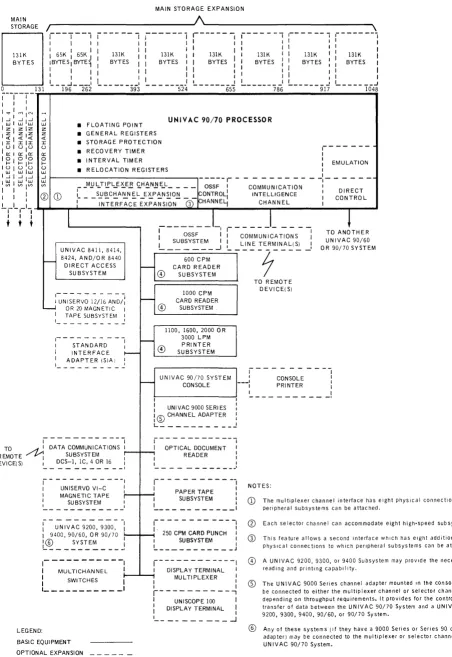
2.2.
SYSTEM HARDWARE COMPONENTS
MAIN STORAGE EXPANSION
MAIN "
STORAGE
,r---
J~---~----~
:---:--: '---: :---1 :---: :---: :---: :---:
\131K
BYTES
--
1 I "'" I MIN ...JIujluj
wi
~I z l z
~I~ ~I I I I 01 0 10
~ 1 ~ I~
t;1t;1t; w I UJ Iw
ujlujluj
v> : v> IV>
I I : L_L _I_
I I 1 1 1 1
t
tt
131 ~ ...J w z z « I 0 0:: 0 I-0 w ...J w v>
CD
16K I 5K I 131K I I I I I I I II I : I
I 5 I 6 J I I 131K I I 131K I I 131K I 131K: I 131K I
IBYTESI BYTE 1 BYTES I I BYTES I I BYTES I I BYTES I I BYTES I BYTES I
I I I I I I I I I I : I I I
:
___ J ___ .: '- _______ :
I :~
______J
~
_______ ::
::
J
196 262 393 ---524 655 786
---917
---1048CD
I
• FLOATING POINT • GEN ERAL REGISTERS • STORAGE PROTECTION • RECOVERY TIMER • INTERVAL TIMER • RELOCATION REGISTERS
Ut-llVAC 90/70 PROCESSOR
1---11
1 EMULATION
I I
1
-1 _ _ Mll~TI£~E~EB ~H~N~~L_ _ _ _ OSSF I
- - 1 - - - -
-I SUBCHANNEL EXPANSION CONTROL: :- - - INTERFACE EXPANSic)N-(3)-IcHANNE~
COMMUNICATION INTELLIGENCE
CHANNEL
_______ '-I ---
_L
I 1 I
I OSSF I I COMMUNICATIONS I
1
1 DIRECT I CONTRO L I
~
UNIVAC 8411,8414,
I - - 8424, AND/OR 8440
DIRECT ACCESS SU BSYSTEM
-1:-:~~~~~i~~
L
_L~N! ~f~N!~'~
J
TO ANOTHER UNIVAC 90/60
OR 90/70 SYSTEM
1- - -
-I ~ UNISERVO 12/16 AND/: ' - - ' OR 20 MAGNETIC I I TAPE SUBSYSTEM 1
1- _ _ _ _ _ _ _ _ ~
1- - - -I STANDARD : I INTERFACE I -: ADAPTER (SIA) :
-®
1000 CPM CARD READER
SUBSYSTEM
1100, 1600,2000 OR
3000 LPM
®
SUBSYSTEM PRI NTERUNIVAC 90/70 SYSTEM
~ CONSOLE
1 I
: UNIVAC 9000 SERI ES :
: ®
CHANN EL ADAPTER :L _ _ _ _ _ _ _ _ _ _ ..1
, - - - , , - - - " " ' j
TO REMOTE DEVICE(S)
1 - - - 1 ___ : CONSOLE :
I PRINTER I ~
- - - -!
TO A ~ DATA COMMUNICATIONS I I OPTICAL DOCUMENT I REMOTE / '
V;
SUBSYSTEM 1 " ' 1 - . . . - - 11 READER : DEVICE(S) ~ _ ~C~I:...I:, ~ ~R
26 __ :
1 _ _ _ _ _ _ _ _ _ _ _ _ :1- - - I 1- - - --I I UNISERVO VI-C
I MAGNETIC TAPE : SUBSYSTEM
1--4--11 PAPER TAPE :
I I SUBSYSTEM 1
I 1
__ - - - _I 1 - - - 1
~4-~1. 250 CPM CARD PUNCH : I SUBSYSTEM I !... ___________
J
1- - - -I 1- - - --I I MULTICHANNEL I I DISPLAY TERMINAL I : SWITCHES " ' 1 - . . . ~ MULTIPLEXER :1- - - _I
r- ---
~
LEGEND: BASIC EQUIPMENT OPTIONAL EXPANSION
I UNISCOPE 100 I
: DISPLAY TERMINAL 1
1 - - _ _ _ _ _ _ _ _ ..J
NOTES:
CD
The multiplexer channel interface has eight physical connections to which peripheral subsystems can be attached.CD
Each selector channel can accommodate eight high·speed subsystems.G) This feature allows a second interface which has eight additional phYSical connections to which peripheral subsystems can be attached.
®
A UN IVAC 9200,9300, or 9400 Subsystem may prOVide the necessaryreading and printing capabi lity.
®
The UNIVAC 9000 Series channel adapter mounted In the console may be connected to either the multiplexer channel or selector channel depending on throughput requirements. It provides for the control and transfer of data between the UNIVAC 90/70 System and a UNIVAC9200,9300,9400,90/60, or 90/70 System.
®
Any of these systems (if they have a 9000 Series or Series 90 channel adapter) may be connected to the multiplexer or selector channel of a UNIVAC 90/70 System.Figure 2-2. UNIVAC 90/70 System Hardware
SYSTEM ORIENTATION
PROCESSOR
MAIN STORAGE CAPACITY
MAIN STORAGE PERFORMANCE
FLOATING-POINT ARITHMETIC
DIRECT CONTROL FEATURE
MULTIPLEXER CHANNEL
SELECTOR CHANNEL
REGISTERS
DISC STORAGE:
UNIVAC 8440 DISC SUBSYSTEM
UNIVAC 8424 DISC SUBSYSTEM
UNIVAC 8414 DISC SUBSYSTEM
UNIVAC 8411 DISC SUBSYSTEM
OPERATING SYSTEM STORAGE FACI LlTY
MAGNETIC TAPE:
UNISE RVO 20 SUBSYSTEM UNISERVO 16 SUBSYSTEM UNISERVO 12SUBSYSTEM UNISERVO VI-C SUBSYSTEM
DER
CARD PUNCH
PAPER TAPE
OPTICAL DOCUMENT READER
COMMUNICATIONS
Disc
Microprogram control Versatile instruction set Hardware relocation Indirect addressing
131K, 196K, 262K, 393K, 524K, 655K, 786K, 917K, or 1048K bytes
A cycle time of 600 nanoseconds for a 4-byte access
Specialized interprocessor access feature for multiple UNIVAC 90/60 or 90170 systems
Up to 8 subsystems - standard
Up to 8 additional subsystems - optional feature Up to 15 subchannel addresses - standard
Up to 16 additional subchannel address - optional feature 175K bytes/second throughput rate
1 - standard
3 additional - optional feature Up to 8 subsystems per channel
1.1 M bytes/second throughput rate per channel
16 for user program functions 16 for supervisor functions 8 for system working 1 for relocation
4 for floating-point arithmetic
119.28 million bytes/pack, maximum 954.24 million bytes/subsystem, maximum 624K bytes/second transfer rate 30 milliseconds average access time
58.352 million bytes/pack, maximum 466.816 million bytes/subsystem, maximum 312 bytes/second transfer rate
30 milliseconds average access time
29.17 million bytes/pack, maximum 233.36 million bytes/subsystem, maximum 312K bytes/second transfer rate 60 mill iseconds average access time
7.25 million bytes/pack, maximum 58 million bytes/subsystem, maximum 156K bytes/second transfer rate 75 mill iseconds average access time
3.0 million bytes capacity 312K bytes/second transfer rate 8.34 milliseconds average access time Uses OSSF control channel
7· and 9-track, phase and NRZI
320K bytes/second transfer rate 192K bytes/second transfer rate 68K bytes/second transfer rate 34K bytes/second transfer rate
250 cards/minute
300 characters/second - read 110 characters/second - punch
300 or 600 documents/minute
acters
2.2.1. Processor
The UN IV AC 90/70 Processor performs control, arithmentic, and input/output operations. The control operations include determination of the sequence in which instructions are executed and interpretation and control of the execution of each instruction. Arithmetic hardware performs all data manipulation including logical operations, aritmmetic operations, data comparisons, and shifting. The input/output hardware initiates, directs, and monitors the transfer of data between main storage and the I/O subsystems.
The processor operates under microprogram control and contains an interval timer, recovery timer, storage protection, register stack, floating-point arithmetic and I/O channels. It also has provisions for optional features such as: direct control for processor-to-processor communication, CIC for communications oriented processing, and OSSF dedicated to the operating system.
The processor register stack contains 16 registers for supervisor functions, 16 registers for user program functions, and 4 registers for floating-point arithmetic operations.
The UN IV AC 90/70 Processor uses industry-standard instructions. The instruction repertoire is an expansion of the repertoire of the UNIVAC 9400 System. The UNIVAC 90/70 System instruction repertoire also includes all of the nonprivileged instructions of the IBM System/360 Model 50.
2.2.2 I/O Channels
The UN IVAC 90/70 System is built with powerful high-speed I/O capabilities. From one to four selector channels are used for high-speed subsystems such as tape and disc. The multiplexer channel can service up to 16 low-speed subsystems such as printers and card readers. The CIC has programmable message control logic to minimize software overhead for communications and to provide the specialized control necessary for a variety of message disciplines.
2.2.2.1. Standard I nterface Adapter (SIA)
The Standard Interface Adapter allows the connection of a Series 70 Communications Controller Multichannel (CCM) to a UNIVAC 90/70 Multiplexor Channel. Features are available that allow up to six CCMs to be attached to an SIA.
2.2.3. Communications
The UN IVAC 90/70 System offers added flexibility in communications-oriented applications. A wide variety of remote devices is available for use with this system. Connection to the processor is accomplished through the CIC or the multiplexer channel.
The UNIVAC 90/70 System may be used with DATA-PHONE* service, TWX networks, TELEX**, and Wideband or any combination of these services up to the maximum throughput of the system.
Communications capability is provided by means of the CIC or by a Data Communications Subsystem (DCS) connected to the multiplexer channel. A description of each follows:
2.2.3.1. Communication Intelligence Channel (CIC)
The CIC provides a flexible, communications-ociented I/O channel that handles a wide variety of message disciplines.
* Trademark and service mark of A T& T Co. ** Trademark of Western Union Tejegrqph Co.
2.2.3.2. Data Communications Subsystem (DCS)
Smaller communications requirements are satisfied by the DCS. Each DCS uses one of the physical connections of the multiplexer channel. A DCS-1 or DCS-1C provides capability for communicating with one duplex line; a DCS-4 or DCS-16 provides capability for communicating with up to 4, or 14 duplex lines respectively.
2.3. SOFTWARE FEATURES
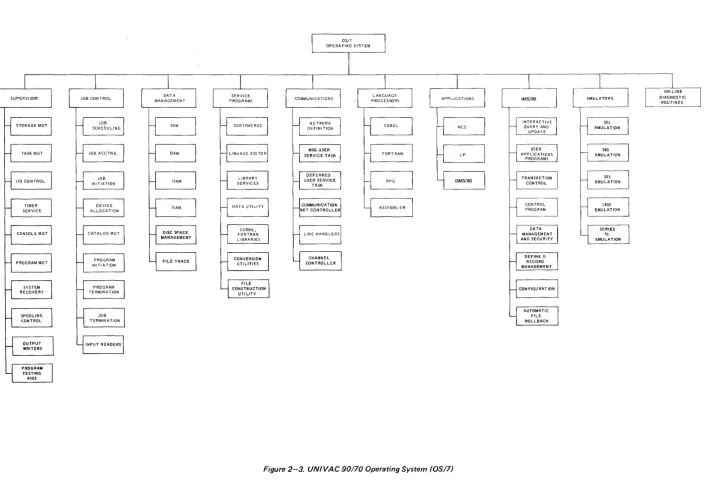
The operating system for the UN IVAC 90/70 System consists of a comprehensive set of control programs, utility service, and programming aids. (See Figure
2-3.)
It is modular in design to fulfill a wide range of data processing requirements. The user can select the precise level of software capability to match his configuration. Control programs provide for communications processing and random and sequential batch processing. Data to be processed can be introduced to the system from either central or remote locations.2.3.1. Supervisor
The supervisor is the part of the operating system that operates with user programs to provide the control necessary for optimum utilization of the UNIVAC 90/70 System hardware and software.
The supervisor consists of those routines which control physical input/output operations, system resource allocation on a dynamic basis, task switching to achieve multijobbing, hardware interrupt servicing, communications with the systems operator, and in general, the interface of user programs with the hardware.
2.3.1.1. Multijobbing/Multitasking
The UN IV AC 90/70 System can concurrently process from 1 to 14 jobs. Each job consists of one or more job steps (programs) which are executed serially. Additionally, a job step may have one or more tasks which are executed concurrently. This structure allows the user complete flexibility in determining the use of the system and in scheduling the tasks to be done.
The allocation of processor time is based on a system switch list which contains information about switching priorities, time-slice values, and processor utilization.
The number of priorities and the initial time-slice values for each priority level are provided by the user at system generation. Priority for a given job may be changed by the system or the operator within predetermined limits.
2.3.1.2. Rollout/Rollin
2.3.2. Data Management
Data management is that part of the software that provides a convenient and easy-to-use interface between user programs and the hardware-oriented I/O portions of the supervisor. The data management facilities provide benefits such as file organization, record blocking and deblocking, buffering, data validation, label processing, and device independence.
Data management offers four methods of accessing files. These methods are:
• Sequential Access Method (SAM)
• Direct Access Method (DAM)
• Indexed-Sequential Access Method (lSAM)
• System Integrated Access Method (SIAM)
The first three access methods are I BM/360 DOS compatible. The fourth access method is designed for system usage.
2.3.3. Job Control
Job control is the nonresident component of the UN IVAC OS/7 Operating System (OS/7) that manages the system resources (main storage, software facilities, and peripheral devices), prepares jobs for processing, and initiates program execution. A job is a user-submitted task or unit of work to be performed. Each job can be divided into job steps to be executed serially. Job steps are made up of problem programs, with each job step containing only one request for program execution.
The services performed by OS/7 job control are directed by the user through control statements known as the job control language. These control statements convey information required by the operating system to initiate and control the processing of jobs, such as identifying the job and the programs that comprise it and specifying main storage requirements and peripheral device assignments necessary for job execution.
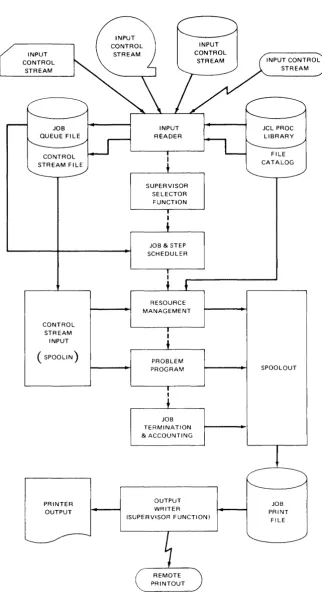
Figure 2-4 shows job flow and the facilities provided by job control.
2.3.3.1. System File Catalog
Use of the system file catalog results in the ability to locate files automatically when only the file identifier is specified. Successive generations of data files may be cataloged and subsequently located by a relative generation number.
Also, control statement sequences can be prepared once and stored in a cataloged library; then the sequences can be called upon as frequently as desired. These control statement sequences are sometimes referred to as cataloged procedures.
2.3.3.2. Automatic Scheduling
NOTES:
INPUT CONTROL
STREAM
CONTROL STREAM
INPUT
( SPOOLlN)
PRINTER OUTPUT
INPUT READER
I
l
SUPERVISOR SELECTOR FUNCTION
I
I
JOB & STEP SCHEDULER
RESOURCE MANAGEMENT
PROBLEM PROGRAM
JOB TERMINATION & ACCOUNTING
OUTPUT
INPUT CONTROL
WRITER (SUPERVISOR FUNCTION)
1. Solid arrows indicate data; broken arrows indicate control.
STREAM
SPOOLOUT
JOB PRINT
FILE
2. Neither SPOOLOUT files on magnetic tape nor card punch files are shown since neither are produced by job control.
Figure 2-4. Job Flow
2.3.4. Other Features
The UNIVAC 90/70 System software also has the following salient features:
• Automatic buffering (spooling) to disc or magnetic tape for such peripherals as the card reader or printer.
• Effective methods for recovery from device errors and system failures.
• Extensive job accounting information suitable to both local and remote batch environments.
• Use of reentrant routines to increase the utilization of main storage and decrease I/O traffic caused by program retrievals.
• Job scheduling and general operations support for a fixed-partitioned system can be optionally selected by the user.
• Emulation for the following Data Processing Systems in a multijobbing environment: IBM 360, 1401, 1440, 1460, and Series 70 real memory systems plus 301 and 501.
3.
CENTRAL HARO\NARE
3.1.
GENERAL
The central hardware for the UN IVAC 90/70 System consists of the following components:
• Processor
• System Console
• Main Storage
Each of these components is discussed in the following paragraphs.
3.2.
PROCESSOR
The UN IVAC 90/70 Processor is a medium-scale, high-performance processor with random or sequential batch processing, scientific processing, and communications processing capabilities. The processor operates under microprogram control. The micro code is resident in a separate semiconductor control storage which has a writable section.
The UN IVAC 90/70 Processor has the following characteristics:
•
I ndustry-compatible instruction repertoire•
Hardware program relocation algorithm•
Indirect addressing•
Write or read/write storage protection•
Multiple control modes•
One multiplexer I/O channel•
One selector I/O channel•
A 15-level interrupt structure•
Program status word interrupt control•
Recovery timer facility• Interval timer facility
• Parity generation and checking on the channel and storage buses
• System console
• Floating-point arithmetic control
The processor also has provisions for the following optional features:
• Up to three additional selector I/O channels
• Subchannel expansion and expanded interface features to enhance the multiplexer I/O channel capability
• Communication Intelligence Channel (CIC)
• Operating System Storage Facility (OSSF)
• Direct control and external interrupt
Arithmetic and input/output control comprise the major functions of the processor. The hardware associated with these functions is described in the following paragraphs.
3.2.1. Arithmetic Hardware
The arithmetic hardware performs all logical operations, arithmetic operations, data comparisons, and shifting. Fixed-point binary arithmetic uses the twos complement number representation. Floating-point and decimal arithmetic use signed absolute value number representation. This hardware also performs single or double indexing of operand addresses together with address relocation and indirect addressing.
3.2.1.1. Register Stack
The register stack contains general purpose registers in two sets of 16 each, four optional registers for floating-point arithmetic operations, eight working registers, and one relocation register.
• General Purpose Registers
The processor can reference two sets of 16 general purpose registers. One set is reserved for the supervisor while the other set can be used by user programs. This design reduces the interrupt processing time overhead required when only a single set of general registers is used. When the processing mode is changed between user program and supervisor modes, the following steps which would be required in single register systems are unnecessary:
1. Store the contents of user program registers.
2. Load the executive routine data into the registers.
3. Store the executive routine data.
4. Reload the user program data back into the registers.
• Floating-Point Registers
Four doubleword floating-point registers are provided to avoid unnecessary storing and loading operations for results and operand. These registers are numbered 0, 2, 4, and 6. For long format instructions, both words of the register are involved in the operation. For short format instructions, only the first word in the register is involved in the operation; the content of the second word in the register is ignored and not changed. If an odd-numbered register is specified, a program exception interrupt request in generated.
• Working Registers
These registers are used for temporaty storage of operands and intermediate results when executing decimal arithemetic operations. Their primary function is to increase execution speed. These registers are not addressable by the user.
• Relocation Register
This register is used by both the processor and the input/output channels to provide automatic program relocation.
3.2.1.2.
Fixed-Point Arithmetic
Fixed-point numbers have a fixed-length format comprising a sign bit followed by an integer field. When the sign bit is 1, the integer represents a negative value; when the sign bit is 0, the integer represents a positive value.
SIGN
Halfword Format INTEGER
Fullword Format INTEGER
Doubleword Format
I
~L
SIGN _ _ INTEGE_R _ _ _ _ _ _10
When held in one of the 16 general registers, a fixed-point number is generally treated as a 32-bit operand. When a halfword fixed-point number is called from storage and loaded into a register, the sign is extended to the left to fill the fullword register. The contents of the register are then handled as a fullword operand in fixed-point arithmetic operations.
Certain operations use a 64-bit operand comprised of one sign bit followed by a 63-bit integer field. The 64-bit operand is located in two adjacent general registers, and it is addressed by an even address referring to the lower-numbered register of the pair.
When fixed-point data is located in storage, it may be stored as a halfword, fullword, or doubleword. This data must be located on the integral storage boundary of its associated format.
3.2.1.3. Floating-Point Arithmetic
The
UN
IVAC 90/70 System can provide floating-point arithmetic operations as an optional feature. A floating-point number comprises a biased exponent (characteristic) and a signed fraction (mantissa). The biased exponent is expressed in excess 64 binary notation; the fraction is expressed as a hexadecimal number having a radix point to the left of the high-order digit. The quantity expressed by the full floating-point number is the product of the fraction and the number 16 raised to the power of the biased exponent minus 64.Floating-point numbers are either a fullword (short format), or a doubleword (long format) in length. Both formats can be used in main storage or in the floating-point registers. In either format, bit 0 is the sign bit of the fraction, and bits 1 through 7 are exponent. The fraction field comprises bits 8 through 31 in the short format and bits 8 through 63 in the long format.
r-
SIGNShort Format
EXPONENT FRACTION
0 1 7 8 31
Long Format
SIGN
L...ot---ltpO~NENT718
_ _
FRAC_TION~~
C
The floating-point instruction set provides for loading, adding, subtracting, comparing, mUltiplying, dividing, storing, and sign control of short or long format operands. Short format operands provide faster processing and require less storage space than long format operands. Long format operands provide greater precision in computation.A normalized floating-point number has a nonzero high-order hexadecimal fraction digit and is the most significant representation of a given quantity. The process of normalization consists of shifting the fraction to the left until the high-order hexadecimal digit is nonzero, and reducing the characteristic by the number of shifts. A fraction with one or more high-order digits of zero is unnormalized. A zero fraction cannot be normalized.
3.2.1.4. Decimal Arithmetic
In the unpacked decimal format, each byte contains one digit of a multi digit number. The byte is divided into two equal fields, a zone field and a digit field. A zone value is represented in the most significant four bits, and the digit is represented in the lease significant four bits. The zone portion of the lease significant byte specifies the sign of the number. The unpacked format must be used when data is to be processed by certain I/O devices such as the printer. The format of a 3-digit operand follows:
0
BYTE
~
ZONE
DIGIT
ZONE
7 8
DIGIT
SIGN
15 16
DIGIT
23
UNPACKED
DECIMAL
OPERAND
In the packed format, each byte contains two digits. The least significant four bits of the least significant byte provide the sign of the number. The packed decimal format is used for all decimal arithmetic operations. The format of a 4-digit number follows:
0
BYTE
~
ZERO
FILL
DIGIT
DIGIT
7 8
DIGIT
DIGIT
15 16
SIGN
23
PACKED
DECIMAL
OPERAND
Decimal numbers (0 through 9) are represented in the 4-bit binary coded decimal form (0000 through 1001). The codes 1010 through 1111 are used for sign codes. The binary values 1011 and 1101 represent a minus sign and the binary values 1010, 1100, 1110, and 1111 represent a plus sign. This assignment of sign codes permits the use of either of two conventions: American National Standard Code for Information Interchange (ASCII) modified to eight bits, or Extended Binary Coded Decimal Interchange Code (EBCDIC). The codes 1100 (plus) and 1101 (minus) are hardware-generated in either the ASCII or EBCDIC mode. A control bit in the program status word determines whether the system is to operate in the ASCII or the EBCDIC mode. See Appendix C.
3.2.1.5. Logical Operations
Logical operations such as comparing, translating, editing, bit setting, and bit testing are performed by the arithmetic section. Logical operations can be performed in the general purpose registers or main storage. The instruction used determines whether the logical operation is to be performed in main storage or in a register.
3.2.2. I nputlOutput
The input/output (I/O) hardware of the UN IVAC 90/70 Processor initiates, directs, and monitors the transfer of data between storage and the peripheral subsystems. After the I/O instruction has been initiated, the data transfer is performed concurrently with other processor functions. The selector channels, the multiplexer channel, the OSSF, the CIC, and the processor can all operate concurrently.
The I/O hardware consists of I/O control logic and the input/output channels using a standard UNIVAC Series 90 I/O interface to connect channels with the unit controllers. This interface is identical for all the I/O control units (except for the CIC) designed for use with all I/O devices currently available on UN IVAC Series 90 Systems as well as for future devices.
3.2.2.1. Selector Channels
One selector channel is included in the basic system configuration; three selector channels are available as optional features to the basic configuration. High-speed devices, such as UN ISE RVO 12, 16, or 20 Magnetic Tape Subsystems, and UN IV AC 8411, 8414, 8424
andlor
8440 Disc Subsystems, are connected only to the selector channels.Eight standard control units may be attached to each selector channel. Up to 16 liD devices can be attached to each of the eight control units depending on the particular subsystem selected. The devices attached to a selector channel are serviced on a one-at-a-time basis. That is, once transfer of data is initiated between a particular device and main storage, that tranafer must be completed before another device on the channel can transfer data.
3.2.2.2. Multiplexer Channel
The processor has one multiplexer channel which has eight physical connections to which standard control units (for such devices as a card reader, card punch, or line printer, and a Data Communications Subsystem (DCS) can be attached. The address format for the multiplexer channel provides for 15 subchannel addresses. These can be a combination of standard and, if a DCS is conncted to the multiplexer channel, DCS subchannel addresses.
Subchannel expansion and expanded interface are two features that can be added to the basic multiplexer channel. The subchannel expansion feature provides an additional 16 subchannel addresses for a total of 31. The expanded interface feature provides eight additional physical connections if the subchannel expansion feature has been installed. Without the subchannel expansion feature, the limit of 15 subchannel addresses prevents expansion to more than 15 physical connections.
The standard control unit occupies one physical connection and uses one standard subchannel address. Devices such as the system console, card reader, line printer, or UN ISERVO V I-C Magnetic Tape Subsystem are connected to the processor through the standard control unit. Each DCS occupies one physical connection but uses up to 28 DCS subchannel addresses. The DCS may be used for data communications over 1 to 14 communication lines.
3.2.3. Processor Modes
There are seven bits in the active program status word which determine processor modes of operation. These modes of operation are described in the following paragraphs.
• Selection of Problem or Supervisor Mode
When operating in the problem mode, a program cannot execute privileged instructions. Also, the program performs only the main storage operations permitted by the storage protection key. When operating in the supervisor mode, there are no restrictions on the instruction usage, and storage protection still appl ies.
• Selection of Register Set
The processor contains two sets of general purpose registers. The user program general registers can be used during the execution of instructions in the problem register mode. Similarly, the supervisor general registers can be used by the supervisor.
• Selection of ASCII or EBCDIC Code Interpretation
• Processor Wait Mode
The processor wait mode is provided to allow the program to suspend instruction processing. This mode is particularly useful when exceptionally high I/O activity precludes a meaningful rate of job execution, when all jobs are waiting for I/O operations to be completed, and when no jobs are in the system.
• Program Trace Mode
When operating in this mode, the execution of a successful branch instruction causes the address of the instruction following the branch instruction and the instruction length code of the branch instruction to be written into a table in main storage.
• Monitor Mode
A program analysis level interrupt is generated prior to the execution of all instructions fetched while in this mode.
• 9400 Compatibility Mode
This mode is provided to inform the software of UNIVAC 9400 System compatibility requirements.
• Special Emulation Mode
This mode permits the UN IVAC 90/70 Processor to access microprograms stored in the writable section of control storage.
3.2.4. Interval Timer
An interval timer is included as an integral component of the UN I VAC 90/70 Processor. It provides the software with a relative running-time count and an incremental interrupt count. The running time counter and the interrupt counter are updated once every millisecond.
The running time counter allows for a continuous measure of elapsed time. The count may be incremented or decremented. The counter value changes from maximum to zero after incrementing, and from zero to maximum after decrementing without causing program intervention.
The interrupt counter allows the interval between interrupts to range from one millisecond to 64 seconds.
3.2.5. Interrupt Processing Control
The UNIVAC 90/70 System contains an efficient multi!evel interrupt system. The processor can react to external and internal error conditions or monitoring conditions by means of this interrupt system. The hardware and associated software allow the processor to change from the user program state to the privileged or supervisor state. The types of interrupts employed in the UN IVAC 90/70 System are:
• Machine Checks
This interrupt request occurs when a hardware malfunction is detected by the processor or when a hardware malfunction not identified as a subsystem fault is detected by the I/O section, or when a program exception is generated while being masked.
• Program Exception
This interrupt request occurs when a program error is detected by the hardware. The interrupt is generated as a result of one of the followi~g:
Operation Exception
An illegal processor operation has been attempted or an operation using a nonexistent processor feature has been attempted.
Privileged Operation Exception
A privileged operation has been encountered in a problem mode.
Execute Exception
The object of an execute instruction is another execute instruction.
Protection Exception
The key in key storage does not match the key in the program status word.
Addressing Exception
Reference is made to a nonexistent storage location.
Specification Exception
An integral boundary reference error has been made; general register pairs or floating-point registers have been specified incorrectly; the length of decimal fields is incorrect. The control indicators set by an LBR or BCR E instruction are invalid.
Data Exception
The operands in decimal and editing operations contain incorrect digit and sign codes; decimal arithmetic fields are aligned incorrectly.
Fixed-Point Overflow Exception
The result of a fixed-point arithmetic operation has caused a high-order carry, or a shift operation has caused the loss of significant bits.
Fixed-Point Divide Exception
The quotient exceeds the size of the associated register, or the result of a decimal-to-binary conversion operation exceeds 31 bits.
Decimal Overflow Exception
The capacity of the result field is exceeded during a decimal arithmetic operation.
Decimal Divide Exception
Exponent Overflow Exception
The characteristic result exceeds 127 during a floating-point arithmetic operation.
Exponent Underflow Exception
The characteristic result is less than zero during a floating-point operation.
Significance Exception
A floating-point addition or subtraction results in a zero fraction.
Floating-Point Divide Exception
Floating-point division is attempted with a zero divisor fraction.
Indirect Address Exception
An indirect address control word (lACW) with an incorrect format has been referenced.
I ndirect Address Specification Exception
A main storage reference has exceeded the 8-level indirect addressing capability.
• Program Analysis
this interrupt request occurs during program monitoring and certain program tracing operations.
• Supervisor Call
This interrupt request occurs as a result of the execution of a supervisor call (SVC) instruction and may have up to 256 different states which are established by the software.
• External
This interrupt is associated with maintenance trace, interrupt key, and the direct control and external interrupt feature. The direct control and external interrupt feature provides for the direct connection between two UN IVAC 90170 Processors. The external interrupt request associated with this feature occurs when certain of the signal-in lines associated with the direct control interface of an object processor are enabled. The states within this level are:
Maintenance Trace
I nterru pt Key
External Signal 2 State *
External Signal 3 State *
External Signal 4 State *
External Signal 5 State
*
External Signal 6 State *
External Signal 7 State *
*This state is a part of the direct control and external interrupt feature.
• Timer
This interrupt request occurs when a present time interval expires.
• Communications Intelligence Channel
This interrupt request occurs when a communications status word is tabled in main storage.
• Other Input/Output Channels
An interrupt request occurs when status is generated or received from a subsystem during channel or subchannel operations. Each channel has its own interrupt to reduce software overhead associated with interrupt analysis.
Selector Channel 1
Selector Channel 2
Selector Channel 3
Selector Channel 4
Operating System Storage Facility
Multiplexer Channel Standard
Multiplexer Channel DCS
3.2.6.
Instruction Repertoire
The power and flexibility of the UN IVAC 90/70 System are reflected in the instruction repertoire and their execution times. The full repertoire includes all nonprivileged instructions of the IBM System/360 universal instruction set. The instruction repertoire has also been enhanced to facilitate dynamic program relocation and indirect addressing.
3.2.6.1.
I nstruction Types
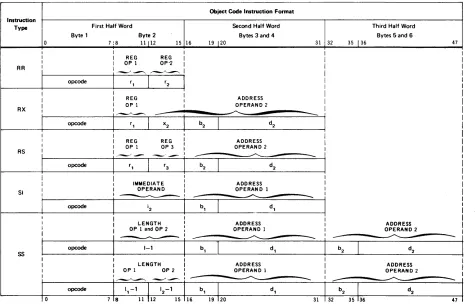
Object Code Instruction Format Instruction
Type First Half Word Second Half Word Third Half Word
Byte 1 Byte 2 Bytes 3 and 4 Bytes 5 and 6
0 7: 8 11112 15 16 19 120 31 32 35 136 47
I I I
I I REG REG I
I I OP 1 OP-2 I RR
: I
-,---
~~Iopcode
I
r1
I
r2I I I
I I REG I ADDRESS
I I OP 1 I OPERAND 2
RX I :~
-
~- - - - I
opcode
I
r1I
x2 b2I
d2I I , 1
I I REG REG I ADDRESS 1
I I OP 1 OP 3 I OPERAND 2
R5 : I /___...1' ~
---
I I ~ I Iopcode
I
r1
I
r3 b2T
d21 I I I
I
I I IMMEDIATE I ADDRESS I
51 I I I I
---,
OPERAND I-
---
OPERAND 1-
-
I Iopcode
I
i2 b1
T
d1I
1
:
I I LENGTH ADDRESS I ADDRESS
I
I OP 1 and OP 2 OPERAND 1 I OPERAND 2
I
---
I II
---
---
---~
-I
I
opcode 1-1 b1"'
d
1
I
b2,
d2SS
I I I I
I I LENGTH ADDRESS I ADDRESS I
I I OP 1 OP 2 OPERAND 1 I OPERAND 2
I :~ -'---
-
----...-...
-
-
I I----
---
-
Iopcode
I
11-1
I
12-1 b1I
d1 b2I
d210 7 Is 11 112 15 116 19 120 31 I 32 35 136 47 1
Figure 3-1. Basic Instruction Formats (Object Code Form)
• Register to Register (RR) Instructions
The R R type instructions are used to process data contained in registers. The maximum length of the data that can be handled is a doubleword. The data may be a signed or unsigned binary number, a short or long format floating-point number, or a decimal number, depending on the specified operation. Operand 1 specifies either a register or a mask. Operand 2 specifies a register.
Some R R type instructions use both operands 1 and 2 as an immediate data operand.
• Register and Indexed Storage (RX) Instructions The RX type instructions are used to process data between registers and indexed storage. The maximum length of the operand that can be handled is a doubleword. The data may be a signed or unsigned binary number, a shour or long format floating-point number, or a decimal number. Operand 1 specifies a register or a mask. Operand 2 specifies a main storage location, which may be further modified by a relocation and indirect addressing, and the number of a register containi ng an index value.
• Register to Storage (RS) Instructions
The RS type instructions are used to perform multiple register and storage operations as well as data shifting. The first and third operands specify the numbers of two general registers or the boundaries for general register usage. Operand 2 specifies a main storage location, which may be further modified by relocation and indirect addressing, or maybe a shift count.
• Storage and I mmediate Operand (SI) Instructions
The SI type instructions are used to perform operations on an 8-bit value, called immediate data, and an operand in storage. Operand 2 specifies the immediate data or mask. Operand 1 specifies a 1-byte or halfword storage location which may be further modified by relocation and indirect addressing depending on the operation.
• Storage to Storage (SS) Instructions
The SS type instructions are used to perform operations on two operands located in storage. I n logical operations the operands are assumed to be equal in length and may be from 1 to 256 bytes. In decimal operations the operands may be different lengths and may be from 1 to 16 bytes.
SYMBOL
OP CODE
L
D~
OP1 OP2 OP3
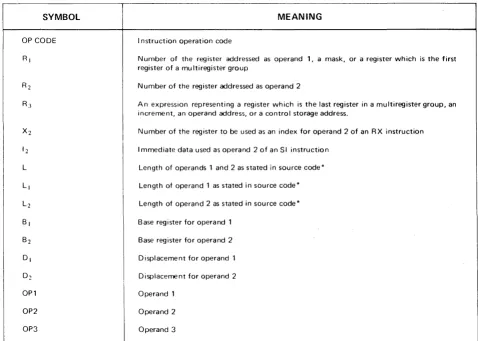
Table 3-1. Symbols Used to Describe Operand Formats
MEANING
I nstruction operation code
Number of the register addressed as operand 1, a mask, or a register which is the first register of a mu Itiregister group
Number of the register addressed as operand 2
An expression representing a register which is the last register in a multiregister group, an increment, an operand address, or a control storage address.
Number of the register to be used as an index for operand 2 of an RX instruction I mmediate data used as operand 2 of an SI instruction
Length of operands 1 and 2 as stated in source code* Length of operand 1 as stated in source code* Length of operand 2 as stated in source code* Base register for operand 1
Base register for operand 2 Displacement for operand 1
Displacement for operand 2 Operand 1
Operand 2 Operand 3
3.2.6.2.
Nonprivileged Instruction Set
This instruction set includes the 132 nonprivileged instructions of the IBM System/360 universal instruction set, an add immediate (AI) instruction, three instructions for indirect addressing (BALE, LBR, and BCRE), and an emulation aid (EA) instruction. Instructions are provided to process a fixed-length binary numbers, floating-point numbers, packed and unpacked decimal numbers, and EBCDIC or ASCII characters. Data may be transferred between main storage and the user program set of general registers and from stroage to storage. The operations of shifting, branching, and logical functions are also included. All nonprivileged instructions are listed in Appendix A.
3.2.6.3.
Privileged I nstruction Set
The privileged instruction set is used by the software operating system when operating in the supervisory state. In this state, all instructions are valid and can be executed. This set of instructions includes the facility to load the current program status word (PSW), entirely or in parts; to load and store the contents of the key storage; to utilize the direct control and external interrupt feature; to control the I/O channels and subsystems; and to load the writable section of control storage. Instructions in the privileged set cannot be executed in a user program. The privileged instructions are listed in Appendix A.
3.2.6.4.
I ndirect Addressing
The UNIVAC 90/70 System nonprivileged instruction set is extended to include three additional instructions: load base relativize (LBR), branch and link external (BALE), and branch on condition to return external (BCRE). These instructions are the operating commands for the UNIVAC 90/70 indirect addressing function. The indirect addressing function is a unique design which has no equivalent in the current industry-compatible instruction set.
Indirect addressing provides uncomplicated entry to reentrant system subroutines under control of the supervisor. The user need not directly indicate the address of the subroutine in a supervisor request. Instead, the reference to the subroutine is implicitly indicated in the transfer address of the BALE instruction. The BALE instruction then references the associated indirect address control word (I ACW) contained in a vector table in main storage. The IACW indicates the address of the reference; the IACW also has control bits which can indicate additional indirection (up to eight levels), switch from relative or absolute addressing, or cause program exception interrupts. The BA LE instruction also provides a means for the user to examine the current control indicators.
Instructions used for operations such as shifting and constant generation are not sensitive to the operand control indicators.
The indirect addressing function in the UNIVAC 90/70 System has the following advantages when referencing system subroutines.
• No interrupt occurs (as with SVC), reducing system overhead, when the subroutine is in main storage.
• The supervisor is capable of moving subroutines without impacting user programs.
• User region sizes are reduced, since code with a low usage frequency is moved into main storage only when referenced.
• The user can place application subroutines or data bases, such as rate tables, under supervisor control.
3.2.6.5. Address Relocation
Another unique design feature in the UN IVAC 90/70 System is address relocation. The address relocation scheme utilizes a hardware relocating register that is dynamically loaded by hardware from a fixed main storage position each time the protection key of the program in control of the system changes.
These relocation registers define virtual address zero in the associated regions of main storage, and the contents of a register are automatically added to all the storage references generated by a user porgram.
This scheme provides a flexible and efficient rollout/rollin capability, because the supervisor can locate the rolled-in program in any portion of main storage by adjusting the associated relocation register.
Address relocation increases system throughout because:
• Storage utilization is improved. There is a decrease in checkerboarding and a resulting reduction of unused space. This unused space can be consolidated to provide additional main storage regions of useful size.
• Except in special cases, the program loader does not have to relocate programs as they are being loaded. This saves considerable processor time.
3.3. MAIN STORAGE
The main storage of the UNIVAC 90/70 System consists of high-speed, semi-conductor storage developed for the UN IVAC Series 90 computers. Main storage is contained in freestanding units with 600 nanosecond read or write cycle time for a fullword.
Minimum storage size is 131,072 bytes. This can be expanded by the following:
65,536-byte increments from 131,072 to 262,144 bytes; and
Address and data are checked for odd parity.
Each main storage cabinet is equipped with seven switches. These switches are used as the most significant bits of the cabinet starting address. If it becomes necessary to place a 131 K storage module offline, the switches on the cabined with the highest addresses can be set to the starting address of the module removed from service. This permits the remaining online modules to have sequential addresses.
3.3.1. INFORMATION POSITIONING
Locations in main storage are addressed consecutively from 0 through a maximum of 1,048,575. Bytes may be accessed separately or in groups. A group of bytes is addressed by the leftmost byte of the group. The bits in a byte are numbered from left to right starting with zero.
0 - - - - 7
Halfword data formats consist of two consecutive bytes.
0 - - - - 7
8 - - - - 1 5
Fullword data formats consist of four consecutive bytes.
0 - - - - 7 8 - - - - 1 5 1 6 - - - 2 3 2 4 - - - 31
Doubleword data formats consist of eight consecutive bytes.
~-L~~-L~~-L~~-L~~-L~~~~~~~~~~~~-V~
0 - - - - 7 8 - - - - 1 5 1 6 - - - - 2 3 2 4 - - - - 3132 - - - 63
Variable data formats consist of a variable number of consecutive bytes.
0 - - - - 7
0 - - - - 7
First Byte Last Byte
Fixed-length fields, such as halfwords and fullwords, have integral boundaries. Fixed-length fields must be loaded into main storage so that the address is evenly divisible by the field length (in bytes). Thus, a halfword must have an address that is a mUltiple of 2, a fullword must have an address that is a multiple of 4, and a doubleword must have an address that is a multiple of 8.
Variable-length data fields are not restricted by boundaries. Instructions must begin on halfword boundaries and must have lengths of two, four, or six bytes.
3
.
3.2.
Low Order Storage
The low order 640 bytes of main storage have been reserved to contain specific operating information. The information stored in these locations is accessed by the hardware and the operating system during the execution of appropriate functions. The operating system provides for the loading and protecting of the information in these locations.
3.3.3
Storage Protection
Program integrity in a mUltijobbing environment is guaranteed by the storage protection capability implemented in the processor and I/O channels. Sixteen keys are provided for this purpose. Write and read/write protection are provided.
Protection is provided in 2048-byte blocks of main storage. The supervisor assigns each block a storage protection key. A comparison is made between a requester key and the appropriate storage protection key. When the keys match, the storage operation specified is performed. When the keys do not match and the block specifies write storage protection, a read operation is allowed and a write operation is disallowed. When the keys do not match and the block specifies read/write storage protection, all operations are disallowed. In the case of disallowed operations,
a program exception interrupt request is generated.
3.3.4
.
Program Relocation Registers
There are 16 program relocation registers located in low order main storage. These registers serve as base registers for the program modules in storage. A copy of the contents of the register associated with the current program status word is stored in a register in the control hardware to facilitate rapid storage addressing.
3.4.
SYSTEM CONSOLE
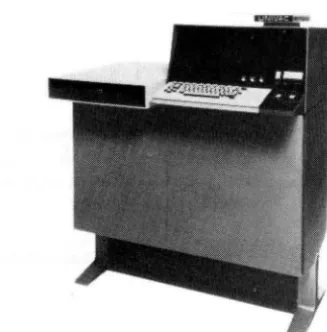
The UN IVAC 90/70 System Console is a freestanding input/output device for directing and monitoring the operation of the system. (See Figure 3-2.) The system console provides a centralized location for initial load control, run/stop control, and system status monitoring. The system console consists of a keyboard and visual display unit, switches and indicators, which are housed in a cabinet that is separate from the processor. The system console communicates with the processor through the multiplexer channel.
The keyboard and visual display unit, a UN ISCOPE 100 Display Terminal, is capable of displaying 96 characters, including uppercase and lowercase alphabets, on the visual display screen. The visual display screen has a screen capacity of 1024 characters at a time. The total number of characters displayed is subdivided into 16 rows of 24 characters each. All communications between the operator and the operating system are displayed. The operator controls consist of an alphanumeric typewriter keyboard, cursor control keys, editing keys, data control keys, control knobs, and indicators. Thus, the operator can key-in a message, see it displayed on the visual display screen, edit it, and transm it it to the processor.
The system console includes all controls and indicators necessary to operate and monitor the operation of the system. A panel is provided to allow operator control of the switches, and to present an indication of the system configuration for the operator.
The system console cabinet also provides space for mounting the UN IVAC 9000 Series Channel Adapter.
As an optional feature, a UN IVAC incremental printer can be connected to the system console to provide additional hard copy output. It may be used to duplicate all messages displayed on the visual display screen. The UN IVAC incremental printer is mounted in a separate cabinet. This printer has a 94-character set (including uppercase a