RETRACTED
ARTICLE
R E S E A R C H
Open Access
Invulnerability mechanism based on
mobility prediction and opportunistic cloud
computing with topological evolution for
wireless multimedia sensor networks
Jianming Zhou
1*and Tao Dong
2Abstract
According to the loss network problems caused by limited resources and environment interference factors, we presented a survivability mechanism based on mobility prediction and based on the topological evolution of cloud computing wireless multimedia sensor network (WMSN). First, based on cooperative neural network and opportunity Markov chain model, the multimedia mobile sensor node state and state transition probability could be predicted. Then, the opportunity computational scheme was given based on mobility prediction of dynamic topology evolution mechanism. Finally, using the network topology reconfiguration and opportunities for cloud computing, an enhanced WMSN survivability and end-to-end quality of service guarantee mechanism was proposed. Experimental results show that compared with the static scheme for WMSNs, the proposed survivability mechanism has the obvious advantage in the node protection, data communication, network life cycle, and decodable frame rate and other aspects, and can effectively improve the invulnerability of WMSNs.
Keywords:Survivability, Opportunistic cloud computing, Mobility prediction, Wireless multimedia sensor networks, Topological evolution
1 Introduction
Through the deployment of large-scale multimedia sensor nodes [1, 2], the information of audio, image, and video in the environment could be transmitted to a cloud platform with the multimedia stream transmission network. Nan X. M. et al. [3] investigated the fundamental concerns with queueing theory and optimization methods for multimedia cloud. Nan G.F. et al. [4] proposed a new cloud-based WMSN to efficiently deal with multimedia sharing and dis-tribution. A mobile cloud-based architecture for enabling remote-resident multimedia service discovery and access was proposed by Zheng X. H. et al. [5]. A new design for large-scale multimedia content protection systems was proposed by Hefeeda M. et al. [6]. However, the failure or damage of the networks may be caused by the long time transmission of multimedia stream, the limited resources of
the multimedia sensor nodes, and the complexity of the cloud computing, etc.
The topology evolution and reconstruction have a lot of influence on the network status, so it has been a concern by some researchers. A novel scheme of how to efficiently and reliably deliver multimedia real-time streams in wire-less sensor networks was proposed in [7]. Image data is transmitted to the base station via fuzzy logic with cluster-ing infrastructure, which considered the nodes mobility [8]. So, Xu Y.F. et al. [9] proposed a prediction scheme, which could predict a large-scale spatial field using suc-cessive noisy measurements obtained by mobile-sensing agents. The correlation between some available design measurements and class stability over versions was investi-gated in article [10], which proposed a stability prediction model using such available measurements. Pirozmand P. et al. [11] studied the mobility characteristics, mobility models and traces, and mobility prediction techniques of human mobility. A multiclass support vector machine-based mobility prediction (Multi-SVMMP) scheme was
* Correspondence:[email protected]
1
School of Information and Electronics, Beijing Institute of Technology, Beijing 100081, China
Full list of author information is available at the end of the article
© Zhou and Dong. 2015Open AccessThis article is distributed under the terms of the Creative Commons Attribution 4.0 International License (http://creativecommons.org/licenses/by/4.0/), which permits unrestricted use, distribution, and reproduction in any medium, provided you give appropriate credit to the original author(s) and the source, provide a link to the Creative Commons license, and indicate if changes were made.
Zhou and DongEURASIP Journal on Wireless Communications
RETRACTED
ARTICLE
proposed in [12], which could estimate the future location of mobile users according to the movement history information of each user in HetNets. A distributed bandwidth reservation scheme called the mobility-prediction-aware bandwidth reservation scheme was proposed by Nadembega A. et al. [13].
Although network and link layers were unified into a single communication module for quality of service (QoS) provisioning [14], the network is seriously dam-aged when the network cannot provide effective QoS protection. Hence, Chen S.M. et al. [15] proposed a train scheduling scheme with optimal invulnerability. A cas-cading failure model for scale-free multi-coupling-link coupled networks was built in [16] based on time-delay coupled map lattices model.
About the combination of cloud and multimedia com-munication, Shen H. et al. [17] proposed a QoS-aware multi-sink opportunistic routing to efficiently deliver multimedia information under QoS constraints. A channel characterization scheme combined to a cross-layer admis-sion control was proposed in dynamic cloud-based multi-media sensor networks, which is used to share the network resources among any two nodes [18]. Baccarelli E. [19] reviewed the current state of the art in green quality of ex-perience (QoE) with reference to mobile users and remote applications. Zhou Y. et al. [20] tackled the problem of con-cealing lost whole frames for multiview 3D video transmis-sion over wireless multimedia sensor networks (WMSNs).
On the basis of the existing research results, the main contributions of our work are as follows: (1) the mobility prediction scheme was designed based on the coopera-tive neural network and opportunistic Markov model; (2) the opportunistic cloud computing based on topo-logical evolution was built according to the results of mobility prediction; (3) the survivability mechanism based on topology reconstruction.
The rest of the paper is organized as follows. Section 2 describes the mobility prediction scheme. In Section 3, we design the opportunistic cloud computing based on topological evolution. In Section 4, we proposed the sur-vivability mechanism based on topology reconstruction. Experiment results are given in Section 5. Finally, we conclude the paper in Section 6.
2 Mobility prediction scheme
In wireless multimedia sensor networks (WMSNs), N multimedia sensor nodes were deployed. Each node is ran-domly moved. A data transmission path was established be-tween WMSNs and cloud platform. The routing request can be initiated by the cloud or any node, so as to establish a wireless transmission path between the nodes and the cloud, which was composed of M nodes. At this point, WMSNs have the following three characteristics:
(1)The multimedia data transmission or node status has the equilibrium point. When the multimedia data is transferred, the WMSN gradually tends to balance with the nodes of the nodes, and it reaches a steady state. (2)There is the direct relationship between the speed and state of the WMSN equilibrium point and the state of the mobile node.
(3)Data transfer between the nodes and the received data from the cloud can be effectively obtained by the mobile node’s collaboration.
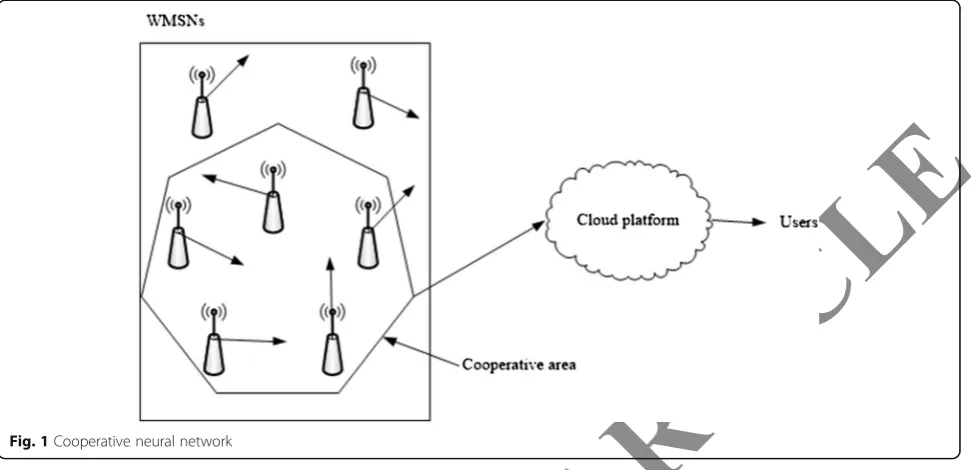
According to the system characteristics, the WMSN can be defined as a cooperative neural network, as shown in Fig. 1. In WMSNs, the heptagonal cooperative neural net-works are composed of data sending node and neighbor nodes as shown in Fig. 1, to provide reliable data transmis-sion service. Data futransmis-sion after convergence evacuation was sent to the cloud. Users can obtain the multimedia data through the clouds. In the WMSNs, the mobile node’s 3D moving trajectory is shown in Fig. 2, which is divided into the time component, the moving vectorxand the moving vector y. The whole system of WMSNs can be obtained by calculating the 3D vector product ofNmobile node.
Therefore, the characteristics of the cooperative neural network are expressed as the formula (1a).
n¼XN
Here, Sik denotes the sending signal form i node to k
node. n denotes the signal received by neighbor nodes after wireless broadcasting by any node. w denotes the cooperative weight. The node would join the cooper-ation when the signal of some neighbor node is larger than one betweeninode and cloud.SCNN is the
conver-gence signal after cooperation to reach the cloud. Based on signal transmission, the 3D vector analysis can be implemented in the i node of the cooperative neural network, as shown in the formula (2a).
ti¼wji−1→N xffiffiffiffiffiffiffiffiffiffiffiffiffiffiffiffiffiffiffiffiffiffiffiffii−12þyi−12
RETRACTED
ARTICLE
sender to receiver using the cooperation-type neural network. The results are as shown in Fig. 3. Fig. 3a shows the actual node deployment plan. Fig. 3b is the forecast results. Fig. 3c gives the analysis results of prediction errors. The results showed that co-operative neural network prediction has the higher accuracy.
Although the cooperative neural network can accurately predict the nodes in a data transmission network topology, there is a poor performance for the future state of the whole network. Therefore, combining with the opportunis-tic Markov chain model as shown in Fig. 4, state transition prediction model of WMSN topology dynamic was pro-posed according to the characteristics of dynamic Markov
Fig. 2Node moving trajectory Fig. 1Cooperative neural network
RETRACTED
ARTICLE
model, where the three transmission path multimedia is established between data sending node sender and receiv-ing cloud.
The probability is determined by probabilistic chance and opportunity dimensions probability with full connec-tion from the sender to the receiver. According to the three-dimensional prediction results of the cooperative neural network, an opportunity-type Markov chain model was defined. The 1D Markov chain model is applied to only one dimension to change, the success arrive probabil-ity of the cloud is P1Px. A two-dimensional Markov chain
model is applied to only two dimensions to change, and the success arrive probability of the cloud is P1PxPy. The
three-dimensional Markov chain model is suitable to three-dimensional transfer, the success arrive probability is P1PxPyPt.
In the Markov chain model, the opportunistic prob-ability sum of the three-dimensional transmission path
is 1, as shown in formula (1). The end-to-end success rate of sending packet Ps can be obtained by formula (2), as well as the outage probability POUT of
transmis-sion path can be calculated by formula (3).
P1þP2þP3¼1 ð1Þ
PS ¼ P1
Ya
i¼1
Px
P2 Ya
i¼1 Yb
j¼1
PxPy
P3 Ya
i¼1 Yb
j¼1 Yc
k¼1
PxPyPt
8 > > > > > > > > > < > > > > > > > > > :
ð2Þ
RETRACTED
The cooperative neural network will lead to WMSNs gradually reach a state of equilibrium. Based on the opportunistic Markov chain model, the equi-librium state probability Pbalance can be obtained as
formula (4).
Pbalance¼PS >POUTjt→∞ ð4Þ
A single mobile node status in WMSNs included the mobile speed VE, topology robustness RE, and
cloud communication stability SE. Therefore, the
mo-bile node working state can be defined as {VE, RE, SE}. The VE could be calculated through cooperative
neural network of two different direction vector com-ponent predictions. RE could be calculated through
the connectivity detection using opportunistic Markov chain model as shown in the formula (5). SE could be
calculated by detecting the cloud success probability using Markov chain model as shown in Eq. (6).
RE¼
3 Opportunistic cloud computing based on topological evolution
On the basis of the mobility prediction model based on cooperative neural network and opportunistic Markov chain, analysis of WMSNs dynamic topology evolution could be obtained combined with the op-portunity to cloud platform for real-time multimedia data calculation.
In dynamic topology evolution process, factors resulting in decline of multimedia communication performance and damage of WMSNs include the calculation complexity, multimedia data transmission Fig. 4Opportunistic Markov model
RETRACTED
ARTICLE
delay, cloud equipment idle rate and efficiency of cloud computing and multimedia sensor energy con-sumption, and multimedia data scale. Therefore, starting from the study of WMSNs survivability per-spective, the dynamic topology evolution analysis model was given.
Here, letEencodedenote the encoding energy
consump-tion of multimedia data. LetEpredictiondenote the energy
consumption of mobility prediction. Let Etopologydenote
the topology evaluation energy consumption. LetEfd
de-note the data transfer energy consumption. Eagr is the
energy consumption of data fusion. Lenstream is the
length of multimedia stream. Lpacket is the number of
transferring data packets.
In cloud platform, the computational complexity of multiple clouds with multimedia data can be obtained by formula (8).
Here, letLOC denote the cloud number of joining the
cooperation. CC is the computational complexity. EN is encoding function of multimedia data packet fusion. Fr is the video frames. MP is the encoding function of sin-gle data packet. In the process of dynamic topology evo-lution, there are the following issues, which should be considered when combining the mobile node state with the opportunity of cloud computing.
(1)The same multimedia data stream in different data packets in the opportunistic Markov chain model can choose different data transmission path. (2)In cooperative neural networks, the mobile nodes,
which are in equilibrium state, are all in equilibrium, which can improve the efficiency of cloud computing. (3)To find and activate the mobile nodes with stable
three-dimensional stability, which are used to establish the end-to-end communication between sending sensor and a cloud platform.
In dynamic topology evolution process, the transmis-sion delay of multimedia data can be obtained by the formula (9). The delay includes the following three parts: (1) the prediction delay with opportunistic Markov chain model, (2) cooperative transmission delay of mobile node, and (3) opportunistic cloud computing delay.
TCC¼
Cloud device idle rate as shown in formula (10).
Pidle¼ 1−
Here, U is the active cloud number. V is the cloud number with opportunistic active status. PYTR|V→U de-note the probability from the waiting state to an active state ofVopportunistic nodes.
Cloud computing efficiency can be obtained by for-mula (11).
4 Survivability mechanism based on topology reconstruction
Based on opportunistic Markov chain model, the multi-media data calculation complexity, multimulti-media data transmission delay, and cloud computational efficiency of WMSN topology evolution would be analyzed in depth. Here, we considered two kinds of calculation schemes. The first is a static cloud computing program that is responsible for the calculation of the data of fixed cloud computing tasks, from the mobile node to the cloud transmission path is fixed. The second is the scheme opportunistic cloud computing scheme. The multimedia stream transmission path of the mobile node and the cloud is dynamic, which can choose the optimal transmission path according to the mobile node top-ology evolution state and provide transmission services of end-to-end communication.
RETRACTED
ARTICLE
complexity, multimedia data transmission delay, cloud equipment idle rate and efficiency of cloud computing and multimedia sensor energy consumption, and dy-namic evolution of network topology in real time. Hence, the best multimedia stream transmission path could be established on the basis of the prediction of mobile nodes.
From Fig. 5a, the calculation complexity of opportun-ity cloud computing scheme is not too sensitive to mo-bile node scale, which is difficult to decline because of the size of the mobile node influence and jitter signifi-cantly. The opportunistic cloud computing scheme can make full use of the mobile node state prediction, com-bined with the opportunity of Markov chain model to choose the best data transmission path. The real-time performance is better than the static cloud computing scheme, which is shown in Fig. 5b. With the increase of the scale of the mobile node, data transmission through
multi-hop to the cloud platform significantly increased the computational complexity of multimedia data and reduced the efficiency of cloud computing. The cloud computing may be weakened. However, the multi-hop opportunity transmission and multiple data fusion could gradually improve the efficiency of cloud computing, as shown in Fig. 5c. Above the performance benefit is the opportunistic cloud calculation scheme using the net-work topology dynamic evolution can perceive the WMSN system state and the mobile node state and cause damage to the network, with strong survivability.
Figure 6 shows network survivability performance of the multimedia data scale and cloud number of multi-media sensor energy consumption and cloud idle equip-ment rate. In Fig. 6a, there are many video frames in multimedia data stream. With the increase in the video frame, static cloud computing scheme for mobile nodes energy consumption of linear increase, easily lead to Fig. 5Topological evolution performance analysis.aComputational complexity of multimedia data.bMultimedia data transmission delay.cCloud computing efficiency
RETRACTED
ARTICLE
WMSNs due to energy failure caused by network dam-aged, and opportunity cloud calculation scheme of en-ergy consumption remains below the 100 kJ, have the ability to resist energy failure damaged. The damage analysis of WMSNs with the cloud device utilization rate was shown in Fig. 6b. Static cloud computing scheme cannot obtain the cloud equipment state in real time, which makes the cloud equipment in idle state for a long time. A large number of multimedia computing focused on fixed cloud equipment, easily lead to cloud device computational inefficiency, which caused the damage of WMSNs. The opportunistic cloud comput-ing scheme can calculate the multimedia data with op-portunistic computing, which can assign computing tasks to the newly increased computing equipment and always maintain high utilization. WMSNs based on the opportunity cloud computing scheme can well deal with the network topology evolution brings network
damage factor, improve resource utilization, and reduce the damage probability.
About multimedia sensor mobile node, its failure gen-erally occurs in the following circumstances:
(1)The resource depletion of mobile nodes. (2)Mobile nodes cannot meet the needs of the
opportunity cloud computing.
Similarly, the failure probability of a multimedia mo-bile node is shown in the formula (12).
PFAðMSÞ ¼PMSjMSRE<THREþPMS→CloudjMSC<OCCC ð12Þ
In the process of opportunity cloud computing, WMSN topology reconfiguration probability is shown in the formula (13).
TPWMSNs¼
XN
i¼1 1−POUT
ð ÞPTRYjV→U
XLen
i¼1
PSð ÞFri jPS<POUTjt→∞
ð13Þ
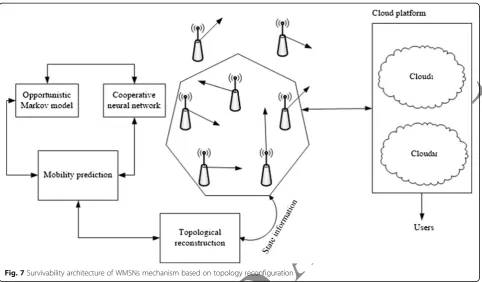
To sum up, according to the forecast of WMSN node state, dynamic selection of sender and cloud multimedia data transmission path, the opportunity selection device cloud data calculation and promote the WMSN topology reconfiguration. Opportunity-based Markov chain model and the cooperation-type neural network, combined with the cloud platform resource state of WMSN top-ology reconfiguration and cloud decision calculation process such as that shown in Fig. 7, can improve the WMSN survivability by chance based on cloud comput-ing and topology reconstruction.
A mobility prediction and opportunistic cloud com-puting scheme network topology reconfiguration is pro-posed in WMSN survivability mechanism, which could real-time enhance network survivability.
5 Performance evaluation
In order to verify the I-MPOCCTE survivability mech-anism performance and end-to-end multimedia commu-nication quality of service support capability in WMSNs, we designed the experimental platform based on NS-2 simulation system. Through the C language, the pro-posed scheme would be embedded into the multimedia sensor nodes and compared with the performance of static WMSN scheme (I-S-WMSNs). The experimental time of video transmission is 60 min, the experimental area is a 600 × 800 m rectangular area, there is a total of 30 multimedia sensor nodes, and cooperative communi-cation distance is 200 m.
In the experiment, the video data is transmitted and transmitted as the object, and the failure probability of WMSNs of the proposed scheme is analyzed, and the num-ber of WMSN mobile nodes and the system execution Fig. 6Invulnerability impact of cloud and multimedia data on
RETRACTED
ARTICLE
efficiency are analyzed. Parameter settings for the multi-media sensor and settings of cloud platform are shown in Tables 1 and 2. Each mobile node’s residual energy, storage space, and computing power of different analysis of WMSNs to cope with node failure can be caused by random net-works are impaired under the mechanism of survivability. In order to facilitate comparison, in the same environment and at the same time, the statistical static WMSN scheme per-formance (as shown in Fig. 8) and the service quality assur-ance capability (as shown in Fig. 9) were analyzed.
From Fig. 8a, it is found that for the I-MPOCCTE with large amounts of data transmission of multimedia applica-tion for a long time, multimedia data sending node failure probability was significantly lower than that in the I-S-WMSNs, and in coping with the task, resource depletion caused the transmitter failure caused by network damage has a significant advantage. This is because part of the node failure causes the topology to change dynamically, in the topology evolution process of the I-MPOCCTE according to the mobile forecast results real-time adjust-ment of transmission network. From Fig. 8b, it shows that
the proposed I-MPOCCTE mobile node failure number increased slowly and at the end of the transmission node failure is less than four; and I-S-WMSNs, due to the fail-ure of the scale of more than 50 %, caused paralysis, this is because the I-S-WMSNs scheme leads to tissue damage and cannot be repaired. And the I-MPOCCTE method combining network topology reconfiguration and oppor-tunity keeps itself more available to the mobile node and the given effective protection, so as to the system for the high rate of implementation of the security, see Fig. 8c.
In addition, the user terminal can decode the frame as shown in Fig. 9. The high decoding frame rate I-MPOCCTE is mainly due to the opportunity for cloud computing, while maintaining low computational complexity and improving the efficiency of the multi-media data decoding and playback quality to provide effective protection.
6 Conclusions
In order to enhance the survivability performance of WMSNs, survivability mechanism based on mobility Fig. 7Survivability architecture of WMSNs mechanism based on topology reconfiguration
Table 1Settings of multimedia sensor
Parameters Value Parameters Value
Sending rate 30 frames/s End-to-end distance 800 m
Video resolution 720 × 480 pixel
Bandwidth 100 Mbit/s
Working frequency 1200 kHz Video encoding algorithm MPEG-4
Table 2Cloud platform
Parameters Value Parameters Value
Number of clouds 10 Working frequency 800 kHz
Disk space 100 TB Computing error <0.005 %
Memory space 1 TB CPU power <0.2 W
RETRACTED
ARTICLE
prediction and cloud computing with topological evo-lution for WMSN is proposed in this paper. Based on cooperative neural network and opportunity Markov chain model, the accurate prediction of multimedia mobile sensor node state and state transition prob-ability then is given based on mobility prediction of dynamic topology evolution mechanism and the op-portunity computational scheme. Finally, combined with network topology reconfiguration and opportun-ity calculation, it puts forward a kind of enhanced WMSNs survivability and end-to-end quality of ser-vice guarantee mechanism. Experimental results show that the sending node failure, playback quality, node life-time, and the execution efficiency of the system, such as the survivability mechanism, have a significant advantage.
The future work is to study the cloud platform failure, repair of damaged node for enhancing the WMSN invul-nerability, and seek for end-to-end QoS guarantee mech-anism in the network with damaged case.
Fig. 8Performance evaluation of invulnerability.aSending node failure probability.bNumber of failure node.cSystem execution efficiency
RETRACTED
ARTICLE
Competing interests
The authors declare that they have no competing interests.
Acknowledgements
This work is supported in part by the Open Research Fund of State Key Laboratory of Space-Ground Integrated Information Technology under grant no. 2014_CXJJ-TX_08.
Author details
1School of Information and Electronics, Beijing Institute of Technology,
Beijing 100081, China.2State Key Laboratory of Space-Ground Integrated Information Technology, Space Star Technology CO., Ltd, Beijing 100018, China.
Received: 23 July 2015 Accepted: 27 October 2015
References
1. S Colonnese, F Cuomo, T Melodia. An empirical model of multiview video coding efficiency for wireless multimedia sensor networks. IEEE Trans. Multimedia15(8), 1800–1814 (2013)
2. Y Yang, Y Wang, D Pi, R Wang. Optimization of self-directed target coverage in wireless multimedia sensor network. Scientific World Journal2014, 416218 (2014)
3. X Nan, Y He, L Guan et al., Queueing model based resource optimization for multimedia cloud. J. Vis. Commun. Image Represent. 25(5), 928–942 (2014)
4. G Nan, Z Mao, M Li, Y Zhang, S Gjessing, H Wang, et al. Distributed resource allocation in cloud-based wireless multimedia social networks. IEEE Netw. 28(4), 74–80 (2014)
5. X Zheng, N Chen, Z Chen, C Rong, G Chen, W Guo. Mobile cloud based framework for remote-resident multimedia discovery and access. J. Internet Tech.15(6), 1043–1050 (2014)
6. M Hefeeda, T ElGamal, K Calagari, A Abdelsadek. Cloud-based multimedia content protection system. IEEE Trans. Multimedia17(3), 420–433 (2015) 7. K-I Kim, T-E Sung. Modeling and routing scheme for (m, k)-firm streams in
wireless multimedia sensor networks. Wirel. Commun. Mob. Comput.15(3), 475–483 (2015)
8. A Alaybeyoglu. Transmission of image data using fuzzy logic based clustering infrastructure in mobile multimedia sensor networks. J. Intell. Fuzzy Syst.28(3), 1235–1242 (2015)
9. Y Xu, J Choi, S Dass, T Maiti. Efficient Bayesian spatial prediction with mobile sensor networks using Gaussian Markov random fields. Automatica49(12), 3520–3530 (2013)
10. M Alshayeb, Y Eisa, A Ahmed Moataz et al., Object-oriented class stability prediction: a comparison between artificial neural network and support vector machine. Arab. J. Sci. Eng.39(11), 7865–7876 (2014)
11. P Pirozmand, G Wu, B Jedari, F Xia. Human mobility in opportunistic networks: characteristics, models and prediction methods. J. Netw. Comput. Appl.42, 45–58 (2014)
12. J Chen, L Ma, and Y Xu. Support vector machine based mobility prediction scheme in heterogeneous wireless networks.
Math. Probl. Eng. (2015)
13. A Nadembega, A Hafid, T Taleb et al., Mobility-prediction-aware bandwidth reservation scheme for mobile networks. IEEE Trans. Veh. Technol.64(6), 2561–2576 (2015)
14. K Demir Alper, H Demiray, S Baydere, Engin QoSMOS: cross-layer QoS architecture for wireless multimedia sensor networks. Wireless Network 20(4), 655–670 (2014)
15. S Chen, J Jiang, S Pang, S Nie, Y Lai. Modeling and optimization of train scheduling network based on invulnerability analysis. Applied Mathematics & Information Sciences.7(1), 113–119, (2013) 16. P Xing-Zhao, Y Hong, D Jun, D Chao, Z Zhi-Hao. Study on cascading
invulnerability of multi-coupling-links coupled networks based on time-delay coupled map lattices model. Acta Physica Sinica.63(7), (2014) 17. H Shen, G Bai, Z Tang, L Zhao. QMOR: QoS-aware multi-sink opportunistic
routing for wireless multimedia sensor networks. Wirel. Pers. Commun. 75(2), 1307–1330 (2014)
18. DP Mendes Lucas, JPC Rodrigues Joel, J Lloret, S Sendra. Cross-layer dynamic admission control for cloud-based multimedia sensor networks. IEEE Syst. J.8(1), 235–246 (2014)
19. E Baccarelli, F Chiti, N Cordeschi R Fantacci, D Marabissi, R Parisi. Green multimedia wireless sensor networks: distributed intelligent data fusion, in-network processing, and optimized resource management. IEEE Wirel. Commun.21(4), 20–26 (2014)
20. Y Zhou, W Xiang, G Wang. Frame loss concealment for multiview video transmission over wireless multimedia sensor networks. IEEE Sensors J. 15(3), 1892–1901 (2015)
Submit your manuscript to a
journal and benefi t from:
7 Convenient online submission
7 Rigorous peer review
7 Immediate publication on acceptance
7 Open access: articles freely available online 7 High visibility within the fi eld
7 Retaining the copyright to your article
Submit your next manuscript at 7 springeropen.com