Volume 2009, Article ID 240610,9pages doi:10.1155/2009/240610
Research Article
A Flexible and Efficient Key Distribution Scheme for
Renewable Wireless Sensor Networks
An-Ni Shen,
1Song Guo,
1and Victor Leung
21School of Computer Science and Engineering, University of Aizu, Fukushima-Ken 965-8580, Japan
2Department of Electrical and Computer Engineering, University of British Columbia, Vancouver, BC, Canada V6T 1Z4
Correspondence should be addressed to Song Guo,[email protected]
Received 1 February 2009; Accepted 11 April 2009
Recommended by Yang Xiao
Many applications of wireless sensor network require secure data communications, especially in a hostile environment. In order to protect the sensitive data and the sensor readings, secret keys should be used to encrypt the exchanged messages between communicating nodes. Traditional asymmetric key cryptosystems are infeasible in WSN due to its low capacity at each senor node. In this paper, we propose a new key distribution scheme for hierarchical WSNs with renewable network devices. Compared to some of the existing schemes, our key establishment methods possess the following features that are particularly beneficial to the resource-constrained large-scale WSNs: (1) robustness to the node capture attack, (2) flexibility for adding new network devices, (3) scalability in terms of storage cost, and (4) low communication overhead.
Copyright © 2009 An-Ni Shen et al. This is an open access article distributed under the Creative Commons Attribution License, which permits unrestricted use, distribution, and reproduction in any medium, provided the original work is properly cited.
1. Introduction
Wireless sensor networks (WSNs) have been envisioned to be very useful for a broad spectrum of emerging civil and military applications [1]. However, sensor networks are also confronted with many security threats such as node compromise, routing disruption, and false data injection, because they normally operate in unattended, harsh, or hostile environment. Among all these threats, the WSNs are particularly vulnerable to the node compromise because sensor nodes are not tamper-proof devices. An adversary might easily capture the sensor devices to acquire their sensitive data and keys and then abuse them to further compromise the communication between other noncap-tured nodes. This typical threat is known as the node capture attack. In order to conquer such problem, it is desirable to design key distribution protocols to support secure and robust pairwise communication among any pair of sensors.
To prevent from the node capture attack is a challenging task in sensor networks that have scarce resources in energy, computation, and communication. Therefore, only lightweight energy efficient key distribution mechanisms are affordable. For example, the conventional asymmetric
key cryptosystem, such as RSA [2] and Diffie-Hellman [3], cannot be implemented in sensor nodes due to their very limited capacities. As the first naive solution, all sensor devices are preloaded the same master key and thus any two nodes can use this master key for secure communication after deployment. However, if one sensor node is physically captured by an adversary, it would compromise the entire network secrecy. Another possible approach is to assign a distinct pairwise key for each pair of sensor nodes before they are deployed. Each sensor node needs to store (n−1) keys, where nis the size of the network. The solution provided secure against the node captured attack but not scalable. Moreover, addition of new sensors to a deployed network is extremely difficult.
(a) (b) Static BS
Cluster head
Sensor node Mobile AP
Figure1: A three-tier hierarchical WSN.
transmissions, and the CH then performs a preprocessing for the raw data received from all other senor nodes in the cluster and finally forwards the aggregated data to the sink node, or Base Station (BS), by long-range transmissions. Key distribution protocols have already been studied comprehen-sively in flat WSNs, for example, in [5–8]. Recent research has more focused on the hierarchical architecture for large-scale resource-constrained WSNs, because it has been shown in [9] that a hierarchical architecture can provide better performance, in terms of communication overhead, than a flat architecture in such networks.
To solve the key agreement problem in hierarchical WSNs, Jolly et al. proposed a key predistribution scheme LEKM [10]. Before deployment, each CH stores a set of keys in its memory and each sensor node randomly selects a key from a CH and stores it with the CH’s Id in its memory. After deployment, each sensor node establishes a securely link with the CH that has been selected. This is done at each sensor node by exchanging key information over the whole network. Such scheme has no computational cost at both sensor node and CH in key establishment phase and is robust against node capture attack after the key establishment phase. However, it has high storage and communication overhead at CHs.
Another proposal IKDM [9] is a polynomial-based protocol for hierarchical WSN. In the IKDM scheme, each sensor node or CH has fixed storage cost in predistribution phase. In order to improve the resilience against the node captured attack, the preloaded key of each sensor node is the exclusive-or result of ( ≥ 1) number of bivariate polynomial keys which can be fetched by its CH from
number of distinctive CHs all over the network. The parameterdefines the tradeoffbetween the communication overhead and the robustness to the node capture attacks at the cluster heads. While the largecan improve the security level of the network, it will also result in significant message exchanges for establishing secure links.
In real applications, new network devices need to be added into an already deployed network from time to time in order to replace the power-exhausted or compromised devices such that the performance of the whole network would not significantly degrade. However, most of schemes, for example, [9,10], cannot provide a full solution to the key management for adding new cluster heads and sensor nodes in hierarchal renewable WSNs. In summary, the security and efficiency requirements in a WSN may include secrecy and authentication, robustness against node capture attack, dynamic membership management (including new network device addition), strong network connectivity, scalability to large-scale networks, and low complexities on memory, com-putation, and communication overhead. These challenges motivate us to propose scalable and robust pairwise key distribution mechanism between sensor devices in large-scale WSNs. In particular, our methods possess the following features that are particularly beneficial to the resource-constrained WSNs: (1) robustness to the node capture attack, (2) flexibility on key establishment for adding new network devices, (3) scalability in terms of storage cost, and (4) low communication overhead.
The rest of this paper is organized as follows.Section 2
presents our network model.Section 3gives an overview of our proposal.Section 4describes a group of protocols for our key distribution mechanism.Section 5analyzes the security and evaluates the performance of our proposal. Section 6
summarizes our findings.
2. Network Model
As in other hierarchical models of sensor network [9–11], our system also assumes that a sensor network is divided into clusters, which are the minimum unit for detecting events. A cluster head coordinates all the actions inside a cluster and each pair of cluster heads in their transmission range can communicate directly with each other. Moreover, we assume a single base station (BS) or an access point (AP) in the network and works as the network controller to collect event data. As illustrated in Figure 1(a), the BS is a fixed infrastructure located in the network with virtually unlim-ited computational and communication power, unlimunlim-ited memory storage capacity, and very large radio transmission range to ensure the full coverage of the whole network area. Another application scenario given inFigure 1(b) shows that the information collected by cluster heads from all its sensor nodes is retrieved by a mobile AP periodically. During the information retrieval operation, the AP broadcasts a beacon to activate cluster heads in its coverage area. Activated cluster heads then transmit their data to the AP through a common wireless channel. In the rest of paper, we use the general term BS for such network controller for describing our key distribution mechanism without discriminating the above two scenarios.
Table1: Notations.
Symbol Explanation
Si The Id of the sensor nodei(1≤ i≤n)
CHi The Id of cluster head in cluster
i(1≤i≤ m)
BS The Id of the base station
NS(CHa)
The set of all sensor nodes in clustera, that is, there is a pairwise key between CHaand any sensor nodeSi∈NS(CHa)
λS The average number of sensor nodes in acluster
NCH(CHa)
The set of all neighboring cluster heads of clustera, that is, there is a pairwise key between CHaand any cluster head
CHb∈NCH(CHa)
λCH The average number of neighboring cluster heads for a cluster head
short radio transmission range. Sensor nodes are restricted to direct communications with its CH only. The CHs are equipped with high power batteries, large memory storages, powerful antenna and data processing capacities, and thus can execute relatively complicated numerical operations. As the most powerful node in a WSN, the BS works as the central controller for data collect and key management. For the latter function, the BS maintains the topology of the whole network (the Ids of network devices and their connectivity information) and the method to generate keys for any secure link just based on Ids. In particular, we introduce two working modes for the BS: (1) on-line mode and (2) off-line mode.
In an on-line working mode, the key generation method at the BS can be requested from any cluster head and the BS should response in a timely manner. However, such on-line service is not always available at the BS. For example, the BS cannot response the request in certain period of time, in which it is already dedicated to some important and uninterruptable tasks as illustrated inFigure 1(a), or the requesting cluster head is not in its service area as illustrated in Figure 1(b). Under both cases, the BS is configured to work in the off-line mode, and the alternative methods for key generation relying on other network devices should be provided by the key distribution protocol.
A three-tier hierarchical wireless sensor network can thus be modeled as a simple graph G with a finite node set, including a base station,mcluster heads, andnsensor nodes. A secure wireless link corresponding to the wireless communication channel belongs to the arc set ofGonly if there exists a pairwise key between the transmission nodes of the link. InTable 1, we summarize the notations used in the rest of the paper.
3. Overview of Our Key Distribution Scheme
In this section, we present the foundations and basic idea of our key distribution scheme based on a three-tier hierarchal network model.
3.1. Key Distribution in Renewable WSNs. Specifics of wire-less sensor networks, such as strict resource constraints and large network scalability, require a proposed security protocol to be not only secure but also efficient. Recent research shows that preloading symmetric keys into sensors before they are deployed is a practical method to deal with the key distribution and management problem in wireless sensor networking environments. After the deployment, if two neighboring nodes have some common keys, they can setup a secure link by the shared keys. As surveyed in [9], the existing schemes can be classified into the follow-ing three categories: random key predistribution schemes, polynomial-key predistribution schemes, and location-based key predistribution schemes.
In our key distribution scheme, a key distribution server (KDS) is available for both of the following cases. (1) KDS is installed in the base station, by which the keys can be delivered instantaneously when the BS is on-line to the requester. (2) It is available to the network deployer when the keys are required to be preloaded into network devices.
In many applications, new network devices need to be replenished into an already deployed network to replace the power-exhausted or compromised devices. The corre-sponding key management should be provided in order to setup the secure link between a new added network device and an existing one. To our best knowledge, there are no full solutions to the dynamic membership management for key distribution in hierarchal WSNs with renewable cluster head and sensor node. For example, some of them can only support the sensor node addition in the case when BS is on-line. The objective of our key distribution protocols is to provide a complete and flexible solution for such renewable WSNs. In particular, we will provide the key distribution protocols for both sensor node and cluster head when the BS is on-line or off-line.
3.2. Symmetric Polynomial Function. In our key distribution scheme, a bivariate symmetric polynomial function (s.p.f.) is used to generate the key for each link of the network. The
t-degree bivariate symmetric polynomial function f(x,y), introduced in [12], is defined as
fx,y= that is large enough to accommodate a cryptographic key. As implied by its name, the symmetric property of a bivariate polynomial function satisfies f(x,y) = f(y,x). In our key distribution scheme, the KDS maintains two bivariate polynomial functions:
(i) the s.p.f. fCH-NS(x,y) is used to establish the key between existing cluster head and new sensor node, (ii) the s.p.f. fCH-NCH(x,y) is used to establish the key
between existing cluster head and new cluster head.
After the pairwise key Ka,b between network devices a
CHa BS
Preload
Si(Si∈NS(CHa)) KBS,Si fCH-NS(Si,y) Siis added in clustera
Si
CHa KCHa,Si=H(fCH-NS(Si, CHa))
ErasefCH-NS(Si,y)
Si, CHa
KCHa,Si=H(fCH-NS(CHa,Si)) Data=E(KCHa,Si,KBS,CHa) Si, data
KCHa,Si=E(data,KBS,CHa)
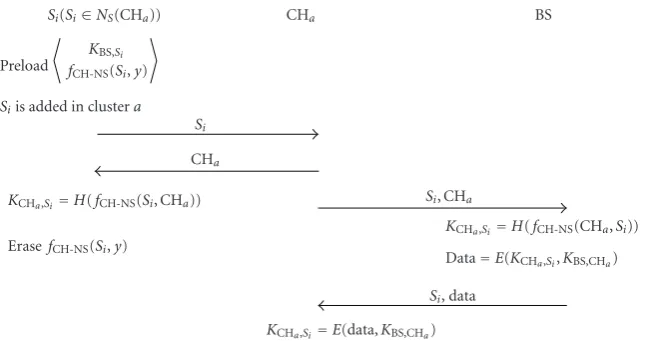
Figure2: Protocol illustration of adding a new sensor node when BS is on-line.
substituting the variables with Ids of the two communicating parties, thedataover the link can therefore be securely trans-mitted as E(data, Ka,b), which is a symmetric encryption
function usingKa,bas the key.
By applying the symmetric property, a secure link can be easily built up by just exchanging the Ids of transmission nodes. However, such scheme suffers thet-security problem, which means at-degree bivariate polynomial key scheme can only keep secure against coalitions of up tot compromised sensors. When the number of compromised nodes is less thant, the coefficients of the polynomial cannot be derived even all the compromised nodes put their stored information together. But once more than t nodes are compromised, the adversary can crack the coefficients of the polynomial such that all the pairwise keys in the entire group would be cracked. Although increasing the value oft can improve the security property of bivariate polynomial key scheme, it is not suitable for wireless sensor networks due to the limited memory size of sensors. In order to conquer this limitation, the pairwise keyx calculated from the polynomials will be further scrambled by a one-to-one hash functionH(x).
4. Key Distribution Protocols
Our scheme supports new network device (sensor node and cluster head) addition for both BS on-line and off-line scenarios with the minimum assumption that the deployed network has completed its key establishment, that is, the keyKa,b for any secure link (a,b) is already shared by both
network devicesaandb. Furthermore, our proposed scheme can provide forward secrecy as well as full prevention from the node capture attack for large-scale sensor networks.
4.1. BS is On-Line. LetSibe the new sensor node to be added
in the network. In order to calculate the key betweenSiand its cluster head, the calculation can be done at the BS if it is working at the on-line mode. Suppose new sensor node Si
is randomly added into the network and eventually belongs to cluster CHa. The following Protocol 1, as illustrated in Figure 2, is to establish a secure link betweenSiand CHa.
Protocol 1(sensor addition when BS is on-line).
(1) The new sensor node Si is randomly deployed to the existing network with preloaded information: the s.p.f. fCH-NS(Si,y) and a keyKBS,Si.
(2) AfterSiis deployed, it exchanges Ids with its cluster head CHa.
(3)Si evaluates its stored s.p.f. fCH-NS(Si,y) at y =
CHa to establish the key between itself and its
cluster head asKCHa,Si = H(fCH-NS(Si, CHa)). After calculating the pairwise key,Si erases the preloaded s.p.f. fCH-NS(Si,y) immediately to avoid potential
attacks.
(4) CHarequests the new key between CHaandSifrom
BS by forwarding the Id ofSiand its own Id.
(5) BS then calculates the corresponding key using the s.p.f. fCH-NS as and returns the encrypted key
E(KCHa,Si,KBS,CHa) back to CHa.
(6) CHa decrypts the received date to recover KCHa,Si using the key KBS,CHa, which was already loaded at CHa since its very initial deployment, that is,
KCHa,Si =E(E(KCHa,Si,KBS,CHa),KBS,CHa).
Now we consider the addition of a new cluster head and the corresponding key distribution procedures when the BS is on-line. We assume the CHa is to be replaced by a new
cluster head CHa, due to its low power level. Note that in the
replacement phase of cluster head, the communication keys with existing network devices (i.e., cluster head and sensor node) are also renewed, not simply making use of the copies of the previous keys. This process avoids potential attack activities and achieves the forward secrecy. In other words, even the attacker could intercept packets and analysis data to compromise the key of old cluster head, it still cannot decrypt the secret data using the old keys.
The following Protocol2, as illustrated inFigure 3, is to build up the keys between the new cluster head CHa, and all
existing sensor nodesSi(Si ∈NS(CHa)) in the same cluster
as well as the keys between the new cluster head CHa, and all
CHa Si
CHb KBS,CHa KCHa,Si KCHa,CHb Preload
Deploy CHato the cluster
where CHais located
CHb(CHb∈NCH(CHa)) Si(Si∈NS(CHa)) BS
Data=E(KCHa,CHb,KBS,CHb), CHa KCHa,CHb=E(data,KBS,CHb)
Data=E(KCHa,Si,KBS,Si), CHa KCHa,Si=E(data,KBS,Si)
Figure3: Protocol illustration of adding a new cluster head when BS is on-line.
Protocol 2(CH addition when BS is on-line).
(1) The following secret information is created and preloaded into CHa:
(i) the pairwise key with base stationKBS,CHa,
(ii) for each sensor nodeSi ∈NS(CHa), its Id and
the keyKCHa,Si=H(fCH-NS(CHa,Si)),
(iii) for each cluster heads CHb ∈NCH(CHa), its Id
and keyKCHa,CHb=H(fCH-NCH(CHa, CHb)),
(2) The new cluster head CHa is then deployed
physi-cally to the cluster area where the old cluster CHais
located.
(3) The base station transmits the encrypted key
E(KCHa,CHb,KBS,CHb) to each neighboring cluster head CHb of CHa such that it can be decrypted as
KCHa,CHb at the side of CHb using the keyKBS,CHb, that is,KCHa,CHb=E(E(KCHa,CHb,KBS,CHb),KBS,CHb). (4) Similarly, BS transmits the encrypted key
E(KCHa,Si,KBS,Si) to each senor node Si of CHa such that it can be decrypted asKCHa,Si at the side ofSi, that is, KCHa,Si = E(E(KCHa,Si,KBS,Si),KBS,Si), using the keyKBS,Si.
4.2. BS is Off-Line
Protocol 3(sensor addition when BS is off-line).
(1) The new sensor node Si is randomly deployed to
the existing network with the following preloaded information:
(i) the pairwise keyKBS,Sishared with BS,
(ii) the Id of a cluster head CHb, which is an
arbitrary CH already in the network,
(iii) the key KCHb,Si = H(fCH-NS(Si, CHb)) shared with CHb,
(iv) the encrypted keyE(KCHb,Si,KBS,CHb) ofKCHb,Si usingKBS,CHb,
(2) The added sensor node Si sends the join-request
message to the cluster head CHawith the preloaded
secret information CHb andE(KCHb,Si,KBS,CHb) and erasesE(KCHb,Si,KBS,CHb) afterwards.
(3) Based on CHb, CHa then knows to request the
secret key from CHb by providing information
E(KCHb,Si,KBS,CHb) and Id ofSi.
(4) After receiving the request message, CHbusesKBS,CHb to decrypt E(KCHb,Si,KBS,CHb) and obtain the pair-wise key KCHb,Si. CHb then re-encrypts it using
KCHa,CHb as the key and sends E(KCHb,Si,KCHa,CHb) back to CHa. Finally, CHbdeletesE(KCHb,Si,KBS,CHb),
E(KCHb,Si,KCHa,CHb), andKCHb,Siimmediately. (5) CHa decrypts E(KCHb,Si,KCHa,CHb) by KCHa,CHb to
obtain the keyKCHb,SiwithSi.
Similar to the on-line case, we assume that the new sensor node Si is randomly added into the network and eventually belongs to cluster CHa. In order to create the key
betweenSiand CHa, a cluster head CHbis randomly assigned
as the proxy of BS as illustrated in Figure 3. All required information to generate the key should be first forwarded to CHb. The detailed process is described in Protocol3.
We notice that the cluster head CHb may be physically
located far from CHa due to the random deployment
process of the sensor nodes, resulting in a relatively high communication overhead between CHadue CHb. In order to
reduce such overhead, up tonumber of CHs are randomly chosen as potential proxies of BS and the corresponding keys are all generated and stored inSi. CHawill choose the
closest one, for example, with minimum hops, as the selected proxy by looking up its routing table based on their Ids. Comparing to the on-line case, we also observe that the BS-on-line case is more efficient than the BS-off-line case in terms of communication and memory overhead when both are possible.
Preload
Si(Si∈NS(CHa))
CHb KBS,Si,KCHb,Si E(KCHb,Si,KBS,CHb Siis added in clustera
Si
CHa
CHb,E(KCHb,Si,KBS,CHb) EraseE(KCHb,Si,KBS,CHb)
Si, CHa,E(KCHb,Si,KBS,CHb)
Data=E(KCHb,Si,KBS,CHb) KCHb,Si=E(data,KBS,CHb) Data=E(KCHb,Si,KCHa,CHb) Data,Si
KCHa,Si=E(data,KCHa,CHb)
KCHb,Si E(KCHb,Si,KBS,CHb) E(KCHb,Si,KCHa,CHb)
CHb(a proxy of BS)
CHa
Erase
Figure4: Protocol illustration of adding a new sensor node when BS is off-line.
Protocol 4(CH addition when BS is off-line).
(1) The following secret information is created and preloaded into CHa:
(i) the pairwise key with base stationKBS,CHa,
(ii) for each sensorSi ∈ NS(CHa), its Id, the key
KCHa,Si = H(fCH-NS(CHa,Si)) and encrypted keyE(KCHa,Si,KBS,Si),
(iii) for each cluster head CHb ∈NCH(CHa), its Id,
the key KCHa,CHb = H(fCH-NCH(CHa, CHb))
and the encrypted keyE(KCHa,CHb,KBS,CHb),
(2) The new cluster head CHa is then deployed
physi-cally to the cluster area where the old cluster CHais
located.
(3) CHa exchanges Ids with each sensor node Si ∈ NS(CHa) and then sends Si the corresponding
encrypted keyE(KCHa,Si,KBS,Si). After that the new cluster head CHa erases E(KCHa,Si,KBS,Si) immedi-ately. Each sensor nodeSithen decrypts the received
information to recover the keyKCHa,Si.
(4) CHa exchanges Ids with each neighboring cluster
head CHb ∈ NCH(CHa) and then sends CHb the
corresponding encrypted key E(KCHa,CHb,KBS,CHb). After that the new cluster head CHa erases E(KCHa,CHb,KBS,CHb) immediately. Each cluster head CHbdecrypts the received information to recover the
keyKCHa,CHb.
5. Security and Performance Evaluation
In this section, we will analyze the security and evaluate the performance of our proposed scheme by comparing with IKDM [9] and LEKM [10].
We note that neither of IKDM and LEKM protocols supports cluster head addition process. Regarding the sensor node addition process, we have the following observations. Recall that in the IKDM scheme, the polynomial functions to be used for key generation are stored in CHs all the time and thus no on-line BS is required. As we shall later, while it simplifies the process by avoiding the involvement of BS, potential security problem has been neglected. In the LEKM scheme, the preloaded key at each sensor node must be stored in some cluster head as well. If the key assigned to the new sensor node has not been preloaded to some CH at very initial deployment of the network, such key must be distributed to a CH as well by the on-line BS. Therefore, in the following evaluation, we only consider the off-line BS case and on-line BS case for the IKDM and LEKM protocols, respectively, in the senor node addition process.
5.1. Security Analysis. The security is analyzed in terms of the ability to defend from the node capture attack, which means the capture of some nodes may compromise the communica-tion between other noncaptured nodes. This is recognized as the major threat in wireless sensor networks. In particular, we consider the security property of all these schemes in two typical scenarios: the fractions of compromised keys in noncaptured sensor nodes as a function of the number of compromised cluster heads and the number of sensor node, respectively.
CHa Si(Si∈NS(CHa)) CHb(CHb∈NCH(CHa))
Preload
Si, CHb
KBS,CHa,KCHa,Si,KCHa,CHb E(KCHa,Si,KBS,Si) E(KCHa,CHb,KBS,CHb) Deploy CHato the cluster
where CHais located
CHa Si
Data=E(KCHa,Si,KBS,Si)
EraseE(KCHa,Si,KBS,Si) KCHa,Si=E(data,KBS,Si) CHa
CHb
Data=E(KCHa,CHb,KBS,CHb)
EraseE(KCHa,CHb,KBS,CHb) KCHa,CHb=E(data,KBS,CHb)
Figure5: Protocol illustration of adding a new cluster head when BS is off-line.
Table2: Storage cost comparison over various distribution schemes.
Schemes Our protocols IKDM LEKM
On-line
Cluster head λS+λCHIds λS+mkeys
λS+λCH+ 1 keys
Sensor node One key N/A One Id
One s.p.f. Two keys
Off-line
Cluster head λS+λCHIds One key
N/A 2λS+ 2λCH+ 1 keys Two s.p.f.
Sensor node Ids Ids
2+ 1 keys Two keys
Now we consider the security property when some cluster heads are compromised. In our key distribution protocols, because the pairwise keys in CHs are unique and hashed, they cannot be used to obtain the corresponding polynomial, that is, all the coefficients of the polynomial, reversely. We conclude that our scheme has full ability to defense the node capture attack. This conclusion applies to LEKM as well because all unrelated keys are removed at CHs after network deployment. On the other hand, the IKDM scheme has thet -security problem because all preloadedt-degree polynomials at each CH will not be removed after network deployment. Once a group of CHs, exceedingt, are captured, all the keys in noncaptured nodes will also be compromised.
5.2. Performance Evaluation. Now we turn our attention to evaluate the performance of this group of key distribution schemes in hierarchical WSNs. The performance metrics are storage and communication overhead.
To supports a large-scale WSN, a feasible solution of key distribution should be scalable in terms of storage cost. In the scheme LEKM [10], the number of keys stored in each CH is linearly proportional to the number of clusters. The IKDM scheme has fixed storage overhead for sensor nodes and
cluster heads. Our scheme has fixed storage cost for sensor nodes. The storage requirementO(λS+λCH) for cluster head is also reasonable because it requires to communicate with at leastλS+λCHnumber of nodes. The performance comparison in various network sizes is summarized inTable 2.
As shown in Figures3and5for the cluster head addition processes, the communication overhead of Protocols2and4
is both fixed under the condition thatλSandλCHare constant numbers, which is true for a uniform node deployment. This feature shows the scalability of our scheme in terms of message complexity. They are also the first solution for key management in WSNs with renewable cluster heads.
In the following, we conduct a simulation study on the communication overhead for the sensor node addition process. We have implemented a simulation tool using Java for the special purpose of evaluating the performance of this group of protocols while the lower MAC layer is assumed to be ideal.
A hierarchical wireless sensor network was simulated with different sizes of n sensor nodes and m clusters. In order to study the scalability of these protocols, we have considered the scenarios with a specified a cluster size m
0
90 160 250 360 490 640 810 1000 Number of added new sensor nodes
Our scheme (on-line)
90 160 250 360 490 640 810 1000 Number of added new sensor nodes
IKDM (=3, off-line) IKDM (=6, off-line)
IKDM (=9, off-line) LEKM (on-line) (b) Other schemes
Figure6: Communication overhead comparison.
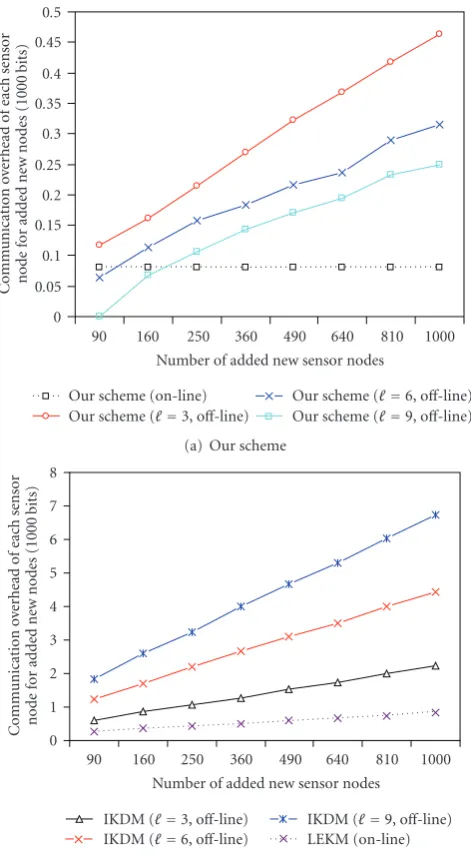
is regularly organized as√m×√mnumber of clusters, and there are exactly 100 sensor nodes in eachR×Rcluster. The transmission range of each cluster head is set as√5R, and the communications between CHs may be made in a multihop manner if they are separated far away from each other. To simulate the sensor node addition process, we consider 10 new sensor nodes to be added to each cluster. In each message interaction for all protocols, the length of each Id and key takes up 32 and 80 bits, respectively.
The performance comparison is made in terms of communication overhead. It is evaluated in the number of bits transmitted for key establishment between a sensor node and a cluster head. In all cases, that is, a sensor node size
n, a cluster sizem, and a specific key distribution scheme, we randomly generated 50 different instances and we present here the average over those 50 instances.
As shown in Figure 6(a), our scheme has the fixed and lowest communication overhead for the on-line scenario. The experimental results also comply with our protocol design for the off-line scenario, in which multiple candidate proxies can improve the performance, that is, the commu-nication overhead is a decreasing function of under fixed network size. In summary, our scheme in both scenarios can significantly outperform other proposals as shown in
Figure 6(b).
6. Conclusion
In this paper, we present an efficient and flexible key distri-bution scheme based on three-tier renewable wireless sensor networks. Our scheme can defend against node capture attack and support dynamic membership management. To our best knowledge, the solution of the key establishment for new cluster heads under both the BS off-line and on-line cases is proposed by the first time. Furthermore, our scheme is efficient and scalable in terms of communication and storage costs, which is particularly beneficial to support large-scale and resource constrained WSNs.
References
[1] I. F. Akyildiz, W. Su, Y. Sankarasubramaniam, and E. Cayirci, “Wireless sensor networks: a survey,”Computer Networks, vol. 38, no. 4, pp. 393–422, 2002.
[2] R. L. Rivest, A. Shamir, and L. Adleman, “A method for obtaining digital signatures and public-key cryptosystems,”
Communications of the ACM, vol. 21, no. 2, pp. 120–126, 1978.
[3] W. Diffie and M. E. Hellman, “New directions in cryptogra-phy,”IEEE Transactions on Information Theory, vol. 22, no. 6, pp. 644–654, 1976.
[4] W. B. Heinzelman, A. P. Chandrakasan, and H. Balakrishnan, “An application-specific protocol architecture for wireless microsensor networks,”IEEE Transactions on Wireless Com-munications, vol. 1, no. 4, pp. 660–670, 2002.
[5] L. Eschenauer and V. D. Gligor, “A key-management scheme for distributed sensor networks,” in Proceedings of the ACM Conference on Computer and Communications Security
(CCS ’02), pp. 41–47, Washington, DC, USA, November 2002.
[6] D. Liu and P. Ning, “Establishing pairwise keys in distributed sensor networks,” in Proceedings of the ACM Conference on
Computer and Communications Security (CCS ’03), pp. 52–61,
Washington, DC, USA, October 2003.
[7] W. Du, Y. S. Han, J. Deng, and P. K. Varshney, “A pairwise key pre-distribution scheme for wireless sensor networks,”
in Proceedings of the ACM Conference on Computer and
Communications Security (CCS ’03), pp. 42–51, Washington,
DC, USA, October 2003.
[8] Y. Cheng and D. P. Agrawal, “Efficient pairwise key establish-ment and manageestablish-ment in static wireless sensor networks,”
in Proceedings of the 2nd IEEE International Conference on
Mobile Ad-Hoc and Sensor Systems (MASS ’05), pp. 544–550,
Washington, DC, USA, November 2005.
[10] G. Jolly, M. C. Kuscu, P. Kokate, and M. Yuonis, “A low-energy management protocol for wireless sensor networks,”
in Proceedings of the 8th IEEE International Symposium on
Computers and Communication (ISCC ’03), pp. 335–340,
Kemer-Antalya, Turkey, June-July 2003.
[11] W. Zhang, H. Song, S. Zhu, and G. Cao, “Least privilege and privilege deprivation: towards tolerating mobile sink compromises in wireless sensor networks,” inProceedings of the 6th ACM International Symposium on Mobile Ad Hoc
Networking and Computing (MobiHoc ’05), pp. 378–389,
Urbana-Champaign, Ill, USA, May 2005.