Original Article
PROCESS OPTIMIZATION, FORMULATION AND EVALUATION OF HYDROGEL
{GUARGUM-G-POLY (ACRYLAMIDE)} BASED DOXOFYLLINE MICROBEADS
NIRANJAN PANDA
1*, KANHU CHARAN PANDA.
1, A. VENKATESHWAR REDDY
1, G.V.SUBBA REDDY
21Anwarul Uloom College of Pharmacy, Newmallepally, Hyderabad-500001, A.P, India. 1*Research scholar, Department of Pharmaceutical Sciences,
JNTUA, Anantapur, 2Department of Chemistry, JNTUA College of Engineering, Pulivendula, YSR(Kadapa) (dist), A.P.
Email: [email protected]
Received: 28 March 2014, Revised and Accepted: 25 April 2014 ABSTRACT
Objective: The objective of the present study was to improve the physical and chemical properties of natural polymers and to reduce the cost of product by graft copolymerization techniques using a natural polymer (Guar gum) and a synthetic polymer {poly (acrylamide)}. The optimized formulation of hydrogel was formulated as microbeads and loaded with Doxofylline and characterized with different parameters.
Methods: Graft copolymer of guar gum-g-poly (acrylamide) was prepared by free radical polymerization technique in a specially designed jacked reaction vessel under constant flow of nitrogen. To initiate the reaction, Ceric ammonium nitrate (CAN) was used as reaction initiator. The graft co-polymer was characterised by using FTIR, TGA, and SEM. Polymeric blend beads of the grafted coco-polymer with sodium alginate were prepared by cross linking with calcium chloride in ionic gelation method and used to deliver a model new generation anti asthmatic drug, Doxofylline. Preparation condition of beads was optimized by considering the percentage entrapment efficiency, particle size, swelling capacity of beads in different PH conditions and their release data.
Results: The formation of grafted copolymers is confirmed by FTIR studies and TGA studies showed a comparatively higher thermal stability of grafted copolymer. The pAAm-g-GG/sodium alginate microbeads were almost spherical in shape as indicated by the SEM studies. Swelling index was found to be maximum in Phosphate buffer PH 7.4 and minimum in Phosphate buffer PH 9.2. Release of doxofylline was found to be in a controlled
manner with increasing polyacrylamide content in the copolymer and sodium alginate content in microbeads and higher release was observed in PH
7.4 medium than that of PH 1.2. In vitro release kinetics of doxofylline from the polymeric beads followed Higuchi kinetics model.
Conclusion: Hydrogel based Doxofylline microbeads were successfully developed by using optimized batches of Guar gum-g-poly (acrylamide) and sodium alginate by free radical ionization technique. All the characterization parameters came under acceptance criteria
Keywords: Hydrogel, Microbeads, Guar gum, Acrylamide, Sodium alginate
INTRODUCTION
Hydrogel based drug delivery system is a most promising novel approach now-a-days for delivery of drug for extended period of time. Hydrogels are the three-dimensional network polymers that swell in aqueous solutions and in swollen state, these become soft and rubbery, resembling a living tissue and some possess excellent biocompatibility. Hydrogel systems possesses a good stability in surrounding conditions like change in PH, ionic strength,
temperature and frequent changes of environment in the GI-tract, which has a variation of environment from the stomach to intestine[1]. Hydrogel from natural polymers, especially polysaccharides have been widely used for their advantages over synthetic polymers such as non-toxic, biocompatible, biodegradable, freely available, able to modify the properties of aqueous environment, capable of thicking, emulsify, stabilize, encapsulate, and swell and to form gels, films. But they can be modified to overcome some drawbacks, like uncontrolled rate of hydration, microbial contamination, drop in viscosity on storing, etc. Graft copolymerization is an easier method to modify the structure of natural polymers and make them attractive biomaterial in controlled release applications. The Microbeads are characteristically free flowing particles consisting of proteins or synthetic proteins or synthetic polymers which are biodegradable in nature and ideally having a particle size in micron range capable of releasing drug for prolonged period of time. Sodium alginate is a salt of alginic acid, which has the capacity to crosslink with other natural or synthetic polymers when it comes in contact with divalent or trivalent cations and the method is called as ionic gelation method. Alginate is a natural carbohydrate polymer commonly used in the drug delivery systems because they are biodegradable, biocompatible and non toxic. Alginate belongs to a family of linear polysaccharides, produced by brown algae, which contain varying amount of 1, 4-linked β-D-mannuronic acid and α-L-guluronic acid residues.
Sodium alginate has been commercially applied and investigated due to its low cost and minimal processing requirement. Alginate gelation takes place when divalent or trivalent cations (usually Ca2+),
interacts ionically with guluronic acid residues, resulting in formation of a three-dimensional network which is usually described by egg-box model. Alginate- Ca2+ has been widely
investigated for oral and nasal drug controlled release applications. So calcium chloride can be used as a cross linking agent for the preparation of microbead in ionic gelation method [2].
Asthma and COPD (Chronic Obstructive Pulmonary Disease) are the most common life threatening pulmonary diseases that requires constant monitoring. Xanthine derivatives are used since a long period of time for treatment of Asthma and COPD. Doxofylline is a new generation xanthine derivative that works by inhibition of phosphodiesterase activities with no cardiovascular side effects that usually seen in case of theophylline and other xanthine derivatives due to decreased affinities towards adenosine A1 and A2 receptors. To reduce the frequency of administration and to improve patient compliance, a once-daily sustained-release formulation of doxofylline is desirable. The drug is freely soluble in water, and hence judicious selection of release-retarding excipients is necessary to achieve a constant in vivo input rate of the drug. The present study aims a successful development of hydrogel based doxofylline microbeads for effective management of asthma and COPD [3,4].
EXPERIMENTAL
Materials
Doxofylline was procured as a gift sample from Dr. Reddy’s Laboratories Hyderabad, India. Guar gum is collected from Girijan Corporation, Hyderabad, India. Acrylamide is purchased from Nice chemicals, Mumbai, India. Calcium Chloride (CaCl2) was purchased
from central drug house (P) ltd., New Delhi. Acetone, Potassium
Dihydrogen phosphate were purchased from SARA fine chemicals, Baroda, India. All the ingredients are laboratory grade. Distilled water used in the process of research work was prepared by double distillation process in the laboratory.
Synthesis of graft copolymer of guar gum-Acrylamide
The graft copolymerization was carried out in a specially designed jacketed reaction vessel having an inlet and outlet port. The inlet port was connected with the nitrogen gas supplied from the nitrogen cylinder (AR grade). The grafted copolymer of guar gum and Acrylamide was prepared by free radical polymerization technique. Specified amount of Guar gum was dissolved in 75-150 ml of water and soaked for overnight under stirring in a 250 ml round bottom flask for complete hydration. Then specified amount of Acrylamide was dissolved in 20ml of water and added to GG solution and mixed uniformly for 1 hour and the mixture was transferred to reaction vessel. To this solution, Ceric Ammonium nitrate (CAN) was added in various concentrations to optimise the formulation and to get better yield. Polymerization was carried out at 600C with a continuous
purging of nitrogen gas for 6 hour in a magnetic stirrer at 100 rpm. After complete polymerization, a sufficient amount of acetone was added to precipitate the grafted co-polymer. Then the grafted polymer was filtered and dried in hot air oven at 400C for 24 hour
[5,6,7,8].
The % yield was calculated as
Percentage yield = (mass of the co-polymer after drying/ mass of the total polymer) × 100
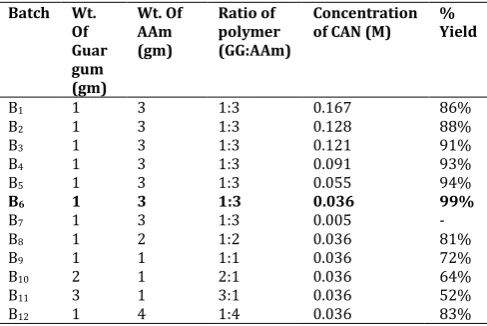
The graft co-polymerization method was optimized for the optimum graft yield using different proportion of Guar gum and poly-Acrylamide and using different concentration of initiator (CAN). The results are shown in table-1 indicating different proportion of Guar gum and polyacrylamide with different concentration of CAN and % yield of co-polymer.
Table 1: Composition of polymers & initiator for different batches in copolymer synthesis. with 25ml of water and crushed it properly to form a gel like mass and mixed with uniform paste like mass of hydrogel by trituration
hydrogel and sodium alginate used are shown in table-2.
Loading of Doxofylline in microbeads
Prepared microbeads from different formulations were loaded with drug by soaking in an aqueous solution containing 10% (w/v) of Doxofylline. Soaking was carried out for nearly 24 hour in order to
insure complete equilibrium. The formulations were filtered and the surface adhered drug solution was removed by washing and blotting with soft filter paper and dried in air and stored in a desiccator until further use.
Drug also loaded during the preparation of microbeads by trituration method. Required quantity of drug was mixed with small quantity of distilled water and drug solution was mixed with
Characterization of paam-g-gg hydrogel and drug loaded Microbead [8,9]
Drug-polymer compatibility study by Fourier Transform Infrared (FTIR) spectroscopy
Guar gum grafted copolymer and the cross-linked drug loaded microbeads along with individual polymers were analysed by FTIR spectroscopy to confirm grafting and cross linked reactions. The polymer samples were crushed with potassium bromide to make pallets. Spectra were taken on a Perkin Elmer paragon 500 FTIR spectrophotometer in a range of 400-4000 cm-1.
Thermogravimetry Analysis
Thermogravimetry analysis was carried out on GG, pAAm-g-GG and cross-linked microbead. The thermograms were recorded with a Shimadzu DTG-50 thermal analyser. The sample was heated from room temperature to 600 0C at a heating rate of 100C per min.
Microscopic studies by scanning electron microscopy (SEM)
Dried microbeads were studied using an optical microscope to measure the particle size and surface characteristics. The particle size was measured by taking 100-200 particles on a glass slide under regular polarised light. SEM analysis was performed to know the topological characterization of microbeads. The sample was kept in a brass holder and coated with Gold. The SEM photograph was taken using JSM-6390 LV Scanning electron microscope (Jeol ltd, Japan) at a magnification of X5 to 300,000 (Resolution-HV 3.0 nm).
Swelling Studies
Equilibrium water uptake of the cross-linked drug loaded microbeads were determined by measuring the extent of swelling of the matrixes in water and it is also compared with different buffer solutions like Hydrochloric acid buffer PH 1.2, acetate buffer PH 4,
Phosphate buffer PH 7.4, and phosphate buffer 9.2. To ensure
compete equilibrium, the samples were allowed to swell for 24 hours. The excess surface adhered liquid drops were removed by blotting in a filter paper and the swollen microbeads were weighed to an accuracy of 0.01mg using an electronic microbalance. The hydrogel microbeads were then dried in an oven at 600C for 5 hours
until there was no change in the dried mass of the samples. The percent equilibrium water uptake was calculated as:
(Mass of swollen microbeads – Mass of dry microbeads / Mass of dry microbeads) × 100
Estimation of Drug entrapment efficiency of microbeads
phosphate buffer PH as the hydrogel microbeads can’t be dissolved
completely in organic solvents or acids. The solution was then gently heated for 2 hours to extract the drugs completely and filtered to analyze the amount of Doxofylline entrapped by using a UV-Visible spectrophotometer (Genesys 2) at 274 nm.
In Vitro drug release study
The in vitro drug release from the pAAm-g-GG/Sodium alginate hydrogel microbeads was carried out in a USP-I rotating basket dissolution apparatus (Hicon dissolution rate test apparatus USP) at a rotation speed of 100 rpm at 37 0C. A proper simulation of
gastrointestinal (GIT) condition was maintained by altering the PH of
dissolution medium at different time intervals following two step dissolution conditions. To simulate the physiological conditions of GIT, first 2 hour of dissolution was carried out in 900 ml of simulated gastric fluid (SGF, 3.2 mg/ml pepsin in 0.05 M HCl, PH 1.2)
and the rest of the time in 900 ml of simulated intestinal fluid (SIF, 10 mg/ml pancreatic fluid in Sorensen’s phosphate buffer, PH 7.4) at
regular intervals of time, the aliquots were withdrawn and analysed for drug using the UV-Visible spectrophotometer (Genesys 2) at 274 nm. After each sampling an equal volume of fresh dissolution media was added to the dissolution medium. All the dissolution studies were repeated six times [12, 16].
Kinetic of release profile [15]
To study the release kinetics, data obtained from in vitro drug release studies were plotted in various kinetic models.
Zero order kinetics was plotted as cumulative percentage amount of drug release vs. time and the equation is represented as follows.
C = K0 t where C = Cumulative drug release at time t.
K0 = Zero order rate constant
First order kinetics was plotted as log cumulative percentage amount of drug release vs. time and the equation is represented as follows.
log C = log C0 - 𝐾𝑡
2.303 where C = Amount of drug remained at time t
CO = Initial amount of drug
K= First order rate constant
Higuchi kinetics was plotted as cumulative percentage amount of drug release vs. square root of time and the equation is represented as follows.
Q = K t1/2
Q = Cumulative percentage drug release at time t.
In Korse-Meyer Peppas kinetic model graph is plotted between logarithms of cumulative drug release vs. logarithm of time. The equation is represented as follows equation:
F = Mt/ Mα = Kmtn
Where Mt is the drug released at time t, Mα is the total amount of
drug in dosage form, F is the fraction of drug release at time t, Km is a constant dependant on geometry of dosage form, ‘n’ is the diffusion exponent indicating mechanism of drug release.
RESULTS AND DISCUSSION
Optimization of graft co-polymerization techniques
The aim of the present study was to attempt graft copolymerization of GG with Acrylamide by using Ce(IV) catalyzed free radical reaction. The chelate complex formed between –OH group of GG decomposes to generate the free radical site, facilitating grafting to occur at the active site of GG with Acrylamide monomer. The reaction is shown in scheme 1. Graft copolymerization process was optimized with concentration and ratio of polymer used by comparing batch to batch yield. It was observed that at concentration greater than 0.1276 M, the hydrogel formed was sticky in nature and deposited at the bottom with less yield. But by
using concentration below 0.1276 M and upto 0.0182 M, the hydrogel formed was non-sticky in nature and that floated on the surface. At polymer ratio of 1:3 (GG:pAAm) and with CAN concentration of 0.0364 M, maximum yield was obtained [11,13].
Fig.5: Showing structural representation of GG-g-AAm
Formulations of GG-pAAm hydrogel/sodium alginate microbeads
Hydrogel obtained from different ratio of Guar gum and pAAm with optimised concentration of CAN were taken. Then different ratio of hydrogel and sodium alginate were used for preparation of microbeads. It was observed that when hydrogel:SA ratio was 3:1, the microbeads formed couldn’t retain it’s spherical shape after drying. By increasing SA ratio the spherical shape of microbeads could be retained and it was optimum when hydrogel: SA ratio is 1:3 having GG:pAAm in hydrogel was 1:3 also.
FTIR characterization of graft copolymer and drug polymer compatibility study in microbeads
The FTIR spectra of Acrylamide, guar gum, hydrogel, pure doxofylline drug and microbeads were shown in figure -2. The grafting reaction between Acrylamide and guar gum was confirmed by FTIR spectroscopy. A sharp peak observed at ̴ 1674 cm-1 which
represents the carbonyl group of amide moiety of the grafted Acrylamide chain is not observed in GG . The –NH stretching which appeared at ̴ 3182 cm-1 of the graft copolymer has overlapped with a
broad peak between ̴ 3650 cm-1 and ̴ 3000 cm-1 of the hydroxyl
group. These data support the grafting reaction between acrylamide
and guar gum. By comparing the spectra of hydrogel, doxofylline and microbeads, the sharp peaks that appear in spectra of doxofylline at ̴ 3110 cm-1 also appears in microbead at ̴ 3145 cm-1 and sharp peak
that appears in spectra of hydrogel at ̴ 3102 cm-1 also appear in
spectra of microbead at ̴ 3104 cm-1. The broad peak between ̴ 3500
cm-1to ̴ 3000 cm-1 appears both in hydrogel and microbead. The
characteristic IR absorption peaks of Doxofylline at ̴ 1700 cm-1 (C=O
stretch), at ̴ 1656 cm-1 (C=C stretch), at ̴ 1547 cm-1 (C=N stretch), at ̴
1477 cm-1 (C-H bend) and at ̴ 1190 cm-1 (C-N vibration) were also
present in the microbeads with no shifting in the major peaks, indicate that no interaction occurred between the Doxofylline and polymers used in the preparation of microbeads.
Microscopic study
The pAAm-g-GG/sodium alginate microbeads were almost spherical in shape as indicated by the SEM photograph as shown in fig-3. The surfaces were smooth without any porous structure. The particle diameter range from 406 to 651 µm and were free flowing without forming any aggregation.
Fig.2: Scanning electron microscopic image of Doxofylline loaded Microbeads at 5kV.
Drug entrapment efficiency
Doxofylline was loaded during preparation of microbeads as well as by soaking of prepared microbeads in drug solution. The drug entrapment efficiency was compared between two methods. It was observed that the drug loaded during the preparation of microbeads by trituration method contains more percent of drug than by soaking method. The drug loaded by method of trituration during preparation of microbeads contain the drug between 90% to 96% for different batches and drug loaded by soaking method contain drug between 85% to 92%. The drug loading efficiency results was shown in following Histogram.
Fig.3: Showing percentage drug content of different formulations.
Swelling studies
Equilibrium fluid uptake of microbeads was performed in different buffer solutions that provided knowledge about release of drug in particular medium and put foundation for choice of the dissolution medium. The percent fluid uptake was found to be maximum i.e 1950 in phosphate buffer PH 7.4 and minimum i.e 230 in phosphate
buffer PH 9.2. The percent fluid uptake was found to be i.e 520 in HCl
buffer PH 1.2. The results are shown in the histogram figure-6.
In-Vitro drug release study
In vitro Doxofylline release from microbeads prepared in every formulation batch was carried out in PH progressive media i.e
simulated gastric fluid and simulated intestinal fluid as the dissolution medium to observe the release behaviour in different PH
conditions. The rate and extent of drug release from different formulations were compared with different proportions of polymer used in microbeads as well as in hydrogel. Among all the formulations the initial release rate is low in simulated gastric fluid and it increase with formulations containing lower amount of sodium alginate. The formulation F5 which contains hydrogel:SA
ratio 1:3 having GG : pAAm ratio 1:3 in hydrogel, had shown a release of drug upto 12 hour in controlled manner. The formulation F3 which contains hydrogel:SA ratio 3:1 having GG : pAAm ratio 3:1
in hydrogel, causes an initial burst release of drug upto 30% within an hour followed by maximum release of drug within 6 hours. Increase in the concentration of sodium alginate in microbeads and decrease in the concentration of guar gum in hydrogel improved the release rate in a controlled manner.
Fig.4: Showing in vitro drug release study of Doxofylline loaded microbeads.
In vitro drug release kinetic mechanism
In order to determine the mechanism of drug release from GG-g-pAAm/sodium alginate microbeads, different kinetic models such as zero order kinetic, first order kinetic, Higuchi model and Korse-Meyer Peppas kinetic models are used for optimised batch F5.
Regression co-efficient (R2) values of each kinetic model were
compared to find out the best fit model. By comparing the R2 values
Fig.6: Showing swelling studies of different formulations in different media.
Fig.7: Showing in-vitro drug release kinetic studies.
Stability studies
After storing the formulations for three months at accelerated stability conditions i.e 40 0C/75% RH as per ICH guidelines, the
Doxofylline loaded microbeads were found to retain the same drug content with minor deviations. Overall results from the stability studies indicated that formulations were physically and chemically stable [14].
CONCLUSION
Different batches of GG-g-pAAm hydrogel were synthesised using specially designed conventional equipments to form graft copolymer which showed a better thermal stability than guar gum. From FTIR study grafting of guar gum with AAm was confirmed with formation of new functional group as shown in figure-1. Graft copolymerization techniques were optimised with respect to the ratio of GG and pAAm used and concentration of CAN used. With CAN concentration above 0.1216 M the hydrogel formed were sticky and settled down at bottom and gave fewer yields. Formulation having GG:pAAm ratio 1:3 and CAN concentration 0.0364 M gave maximum yield around 96%. The graft co-polymerisation was cross-linked with sodium alginate by using calcium chloride as a cross linking agent and ten different formulations were formulated by using different ratio of hydrogel and sodium alginate. The drug doxofylline was loaded to
different formulations by two different methods i.e by trituration and by soaking methods. It was observed that the entrapment efficiency was higher if the drug is loaded during formation of microbeads before cross linking. The FTIR study was carried out for prepared microbeads and doxofylline to know the drug polymer interaction and it was observed that there is no interaction between drug and polymers. The swelling studies were carried out by using different buffer solutions and distilled water. The swelling index was found to be maximum in phosphate buffer PH 7.4. The swelling index
was calculated for different formulations in each medium and it was observed that the formulation containing more concentration of GG had more swelling index in comparison to other formulations.
In vitro drug release studies were carried out in simulated gastric fluid followed by simulated intestinal fluid. It was observed that the formulation that contains more concentration of GG in hydrogel and less concentration of sodium alginate in microbeads causes initial burst release of drug followed by maximum release upto 6 to 8 hours. Formulation F5 which contains hydrogel with ratio of
ACKNOWLEDGEMENT
Author thanks to Dr Reddy,s laboratories limited (Hyderabad, India) to provide Doxofylline BP pure drug as a gift sample. Thanks to SD fine chemicals, Mumbai for providing Acrylamide and sodium alginate. Author is thankful to P.G department of pharmaceutics, SSJCPS, Bhubaneswar; for providing me opportunity to carry out polymer synthesis work. Author is also thankful to management and principal Anwarul Uloom College of Pharmacy, New Mallepally, Hyderabad for providing laboratories and reagents for research work. Thanks to library staff Anwarul Uloom College of Pharmacy, New Mallepally, Hyderabad for providing the facility and their active support to carry out literature survey.
REFERENCES
1. Chein YW., Novel drug delivery system. 2nd ed. Morcel Dekker. Inc, 1997, 1-42.
2. Gwen MJ., Joseph RR., Banker GS and Rhodes CT, (editors).
Modern pharmaceutics. 3rd ed., Morcel Dekker. Inc, 1996, 575.
3. Goodman and Gillman’s, The Pharmacological Basis of
Therapeutics, 11th ed. Laurence L. Brunton, John S. Lazo, 1635-1638.
4. www. Medicines.org.uk/emc/browsedocuments
5. Aulton ME. Wells TI., Pharmaceutics: The Science of Dosage
Form Design, London, England: Churchill Livingstone: 1988: 185-189.
6. X. QU, A. Wirsen, A.C Albertsson, Novel PH-sensitive chitosan hydrogel: swelling behaviour and states of water, polymer 41 (2000) 4589-4598.
7. Narayan B; Jonathan G; Miqin Z; chitosan based hydrogels for controlled localised drug delivery. Adv. Drug Delivery Re 2010, 62, 83-99.
8. Tejraj M. Aminabhavi; et al water transport and drug release study from cross-linked polyacrylamide grafted guar gum hydrogel microsperes for the controlled release application, Euro. Jour. of Ph. And Bioph. 53 (2002) 87-98.
9. P. Sunny Gils, et al; controlled release of Doxofylline from Biopolymer based Hydrogels; Am.Jour. of Biomed. Sc. 2010, 2(4), 373-383.
10. Baljit S., Nirmala, C.; Diatary fiber Psyllium based hydrogels for use in insulin delivery. Int. J. Diabet. Melt. 2010, 2, 32-37. 11. Clive, D.P. (2010) Doxofylline: A “Novofylline” pulmon. Pharm
Therap. Doi: 10.1016/J.Pupt.2010.04.02
12. T.M Aminavi, G.V. Patil, S.F. Harlapur; R.H. Balundgi; A
reviewed on sustained release of cardiovascular drugs through Hydroxy Propyl Methyl Cellulose and sodium carboxymethyl cellulose polymers, Des.Monom.Polym.1(1998) 347-372. 13. B. Gander, V.Beltrami, R. Gurny. et.al, Effects of the method of
drug incorporation and the monolith on drug release from cross-linked polymers. Int. J. Pharm. 58(1990) 63-71.
14. Carstensen, J.T.; C.T. Rhodes Drug stability; Principles and practicle; Markel Dekkar:: New York; 2000.
15. Hadjioannu T.P.,et.al, Quantitative Calculations In Pharmaceutical Practice and Research, New York: VCH Publishers Inc., 1993, 345-348.