ISOLATION OF HEN EGG WHITE LYSOZYME BY CATION EXCHANGE CHROMATOGRAPHY,
ANALYSIS OF ITS DIGESTIBILITY AND EVALUATION OF THE INHIBITION LIPID
PEROXIDATION IN THE ZEBRAFISH MODEL
CARRILLO W*, TUBÓN J, VILCACUNDO R
Laboratory Functional Foods, Faculty of Foods Science and Engineering, Technical University of Ambato, Av. Los Chasquis y Rio Payamino, Campus Huachi, CP 1801334, Ambato-Ecuador. Email: [email protected]
Received: 29 February 2016, Revised and Accepted: 10 March 2016
ABSTRACT
Objective: The aim of this study was to separate and identify lysozyme using cation exchange chromatography, evaluate the protein digestibility and analyze the inhibition lipid peroxidation in the zebrafish model.
Methods: Hen egg white lysozyme was isolate with cation exchange chromatography. Residual muramidase activity was evaluated with the spectrophotometric method. Isolate lysozyme (ILZ) and hydrolysates were analyzed with sodium dodecyl sulfate-polyacrylamide gel electrophoresis (SDS-PAGE) electrophoresis and reversed-phase high-performance liquid chromatography (RP-HPLC).
Results: To identify the protein, the sample was isolated with cationic exchange chromatography, sample was analyzed using RP-HPLC and SDS-PAGE confirming that the fraction was hen lysozyme egg white. The enzymatic activity of the isolated protein was normal compared to the commercial lysozyme activity. Hydrolysates had no muramidase activity and were able to inhibit lipid peroxidation in zebrafish larvae.
Conclusions: Cation exchange chromatography is a good method to ILZ from egg white. Hydrolysates of lysozyme were effective to inhibit lipid peroxidation in zebrafish model.
Keywords: Lysozyme, Cation exchange chromatography, Enzymatic hydrolysis, Muramidase activity.
INTRODUCTION
Lysozyme (EC 3.2.17, N-acetyl-muramic-hydrolase) is a globular basic protein found in nature and is characterized by its high enzymatic activity. It was first discovered in nasal mucous by Alexander Fleming, who named it “Lysozyme” as he observed its lytic activity toward bacterial cocci [1]. The egg albumen is known to have an exceptionally high amount of lysozyme, normally referred to as hen’s egg lysozyme, representing 3.5% of the egg white protein content [2-5]. The lysozyme is a basic protein consisting of 129 amino acids and a molecular weight of 14.3 kDa. This enzyme acts by lysing the cell walls of certain Gram-positive bacteria such as lactic acid bacteria and Clostridium sp. by splitting β (1-4) linkages between N-acetylmuramic acid and N-acetylglucosamine of the peptidoglycan of bacterial cell walls [6-9]. Lysozyme has been associated with many biological activities such as antibacterial, antiviral, immunomodulating, immunostimulating, antioxidant, antiviral, and antitumoral activities among others [10-17]. Classical separation methods of proteins are based on the salting out of solution or precipitation with alcohol. These techniques have been extended by the ion exchange (IEX) chromatography and membrane separation in recent years. Presently, researchers are looking for separation methods, which will be cheap, easy, nontoxic, and maintaining the highest biological activity of isolated proteins [18-21]. The aim of the study was to isolate lysozyme (ILZ) using cation exchange chromatography, evaluate its digestibility and then measure their muramidase activity and ability to inhibit lipid peroxidation in zebrafish larvae.
METHODS
Lysozyme and materials
Lysozyme (L2879, chloride form from chicken egg white Grade VI, 40000 units/mg protein, EC 3.2.1.17) and pepsin crystalline (4500 units/mg obtained from porcine stomach mucus and Micrococcus lysodeikticus) were purchased from Sigma Chemical Co. (Saint Louis, MO, USA).
Isolation of proteins from egg white
About 500 ml of egg white treated with ethanol 30% and adjusted pH at 5.8 to separate the mucine. The solution was centrifuged at 4.000 rpm for 30 minutes at 4°C. The supernatant was discarded, and the precipitate was adjusted at pH 7.4 with 1 M NaOH and subject to IEX chromatography.
IEX chromatography
Proteins form egg white were separated by IEX as described by Recio and Visser [22] with some modifications using a fast protein liquid chromatography (FPLC) system with a cation exchange column HiLoadTM 26/10 SP-Sepharose Fast Flow (Pharmacia) [23]. Solvent A was 10 mM ammonium hydrogen carbonate acidified to pH 7 with formic acid, and solvent B was 3 M of ammonia solution. The effluent was monitored at 280 nm. Each chromatographic run was repeated 10 times, and the collected fractions were pooled, frozen, and lyophilized. Following these fractions were analyzed with reversed-phase high-performance liquid chromatography (RP-HPLC) and sodium dodecyl sulfate-polyacrylamide gel electrophoresis (SDS-PAGE).
Enzymatic hydrolysis of lysozyme
Commercial, ILZ and hydrolysates were initially dissolved at 5 mg/ml in potassium phosphate buffer 10 mM (pH 1.5). 1 ml of this lysozyme solution was mixed with 50 mL of pepsin solution of 200 U/mg (5 mg/ml in solution of 0.035 M NaCl, pH 2.0) to obtain an enzyme-to-substrate ratio of 1:20 w/w. This mixture was incubated at 37°C for 1 hr. The reaction was stopped by heating at 80°C for 15 minutes, and the pH was adjusted at 7.0 by addition of 1 M NaOH [7].
SDS-PAGE analysis
The samples were dissolved in 10 mM Tris-HCl buffer, pH 8, 2.5% SDS, and 10 mM ethylenediaminetetraacetic acid (non-reducing conditions) or the same buffer containing 5% b-mercaptoethanol (reducing conditions), and heated at 95°C for 10 minutes [24]. Analysis by
PAGE used PhastSystem Electrophoresis apparatus, precast 20% homogeneous gels and PhastGel SDS Buffer Strips (GE HealthCare, Barcelona, Spain), following the electrophoretic and silver staining conditions of the manufacturer.
RP-HPLC analysis
Lysozyme hydrolysates, at a concentration of 2.0 mg/ml, were analyzed using a Hi-Pore® RP-318 (250 mm × 4.6 mm i.d.) column (Waters,
Milford, MA) in a Waters 600 HPLC system. Solvent A was 0.37% (v/v) trifluoroacetic acid (Scharlau Chemie, Barcelona, Spain) in double-distilled water, and solvent B was 0.27% (v/v) trifluoroacetic acid in HPLC-grade acetonitrile (Lab-Scan, Gliwice, Poland). The chromatographic conditions were as in Martos et al. [25]. Detection was at 220 nm, and data were processed using Empower 2 Software (Waters).
Muramidase activity assay
The lytic activity of lysozyme was determined by monitoring the decrease in turbidity of a suspension of M. lysodeikticus cell spectrophotometrically at 450 nm at 25°C, according to Shugar’s method [26]. One unit of lysozyme was defined as a decrease in the absorbance at 450 nm of 0.001 minutes−1. The muramidase activity of each sample was assayed in triplicate.
Thiobarbituric acid reactive substances (TBARS)
The thiobarbituric acid reactive species method was used as described by Westerfield, 1995 [27]. The zebrafish colony was established in the laboratory, in an environmental growth or glass aquarium, provided with internal filter and aerator activated carbon for water oxygenation. The population of animals was fed three times a day with food chips for fish. Adult fish were kept on 16 hrs light and 10 hrs dark cycles. Embryos were obtained by photo-induced spawning over green plants and were cultured at 28°C in fish tank water. Larvae of 5 dpf were then incubated in 24-well plates, 30 larvae per well for each 100 mg/ml of lysozymes and hydrolysates. Lipid peroxidation was initiated by adding 1 ml 500 µM H2O2 and incubated for 24 hrs at 28°C. Groups
from 30 larvae/well in aquarium water were used as controls. Then, it was removed the H2O2, and it was added 500 µl of Tween 0.1%.
Each group was mixed and homogenize with a T25 ultra turrax IKA after the absorbance was measured at 532 nm, and the decrease of absorbance indicates an increase of antioxidant activity. Values of antioxidant activity were expressed as the percentage inhibition of lipid peroxidation in larvae homogenate as follows: The total antioxidant activity % inhibition of lipid peroxidation=[(Ab−As)/Ab×100] where Ab = absorbance of control and As= absorbance of sample. The test larval was monitored using a microscope with a Motic Moticam 580, 5 MP.
Test of toxicity in the model of zebrafish
Zebrafish of the AB strain (wild-type, wt) embryos were obtained from natural spawnings. Embryos were raised and fish were maintained as described by Westerfield [27]. After collection and disinfection, eggs were reared in 24-well microplates with 1 ml of water.
Fish embryo toxicity (FET) test
The assay was based on the OECD draft guideline on FET test [28] and is described in detail by Domingues et al. [29]. 10 eggs per treatment (3 replicates) were selected and distributed in 24-well microplates. The test started with newly fertilized eggs exposed to the nominal concentrations of 0; 2.5; 5; 25; 50; 100 mg/ml of lysozymes and hydrolysates run for 2 days. Embryos were observed at 24 and 48 hrs under a stereomicroscope (magnification used for observations was ×40). The following parameters were evaluated as an endpoint and considered lethal if one of them is detected egg coagulation, lack of development somites, lack of tail detachment, and lack of heartbeat [30].
Statistical analysis
Results are presented as means±standard deviation from three replicates of each experiment. Differences between mean values were
determined by the analysis of variance (ANOVA). The post hoc analysis was performed by the Tukey test. All tests were considered significant at p<0.05. Statistical analysis was performed using the software package Prism 4 for Windows, version 4.3 (GraphPad Software Inc., www.graphpad.com).
RESULTS
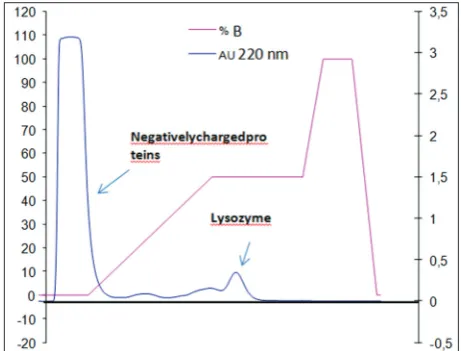
Hen egg white lysozyme is a protein with high isoelectric point (pI=10.7) in physiological conditions. At pH 7.0, lysozyme has positive charge but at pH >10.7 has negative charge. The egg white has different proteins such as ovalbumin (pI=4.5), ovotransferrin (pI=6.0), and ovomucin (pI=4.1); these proteins have an isoelectric point under 7.0; therefore, they have a net negative charge. These charge differences according to pI allow separating the white egg through cationic exchange chromatography [19]. This fact can be observed in Fig. 1. At the beginning of the chromatogram, a peak with high absorption can be observed at the wavelength used (220 nm), this peak relates to proteins with negative charge nature, as these proteins are unable to join to the negative charge of the column, resulting in being eluted with the solvent. While lysozyme was found retained in the column by charge affinity, the percentage of ammoniac concentration was increased to gradually increase pH, when pH overcome the pI of lysozyme, lysozyme changes the charge to become negatively charged and being eluded from the column, this fact is reflected at the second peak of the chromatogram with an absorption at the wavelength of 220 nm. To determine if lysozyme was effectively separated, the collected FPLC fraction was subject to RP-HPLC with the aim of confirming with its time retained compared to the time retained of a standard of commercial lysozyme (CLZ), to confirm whether or not effectively is lysozyme.
Fig. 2a shows 38 minutes retained time for a standard lysozyme at the concentration of 2 mg/ml; it was then observed the same retained time for the fraction obtained through fast protein liquid chromatography (FPLC) (Fig. 2b). Both CLZ and the fraction of FPLC were subject to hydrolysis with pepsin at pH 1.2; and it was observed the same behavior for both of them. Pepsin hydrolyzes protein completely at this pH. The products of the hydrolysis are identical in the CLZ and the isolated lysozyme (Fig. 2c and d).
The fraction obtained through FPLC was analyzed by SDS-PAGE. In Fig. 3, it is shown that lane 2 reflects the CLZ, lane 3 to the purified FPLC lysozyme, both bands being at the same height of retain in the gel.
Using data of lane 1, which corresponds to the molecular weight marker, we can see that both bands are at 14.400 Da. Confirming the molecular weight of the purified protein in the FPLC obtained fraction. In lanes number 4 and 5, two bands below 14.400 Da can be observed;
those lanes relate to peptides resulting of the product of the hydrolysis with pepsin. No intact lysozyme can be observed at this hydrolysis pH.
We finally evaluate the enzymatic activity of the lysozyme of white egg or also called muramidase activity. White egg lysozyme has the capacity of hydrolyzing the walls of bacteria Gram-positive. For this test, lyophilized walls of Micrococcus lysodeikticus ATCC 4698 were used, the decrease of observance at 450 nm was measured. In Fig. 4, it can be seen that the FPLC purified lysozyme presented 97% of muramidase activity, the CLZ hydrolyzed only kept 1.7% of said activity and the FPLC purified lysozyme hydrolyzed presented only kept 2.0% of said enzymatic activity, this data indicate that the active site of lysozyme was reduced to small fragments, which have no muramidase activity.
These results are in agreement with different studies where has been described hydrolyzed lysozyme with no muramidase activity [4,31].
In Fig. 5a, it can be seen that CLZ and the isolated lysozyme through chromatography were only able to inhibit the lipid peroxidation in zebrafish larvae 21% and 23%, respectively, whereas hydrolyzed presented a high activity, being able to inhibit 82% for the hydrolyzed of CLZ and 84% for the isolated hydrolyzed lysozyme through cationic exchange chromatography. Both hydrolyzed were effective, and there
are not meaningful differences when they are analyzed statistically. The zebrafish larvae after 24 hrs of the assay when were examined no show obvious morphological abnormalities as crooked bodies, spinal deformities, and not exhibit any significant effects on the growth of the body zebrafish larvae (Fig. 5b).
As shown in Fig. 6a, the mortality of the Zebrafish egg when they were treated with different concentrations of lysozymes and hydrolysates. No significant effect on the survival rate was observed for all treatments groups. When the morphologies of these lysozymes treated were examined, no show obvious morphological abnormalities such as egg coagulation, lack of development somites, lack of tail detachment, and lack of heartbeat. The embryos were normal (Fig. 6b).
DISCUSSION
Hen egg is one of the most common foods that induce hypersensitive reactions in young children. Egg white contains more than 20 kinds of proteins. Ovomucoid (Gal d 1), ovalbumin (Gal d 2), ovotransferrin (Gal d 3), and lysozyme (Gal d 4) have been identified as main allergens in the egg white. Hen egg white lysozyme is a potent allergen named Gal d4 with resistant at hydrolysis with pepsin. It is known that lysozyme
Fig. 3: Sodium dodecyl sulfate-polyacrylamide gel electrophoresis analysis of lysozyme. Lane 1: Weight molecular, Lane 2: Commercial lysozyme (CLZ), Lane 3: Isolate lysozyme (ILZ), Lane
4: Hydrolysate of CLZ, Lane 5: Hydrolysate of ILZ. Coomassie-stained polyacrylamide gel
Fig. 4: Residual muramidase activity of commercial lysozyme (CLZ), isolate lysozyme (ILZ), hydrolysate of CLZ and hydrolysate
of ILZ. The decrease in turbidity of a cell suspension of
Micrococcus lysodeikticus was determined at 450 nm in phosphate buffer at pH 6.24 and 25°C. Data were analyzed by analysis of variance (GraphPad Prism), and the means were separated by
Tukey’s multiple range test. The significance was defined at p≤0.05
Fig. 5: (a) Thiobarbituric acid reactive results of lysozyme. Data are expressed as % thiobarbituric acid reactive substances inhibition compared to a negative control (error bars expressed
as ±SD). n=30 zebrafish larvae. Commercial lysozyme (CLZ), isolate lysozyme (ILZ), hydrolysate of CLZ and hydrolysate of ILZ, (b) Morphologies of zebrafish larvae after incubation with
lysozymes Fig. 2: Reversed-phase high-performance liquid chromatography
of lysozyme, (a) commercial lysozyme (CLZ), (b) isolate lysozyme (ILZ), (c) hydrolysate of CLZ, (d) hydrolysate of ILZ
a
b
c
d
has resistance to the hydrolysis with pepsin, but it has been recently described that lysozyme at pH 1.2 has total susceptibility to the hydrolysis with pepsin [7,32-34]. In this study, hen egg white lysozyme was hydrolyzed with pepsin at low pH in simulated gastric fluid (SGF).
The relationship between allergenicity and stability to digestion and the most appropriate experimental conditions for measurement of stability have been the subject of some discussion. The first report by Astwood et al. [31] demonstrated that many animals and plant food allergens displayed resistance to pepsin digestion in vitro, whereas other common plant proteins believed not to be allergenic were digested rapidly (within 30 seconds). The hydrolysis in vitro with pepsin was assayed in SGF 0.35 M NaCl. However, in subsequent studies, the relationship between resistance to digestion and allergenicity was found not to be absolute [35-37].
CONCLUSIONS
Isolate protein by cation exchange chromatography was analyzed with RP-HPLC; SDS-PAGE and identified as hen egg white lysozyme. It slytic enzymatic was normal compared to CLZ. Isolated lysozyme was susceptible to in vitro digestion with pepsin at pH 1.5. Hydrolyzed of both commercial and isolated lysozymes were able to inhibit lipid peroxidation in zebrafish larvae.
ACKNOWLEDGMENTS
This study was supported by Universidad Técnica de Ambato, Ecuador. This work has been reviewed in the English edition by Emilio Labrador. This work was support for project form Universidad Técnica de Ambato.
REFERENCES
1. Jollès P, Jollès J. What’s new in lysozyme research? Always a model system, today as yesterday. Mol Cell Biochem 1984;63(2):165-89. 2. You SJ, Udenigwe CC, Aluko RE, Wu J. Multifunctional peptides from
egg white lysozyme. Food Res Int 2010;43(3):848-55.
3. Memarpoor-Yazdi M, Asoodeh A, Chamani T. A novel antioxidant and antimicrobial peptide from hen egg white lysozyme hydrolysates. J Funct Foods 2012;4:278-86.
4. Mine Y, Ma F, Lauriau S. Antimicrobial peptides released by enzymatic hydrolysis of hen egg white lysozyme. J Agric Food Chem 2004;52(5):1088-94.
5. Mine Y, Yang M. Recent advances in the understanding of egg allergens: Basic, industrial, and clinical perspectives. J Agric Food Chem 2008;56(13):4874-900.
6. Callewaert L, Michiels CW. Lysozymes in the animal kingdom. J Biosci 2010;35(1):127-60.
7. Carrillo W, García-Ruiz A, Recio I, Moreno-Arribas MV. Antibacterial activity of hen egg white lysozyme modified by heat and enzymatic treatments against oenological lactic acid bacteria and acetic acid bacteria. J Food Prot 2014;77(10):1732-9.
8. Cegielska-Radziejewska R, Lesnierowski G, Kijowski J. Antibacterial activity of hen egg white lysozyme modified by thermochemical technique. Eur Food Res Technol 2009;228(5):841-5.
9. Cegielska-Radziejewska R, Lesnierowski G, Szablewski T, Kijowski J. Physico-chemical properties and antibacterial activity of modified egg white-lysozyme. Eur Food Res Technol 2010;231(6):959-64.
10. Jiménez-Saiz R, Martos G, Carrillo W, López-Fandiño R, Molina E. Susceptibility of lysozyme to in-vitro digestion and immunoreactivity of its digests. Food Chem 2011;127:1719-26.
11. Lunow D, Kaiser S, Brückner S, Gotsch A, Henle T. Selective release of ACE-inhibiting tryptophan-containing dipeptides from food proteins by enzymatic hydrolysis. Eur Food Res Technol 2013;237:27-37. 12. Abdou AM, Higashiguchi S, Aboueleinin AM, Kim M, Ibrahim HR.
Antimicrobial peptides derived from hen egg lysozyme with inhibitory effect against Bacillus species. Food Control 2007;18:173-8.
13. Ibrahim HR, Higashiguchi S, Koketsu M, Juneja F, Kim M, Yamamoto T, et al. Partially unfolded lysozyme at neutral pH agglutinates and kills gram-negative and gram-positive bacteria through membrane damage mechanism. J Agric Food Chem 1996b;44(12):3799-806.
14. Ibrahim HR, Matsuzaki T, Aoki T. Genetic evidence that antibacterial activity of lysozyme is independent of its catalytic function. FEBS Lett 2001;506:27-32.
15. Ibrahim HR, Inazaki D, Abdou A, Aoki T, Kim M. Processing of lysozyme at distinct loops by pepsin: A novel action for generating multiple antimicrobial peptide motifs in the newborn stomach. Biochim Biophys Acta 2005;1726(1):102-14.
16. Lesnierowski G, Borowiak R, Cegielska-Radziejewska R, Stangierski J. Resorcinol as protective agent in thermochemical modification of lysozyme. Food Technol Biotechnol 2013;51(3):410-3.
17. Lesnierowski G, Cegielska-Radziejewska R, Kijowski J. Thermally and chemical thermally modified lysozyme and its bacteriostatic activity. Worlds Poult Sci J 2004;60:303-9.
18. Awade AC. On hen egg fractionation: Applications of liquid chromatography to the isolation and the purification of hen egg white and egg yolk proteins. Z Lebensm Unters Forsch 1996;202:1-14. 19. Chiu HC, Lin CW, Suen SY. Isolation of lysozyme from hen egg
albumen using glass fiber-based cation-exchange membranes. J Membr Sci 2007;290(1):259-66.
20. Lesnierowski G, Kijowski J. Lysozyme. In: Huopalathi R, López-Fandiño R, Amton M, Schade R, editors. Bioactive Compounds. Berlin, Heidelberg: Springer-Verlag; 2007. p. 33-42.
21. Lesnierowski G, Kijowski J, Cegielska-Radziejewska R.
Ultrafiltration-modified chicken egg white lysozyme and its antibacterial action. Int J Food Sci Tech 2009;44:305-11.
22. Recio I, Visser S. Identification of two distinct antibacterial domains
within the sequence of bovine αs2-casein. Biochim Biophys Acta
1999;1428(2-3):314-26.
23. Rodríguez Saint-Jean S, De las Heras A, Carrillo W, Recio I,
Ortiz-Delgado JB, Ramos M, et al. Antiviral activity of casein and αs2 casein
hydrolysates against the infectious haematopoietic necrosis virus, a rhabdovirus from salmonid fish. J Fish Dis 2013;36(5):467-81. 24. Laemmli UK. Cleavage of structural proteins during the assembly of
the head of bacteriophage T4. Nature 1970;227(5259):680-5.
25. Martos G, Contreras P, Molina E, López-Fandiño R. Egg white ovalbumin digestion mimicking physiological conditions. J Agric Food Chem 2010;58(9):5640-8.
26. Shugar D. The measurement of lysozyme activity and the ultra-violet inactivation of lysozyme. Biochim Biophys Acta 1952;8(3):302-9. 27. Westerfield M. The Zebrafish Book. A Guide for the Laboratory Use
of Zebrafish (Danio rerio). 3rd ed. Eugene, OR: University of Oregon
Press; 1995. p. 385.
28. OECD. Test N. 236: Fish Embryo Acute Toxicity (FET) Test. Paris: OECD Publishing.
29. Domingues I, Oliveira R, Lourenço J, Grisolia CK, Mendo S, Soares AM. Biomarkers as a tool to assess effects of chromium (VI): Comparison of responses in zebrafish early life stages and adults. Comp Biochem Physiol C Toxicol Pharmacol 2010;152(3):338-45.
30. Nagel R. DarT: The embryo test with the zebrafish Danio rerio - A
general model in ecotoxicology and toxicology. Altex 2002;19 Suppl 1:38-48.
31. Astwood JD, Leach JN, Fuchs RL. Stability of food allergens to digestion in vitro. Nat Biotechnol 1996;14(10):1269-73.
32. Ibrahim HR, Thomas U, Pellegrini A. A helix-loop-helix peptide at the upper lip of the active site cleft of lysozyme confers potent antimicrobial activity with membrane permeabilization action. J Biol Chem 2001;276(47):43767-74.
33. Thomas K, Aalbers M, Bannon GA, Bartels M, Dearman RJ,
Fig. 6: (a) Survival rate of zebrafish embryos exposed with various concentrations of lysozymes for 48 hrs, (b) photography of
zebrafish egg after 48 hrs incubation with lysozymes
Esdaile DJ, et al. A multi-laboratory evaluation of a common in vitro pepsin digestion assay protocol used in assessing the safety of novel proteins. Regul Toxicol Pharmacol 2004;39(2):87-98.
34. Polverino de Laureto P, Frare E, Gottardo R, Van Dael H, Fontana A. Partly folded states of members of the lysozyme/lactalbumin superfamily: A comparative study by circular dichroism spectroscopy and limited proteolysis. Protein Sci 2002;11(12):2932-46.
35. Lucas JS, Cochrane SA, Warner JO, Hourihane JO. The effect of
digestion and pH on the allergenicity of kiwifruit proteins. Pediatr Allergy Immunol 2008;19(5):392-8.
36. Fu TJ, Abbott UR, Hatzos C. Digestibility of food allergens and nonallergenic proteins in simulated gastric fluid and simulated intestinal fluid-a comparative study. J Agric Food Chem 2002;50(24):7154-60. 37. Foster ES, Kimber I, Dearman RJ. Relationship between protein