R E S E A R C H
Open Access
Adaptive narrowband interference mitigation by
designing UWB waveforms based on radial basis
function neural networks
Xuebin Sun
*, Bin Li, Chenglin Zhao and Yuhang Jia
Abstract
In order to mitigate the mutual interference between ultra-wideband (UWB) impulse radio and other existing wireless systems, a novel adaptive interference-avoiding UWB pulse, in the context of the appealing cognitive radio, is presented based on the radial basis function neural networks. Theoretical and implementation architecture for UWB pulse generator is addressed. Transmission performance in the presence of narrowband interference including tone interference is comprehensively analyzed. The presented generator can adaptively change the spectrum shape of UWB signals according to the authorized users’working states, and hence the mutual interference between UWB and other systems sharing the frequency bands can efficiently be avoided. The critical performance indication parameters, such as the SNR, SIR, and BER of UWB communication links, are also derived. Performance evaluations and comparisons between the proposed scheme and other pulse optimization methods have been provided based on the extensive numerical simulations. It is demonstrated that the presented pulse can indeed achieve much superior performance in terms of either single-link BER or anti-jamming capability.
Keywords:Ultra-wideband, Waveform design, Narrowband interference, Adaptive interference suppression, Radial basis function neural networks
1. Introduction
Ultra-wideband (UWB) impulse radio (UWB-IR) is a promising technology in short-range and high data rate communications, such as the wireless personal area net-works. Occupying an enormous emission bandwidth, nevertheless, UWB transmitter should carefully take nar-rowband interference into consideration in the presence of other wireless communication systems, also for the elegant coexistence with each other. Although the U.S. Federal Communications Commission (FCC) has strictly regulated the maximum limitation of transmission power of UWB signals [1], recent studies also reveal that even UWB emission signal taking the regulated spectral may still produce unfavorable interference to other narrowband wireless communication systems [2], and simultaneously, its own transmission performance may greatly be dis-rupted by corresponding narrowband interference genera-ted from these wireless services. Since traditional wireless
communication systems always have a communication priority which means they may not change their working time or spectral characteristics to cooperate UWB devices, how to suppress interference from and to narrowband wireless communication systems is of great importance for UWB systems.
For UWB-IR system, there are mainly three kinds of re-solutions to suppress narrowband interference, including a minimum mean square error (MMSE) criterion-based RAKE receiver, a notch filter, and a special pulse designing [3]. However, the RAKE receiver designing can only bene-fit for UWB devices to reduce the external interference from narrowband systems, while its interference to the narrowband systems cannot be mitigated at all. For a notch filter designing, the hardware implementation is ra-ther complex. More importantly, these schemes may not change their spectral structure according to various dy-namically changed spectral environments, and thus can hardly keep coexistence with other narrowband wireless services. The most effective way to mitigate mutual * Correspondence:[email protected]
Key Lab of Universal Wireless Communications, MOE, Beijing University of Posts and Telecommunications, Beijing, People’s Republic of China
interference is to carefully design an adaptively interfe-rence-avoiding UWB pulse [4-7].
In [4], based on the emerging concept of cognitive radios (CRs), multiple pulse waveforms adaption is considered for generating the expected spectral notches while matching FCC spectral mask. A novel UWB pulse designing algo-rithm based on linear combination of different derivative functions of Gaussian pulses is proposed in [5], and the re-sults suggested that it can achieve better BER performance and anti-jamming capability than the traditional Scholtz’s monocycle. Another adaptive UWB pulse shaping method based on the orthogonal wavelet is present in [6], the CR-based technique is also introduced. The designed pulse can indeed get a relatively high spectral efficiency compared with the other methods. However, most of the waveform designing schemes presented in [4-7] just take tone inter-ference into consideration, which makes their spectrum utilization and single-link BER performances significant-ly decrease as the increase of the total tone interference number. In [8], the interference with a broad frequency bandwidth can be suppressed through the pulse notch technique, however, the attenuation of designed UWB PSD in the interesting band corresponding interferences is only 50 dB or less, which may be still not applicable for CR sce-narios considering that it cannot change its pulse spectrum to accommodate to authorized users’working state.
Motivated by the considerations above, in this article based on the novel CR concept, an adaptive interference-avoiding UWB pulse is presented by resorting to radial basis function neural networks (RBFNN). Theoretical RBFNN architecture for UWB pulse generator is compre-hensively addressed. Transmission performance in the presence of narrowband interference including tone inter-ference is also analyzed. Key performance indications, such as the signal-to-thermal noise ratio (SNR), signal-to -interference ratio (SIR), and BER of UWB communica-tion links, are also derived. Numerical derivacommunica-tions and per-formance evaluation have demonstrated that this UWB pulse can indeed effectively avoid interference from other wireless systems, and can adaptively change its emission spectrum shape to completely mitigate the potential inter-ference to the authorized users.
The remainder of this article is organized as follows. Section 2 describes the adaptive interference-avoiding UWB pulse design algorithm. Theoretical performance of UWB links with narrowband interference is analyzed in Section 3. Performance evaluation and comparison be-tween the proposed pulses and the existing method are presented. Numerical simulations are then given in Section 4. At last, we conclude the article in Section 5.
2. RBFNN-based pulse designing
In this article, our proposed UWB waveform designing scheme mainly abstracts pulse designing problem under
different spectral constraint to be a classic interpolation in mathematics, and then we may properly adopt the RBFNN to get a novel pulse generator [9]. Due to the excellent function interpolation capability of RBFNN, our UWB pulse can have a perfect spectrum utilization efficiency over other designed pulses in [3-7], and less hardware imple-mentation complexity in [10]. More importantly, with no change of hardware structure, the implementation algo-rithm can adaptively adjust the frequency spectrum to dy-namically avoid authorized frequency working bands in a short time [11-13].
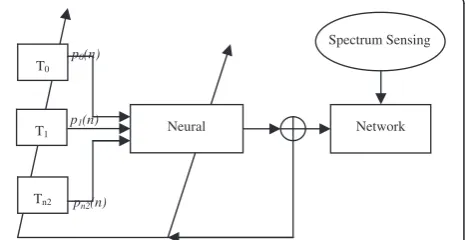
Figure 1 shows the network theoretical model for UWB pulse generation [9], which according to the external en-vironment such as authorized users’working states, deter-mine the expected optimal spectrum UWB signalt, then settas the target signal, adaptively update the parameters of the networks including network weightw, position and waveform of base function to get the minimum error be-tween the network outputa and target signalt [14]. The detailed description of all components of the network model is presented in the following sections.
2.1. Transform functionTi
The transform functionTiis used to generate network in-put pi(n)(i = 0,1,. . .,n2), network input pi(n) is the basis function. Sincepican be expressed aspi(n)(n= 0,1,. . .,N), then we can construct anN× 1 dimensional vectorP
P¼ p0;p1;p2;. . .;pn2
ð1Þ For simple analysis, we chose the Gaussian pulse as the basis function where μi and si are adjustable parameters for transform
function Ti; fs is the sample frequency. We can
pn2(n)
Neural Network
Spectrum Sensing
adaptively adjust μi and si to change the position and waveform of the respective basis function pi(n) to ap-proach the target function in an optimal way.
2.2. Target output vectort
The target output vector t is the optimal frequency
spectrum at the current moment. Take the template
made by FCC as example, assuming that there are I
kinds of authorized users, our target output vector can be expressed ast= {tk,k= 0,1,. . .,N–1} and
tk¼pffiffiffiffiffiffiffiffiffiffiffiffiffiffiffiffiffiMFCCð Þf ΠI
i¼1ð1Gið Þf Þf¼kfs;
ð3Þ
whereMFCC(f) is the frequency spectrum template made by FCC,Gi(f) is a gate function and denotes that theith authorized frequency band [fi1, fi2] is recognized. And Gi(f) can be given by
Gið Þ ¼f 10 f∈others½fi1;fi2
ð4Þ
2.3. Network parameters updating
To minimize the MMSE between the network output vector a and the target output vector t, it is needed to adjust the network weight vector w, and parameters μi and si for transform function. We can define the mean square error as During the adjustment of RBFNN, the updating of the
network weight vector w is by the Windrow-Hoff rule
and parametersμiandsiby the steepest descent method, respectively [15].
2.4. Output pulse
When the network weight vectorw, parametersμiandsi are converged to an optimal value, the mean square error between the practical networks output a and the
target output vector t come to the minimum, thus the
UWB pulse in frequency domain can approach the FCC frequency spectrum templateMFCC(f) the most. We can get the output pulse in time domain.
s nð Þ ¼IDFTða⊗ΘÞ
¼IDFT purelinð ðwTP⊗ΘÞÞ; ð6Þ
whereΘ is the phase response vector for users, and lin-ear phase is chosen for our proposed pulse design,⊗ de-notes the piecewise product of two vectors and purelin denotes the transfer function of the neural networks,zis the double-side frequency spectrum conjugate and sym-metry ofz, andzis the single-side frequency spectrum.
3. Performance analysis with interference
In this section, we may analysis the transmission perform-ance of UWB signals both in absence of narrowband inter-ference and in the presence of inevitable narrowband interference.
3.1. Basic assumptions
1) The BER performance is calculated for a UWB receiver over a single AWGN channel, the effect of multipath and multi-user interference is out the consideration of this research.
2) For the UWB communication architecture, the bipolar pulse amplitude modulation (BPAM) scheme is adopted in transmitter, and the optimal correlation receiver in adopted in receiver which
is also is depicted in Figure2 [11]. Besides, we
also assume the perfect synchronization between the transmitter and receiver has been achieved. 3) Each of narrowband interference may have a
relatively plat PSD in their working bandwidth, which is reasonable for most wireless services that employ the appealing CDMA or OFDM
transmission techniques. Hence, we can conveniently calculate the power of each interference simply byPNBi = AiBNBi , where PNBi ,
Ai, andBNBi , respectively, denote the power, the
PSD amplitude, and the frequency working
bandwidth of the ith narrowband interference.
3.2. Analysis with narrowband interference
Since BPAM modulation is adopted in UWB transmitter, then the emission signal can be given by
strð Þ ¼t X
þ1
j¼1
djpffiffiffiffiffiffiffiffiETXp0ðtjTsÞ ð7Þ
where pffiffiffiffiffiffiffiffiETX is transmitted power per bit, p0(t– jTs) is the proposed baseband pulse,Tsis pulse repetition time or frame time,dj∈{+1,–1} is the transmitted information data bits. After propagated in AWGN channel, the re-ceived signals can be expressed into
r tð Þ ¼sreð Þ þt rintð Þ þt n tð Þ ð8Þ
where
sreð Þ ¼t X
þ1
j¼1
βdjpffiffiffiffiffiffiffiffiETXp0ðtjTsτÞ ð9Þ
is the useful signal, while rint(t) and n(t) represent the narrowband interference and the thermal noise, respect-ively. τand βare the propagation delay and the ampli-tude gain of wireless AWGN channel, respectively. The Fourier transforms of sre(t), rint(t), and n(t) can be de-noted by Sre(f), Rint(f), and N(f), respectively. Usually, within the soft decision framework, the received signals are correlated and demodulated per frame, thus assum-ing in a symbol cycle [0,Ts], the data bit dj= +1, and we can define, during the local correlator, the Fourier trans-forms of the template signal as
V fð Þ ¼P0ð Þf ej2πf TSej2πfτ ð10Þ then the sample output of the correlator at the moment Tscan be given by
Z¼
Z fH
fL
R fð ÞV fð Þdf ¼ZuseþZintþZther ð11Þ
where Z, Zuse, Zint, and Zther, respectively, represent the decision variable, the useful signal component, the inter-ference component, and the thermal noise component. Furthermore, the energy of useful signal component can be calculated by
Euse ¼ðZuseÞ2
¼E
f
βpffiffiffiffiffiffiffiffiETXZ fH
fL
P0ð Þf ej2πf Tsej2πfτ
P0ð Þf ej2πf Tsej2πfτdf
g
2¼β2 ETX
Z fH
fL
P0ð Þf P0ð Þf df !2
¼β2 ETXE2
p
ð12Þ
whereEpis the in-band power of the proposed UWB pulse. Also, the received interference energy can be expressed into
Eint¼Zint2
¼E
Z fH
fL
Rintð Þf P0ð Þf ej2πf Tsej2πfτdf
( )2
¼E
Z fH
fL
Rintð Þf P0ð Þf df
Z fH
fL
Rintð Þf P0ð Þf df
( )
ð13Þ Since we made an assumption that each narrowband system has a plat PSD, we mainly consider two types of interference:
Case A: tone signal interference
In Case A, P0(f) and P0*(f) in (13) are constants, thus further mathematic treatment of (13) may lead to
Eint¼ X
i
PNBi P02 fNBi
ð14Þ
where P2
0 fNBi
is the PSD value of the proposed UWB
pulse at the working frequency of theith tone interference.
0 2 4 6 8 10 12
-90 -80 -70 -60 -50 -40
frequency (GHz)
Normalized PSD (dBm/MHz)
PSD of the pulse
FCC emissionmask
Case B: narrowband signal interference with working bandwidth BNB
i
In this case, each interference signal is a narrowband signal with working frequency bandwidth BNBi . Given that each interference has a plat PSD, (13) can be further expressed into
Eint¼
X
i
Pi
NB
Z
Bi
NB P2
0ð Þf
df ð15Þ
For the variable Zther, it is apparent that its mean is equal to zero, and the corresponding variance can be given by
σ2 ther¼E
Z fH
fL
N fð ÞP0ð Þf df
( )2
¼N0
2 Ep ð16Þ
0 2 4 6 8 10 12
-85 -80 -75 -70 -65 -60 -55 -50 -45 -40
Freqency (GHz)
Normalized PSD
Pulse in [7] Pulse in [6] Modified UWB pulse FCC emission mask
Figure 4The spectral characteristic of designed UWB pulses under FCC spectral emission mask.
0 2 4 6 8 10 12
-85 -80 -75 -70 -65 -60 -55 -50 -45 -40
Frequency /GHz
PSD /dBm/MHz
Pulse 1 in [7] Pulse 2 in [7] Pulse in [6] Proposed pulse FCC emission mask
Besides, SIR and SNR can be given by
3.2.1. Comparison with the pulse designed by Zhou et al. In [5], a UWB pulse based on CR with in-band interfer-ence suppression is designed by Zhou et al., whose spec-tral characteristic is showed in Figure 3. In fact, the corresponding PSD of generated pulse may not exactly comply with FCC emission mask, and it is noted that this spectral mismatch may produce serious interference to the other wireless services. Omitting that point, it is proved that the pulse has a better single-link BER per-formance in AWGN and anti-jamming capability com-pared to the other conventional waveforms such as Scholtz’s monocycle. The comparison of BER performance analysis with narrowband interference between the pulse in [5] and our proposed pulse is presented as follows.
We define the received energy of the above reference pulse asEb=β2ETXEp.zll, and assuming that eachPNBi is identical, define the total energy of the interference as Ei = PNBi , take the CaseB as example, then the SIR and
SNR of UWB system which adopts the pulse in [5] can be given by And let us define SNR gain as
γ¼ Ep
Ep:zll ð21Þ
Then, the SIR gain can be given by
η¼ SIR
To calculate the parameter γ, we define the spectrum utilization ratio as
Thus (22) can be rewritten as
γ¼ φP0
φPzll
ð24Þ whereφP0 and φPzll are the spectrum utilization ratios of our proposed pulse and the pulse in [5].
Then with soft decision, take CaseBas example, the BER of the pulse can be given by
Prð Þbzll ¼Q
The BER of our proposed pulse can be given by
PrðbthisÞ¼Q
4. Simulation conditions and results
To comprehensively evaluate the transmission perform-ance of our pulse presented in the presence or absence of the narrowband interference, we also give the two additional UWB pulse designing techniques, respect-ively, based on the orthogonal wavelet in [6] and the Gate function in [7]. The designed spectral characteristic of these UWB waveforms has been illustrated in Figures 4 and 5, respectively, for two different scenes. We first note that, for the windowing-based pulse design scheme in [7], the low-frequency band from 0.99 to 1.66 GHz of the regulatory FCC mask may not be utilized any more, greatly restricting some significant UWB ap-plications such as through-wall sensing. Besides, from the simulation result in Figure 4, both the generated UWB waveform cannot fully use the low frequency below 0.99 GHz. Nevertheless, it is clearly seen that our presented UWB pulse can essentially utilize the whole spectral mask.
On the other hand, when avoiding specific frequency band to mitigate mutual interference, the UWB wave-forms are also plotted together in Figure 5. It is obvious that, for windowing-based pulse design scheme in [7], the spectrum utilization of the generated waveforms may considerably be reduced from Figure 5. Similar ob-servation can be made on the orthogonal wavelet-based UWB waveforms. So, the spectral notch may greatly de-grade transmission performance of UWB systems. More important, the generated spectral notch is not sufficient to mitigate mutual interference given the maximum spectral attenuation can only approach 25 dB. In com-parison, our present UWB pulse can produce the
effec-tive spectral notch with a depth of 95 dB, which can completely mitigate the inference even when multiple UWB users are taken into consideration.
4.1. Without narrowband interference
When the narrowband interference is absent, the receiv-ing performance under the optimal correlator structure is only related with the SNR. Accordingly, the bit error probability can be calculated by
Prb ¼Q
ffiffiffiffiffiffiffiffiffiffiffi
φ2Eb
N0 r
ð27Þ
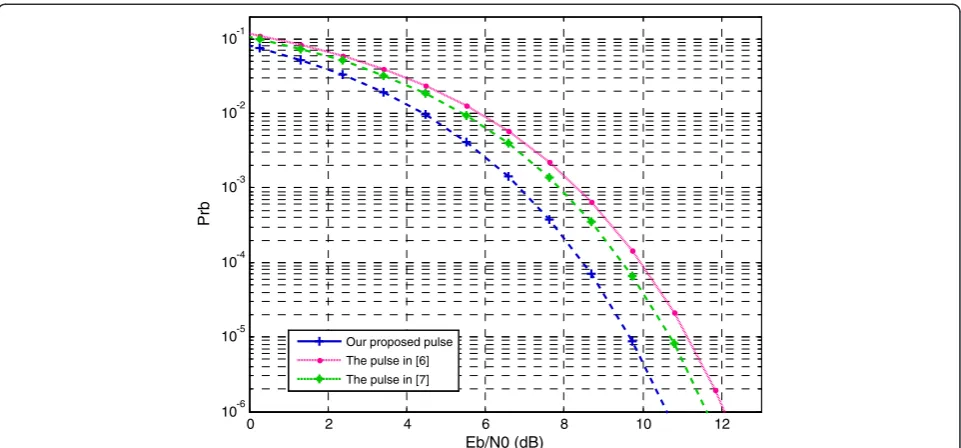
where the Eb=β2ETXEp.FCC, and Ep.FCCis the power of the FCC integrated from 0 to 10.6 GHz, thus the key factor of the UWB pulse related to the bit error proba-bility is only the spectrum utilization ratio φ. Based on (23) and from the numerical simulations, the spectrum utilization of UWB pulse in [6,7] and our proposed are 69.8, 77.5, and 97.9% (N = 32), respectively. Correspon-dingly, the bit error probability of three pulse in absence of narrowband interference is depicted in Figure 6, from which we can obviously note that, for the single-link, BER performance of our proposed pulse is much superior to the other pulses. From this simulation shown in Figure 7, SNR advantage of our presented UWB pulse to that of in [7] is about 2.5 dB.
4.2. With narrowband interference
If we take the practical narrowband interference into consideration, the transmission performances of UWB waveforms that have adopted specific spectral avoidance
0 2 4 6 8 10 12 14 16 18 20
10-6
10-5
10-4
10-3
10-2
10-1
100
Eb/N0 (dB)
Prb
Proposed,Eb/Ei=-100dB In [5], Eb/Ei = -100dB In [6], Eb/Ei = -100dB In [7], Eb/Ei = -100dB Proposed,Eb/Ei=-130dB In [5], Eb/Ei = -130dB In [6], Eb/Ei = -130dB In [7], Eb/Ei = -130dB
have also been given in Figures 6 and 8. Without loss of generality, for each UWB pulse, an avoiding spectral band centralized at 5.8 GHz is adopted. For our pro-posed method, taking the equivalent orderN= 32 in our experiments. Based on numerical simulations, the spectrum utilization when taking the narrowband inter-ference may slightly be reduced to 90% under the FCC spectral emission mask. Meanwhile, we also noted that spectrum utilization of other existing pulses may also be decreased much seriously, such as in [6,7], the spectrum utilization ratios are reduced to 58 and 40%, respectively. On the other hand, although spectrum utilization of the
UWB pulse introduced in [5] is about 64%, this emission waveform can hardly be applied given the obvious spec-tral mismatch. As analyzed in Section 3, BER perform-ance of these UWB pulses can be derived as is shown in Figure 8. Notice that the narrowband bandwidth is chosen to be 100 MHz.
For the tone signal interference in CaseA, as is mostly considered when evaluate the performance of the opti-mal shaped pulses, the narrowband interference to UWB system is relatively limited, which can obviously be seen
from Figure 6. The simulated Eb/Eirange may changes
from−150 to−90 dB. If we setEb/N0to 10 dB, then the
-70 -60 -50 -40 -30 -20
10-5 10-4 10-3 10-2 10-1 100
Eb/Ei (dB)
Prb
Proposed
In [5] In [6]
In [7]
-70 -60 -50 -40 -30 -20
10-7 10-6 10-5 10-4 10-3 10-2 10-1 100
Eb/Ei (dB)
Prb
Proposed
In [5] In [6]
In [7]
a
b
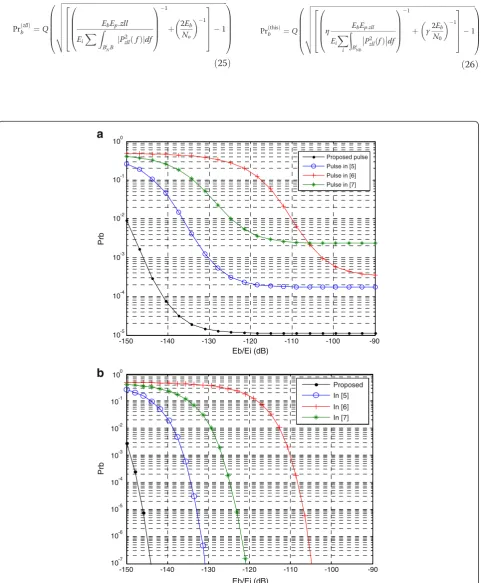
total interference to UWB receivers can be omitted whenEb/Eibecomes larger than−90 dB, no matter what kind of emission pulse is adopted. Besides, it is obvious to find that all these BER curves may converge to certain steady constants with the increasing of Eb/Ei. For ex-ample, for our propose pulse and the other pulses in [5-7], their converged BER values are 1 × 10⁻⁵, 9 × 10⁻³, 7 × 10⁻³, and 9 × 10⁻², respectively. Given that the achieved spectrum utilization of the four pulses are 90, 64, 58, and 40%, with the increasing theEb/Ei, the corre-sponding SIR may become smaller and smaller, and hence BER performance may gradually approach to that of Eb/N0 = 10 dB. Correspondingly, another important parameter in Figure 6a is the value ofEb/Eiover which the BER curves tend to become plat or keep invariant, which can conveniently be defined as the threshold Eb/Ei denoted byCEb/Ei. Indeed, this thresholdEb/Eimay effectively reflect the corresponding anti-jamming cap-ability. Specifically, the larger CEb/Ei is, the stronger the anti-jamming capability is. From Figure 6, we also noted thatCEb/Eiof our proposed pulse and the existing pulses in [5-7] are −130,–120, –90, and−115 dB, respectively. Also, the attenuation depth in spectral avoiding band can be account for the difference of the CEb/Ei, which has been indicated by Equations (25) and (26). From Figure 7, the spectrum attenuation depths of our pro-posed pulse and the existing pulses in [5-7] are −100,
–90,–65, and−85 dBm/MHz, respectively.
When the Eb/N0 is set to 20 dB, the narrowband
interference from external tone signal may become much smaller as we can see from Figure 6b, in which the BER curves may not converge any more since SNR
is large enough in this case, and the single-link BER per-formance is only related to attenuation depth in corre-sponding spectral avoiding band. The result is more obvious that our proposed pulse performance is the best, and the less well is the pulse in [5], the pulse in [6] may behave the worst.
In Figure 8, another relationship between the achieved
BER and Eb/N0 is also provided, with Eb/Ei is fixed
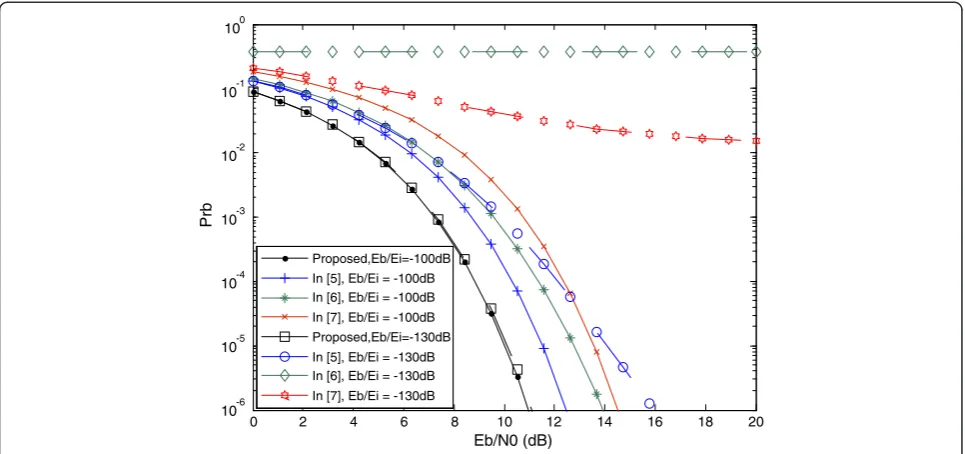
to−100 and−130 dB, respectively. WhenEb/Ei=−100 dB, all of the UWB receivers may suffers no or little influ-ence from this tone interferinflu-ence, and hinflu-ence the corre-sponding BER performance is only related to the
spectrum utilization ratio and Eb/N0. When Eb/Ei =
−130 dB, the convergent BER of UWB pulse in [6] is a constant about 0.4 which means that the UWB system cannot work anymore; BER of the pulse presented in [7] is converged to 0.08 as theEb/N0increasing, while our proposed pulse performs with just a little influence from this tone interference.
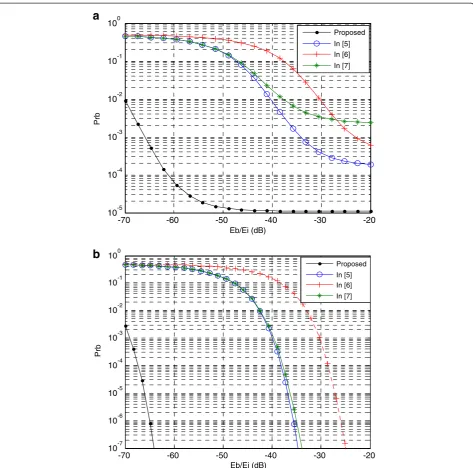
Differentiated from the tone interference, with a band-width of 100 MHz and centralized at 5.8 GHz, another more general narrowband signal is also considered as the external interference to UWB receivers in this ex-periment. Accordingly, transmission performance of dif-ferent UWB pulses with spectral avoidance has also been presented in Figures 9 and 10. The analysis is much similar to that of the tone interference situations, nevertheless, it is also noted that UWB receivers is much more immune to narrowband interference than the tone interference. Correspondingly, the BER performance can be also derived from Equations (25) and (26). In this simulation, theEb/Eiis varied from −70 to −20 dB as is
0 2 4 6 8 10 12 14 16 18 20
10-6 10-5 10-4 10-3 10-2 10-1 100
Eb/N0 (dB)
Prb
Proposed, Eb/Ei= -30dB In [5], Eb/Ei= -30dB In [6], Eb/Ei= -30dB In [7], Eb/Ei= -30dB Proposed,Eb/Ei= -40dB In [5], Eb/Ei= -40dB In [6], Eb/Ei =-40dB In [7], Eb/Ei =-40dB
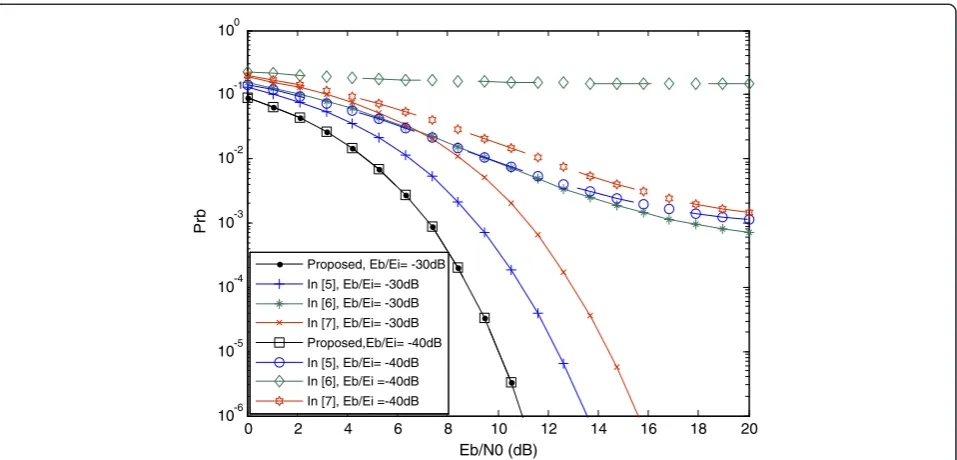
illustrated in Figure 9a,b. Much similar to the case of tone interference, all the four BER curves will converge to different steady value. Specifically, the converging values of our proposed pulse and the existing pulses in [5-7] are as the same as the case with tone interference, which is mainly because the interference can be still omitted whenEb/Eiis larger than−20 dB. However, the threshold values CEb/Ei are considerably changed, which respectively are−50,–25,–20, and−25 dB. WhenEb/N0 is set to 20 dB, BER performance is also mainly related to the attenuation depth in avoiding spectral bands. Since the gen-erated notches of [5,7] corresponding to narrowband inter-ference keep almost the same, their BER performances are also very close as well. It is apparent that, from Figures 9 and 10, our proposed pulse still behaves the best because of its largest attenuation spectral depth, greatly suppressing the narrowband interference and improving the UWB re-ceiver SNR. The relationship between BER andEb/N0with the fixed Eb/Ei of −30 and −40 dB, respectively, is pre-sented in Figure 10. It is also demonstrated from this nu-merical simulations that our proposed UWB pulse has the strongest anti-jamming capability, which can totally miti-gate the narrowband interference and hence the change of Eb/Ei may slightly affect final BER performance. In com-parison, although the produced pulses in [5,7] behave not bad whenEb/Eiis−30 dB, both of their BER value may be always above 10–3, while our proposed pulse behaves as well as in absence of this narrowband interference.
5. Conclusion
As an underlying spectral accessing technique, UWB has always been confronted with stringent emission limitation from the radio management. Accordingly, the spectral co-existence between UWB and other wireless services has long been remained as one challenge research area. The CR-based UWB transmission scheme may provide an at-tractive solution for the mutual interference mitigation issue. As a consequence, the UWB waveform designing that can fully utilize spectral energy, and meanwhile can also effectively avoid specific band, has greatly been ad-vanced in recent years. In this study, a novel adaptive interference-avoiding UWB waveform is suggested. The algorithm to design UWB pulses based on RBFNN and CR is studied. Three cases of the external interference, tone interference, narrowband interference with its wor-king bandwidth of 100 MHz are considered. From the numerical simulations and thorough performance evalu-ation, it is shown that our proposed pulse-indeed behav-iors much better than the other pulse designing schemes from aspects of both the single-link BER performance and the anti-jamming capability.
Competing interests
The authors declare that they have no competing interests.
Acknowledgments
This research was supported by the Fundamental Research Funds for the Central Universities (2012RC0103), the National Natural Science Foundation of China (60902046, 60972079, 61271180), and by the National major special science and technology project of China (2011ZX03005-002, 2012ZX03001022).
Received: 18 January 2013 Accepted: 12 February 2013 Published: 2 April 2013
References
1. Federal Communications Commission (FCC),Revision of part 15 of the commission’s rules regarding ultra-wide band transmission systems, First Report and Order, ET Docket 98–153, FCC 02–48, 2002. April
2. Z Li, WX Zou, B Li, Z Zhou, XJ Huang, Analysis on coexistence of ultra wideband with OFDM-Based communication systems. IEEE Trans. Electromagn. Compat.53(3), 823–830 (2011)
3. SY Xu, QH Yang, KS Kwak, Suppression of IEEE 802.11a interference using SVD-based algorithm for DS-UWB systems in wireless multipath channels. AEU-Int. J. Electron. C67(10), 700–704 (2007)
4. HG Zhang, XF Zhou, KY Yazdandoost, I Chlamtac, Multiple signal waveforms adaptation in cognitive ultra-wideband radio evolution. IEEE J. Sel. Areas Comm.24(4), 878–884 (2006)
5. LL Zhou, HB Zhu, NT Zhang, Iterative solution to the notched waveform design in cognitive ultra-wideband radio system. Prog. Electromagn. Res. (PIER)75, 271–284 (2007)
6. XL Wu, XJ Sha, C Li, NT Zhang, Orthogonal wavelet based dynamic pulse shaping for cognitive ultra-wideband communications, inProceedings of the IEEE Global Telecommunication Conference (GLOBECOM’08), vol.10, New Orleans, LA, USA, 2008, pp. 772–786
7. WH Zhang, HB Shen, ZQ Bai, K Kyung-sup, A novel NBI suppression scheme in UWB ranging system. IEICE Trans.90-A(11), 2439–2441 (2007)
8. HB Shen, WH Zhang, KS Kwak, Cognitive implementation of chirp waveform in UWB systems. IEICE Trans.91-B(1), 147–150 (2008)
9. B Li, Z Zhou, WX Zou, A novel adaptive spectrum forming filter: application in cognitive ultra-wideband. Sci. China Inf. Sci.53(12), 2584–2599 (2010) 10. K Ohno, T Ikegami, Interference mitigation study for UWB radio using template
waveform processing. IEEE Trans. Microw. Theory54, 1782–1792 (2006) 11. RY Yang, Z Zheng, An adaptive interference-avoiding system for DS-UWB
cognitive radio, inProceedings of the First International Conference on Communication Network, China (CHINACOM2006), vol.1, Beijing, China, 2006, pp. 1–5
12. A Rabbachin, TQS Quek, PC Pinto, I Oppermann, MZ Win, Non-coherent UWB communication in the presence of multiple narrowband interferers. IEEE Trans. Wirel. Commun.9(11), 3365–3379 (2010)
13. B Maria-Gabriella Di, G Guerino,Understanding Ultra-Wideband Radio Fundamentals(Prentice Hall, Upper Saddle River, NJ, 2004) 14. B Li, Z Zhou, W Zou, Interference mitigation between ultra-wideband
sensor network and other legal systems. EURASIP J. Wirel. Commun. Netw. (JWCN)2010(2010). Article ID 290306
15. F Guo, YQ Zhuang, A new UWB pulse design algorithm for in-band interference suppression. Acta. Photonica. Sinic.6, 1345–1348 (2006)
doi:10.1186/1687-1499-2013-94

![Figure 3 The spectral characteristic of the pulse designed in [5].](https://thumb-us.123doks.com/thumbv2/123dok_us/969408.1119017/4.595.61.541.88.443/figure-spectral-characteristic-pulse-designed.webp)