A Study on Short Term Wind Power
Prediction using Machine Learning Approach
Devyani Patidar1, Dr. Krishna Teerth Chaturvedi2
DDIPG Scholar, Department of Electrical & Electronics Engineering, UTD RGPV, Bhopal, India1 Professor, Department of Electrical & Electronics Engineering, UTD RGPV, Bhopal, India2
ABSTRACT: Wind energy is one of the renewable energy resources with the lowest cost of electricity production and
with the largest resource available worldwide. It is one of the most promising clean energy sources and keeps extending its coverage in power generation. Wind power technologies now constitute a major contribution to the growing clean electricity market worldwide. This type of electricity generation is highly dependent on the weather conditions variability, particularly the variability of the wind speed. Wind power forecasting methods can be used to plan unit commitment, scheduling and dispatch by system operators, and maximize profit by electricity traders. Therefore, accurate wind power forecasting models are required to the operation and planning of wind plants and power systems. This paper provides a review on comparative analysis on the foremost forecasting models, associated with wind speed and power, based on physical methods, statistical methods, hybrid methods over different time-scales. Furthermore, this paper gives emphasis on the accuracy of these models and the source of major errors, thus problems and challenges associated with wind power prediction are presented.
KEYWORDS: Energy management, Forecasting, Weather Prediction, Wind power, Machine Learning.
I. INTRODUCTION
Renewable energy source utilization mainly wind power generation has acquired magnificent considerations in number of countries.
Wind energy is one of the RES characterized by the lowest cost of electricity production and the largest resource available. Therefore, a number of countries are beginning to recognize that wind power provides a significant opportunity for future power generation. As a result, the installed wind capacity grows more than 30% each year. And according to wind energy and green peace organization plan, 12% of all electricity generation should be achieved through wind power by 2020, with about 30GW [1]. As wind integration grows dramatically, the requirements for solving various problems, which include effective market design, Electricity Market Clearing, real-time grid operations, ancillary service requirements and costs, competitive power quality, power system stability and reliability, transmission capacity upgrades and standards of interconnection, become more challenging [2]-[4].
However, improved wind forecasting can be considered as one of the most efficient way to overcome many of these problems. Forecasting tools can enhance the position of wind by dealing with the intermittence nature of wind. Although wind energy may not be dispatched presently, the cost impacts of wind can be reduced to a large extent if the wind energy can be scheduled making use of accurate wind forecasting. Hence, the improvement of the performance of wind power and wind speed forecasting tool has significant economic and technical impact as well on the system by increasing wind power penetration [3].
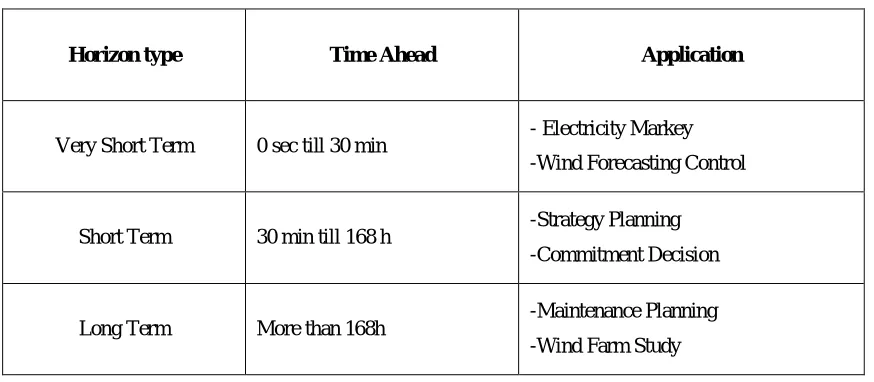
Various methods classified according to time-scales or methodology, are available for wind forecasting. Actually, classification of wind forecasting approaches in terms of time-scale is unclear. However, making reference to a great deal of studies in this field, wind forecasting can be separated based on the prediction horizon into three categories: Immediate-short-term (8hours-ahead) forecasting
Long-term (multiple-days-ahead) forecasting.
Table I: Application of forecasting approaches
Horizon type Time Ahead Application
Very Short Term 0 sec till 30 min - Electricity Markey -Wind Forecasting Control
Short Term 30 min till 168 h -Strategy Planning -Commitment Decision
Long Term More than 168h -Maintenance Planning
-Wind Farm Study
II. WIND POWER FORECASTING IN COMPETITIVE ELECTRICITY MARKET CONTEXT
The use of renewable energy sources (in short: wind, solar,geothermal, water and biomass), is gradually increasingworldwide [4]. There are two moments in recent decades whichhave marked the definitive bet on renewable energy as aneffective alternative to electricity production using fossilfuels:
The first serious interest on the industrial world concerning renewable energy has been triggered by the Arab oil embargo in the early 70’s of last century.Starting that time people recognized the dangers of fossil fuels-addiction and some policies that favor the implementation of renewable energy sources have been launched.
The second moment was precisely the advent of competition in the electricity sector. Indeed, the demands of competition in electricity markets necessitate a re-evaluation of renewable energy policies. Restructuring the electric power industry has refocused attention on renewable energy and on the policies that affect it in competitive electricity markets.The development of renewable energy, which reduces dependence on fossil fuels, does not need to be imported, and generally produces fewer and less toxic pollutants than fossil fuels is crucial for the sustainable development of future generations.
Wind power generation is increasing all over the worldand the electricity sector has to integrate this “intermittent”power source into the electricity grid. The problem ofintegrating huge amounts of wind power into power networkcould be solved by using accurate wind speed or wind powerforecasting.
Recently, several techniques have been developed toforecast the wind power and speed. Existing techniquescan be classified as statistical, physical and time seriesmodeling techniques based on the forecasting modelsthey used [1]. Currently, it is observed that researchersemploy a combination of statistical model and physicalmethods besides each other to get an optimal approachthat is applicable for longer horizons of prediction systems.In these techniques statistical model plays auxiliaryrole to data collected by physical methods.
Physical approach (deterministic approach)
Statistical method is based on vast amount of historical data without considering meteorological conditions. It usually involved artificial intelligence (neural networks, neuro-fuzzy networks) and time series analysis approaches.
Hybrid approach
Hybrid method which combines physical methods and statistical methods, particularly uses weather forecasts and time series analysis.
III.RELATED WORK
In [6], a method was proposed to forecast wind power in the short-term, based on the application of an Evolutionary Algorithm optimisation for the automated specification of neural networks (NN) and nearest neighbour search. In the same work, the forecasted results were compared with two others algorithms based on particle swarm optimisation (PSO) and differential evolution. The proposed method used weather data combined with historical wind power data from several wind farms in Germany. Also, the system was tested with data from 2004 to 2007 with a time step of 1 hour.
In [7], a forecasting method was presented to predict the wind power in two wind farms in Portugal for the subsequent 72 hours, combining feed forward NN and Entropy and Correntropy Theories to help reduce the forecasted error distribution. The proposed system was tested in online and offline frameworks for the years 2005 and 2006.
In [8], a forecasting method was proposed to predict the wind speed for the next 24 and 48 hours using a Fractional Auto Regressive Integrated Moving Average (ARIMA), or fractional ARIMA model. The presented results were collected for 4 wind farms in North of Dakota, USA. After wind speed forecasting, the obtained results were combined with the mechanical characteristics of wind driven data to determine the wind power output. Furthermore, the final results were compared with a persistence model.
In [9] a forecasting method was proposed for the very-shortterm, combining an exponential sweetening method and data mining. The proposed method combined the collected data of a SCADA system with weather, physical and mechanical wind-driven data. In addition, the forecasting system was compared with other systems such as NN and support vector machines (SVM). The system predicted, with different timesteps, the results for more than 168 hours ahead. In summary, model 1 predicts wind-driven function coefficients, model 2 uses mechanical wind-driven data and wind speed to predict the wind power output, and model 3 uses data mining parameters combined with previous models to predict wind power data.
In [10] a forecasting method was proposed using a differential evolutionary algorithm with a new crossover operator and selection mechanism to train the Ridgelet NN and wavelet transform (WT) for the next 24 hours ahead without exogenous variables. The case study used historical wind power data from Ireland from 2010 to predict wind speed, and wind power in Spain from 2010 to predict wind power.
In [11], a wind power forecasting method was proposed to predict 24 and 48 hours ahead, composed of feature selection components which perform irrelevance and redundancy filtering of historical data. This method also used a forecasting engine based on a NN cascaded structure with enhanced PSO. The system was tested at two wind farms located in Alberta, Canada, and Oklahoma, USA.
In [12], a wind power forecasting method was proposed based on WT and NN to predict the next 3 hours ahead up to 24 hours ahead with a time step of 15 minutes. The system used historical data of wind power provided by the SCADA system in Portugal between 2006 and 2007 without exogenous or weather data.
In [14], a hybrid forecasting methodology was proposed based on ANFIS and PSO to predict the wind power in Portugal without exogenous or weather data, forecasting with only historical wind power data from the SCADA Portuguese system from 2006 to 2007.
In [15], a new hybrid and evolutionary forecasting method was presented, based on a combination of evolutionary PSO and ANFIS algorithms to predict the next 24 hours ahead, with a time step of 15 minutes for wind power production in Portugal, without exogenous or weather data. The proposed forecasting system was compared with other forecasting approaches, such as ARIMA, NN, Data Mining, and others.
In [16], a forecasting model was proposed based on multi observation points divided into 2 stages, to predict the speed and direction of wind in stage 1, and stage 2 uses the obtained data from stage 1 to predict the wind power output of the wind farm utilising dependent power curves. The study is performed with physical data from a wind farm at an Australian island. The proposed method was also compared with the grey model and persistence model.
In [17], a forecasting method was presented with a switching regime based on artificial intelligence to predict wind power, specifically the extreme events associated with the uncertainty of numerical weather prediction (NWP). The NN used was based on resonance theory and probabilistic methods, and was tested at two different wind farms, namely one in Denmark with historical data from 2000 to 2002 and one at Crete, Greece, with historical data from 2006 to 2008. In [18], the problem regarding the large penetration of new wind farms into the electric grid was tackled, reviewing the pros and cons, and the advances in wind power forecasting approaches.
A NN was proposed to predict the active and reactive power in the electrical grid using the study case of a wind farm in Germany. The time step of this approach is 1 hour to predict from 24 to 48 hours ahead.
In [19], a probabilistic model forecasting of wind power was proposed, which uses prediction points and uncertainty data from deterministic models. These results come from the quality of NWP data, daily wind power forecasting, and weather stability (speed and direction of wind). Also, this forecasting approach used a combination of a multiple NN with PSO algorithm. The historical data used comes from the wind farms located in Denmark and Greece. Furthermore, this method predicts the wind power for the next 60 hours ahead.
In [20], a wind power forecasting approach was proposed based on 3 models of WT and SVM to predict, with a time step of 1 to 3 hours ahead, the wind power output of a wind farm located in the State of Texas, USA. Model 1 is ensemble accordingly with the wind-drives characteristics and WT principles. Model 2 combines the wind-driven characteristic with a substitution of Kernel RBF functions. While model 3 is a combination of the two previous models and the output is the wind power forecast.
In [21], a wind speed and wind power forecasting method was proposed for the next 30 hours ahead using in a first stage a combination of WT and NN to predict the wind speed, and in the second stage a feed forward NN to create a non-linear mapping between the wind speed and wind power results. These results were obtained without weather variables and performed for a wind farm located in Denver, USA.
In [22] a Support Vector Machines (SVM) model for short-term windspeed is proposed and its performance is evaluated andcompared with several artificial neural network (ANN) basedapproaches. A case study based on a real database regarding three years for predicting wind speed at 5 minutes intervals ispresented.
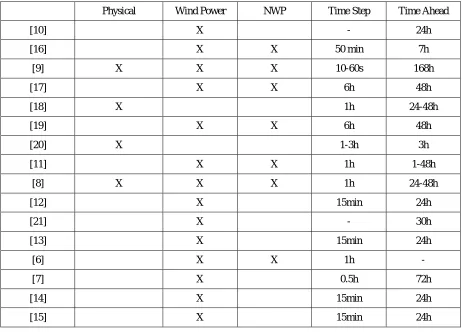
Table II: General Characteristics of Forecasting Approaches
Physical Wind Power NWP Time Step Time Ahead
[10] X - 24h
[16] X X 50 min 7h
[9] X X X 10-60s 168h
[17] X X 6h 48h
[18] X 1h 24-48h
[19] X X 6h 48h
[20] X 1-3h 3h
[11] X X 1h 1-48h
[8] X X X 1h 24-48h
[12] X 15min 24h
[21] X - 30h
[13] X 15min 24h
[6] X X 1h -
[7] X 0.5h 72h
[14] X 15min 24h
[15] X 15min 24h
IV.CONCLUSION
This paper provides a review on different tools with various techniques used for developing wind farm power prediction considering different time scales. Several forecasting models, which have their own characteristics, were discussed. In addition, emphasize was given on accuracy of prediction models and the source of error. This paper also presents an overview of the most recent wind power forecasting approaches. The information provided here is aimed to represent a valuable database and a good starting point for future development in the field.
REFERENCES
1. P.B. Breslow and D.J. Sailor, Vulnerability of wind power resources to climate change in the continental United States, Renewabl Energy,2002.
2. H. Lund, “Large-scale integration of wind power into different energy systems,” Energy, vol. 30, no. 13, pp. 2402-2412, Oct. 2005. 3. Long-term and medium-term development of renewable energy, 2007, State council of the People's Republic of China.
4. Y-K Wu, and J-S Hong, “A literature review of wind forecasting technology in the world,” IEEE Power Tech 2007, Lausanne, pp. 504-509, 1-5 July 2007.
5. M. Lange, and U. Focken, “New developments in wind energy forecasting,” IEEE Power and Energy Society General Meeting 2008 - Conversion and Delivery of Electrical Energy in the 21st Century, pp. 1-8, 20-24 July 2008.
7. R. J. Bessa, V. Miranda, J. Gama, “Entropy and correntropy against minimum square error in offline and online three-day ahead wind power forecasting”, IEEE Trans. Power Syst., volume 24, pp. 1657-1666, 2009.
8. R. G. Kavassery, K. Seetharaman. “Day-ahead wind speed forecasting using f-ARIMA models”, Renew. Ener., volume 34, pp. 1388-1393, 2009.
9. A. Kusiak, Z. Zhang. “Short-horizon prediction of wind power: a data-driven approach”, IEEE Trans. Energy Conv., volume 25, pp. 1112-1122, 2010.
10. N. Amjady, F. Keynia, H. Zareipour. “Short-term wind power forecasting using ridgelet neural network”, Elec. Power Syst. Res., volume 81, pp. 2099-2107, 2011.
11. N. Amjady, F. Keynia, H. Zareipour. “Wind power prediction by a new forecast engine composed of modified hybrid neural network and enhanced particle swarm optimization”, IEEE. Trans. Sust. Energy, volume 2, pp. 265-276, 2011.
12. J. P. S. Catalão, H. M. I Pousinho, V. M. F. Mendes. “Short-term wind power forecasting in Portugal by neural network and wavelet transform”, Renew. Ener., volume 36, pp. 1245-1251, 2011.
13. H. M. I. Pousinho, V. M. F. Mendes, J. P. S. Catalão. “Application of adaptive neuro-fuzzy inference for wind power short-term forecasting”, IEEJ Trans. Elect. and Electr. Eng., volume 6, pp. 571-576, 2011.
14. H. M. I. Pousinho, V. M. F. Mendes, J. P. S. Catalão. “A hybrid PSO-ANFIS approach for short-term wind power prediction in Portugal”, Ener. Conv. Manag., volume 52, pp. 397-402, 2011.
15. J. P. S. Catalão, G. J. Osório, H. M. I. Pousinho, “Short– term wind power forecasting using a hybrid evolutionary intelligent approach”, 16th Int. Conf. Int. Syst. Appl. to Power Syst., pp. 1-5, 2011.
16. M. Khalid, A. V. Savkin. “A method for short-term wind power prediction with multiple observation points”, IEEE Trans. Power Syst., volume 27, pp. 579-586, 2012.
17. G. Sideratos, N. Hatziargyriou. “Wind power forecasting focused on extreme power system events”, IEEE Trans. Sust. Energy, volume 3, pp. 445-454, 2012.
18. G. K. Venayagamoorthy, K. Rohrig, I. Erlich. “Short-term wind power forecasting and intelligent predictive control based on data analytics”, IEEE Power Ener. Mag., volume 10, pp. 71-78, 2012.
19. G. Sideratos, N. Hatziargyriou. “Probabilistic wind power forecasting using radial basis function neural network”, IEEE Trans. Pow. Syst., volume 27, pp. 1788-1796,2012.
20. Y. Liu, J. Shi, Y. Yang, W.-J. Lee. “Shot-term wind-power prediction based on wavelet transform-support vector machine and statistic-characteristics analysis”, IEEE Trans. Indus. Appl., volume 48, pp. 1136-1141, 2012.
21. K. Bhaskar, S. N. Singh. “AWNN-Assisted wind power forecasting using feed-forward neural network”, IEEE Trans. Sust. Ener., volume 3, pp. 306-315, 2012.
22. Tiago Pinto, Sérgio Ramos, Tiago M. Sousa, Zita Vale, “Short-term Wind Speed Forecasting using Support Vector Machines”, IEEE, 2014.