A Study on Admission Control using
Heterogeneous Network
Vaidehi D1, Pratijnya A2, Vinayak k3
Assistant Professor, Dept. of ECE, KLSGIT, Karnataka, India1
Assistant Professor, Dept. of ECE, KLSGIT, Karnataka, India2
Assistant Professor, Dept. of ME, KLSGIT, Karnataka, India3
ABSTRACT: The evolution towards a heterogeneous wireless environment presents an opportunity to realise new advances in wireless access research and development. It will force new developments and co-operations in resource sharing and control between the networks; increasing general efficiency and offering a standard set of services to the user.Radio Resource Management is the bridge between diverse Radio Access Technologies. A common view of RRM, supporting a set of common radio-independent algorithms, provides a generic framework for the deployment of a wide variety of data services.
KEYWORDS: heterogeneous network, Radio resource management.
I.INTRODUCTION
Advancements in mobile communications are being driven by the emergence of Multiple Radio Access Technologies (MRAT) which is referred in[1]. Technologies like Bluetooth, WLAN and evolving UMTS networks, offer different capacity characteristics, coverage and costs. Two variations of heterogeneity are currently used and they are, HotSpot extensions to 3G Networks and a fully heterogeneous access network incorporating a wide variety of radio technologies.
Evolution to complete heterogeneity must be focused on the user, rather than on network operators. This promotes integration with and interoperability across existing systems, leading to a totally transparent public-private wireless broadband communication system that will extend the public network with ubiquitous coverage using multiple overlapping private systems . A fully heterogeneous access network will have the ability to integrate all systems, offering all services, all of the time, allowing users to be provided with seamless transparent mobile access to the most efficient, preferred network type depending on the required data-rate, user profile or traffic load.
.
The existing admission control strategies can handle the resource management in homogeneous wireless networks but are unable to handle the issue in heterogeneous wireless environment. The mobility of the terminals in the mobile communication environment makes the resource allocation a challenging task when the resources are always in scarce. The efficient call admission control policies should be in place which can take care of this contradicting environment to optimize the resource utilization. The design of call admission control algorithm must take into consideration the packet level QoS parameters like minimum delay, jitter as well as session level QoS parameters like call blocking probability (CBP) and call dropping probability (CDP), which is referred from[2]. The CBP is the probability of denial of accepting the new call and CDP the likelihood of dropping the call by a new access network due to decline of the network resources to an unacceptable level in other words the networks is exhausted with the available resources at which it drops the handover calls.
II.CALL ADMISSION CONTROL IN HETEROGENEOUS NETWORKS
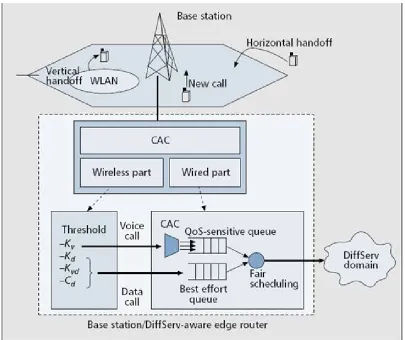
CAC module is divided into two submodules (i.e., two-tier CAC): one for the wireless part and the other for the wired part (Figure. 1).
In the wireless part the CAC needs to handle multiple classes of calls as well as calls due to vertical handoff from other types of networks. If the call is used for data transfer, ABA can be applied to increase resource utilization. Moreover, CAC in the wireless part must consider the nature of capacity of the systems (i.e., soft or hard) so that resource reservation and admission control can be performed optimally. Since the wireless resources are the scarcest resources in the system, the CAC submodule in the wired part must ensure that the wired network can maintain the QoS of traffic from wireless users (already transmitted across the wireless links) at the desired level. Both the call- and packet-level performance requirements need to be satisfied in the wireless part and this is referred in [3].. Packet-level QoS performance in the wireless part can be maintained through ABA and proper scheduling mechanisms. Call-level performance depends on the resource reservation and admission control strategy in the wireless part. However, in the wired part, only packet-level QoS requirements need to be satisfied.
Figure 1. The system model for the proposed CAC scheme.
CAC is a network process that receives as an input, a connection request that specifies the traffic descriptor and QoS (quality of service) requirements of the connection and returns a response granting or denying the admission request. The objective of the CAC is to ensure that the network meets its end-to-end QoS guarantees to connections that are admitted into the network. The CAC process is responsible for deciding whether a new connection request can be accepted, and if so, then how much resource should be allocated to it.
is a research field that has been receiving a considerable amount of interest since the introduction of IP network architectures designed to support QoS for traffic flows.
III.ADMISSION CONTROL MECHANISM
Call Admission Control (CAC) is used in the call set-up phase and applies to real-time media traffic as opposed to data traffic. CAC mechanisms complement and are distinct from the capabilities of Quality of Service tools to protect voice traffic from the negative effects of other voice traffic and to keep excess voice traffic off the network. Since it averts voice traffic congestion, it is a preventive Congestion Control Procedure. It ensures that there is enough bandwidth for authorized flows. Connection Admission Control can be used to prevent congestion in connection-oriented protocols such as ATM.
3.1 Joint Call Admission Control in heterogeneous cellular networks
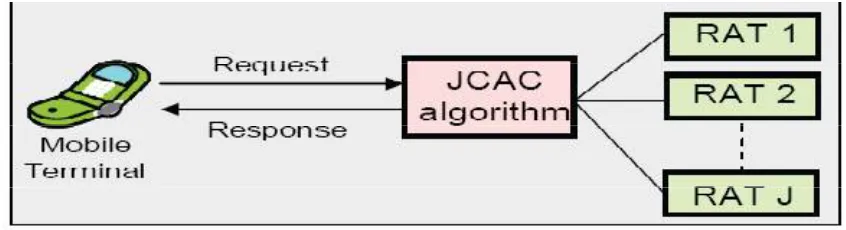
JCAC algorithm is one of the JRRM algorithms, which is referred from[4]. which decides whether an incoming call can be accepted or not. It also decides which of the available radio access networks is most suitable to accommodate the incoming call. Figure 2 shows call admission control procedure in heterogeneous cellular networks. A multi-mode mobile terminal wanting to make a call will send a service request to the JCAC algorithm. The JCAC scheme, which executes the JCAC algorithm, will then select the most suitable RAT for the incoming call.
Figure 2. Call admission control procedure in heterogeneous cellular networks.
Bandwidth allocation strategies for wireless networks can be classified into four groups namely complete sharing, complete partitioning, handoff call prioritization, and service class prioritization.
Complete Sharing:- An incoming call is accepted, regardless of the class/ type, as long as there is enough radio resource to accommodate it.
Complete Partitioning:- Available bandwidth is partitioned into pools and each pool is dedicated to a particular type of calls. An incoming call can only be admitted into a particular pool.
Handoff Call Prioritization:- Handoff calls are given more access to radio resources than new calls. New calls may be blocked whereas handoff calls are still being admitted.
Service-Class Prioritization:- Certain classes of calls are given preferential treatment over some other classes of calls. For example, class-1 calls may be blocked whereas class-2 calls are still being admitted.
3.2) Call admission control in integrated WLAN and 3G cellular networks
There have been some works on call admission control in integrated WLAN and 3G cellular networks, which is referred from[5]. Most significant ones are WLAN-first approaches, mobility based algorithms and policy based CAC schemes.
Mobility based algorithms: The processing load and new call blocking probability can be reduced while maintaining reasonable throughput in the WLAN. Besides handoff management based on mobility information, more works are needed for considering service differentiations, QoS cost, and user preference, to provide global optimization for resource utilization in integrated networks.
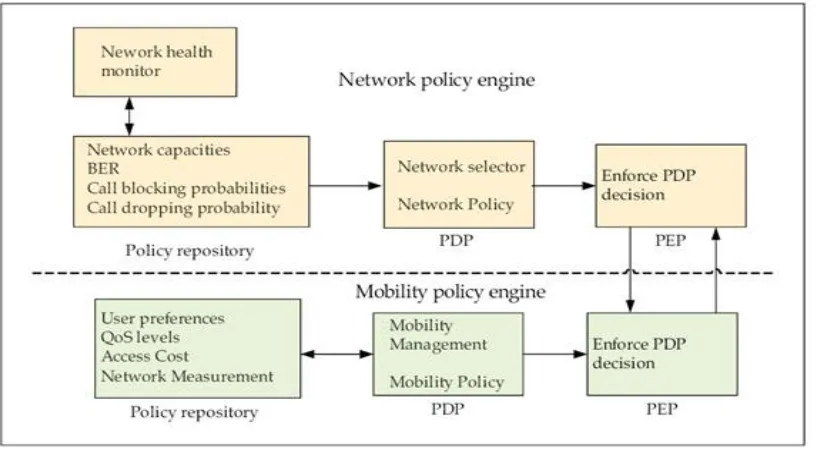
Policy Based CAC Schemes: As shown in Figure 3, a pairing of a policy decision point (PDP) and policy enforcement point (PEP) exist in both engines, along with policy repositories. PEP is responsible for the execution of a policy that is decided by PDP, and the policy repositories define the policies that must be followed for a proper handover decision. In the call admission control procedure, PEPs in the mobile terminals consult a PDP residing at the network for available resources. The PDP will make a decision on call admission, based on network capacities, QoS level, call types, user preferences as well as estimations on current network load and performances. This approach gives flexibility to the terminal and the network to make the best possible handover decision, and implements load balance. However, there are several drawbacks of this policy method, such as high latencies to fetch context information during the candidate access point classification procedure, and no optimization policy is defined for resource allocation in integrated networks.
Figure 3. Policy based call admission control
3.3) Admission Control in IP Multicast over Heterogeneous Access Networks
The architecture uses the existing AAA functionality to perform user identification and multicast session admission control. This control is made at the network layer with no protocol modification.
WiMAX and UMTS network architecture is depicted in Figure 4. Before packets can be transmitted, an IEEE 802.16 transport connection must be created between a Base Station (BS) and a Subscriber Station (SS). These connections are identified by a 16-bit Connection ID (CID) number, and by a layer 2 tunnel between the BS and Access Service Network Gateway (ASN-GW) referred from[7]. In WiMAX the role of IGMP router falls upon the ASN-GW network element, which is also responsible for client AAA. Upstream connections (SS to ASN-GW) are exclusively point-to-point. Downstream connections can be used to transmit data to a group of SSs (under the same BS), using multicast CIDs (mCIDs). Multicast CIDs are therefore suited for IP Multicast data transmission. This solution requires the establishment and management of mCIDs and their associations with IP multicast-based services. These management mechanisms and related protocols are still under development by the WiMAX Forums Networking Group.
IP multicast packet transmission inside the UMTS network is performed over point-to-point tunnels (from the GGSN to the UE), thus no sharing gains are achieved. MBMS adds a new network element to the UMTS network. Its functions include MBMS multicast session announcements, user authentication and authorization, and signaling. In order to support MBMS services all UMTS network elements require additional functionality. MBMS multicast data distribution is designed only for downstream connections (from the BM-SC to the UE); any upstream multicast traffic must go to the GGSN and then forwarded to the intended recipients. Multicast group joining and leaving is carried out through IGMP messages and multicast groups are represented by IPv4 class D addresses. MBMS is designed for IP multicast interoperability. However, the interface that connects the BM-SC to external Packet Data Networks (PDNs) is not yet specified in the latest 3GPP release. Therefore, MBMS services are limited to a single UMTS network.
3.4) Priority Based Admission Control Mechanism
The highest priority is audio traffic, the second is video streaming, and the lowest is data transmission. And the priorities of these services are given in Table 1. Because each service has special attributes and performance requirements, we set up the priority of networks for the services. For example, there are three networks considered like WLAN, WCDMA and WiMAX, referred from[8]. The network priority of audio is WCDMA, WiMAX. And WLAN, that of the video is WLAN, WiMAX and WCDMA, and the data is WLAN, WiMAX and WCDMA. Thus, it can make the system accommodate much more users and improve the system utilization.
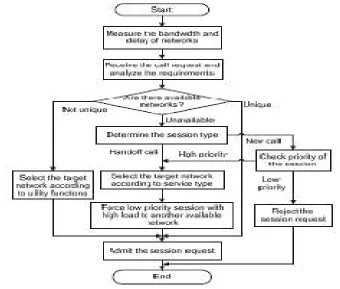
The process of admission control is proposed on basis of utility function in Figure 5. At first, the platform measures the status information of heterogeneous networks such as service type, session type, bandwidth requirement, delay sensitivity, user preference etc. When a session request arrives, the admission control module will look up the available network list and select the target network according to the session information.
The new session with highest priority for example audio session is admitted by forced handoff like as the handoff session and the other new sessions are rejected.
When the forced handoff occurs, those outward sessions at the marginal border are selected as the first choice. The sign will be marked up after the handoff is finished, which can avoid the frequent handoff. Thus these criteria can guarantee the success probability of all handoff sessions and new session with high priority.
Figure 5. The admission control mechanism Data Flow.
3.5) Throughput Based Admission Control.
Now the discussion is on Throughput Based Admission Control algorithms protect the network from overloading by
determining whether incoming requests will be rejected or accepted. If the acceptance of a user will increase the load η
on the cell above a threshold level ηthreshold whereby the quality of the ongoing calls is reduced and the quality of the
call itself cannot be guaranteed, the user will not be admitted to the system.
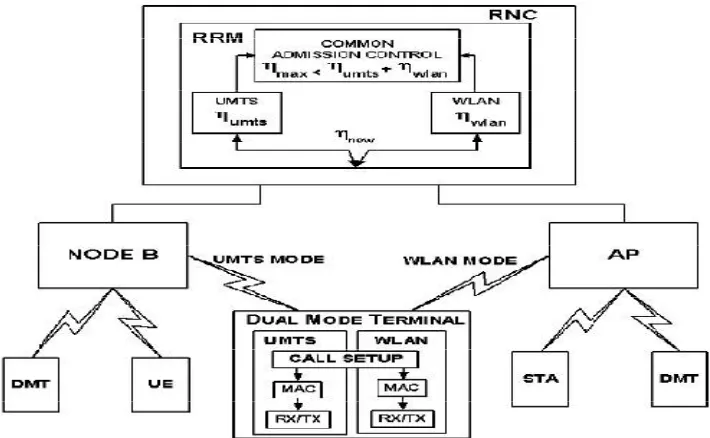
The system presented in Figure 6 is a very tightly coupled UMTS/WLAN network. In this environment the RNC monitors and manages all service requests from the WLAN and UMTS access networks. The systems transport preferences are to initiate inelastic services, such as voice or video, and some low rate data on UMTS. Other higher rate data services, such as file transfers are initiated on WLAN. The purpose of CAC is ti improve the stability and capacity of the combined systems. This is achieved by allowing a burdened system redirect new service request, or low priority service.
For Example, A mobile initiated voice call request is generated via the RACH, referred from[9], which is forwarded
ongoing WLAN services. If ηnew + ηwlan ≤ ηthreshold the service is admitted to WLAN. Failing that, the service is blocked, and backoff occurs.
Figure 6 :Admission control in Heterogeneous Networks.
IV. DISCUSSION
Case study research can mean single and multiple case studies, can include quantitative evidence, relies on multiple sources of evidence, and benefits from the prior development of theoretical propositions. The case study is a research approach, situated between concrete data taking techniques and methodologic paradigms.
ATM Based Heterogeneous Networks (ABHN)
example of an ABHN networks. For our analysis, we will only use legacy LANs of FDDI and 802.5 token ring, referred from[18]. There are four major components in an ABHN. 1)Hosts,2)Legacy LANs,3)Edge devices and 4)ATM backbone. Hosts are connected to legacy LANs such as Ethernet,802.5 token ring and FDDI. These legacy LANs are, in turn, connected to edge devices.
Edge devices act as interface between legacy LANs and the ATM backbone and does packet mapping from one medium to another. The edge device on the sending side of the connection receives packet from the connected legacy LAN. The packet is handled by the edge device is different ways, depending on where the destination LAN is located. The location of destination LAN falls into three cases:
1) It may be on the same LAN as the sender. A connection from host 1 to host 2 in figure falls in this case. The edge device acts as MAC layer and handles the packet according to MAC layer protocol of the destination LAN. For example, if the destination LAN is a token ring, then the edge device will buffer the packet until it receives the token. After receiving the token, it will transmit the packet.
2) It may be on a different LAN that the sender, but connected to same edge device. In this case, the edge device replaces the header of the packet with the new header that confirms to the destination LAN specification, referred from[19]. The packet is than transmitted according to the MAC protocol of the destination LAN.
3) It may be on different LAN and different edge device then the sender. the connection, in this case, crosses the ATM backbone. After receiving the packet, the edge device on the sender’s side(ED1)may apply LLC encapsulation, switch it into appropriate port and then segment the packet to ATM cells which are then transmitted to the ATM backbone. The edge device on the receiver’s side(ED2)receives the cells from the ATM backbone and reassembles them. it then strips off the LLC encapsulation and transmits the packet according to the MAC protocol of the destination LAN.
V.CONCLUSION
Thus a Admission Control uses different mechanism like joint admission control, novel, policy and priority based, and admission control can be defined as the set of online actions that need to be taken during the flow establishment phase to determine whether the flow should be admitted or not and its primary role is to control the amount of traffic injected to the network. Then a novel joint CAC scheme which is used for resource reservation and admission control. The responsibility of CAC is not only to avoid blocking and dropping handover connection, but also to reduce unnecessary handover. Further, it decides which of the available radio access network is most suitable to accommodate the call. The CAC then uses the priority mechanism, which is used to accommodate the high priority call than the lower priority by determining whether priority of the session is high or low. Finally the discussion is on throughput based scheme, which is going to admit the call, which is less than the presser threshold value, otherwise it drops the call. Finally the discussion is on the challenging issues like, cross layer design, fairness in resource allocation & transmission rate etc. The network guarantee the minimum bandwidth request for the ongoing call and which is used to provide the Qos to the users. Based on the available resources, the scheme provides the highest possible bandwidth between the minimum and maximum requirement to every call. To provide requested Qos under any offered traffic conditions. And performing authentication prior to establishing connections over networks.
REFERENCES
[1] F. Ma, W.A. Zhou, J.D. Song, “Application of Spectrum Pooling Based on Cognitive Radio for Modern Service Industry”, The IET 2nd international conference on wireless, mobile& multimedia networks on 12-15 October,2008, pp. 102-105.
[2] Georgoulas, S.; Pavlou, G.; Borcoci, E.; Ho, K.H.; Vraka, E.; “Admission Control for End-to-End Multimedia Content Delivery with Quality of Service Guarantees”, Image Analysis for Multimedia Interactive Services, 2008. WIAMIS '08. Ninth International Workshop on 7-9 May 2008 Page(s):105 – 108.
[3] Tragos, E.Z.; Tsiropoulos, G.; Karetsos, G.T.; Kyriazakos, S.A.; “Admission control for QoS support in heterogeneous 4G wireless networks Network”, IEEE Volume 22, Issue 3, May-June 2008 Page(s):30 – 37
[5] CHEN Ming-xin; LIU Gan; ZHU Guang-xi ,“Utility Based Call Admission Control in WLAN”,Acta Electronica Sinica,2008,07, Vol.36 , No.7 July 2008 pages 0341-4341. [7] LIU Yan hang; YUAN Sen miao; SUN Hui ping, “A Measurement- Based Admission Control Algorithm of General Packet Radio Service”, Journal of Software, Vo l. 12, No. 10,2001, pages 1525- 1533
[6] W. Song, H. Jiang, W. Zhuang, and X. Shen, “Resource Management for QoS Support in Cellular/WLAN Interworking”, IEEE Network, vol.19, no.5, pp.12-18, Sept-Oct 2005.
[7] D. Niyato, and E. Hossain, “call Admission Control for QoSProvisionning in 4G Wireless Networks: Issues and Approaches,” IEEE Network, vol. 19, no.5, pp-11, Sept-Oct 2005.
[8] C. Goulding, B. Holland, E. Kiely and R. Skehill; “WLAN/UMTS Integration Techniques”; to appear in Proceedings of Irish Signals & Systems Conference, Belfast 2004
[9] S.L. Tsao and C.C. Lin; “Design and evaluation of UMTS-WLAN interworking strategies”; in Proceedings of Vehicular Technology Conference 2002; IEEE VTC 56th, Fall 2002
[10] M. Jaseemuddin; “An Architecture for Integrating UMTS and 802.11 WLAN Networks”; in Proceedings of Eight IEEE International Symposium on Computers and Communication ISCC03; 2003
[11] K. Ahmavaara, H. Haverinen and R. Pichna; “Interworking Architecture Between 3GPP and WLAN Systems”; IEEE Communications Magazine; Vol. 41; November 2003
[12] 3GPP TS 25.922; “Radio Resource Management Strategies”; V5.0.0 (2002-03)
[13] O. Sallent, J. Perez-Romero, R. Agusti, F. Casadevall; “Provisioning multimedia wireless networks for better QoS: RRM strategies for 3G W-CDMA”; IEEE Communications Magazine; Vol. 41; Feb. 2003
[14] H. Holma, A. Toscala; “WCDMA for UMTS”; John Wiley & Sons, England; 2000.
[15] H. Holma, J. Laakso; “Uplink Admission Control and Soft Capacity with MUD in CDMA”; in Proceedings of Vehicular Technology Conference 1999; Vol. 1; VTC 1999 Fall, IEEE VTS 50th
[16] Y. Fang, Y. Zhang; “Call Admission Control Schemes and Performance Analysis in Wireless Mobile Networks”; IEEE Transactions on Vehicular Technology; Volume 51, No.2 March 2002
[17] F. Yong Li, N. Stol; “A priority-orientated call admission control paradigm with QoS renegotiation for multimedia services in UMTS”; in Proceedings of Vehicular Technology Conference 2001; Vol. 3; VTC 2001 Spring, IEEE VTS 53rd
[18] L. Vignali; “Adaptive Admission Control for Granted Speech User QoS in a WCDMA mixed service scenario”; in Proceedings of IEE 3G Mobile Communication Technologies 2002; Conference Publication no. 489
[19] V. Phan-Van, D.D. Luong; “Capacity Enhancement with Simple and Robust Soft-Decision Call Admission Control for WCDMA Mobile Cellular PCN’s”; in Proceedings of Vehicular Technology Conference 2001; Vol.3; VTC 2001 Fall, IEEE VTS 54th
[20] R. Ramjee, R. Nagarajan, and D. Towsley, “On Optimal Call Admission Control in Cellular Networks,” Proc. IEEE INFOCOM ’96, vol. 1, Mar. 1996, pp. 43–50.
[21] B. Epstein and M. Schwartz, “Predictive QoS-based Admission Control for Multiclass Traffic in Cellular Wireless Networks,” IEEE JSAC, vol. 18, Mar. 2000, pp. 523–34.
[22] D. A. Levine, I. F. Akyildiz, and M. Naghshineh, “A Resource Estimation and Call Admission Algorithm for Wireless Multimedia Networks Using the Shadow Cluster Concept,” IEEE/ACM Trans. Net., vol. 5, Feb. 1997, pp. 1–12.