International Journal of Research (IJR)
e-ISSN: 2348-6848, p- ISSN: 2348-795X Volume 2, Issue 3, March 2015Available at http://internationaljournalofresearch.org
A Key Aggregate Framework with Adaptable Offering of
Information in Cloud
1P.S.Sandhya Kumari ; 2Dr. P. Venkateswarlu & 3Md.Afzal
1M.Tech (CSE), Department of Computer Science & Engineering
Nagole Institute of Technology & Science, Kuntloor (V), Hayathnagar (M), RR District, Hyderabad, India. E-mail id:[email protected]
2
Professor & HOD, Department of Computer Science & Engineering. E-mail id: [email protected]
3
Assistant Professor, Department of Computer Science & Engineering. E-mail id: [email protected]
Abstract-
In Cloud computing, data storage is an efficient technique. This investigation explains secure, efficient, and flexible method to share data with other people in cloud storage system.
This survey, describe novel public-key
cryptosystems. This system produce constant-size cipher texts such that efficient delegation of decryption rights for any set of cipher texts are possible. This innovation scheme can aggregate any set of secret keys and make them as a compact single key .The power of all the keys being aggregated in a single key. In other words, holder of the secret key can release a constant-size aggregate key for flexible choices of cipher text set in cloud storage .In this scheme other encrypted files outside the cipher text set remain confidential. The compact aggregate key can be suitably sent to others or be stored in a smart card with very limited secure storage.
Keywords:
Aggregate key cryptosystem; Cloud storage;
data sharing; key aggregate encryption.
1. INTRODUCTION
Cloud storage is nowadays very popular storage system. Cloud storage is storing of data off-site to
International Journal of Research (IJR)
e-ISSN: 2348-6848, p- ISSN: 2348-795X Volume 2, Issue 2, March 2015Available at http://internationaljournalofresearch.org
decryption. By contrast, in asymmetric key encryption different keys are used, public key for encryption and private key for decryption. Using asymmetric key encryption is more flexible for our approach. This can be illustrated by following example. Suppose Alice put all data on Box.com and she does not want to expose her data to everyone. Due to data leakage possibilities she does not trust on privacy mechanism provided by Box.com, so she encrypt all data before uploading to the server. If Bob ask her to share some data then Alice use share function of Box.com. But problem now is that how to share encrypted data. There are two severe ways: 1. Alice encrypt data with single secret key and share that secret key directly with the Bob. 2. Alice can encrypt data with distinct keys and send Bob corresponding keys to Bob via secure channel. In first approach, unwanted data also get expose to the Bob, which is inadequate. In second approach, no. of keys is as many as no. of shared files, which may be hundred or thousand as well as transferring these keys require secure channel and storage space which can be expensive. Therefore best solution to above problem is Alice encrypts data with distinct public keys, but send single decryption key of constant size to Bob. Since the decryption key should be sent via secure channel and kept secret small size is always enviable. To design an efficient public-key encryption scheme which supports flexible delegation in the sense that any subset of the ciphertexts
Fig 1 Cloud Computing Architecture
1.1Cloud key characteristics
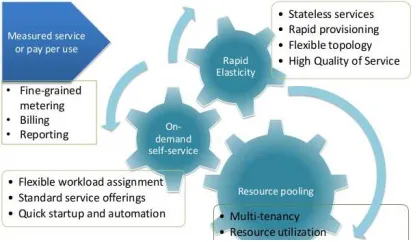
On-Demand Self-Service: Cloud client will
build use of cloud resources with none human interaction between them and therefore the cloud service supplier (CSP).In addition; they'll schedule, manage and deploy any of cloud services like computation and storage once required. This results in reduction within the personnel overhead of the cloud supplier, cut in prices of the offered services.
Broad Network Access: Cloud services area unit
accessible over the network via standardized interfaces that allows users to access the services not solely by advanced devices like personal computers, however conjointly by light-weight weight devices like sensible phones. Additionally, the lowered price of high-bandwidth network communication to the cloud provides access to a bigger pool of IT resources that sustain a high level of utilization.
Location-Independent Resource Pooling: The cloud should be ready to meet consumer’s desires from resources. To do so, the cloud uses a method known as virtualization that allows the cloud supplier to pool his computing resources. This resource pool allows the sharing of virtual and physical resources by multiple shoppers. As declared by bureau, There could be a sense of location independence in this the client usually has no management or information over the precise location of the provided resources however could also be ready to specify location at a better level of abstraction.
Rapid Elasticity: it's the power of the cloud to
International Journal of Research (IJR)
e-ISSN: 2348-6848, p- ISSN: 2348-795X Volume 2, Issue 2, March 2015Available at http://internationaljournalofresearch.org
(e.g., storage, processing, bandwidth, and active user accounts). Resource usage are often monitored, controlled, and reportable providing transparency for each the supplier and client of the utilized service
Fig 2 Cloud Computing Characteristics and Application
2. LITERATURE SURVEY
Cloud computing is visualized as architecture for succeeding generation. It has many facilities though have a risk of attacker who can access the data or leak the users identity. While setting a cloud users and service providers authentication is necessary. The issue arises whether loud service provider or user is not compromised. The data will leak if any one of them in compromised. The cloud should be simple, preserving the privacy and also maintaining users identity [1] The flexible use of cloud storage for user is a need as it is seams accessing data locally though that is present at remote side. It is important to inspect the data set on the cloud. So it is necessary to allow a public audit for integrity of outsourced data through third party auditor (TPA). TPA is also beneficial for cloud service provider. It checks the correctness of the outsourced data. TPA should be able to do public audit ability, storage correctness, privacy preserving, Batch auditing with minimum communication and computation overhead [2]. There are many cloud users who wants to upload there data without providing much personal details to other users. The anonymity of the user is to be preserved so that not to reveal the identity of data owner. Provable data possession (PDP) uses similar demonstrating marks to reduce computation on server, and network traffic. PDA
International Journal of Research (IJR)
e-ISSN: 2348-6848, p- ISSN: 2348-795X Volume 2, Issue 2, March 2015Available at http://internationaljournalofresearch.org
privileges as different attributes are issued by different authorities. The attribute authorities ensure the honesty of the user privilege so the confidentiality is maintained by central authority [8]. supply for cryptological keys
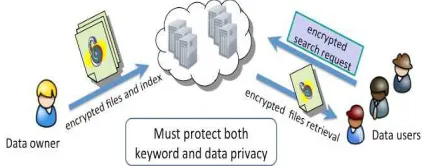
Fig 3 Secured data sharing architecture in cloud
3. RELATED WORK
SYMMETRIC-KEY
ENCRYPTION
WITH
COMPACT KEY
Benaloh et al. [2] presented an encryption scheme which is originally proposed for concisely transmitting large number of keys in broadcast scenario [3]. The construction is simple and we briefly review its key derivation process here for a concrete description of what are the desirable properties we want to achieve. The derivation of the key for a set of classes (which is a subset of all possible ciphertext classes) is as follows. A composite modulus is chosen where p and q are two large random primes. A master secret key is chosen at random. Each class is associated with a distinct prime. All these prime numbers can be put in the public system parameter. A constant-size key for set can be generated. For those who have been delegated the access rights for Sˈ can be generated. However, it is designed for the symmetric-key setting instead. The content provider needs to get the corresponding secret keys to encrypt data, which is not suitable for many applications. Because method is used to generate a secret value rather than a pair of public/secret keys, it is unclear how to apply this idea for public-key encryption scheme. Finally, we note that there are schemes which try to reduce the key size for achieving authentication in symmetric-key encryption, e.g., [4]. However, sharing of decryption power is not a concern in these schemes.
IBE WITH COMPACT KEY
Identity-based encryption (IBE) (e.g., [5], [6], [7]) is a public-key encryption in which the public-key of a user can be set as an identity-string of the user (e.g., an email address, mobile number). There is a private key generator (PKG) in IBE which holds a master-secret key and issues a secret key to each user with respect to the user identity. The content provider can take the public parameter and a user identity to encrypt a message. The recipient can decrypt this ciphertext by his secret key. Guo et al. [8], [9] tried to build IBE with key aggregation. In their schemes, key aggregation is constrained in the sense that all keys to be aggregated must come
from different ―identity divisionsǁ. While there are
an exponential number of identities and thus secret keys, only a polynomial number of them can be aggregated.[1] This significantly increases the costs of storing and transmitting ciphertexts, which is impractical in many situations such as shared cloud storage. As Another way to do this is to apply hash function to the string denoting the class, and keep hashing repeatedly until a prime is obtained as the output of the hash function.[1] we mentioned, our schemes feature constant ciphertext size, and their security holds in the standard model. In fuzzy IBE [10], one single compact secret key can decrypt ciphertexts encrypted under many identities which are close in a certain metric space, but not for an arbitrary set of identities and therefore it does not match with our idea of key aggregation.
ATTRIBUTE-BASED
ENCRYPTION
Attribute-based encryption (ABE) [11], [12] allows each ciphertext to be associated with an attribute, and the master-secret key holder can extract a secret key for a policy of these attributes so that a ciphertext can be decrypted by this key if its associated attribute conforms to the policy. For example, with the secret key for the policy (1 ˅ 3 ˅
International Journal of Research (IJR)
e-ISSN: 2348-6848, p- ISSN: 2348-795X Volume 2, Issue 2, March 2015Available at http://internationaljournalofresearch.org
FRAMEWORK
The data owner establishes the public system parameter through Setup and generates a public/master-secret key pair through KeyGen. Data can be encrypted via Encrypt by anyone who also decides what ciphertext class is associated with the plaintext message to be encrypted. The data owner can use the master-secret key pair to generate an aggregate decryption key for a set of ciphertext classes through Extract. The generated keys can be passed to delegates securely through secure e-mails or secure devices Finally, any user with an aggregate key can decrypt any ciphertext provided that the ciphertext’s class is contained in the aggregate key via Decrypt. Key aggregate encryption schemes consist of five polynomial time algorithms as follows:
1. Setup (1λ , n) : The data owner establish
public system parameter via Setup. On input of a security level parameter 1λ and number of ciphertext classes n , it outputs the public system parameter param
2. KeyGen: It is executed by data owner to
randomly generate a public/ master-secret key pair (Pk, msk).
3. Encrypt (pk, i, m) : It is executed by data
owner and for message m and index i ,it computes the ciphertext as C.
4. Extract (msk, S): It is executed by data owner
for delegating the decrypting power for a certain set of ciphertext classes and it outputs the aggregate key for set S denoted by Ks.
5. Decrypt (Ks, S, I, C): It is executed by a
delegate who received, an aggregate key Ks generated by Extract. On input Ks, set S, an index i denoting the ciphertext class ciphertext C belongs to and output is decrypted result m.
4. DATA SHARING
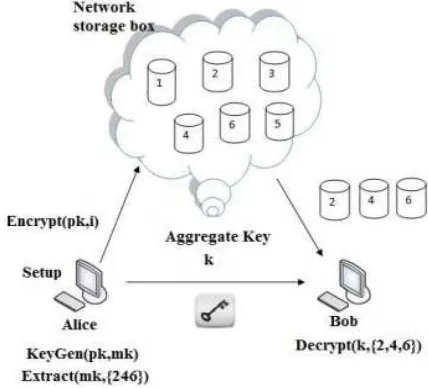
KAC in meant for the data sharing. The data owner can share the data in desired amount with confidentiality. KCA is easy and secure way to transfer the delegation authority. The aim of KCA is illustrated in Figure 4.
Fig 4. Use of KAC for data sharing
For sharing selected data on the server Alice first performs the Setup. Later the public/master key pair (pk, mk) is generated by executing the KeyGen. The msk master key is kept secret and the public key pk and param are made public. Anyone can encrypt the data m and this data is uploaded on server. With the decrypting authority the other users can access those data. If Alice is wants to share a set S of her data with a friend Bob then she can perform the aggregate key KS for Bob by executing Extract (mk, S). As kS is a constant size key and the key can be shared through secure e-mail. When the aggregate key has got Bob can download the data and access it. 5.
5. CONCLUSION
International Journal of Research (IJR)
e-ISSN: 2348-6848, p- ISSN: 2348-795X Volume 2, Issue 2, March 2015Available at http://internationaljournalofresearch.org
REFERENCES
[1] C. Wang, S. S. M. Chow, Q. Wang, K. Ren, and W. Lou, Privacy- Preserving Public Auditing for Secure Cloud Storage, IEEE Trans. Computers, vol. 62, no. 2, pp. 362–375, 2013.
[2] S.Kamara and K.Lauter,―Cryptographic Cloud Storage,Proc.Int’l Conf. Financial Cryptography and Data Security (FC), pp. 136-149, Jan. 2010
[3] D. Boneh, C. Gentry, B. Lynn, and H. Shacham, Aggregate and Verifiably Encrypted Signatures from Bilinear Maps, in Proceedings of Advances in Cryptology - EUROCRYPT ’03, ser. LNCS, vol. 2656. Springer, 2003, pp. 416–432.
[4] V. Goyal, O. Pandey, A. Sahai, and B. Waters, Attribute-Based Encryption for Fine-Grained Access Control of Encrypted data, in Proceedings of the 13th ACM Conference on Computer and Communications Security (CCS ’06). ACM, 2006, pp. 89–98.
[5] S. Yu, C. Wang, K. Ren, and W. Lou, Achieving Secure, Scalable, and Fine-Grained Data Access Control in Cloud Computing, Proc. IEEE INFOCOM, pp. 534-542, 2010.
[6] M. Chase and S. S. M. Chow, Improving Privacy and Security in Multi-Authority Attribute-Based Encryption, in ACM Conference on Computer and Communications Security, 2009, pp. 121–130
[7] M. J. Atallah, M. Blanton, N. Fazio, and K. B. Frikken, “Dynamic and Efficient Key Management for Access Hierarchies,” ACM Transactions on Information and System Security (TISSEC), vol. 12, no. 3, 2009.
[8] J. Benaloh, M. Chase, E. Horvitz, and K. Lauter, “Patient Controlled Encryption: Ensuring Privacy of Electronic Medical Records,” in Proceedings of ACM Workshop on Cloud Computing Security (CCSW ’09). ACM, 2009, pp. 103–114.
[9] F. Guo, Y. Mu, Z. Chen, and L. Xu, “Multi-Identity Single-Key Decryption without Random Oracles,” in Proceedings of Information Security and Cryptology (Inscrypt ’07), ser. LNCS, vol. 4990. Springer, 2007, pp. 384–398.
[10] V. Goyal, O. Pandey, A. Sahai, and B. Waters, “Attribute-Based Encryption for Fine-Grained Access Control of Encrypted data,” in Proceedings of the 13th ACM Conference on Computer and Communications Security (CCS ’06). ACM, 2006, pp.89–98.