Vol. 3, Issue 11, November 2014
Weapon Authentication and Control System
Using Palm Image Verfication
C.A.Devi
PG Student [EST], Dept. of EEE, Saveetha Engineering College, Thandala m, Kancheepura m, Ta milnadu, India 1
ABSTRACT:A system designed to prevent people from accessing firearms such as guns or pistols of an authorized person, so that the fire arms are not misused. In many cases these arms are misused by the authorized persons itself after the license period, so to overcome these defects we are discovering a new system in which we use a biometric system to detect the palm print of the person who owns it. There must be a license period for the fire a rms and these license period say for one year is entered in the embedded mic roprocessor fitted in the firea rm. A bio metric system is essentially a pattern recognition system that makes use of biometric tra its to recognize indiv iduals. Palm is the inner surface of the hand between the wrist and fingers. Palm print is referred to as the principal lines, wrinkles and ridges on the palm. This system proposes Weber’s local descriptors based texture analysis of palm print. The hand palm print image is aligned and cropped according to the key points. The palm p rint image is enh anced and resized. The features of the palm print are co mpared with the database image feature vectors using correlation metric. If this module is completed successfully then the person info which contains person authentication number with four dig its key will be matched with the e xtracted data fro m the already hidden image fo r second level security.
I. INTRODUCTION
It is a common story that weapons of police men are stolen. A result of this is the use of these weapons for various crimes. It is not uncommon to see these weapons of law enforcement being used to break the law instead. The problem is that the pistols do not recognize their rightful owner and thus anybody who has the gun can use it freely. The need of the hour is of a system that checks the identity of the person who holds the gun before he can fire it. Simila r to the problem is the theft of cars. People often misplace their car keys at their workp laces or eating places. By the time they come to know of it the car is gone. A system has to be designed that incorporates personal scanning in the key so that it operates only when it is in the hand of rightful o wner.All the problems that we have listed so far have one common solution. A Wireless Link between two or more objects. For e xa mp le in case of the pistol there will be a wireless lin k between the pistol and an object on the body of the police man, say his b adge. This means that the pistol will sense the badge before operating and it will work only if it gets the correct response from the badge. The pistol may depend on responses of a number of devices to ma ke the pistol even more useless without these devices. Modules can be put in the badge, shoes and belt of the policeman and the pistol will operate only on a signal fro m all the three devices
II. EXIS TING S YSTEM: AUTHENTICATION MECHANIS M B Y US ING THE RFID READER
Fig. 3.1 Bloc k Diagra m fo r Authentication by RFID reader
Vol. 3, Issue 11, November 2014
specific user ID. When weapon is set to validation RFID reader reads RFID tag. RFID reader sends the read data to microcontroller ch ip where authorizat ion of user is checked. If a person is authorized the microcontroller unloc ks the gun by instructing magnetic locks. This method proved to be a failure because if the gun gets locked once, it is impossible to unlock it again.
AUTHENTICATION B Y US ING FINGER PRINT SCANNER B LOCK DIAGRAM
Fig 3.2 Block Diagra m for finger p rint scanner authentication
The authorization of user can be checked by using finger print scanner. Finger print of user is scanned by finger
print scanner. Scanner sends the data to microcontrolle r chip whe re authorizat ion of user is checked. If a person is
authorized the microcontrolle r unlocks the gun by instructing magnetic locks. Tis method was a failu re because finger print bluffing can easily be done and the database could not store a large value of sa mples.
III. PROPOS ED S YSTEM
Only the authorized person can access firearms.For this purpose 3D palm print recognition is usedAfter the
e xpiry of license period, no one can access the firearm or the Weapon. Intimat ion is given to main person about the misuse of weapon through GSM. After the e xpiry of license period, the int imation is given to the authorised user
through a message.
WEAPON S ECTION B LOCK DIAGRAM
The weapon section consists of a came ra to capture the images of palm prints and these images are sent
Vol. 3, Issue 11, November 2014
Fig.3.3 Block Diagra m for Weapon section
CONTROL ROOM S ECTION B LOCK DIAGRAM
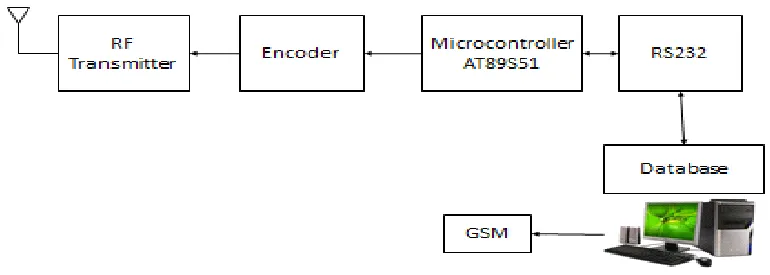
The control room section consists of a Database personal computer where the authenticated images are stored. The database is connected to the microcontroller AT89S51 by the RS232 cab le. The RS232 cable consists of the MAX converter to convert the serial voltages into TTL outputs. The images in turn are to be compared at the weapon section. Thereby these images are encoded and are transmitted through the RF Transmitter and are received at the RF Receiver. In case of expiry of license of the gun, the license period is entered in the database and after this expiry, the pers on is
unable to use the gun and the message is sent to the user or to the main person through GSM.
Vol. 3, Issue 11, November 2014
PALM PRINT CLASSIFICATION
GS M
Global system for mob ile co mmunication (GSM) is a globally accepted standard for digital ce llular communicat ions is the name of a standardization group established in 1982 to create a common European mobile telephone standard that would formulate specificat ion for a pan European mobile cellula r radio system operating at 900M Hz.GSM provides reco mmendations not require ments. The GSM specification defines the functions and interface require ments in detail but do not address the hardware. The reason for this is to limit the designers as little as possible but still make it possible for the operators to buy equipment’s from different suppliers. The GSM network is divided in to three ma jor systems: The switching system (SS), The base station system (BSS),
The Operation supporting system (OSS).
GS M MODEM
A GSM mode m is a wire less modem that works with a GSM wireless network. A wire less modem behaves like a dial-up modem. The ma in difference between them is that a dial-up mode m sends and receives data through a fixed telephone line wh ile a mode m sends and receives data through radio waves.
A GSM mode m can be an e xterna l device as a PC card/PCIMA card. Typically, an e xte rnal GSM mode m is connected to a computer through a serial cable or USB cable.as mentioned in earlie r sections of this SMS tutorial, computers use AT commands to control modems. Both GSM mode ms and dial-up mode ms support a common set of standard AT commands.
VOICE CALLS
Vo ice calls are not an application area to be targeted.in future if interface like a microphone and speaker are provided for some applications then this could be considered.
SMS
SMS is an area where the mode m can be used to provide features like :
Pre stored SMS transmissions.
Vol. 3, Issue 11, November 2014
project work was developed after conducting a number of e xp eriments before finalizing the design work, this reduced the bottle necks and we did not face much difficu lty in the final integration process. In general the entire development of the project work was educative and we could gain a lot of e xpe rience by way of doing the project practica lly. We could understand the practical constraints of developing such systems about which we have studied by way of lectures in the theory classes. It was satisfying to see so many theoretical aspects work before us in real li fe practice, wh ich we have the various processes that are involved in the weapon section and control room sections
REFERENCES
1. Henry.E, Classification and Uses of Fingerprints. London, U.K.: Routledge, 1900.
2. Joachims.T , “Optimizing search engines using clickthrough data,” in Proc. 8th ACM SIGKDD, 2002, pp. 133 –142.
3. Lumini .A, D. Maio, and D. Maltoni, “ Continuous vs. exclusive classifi- cation for fingerprint retrieval,” Pattern Recognit. Lett., vol. 18, no. 10, pp. 1027–1034, Oct. 1997.
4. Maltoni. D, D. Maio, A. K. Jain, and S. Prabhakar, Handbook of Finger - print Recognition. New York: Springer-Verlag, 2003.
5. Wu. D.X.Q. Zhang, K. Q. Wang, and B. Huang, “Palmprint classification using principal lines,” Pattern Recognit., vol. 37, no. 10, pp. 1987– 1998, 2004.