A Low-Complexity Blind Multiuser Receiver
for Long-Code CDMA
Quang Hieu Dang
Department of Electrical Engineering, Delft University of Technology, Mekelweg 4, 2628 CD Delft, The Netherlands Email:[email protected]
Alle-Jan van der Veen
Department of Electrical Engineering, Delft University of Technology, Mekelweg 4, 2628 CD Delft, The Netherlands Email:[email protected]
Received 3 November 2003; Revised 15 March 2004
Receivers for long-code systems are for computational reasons usually based on simple matched-filter techniques, and hence suffer from multiaccess interference. Decorrelating RAKE and MMSE receivers do not have this problem but have not been widely studied due to the apparent complexity of the inversion of a large code matrix. Tong, van der Veen Dewilde, and Sung (IEEE Tr. Signal Proc., 2003) derived a blind decorrelating RAKE receiver (DRR) and channel estimation algorithm for long-code CDMA systems, and showed how it can be efficiently implemented. In this paper, we continue on that work. We propose both single-user and multiuser blind source-channel estimation algorithms by making use of an iterative estimation scheme initialized by the DRR. Simulation results show significant improvement, even in heavily loaded systems. Moreover, with an implementation based on time-varying system theory, the proposed algorithm can be implemented efficiently at a cost similar to the RAKE.
Keywords and phrases:long code CDMA, blind multiuser detection, channel estimation.
1. INTRODUCTION
Long-code (or aperiodic-code) DS-CDMA systems are cur-rently being used in the IS-95 mobile communication net-work standard and have been adopted in several third-generation standards such as UMTS. Originally, the receivers proposed for such systems were based on the RAKE struc-ture, that is, banks of matched filters which correlate the re-ceived data with the desired user’s code, followed by a com-bining of the outputs (RAKE fingers). Since multiuser inter-ference is not completely cancelled, the performance is de-graded, especially when the network is heavily loaded and power-control imperfect. It is therefore interesting to look at multiuser receivers.
Channel estimation and multiuser detection for long-code wideband CDMA have not seen the same levels of at-tention as their short-code equivalents, yet have been con-sidered by a number of authors and are receiving renewed interest. A first classification of the available literature can be made according to the assumptions posed on the sce-nario.
(i) Narrowband versus wideband propagation channels. Here we consider wideband channels, for which equal-ization is needed.
(ii) Uplink versus downlink scenarios. We will consider only the uplink. The downlink case is different because users are perfectly synchronized, orthogonal, and with the same propagation channel, and only a single user needs to be decoded.
(iii) Synchronous and asynchronous transmissions. We consider the asynchronous case.
(iv) Training-based channel estimation algorithms versus blind algorithms. We consider the blind case.
The complexity of the problem greatly depends on these assumptions. For example, in the case of synchronous trans-missions and delay spreads of at most a few chips, the receiver can drop the samples that have intersymbol interference (ISI) [1,2,3,4]. This decouples the problem and allows symbol-by-symbol processing.
matrix inversion with a complexity cubic in the number of users and processing gain is avoided by iterative techniques (gradient descent), leading to a quadratic complexity.
Blind techniques based on second-order moment match-ing (i.e., stochastic techniques) have appeared in [9,10,11, 12,13,14,15]. These rely on the convergence of time aver-ages, which often requires hundreds of symbols. Other ap-proaches are based on iterative optimization of a likelihood function [16,17], which tends to have a very high complex-ity. Several other approaches are valid only for the downlink, for example [1]; see also [18] which contains an extensive reference list.
The algorithms in this paper continue on the blind mul-tiuser joint symbol-channel estimation techniques in [19,20] and can be called deterministic, since no statistical model of the sources is assumed. In these papers, Tong et al. con-sidered an uplink decorrelating RAKE receiver (DRR) algo-rithm where the base station knows all codes. By constructing and inverting a code matrix, a blind decorrelating RAKE and MMSE receiver was derived to estimate the channel and de-sired user symbols, based on all samples in a frame. After the decorrelating step, the users are treated independently, which is computationally advantageous but gives suboptimal per-formance when compared to an informed multiuser MMSE receiver. There are two reasons for this. Firstly, due to the code inversion, the noise becomes correlated among symbols and users. This reduces the performance of the subsequent single-user estimation and detection step. A second and more important reason is that code inversion followed by channel inversion is suboptimal, and gives more noise enhancement than the inversion of the product of the code and channel matrices. In this paper, we take these effects into account.
We propose to use the single-user channel estimates from the DRR as an initial point for an iterative symbol/channel estimation algorithm which also considers the noise corre-lations. This can be done on a per-user basis, or, with bet-ter performance, jointly in a multiuser fashion. In heavily loaded systems, this algorithm shows a significant improve-ment over the current decorrelating RAKE receiver and the conventional RAKE receiver.
The proposed multiuser algorithm is by itself not a very surprising result. Similar iterative receivers are known for short-code (periodic-code) CDMA systems, for example, the (parallel interference cancellation PIC) receivers, and for long-code CDMA an iterative blind receiver that appears to be related to ours was proposed in [8]. Such receivers usually act on symbol-by-symbol data, whereas the proposed algo-rithm acts on a slot of data (Msymbols). What is new here is the observation that the blind DRR (or the related blind RAKE receiver) provides a very good initial point for the iter-ation, and the observation that an efficient implementation for the algorithm is possible. A direct implementation has a complexity that grows with M3, and would soon be pro-hibitive. However, the matrices to be inverted are sparse and structured (they are related to a band matrix after permuta-tions). As in [20], we consider the use of time-varying state space theory developed by Dewilde and van der Veen [21] to implement matrix multiplications, QR-factorizations, and
matrix inversions.1 We will demonstrate that the resulting complexity of the iteration is similar to that of the DRR, that is, linear in the number of transmitted symbolsMand linear in the code length (coding gain)G. For largeM, the com-plexity is of orderGKper estimated symbol per user, where K is the number of users. The conventional RAKE receiver has complexityGLper estimated symbol per user, whereLis the channel length in chips. Hence, the proposed algorithm is not much more complex, and certainly feasible.2
A preliminary version of this paper was presented at SPAWC ’03 [23]. The present version offers additional sim-ulations and a detailed complexity count. The outline of the paper is as follows.Section 2gives the data model and de-scribes the blind receiver algorithm from [20].Section 3 de-rives the proposed algorithms, in both multiuser and single-user fashions.Section 4derives the complexity of the algo-rithms, andSection 5shows the performance by simulations. Finally,Section 6gives the conclusions.
2. PROBLEM STATEMENT AND
PRELIMINARY RESULTS
2.1. Data model
We consider the same data model as in [20]. The context is the uplink of a slotted system with K asynchronous users. In a slot, theith user transmits a vectorsiconsisting ofMi
symbolssik. Each symbolsikis spread by an aperiodic code
(vector)cikof lengthGi. After multipath propagation over a
channel with lengthLichips and relative delayDi
(asynchro-nism), pulse-shaped matched filtering and chip-rate sam-pling, the receiver stacks the received samples in a slot in a vector y. The contribution ofsik to y is a linear
combina-tion of the transmitted signalciksik, plus delays of it, properly
scaled by theLichannel coefficients collected in a vectorhi,
or
yik=Tikhisik, k=1,. . .,Mi, (1)
which is illustrated in Figure 1a. Tik is a Toeplitz matrix
whoseLicolumns consist of shifts of the code vectorcik.
In-cluding allKusers and the noise, we have
y=THs+w, (2)
T:=T1,. . .,TK
, (3)
H:=diagIM1⊗h1,. . .,IMK⊗hK
, (4)
1This theory for time-varying systems should be regarded as a computa-tional framework applicable toanymatrix, potentially even of infinite size, and should not be confused with the modeling of long-code CDMA sys-tems as a time-varying system as is sometimes done in the literature. There are connections, for example, between our matrix inversion techniques and Kalman filtering.
(k−1)Gi+Di
cik
yik=
Tik hi sik
Gi
Li
(a)
T=
Di
Gi
H=
Hi
s= si
(b)
Figure1: (a) Effect of a single transmitted symbol on the received data vectory, (b) structure of the code matrixT, channel matrixH, and
symbol vectors.
where theih user’s code matrix isTi := [Ti1,. . .,Ti,Mi], the
channel matrix H is block diagonal with I⊗hi as the ith
block, vectorsis a stacking of all symbol vectors of all users, as illustrated inFigure 1b, andwis a vector representing the additive Gaussian noise.
Thas size max(MiGi+Di+Li−1)×
K
1(MiLi), andH
has sizeK1(MiLi)×
K
1(Mi). For convenience, we will
usu-ally consider the case of users with equal parameters, but the general case is certainly not ruled out.
In the derivations of the algorithms, we will make the fol-lowing assumptions.
(A1) The code matrixTis known. This implies that the re-ceiver knows the codes, the user delay offsetsDi, and
the number of pathsLiof all users.
(A2) THis tall and full column rank, which (for users with equal parameters) impliesK < G, that is, the number of users is less than the processing gain. We will also require another matrix to be tall (TSin (18)), which will implyKL < MG. For initialization using the DRR, we need to require moreover thatTis tall and full col-umn rank, which impliesKL < G(for users with equal parameters).
(A3) The noisewis white Gaussian, with unknown variance σ2.
The problem we consider is to find, given the code matrix
Tand the received data vectory, good estimates of all users’ source symbolssand all channel coefficientsh, where
h=hH1,. . .,hHKH (5) is the stacking of all users’ channelshi.
2.2. Decorrelating RAKE Receiver (DRR) algorithm As introduced in [20], the decorrelating RAKE receiver (DRR) algorithm first applies a decorrelating matched filter, orT† = (THT)−1TH, to the vector of received datay. This
removes all multiuser interference. The output of the decor-relating matched filter is given by
u=T†y=Hs+n, (6)
wheren=T†wis a colored noise vector. The new noise co-variance matrix is
Rn:=E
nnH=σ2THT−1. (7) SinceHis block diagonal, the filter output can be separated into individual user contributions. Splituinto Ksegments
ui, one for each user, then
ui=
I⊗hi
si+ni, i=1,. . .,K. (8)
By unstacking the vectoruiinto a matrixUi, we obtain the
model
Ui=hisTi +Ni, i=1,. . .,K. (9)
The channel estimation proceeds by taking a rank-1 decom-position ofUi, via a singular value decomposition. The
dom-inant left singular vector is an estimate of hi, and the
cor-responding right singular vector determines the symbolssi
up to an unknown scaling. Since the noise Ni is not white,
a prewhitening can improve the decomposition [20]; unfor-tunately, it is not possible to prewhiten each column ofUi
separately because it would destroy the rank-1 property. A blind RAKE receiver is obtained in a similar way, but by settingu=THyin (6).
With an initial channel estimateh(0)obtained in this way, it was also briefly mentioned in [20] that further refinements can be obtained in a two-step iterative fashion, that is, an alternating least squares algorithm similar to the ILSP algo-rithm [24]. Based on (9),
(1) givenh(ik−1), solve
s(ik)=arg min si
Ui−h(k−1)
i sTi
2
= 1
h(ik−1)2·
h(ik−1)HUi
T
.
(10)
(2) keepings(ik)fixed, solve
Although this algorithm was proposed in [20], its perfor-mance was not shown.
2.3. Discussion
To simplify the initial estimation of the channel, the preced-ing derivation from [20] ignored most of the information on the noise covariance matrixRn, namely the noise correlations
among the users, and the symbol-by-symbol temporal cor-relations. Also the iterative refinement did not take any noise correlation properties into account. Our aim will be to im-prove the estimation by taking the complete noise model into account. As it turns out, the elegant rank-1 channel estima-tion property is hard to generalize. However, using the DRR or the blind RAKE to obtain an initial channel estimate, we can improve the estimates by straightforward multiuser two-step iterations, discussed in the next section.
3. JOINT SOURCE-CHANNEL ESTIMATION
Our derivations will use the following lemma.
Lemma 1. Lethandsbe vectors of lengthLandM, respec-tively. Then(IM⊗h)s=(s⊗IL)h.
Proof. Using the multiplicative property of Kronecker prod-ucts, (A⊗B)(C⊗D)=(AC⊗BD), we immediately obtain
3.1. Single-user estimation with noise whitening Consider the single-user model (8). The covariance of the noiseniis denoted by (Rn)i, and is known: it is a submatrix
where ˜niis white noise. Using the lemma, we can now
intro-duce a similar alternating LS algorithm to estimatesiandhi
in turns, for each useriseparately.
(1) Givenh(ik−1), solve
Subsequently, round the entries ofs(ik)to the nearest elements of the alphabet.
Figure2: Structure of (a) matrixHand (b) matrixS.
(2) Keepings(ik)fixed, solve
In comparison to the original single-user iterative algo-rithm, the performance is expected to be better, since the noise correlations of the data vector are taken into account. On the other hand, correlations among users are still ig-nored. Also, the noise enhancement due to the preprocessing withT†is not avoided.
3.2. Iterative multiuser estimation
Compared to the single-user estimation algorithms, it is known that joint detection algorithms can achieve significant performance gains, at the expense of increased complexity. We will derive such an algorithm in this section, then verify its complexity in the next section.
Consider the original data model in (2). We can formu-late the channel/data estimation problem as a typical least squares problem: findhandsto minimizey−THs2, where
H=diag(I⊗h1,. . .,I⊗hK). In the presence of white
Gaus-sian noise, this LS cost function is also optimal in a maxi-mum likelihood sense.
Before we show the iteration, we use the lemma to rewrite the cost function also as a function ofh, that is,y−TSh2, where
S=diags1⊗IL1,. . .,sK⊗ILK
. (16)
The structure ofSis shown inFigure 2b.
With a good initial channel estimate, sayh(0), we can use the following iteration to improve the estimate. For iteration indexk=1, 2,. . .until convergence,
(2) keeping the source symbolss(k)fixed, solve
After the iterations, step 1 is repeated once more to get the final estimate of the source symbols. Assuming the decisions are correct, the algorithm will approach the multiuser Linear MMSE solution with the channel estimated from completely known symbols.
Although written differently, the second estimation step is similar to other batch training-based techniques proposed for long-code CDMA (cf. [5,8]).
As an alternating projection algorithm, it is known that it will converge monotonically to a local optimum. Gener-ally, the algorithm only completely converges after a number of iterations. However, with an initial estimate of the chan-nel provided by the DRR or the blind RAKE discussed in Section 2.2, the algorithm rapidly converges with only one it-eration. Because in this formulation the noise is not colored, the final estimates can be much better than those of the ini-tial single-user algorithms that have to work with incomplete noise models.
Apart from this, a second reason why this algorithm is expected to have better performance is that it uses inverses (TH)† and (TS)† of taller matrices, whereas the previous algorithm implicitly worked with H†T† for computing the symbol estimates. WhileH†T†is a valid left inverse ofTH, it is not the minimum-norm left inverse, hence it can give unnecessary noise enhancement.
Another advantage is that the algorithm’s performance can still be stable even whenTis not tall, that is, in heavily loaded cases. In that case, the algorithm needs to be initial-ized by the blind RAKE channel estimation algorithm (i.e., useTHrather thanT†in (6)).
3.3. Multiple receive antennas
In the near future, many base stations will be equipped with multiple antennas. We indicate how the two-step iteration have to be modified to take this into account. The multi-antenna version for DRR was shown in [20].
Consider a case wheredreceive antennas are used. No structure is imposed on this antenna array. Letyj,Hj, and
wjbe the received vector, the channel matrix, and the noise
vector for thejth antenna, respectively. Applying the identity
THjs=TShj, we have the two versions of the data model
wherehjis the stacking of all channel vectors for the jth
an-tenna.
In the first step of the iterative algorithm, where source symbols are estimated from known channel vectors using (19), we need to apply the inverse of [(TH1)T(TH2)T· · ·(THd)T]T to the data vector. Since
this matrix is d times taller than before, its conditioning is expected to be much better so that the estimation of s
is significantly improved. In the second step, estimating the channels from known source symbols using (19), the matrix to be inverted,Id⊗(TS), has the same conditioning as the matrix (TS) in the single-antenna case. Actually, each channel is estimated independently from the source symbols, which means that no gain is obtained in this step. However, since the symbols are estimated at higher accuracy, the overall performance improvement over the single antenna case is significant, even after only one iteration.
4. COMPUTATIONAL COMPLEXITY
In this section, the computational complexity of the two-step iterative algorithm is discussed. In summary, one iteration of the algorithm consists of the following steps:
(1) given the channel coefficientsh, estimate the source symbolssby solvingy=THs+w,
(2) with known source symbolss, estimate the channel co-efficientshby solvingy=TSh+w.
For simplicity of expressions, all users are assumed to have equal parameters. We compute the complexity of three im-plementations: a direct one, one that exploits the sparse structure of T (many zero entries), and one that uses this sparse structureandthe fact that the nonzero entries occur in bands.
order-GM(MK)2operations, inversion of this matrix costs (MK)3 operations, computation of THy costs
GM·MKoperations, application of (THT)−1to this vector costs another (MK)2. The total cost is of order GM3K2+ (MK)3.
(2) Via QR-factorization ofT = QR, subsequentlyv =
Similarly, the complexity of ˆh=(T)†yis,
(1) via (THT)−1·THy, orderGM(KL)2+ (KL)3, (2) via QR-factorization ofT=QR, orderGM(KL)2. 4.2. Computation using sparse structure ofT,H, andS
In the direct computation, we did not recognize the fact that many entries ofT,H, andSare zero. Each row ofThas only KLnonzero entries, whereasHandSare block diagonal and a permutation of a block-diagonal matrix, respectively. Ex-ploiting this, the computation of T := T·H costs order-GMKLoperations, and also the computation of T := TS
costs orderGMKL. In the latter case, we can also recognize the fact that these are integer operations (the entries ofTand
Sare typically±1 or some other finite alphabet).
In the computation of ˆs:=(T)†yusing the sparse struc-ture ofT, we cannot use the technique via QR-factorization because it destroys the structure. Each row of T has only K nonzero entries, each column has G nonzero entries. Via (THT)−1 ·THy, the computation of TH ·T costs
order-G(MK)2operations, inversion of this matrix still costs (MK)3 operations, computation ofTHycostsGMK
oper-ations, and the application of (THT)−1 to this vector costs (MK)2. The total cost is of orderG(MK)2+ (MK)3.
Unfortunately, this direct computation cannot use back-substitution, hence the complete matrix (TH · T)−1 is formed even if it is applied only to a single vector. There are iterative techniques (e.g., conjugate gradient, cf. the chan-nel estimation techniques reported in [5,7]) that compute an approximation to the result; they have complexity of or-der (MK)2. The total complexity would then beG(MK)2+ (MK)2, or of orderG(MK)2.
In the computation of ˆh = (T)†y, no advantage is obtained because T is a full matrix. We can recognize, however, thatThas integer entries, hence computation of (THT)−1costs orderα(KL)2, whereαis the complexity of adding GMinteger numbers. If approximate iterative tech-niques are used for applying the inverse, then the total com-plexity becomes order (KL)2. This is similar to the complex-ity of the channel estimation step in [5,7].3
4.3. Computation via time-varying state space representations
A matrix-vector multiplicationy = Tucan be regarded as a time-varying systemT, which has input signaluand pro-ducesyas the output. Such a system can be realized using time-varying state space equations,
xn+1=Anxn+Bnun,
yn=Cnxn+Dnun,
(20)
wherexnis a state-vector that carries information from one
stage to the next. This representation shows in some more
3Note that, in the cited papers, it was assumed that no synchronization is available and hence the channel length was taken equal to the code length. Therefore, they reported a complexity of (KG)2.
detail how the entries ofy=Tuare computed one-by-one. A complete theory based on this can be found in [21]. In [20], this theory was applied to the efficient inversion of the code matrixTin the current application. Essentially, efficient computations are possible becauseThas many zero entries andthey occur in bands, a result of the FIR channel assump-tion. Therefore, the channel inversion can have a lower com-plexity: the QR-factorization, application ofQH, and
appli-cation ofR−1via backsubstitution can all be done using the state space realization.4It is also shown that the realization of
ThasGM stages, and in thenth stage, [Cn,Dn] are directly
specified in terms of the nonzero entries of thenth row ofT, whereas [An,Bn] are shift matrices (similar to identity
matri-ces).
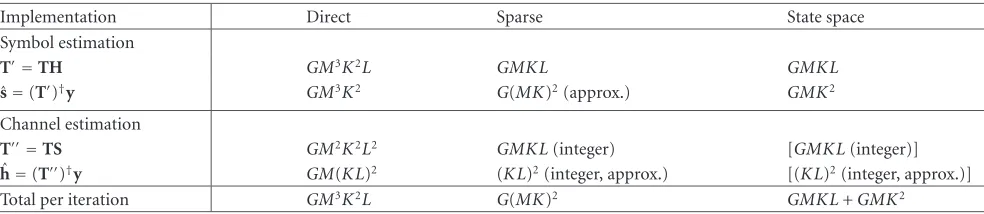
Without repeating the derivations of [20], we mention the resulting complexities. Computation of a state space re-alization ofT=T·Hcosts order-GMKLoperations, and the result is a realization withGMstages, each withKnonzero entries. Computation of the QR-factorization of T costs GMK2operations, and applyingQH orR−1to a vector via backsubstitution costsGMK operations. In total, the com-plexity is of order-GMKL+GMK2operations. This is a fac-torMless than in the preceding section, even if here theexact solution is computed.
In the computation of ˆh=(T)†y, no specific advantage of using state-space realizations is obtained becauseTis not sparse. In this case, the complexity of the preceding section will be assumed.
4.4. Summary
The preceding complexities are summarized in Table 1. For K > L, the dominant term in the complexity is of order GMK2, contributed by the symbol estimation step. Per es-timated symbol per user, the complexity isGK. This can be compared to the complexity of a RAKE receiver (comput-ingu=THy), which isGMKL, orGLper estimated symbol
per user. This suggests that the two-step algorithm does not cost much more, hence is feasible to implement in practice. If K < L, the dominant complexity isGMKL, of the same order as for the RAKE.
To put this in further perspective, we mention the com-plexity of a few other proposed algorithms. The Bayesian approach in [17] has a complexity of GL2 per symbol per user per iteration (about 50–100 iterations are needed). The Kalman filter receiver structure in [25] requiresGKL2 per symbol per user, a known channel is assumed. The reported complexity of the approach in [13] isG2L2per user, for the channel estimation step only.
5. SIMULATION RESULTS
Simulations are used to compare the proposed algorithms to the blind RAKE receiver and the DRR. We simulate a
Table1: Computational complexity of the two-step iterative algorithm.
Implementation Direct Sparse State space
Symbol estimation
T=TH GM3K2L GMKL GMKL
ˆ
s=(T)†y GM3K2 G(MK)2(approx.) GMK2
Channel estimation
T=TS GM2K2L2 GMKL(integer) [GMKL(integer)]
ˆ
h=(T)†y GM(KL)2 (KL)2(integer, approx.) [(KL)2(integer, approx.)] Total per iteration GM3K2L G(MK)2 GMKL+GMK2
long-code CDMA uplink with K = 8 equal-power users transmitting BPSK symbols in frames of lengthM=10 sym-bols, spread by randomly generated codes with gainG=32. All channels have lengths L = 3 and have a random de-lay to model asynchronism, and all channel coefficients are equal-powered, complex normal random numbers. A hun-dred Monte Carlo runs are used to derive the performance statistics.
Only a single iteration of the two-step algorithm is used. The well-known phase ambiguity problem in blind estima-tion is easily solved by using a single training pilot symbol or by differential encoding.
5.1. Channel estimation mean square error comparison
The channel mean square errors (MSEs) of the various algo-rithms are compared for varying signal-to-noise ratio (SNR), that is, the energy per bit divided by the noise power (Eb/N0).
The reference curve is the linear MMSE receiver with known source symbols.
Figure 3ashows the results. It is seen that the proposed it-erative algorithms (multiuser estimation, either initialized by DRR or RAKE) have significant gains over the DRR and es-pecially over the conventional RAKE receiver. When the SNR is sufficiently high (SNR>9 dB), their performance is almost the same as the ideal linear MMSE receiver (computed from known symbols) with gain of about 7 dB over the DRR.
When the noise is strong, the proposed algorithm initial-ized by RAKE seems to be a better candidate than the one with DRR as the initial estimate. This is attributed to the noise enhancement of T†, since Tis not very tall. Conse-quently, as the SNR increases, the gap between the two curves reduces quickly to zero.
In addition, the iterative single-user estimation version of the proposed algorithm also has a good performance with gain of about 2 dB over the DRR. However, separate simula-tions showed that the noise whitening did not give any im-provement in MSE over the unwhitened iterative DRR (its curve is not shown for clarity).
Figure 3b shows how the algorithms’ performance changes with respect to the number of users (K) while the SNR is kept fixed at a moderate level, 10 dB. WhenKis small, the proposed curves are nearly identical to the MMSE re-ceiver. Since DRR requiresTto be tall, the maximal number of users for DRR is given byK0 = G/L. When
approach-ing this limit (K ≈ 7 to 8 so thatTis barely tall), the per-formance of DRR starts to deteriorate: the conditioning of
Tbecomes poor andT†will significantly amplify the noise. The two-step algorithm initialized by DRR still has a good performance. However, whenK ≥K0=10, its performance degrades drastically while the algorithm initialized by RAKE still maintains a good performance. Its curve gradually de-taches from the MMSE curve asKincreases.
It can be interpreted from the preceding results that our proposed multiuser algorithm converges rapidly, and even a single iteration can have significant improvement in channel estimation, which is comparable to the linear MMSE receiver. Moreover, the proposed algorithm is rather independent of the initial estimate when the system is not heavily loaded. When the number of usersKbecomes critical, initialization by the blind RAKE is the preferred choice because it does not suffer from sudden noise enhancement.
5.2. Bit error rate (BER) comparison
We next study the BER performance of the various algo-rithms. The reference curve indicates the performance of the linear MMSE receiver based on true channel coefficients. Figure 4acorresponds toFigure 3aand shows that the mul-tiuser version of the proposed mulmul-tiuser algorithm has sig-nificant improvement over the DRR. The gain is approxi-mately 4 dB at BER=10−2, and slightly increases when the BER decreases. The single-user noise-whitened iterative ver-sion, despite its rather good performance in channel estima-tion, is only slightly better than its corresponding DRR (the gain is about 1 dB). Without noise whitening, however, the BER results of the original iterative algorithm inSection 2.2 were slightly worse than the noniterative DRR (curves not shown for clarity), therefore, the whitening step is advis-able.
The proposed multiuser algorithm seems to have the same BER when the SNR is high enough, independent of its initialization by the DRR or by the blind RAKE. However, when the noise is strong, the iterations initialized by RAKE have a slightly better performance because they do not suffer from noise enhancement in caseTis not tall.
DRR RAKE
Single-user iteration (DRR-initialized) Proposed (DRR-initialized)
Proposed (RAKE-initialized) MMSE (known source symbols)
K=8 users G=32 chips M=10 symbols L=3 chips 100 MonteCarlo 101
100
10−1
10−2
MSE
−5 0 5 10 15 20
Eb/N0(dB)
(a)
DRR RAKE
Proposed (DRR-initialized) Proposed (RAKE-initialized) MMSE (known source symbols)
EbN0=10 dB G=32 chips M=10 symbols L=3 chips 100 MonteCarlo 101
100
10−1
10−2
MSE
2 4 6 8 10 12 14 16
K(users)
(b)
Figure3: Channel estimation error (MSE), forG=32 chips,M=10 symbols, andL=3 chips versus (a) SNR (fork=8 users), and (b)
number of users (k) (forEb/N0=10 dB).
DRR RAKE
Single user iteration (DRR-initalized) Proposed (DRR-initalized)
Proposed (RAKE-initalized) MMSE (true channel)
K=8 users G=32 chips M=10 symbols L=3 chips 100 MonteCarlo 100
10−1
10−2
10−3
10−4
BER
−5 0 5 10 15 20
Eb/N0(dB)
(a)
DRR RAKE
Proposed (DRR-initialized) Proposed (RAKE-initialized) MMSE (true channel)
K=8 users G=32 chips M=10 symbols L=3 chips 100 MonteCarlo 100
10−1
10−2
10−3
10−4
BER
−5 0 5 10 15 20
Eb/N0(dB)
(b)
6. CONCLUSION
We have derived a multiuser joint source-channel estima-tion for long-code CDMA, which is the combinaestima-tion of the blind (decorrelating) RAKE receiver with an iterative sym-bol/channel estimation algorithm. The algorithm shows a significant improvement over the decorrelating RAKE re-ceiver and the conventional RAKE rere-ceiver. The gain is espe-cially impressive in heavily loaded systems, even if the noise is strong.
Using time-varying state space realizations, we showed that the proposed algorithm can be efficiently implemented, especially if the number of symbols in a slot is relatively large. Per estimated symbol per user, the complexity is of orderGK, whereas the complexity of a RAKE receiver isGL, whereGis the code length, Kthe number of users, andLthe channel length in chips (assumingK > Land the number of symbols in a slot sufficiently large). Thus, the proposed scheme has a complexity that is similar to that of the RAKE receiver.
ACKNOWLEDGMENTS
This research was supported in part by the Dutch Ministry of Economic Affairs under TSIT 1025 “Beyond-3G,” and by NWO-STW under the VICI programme (DTC.5893). Parts of this paper were presented at SPAWC ’03 [23].
REFERENCES
[1] A. J. Weiss and B. Friedlander, “Channel estimation for DS-CDMA downlink with aperiodic spreading codes,” IEEE Trans. Communications, vol. 47, no. 10, pp. 1561–1569, 1999. [2] M. Melvasalo and V. Koivunen, “Blind channel estimation in multicode CDMA system with antenna array,” inProc. 2nd IEEE Sensor Array and Multichannel Signal Processing Work-shop Proceedings, pp. 565–569, Rosslyn, Va, USA, August 2002. [3] P. Liu and Z. Xu, “Linear multiuser detection for uplink long-code CDMA systems,” inProc. IEEE Int. Conf. Acous-tics, Speech, Signal Processing, vol. 4, pp. IV.97–IV.100, Hong Kong, April 2003.
[4] Y. Zhang and R. Zhang, “Blind MMSE multipath combining for long-code CDMA systems,” inProc. IEEE Int. Conf. Acous-tics, Speech, Signal Processing, vol. 4, pp. IV.113–IV.116, Hong Kong, April 2003.
[5] S. Buzzi and H. V. Poor, “Channel estimation and multiuser detection in long-code DS/CDMA systems,” IEEE Journal on Selected Areas in Communications, vol. 19, no. 8, pp. 1476– 1487, 2001.
[6] S. Buzzi and H. V. Poor, “On parameter estimation in long-code DS/CDMA systems: Cramer-Rao bounds and least-squares algorithms,”IEEE Trans. Signal Processing, vol. 51, no. 2, pp. 545–559, 2003.
[7] S. Bhashyam and B. Aazhang, “Multiuser channel estima-tion and tracking for long-code CDMA systems,”IEEE Trans. Communications, vol. 50, no. 7, pp. 1081–1090, 2002. [8] M. Torlak, B. L. Evans, and G. Xu, “Blind estimation of
FIR channels in CDMA systems with aperiodic spreading se-quences,” inProc. 31st Asilomar Conference on Signals, Systems and Computers, vol. 1, pp. 495–499, Pacific Grove, Calif, USA, November 1997.
[9] M. D. Zoltowski, Y.-F. Chen, and J. Ramos, “Blind 2-D RAKE
receivers based on space-time adaptive MVDR processing for IS-95 CDMA system,” inProc. IEEE Military Communications Conference, vol. 2, pp. 618–622, McLean, Va, USA, October 1996.
[10] H. Liu and M. D. Zoltowski, “Blind equalization in antenna array CDMA systems,”IEEE Trans. Signal Processing, vol. 45, no. 1, pp. 161–172, 1997.
[11] Y.-F. Chen, M. D. Zoltowski, C. Ramos, J. Chatterjee, and V. P. Roychowdhury, “Reduced-dimension blind space-time 2-D RAKE receivers for DS-CDMA communication systems,” IEEE Trans. Signal Processing, vol. 48, no. 6, pp. 1521–1536, 2000.
[12] N. D. Sidiropoulos and R. Bro, “User separation in DS-CDMA systems with unknown long PN spreading codes,” inProc. 2nd IEEE Workshop on Signal Processing Advances in Wireless Com-munications, pp. 194–197, Annapolis, Md, USA, May 1999. [13] Z. D. Zu and M. K. Tsatsanis, “Blind channel estimation for
long code multiuser CDMA systems,”IEEE Trans. Signal Pro-cessing, vol. 48, no. 4, pp. 988–1001, 2000.
[14] C. J. Escudero, U. Mitra, and D. T. M. Slock, “A Toeplitz dis-placement method for blind multipath estimation for long code DS/CDMA signals,” IEEE Trans. Signal Processing, vol. 49, no. 3, pp. 654–665, 2001.
[15] Z. Xu, “Computationally efficient multiuser detection for aperiodically spreading CDMA systems,” inProc. IEEE Int. Conf. Acoustics, Speech, Signal Processing, vol. 4, pp. 2249– 2252, Salt Lake City, Utah, USA, May 2001.
[16] K. Li and H. Liu, “Channel estimation for DS-CDMA with aperiodic spreading codes,” inProc. IEEE Int. Conf. Acoustics, Speech, Signal Processing, vol. 5, pp. 2535–2538, Phoenix, Ariz, USA, March 1999.
[17] Z. Yang and X. Wang, “Blind turbo multiuser detection for long-code multipath CDMA,” IEEE Trans. Communications, vol. 50, no. 1, pp. 112–125, 2002.
[18] Z. Xu, P. Liu, and M. D. Zoltowski, “Diversity-assisted channel estimation and multiuser detection for downlink CDMA with long spreading codes,” IEEE Trans. Signal Processing, vol. 52, no. 1, pp. 190–201, 2004.
[19] L. Tong, A.-J. van der Veen, and P. Dewilde, “Channel estima-tion for long-code WCDMA,” inProc. IEEE Int. Symp. Circuits and Systems, vol. 3, pp. 651–654, Phoenix-Scottsdale, Ariz, USA, May 2002.
[20] L. Tong, A.-J. van der Veen, P. Dewilde, and Y. Sung, “Blind decorrelating RAKE receivers for long-code WCDMA,”IEEE Trans. Signal Processing, vol. 51, no. 6, pp. 1642–1655, 2003. [21] P. Dewilde and A.-J. van der Veen, Time-Varying Systems
and Computations, Kluwer Academic Publishers, Dordrecht, Netherlands, 1998.
[22] H. Holma and A. Toskala, Eds., WCDMA for UMTS, John Wiley & Sons, West Sussex, England, 2nd edition, 2002. [23] Q. H. Dang and A.-J. van der Veen, “Single- and multi-user
blind receivers for long-code WCDMA,” inProc. IEEE Work-shop on Signal Processing Advances in Wireless Communica-tions, Rome, Italy, June 2003.
[24] S. Talwar, M. Viberg, and A. Paulraj, “Blind separation of syn-chronous co-channel digital signals using an antenna array. I. Algorithms,” IEEE Trans. Signal Processing, vol. 44, no. 5, pp. 1184–1197, 1996.
Quang Hieu Dang was born on October 28, 1976 in Hai Duong, Vietnam. He re-ceived the B.S. degree in electronics and telecommunications from Hanoi University of Technology, Vietnam, in May 1999, and the M.S. degree from Delft University of Technology in August 2003. From 1999 to 2001, he was employed as a Research and Teaching Assistant at Hanoi University of Technology. He is currently working as a
Ph.D. student at Delft University of Technology. His research ex-pertise is in signal processing for long-code WCDMA and for ultra wideband communication (UWB).
Alle-Jan van der Veen was born in The Netherlands in 1966. He graduated (cum laude) from Delft University of Technol-ogy, Department of Electrical Engineering, in 1988, and received the Ph.D. degree (cum laude) from the same institute in 1993. Throughout 1994, he was a postdoctoral scholar at Stanford University. At present, he is a Full Professor in the Signal Process-ing Group of Delft Institute of