R E S E A R C H
Open Access
Pilot allocation scheme based on coalition
game for TDD massive MIMO systems
Hui Zhi
1*and Xiaoguang Ding
2Abstract
Pilot contamination is a major factor that restricts the system performance of time division duplex (TDD) massive multiple-input multiple-output (MIMO) systems. Reasonable pilot allocation is an effective method to reduce pilot contamination. However, most of the existing pilot allocation methods focus on cells of the same size, a regular shape, an equal number of users per cell, and/or independent fading channels. When they are generalized or modified to actual scenes (in which cells have irregular shapes, users are randomly distributed, and channels are correlated fading channels), they are inflexible and cannot guarantee the target performance requirement. Considering both flexibility of pilot allocation and system performance, this paper introduces the idea of a coalition game into pilot allocation and proposes a pilot allocation scheme based on the coalition game. Different utility functions are analyzed under correlated fading channels; the adjustment principle of coalition structure and the coalition formation algorithm are given. Simulation results show that the proposed scheme can be used in any actual scene as well as guarantee the target performance requirement.
Keywords:Massive MIMO, Pilot allocation scheme, Coalition game
1 Introduction
1.1 The research background of this paper
With the appearance of smartphones and tablets, wireless communication requires increasingly higher communication rates. Therefore, many technologies have been proposed to improve the communication rate of 5G, and massive multiple-input multiple-out-put (MIMO) is one of these technologies. Compared with traditional wireless networks, massive MIMO significantly enhances the spectral and power effi-ciency [1].
However, the excellent performance of massive MIMO depends on the accuracy of channel estima-tion. For conventional channel estimation in time div-ision duplex (TDD) massive MIMO systems, users transmit pilot signals in the uplink, and base stations (BSs) receive the pilot signal and estimate channel state information (CSI). Then, BSs can use the CSI for uplinking received signal detection and downlink-ing transmission precoddownlink-ing. Therefore, the accuracy
of channel estimation is one of the key factors that affect the system performance of uplink and down-link. In pilot-based channel estimation, the number of pilots is finite and limited by the channel coherence time, so mobile users in different cells might have to reuse the same pilot. Pilot reuse seriously affects the channel estimation accuracy at BSs and further influences the system performance of uplink and downlink, where the influence is known as pilot con-tamination [2]. Recent studies have shown that pilot contamination is one of the key factors that affect the performance of TDD massive MIMO systems [1–4]. Therefore, many methods have been proposed to reduce pilot contamination, such as pilot contamin-ation precoding [4], time-shifted pilots [5, 6], spatial domain-based pilot allocation [7], design and transmit power control of pilot sequences [8, 9], and pilot reuse [10, 11].
For instance, reference [4] shows that the performance of TDD massive MIMO system is limited by pilot conta-mination. Furthermore, reference [4] considers the up-link precoding and downup-link precoding (called pilot contamination precoding) based on slow fading coeffi-cients to reduce pilot contamination. Papers [5, 6] * Correspondence:[email protected]
1Key Lab of Intelligent Computing and Signal Processing (Ministry of
Education), Anhui University, Hefei 230601, China
Full list of author information is available at the end of the article
discuss the time-shifted pilot method in hexagonal cells, which means cells are divided into different groups, and cells in different groups transmit pilots in different time slots; analyses show that this method can effectively reduce pilot contamination. However, this method assumes that the number of users in each cell is fixed and equal. In addition, it requires strict system synchronization, making implementation complex and difficult. Paper [7] proposes a spatial do-main method with the do-main idea that users with high channel orthogonality can use the same pilot. This method also assumes that cells have a regular shape and that the number of users in each cell is fixed and equal. Furthermore, this method is highly complex because BSs need to know the CSIs between all users and all BSs to carry out the search for highly orthogonal channels. Paper [8] gives a design for non-orthogonal pilot signals, and paper [9] proposes a pilot power alloca-tion method based on cell grouping to alleviate pilot contamination. The methods in [8, 9] both assume that cells have a regular shape and the number of users per cell is fixed. Paper [10] presents a pilot re-use method based on cell grouping and analyzes the system performance of different pilot reuse factors. In paper [11], a fractional pilot reuse method is pro-posed in which users are classified into cell-center users and cell-edge users, where the cell-center users reuse the same pilot subset and the cell-edge users use the remaining pilots according to cell grouping.
Studies [12,13] try to introduce game theory into pilot allocation to reduce pilot contamination. However, the pilot allocation methods in [12, 13] both consider the games between cells. Simply because of the games between cells, the suitable application scene of [12, 13] is still fixed and has an equal number of users in each cell, although reference [13] attempts to discuss irregu-larly shaped cells.
Reviewing the studies in [4–13], reasonable pilot allo-cation can effectively reduce pilot contamination and improve system performance. However, in order to fa-cilitate theoretical analysis and simulation, most of these pilot allocation methods assume that cells have a regular shape (most are hexagons), the number of users per cell is equal, and/or channels are independent. However, in reality, the cell shapes are affected by various factors, such as landforms and buildings, and do not always have a regular shape. Moreover, mobile users are randomly distributed in reality, so it is impossible for the number of users in each cell to be equal or fixed. When the number of base station antennas is very large, it is diffi-cult to ensure the distance between the antennas, and it is difficult to ensure that all channels are independent.
Most of these pilot allocation methods (in references [4–13]) assume that the number of users per cell is equal
or fixed for two main reasons. First, when the number of users in each cell is equal or fixed, it is easy to allocate pi-lots. For example, in references [4–13], in order to avoid the use of the same pilot in adjacent cells (pilot con-tamination is large in this case), these pilot allocation methods [4–13] always reserve a certain number of pilots for each cell. If the number of users in each cell is equal or fixed, it is convenient to estimate the number of pilots per cell, so that when pilots are al-located, the pilots of adjacent cells can be differenti-ated. Second, when the number of users in each cell is equal, the dimension of the channel matrix in each cell is equal, which is convenient for merging in mathematical operation in theoretical analysis.
If we modify these methods [4–13] to the actual scenes in which all users are randomly distributed and the number of users per cell is unequal, the system per-formance will not be guaranteed. For example, if the number of users is large in a cell, using these methods [4–13], pallocated pilots are insufficient, and pilot re-use will care-use large pilot contamination. On the other hand, if the number of users in a cell is small, using these methods [4–13], the pilot resource cannot be fully utilized, and this will cause the waste of pilot re-sources and then affect overall performance. Obvi-ously, this point reflects that these methods [4–13] lack flexibility.
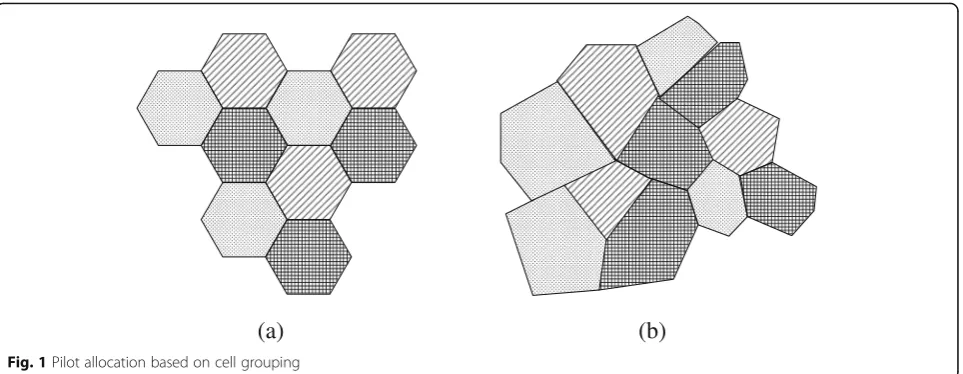
The assumption of a regular cell shape is also bene-ficial to pilot allocation. When the cell shape is regu-lar, cells can be grouped first. For example, as shown in Fig. 1a, taking pilot reuse factor 3 as an example, the cells in the picture have three types of back-ground pattern. The cells with the same backback-ground pattern are grouped together and reuse the same pilot subset (the total pilot set has been divided into three orthogonal pilot subsets). Cells with different back-ground patterns use different orthogonal pilot subsets. References [9–11] use similar cell grouping pilot allo-cation methods. However, the actual situation is that the cell shape is irregular. The pilot multiplexing in 11 cells shown in Fig. 1b is based on the pilot alloca-tion method in Fig. 1a. It can be seen that in Fig. 1b, because of the irregular cell shape, the same pilot subset is used in adjacent cells, which will cause ser-ious pilot contamination; thus, the system perform-ance cannot be guaranteed.
So we can conclude that if we modify these methods [4–13] to the actual scenes (in which cells have irregular shapes, users are randomly distributed), the system performance will not be guaranteed.
generalized or modified to the actual scenes, but they still cannot guarantee the target performance require-ment. Paper [14] presents a statistical greedy pilot scheduling algorithm, which focuses on users in a single cell and searches users with small channel correlations to use the same pilot. This algorithm does not consider the application scenario of multi-cells and the correl-ation of the channels between different users and differ-ent BSs, so it cannot reduce the interference among different cells and thus cannot guarantee system per-formance in multi-cell scenarios. That is to say, although this algorithm can be generalized to multi-cell scenarios of arbitrary BS locations and an unequal number of users per cell, it cannot guarantee target performance satisfaction. Thus, it is essentially different from our work; the proposed pilot allocation scheme in our work can be used in arbitrary scenarios as well as guarantee system performance.
Paper [15] proposes a greedy approach; its main idea is selecting one user from each cell (there are P users per cell) to form a user set during each search, and users in the same set use the same pilot. The principle of user selection is to minimize the sum mean square error of channel estimation for the users using the same pilot. The greedy approach assumes the number of users per cell is equal; it cannot be used in the case of different numbers of users per cell, so it is different from our work and we have to make modifications in simulations. In addition, it only considers the sum-mean-square error of users with the same pilot and does not consider the total performance of all users; furthermore, it is a one-time search for all users and cannot achieve global optimization, whereas the proposed pilot allocation scheme in our work considers the total performance of all users and performs a cyclic search for all users. Therefore, in comparison, the greedy approach in [15] cannot meet the needs of total performance, whereas
our scheme can meet overall performance requirements through cyclic search.
1.2 The main contents of this paper
In order to find the flexible pilot allocation method that can be used in any actual scenes and provide perfor-mance guarantee, we introduce the idea of a coalition game into pilot allocation and propose a pilot allocation scheme based on the coalition game in this paper. We consider the game between users and divide users into different sub-coalitions. Because this coalition game is among users, the proposed pilot allocation scheme is more flexible and can be used in any actual scene. Because the purpose of each coalition adjustment is to improve the target performance (average utility function), the target performance can be satisfied through the cyclic search of coalition adjustment. The contributions of this paper are as follows.
1) To be applied in arbitrary actual scene (with irregular shape cells, unequal number of users per cell, and correlated fading channels) and provide target performance guarantee, a novel pilot allocation scheme based on the coalition game is proposed.
For the game between users, the coalition structure is defined, different utility functions are analyzed, and the coalition formation algorithm is given. 2) The implementation method of the proposed pilot
allocation scheme is presented.
3) Simulations are developed to show that the proposed scheme can be used in any actual scene, effectively reduce pilot contamination, and provide a certain target performance guarantee. Moreover, the comparisons of computational complexity between different schemes are discussed.
(a)
(b)
The remainder of this paper is organized as follows. The system model for the massive MIMO system is described in Section2. Different utility functions are analyzed under cor-related fading channels in Section3, including mean square error of channel estimation (MSE-CE), mean square error of signal detection (MSE-SD), received signal-to-interferen-ce-plus-noise ratio (SINR), and spectrum efficiency (SE). In Section4, the definition of the coalition game is given, and then the coalition structure, the adjustment principle of coalition structure, and the condition of final sta-bility are defined. After that, the coalition formation algorithm is given, a pilot allocation scheme based on the coalition game is proposed, and the implementa-tion method of the proposed scheme is discussed. In Section 5, simulations are developed with respect to different utility functions, and the proposed pilot allo-cation scheme is compared with the greedy approach in reference [15] and the random coalition scheme. Section 6 concludes this paper. The proof of theorem is given in the Appendices 1, 2, and 3.
2 System model
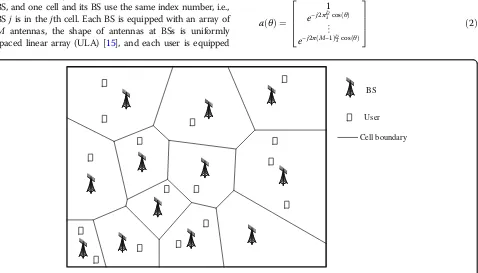
Consider the massive MIMO system as shown in Fig. 2. There are L cells and N users in a fixed area, where we focus on the uplink. Each cell is assigned an index in the set ℒ= {1, 2,⋯,L}. The kth user in the jth cell is denoted by user (j,k). Assume celljhasKjactive users, thus
PL j¼1Kj ¼N. All users form the setN withN ¼ fð1;1Þ;⋯ð1;K1Þ ;⋯ðj;1Þ;⋯ðj;KjÞ;⋯ðL;1Þ;⋯ðL;KLÞg. Each cell has one
BS, and one cell and its BS use the same index number, i.e., BSjis in thejth cell. Each BS is equipped with an array of M antennas, the shape of antennas at BSs is uniformly spaced linear array (ULA) [15], and each user is equipped
with a single antenna. Assume that BSs are subject to a ran-dom distribution and that the users are subject to another random distribution, the distributions of BSs and users are independent. Each user selects and accesses its nearest BS according to the strength of the received BS signals, so the number of users in each cell (Kj,j∈{1, 2,⋯,L}) is not equal.
Assume zu jk∈R
2and zb l∈R
2 are the locations of user
(j,k) and BS l respectively, and zjk is known at all
BSs. dl(zjk) is the distance from user (j,k) to BS l.
The channel between user (j,k) and BS l is defined as
hljk∈ℂM× 1, and we consider correlated Rayleigh
fad-ing channels [15–17]. (For other types of correlated channel models and independent channel models, our pilot allocation scheme is also applicable.) The chan-nel hljk is the superposition of Farriving paths,
hljk ¼
1
ffiffiffiffi F
p X
F
f¼1
a θð Þljkf
αð Þf
ljk ð1Þ
where aðθðljkfÞÞ∈ℂM1 is the antenna steering vector cor-responding to angle-of-arrivals (AoAs) θljk∈[0, 2π), f is the path index, and αðljkfÞi:i∼:d:CN ð0; βljkÞ is the channel coefficient of the fth path, βljk denotes the large-scale fading coefficient and βljk¼δkzu
jk−zblk −v
2 , where νis the path loss exponent,δis a constant of channel coefficient, and we let δ be a constant for arbitrary path f and arbitrary channelhljkin our simulations.
The expression ofa(θ) is
að Þ ¼θ
1
e−j2πDλcosð Þθ
⋮
e−j2πðM−1ÞDλcosð Þθ
2 6 6 4
3 7 7
5 ð2Þ
BS
User
Cell boundary
where D is the interval of antenna spacing at the BS, andλis the signal wavelength.
As an approximation, we consider a ring of radius rs
comprising many scatters around the user. In this case [16], θljk obeys a uniform distribution on ðθminljk ;θ
max
ljk Þ,
whereθminljk <θmaxljk ∈½0;πÞ, and
θmin
ljk ¼ arctan zujk
ljk ¼ arctan zu denotes the expectation.
3 Analysis of different utility functions
The uplink transmission time-frequency resources are divided into frames consisting of Tc seconds and Bc Hz;
thus, each frame containsQ = TcBctransmission symbols
(P pilot symbols and Q-P data symbols, pilot symbols and data symbols are transmitted in different time slots). Assume channels between BSs and users have constant channel response within a frame but vary between frames. Therefore, the number of available orthogonal pilot sequences isP.
Assume that the coalition game divides all users into P sub-coalitions (N>P). P pilots are allocated to the P sub-coalitions respectively. That is, users in the same sub-coalition use the same pilot, users in differ-ent sub-coalitions use differdiffer-ent pilots, and P pilots are mutually orthogonal. The analysis of utility func-tion must be carried out under a certain coalifunc-tion structure, so we first give the coalition structure def-inition in defdef-inition 1.
Definition 1 (Coalition structure). User set N is
divided into P disjoint sub-coalitions S1;S2;⋯;SP, and
∪P
n¼1Sn¼ N, ∩nP¼1Sn¼∅. Coalition structure S is the
coalitional division state, i.e.,S ¼ fS1;S2;⋯;SPg.
3.1 Analysis of MSE-CE
MSE-CE means the mean square error of channel estimation. During the uplink pilot transmission, all users transmit pilots at the same time, thus the received pilot signal at the BSlis
ypilot issue in the uplink, here we consider the transmit power control and let tjk=T/βjjk, where Tis a design
parameter of transmit power. Npilotl ∈ℂMP is the
equivalent additive white Gaussian noise (AWGN) at the receiver with independent and identically distrib-uted (i.i.d.) elements of CN ð0;σ2Þ, where σ2
is the variance of each element in noise .
After decorrelation and power normalization of
ypilot
l , BS l can obtain the channel observation of hljk,
which is structure S, and user (j,k) belongs to the sub-coalition ΛSðj;kÞ.
According to the definition of minimum mean square error (MMSE) estimation and expressions (14), (15) in ref-erence [14], the MMSE estimation of channelhljkat BSl,
which is based on the channel observationhljk, is given by
^
is the
covari-ance matrix ofhljk.
Similar to expression (7), we can obtain the channel estimation ofhjjk(the channel between user (j,k) and its
own BSj), which is
with covariance R^
hjjk¼RjjkC
−1
jjkRjjk. Thus, we can
deter-mine that the channel estimation error is ~hjjk ¼hjjk− ^
estimation [14, 18], channel estimation error h~jjk is
are also mean and covariance of hjjk conditioned on
hljk, respectively [18].
The mean square error of channel estimation (MSE-CE) ^hjjk means the sum of squares estimation
er-rors for each element ofhjjk(you can refer to expression
(18) in [14]); so the MSE-CE of h^jjk is MSE‐CEjk
We define the sum MSE-CE of all users as the sum of the estimation mean square error (MSE) of the channels between each user and its own BS. Thus, the average MSE-CE per user is
MSE‐CEave¼
3.2 Analysis of MSE-SD and received SINR
MSE-SD means the mean square error of signal detec-tion. During the uplink data transmission, all users send their data to all BSs at the same time, and the received signal at BSjis
where xmn∈ℂ1 × 1 represents the symbol transmitted
from user (m,n), Efjxmnj2g ¼1 , ydataj ¼ ½yj1;⋯;yjM j can be rewritten as ydata
j ¼
PL
m¼1Hjm Tdmxmþndataj ¼PLm¼1Gjmxmþndataj .
To distinguish the symbol of each user, the BS j se-lects the combination matrix Wschemejj ∈ℂMKj, which is directly multiplied with the received signal, and the
processed data of all Kj users in the jth cell can be
written as
Considering the maximum ratio combining (MRC), zero-forcing combining (ZFC), and MMSE schemes of the received signalydata
j , thus
onal matrix parameter that is set for EfðwMRC jjk Þ
Theorem 1 For a given coalition structure S, the
Q5¼Ehfwmmsejjk ðwmmsejjk ÞHg, Q6¼Ehf^hjjkðwmmsejjk Þ H
g, Q7 ¼EhfðWmmsejj ÞHWmmsejj g, wzfcjjk is the kth column of the
matrixWzfc
jj ¼H^jjðH^ H jjH^jjÞ
−1
, andwmmse
jjk is thekth column
of the matrixWmmse
jj ¼H^jjðH^ H
jjH^jjþσ2ðTdjÞ ‐2
Þ−1.
For a given coalition structure S, the uplink received SINR for user (j,k) at BS j for MRC, ZFC, and MMSE schemes are given by the expressions (17), (18) and (19) respectively.
Proof The proofs of Theorem 1 for MRC, ZFC, and MMSE schemes are given in Appendices 1, 2, and 3, respectively.
3.3 Analysis of spectrum efficiency
Based on previous theoretical analyses, according to Shannon capacity and referring to expression (11) in [19], the uplink spectrum efficiency (SE) of user (j,k) is
SEscheme
jk ¼ 1− P Q
log2 1þSINRscheme
jk
ð16Þ
where the SINRschemejk for MRC, ZFC, and MMSE schemes are given by expressions (17), (18), and (19), respectively.
4 Pilot allocation scheme based on a coalition game
As mentioned in Section 3, we use the idea of parti-tion form [20] in the coalition game, and all users will be divided into P sub-coalitions (N>P). P pilots are allocated to the P sub-coalitions respectively. That is, users are players in the coalition game. Users in the same sub-coalition use the same pilot and interact with each other in channel estimation. Users in differ-ent sub-coalitions use differdiffer-ent pilots, and they do not affect each other in channel estimation. There-fore, there are mutually influencing and mutually con-straining relationships between users, which coincides with the idea of the coalition game. For this reason, we introduce the idea of the coalition game into pilot allocation. The definition of the coalition game is given as follows.
Definition 2 (Coalition game). The coalition game is
G¼ hN;fuj;kgðj;kÞ∈Ni, where N is the set of game
players; that is to say, users are players in the coali-tion game. uj,kis the utility function of player(j,k)(user
(j,k)), and it is also called the payoff function in game theory.
In this coalition game, each player must belong to a sub-coalition, and the definition of coalition structure is given in definition 1.
The purpose of the coalition game is to optimize util-ity function, so different performance metrics can be used as the utility function in the coalition game. In this paper, we use the MSE-CE (uj;kðSÞ ¼MSE‐CEjkðSÞ),
MSE-SD (uj;kðSÞ ¼MSE‐SDschemejk ðSÞ), received SINR (
uj;kðSÞ ¼SINRschemejk ðSÞ), and SE (uj;kðSÞ ¼SEschemejk ðSÞ)
as the utility functions in the coalition game when we want to satisfy the corresponding system performance. The optimization of a certain utility function is also the minimization of pilot contamination corresponding to this performance.
According to the partition form definition in the coali-tion game theory [20], we need to describe three ele-ments: (1) the coalition structure, (2) the adjustment principle of the coalition structure, and (3) the final sta-bility of the coalition structure.
During each adjustment of the coalition structure, one user leaves its sub-coalition and joins another sub-coalition. This adjustment reduces interference of the original sub-coalition of the user and increases the interference of the newly joined sub-coalition.
The definition of coalition structure is given in defin-ition 1. To benefit each user, the coaldefin-ition structure needs to continuously adjust until final stability. For a certain adjustment, assume player (j,k) leaves its sub-coalitionΛSðj;kÞand joins another sub-coalitionSi,
where Si∈ffS1;S2;⋯;SPgnΛSðj;kÞg. That is, the entire coalition structure changes from the original S into a
new structure SΦ. We describe this adjustment as Sð→j;kÞ SΦ. According to the individual stability concept in the coalition game [21], the adjustment of a user (j,k) leav-ing its sub-coalition ΛSðj;kÞ and joining another sub-coalition Si is permissible if this adjustment can
SINRmrc jk ¼
1
XL
l;m ð Þ∉Λðj;kÞ
td lm td
jk
1 δ2 jjk
sum Rjlm∘RT^hjjk
n o
þ X
L
l;m ð Þ∈Λðj;kÞ
td lm td
jk
1 δ2 jjk
td lm td
jk
sum RjlmR−jjk1
∘RT
^
hjjk
n o
2þsum R~hjlm∘R
T
^
hjjk
n o
( )
þ σ
2
td jkδjjk−
1
strictly improve its utility function and does not reduce the average utility function of all users. Therefore, we have definition 3.
Definition 3(Principle of adjustment). The adjustment
Sð→j;kÞSΦ is permissible if uj;kðSΦÞ is better than uj;kðSÞ
From definition 3, we can see that any user that wants to join another sub-coalition should be beneficial to it-self without damaging the average interest of all users. Thus, the average utility function will be optimal at the final stability.
This adjustment comes to an end as defined in defin-ition 4, which is similar to the defindefin-ition of final stability in [21].
Definition 4 (Final stability). The whole coalition
struc-tureS is stable if there is no permission of adjustmentSð→j;kÞ SΦ for all usersðj;kÞ∈N and all sub-coalitions, orα≥τ, or the average utility function (1
N
X
ðl;mÞ∈N
ul:mðSÞ) is not worse
than U for a given performance index U (where U≥Uminfor
MSE-CE and MSE-SD, U≤Uminfor SINR and SE).
In definition 4, assume the average utility function is equal to Umin when there is no permission of ad-justment Sð→j;kÞSΦ for all users ðj;kÞ∈N and all sub-coalitions. That is to say, Umin is the global opti-mal value of average utility function. In addition, for the given performance index of the average utility function, 1
According to the discussions above, the coalition for-mation algorithm is given in algorithm 1. In definition 4 and algorithm 1, α is the current number of searches and τ is the limitation of total number of searches, which is used to prevent the coalition formation algo-rithm from falling into an endless loop.
We can see from algorithm 1 that each adjustment of the coalition structure further optimizes the aver-age utility function. Taking the utility function MSE-CE as an example, the purpose of every search-ing in algorithm 1 is to reduce the average MSE-CE, and every adjustment of the coalition structure can reduce the average MSE-CE. According to the condi-tions of final stability in definition 4, algorithm 1 is convergent. Therefore, when the condition of final stability is that 1
N
X
ðl;mÞ∈N
ul:mðSÞ is not worse than U
for a given performance index U (where U≥Umin for MSE-CE), this algorithm can search continuously until the performance U is satisfied, it is a state of fi-nite convergence. Therefore, this pilot allocation scheme can provide performance guarantee.
We go on to discuss the implementation method of the proposed pilot allocation scheme. The utility func-tion calculafunc-tions require the distance of each user to each BS. If algorithm 1 operates at BSs, all BSs should cooperate and exchange many messages. Therefore, both the calculations of utility functions and the processes of algorithm 1 can be set at the upper layer of BSs, i.e., completed by the base station controller (BSC). Each BS sends its own location and user locations to BSC. BSC calculates distances, utility functions, and the coalition formation algorithm, and then BSC sends the results of the coalition formation algorithm (i.e., the results of pilot allocation) to each user through BS forwarding. This can greatly reduce the complexity of the whole sys-tem. Although the computational complexity of this scheme is still somewhat high, with the general improve-ment of computing power, processing delays of BSC can be reduced. In addition, BSC needs to send the results of pilot allocation to each user; this will increase the signal-ing delays of the system. However, this is similar to the case that the receiver transmits the channel estimation back to the sender, only the transmission delay between BSs and BSC is added; however, the transmission delay of this kind of optical fiber line is very small, so we think this signal transmission can be hopefully achievable.
Stated thus, the proposed scheme can be hopefully ap-plied in actual situations.
5 Simulation results and discussions
In this section, simulation results are provided to illustrate the system performance of the proposed pilot allocation scheme based on the coalition game. All experiments are Monte Carlo simulations (based on the results of theoret-ical analysis of different utility functions) under correlated Rayleigh fading channels. Then, we compare the proposed pilot allocation scheme with the pilot allocation scheme based on the greedy approach in [15] and the random co-alition scheme (i.e., randomized pilot allocation) in terms of different performance and computational complexity.
The greedy approach in [15] assumes that there are P users per cell and there arePorthogonal pilots. The greedy approach selects one user from each cell to form a user set during each search, all users are grouped into Psets by P searches. Users in the same set use the same pilot, and users in the different sets use different pilots. The principle of user selection is to minimize the sum mean square error of channel estimation for the users using the same pilot.
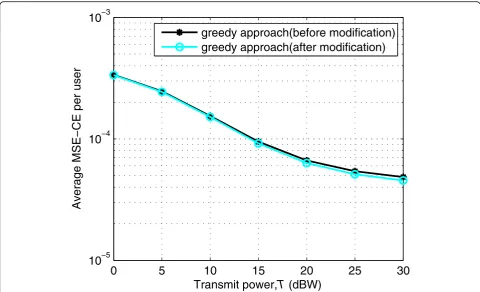
The greedy approach in [15] assumes the number of users per cell is equal, and it cannot be used in the case of different number of users per cell, so we have to make modifications to facilitate the comparison. When simu-lating this greedy approach, η¼ dN
Pe (η represents the
average number of users in each set) users are selected to form a set during each search, regardless of whether the selected users are in different cells. In addition, in all the following simulations, this greedy approach uses the MMSE combining scheme. Taking the MSE-CE as an example, the performance comparison of the greedy ap-proach before and after the modification is shown in Fig. 3 (when using parameters in Table 1). We can see that the values of MSE-CE are very close before and after modification. As to other performance (like MSE-SD, SINR, SE), the results are similar according to our simulations; thus, we omit these results to save space. So, we can compare our scheme with the modi-fied greedy approach, and the performance improvement can be seen in Figs. 4, 5, 6, 7, 8,9, 10, 11, and 12. The greedy approach in Figs.4,5,6,7,8,9,10,11, and12is referring to the greedy approach after modification.
In the following simulations, for all coalition game pilot allocation schemes, we show the optimal results of the coalition formation algorithm, i.e., the condition of
the final stability is the no permission of adjustment S
→ ðj;kÞ
SΦ. However, we know that the proposed pilot allo-cation scheme based on the coalition game can provide a certain performance guarantee through a user cyclic
search. For a given performance (average utility func-tion) indexU, the proposed scheme can search continu-ously until the performance index Uis satisfied. Taking the utility function of MSE-CE as an example, Fig. 4 shows the relationship between the average MSE-CE and the number of searches (α) for a certain location of BSs and users. We can see that, with the increase of α, the average MSE decreases, and whenα≥22, the average MSE reaches its minimum value. To satisfy the average MSE-CE performance index of 10−4, we should set the total number of search limitation τ to greater than or equal to 14.
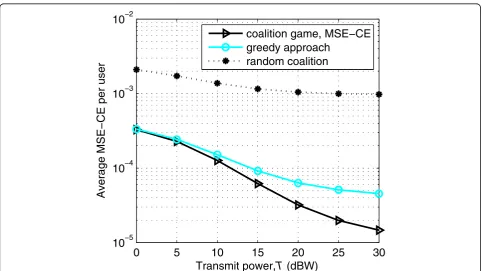
Figure 5 shows the average MSE-CE per user versus the transmit power T with P= 4. The unit of transmis-sion powerTis the watt in decibels (i.e., dBW). The“ co-alition game, MSE-CE” means the pilot allocation scheme based on the coalition game when utility func-tion is MSE-CE. The “greedy approach” means the greedy approach in [15]. We can see that the coalition game for MSE-CE can achieve lower average MSE than the greedy approach and random coalition. Although the object function of the greedy approach in [15] is also MSE-CE, the greedy approach is worse than the coali-tion game for MSE-CE, because the greedy approach in [15] is a one-time search for users, but the coalition
0
5
10
15
20
25
30
10
−510
−410
−3Transmit power,
T
(dBW)
Average MSE−CE per user
greedy approach(before modification)
greedy approach(after modification)
Fig. 3Comparison of the greedy approach before and after the modification
Table 1Simulation parameters
Parameter Symbol Value
Number of cells L 4
Number of users N 12
Path-loss exponent v 2.5
Number of antennas M 100
Number of paths F 50
Number of symbols in each frame Q 15
Ring radius of scatters around users rs 100 m
Antenna spacing at BS D λ/2
Channel coefficient δ 10
Standard deviation of noise power σ2 10 W
0
5
10
15
20
25
30
35
10
−510
−410
−3Number of searches
α
Average MSE−CE per user
coalition game, MSE−CE
Fig. 4Average MSE-CE versus the number of searches (α) withP= 4 andT= 20 dBW
0
5
10
15
20
25
30
10
−510
−410
−310
−2Transmit power,
T
(dBW)
Average MSE−CE per user
coalition game, MSE−CE
greedy approach
random coalition
3
4
5
6
7
10
−610
−510
−410
−310
−2Number of available pilots P
Average MSE−CE per user
coalition game, MSE−CE
greedy approach
random coalition
Fig. 6Average MSE-CE versus the number of available pilotsPwithT= 20 dBW
0 5 10 15 20 25 30
10−3
10−2
10−1
100 101 102
Transmit powerT (dBW)
Average MSE−SD per user
coalition game,MSE−SD,MMSE greedy approach
coalition game,MSE−SD,ZFC coalition game,MSE−SD,MRC random coalition,MMSE random coalition,ZFC random coalition,MRC
0 5 10 15 20 25 30 0
10 20 30 40 50 60 70
Transmit powerT (dBW)
Average received SINR per user
coalition game,received SINR,MMSE greedy approach
coalition game,received SINR,ZFC coalition game,received SINR,MRC random coalition,MMSE
random coalition,ZFC random coalition,MRC
25.5 26 26.5 0
1 2
Fig. 8The average received SINR versus transmit powerTwithP= 4
0 5 10 15 20 25 30
0 1 2 3 4 5 6
Transmit powerT (dBW)
Average SE per user
coalition game,SE,MMSE greedy approach
coalition game,SE,ZFC coalition game,SE,MRC random coalition,MMSE random coalition,ZFC random coalition,MRC
3 3.5 4 4.5 5 5.5 6 6.5 7
10−5
10−4
10−3
10−2
10−1
100
Number of available pilots P
Average MSE−SD per user
coalition game,MSE−SD, MMSE greedy approach
coalition game,MSE−SD, ZFC coalition game,MSE−SD, MRC random coalition,MMSE random coalition,ZFC random coalition,MRC
Fig. 10Average MSE-SD versus the number of pilots withT= 20 dBW
3 3.5 4 4.5 5 5.5 6 6.5 7
0 10 20 30 40 50 60 70 80 90 100
Number of available pilots P
Average received SINR per user
coalition game,received SINR, MMSE greedy approach
coalition game,received SINR, ZFC coalition game,received SINR, MRC random coalition,MMSE
random coalition,ZFC random coalition,MRC
game for MSE-CE is a cyclic search for users. In addition, the greater the transmit power, the more obvi-ous the performance improvements.
Figure 6 shows the average MSE-CE per user versus the number of available pilots P with T= 20 dBW. We can see that the coalition game for MSE-CE can achieve lower average MSE-CE than the greedy approach. The performance of random alliance is the worst because of random allocation of pilots. When the number of pilots becomes larger, the average MSE-CE of all schemes be-comes smaller. This is because the larger the number of pilots, the larger the number of sub-coalitions and the smaller the interference between users.
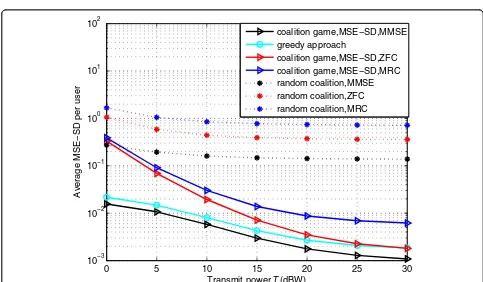
Figure 7 shows the average MSE-SD per user versus the transmit power T with P= 4. The “coalition game, MSE-SD, MMSE,” “coalition game, MSE-SD, ZFC,” and “coalition game, MSE-SD, MRC”means the pilot alloca-tion scheme based on the coalialloca-tion game when utility function is MSE-SD with the MMSE scheme, when util-ity function is MSE-SD with the ZFC scheme, and when utility function is MSE-SD with the MRC scheme, re-spectively. It can be seen that the coalition game for MSE-SD with MMSE is better than the coalition game for MSE-SD with ZFC, and the coalition game for MSE-SD with ZFC is better than the coalition game for MSE-SD with MRC. That is because the MRC scheme cannot reduce interference and noise, and the ZFC
scheme can reduce interference, but cannot reduce noise, whereas the MMSE scheme can reduce both interference and noise. When the transmit power is small, the performance of the greedy approach is slightly worse than that of the coalition game for MSE-SD with MMSE and better than that of the coalition game for MSE-SD with ZFC and the coalition game for MSE-SD with MRC. Because the purpose of the greedy approach in [15] is to minimize the sum of normalized MSE-CE of all users, its performance is better than the coalition game for MSE-SD with ZFC and the coalition game for MSE-SD with MRC. The greedy approach is worse than the coalition game for MSE-SD with MMSE because the greedy approach is a one-time search for users, but the coalition game for MSE-SD with MMSE is a cyclic search for users. With the increase of transmit powerT, the advantage of the coalition game for MSE-SD with MMSE relative to the greedy approach is increasingly obvious. In addition, for each combining scheme (MMSE, ZFC, or MRC), the coalition game is better than random coalition.
Figure 8 shows the average received SINR per user versus the transmit powerTwithP= 4. The utility func-tions of all coalition game schemes in Fig.8are received SINR. When transmit powerTbecomes larger, the aver-age received SINR of the coalition game schemes and greedy approach become larger. But random coalition
3 3.5 4 4.5 5 5.5 6 6.5 7
0 0.5 1 1.5 2 2.5 3 3.5 4 4.5
Number of available pilots P
Average SE per user
coalition game,SE, MMSE greedy approach
coalition game,SE, ZFC coalition game,SE, MRC random coalition, MMSE random coalition, ZFC random coalition, MRC
schemes change little with the increase ofT, that is be-cause the interference between all users is increasing when transmit powerT becomes larger. From Fig.8, we can see that the coalition game for received SINR with MMSE is better than the greedy approach, and other re-sults are similar to Fig.7.
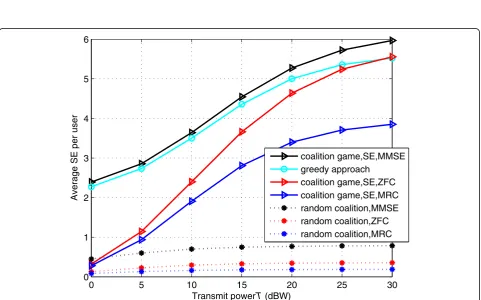
Figure9shows the average SE per user versus transmit powerT withP= 4. The utility functions of all coalition game schemes in Fig. 9 are SE. We can see that when transmit powerT becomes larger, the average SE of the coalition game schemes and greedy approach become larger. When comparing these different schemes, the re-sults are similar to Figs.7and8.
Figure 10shows the average MSE-SD per user versus the number of available pilots P withT= 20 dBW. The utility functions of all coalition game schemes in Fig.10 are MSE-SD. It can be seen that the coalition game for MSE-SD with MMSE is better than the coalition game for MSE-SD with ZFC, and the coalition game for MSE-SD with ZFC is better than the coalition game for MSE-SD with MRC. All these results are the same as Fig.7. In addition, the larger the number of available pi-lots, the smaller the average MSE-SD of all schemes. This is because when the number of pilots becomes lar-ger, fewer users use the same pilot; thus, the interference between users can be reduced, and the system perform-ance can be improved.
Figure 11 shows the average received SINR per user versus the number of available pilots with T= 20 dBW. The utility functions of all coalition game schemes in Fig.11are received SINR. We can get the similar results as in Fig.8.
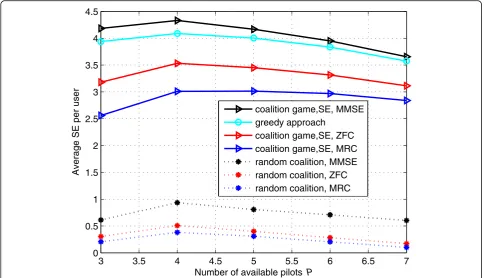
Figure 12 shows the average SE per user versus the number of available pilots with T= 20 dBW. The util-ity functions of all coalition game schemes in Fig. 12 are SE. The results in Fig. 12 are different from those
in Fig. 9. When the number of pilots becomes larger, the average SE of all schemes first becomes larger and then becomes smaller. That is because when the number of pilots is very small, the number of sub-coalitions is small and the interference between users is large, so the SE is small. On the other hand, when the number of pilots becomes very large, the number of data symbols in each frame becomes small and the coefficient in front of the log in expression (16) becomes small, so the SE is also small. That is to say, there exists the optimal number of pilots to maximize SE. We can see in Fig. 12 that the optimal number of pilots is four for all schemes.
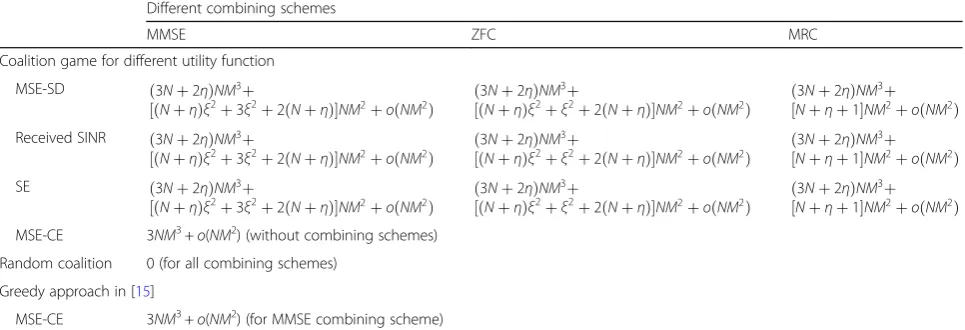
Table 2 shows the complexity (in terms of the multiplication times) during each search for different schemes. It is assumed that calculating the inversion of an M-dimensional matrix needs about M3 multipli-cations, η¼ dN
Pe represents the average number of
users in each sub-coalition, and ξ¼ dN
Le represents
the average number of users in each cell, where ⌈∗⌉ means the round up number of *. The expressions in Table 2 are obtained according to the multiplication times of Eqs. (9),(13)~(19), and we have assumed that
Rjlm is known according to large-scale channel fading and the locations of users and BSs and that R^
hjlm, Q1,
Q2, Q3, Q4, Q5, Q6, and Q7are obtained through stat-istical average of channel estimation and calculated once during each search. o(NM2) represents higher order infinitesimal of NM2.
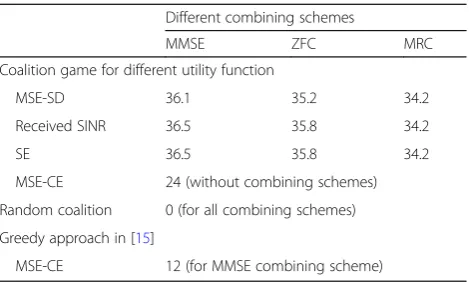
Table3 shows the average number of searches (i.e.,α) for each scheme, and also means the calculation times of average utility function in coalition formation algorithm. The values in Table3are obtained through Monte Carlo simulations, and they are the average number of searches for 10,000 user and BS locations. For all
Table 2The multiplication times during each search for different schemes Different combining schemes
MMSE ZFC MRC
Coalition game for different utility function
MSE-SD ð3Nþ2ηÞNM3þ
½ðNþηÞξ2þ3ξ2þ2ðNþηÞNM2þoðNM2Þ ð
3Nþ2ηÞNM3þ
½ðNþηÞξ2þξ2þ2ðNþηÞNM2þoðNM2Þ ð
3Nþ2ηÞNM3þ ½Nþηþ1NM2þoðNM2Þ
Received SINR ð3Nþ2ηÞNM3þ
½ðNþηÞξ2þ3ξ2þ2ðNþηÞNM2þoðNM2Þ
ð3Nþ2ηÞNM3þ
½ðNþηÞξ2þξ2þ2ðNþηÞNM2þoðNM2Þ
ð3Nþ2ηÞNM3þ ½Nþηþ1NM2þoðNM2Þ
SE ð3Nþ2ηÞNM3þ
½ðNþηÞξ2þ3ξ2þ2ðNþηÞNM2þoðNM2Þ
ð3Nþ2ηÞNM3þ
½ðNþηÞξ2þξ2þ2ðNþηÞNM2þoðNM2Þ
ð3Nþ2ηÞNM3þ ½Nþηþ1NM2þoðNM2Þ
MSE-CE 3NM3+o(NM2) (without combining schemes)
Random coalition 0 (for all combining schemes)
Greedy approach in [15]
coalition game pilot allocation schemes in Table 3, the condition of the final stability is the no permission of
ad-justmentSð→j;kÞSΦ.
In Table 3, the average number of search of random coalition is 0 because random coalition means ran-domized pilot allocation and there is no adjustment of the coalition structure. The average number of search of the greedy approach in [15] is 12 because the greedy approach is a one-time search for all users and the number of users is 12. The average number of search of the coalition game for different utility functions (MSE-SD, received SINR, or SE) is very close, and they are all close to 36, which means each user is searched about 3 times on average. The aver-age number of searches of the coalition game for MSE-CE is 24, which means each user is searched about 2 times on average.
The total complexity of each scheme is the result of the multiplication of the corresponding items in Tables2 and 3. Combining Tables 2 and 3, when comparing the total multiplication times, we can see that random coali-tion has the lowest complexity, the greedy approach is higher than random coalition, the coalition game for MSE-CE is higher than the greedy approach, and the co-alition game for MSE-SD, received SINR, and SE are very close and has the highest complexity. The total multiplication times of the coalition game for differ-ent utility functions (MSE-SD, received SINR, or SE) are also very close, and they are higher than the co-alition game for MSE-CE and the greedy approach, although their average search time does not differ much. That is because the multiplication times during each search of the coalition game for different utility functions (MSE-SD, received SINR, or SE) are larger than the coalition game for MSE-CE and the greedy approach. In a word, the total multiplication times of the coalition game for MSE-CE and the greedy ap-proach is much higher than that of random coalition,
but lower than that of the coalition game for MSE-SD, received SINR, and SE.
6 Conclusions
A pilot allocation scheme based on the coalition game is proposed for TDD massive MIMO systems. This scheme can be suitable for any actual scene in which cells are ir-regularly shaped (BSs distribute randomly), numbers of users per cell are not equal (users distribute randomly), and channels are correlated fading channels, and this scheme can provide performance guarantee. The defin-ition of the coaldefin-ition structure is given, and different utility functions are analyzed. To benefit each user, the adjust-ment principle of the coalition structure is set, and the co-alition formation algorithm is provided. According to the coalition formation algorithm, the pilot allocation scheme based on the coalition game (for different utility functions) is simulated and compared with the greedy approach in [15] and random coalition. And then, the computational complexity in terms of multiplication times for different pilot allocation schemes is compared. Simulation results show that when considering the performance comparison of different pilot allocation schemes, the results for differ-ent performance metrics (differdiffer-ent utility functions) are similar. The coalition game for each utility function with MMSE achieves the best performance with high computa-tional complexity. For each utility function and for each combining scheme (MMSE, ZFC, or MRC), the coalition game is better than random coalition. When comparing the performance of different combining schemes, with re-gard to the coalition game for each utility function, MMSE is better than ZFC and ZFC is better than MRC. The per-formance of the greedy approach in [15] is between the coalition game for each utility function with MMSE and the coalition game for each utility function with ZFC. In addition, we obtain the optimal number of pilots to maximize SE through simulations.
7 Appendix 1
According to expression (11), the mean square error of signal detection (MSE-SD) for user (j,k) is
MSE‐SDscheme
jk ¼E
1ffiffiffiffiffi
td jk q wscheme
jjk
H XL
m¼1
XKm
n¼1
ffiffiffiffiffiffiffi
td mn q
hjmnxmnþndataj !
−xjkj2g ¼Eh wschemejjk
H
^ hjjk−1
2
( )
þEh wschemejjk
H
~ hjjk
2
( )
þX
L
l¼1
XKl
m¼1 td
lm
td jk
Eh wschemejjk
H
hjlm
2
( )
−Eh wschemejjk
H
hjjk
2
( )
þ1 td jk
Eh wschemejjk
H
ndata
j
2
( )
ð20Þ
Then, according to reference ([19], Lemma 2), the re-ceived SINR for user (j,k) at BSjis
Table 3The average number of searches (α) for different schemes
Different combining schemes
MMSE ZFC MRC
Coalition game for different utility function
MSE-SD 36.1 35.2 34.2
Received SINR 36.5 35.8 34.2
SE 36.5 35.8 34.2
MSE-CE 24 (without combining schemes)
Random coalition 0 (for all combining schemes)
Greedy approach in [15]
SINRscheme first and the second items of expression (20).
According to the definition of the MRC scheme, we obtain
Therefore, the first item of expression (20) is
Eh wmrcjjk
¼1. This is the result of the fourth item of expression (20). Because~hjjk is independent ofwwrcjjk , the second item of
expression (20) is For the third item of expression (20) and the first item of the denominator in expression (21), two cases (i.e., ðl;mÞ∉ΛSðj;kÞ and ðl;mÞ∈ΛSðj;kÞ) are
where the second equation exists because of the inde-pendence of^hjjk andhjlmforðl;mÞ∉ΛSðj;kÞ.
According to expression (7) and the analysis above, when
ðl;mÞ∈ΛSðj;kÞ,^hjlm¼
jjkh^jjk. Substituting it into
expression (26), we can get (A-8) forðl;mÞ∈ΛSðj;kÞ
where equation (a) exists for RjlmR−jjk1 is a Hermitian
matrix, and h^HjjkRjlmR−jjk1^hjjk ¼sumfðRjlmR−jjk1Þ∘ð^hjjk^h
. In addition, due to the mutual
independence of ^hjjk and hjlm, Ehf^h
g. Therefore, the third item of
ex-pression (20) (the first item of the denominator in ex-pression (21)) is
1 8 Appendix 2
We consider the ZFC scheme. For ZFC, the wzfc
jjk is the
Therefore, the first item of expression (20) is
Eh wzfcjjk
Becauseh~jjk is independent ofwzfcjjk, the second item of
expression (20) is fourth item of expression (20) is
Eh wzfcjjk
Using a similar analysis method as MRC in Appendix1, we can divide the third item of expression (20) (the first item of the denominator in expression (21)) into two cases.
1 9 Appendix 3
We consider the MMSE scheme, thewmmse
jjk is thekth column
of the matrix Wmmse
jj ¼H^jjðH^
Therefore, the first item of expression (20) is
Eh wmmsejjk
is independent of wzfc
jjk, the second item of expression
(20) is
where the last approximate equality exists whenM→∞. Using a similar analysis method as MRC inAppendix 1, we can divide the third item of expression (20) (the first item of the denominator in expression (21)) into two cases. The results is
XL
In addition, the last item of expression (20) (the last item of the denominator in expression (21)) is5
MSE‐SDmmsejk ¼ X
AoA:Angle-of-arrival; AWGN: Additive white Gaussian noise; BS: Base station; BSC: Base station controller; CSI: Channel state information; MIMO: Multiple-input multiple-output; MMSE: Minimum mean square error; MRC: Maximum ratio combining; MSE: Mean square error; MSE-CE: Mean square error of channel estimation; MSE-SD: Mean square error of signal detection; SE: Spectrum efficiency; SINR: Signal-to-interference-plus-noise ratio; TDD: Time division duplex; ULA: Uniformly spaced linear array; ZFC: Zero-forcing combining
Funding
This research is supported by the Natural Science Foundation of Anhui Province, the Startup Research Foundation of Anhui University (01001770-10117700011), the College Natural Science Research Project of Anhui Province (KJ2016A042).
Availability of data and materials
Data sharing not applicable to this article as no datasets were generated or analyzed during the current study.
Authors’contributions
HZ has contributed 70% of the work, and the rest is contributed by XD. Both authors read and approved the final manuscript.
Competing interests
The authors declare that they have no competing interests.
Publisher’s Note
Springer Nature remains neutral with regard to jurisdictional claims in published maps and institutional affiliations.
Author details
1Key Lab of Intelligent Computing and Signal Processing (Ministry of
Education), Anhui University, Hefei 230601, China.2QuantumCTek Co., Ltd., Hefei 230088, China.
Received: 8 November 2018 Accepted: 14 February 2019
References
1. L. Lu, G.Y. Li, A.L. Swindlehurst, et al., An overview of massive MIMO: benefits and challenges. IEEE J. Sel. Top. Sign. Proces.8(5), 742–758 (2014). 2. Z. Gong, C. Li, F. Jiang, Pilot contamination mitigation strategies in massive
MIMO systems. IET Commun.11(16), 2403–2409 (2017).
3. T.L. Marzetta, Noncooperative cellular wireless with unlimited numbers of base station antennas. IEEE Trans. Wirel. Commun.9(11), 3590–3600 (2010). 4. A. Ashikhmin, T. Marzetta,Pilot Contamination Precoding in Multi-Cell Large
Scale Antenna Systems. Proceedings International Symposium on Information Theory (ISIT)(2012), pp. 1137–1141.
5. M.H.C. Garcia, J. Luo, inProceedings of 2018 IEEE Wireless Communications and Networking Conference (WCNC). Time-shifted pilots multiplexed with uplink data and unequal power allocation (IEEE, Barcelona, 2018), pp. 1–6. 6. W. Chang, Y.K. Hua, S.F. Liao, Partial overlapped time-shifted pilots for
massive MIMO systems. IEEE Commun. Lett.21(11), 2480–2483 (2017). 7. H. Echigo, T. Ohtsuki, W. Jiang, Y. Takatori, inProceedings of 2017 IEEE Global
Communications Conference (GLOBECOM). Fair pilot assignment based on AOA and pathloss with location information in massive MIMO (IEEE, Singapore, 2017), pp. 1–6.
8. H. Wang, W. Zhang, Y. Liu, Q. Xu, P. Pan, On design of non-orthogonal pilot signals for a multi-cell massive MIMO system. IEEE Wireless Commun. Lett. 4(2), 129–132 (2015).
9. P. Liu, S. Jin, T. Jiang, Q. Zhang, M. Matthaiou, Pilot power allocation through user grouping in multi-cell massive MIMO systems. IEEE Trans. Commun.65(4), 1561–1574 (2017).
10. H. Zhi, Q. Yuan, J. Zhu, Y. Hu,A pilot allocation scheme for TDD massive MIMO system enabled HetNet, 9th IEEE International Conference on Communication Software and Networks (ICCSN, GuangZhou, 2017), pp. 443–447.
11. J. Fan, W. Li, Y. Zhang, J. Deng, inProceedings of IEEE 85th Vehicular Technology Conference (VTC Spring). Fractional pilot reuse with vertical sectorization in massive MIMO systems (IEEE, Sydney, 2017), pp. 1–5. 12. H. Ahmadi, A. Farhang, N. Marchetti, A. MacKenzie, A game theoretic
approach for pilot contamination avoidance in massive MIMO. IEEE Wireless Commun. Lett.5(1), 12–15 (2016).
13. R. Mochaourab, E. Björnson, M. Bengtsson, Adaptive pilot clustering in heterogeneous massive MIMO networks. IEEE Trans. Wirel. Commun.15(8), 5555–5568 (2016).
14. L. You, X. Gao, X. Xia, N. Ma, Y. Peng, Pilot reuse for massive MIMO transmission over spatially correlated rayleigh fading channels. IEEE Trans. Wirel. Commun.14(6), 3352–3366 (2015).
15. H. Yin, D. Gesbert, M. Filippou, Y. Liu, A coordinated approach to channel estimation in large-scale multiple-antenna systems. IEEE J. Sel. Areas Commun.31(2), 264–273 (2013).
16. L.S. Muppirisetty, H. Wymeersch, J. Karout, G. Fodor, inProceedings of 2015 IEEE Global Communications Conference (GLOBECOM). Location-aided pilot contamination elimination for massive MIMO systems (IEEE, San Diego, 2015), pp. 1–5.
17. L.S. Muppirisetty, T. Charalambous, J. Karout, G. Fodor, H. Wymeersch, Location-aided pilot contamination avoidance for massive MIMO systems. IEEE Trans. Wirel. Commun.17(4), 2662–2674 (2018).
18. T. Kailath, A.H. Sayed, B. Hassibi,Linear Estimation(Prentice-Hall, Upper Saddle River, 2000).
19. E. Björnson, E.G. Larsson, M. Debbah, Massive MIMO for maximal spectral efficiency: How many users and pilots should be allocated? IEEE Trans. Wirel. Commun.15(2), 1293–1308 (2016).
20. M.J. Osborne, A. Rubinstein,A Course in Game Theory(MIT Press, Cambridge, 1994).