30 |
P a g e
DATA SECURITY USING LIGHTWEIGHT
PATTERN
N. Subramanyan
1, K. Hari Priya
2, Y. Suma
31
Teaching Assistant, Dept. of CSE, YSR Engineering College of YVU, Proddatur, (India)
2,3
Student IV B.Tech CSE, YSR Engineering College of YVU, Proddatur, (India)
ABSTRACT
The present generation facing so many problems in the data transfer due to lack of security. The establishment
of network is not an issue but providing security for the information is a big issue in current environment. There
exist various tools and methods to destroy the security. In today’s world, being number of data protection
algorithms are introducing, on the other hand there is a rapid growth in algorithm’s to break the security. The
present paper concentrates on light weight pattern representation with respect to directions along with this, to
provide more flavor gray code and nibble swapping were introduced for effective protection of data.
Keywords: Cryptography, Gray Code, Light Weight Pattern, Nibble Swapping, Security
.
I. INTRODUCTION
Security grew to become a foremost situation in current era. The historical past of safety allows for a greater understanding of the emergence of protection. Network security has come to be an extra primary to users, companies, etc. The monstrous subject of network security is cryptanalysis. There are five major foremost security offerings. Among them the first one is confidentiality, which means that the knowledge in a laptop procedure and expertise that is transmitted are accessible just for reading by licensed ones or events. For example exhibiting, printing and other varieties of disclosure. The second one is authentication, which ensures that the origin of a message or digital record is properly identified, with an assurance that the identification just is not false. The third one is integrity, which ensures that to modify computer procedure assets and transmitted information the most effective licensed parties are ready. Fourth one is non repudiation, which requires that neither the sender nor the receiver of a message be able to deny the transmission. The fifth one is access manipulate, which requires that access to knowledge resources could also be managed by the goal approach. For a broad sort of purposes, procedure and network technological know-how is a key science. The accessories for network protection are identity threads, security practices, identification vulnerities, identity property, security practices, design for security, security policy, and protection technologies, manage incidents and investigate asset price.
II. R
EVIEW ON NETWORK SECURITY
The term „Cryptography‟ comes from the Greek word which means "secret (crypto) writing (grapy)". The art of
31 |
P a g e
retransformed back to its original form is called as cryptography. The cryptography [1,2] is a 5-tuple that contains (E, D, M, K, C), where E-encryption algorithm, D-decryption algorithm, M-the set of plain texts, K-the set of keys, C-the set of cipher texts;
E: M*K→C (1)
D: C*K→M (2)
Encryption means the process of converting plain text into cipher text and the process of converting cipher text into plain text is called as decryption [3];
E (key, plain text) =cipher text (3)
D (key, cipher text) =plain text (4)
Encryption algorithm is an important tool in cryptography which is used to make content unreadable by all others except the meant receiver. Encryption or decryption methods fall into two types. One is symmetric key algorithm and the one other is public key or asymmetric algorithm. In symmetric key encryption algorithms, the encryption and decryption keys are identified each to sender who sends the message and receiver who receives the message. In almost all circumstances, the encryption and decryption keys are the same. In public/asymmetric key cryptography, there are two keys namely public and private keys. In this algorithms encryption secret's made public, but it is computationally infeasible to find the decryption key without the expertise known to the receiver side.
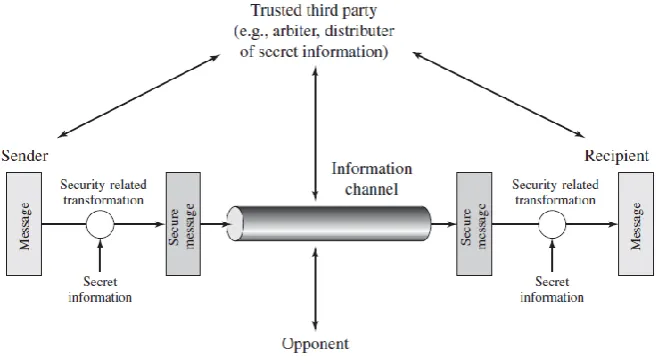
Figure 1. A model for network security system
The science of breaking ciphers is called as cryptanalysis, and the art work of devising them is mutually often called as cryptology.
2.1 History of cryptography
32 |
P a g e
2.1.1 The oldest cryptographic technique - Hieroglyph
The use of „hieroglyph‟ is the first known evidence of cryptography. Some 4000 years ago, the Egyptians used
to communicate by using messages written in hieroglyph cryptographic technique. This secret code was known only to the scribes who transmit messages on behalf of the kings in the oldest days. One such hieroglyph cryptographic technique is shown in Fig.2.
Figure 2. Hieroglyph-Cryptography Technique
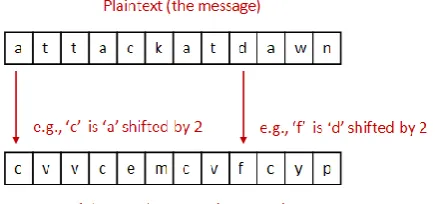
Caesar shift cipher is the earliest roman method of cryptography, which relies on shifting the letters of a message by an agreed number and the recipient who receives this message would then shift the letters of message back by the same agreed number and finally obtain the original message.
Figure 3. Caesar Shift Cipher
2.2 Public Key Cryptography
Asymmetric cryptography which is also known as public-key cryptography is a cryptography in which a pair of keys like public and private keys is used to encrypt and decrypt a message so that the message occurs very securely. Initially, a network user receives a public and private key pair from a specific certificate authority. Any other user who wants to send a message which is encrypted can get the intended recipient's public key from a public directory.
33 |
P a g e
They use the specific key to encrypt the message, and they send it to the receiver. When the receiver gets the message, they decrypt it with their private key, which no one else should have access to it.
2.3 Types of intrusions
There are some basic classes of attacks which causes for slow network performance, viruses, uncontrolled traffic etc.
A. Protection threats
There are some quantities of safety attacks that can be the rational of a network security assault. Among them most important security attacks/threats are denial of service, dispensed denial of service, trojan horses, viruses, malwares, spywares, unauthorized entry to the network information and assets, uncontrolled internet entry and the accidental deletion of the records.
B. Virus attack
When virus attack occurs, it penetrates the security and third party tries to pinch the information from the system. Viruses planted into the systems through some fake programs.
C. Unauthorized entry
Entry to the some community resources and data should only be allowed handiest to the approved persons.
D. Unauthorized application installations
One other important virus and network security assault prevention method is to install most effective applications of the licensed program to our network server and in all client systems.
III. PROPOSED WORK
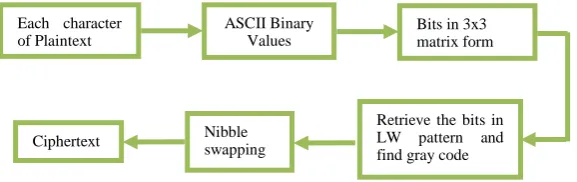
The main aim of the proposed work is to enhance the security with lightweight pattern [4,5]. This work consist various stages with respect to encryption and decryption procedures. The first stage of this work deals with pattern oriented intermediate cipher text[6,7] generation. Further to enhance the security different operations are applied such as gray coding and nibble swapping. Fig. 5 illustrates steps involved in encryption process. Fig 6. illustrates the steps involved in decryption process.
Figure 5. Flowchart Showing Steps In Encryption
Each character of Plaintext
ASCII Binary Values
Bits in 3x3 matrix form
Retrieve the bits in LW pattern and find gray code Nibble
34 |
P a g e
Figure 6. Flowchart showing the steps in decryption
3.1 Encryption algorithm
Encryption is performed in three rounds. Steps in Round 1 are as follows
Step 1: For each plaintext character, find the corresponding ASCII value.
Step 2: Convert the ASCII value into its equivalent binary bits.
Step 3: Arrange the binary bits in 3x3 matrix.
Step 4: Retrieve the bits in 8-directions pattern like N NE E NW W SW S SE.
Steps in Round 2 are as follows
Step 5: Find gray code for the obtained binary bits.
Step 6: Compute the decimal number for each row.
Steps in Round 3 are as follows
Step 7: Apply nibble swapping for each decimal number.
Step 8: The final cipher is obtained by converting result into its equivalent ASCII.
3.2 Decryption algorithm
Decryption is performed in three rounds. Steps in Round 1 are as follows
Step 1: For each ciphertext character, find the corresponding ASCII value Step 2: Apply nibble swapping for the obtained cipher text.
Step 3: Find the appropriate binary equivalent for it. Steps in Round 2 are as follows
Step 4: Perform gray to binary code for the above resulted binary bits. Steps in Round 3 are as follows
Step 5: Arrange the bits in 3x3 matrix using 8-directions pattern. Step 6: Retrieve the bits according to the lightweight pattern . Step 7: Convert the binary bits into its equivalent decimal values. Step 8: The original plain text is obtained by finding ASCII value.
Each character of ciphertext
ASCII Binary Values
Nibble swapping
Gray to binary code conversion Bits in 3x3
matrix form using LW pattern Plaintext Binary to ASCII
35 |
P a g e
3.3 Example for encryption algorithm
Given plain text is: CRYPTOGRAPHY
Table 1. Encryption Example
Plaintext Character ASCII Value Binary equivalents After Applying LW Pattern
Gray code After Nibble
swapping
Ciphertext Character
C 67 01000011 11000010 10100011 58 :
R 82 01010010 10001010 11001111 252 ü
Y 89 01011001 01101010 01011111 245 õ P 80 01010000 00001010 00001111 240 ð
T 84 01010100 00011010 00010111 113 q
O 79 01001111 11110010 10001011 184 ¸ G 71 01000111 11010010 10111011 187 »
R 82 01010010 10001010 11001111 252 ü
A 65 01000001 01000010 01100011 54 6 P 80 01010000 00001010 00001111 240 ð
H 72 01001000 00100010 00110011 51 3 Y 89 01011001 01101010 01011111 245 õ
Final ciphertext is “: ü õ ð q ¸ » ü 6 ð 3 õ”
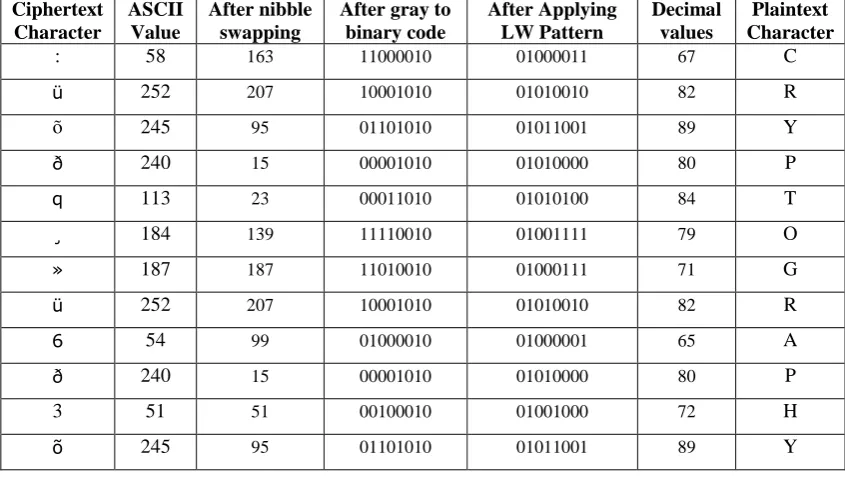
3.4 Example fordecryption algorithm
Given ciphertext is: : ü õ ð q ¸ » ü 6 ð 3 õ
Table 2. Decryption Example
Ciphertext Character ASCII Value After nibble swapping
After gray to binary code After Applying LW Pattern Decimal values Plaintext Character
: 58 163 11000010 01000011 67 C
ü 252 207 10001010 01010010 82 R
õ 245 95 01101010 01011001 89 Y
ð 240 15 00001010 01010000 80 P
q 113 23 00011010 01010100 84 T
¸ 184 139 11110010 01001111 79 O
» 187 187 11010010 01000111 71 G
ü 252 207 10001010 01010010 82 R
6 54 99 01000010 01000001 65 A
ð 240 15 00001010 01010000 80 P
3 51 51 00100010 01001000 72 H
õ 245 95 01101010 01011001 89 Y
36 |
P a g e
IV. ADVANTAGES
o The number of ways to represent the intermediate cipher text at round1 is 8!.
o To enhance the security, gray code is applied for the result of round1.
o Nibble swapping is added as one of the flavor to enhance the security.
V. CONCLUSION
Security is a complicated topic in current tendencies. In this paper, direction oriented encryption is proposed. The proposed algorithm having a lightweight secret key which produces an intermediate cipher text. Two extra operations are carried out to enhance the protection. Apart from this, unauthorized user can not be ready to decrypt the message within the feasible amount of time despite of figuring out the key pattern. This algorithm avoids man in the middle of intrusions. Moreover, the proposed system will also be applied with cloud computing, uni-code system, smartcard protection and steganography.
REFERENCES
[1] Darga, Paul T., Liffiton, Mark H., Sakallah, Karem A. and Markov. Igor L., Exploiting structure in symmetry detection for cnf. DAC, pages 530–534. ACM, 2004.
[2] Ammar, A., El Sherbini, A. , Ashour, I. , Shiple, M., Random data encryption algorithm (RDEA), Radio Science Conference, 2005. NRSC 2005. Proceedings of the Twenty-Second National, 15-17 March 2005. [3] Junttila., Tommi and Kaski. Petteri, Conflict propagation and component recursion for canon-ical labeling. Theory and Practice of Algorithms in (Computer) Systems, Lecture Notes in Computer Science, 6595:151–162. Springer Berlin / Heidelberg, 2011.
[4] “Analysis and Review of Encryption and Decryption for Secure Communication”, International Journal of Scientific Engineering and Research (IJSER) Vol.2 Issue.2, Feb-2014.ISSN (online) 2347-3878.
[5] “Recommendation for Cryptographic Key Generation”, National Institute of Standards and Technology Special Publication 800-133 Natl. Inst. Stand. Technol. Spec. Publ. 800-133, 26 pages (December 2012)
[6] Agrawal., Monika, Mishra., Pradeep, A Comparative Survey on Symmetric Key Encryption Techniques, International Journal on Computer Science & Engineering; May2012, Vol. 4 Issue 5, p877.
[7] Govind Prasad Arya, Aayushi Nautiyal, ashish pant,Shiv Singh & Tishi Handa, “A cipher design with automatic key generation using the combination of substitution and transposition techniques and basic arithmetic and logic operations,” the SIJ Tansactions on computer science engineering & its