A Review on Circuit hybrid attribute based encryption of
data with fragmentation for increasing ideal performance
and security in cloud computing
Ahuja Roma
1, Hailkar Kalyani
2, Kale Saurabh
3Prof A.A.Khatri
41,2,3
UG Scholar,
4Assist
.Professor,
Dept. of Computer Engineering, JCOE, Pune (India)
ABSTRACT
Cloud computing is innovation that uses advanced computational power and improved storage capacities. Cloud
computing offer the number of significant advantages. One of the main advantage of cloud computing is
pay-as-per-use, which means according to the use of service the customer has to pay. Where the prime disadvantage
of cloud computing is achieving security to the data which is store in cloud. The data compromise may occur due to
attacks by other users and node within cloud. In this paper, We propose Hd-ABE (Hybrid Attribute Based
Encryption ) In which data owner should set the access structure of attributes with encrypted data , The user only
whose attributes are match with access structure of owner only that user can decrypt the data. To secure data which
is store in single node with in cloud we use DROPS (Division and Replication of Data in the cloud for Optimal
Performance and Security) methodology, in which we divide the file into fragments, and replicate the fragmented
data over the cloud.
Keywords: Cloud computing, Security, Hybrid attribute based encryption, Fragmentation.
I. INTRODUCTION
Cloud computing is computing technique which describes the combination of different data, software which are
accessible via internet. Cloud computing is innovation that uses advanced computational power and improved
storage capacities. In this cloud computing prime disadvantage is security of data, to provide end-to-end data
security and privacy in the cloud, sensitive data has to encrypt before outsourcing to protect data privacy.In cloud
computing, effective data utilization is very difficult task because data may hack by other users and node within
cloud .As application move to cloud computing platform, A hybrid attribute based encryption in which every cipher
text is label with some attribute, location and a time interval while private key is associated with a time instant. The
cipher text can only be decrypted if both the time instance is in the allowed time interval and attributes associated
with ciphertext satisfy the key’s access structure.
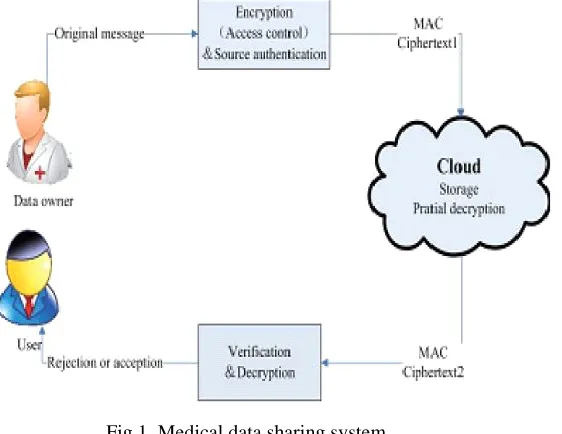
under certain access policies. in this system doctor encrypt the data with access structure of attributes and location
attribute , the patient who’s attributes are match with access structure only that patient can decrypt or download the
data , It provide multiple parallel efforts underway to modernize medical record system for greater efficiency ,
improved patient care, patient safety and cost saving.
Fig 1. Medical data sharing system
To increase more security in cloud data which is store in single node we can use DROPS (Division and Replication
of Data in the cloud for Optimal Performance and Security) methodology, in which we divide the file into
fragments, and replicate the fragmented data over the cloud nodes. Each of the nodes stores only a single fragment
of a particular data file that ensures that even in case of a successful attack, no meaningful information is revealed to
the attacker. Moreover, the nodes storing the fragments are separated with certain distance by means of graph
T-coloring to prohibit an attacker of guessing the locations of the fragments
.
II.
LITERATURE REVIEW
a) Title: Identity Based Cryptosystem and signification schemes.
Authors: Adi Shamir.
Description:
IDE is nothing but Identity based encryption. Original IDE gives by Adi Shamir in [1]1984. In Identity based
encryption view the identities as a string of characters. Identity based encryption (IDE), is an important primitive of
ID_based cryptography. As such it is a type of public key encryption in which the public key of user is some unique
information about the identity of the user for example a user’s email address, if owner of data want to send same
message or same data to multiple user at a time then it is necessary to select email ID of all users. So it is a time
b) Title: Fuzzy Identity Based encryption.
Authors: Sahai and Waters.
Description:
Fuzzy identity based was introduced by sahai and waters in 2005. They modify original IDE given by Adi Shamir in
[1]1984.In fuzzy identity based encryption view the identities as a set of attribute; It is also called as Attribute Based
Encryption. Fuzzy IBE is first paper give the concept of attribute based encryption with public key cryptography.
Fuzzy IBE is an attribute type encryption where set of attributes are used to represent an identity. The set of attribute
are set by owner when owner wants to send one data to multiple users, the users whose attributes get matched with
specified attribute, will only get the access to the data. The disadvantage of Fuzzy IBE is data owner need to use
every authorized user’s public key.
c) Title: Key-Policy Attribute Based Encryption (KP-ABE).
Authors: Parmar Vipul Kumar
Rajanikanth Aluvalu
Description:
KP-ABE (Key-Policy Attribute Based Encryption)is modified form of classical model of ABE. The keys only
associated with the policy that is to be satisfied by the attributes that are associating the data can decrypt the data. [3,
4] Key Policy Attribute Based Encryption (KP-ABE) scheme is a public key encryption technique that is designed
for one-to-many communications. In a Key-policy attribute based encryption system, Cipher text are branched by
the sender with the set of descriptive attributes. The disadvantages of KP-ABE are like Encryptor can not decide
who can decrypt the encrypted data, it can only choose descriptive attributes for the data, and has no choice but to
trust the key issuers.
d) Title: Cipher text-Policy Attribute Based Encryption An Expressive, Efficiently and provably secure Realization.
Authors: Brent Waters
Description:
CP-ABE is modified form of classical model of ABE, It fulfill some drawbacks of KP-ABE. In CP-ABE encryptor
can decide who can decrypt the encrypted data. In CP-ABE, each user is linked with a set of attributes. His secret
key is generated based on his attributes. While encrypting a message, the encryptor specifies the threshold access
structure for his interested attributes. This message is then encrypted based on this access structure such that only
those whose attributes satisfy the access structure can decrypt it. With CP-ABE technique, encrypted data can be
kept confidential and secure against collusion attacks. The disadvantage is in CP-ABE only static attribute are
specified there is no dynamic attribute is used.
e)Title: Designing a Hybrid attribute-Based encryption scheme supporting Dynamic Attribute.
Authors: Stefan G.Weber
Description:
i.e. properties that users satisfy. It is hybrid; as it combines Ciphertext attribute based encryption (CP-ABE) [5] with
location based encryption (LBE) on the level of symmetric key. It handle both static and dynamic attribute like
location.The location based encryption is used for security mobile communication by limiting area inside which the
recipient can decrypt the message.
f)Title:SECURE DYNAMIC FRAGMENT AND REPLICA ALLOCATION IN CLOUD STORAGE
Authors: P.Anand, R.Bharath, C.Ganapathy, S. Sam Victor.
Description:
In this paper we get information about hoe the data is fragment and store in different nodes in cloud. This is used to
increasing security of data which is store in cloud.For achieving this security DROP Methodology is used. Division
and Replicationof Data in the Cloud for Optimal Performance and Security (DROPS) that collectively approaches
the security and performance issues. In the DROPS methodology, we divide a file into fragments, and replicate the
fragmented data over the cloud nodes. Each of the nodes stores only a single fragment of a particular data
File that ensures that even in case of a successful attack, no meaningful information is revealed to the attacker.
Moreover, the nodes storing the fragments are separated with certain distance by means of graph T-coloring to
prohibit an attacker of guessing the locations of the fragments.
III. MOTIVATION
1) Tampering: Tampering of sensitive data by buisness opponent for profit reasons otherwise ranking:- Tampering
here means manipulating the data, making changes to the originally stored data .This action is performed by
business opponents or hackers for profit reason ,ranking , emotional or mental harassment .
2) Data is stored in single node:-In this the data is stored in cloud, but on a single node. If successful attack takes
place on that node the whole data gets hacked.
3) Insecure key management system:-In cloud computing the data is stored in cloud. And the key required to decrypt
the ciphertext data is also provided by the cloud. If the key gets hacked by the hacker the entire data gets in control
of the hacker.
IV. OBJECTIVE
1) Provide security to data by using a strong data encryption algorithm which is difficult to break.
2) A strong data storage infrastructure for cloud is to be built.
3) To improve the network bandwidth efficiency and usability of cloud data.
4) Propose a new cryptographic primitive called attribute based encryption scheme with outsourcing key
issuing and outsourcing decryption, which can implement keyword search function (KSF- OABE).
V. PROPOSED SYSTEM
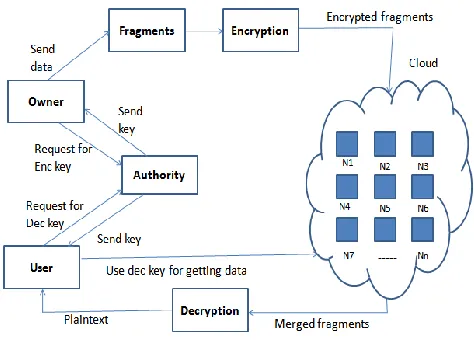
Fig 2. .Proposed system
The proposed system design circuit ciphertext-policy attribute-based encryption with time-specified attributes
scheme has been developed. In this scheme, every ciphertext is labeled with some attribute and a time interval while
private key is associated with a time instant. The ciphertext can only be decrypted if both the time instant is in the
allowed time interval and the attributes associated with the ciphertext satisfy the key’s access structure.
The system contains four modules,
1) Owner
2) User
3) Authority
4) Cloud Server
Owner: Owner is responsible to upload the data in numbers of fragments and assign the attribute to data and create
the access structure.
Authority: Authority is responsible to perform authentication of owner and user as well as to send keys, for
encryption and decryption to owner and user respectively if they are valid.
User: User is responsible to access or download the data which is given by owner.
Cloud Server: Cloud server is responsible to provide storage space to store the data into different nodes and
partially decrypt the data when user wants to access.
V. CONCLUSION
From the above decision and debate we come to a conclusion, that use of circuit hybrid attributes based encryption
we will convert a simple plain text data to strong and high level cipher text data with attribute access structure, this
cost of the computation and communication consumption is low, which open the gates for implementing the system
in real. We also conclude that we can also increase the security of data stored in cloud by fragmenting the data and
storing it on different nodes this will increase the security of stored data. The use of TPA has made the system more
secure to an extent. So overall discussion states that this system can be a great advantage for security in cloud
computing.
VI. FUTURE WORK PLANNING
The entire plan to design the system is divided into three phases. The first phase deals with partial front end part
which includes the login and registration page for owner and user. It will contain different attributes with fine
grained access policy. Our second phase will contain authority i.e. TPA which will make owner and user check and
depending on the result , if valid then it will assign the encryption and decryption key to owner and user
respectively. Our third phase will be introducing another concept, in which we are going to make fragments of data
to be transferred. This fragment will be stored in the cloud individually at different nodes. Rather than storing it as
an entire data on single node. This technology will help us in the case of security of stored data. This means even if
single node is found. It will very difficult to tack other sibling nodes. This is our total planning. On which we will be
working further.
REFERENCE
[1.]
Adi Shamir,”Identity Based Cryptosystem and signification schemes”
[2.] A. Sahai and B. Waters, "Fuzzy identity based encryption", Proc. 30th Annu. Int. Conf. Theory Appl.
Cryptograph. Techn, pp. 457-473, 2005
[3.] N.krishna L.Bhavani “HASBE A Hierarchical Attribute Set Based Encryption For Flexible Scalable And Fine
Grained Access Control In Cloud Computing” International Journal of Computer & Organization Trends –Volume 3 Issue 9 – Oct 2013.
[4.] Parmar Vipul Kumar, Rajanikanth Aluvalu” Key-Policy Attribute Based Encryption(KP-ABE)”,International
Journal of Innovative and Emerging Research in Engineering Volume 2, Issue 2, 2015.
[5.] B. Waters, “Ciphertext-policy attribute-based encryption: An expressive, efficient, and provably secure
realization,” in Proc. 14th Int. Conf. Practice Theory Public Key Cryptograph. Conf. Public Key Cryptograph,
2011.
[6.] Stefan G.Weber,” Designing a Hybrid attribute-Based encryption scheme supporting Dynamic Attribute”,in
Proc. 27th Int. Cryptol.Conf.,2016
[7.] P.Anand, R.Bharath, C.Ganapathy, S. Sam Victor,”SECURE DYNAMIC FRAGMENT AND REPLICA
ALLOCATION IN CLOUD STORAGE”, International Journal of Computer Informatics & Technological