659 |
P a g e
STRUCTURAL RESPONSE OF FLAT SLAB
STRUCTURE FOR SLENDER COLUMN
Sushil S. Karande
1,
Shrinivas R. Suryawanshi
21
PG Scholar, Department of Civil Engineering, JSPM’sICOER
Wagholi, Pune, Maharashtra, (India)
2
Assistant Professor
, Department of Civil Engineering,
JSPM’sICOER Wagholi, Pune Maharashtra,( India)
ABSTRACT
Now a day’s flat slab structural system take more attention due to its advantages and flexibility. When height of
column increased for architectural flexibility then column called as slender column. Dynamic analysis is carried
out on G+12 storied commercial buildings using ETABS software. 12 Models of G+12 commercial building having
different panel sizes and column heights are created using ETABS software.These 12 models are of three different
panel sizes with four various ground column height while the other columns height keep constant. Analysis gives the
effect of parameters like Base shear, Storey Drift, Frequency of Structure and time period on Flat slab structure
having slender columnit is observed that, when height of ground column increased then base shear, storey shear
and frequency of structure get reduced. While in case of storey drift and storey displacements get decreased.
Keywords – Base Shear, Dynamic Analysis, Slender Column, Flat Slab, Time Period, Storey Drift
I. NTRODUCTION
A reinforced concrete flat slab is a slab supported directly by columns without beams and also known as beamless slab. It gives adequate strength and reduction in negative bending moment at support due to thickened close to the columns supporting to it. In metropolitan cities like Pune, Mumbai there are advantage to use the flat slab structural system but it may be damaged severely if design and analysed using only IS code with conventional practices. Hence necessary to know the seismic performance of flat slab structures under dynamic loading and designed with recommendations made using this analysis.
Slender column is one who’s effective length to width (i.e. shorter c/s dimension) is greater than 12 then it is known as slender column. A slender column also called as long column. Due to axial compression slender columns get deflected. Due to this deflection failure may occurs, hence separate consideration of BM due to displacement and eccentricity in design required. If we consider load carrying capacity of short column then it is greater than that of slender column but in this advance construction world, increasing architectural requirements there is need to construct the structure taller. Adoption of proper design and analysis we can achieve this requirement.
660 |
P a g e
II. OBJECTIVES
2.1 To analyse the flat slab structures having slender columns underseismic loading.
2.2 To know the effect of change in ground column height and panel size on seismic parameters. 2.3 To make guideline for design of flat slab structures.
III. MODEL DESCRIPTION AND ANALYSIS
3.1 Model Development
ETABS 2015 is selected for the study purpose. All twelve models created in ETABS are G+12 storied commercial building located at Mumbai having square shape. Floors consist of 5 panels in each direction having square shape. Models consist of square shape opening at the middle of structure with 230 mm shear wall in all direction. End condition of both column and shear wall assumed as fixed. Floor to floor height of building is 3048 mm except ground column height. The height of base column is increase by 760 mm from 3048 mm to 5334 mm. Use M25 grade concrete and Fe500 reinforcement. Assume cover for beam, column and shear wall as 25 mm, 30 mm, and 25 mm respectively. Take E = 2.5x10³ N/mm2, Fck = 25 N/mm2,Fy= N/mm2.
3.2 Analysis
The 12 modelsof 3 different panel sizes with 4 ground column heights. Middle opening with 230 mm thick shear wall located in all four directions. The beam is provided to the outer periphery of the building as modification in structure. Other parameters used in study aretabulated as follows.
Table 1 Details Of Loading And Earthquake Parameter
Dead load ( floors ) - 1 KN/m2 Response Reduction Factor - 5
Live load (floors ) - 2.5 KN/m2 Importance Factor - 1
Dead load ( terrace ) - 2.5 KN/m2 Damping Ratio - 5%
Live load (terrace ) - 1.5 KN/m2 Seismic Zone - III
Diaphragm - Rigid Zone Factor - 0.16
Type of Structure - SMRF Soil Type - Medium (Type II)
Table 2 Details Of Flat Slab, Drop, Peripheral Beam And Mid Opening
Case
No
Panel Size
(mm)
Middle Opening
(mm)
Slab Thk.
(mm)
Peripheral
Beam (mm)
Drop size
(mm)
Thickness
of drop (mm)
1 4600 x 4600 1500 x 1500 215 230 x 500 1500 x 1500 60
2 6100 x 6100 2000 x 2000 260 380 x 380 2000 x 2000 70
661 |
P a g e
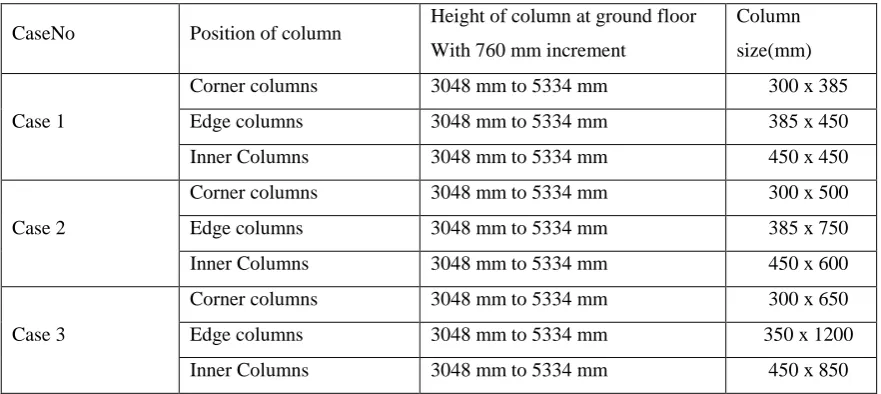
Table 3 Details Of Columns
CaseNo Position of column Height of column at ground floor
With 760 mm increment
Column size(mm)
Case 1
Corner columns 3048 mm to 5334 mm 300 x 385
Edge columns 3048 mm to 5334 mm 385 x 450
Inner Columns 3048 mm to 5334 mm 450 x 450
Case 2
Corner columns 3048 mm to 5334 mm 300 x 500
Edge columns 3048 mm to 5334 mm 385 x 750
Inner Columns 3048 mm to 5334 mm 450 x 600
Case 3
Corner columns 3048 mm to 5334 mm 300 x 650
Edge columns 3048 mm to 5334 mm 350 x 1200
Inner Columns 3048 mm to 5334 mm 450 x 850
3.3 Load Combinations
Load combinations used in analysis are as follows -
1.5 (DL + LL)
1.5 (DL ± EQx)
1.5 (DL ± EQy)
1.2 (DL + LL ± EQx)
1.2 (DL + LL ± EQy)
90 DL ± EQx
90 DL ± EQy
662 |
P a g e
IV. VALIDATION OF SOFTWARE RESULTS WITH MANUAL CALCULATIONS
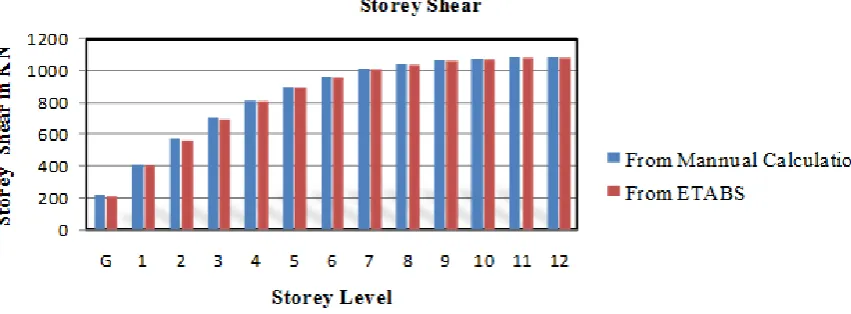
G+12 storied commercial building is analysed using IS: 1893-2002 and ETABS 2015 software. Time period used in manual calculation is taken from ETAB. Model of case 2 with column height 3048 mm is used for validation of software results. Dynamic analysis for Model in case 2 is done with use of parameters mentioned in model description and above tables.
Fig. 2 Graphical Representation Of Storey Shear From ETABS And Manual Calculation
Base shear obtained from ETABS is 1085.34 KN and 1085.9 KN from manual calculation. There is 0.14% Difference Between the software results and manual calculation as shown in Figure 2. Hence software results are valid and can be used.
V. RESULT AND DISCUSSION
5.1 Effect Of Slender Column On Base Shear
A horizontal forces induced at the base of structure due to earthquake are known as base shear force. Base shear variation due to change in column height about ground floor by analysis using response spectrum method shown in table 4
Table 4 Effect Of Slender Column On Base Shear
Column Length
at GL (m)
Base Shear (KN) Avg. Decrease in base
shear
Case 1 Case 2 Case 3
3.048 417.12 1085.90 1725.46
2.17 %
3.81 410.52 1069.21 1685.67
4.572 398.76 1050.64 1646.78
5.334 389.07 1025.23 1608.76
Above table show the result of base shear. Base shear is decrease with increase in storey height for all cases. Similarly storey shear also varies with pattern like base shear. There is 2.17% decrease in base shear.
5.2 Effect Of Slender Column On Storey Drift
663 |
P a g e
Table 5 Effect Of Slender Column On Storey Drift
Column Length
@ GL (m)
Storey drift (mm) Avg. Increase in
Storey drift
Case 1 Case 2 Case 3
3.048 0.220 0.153 0.168
11.6136%
3.81 0.248 0.178 0.195
4.572 0.268 0.202 0.219
5.334 0.275 0.228 0.241
Change in storey drift is as per table no 5. For all cases we observe that, storey drift is increased with increase in height of column. Average increase in storey drift is 11.6136% is observed here.
5.3 Effect Of Slender Column On Storey Displacement
Storey displacement is the lateral displacement of the storey relative to the base. Total displacement of the building measured with respect to base is displacement.
Table 6 Effect Of Slender Column On Storey Displacement
Column Length
@ GL (m)
storey displacement (mm) Avg. increase in
storey
displacement
Case 1 Case 2 Case 3
3.048 20.5 19.4 18.0
2.8915%
3.81 21.2 19.9 18.2
4.572 21.3 20.3 18.6
5.334 23.1 21.4 18.9
Storey displacement for all cases considered for study as shown in table 6. Average increase in storey displacement is 2.8915% and its increase with increase in storey height.
5.4
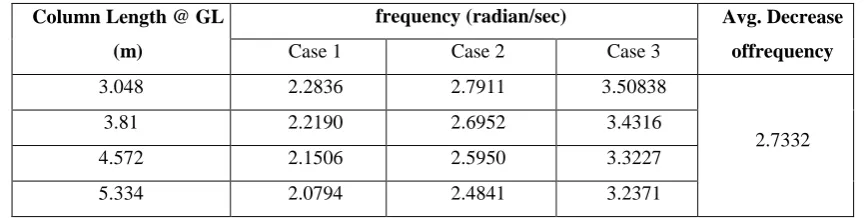
Effect Of Slender Column On Frequency
Frequency of any accelerating object is the number of oscillations completed by object per unit time. It is very important parameter in structural analysis. A modal analysis of structure, calculate the made shapes of that structure gives Eigen values and Eigen vectors.
Table 7 Effect Of Slender Column On Frequency
Column Length @ GL
(m)
frequency (radian/sec) Avg. Decrease
offrequency
Case 1 Case 2 Case 3
3.048 2.2836 2.7911 3.50838
2.7332
3.81 2.2190 2.6952 3.4316
4.572 2.1506 2.5950 3.3227
5.334 2.0794 2.4841 3.2371
664 |
P a g e
VI .CONCLUSION
From Response spectrum analysis of G+12 commercial flat slab structures we conclude that, Base shear of the structure reduced by 2.17% with increase in height of structure about ground column. Similarly storeys shear also increase with increased height. When height of structure increased, frequency of structure also decreased. Average frequency obtained is 2.7332 radians/ sec. In case of storey drift and storey displacement, it get increased by 11.6136% and 2.8915% respectively.
VII. ACKNOWLEDGEMENTS
I would like to say thanks to my project guide Prof. S R Suryawanshi as well as our Department head Dr. A W Dhawale and to allpeople who help me during this project.
REFERENCES
Journal Papers
[1] Mohammad I. Hossain, Tahsin R. Hossain (2014),’ Column slenderness computation and evaluation using finite element method and commercial software’, International Journal of Civil and Structural Engineering,
ISSN 0976 – 4399, Volume 5, No 1.
[2] Hossain Mohammad., Hossain Tahsin.(2014),‘Finite Element Approach to Study on Slender Column for Flat Plate Buildings’, International Journal of Civil and Structural Engineering Research, ISSN 2348-7607, vol. 2, pp.15-24.
[3] Navyashree K, Sahana T.S (2014), ‘Use of Flat Slabs In Multi-Storey Commercial Building Situated In High Seismic Zone’,International Journal Of Research In Engineering And Technology, ISSN: 2319-1163, Vol. 3.
[4] Kalyan Chowdary Kodali, B.Dean Kumar (2014), ‘Comparative Study Of Seismic Performance Of High Rise 30 Storey Building With Beam Slab, Flat Slab And Alternate Flat - Beam Slab Systems In Zone V’, International Journal Of Research In Engineering And Technology, ISSN: 2321-7308, Vol. 4
[5] Dr. Uttamasha Gupta, Shruti Ratnaparkhe (2012),’Seismic Behaviour Of Buildings Having Flat Slabs With Drops’,International Journal Of Emerging Technology And Advanced Engineering, ISSN
2250-2459, Vol. 2
[6] R. P. Apostolska, N. Mircic (2008),’Seismic Performance of Flat-Slab Building Structural Systems’, The 14thWorld Conference on Earthquake Engineering, October 12-17, 2008, Beijing, China
Books
[7] Dr. V. L. Shah et al. (1986), ‘Limit state theory and design of reinforced concrete’, Sixth Edition, Structures Publications.
[8] Manish Shrikhandeand Pankaj Agrawal (2006), ‘Earthquake Resistance Design of Structure’, 1st Revised Edition. New Delhi, PHI Learning Pvt. Ltd.
665 |
P a g e
[9] IS 456-2000 Indian Standard Plain and Reinforced Concrete – Code of Practice (Fourth Revision).