Network Anomaly Detection: Methods and Tools.
Y.S.Kalai Vani
1, E.K.Radhika
2 1,2Dept. of computer science, Sindhi college-Bangalore
ABSTRACT
Network anomaly detection is an important and dynamic research area. Many network intrusion detection
methods and systems (NIDS) have been proposed in the literature. In this paper, we provide a structured and
comprehensive overview of various facets of network anomaly detection so that a researcher can become
quickly familiar with every aspect of network anomaly detection. In this paper we explained the methods and
tools used for network anomaly intrusion. We focused on the survey on which the intrusion detection method is
used to detect the intrusion. In this paper we focused the different types of data sets such as structured and semi
structured and unstructured and how it follows the technique of detection based on the attacks in the network.
Keywords — Anomaly detection, , Attack, dataset, intrusion detection, classifier, tools.
I.INTRODUCTION
Anomaly detection means to the problem of finding patterns in data that do not conform to expected behavior.
These patterns are called as non-conforming patterns[1] are often referred to as anomalies, outliers, discordant observations, exceptions, aberrations, surprises, peculiarities or contaminants in different application domains. Anomaly detection focuses on the techniques which solve the problem in the credit fraud detection, insurance or health care, intrusion detection for cyber-security, fault detection in safety critical systems, and military surveillance for enemy activities.
II.ANOMALIES
2.1
WHAT ARE ANOMALIES.
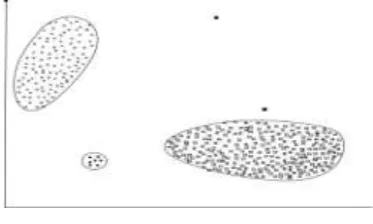
Anomalies are patterns are that do not have normal behavior that is which are in unusual pattern. Figure 1 illustrates anomalies in a simple 2-dimensional data set. The data has two normal regions, N1
and N2, since most observations lie in these two regions. Points that are sufficiently far away from the
regions, e.g., points o1 and o2, and points in region O3, are anomalies.
Fig: Outliers in Anomaly
Anomalies might be induced in the data for a variety of reasons, such as malicious activity, e.g., credit card fraud, cyber-intrusion, terrorist activity or breakdown of a system, but all of the reasons have a common characteristic that they are interesting to the analyst.
2.2
TYPES OF ANOMALIES
2.2.1 Point Anomalies.
In a data set an indivudual data instance can be considered as anomalous if it has unusual behaviour , then the instance is termed as a point anomaly. This is the simplest type of anomaly and is the focus of majority of research on anomaly detection.
For example, in Figure 1, points o1 and o2 as well as points in region O3 [3][4] lie outside the boundary of the
normal regions, and hence are point anomalies since they are different from normal data points. As a real life example, consider credit card fraud detection. Let the data set correspond to an individual's credit card transactions. For the sake of simplicity, let us assume that the data is defined using only one feature: amount spent. A transaction for which the amount spent is very high compared to the normal range of expenditure for
that person will be a point anomaly.
2.2.2 Contextual Anomalies.
anomalies [5]which are considered both content and contextually anomalous. The notion of a context is induced
by the structure in the data set and has to be specified as a part of the problem formulation.
2.2.3 Collective Anomalies.
If a collection of related data instances is anomalous with respect to the entire data set, it is termed as a collective anomaly. The individual data instances in a collective anomaly may not be anomalies by themselves, but their occurrence together as a collection is anomalous.
III.ANOMALY
DETECTION
TECHNIQUES
The labels consists of normal behavior then that is considered as normal data instance and if the label has the unusual behavior then the data instance denoted by the anomalous. Labeling of the data done manually by a human expert and hence requires substantial effort to obtain the labeled training data set. The set of labels which are anomalous of data instances which cover all possible type of anomalous behavior is more difficult than getting labels for normal behavior. Moreover the anomalous behavior is often dynamic in nature, e.g., new types of anomalies might arise, for which there is no labeled training data. In certain cases, such as air traffic safety, anomalous instances would translate to catastrophic events, and hence will be very rare. Based on the extent to which the labels are available, anomaly detection techniques can operate in one of the following three modes:
3.1
Supervised anomaly detection
. Supervised anomaly detection which consists of the trained data set[6] . Typical approach in such cases is to build a predictive model for normal vs. anomaly classes. Any unseen data instance is compared against the model to determine which class it belongs to. The intrusion detection is classified into supervised and unsupervised anomaly detection. The anomalous instances which are[7] compared to the normal instances in the training data. Issues that arise due to imbalanced class distributions have been addressed in the data mining and machine learning literature. Many numbers of techniques have been proposed that inject artificial anomalies in a normal data set to obtain a labeled training data set. Other than these two issues, the supervised anomaly detection problem is similar to building predictive models.3.2
Unsupervised anomaly detection
. Methods in which that operate the unsupervised mode do not require training data, and thus are most widely applicable. The techniques in this category make the implicit assumption that normal instances are far more frequent than anomalies in the test data. It decides the assumption is not true then such techniques suffer from high false alarm rate.Many semi-supervised techniques can be adapted to operate in an unsupervised mode by using a sample of the unlabeled data set as training data. Such Techniques of adaptation assumes that the test data contains very few anomalies and the model learnt during training is robust to these few anomalies.
IV. OUTPUT OF ANOMALY DETECTION
4.1 Scores. The technique which has Scoring schemes assign an anomaly score to each instance in the test data depending on the degree to which that instance is considered an anomaly. Thus the output of such techniques is a ranked list of anomalies. An analyst may choose to either analyze top few anomalies or use a cut-of threshold to select the anomalies.
4.2 Labels. Methods used in this technique assign a label (normal or anomalous) to each test the data instance.
This techniques which has scoring method based anomaly detection techniques allow the analyst to use a domain-specific frequency to select the most relevant anomalies. Methods that provide binary labels to the test instances do not directly allow the analysts to make such a choice, though this can be controlled indirectly through parameter choices within each technique.
V. INTRUSION DETECTION SYSTEM
An intrusion detection system is a system which analyses the network traffic and find the malicious activity in
the network traffic and alerts the system or network administrator. In some situations the IDS may also respond
to anomalous or malicious traffic by taking action such as blocking the user or source IP address from accessing
the network.IDS come in a variety of “flavours” and approach the goal of detecting suspicious traffic in
different ways.
There are two types of Intrusion detection system which are given below to monitor the network intrusion.
5.1 Network Intrusion Detection System
Network Intrusion Detection Systems are used to find the intrusions in a network which used a strategic point or
points within the network to monitor traffic to and from all devices on the network. NIDS[12] used to find the
unusual pattern from the data set which will come in the network traffic. If the malicious activities found in the
form of anomalous the it produces an alarm which causes
5.2 Host Intrusion Detection System
Host Intrusion Detection Systems are run on individual hosts or devices on the network. An HIDS[13]monitors
the inbound and outbound packets from the device only and will alert the user or administrator of suspicious
activity is detected
5.2.1 Signature Based
A signature based IDS will monitor packets on the network and compare them against a database of signatures
or attributes from known malicious threats. This is similar to the way most antivirus software detects malware.
The issue is that there will be a lag between a new threat being discovered in the wild and the signature for
detecting that threat being applied to your IDS. During that lag time, your IDS would be unable to detect the
5.2.1.Anomaly Based
An IDS which is anomaly based will monitor network traffic and compare it against an established baseline. The
baseline will identify what is “normal” for that network- what sort of bandwidth is generally used, what
protocols are used, what ports and devices generally connect to each other- and alert the administrator or user
when traffic is detected which is anomalous, or significantly different than the baseline. The key challenge for
anomaly detection in his domain is the huge volume of data. The anomaly detection techniques need to be computationally efficient to handle these large sized inputs. Moreover the data typically comes in a streaming fashion, thereby requiring on-line analysis. Another issue which arises because of the large sized input is the false alarm rate. Since the data amounts to millions of data objects, a few percent of false alarms can make analysis overwhelming for an analyst. Labeled data corresponding to normal behavior is usually available, while labels for intrusions are not. Thus, semi-supervised and unsupervised anomaly detection techniques are preferred in this domain.
Intrusion is a set of actions aimed to compromise the security of computer and network components in terms of confidentiality, integrity and availability [14]. This can be done by an inside or outside agent to gain unauthorized entry and control of the security mechanism. To protect infrastructure of network systems, intrusion detection systems (IDSs) pro-vide well-established mechanisms, which gather and analyze information from various areas within a host or a network to identify possible security breaches.
5.3 Functions of Intrusions detection:
Intrusion detection functions include (i) monitoring and analyzing user, system, and network activities, (ii) configuring systems for generation of reports of possible vulnerabilities, assessing system and file integrity (iv) recognizing pat-terns of typical attacks (v) analyzing abnormal activity, and tracking user policy violations. An IDS uses vulnerability assessment to assess the security of a host or a network. Intrusion detection works on the assumption that intrusion activities are noticeably different from normal system activities and thus detectable. VI.Different Classes of Attacks
Anderson [2] classifies intruders into two types: external and internal. External intruders are unauthorized users of the machines they attack, whereas internal intruders have permission to access the system, but do not have privileges for the root or superuser mode. A masquerade internal intruder logs in as other users with legitimate access to sensitive data whereas a clandestine internal intruder, the most dangerous, has the power to turn off audit control for themselves.
There are various classes of intrusions or attacks [15] in computer systems. A summary is reported in Table I
Attack name Characteristics Example
Virus (i) A self replicating program that infects the system without any knowledge or permission from the user. (ii) Increases the Trivial.88.D,
Classification Of Intrusion Detection And Intrusion Detection Systems
Network intrusion detection has been studied for almost 20 years. Generally, an intruder’s behavior is noticeably different from that of a legitimate user and hence can be detected [41]. IDSs can also be classified based on their deployment in real time.
Worm (i) A self replicating program that propagates through network services on computer systems without user intervention. (ii) C an SQL Slammer,
highly harm network by consuming network bandwidth. Mydoom, CodeRed
Nimda
Trojan (i) A malicious program that cannot replicate itself but can cause serious security problems in the computer system. (ii) App ears Example-Mail Bomb,
as a useful program but in reality it has a secret code that can create a backdoor to the system, allowing it to do anything on phishing attack
the system easily, and can be called as the hacker gets control on the system without user permission.
Denial of ser- (i) Attempts to block access to system or network resources. (ii) The loss of service is the inability of a particular network or a Buffer overflow, ping of
vice (DoS) host service, such as e-mail to function. (iii) It is implemented by either forcing the targeted computer(s) to reset, or co nsuming death(PoD), TCP SYN,
resources. (iv) Intended users can no longer communicate adequately due to non-availability of service or because of obstructed smurf, teardrop
communication media.
Network (i) Any process used to maliciously attempt to compromise the security of the network ranging from the data link layer to the Packet injection, SYN
Attack application layer by various means such as manipulation of network protocols. (ii) Illegally using user accounts and privileg es, flood
performing actions to delete network resources and bandwidth, performing actions that prevent legitimate authorized users fro m
accessing network services and resources.
Physical An attempt to damage the physical components of networks or computers. Cold boot, evil maid
Attack
Password At- Aims to gain a password within a short period of time, and is usually indicated by a series of login failures. Dictionary attack, SQL
tack injection attack
Information Gathers information or finds known vulnerabilities by scanning or probing computers or networks. SYS scan, FIN scan,
Gathering XMAS scan
Attack
User to Root (i) It is able to exploit vulnerabilities to gain privileges of superuser of the system while starting as a normal user on the system. Rootkit, loadmodule,
(U2R) attack (ii) Vulnerabilities include sniffing passwords, dictionary attack, or social engineering. perl
Remote to Lo- (i) Ability to send packets to a remote system over a network without having any account on that system, gain access either Warezclient,
cal (R2L) at- as a user or as a root to the system and do harmful operations. (ii) Performs attack against public services (such as HTTP an d warezmaster, imap,
tack FTP) or during the connection of protected services (such as POP and IMAP). ftp write, multihop,
phf, spy
Probe (i) Scans the networks to identify valid IP addresses and to collect information about host (e.g., what services they offer, IPsweep, portsweep
operating system used). (ii) Provides information to an attacker with the list of potential vulnerabilities that can later be used
1)
Host-based IDS (HIDS):
A HIDS monitors and analyzes the internals of a computing system rather than its external interfaces [42]. A HIDS might detect internal activity such as which program accesses what resources and attempts il-legitimate access. An example is a word processor that sud-denly and inexplicably starts modifying the system password database. Similarly, a HIDS might look at the state of a system and its stored information whether it is in RAM or in the file system or in log files or elsewhere. One can think of a HIDS as an agent that monitors whether anything or anyone internal or external has circumvented the security policy that the operating system tries to enforce.2)Network-based IDS (NIDS): An NIDS deals with detect-ing intrusions in network data. Intrusions typically occur as anomalous patterns though certain techniques model the data in a sequential fashion and detect anomalous subsequences [42]. The primary reason for these anomalies is attacks launched by outside attackers who want to gain unauthorized access to the network to steal information or to disrupt the network.
In a typical setting, a network is connected to the rest of the world through the Internet. The NIDS reads all incoming pack-ets or flows, trying to find suspicious patterns. For example, if a large number of TCP connection requests to a very large number of different ports are observed within a short time, one
In a typical setting, a network is connected to the rest of the world through the Internet. The NIDS reads all incoming pack-ets or flows, trying to find suspicious patterns. For example, if a large number of TCP connection requests to a very large number of different ports are observed within a short time.
Aspects of Network Anomaly Detection
In this section, we present some important aspects of anomaly-based network intrusion detection. The network intrusion detection problem is a classification or clustering problem formulated with the following components [3]: (i) types of input data, (ii) appropriateness of proximity measures, labeling of data, (iv) classification of methods based on the use of labeled data, (v) relevant feature identification and reporting anomalies.
VI.METHODS
AND
SYSTEMS
FOR
NETWORK
ANOMALY
DETECTION
In the various classes in any particular scheme we may adopt. We have decided on six distinct classes of methods and systems. We call them statistical, classification-based, clustering and outlier-based, soft computing, knowledge-based and combination learners. Most methods have subclasses as given in Figure 2. Figure 5 shows the approximate statistics of papers published in each category.
unnecessary traffic to hijack the bandwidth so that legitimate users are unable to receive service(s). Security related anomalies are three types: (i) point, (ii) contextual and (iii) collective anomalies. This classification scheme is described in Table IV. However, this survey of ours is concerned with security related network anomalies only.
Fig:2 Classification of network anomaly detection methods (GA-Genetic Algorithm, ANN-Artificial Neural Network, AIS-Artificial Immune System)
VII. OPEN ISSUES AND CHALLENGES
Although, many methods and systems have been developed by the research community, there are still a number of open research issues and challenges. The suitability of performance metrics is a commonly identified drawback in intrusion detection. In evaluating IDSs, the three most important qualities that need to be measured are completeness, correctness, and performance. The current state- of-the-art in intrusion detection restricts evaluation of new systems to tests over incomplete datasets and micro-benchmarks that test narrowly defined components of the system. A number of anomaly-based systems have been tested using contrived datasets. Such evaluation is limited by the quality of the dataset that the system is evaluated against. Construction of a dataset which is unbiased, realistic and comprehensive is an extremely difficult task.
After a study of existing NIDSs, we find that it is still extremely difficult to design a new NIDS to ensure robustness, scalability and high performance. In particular, practitioners find it difficult to decide where to place the NIDS and how to best configure it for use within an environment with multiple stakeholders. We sort out some of the important issues as lenges and enumerate them below.
(i) Runtime limitation presents an important challenge for a NIDS. Without losing any packets, a real time IDS should be ideally able to capture and inspect each packet.
(ii) Most NIDSs and network intrusion detection methods depend on the environment. Ideally, system or method should be independent of the environment.
(ii) The nature of anomalies keeps changing over time as intruders adapt their network attacks to evade existing
VIII. CONCLUDING REMARKS
In this paper, we have examined the state-of-the-art in the modern anomaly-based network intrusion detection. The discussion has emphasized two well-known criteria to classify and evaluate NIDSs: detection strategy and evaluation datasets. We have also presented many detection methods, systems and tools. In addition, we have discussed several evaluation criteria for testing the performance of a detection method or system. A brief description of the different existing datasets and its taxonomy is also provided. Finally, we outline several research issues and challenges for future researchers and practitioners who may attempt to develop new detection methods and systems for the latest network scenarios.
REFERENCES
[1] A. Sundaram, “An introduction to intrusion detection,” Crossroads, vol. 2, no. 4, pp. 3–7, April 1996. [2] J. P. Anderson, “Computer Security Threat Monitoring and Surveil-lance,” James P Anderson Co, Fort Washington, Pennsylvania, Tech. Rep., April 1980.
[3] V. Chandola, A. Banerjee, and V. Kumar, “Anomaly Detection : A Survey,” ACM Computing Surveys, vol. 41, no. 3, pp. 15:1–15:58, September 2009.
[4] N. K. Ampah, C. M. Akujuobi, M. N. O. Sadiku, and S. Alam, “An intrusion detection technique based on continuous binary communica-tion channels,” International [5] .J. Security and Networks, vol. 6, no. 2/3, pp. 174– 180, November 2011.
[5].A. Patcha and J. M. Park, “An overview of anomaly detection tech-niques: Existing solutions and latest technological trends,” Computer Networks, vol. 51, no. 12, pp. 3448–3470, 2007.
[6]. P. Garcia-Teodoro, J. Diaz-Verdejo, G. Macia-Fernandez, and E. Vazquez, “Anomaly-based network intrusion detection : Techniques, systems and challenges,” Computers & Security, vol. 28, no. 1-2, pp. 18–28, 2009
[7] V. Hodge and J. Austin, “A survey of outlier detection methodologies,” Artificial Intellligence Review, vol. 22, no. 2, pp. 85–126, 2004.
[9].M. Agyemang, K. Barker, and R. Alhajj, “A comprehensive survey of numeric and symbolic outlier mining techniques,” Intelligence Data Analysis, vol. 10, no. 6, pp. 521–538, 2006.
[9].D. Snyder, “Online intrusion detection using sequences of system calls,” Master’s thesis, Department of Computer Science, Florida State University, 2001.P. J. Rousseeuw and A. M. Leroy, Robust Regression and Outlier Detection. John Wiley & Sons, 1987.
[10]. V. Barnett and T. Lewis, Outliers in Statistical Data. John Wiley & Sons, 1994.D. Hawkins, Identification of Outliers. New York: Chapman and Hall, 1980.
[11]. R. J. Beckman and R. D. Cook, “Outliers,” Technometrics, vol. 25, no. 2, pp. 119–149, 1983. Z. Bakar, R. Mohemad, A. Ahmad, and M. Andderis, “A comparative study for outlier detection techniques in data mining,” in Proc. IEEE Conference on Cybernetics and Intelligent Systems, 2006, pp. 1–6.
[12] P. Gogoi, D. K. Bhattacharyya, B. Borah, and J. K. Kalita, “A Survey of Outlier Detection Methods in Network Anomaly Identification,” Computer Journal, vol. 54, no. 4, pp. 570–588, April 2011.
[13] A. Callado, C. Kamienski, G. Szabo, B. Gero, J. Kelner, S. Fernandes, and D. Sadok, “A Survey on Internet Traffic Identification,” IEEE Commun. Surveys Tutorials, vol. 11, no. 3, pp. 37–52, 2009.
[14] W. Zhang, Q. Yang, and Y. Geng, “A Survey of Anomaly Detection Methods in Networks,” in Proc.International Symposium on Computer Network and Multimedia Technology, January 2009, pp. 1–3. [15] A. Sperotto, G. Schaffrath, R. Sadre, C. Morariu, A. Pras, and B. Stiller, “An Overview of IP Flow-Based Intrusion Detection,” IEEE Commun. Surveys Tutorials, vol. 12, no. 3, pp. 343–356, quarter 2010.