An Efficient Centralized Clustering approach for
Wireless Sensor Networks
M.Srinivasa Rao1 and K.Durga Bhavani2
1 Asst.Professor, 2 Asst. Professor
1 MCA Dept., 2 CSE Dept., Swarnandhra Institute of Engineering and Technology, Narsapur
Abstract: Wireless Sensor Networks consists of no. of micro sensor nodes to monitor a remote environment by using aggregated data from individual nodes and transfer this data to the base station for further purpose. Here the energy of operated nodes is susceptible store of the Wireless Sensor Network, which is useless at a rate when information is transmitted, because transmission energy is reliant on the expanse of transmission. In clustering approach, the cluster head node slack a major quantity of energy during transmission to base station. So hear the selection of cluster head is important task. An efficient etiquette must opt cluster heads based on environmental position of node and its outstanding energy. So, we need etiquette for cluster head selection in wireless sensor network, it is sprint at the base station and tumbling the node’s liveliness use and growing their life span. We implement a fuzzy-logic for the purpose of select a cluster head node along with the nodes of network, it is depending on two parameters one is contemporary energy of the node and second is remoteness of the node from the base station. The etiquette is named TRICKLE based on energy and distance and is scuttle at base station where a new situate of cluster heads are selected at every round, and it is increase the network life span. The replication results show that the proposed approach is more effective than the existing etiquette.
I.INTRODUCTION
Wireless Sensor Networks are networks that contain of sensors that are disseminated in an unprepared fashion in excess of a clear environmental area, aimed at sensing some predefined information from the adjoining, dispensation them and transmitting them to the go under the surface station. The sensors work with one another to confine some corporal event. The data assembled is then transformed to find significant outcomes. Isolated sensor systems consist of of protocols and algorithms with self-arranging capability. Wireless Sensor Networks be capable of be broadly separated into two types one is shapeless Wireless Sensor Networks and prearranged Wireless Sensor Networks. While shapeless Wireless Sensor Network has a huge set of nodes, put up in an ad-hoc fashion, prearranged Wireless Sensor Network has few, hardly distributed nodes with pre-planned consumption. The shapeless Wireless Sensor Networks are complicated to preserve, but it is quite simple to sustain prearranged Wireless Sensor Networks.
Fig 1: Uses of Wireless Sensor Network
1.1Sensor Node
Wireless Sensor Networks principally consists of nodes identified as sensors. Sensors are campaign with squat liveliness as they activate on succession, having inadequate memory and dispensation ability and are premeditated to stay alive tremendous ecological circumstances. These are frequently owing to their diminutive size. They are moreover featured with characteristics organizing and self curative supremacy. The fundamental parts of a Sensor Node is
1. A sensing subsystem that is worn for data capturing commencing the bona fide globe.
2. A subsystem for dispensation that is worn for neighboring data dispensation and luggage compartment.
3. A subsystem consisting of wireless communication to be used to for data in receipt of and spread.
1.2Wireless Sensor Network Communication
The communication systems in Wireless Sensor Networks consist of three layered architecture. The three layers are:
1. Transport Layer: The major apprehension of the Transport Layer is obstruction recognition and alleviation. Trustworthiness of the network is also tartan in this layer. The track of data communication and packet improvement are significant events taken concern by this layer. This layer is also afraid with energy management. 2. Network Layer: The major apprehension of
the network. Data aggregation and computational expenses are taken care by this layer. This is also an energy resourceful layer.
3. Data Link Layer: The major apprehension of the Data-link Layer is to convey data stuck between two nodes that are actually connected, distribution the identical link. CSMA/CA is accepted out by this layer.
1.3 Clustering Protocols for Wireless Sensor Network Confederation calculations for Wireless Sensor Networks might be inaccessible as Centralized cluster calculations and scattered assemblage calculations. Circulated clustering systems are yet again out-of-the-way into four sub segments relying ahead the variety of cluster, necessity for clusters and parameters utilized for determination. The four sub sections are Identity based grouping, Iterative, Neighborhood information based and Probabilistic individually. Probabilistic systems for framing clusters in Wireless sensor systems rely on attributed probability values for sensor hubs. Low Energy Adaptive Clustering pecking order convention proposed in is such a protocol, giving of set of strength consumption by arbitrary turn of group heads then ensuring corresponding lumber adjusting in one recoil sensor systems. TRICKLE is paying attention just about transmission of position subtle elements and energy levels of every sensor hub to base station and sensor hubs with energy level above decided before hand edge are chosen for getting to be cluster heads by the base station itself.
II. PROPOSED WORK
A Wireless sensor network is a set of reasonable battery powered devices the sensors which are deployed to perceive events which are predefined method and transfer sensed information to the base station for even more introspection. They have integrated computing, sensing and wireless communication capabilities. It has been experimental that wireless sensor networks have huge potentials for quite a range of applications like military monitoring, monitoring the surrounding, infrastructure and facility diagnosis etc. It is expected that wireless sensor networks have slightest possible total energy consumption and that they balance energy consumption for individual sensor nodes. For Wireless Sensor Networks, the most important design task is to increase the life of network devoid of sacrificing sensing and other network goals. An energy efficient routing algorithm has to be utilized for the purpose of communicating data. The algorithm should have the these three primary characteristics
Minimum convention of total energy Balanced utilization of energy
Characteristics in a disseminated manner
2.1 The Radio Energy Dissipation Model
This work adopts the first order radio model to calculate the energy dissipation. For transmitter circuit, when the distance between the transmitter and receiver is less than the threshold value d0, the free space (fs) model is
employed, in which the energy consumption is proportional to d2. Otherwise the multipath (mp) fading channel model is used, where the energy consumption is proportional to d4. Equation (3.1) shows the volume of energy expended for sending l bit data to d distance, where (3.2) shows the volume of energy spent for accepting l bit data.
Fig 2: Topology Structure for TRICKLE
Where d0= √€fs/€mp
€fs= energy usage factor of amplification for free space €mp=multipath radio models
In the transmitter and receiver circuit ETxelec and ERxelec are the electronics energy consumptions per bit respectively, which rely on characteristics like the modulation, digital coding, spreading of the signal, and filtering.
2.2 System Assumptions
We consider Wireless sensor network implementations in where sensor nodes are erect in a accidental order so that the environment is monitored incessantly. The data accumulated by sensor nodes is transmitted to a base station positioned in exterior of the chosen area. Every sensor node can function moreover in sensing mode to check the immediate and send it to the allotted cluster head or in Cluster Head mode to collect data, clutch it and send it to the base station. The additional presumptions are as follows:
The sensor nodes and base station are immobile. All the nodes possess the equal energy initially. All nodes are given unique identifier.
The distance among nodes is calculated depending on the received strength of signal.
All nodes have ability to compute their respective distance from base station, based on GPS or other location detection scheme.
2.3 Fuzzy Inference System for the Protocol
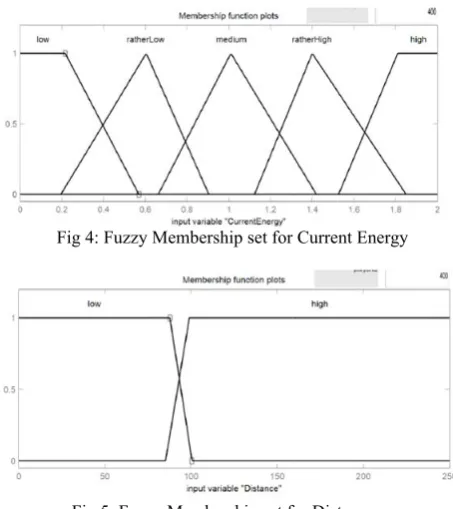
The work has used the Fuzzy Inference Systems (FIS) to calculate the chance for each node, which is the chance of the node to become the Cluster Head in that particular round. As depicted in Fig.3, two variables are input for the FIS, which are the Current Energy of the node and the Distance of the node from base station, and the one and only output parameter for the node is the probability for being selected CH for the round. This is named chance. Higher the value of chance, the more is the node's chance to become CH. The fuzzy membership set describing the Current Energy input variable is depicted in Fig.4. Here the linguistic variables used for describing the fuzzy set are as follows: High, rather high, medium, rather low and low. Trapezoidal membership
Fig 3: Fuzzy Inference System for TRICKLE
Functions are used for each of the other linguistic variables in the input set. The second input variable is the Distance of the node from BS. The fuzzy membership set that chalks the Distance input variable is shown in Fig.5. High and low linguistic variables are used for this set. For both of high and low a trapezoidal membership function is utilized. The chance of a CH candidate is the only fuzzy output variable. The fuzzy membership set defined for the output-chance, is shown in Fig.6. There are seven linguistic variables used in this set. They are very high, high, rather high, medium, rather low, low and very low. Very high and very low are represented by trapezoidal membership function while the other linguistic variables are shown with the help of triangular membership functions. Triangular and trapezoidal membership functions are purposefully chosen here to reducing the cost of computation.
The calculation of chance is done using fuzzy if-then mapping rules that is defined in the fuzzy tool box, so that the uncertainties are handled. On the basis of the two fuzzy input variables, 10 fuzzy mapping rules are declared in Table 3.1. The fuzzy rules define and derive the chance variable. This fuzzy output variable has to be converted into a crisp values to be used in practice. This approach uses the center of area (COA) method for defuzzification in the chance variable. The fuzzy rules are derived either from the heuristics of problem or from the experimental observable data available.
Fig 4: Fuzzy Membership set for Current Energy
Fig 5: Fuzzy Membership set for Distance
In this work, heuristic based fuzzy logic rules are generated. the principle used is: A node who’s Current Energy is more and who's Distance from BS is lesser(less than d0) gets a greater chance to become Cluster Head.
Fig 6: Fuzzy Membership set for Chance
2.4 Proposed Algorithm
Algorithm 3.1: The Proposed Cluster Head Selection Algorithm
Input:
N: the wireless sensor network nn: the total number of nodes in N
k: the expected number of clusters for each round a : a node in N
T: a randomly selected value for becoming a CH candidate Chance (a): the chance of the node to be CH, calculated based on current Energy
and distance from BS
Probability (a): true for the node which has chance(a) value above threshold
Bucket (a): the node a is a member for random selection of CH
Candidate (a): a is a candidate for cluster head Output:
Cluster (a): the CH of the node, which is a node from among nn nodes
Function:
broadcast(data, range of distance); send(data, receiver);
fuzzylogic(currentEnergy, distance );
_ndMinDist(nodesX1[], nodesY1[], nwSize1, nodesX2[], nodesY2[], nwSize2,
nodeIndex, clusterIndex) ;
1 send(data[currentEnergy, distance], BS); 2 foreach node nn do
3 chance(a) < - fuzzylogic(currentEnergy, distance); 4 probability(a) <- false;
5 if (chance(a) > T) then 6 probability(a): true; 7 count++;
8 bucket(a); 9 else
10 probability(a):false; 11 end
12 end
13 candidate(a) = random(bucket);
14 cost = _ndMinDist(nodesX1[], nodesY1[], k, nodesX2[], nodesY2[], nn,
nodeIndex, clusterIndex); 15 minCost = cost; 16 itr = count*count; 17 while itr do
18 candidate(a) = random(bucket);
19 cost = _ndMinDist(nodesX1[], nodesY1[], k, nodesX2[], nodesY2[], nn,
chIndex, clusterIndex); 20 if (cost < minCost) then 21 minCost = cost;
22 cluster(a) = clusterIndex(a); 23 end
24 itr--; 25 end
26 broadcast(cluster[], N);
III. SIMULATION AND RESULTS
Here in simulation and results section, we present the harvest of untried simulations to prove the efficacy of the proposed approach. The proposed clustering algorithm TRICKLE-C(ED) is compared with the basic Centralized Cluster-Head selection algorithm TRICKLE-C. The simulation results prove that the approach selected in the work reveals improved performances.
3.1Simulation Environments
This simulation was deployed using the usual network simulator NS-2.34. There are 100 nodes. They are extend in a random order in a 100 x 100 area. The values that are used in the first order radio model are revealed in Table 2.
3.2Simulation Results
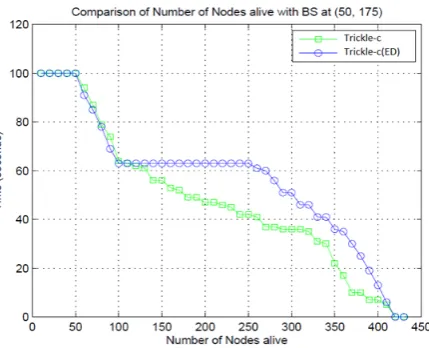
Given a predetermined Base Station and 100 nodes set topology of Sensor nodes, the number of nodes alive through the time of simulation is compared for TRICKLE-C and TRITRICKLE-CKLE-TRICKLE-C(ED) in the following Fig.3.1 and Fig.3.2. Fig.3.2 also shows comparable characteristics of TRICKLE-C(ED) in comparison to TRICKLE-C in Fig.3.1, when base station is at (100,175). In Fig.3.1, at any point of time during the simulation, the number of nodes alive for TRICKLE-C(ED) network is more than that of TRICKLE-C network. It can also be experiential that the network for TRICKLE-C(ED) and TRICKLE-C pass on at almost same time.
Fig 3.1: Configuration Parameters used
Fig 3.3: Nodes alive when BS is at (100,175)
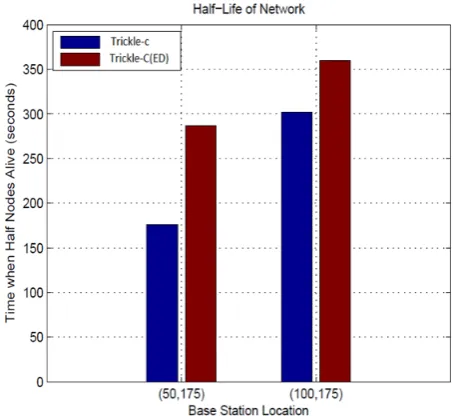
As shown in Fig.3.3, the proposed TRICKLE-C(ED) method performs better than TRICKLE-C.When the base station is at (50,175) the HNA (Half Node Alive) efficiency of TRICKLE-C(ED) is 41.71 % more than TRICKLE-C, and when the base station is at (100,175) the HNA efficiency of TRICKLE-C(ED) is 20.27 % supplementary than TRICKLE-C; while the total energy utilization of the network under each of the two protocol is almost equivalent.
Fig 3.4: Comparison of Half Node Alive (HNA) of the Network under both Protocols
Fig.3.5 shows that the Half Node Alive (HNA) standing of a network under TRICKLE-C(ED) is always enhanced than TRICKLE-C, when compared on basis of escalating average distance of base stations from the sensor nodes of network.
Fig 3.5: Comparison of Total Energy dissipated for same network under both Protocols
Fig 3.6: Time at which half of the nodes are alive for each of the Base Stations locations
IV.CONCLUSION
This work, named TRICKLE-C(ED) proposes a centralized approach for Cluster Head selection based on fuzzy rules for energy and distance. The main intend of the proposed algorithm is to extend the lifespan of the Wireless Sensor Network by uniforming dividing and spreading the load and to improve the network protocol hard annealing algorithm, to reduce the execution time at the base station. To achieve this mark, we have rigorous on predicting the set of nodes eligible for cluster head selection based on current energy and distance of node from base station, thus reducing the number of iteration and random cluster head selection steps in TRICKLE-C algorithm.
V. FUTURE ENHANCEMENT
This TRICKLE-C(ED) algorithm is developed and designed for the Wireless Sensor Networks having at standstill sensor nodes. As a future work, this protocol can be extended for trade mobile sensor node networks. Also, future improvements for this work are to amalgamate this Cluster Head selection approach with multi hop TRICKLE which overcomes the scalability restraint of TRICKLE and TRICKLE-C. The Algorithm may require improvement for an event driven network scenario, in which the frequency of event is very low.
REFERENCES
[1] Y.G. Iyer, S. Gandham, and S. Venkatesan. Stcp: a generic transport layer protocol for wireless sensor networks. In Computer Communications and Networks, 2005. ICCCN 2005. Proceedings. 14th International Conference on, pages 449{454, Oct 2005. [2] Yangfan Zhou, M.R. Lyu, Jiangchuan Liu, and Hui Wang. Port: a
price-oriented reliable transport protocol for wireless sensor networks. In Software Reliability Engineering, 2005 ISSRE 2005. 16th IEEE International Symposium on, pages 10 pp.{126, Nov 2005.
[3] Chieh yih Wan and Shane B. Eisenman. Coda: Congestion detection and avoidance in sensor networks. pages 266{279. ACM Press, 2003.
[4] V.C. Gungor and O.B. Akan. Dst: delay sensitive transport in wireless sensor networks. In Computer Networks, 2006 International Symposium on, pages 116{122, 2006.
[5] Chieh yih Wan, Andrew T. Campbell, and Lakshman
Krishnamurthy. Pump slowly, fetch quickly (psfq): a reliable transport protocol for sensor networks. In IEEE Journal on Selected Areas in Communications, pages 862{872, 2005.
[6] O.B. Akan and I.F. Akyildiz. Event-to-sink reliable transport in wireless sensor networks. Networking, IEEE/ACM Transactions on, 13(5):1003{1016, Oct 2005.
[7] R. A. Santos, A. Edwards, O. Alvarez, A. Gonzalez, and A. Verduzco. A geographic routing algorithm for wireless sensor networks. In Electronics, Robotics and Automotive Mechanics Conference, 2006, volume 1, pages 64{69, Sept 2006.
[8] Rui Zhang, Hang Zhao, and Miguel A. Labrador. The anchor location service (als) protocol for large-scale wireless sensor networks. In Proceedings of the First International Conference on Integrated Internet Ad Hoc and Sensor Networks, InterSense '06, New York, NY, USA, 2006. ACM.
[9] Xiaojiang Du and Fengjing Lin. Secure cell relay routing protocol for sensor networks. InPerformance, Computing, and Communications Conference, 2005. IPCCC 2005. 24th IEEE International, pages 477{482, April 2005.