Comparative Study on Partial Replacement of
Concrete below Neutral Axis of Beam Using
Seeding Trays and Polythene Balls
Basil tom jose1 and Divya Sasi2
1
Civil Engineering Department, APJ Abdul Kalam Technological University, Mar Baselios Institute of Technology and Science Nellimatam, Ernakulam, India
2
Civil Engineering Department, APJ Abdul Kalam Technological University, Mar Baselios Institute of Technology and Science Nellimatam, Ernakulam, India
Abstract
Reinforced concrete is being used in most of construction activities. Present days the problem faced by the construction industry is acute shortage of raw materials. For simply supported reinforced concrete beam, the region below neutral axis is in tension and above neutral axis is in compression. As concrete is weak in taking tension, steel reinforcements are provided in the tension zone. The concrete below the neutral axis act as a stress transfer medium between the compression and tension zone. Partial replacement of the concrete below the neutral axis is an idea that can create reduction in weight and savings in materials. In this study, an experimental investigation on partial replacement of concrete below the neutral axis is done by using seeding trays and the results were compared with normal M25 grade concrete RCC beams and replaced beams by using polythene balls
Keywords: Neutral Axis, Partial replacement, Self - Weight, seeding trays
1. Introduction
Concrete is the major structural component. With increasing demand and consumption of cement, researchers use the various waste materials to replace the concrete. In recent days the problem faced by the construction industry is the acute shortage of raw materials. Researchers have been investigating many alternative materials to suite the Indian scenario. Rice husk, saw dust, light weight aggregates, copper slag, fly ash, are some of the materials experimented. In simply supported reinforced concrete beam, the neutral axis divides the tension zone and compression zone. The region below the neutral axis is in tension and the region above neutral axis is in compression. Since concrete is weak in taking up tension, steel reinforcements are provided at the tension zone of the beam.. We have responsibility to
reduce the effect of the application of concrete materials to environmental impact. Our assumption to design the R.C beams is the contribution of tensile stress of the concrete is neglected. The flexural capacity (MR) of the beam is influenced only by compressive stresses in the concrete and the tensile stress in the steel reinforcement. Efficient use the concrete materials can be done by replacing the concrete in and near the neutral axis. Different studies were conducted by researchers all over the world to propose an effective method for replacement of concrete below neutral axis. In this study, the partial replacement of concrete below the neutral axis creating by using different percentage of seeding trays and the results were compared with normal M25 grade concrete RCC beams and replaced beams by using polythene balls.
2. Objectives
The main objectives of this study are:
1. To study the flexural behavior of beams by partial replacement of concrete below neutral axis with seeding trays.
2. To compare the effect of replacement of concrete
by seeding trays with other methods using Polythene balls.
3. To analyze the material saving for different
methods of replacement.
4. To propose an effective method for the
3. Materials and Properties
The materials used for this experimental study are cement, Fine aggregate, Coarse aggregate, water, and their properties are summarized in the table. In this study, the partial replacement of concrete below the neutral axis by using different percentage of seeding trays, the seeding trays are used for tissue culture purposes. By using seedling trays, growers can produce healthier, more uniform and vigorous seedlings and allow for field planting without disturbing the root system. The main advantage of the seeding tray is light weight and low cost, it also provides an aesthetic appearance. The seeding tray is shown in Fig.1.
Fig .1. Seeding Tray
Table .1
Sl.No Material Property Property Value
1 Cement
Specific
Gravity 3 Initial
setting time
130 minutes 2 Coarse Aggregate Specific
Gravity 2.85 3 Fine Aggregate Specific
Gravity 2.7
4 Mix Design
Mix design can be defined as the process of selecting suitable ingredients of concrete and determining their relative amounts with the objective of producing a concrete of the required strength, durability and workability as economically as possible. The mix design for traditional concrete will carry out as per IS10262:2009. The grade of concrete adopted for this study is M25.Maximum size of aggregate taken is 20mm. The target strength of concrete is 31.4 N/mm2.The mix proportion is shown in table 2.
Table 2 : Mix Proportion
Water Cement Fine
Aggregate
Coarse
Aggregate
197 litters 394 kg 725.76 kg 1149.12 g
4.1. Details of Specimens
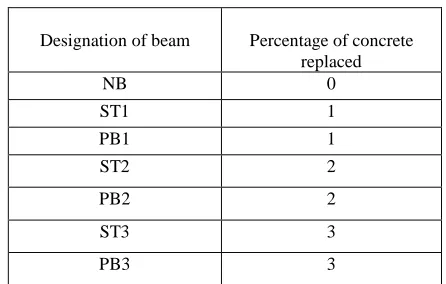
The details of specimens cast with their percentage are shown in Table 3.
Table 3. Details of Specimen
Designation of beam Percentage of concrete replaced
NB 0
ST1 1
PB1 1
ST2 2
PB2 2
ST3 3
PB3 3
5.Experimental Programme
The main objectives of the experimental investigation is to develop the properties of fresh and hardened concrete and the various mechanical properties like compressive strength, flexural strength, splitting tensile strength and load-deflection behavior by conducting suitable laboratory tests on hardened concrete specimens.
6. Results and Discussions
The fresh and hardened properties of all the mixes are shown below.
6.1. Properties of Fresh Concrete
Slump test and compaction factor test was conducted for determining the workability of concrete. The properties of fresh concrete is shown in Table 4.
Table 4. Properties of fresh concrete
Tests Value Slump test 150 mm
Compaction factor test 0.928
6.2. Properties of Hardened Concrete
The various tests to be carried out on hard concrete are: 1. Compressive strength Test
2. Split tensile Strength Test 3. Flexural strength Test
Fig.2. Four Point Loading Test Set Up.
Fig. 3. Reinforcement with Seeding Tray
Fig. 4. Beam with Seeding Trays
Hardened concrete properties such as compressive strength, split tensile strength of M25 concrete mix in 7 days and 28 days were found and listed in table 5.
Table 5. Properties of hardened concrete
Property Strength at 7 days(N/mm2)
Strength at 28 days (N/mm2)
Compressive strength of cube
27.93
38.23
Split tensile strength of
cylinder 1.924 2.28
The Compressive strength of cube in 28 days is 38.23 N/mm2 which is greater than target strength and tensile strength is in the theoretical limit of M25 grade concrete
6.3 Properties of Beams with Seeding Trays and
Polythene Balls
6.3.1 Flexural Strength
Ultimate load values and flexural strength of 4 point loading of different specimens are shown in table 6 and table7. The flexural strength test set up is shown in Fig.5.
Fig. 5. Flexural Strength Test Setup
Table 6. Ultimate load and Flexural strength values for beam with seeding trays.
Specimen Ultimate Load (kN)
Flexural strength (N/mm2)
Percentage reduction in flexural strength
N.B 65 10.2 0
S.T 1 64.5 10 2
S.T 2 63.6 9.9 3
ST 3 63 9.8 4
Table 7. Ultimate load and Flexural strength values for beam with Polythene Balls.
Specimen Ultimate Load (kN)
Flexural strength (N/mm2)
Percentage reduction in flexural strength
N.B 65 10.2 0
P.B 1 63 9.6 5.8
P.B 2 62 9.4 6.8
Table. 6 and 7 shows the ultimate load and flexural strength values of Normal beam (NB) and concrete replaced beams with seeding trays and polythene balls in 28 days. The ultimate load and flexural strength of beam specimens are slightly decreasing with increase in replacement, which shows, we can replace the concrete in tension side of beam without affecting the strength.
6.3.2 Load vs Deflection
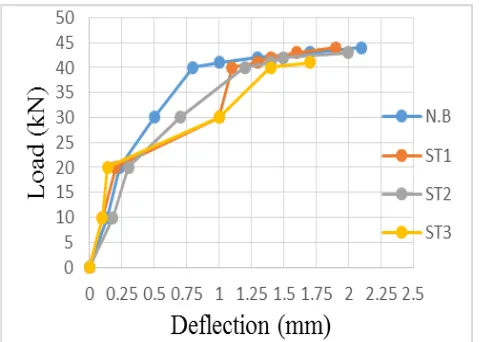
The load vs deflection characteristics of beam were studied. The deflection is plotted along X- axis and corresponding loads in the Y- axis, the load- deflection graph for replaced beam with seeding trays and polythene balls are shown in Fig.6 and Fig.7.
Fig. 6. .Load deflection graph of beam specimens with seeding trays
Fig. 7. .Load deflection graph of beam specimens with polythene balls
6.3.3 Weight Comparison
The weight comparison of normal beam and replaced beam specimens are discussed in table 8.
Table 8. Weight comparison of replaced beam specimens with normal beam
Beam
Weight of Concrete
(kg)
Difference in weight of concrete (kg)
% reduction in weight
NB 39.700 - -
ST 1 39.300 0.400 1
ST 2 38.900 0.800 2
ST 3 38.450 1.250 3.25
P.B 1 39.400 0.400 1
P.B 2 38.000 0.800 2
P.B 3 37.700 1.100 3
From table.8 we can see that, as the concrete below the neutral axis is replaced by using seeding trays and polythene balls in different percentage reduce the weight of concrete and it leads to the reduction in self weight, material savings and cost reduction etc.
6.3.4 Crack Pattern
The crack pattern for normal beam specimen (NB) and replaced beam specimens are observed by the experimental investigation of beam specimens. The crack pattern of beam specimens are shown in Fig.8 to Fig. 10
.
Fig. 9. Crack pattern of ST1
Fig. 10. Crack pattern of PB 1
During the testing, the normal beam (NB) have narrow have cracks and replaced beam specimens have wide cracks. A crack normally propagates in the vertical direction and as the load increases it extended upward suddenly due to the combined effect of shear and flexure. If the load is increased further, cracks propagate to top and the beam splits. Normal beam shows narrow cracks compared to the beam with seeding trays and polythene balls
7. Comparison of Results
The comparison of the results for the different percentage of replaced beam specimens with seeding trays and polythene balls are discussed here.The properties such as Ultimate load, Ductility index etc. are considered for this.
7.1
Ultimate Load – Percentage Replacement
The comparison of Ultimate load v/s different percentage of replacement of concrete with seeding trays and polythene balls are shown in Fig. 11.
Fig. 11. Ultimate load – percentage replacement graph
From the graph we can see that the ultimate load value is decreases with increase in percentage of replacement.The ultimate load value is greater for the replaced beam with seeding tray compare with polythene balls
.
7.2 Ductility index - Percentage Replacement
The comparison of Ductility index v/s different percentage of replacement of concrete with seeding trays and polythene balls are shown in Fig.12. Ductility is an important factor for any of the structural element or structure itself especially in the seismic regions. A ductile material is one which undergo large strains while resisting loads.
Fig.12. Ductility index - Percentage Replacement
From fig. we can see that the Ductility index value is
decreases with increese in percentage of replacement.The
8. Conclusion
From the study, it can be concluded that partial replacement of concrete below neutral axis is an effective method to create reduction in weight and saving in materials and their by we can reduce the construction cost. Replaced reinforced concrete beams can be used for sustainable and environment friendly construction work as it saves concrete for construction. In this study seeding trays are used for the partial replacement, the main advantage of this material is low cost and aesthetic appearance. Then compare the result with partial replacement of concrete using polythene balls. It has been observed that the replacement of concrete by voids in reinforced concrete beams does not require any extra labour or time. Economy and reduction of weight in beams depends on the percentage replacement of concrete. The concrete saving will be more effective as the length and depth of the beam increases. TheFlexural strength slightly decreases from normal beam (NB) to replaced beam specimens, Ductility index shows a reduction with increase
in replacement. The Weight of the specimen decreases
from NB to replaced beams with seeding trays and polythene balls
Acknowledgments
I express my deepest sense of gratitude to Ms. Divya Sasi, Asst. Professor, MBITS, Nellimattom, my esteemed guide and my cordial thanks for her warm encouragement, thoughtful guidance, insightful decision, critical comments and correction of the thesis.. I am deeply indebted to my project coordinator Asst.Prof. Manju George, for her timely help and encouragement
.
I also express my sincere thanks to all the faculty members and students of the Civil Engineering Department of Mar Baselios Institute of Technology and Science for their co-operation and support.References
[1] Ahmed Abouzied (2015) Structural performance of new fully and partially concrete-filled rectangular FRP- tube beams, Construction and Building Materials (2015)652-660
[2] Jain Joy and Rajesh Rajeev (2014)—Effect of Reinforced Concrete Beam with Hollow Neutral Axis, International Journal For Scientific Research And Development (2014), volume 3 [3] B S Karthik, Dr.H.Eramma & Madhukaran (2014), Behaviour Of Concrete Grade Variation In Tension And Compression Zones Of RCC Beams‖,International Journal Of Advanced Technology In Engineering And Science, Volume No.02.
[4] Dr. G. Hemalatha And W.Godwin Jesudhason (2013), ―Experimental Investigation On Beams Partial Replacement Below The Neutral Axis‖, International Journal Of Civil And Structural Engineering Research,Vol. 2
[5] A.Paul Makesh, S.Moses Aranganathan, S.Seileysh Sivaraja (2011), ―Cost Effectiveness To Residential Building Using Green Building Approach‖ International Journal Of Engineering Science And Technology, Vol. 3, No. 12.
[6] Aswathy S Kumar, Anup Joy ( 2015) “Experimental Investigation on Partial Replacement of Concrete Below Neutral Axis of Beam” International Journal of Science and Research, Vol . 4
[7] Ahmed Abouzied (2017) Flexural behavior of rectangular FRP- tube filled with concrete, Experimental and theoretical studies, Engineering Structures(2017) 59–73
[8] Anju Varghese , Basil.M.Joseph (Aug 2016) “Experimental and Numerical Studies on Reinforced Concrete Hollowcore Sandwich Beams” International Journal of Innovative Research in Science, Engineering and Technology, Vol. 5
[9] Nibin Varghese, Anup Joy ( May 2016) “Flexural Behaviour of Reinforced Concrete Beam with Hollow Core at Various Depth” International Journal of Science and Research (IJSR), Vol.5.