On the Impossibility of Constructing Efficient Key
Encapsulation and Programmable Hash Functions
in Prime Order Groups
?Goichiro Hanaoka, Takahiro Matsuda, and Jacob C.N. Schuldt Research Institute for Secure Systems,
National Institute of Advanced Industrial Science and Technology {hanaoka-goichiro, t-matsuda, jacob.schuldt}@aist.go.jp
Abstract. In this paper, we focus on the problem of minimizing ciphertext overhead, and discuss the (im)possibility of constructing key encapsulation mechanisms (KEMs) with low ciphertext overhead. More specifically, we rule out the existence of algebraic black-box re-ductions from the (bounded) CCA security of a natural class of KEMs to any non-interactive problem. The class of KEMs captures the structure of the currently most efficient KEMs defined in standard prime order groups, but restricts an encapsulation to consist of a single group element and a string. This result suggests that we cannot rely on existing techniques to construct a CCA secure KEM in standard prime order groups with a ciphertext overhead lower than two group elements. Furthermore, we show how the properties of an (algebraic) programmable hash function can be exploited to construct a simple, efficient and CCA secure KEM based on the hardness of the decisional Diffie-Hellman problem with the ci-phertext overhead of just a single group element. Since this KEM construction is covered by the above mentioned impossibility result, this enables us to derive a lower bound on the hash key size of an algebraic programmable hash function, and rule out the existence of algebraic (poly, n)-programmable hash functions in prime order groups for any integer n. The latter result answers an open question posed by Hofheinz and Kiltz (CRYPTO’08) in the case of algebraic programmable hash functions in prime order groups.
Keywords: key encapsulation, chosen ciphertext security, programmable hash functions, algebraic black-box reductions
1
Introduction
The development of efficient and secure public key encryption has long been a central research area in cryptography, and in particular, achieving security against chosen ciphertext attacks (CCA security) while maintaining practical efficiency has been the focus of many papers in the literature. One of the most commonly used performance measures for public key encryption schemes, and the measure that we are going to focus on in this paper, is ciphertext overhead which expresses the additional cost in terms of storage and bandwidth when operating with encrypted data as opposed to unencrypted data.
The currently most efficient encryption schemes are based on hybrid encryption [14]. In this approach, a public key component, referred to as a key encapsulation mechanism (KEM), is used to encapsulate (i.e. encrypt) a random session key, and the actual message is then encrypted using a symmetric cipher which is referred to as a data encapsulation mechanism (DEM). The ciphertext overhead of this type of construction is dominated by the KEM. More specifically, if the KEM achieves CCA security, a redundancy-free DEM can be used since, in this case, only one-time CCA security is required of the DEM to obtain a CCA secure hybrid encryption scheme (i.e. a strong pseudo-random permutation can be used as a DEM [38]). If the KEM achieves the slightly weaker notion of constrained CCA security [28], an authenticated DEM is required, which will introduce an additional overhead of a message authentication code (MAC) assuming the authenticated DEM is
?
Table 1.The currently most efficient KEMs in terms of ciphertext overhead. The schemeKiltz[33]† is identical toKiltz[33], except that no hash function is used to derive the session-key (see Sect. 4.2 of [33]). In the table,CCCAdenotes constrained CCA [28] andq-CCAdenotesq-bounded CCA [13]. Furthermore, DDH denotes the decisional Diffie-Hellman assumption, CDH the computational Diffie-Hellman assumption, GDH the gap Diffie-Hellman assumption, GHDH the gap hashed Diffie-Hellman assumption, and DBDH the decisional bilinear Diffie-Hellman assumption.
Scheme Security Hardness Ciphertext
assumption overhead
CS[14] IND-CCA DDH 3|G|
HaKu[22, Sect. 5] IND-CCA CDH 3|G|
HaKu[22, Sect. 4.1] OW-CCA CDH 3|G|
KD[34] IND-CCCA DDH 2|G|
HoKi[28] IND-CCCA DDH 2|G|
HaKu[22, Sect. 6] IND-CCCA DDH 2|G|
Kiltz[33] IND-CCA GHDH 2|G|
Kiltz[33]† OW-CCA GDH 2|G|
BMW[8] IND-CCA DBDH 2|G|
CHH+[13] IND-q-CCA DDH 1|G|
implemented using the encrypt-then-mac approach [3]. Alternatively, the KEM can be generically converted to a CCA secure KEM [2, 24], but this will likewise introduce an additional overhead of a MAC. Hence, when comparing the ciphertext overhead of CCA secure and constrained CCA secure KEMs, this additional overhead should be taken into account.
State-of-the-art Schemes. The currently most efficient (constrained) CCA secure KEMs, which are provably secure in the standard model, are defined in prime order groups [14, 34, 8, 33, 28, 10, 22, 25, 42, 24]. The ciphertext overhead in these schemes consists of at least two group elements. Note that for KEMs defined in prime order groups, each group element in the ciphertext overhead will contribute with at least 2λ bits for a security level ofλbits, since the order pof the group will have to satisfy p >22λ to prevent generic attacks against the underlying assumptions of the security of the KEMs. On the other hand, an additional overhead of a MAC, which must be taken into account when considering constrained CCA secure schemes, contributes with onlyλbits.
Table 1 shows an overview of the security level achieved, security assumption used, and the ciphertext overhead of the currently most efficient schemes in terms of ciphertext overhead. Note that to obtain a ciphertext overhead of just two group elements while maintaining full CCA security, the current schemes require either interactive assumptions, e.g. Kiltz [33], or special groups equipped with a pairing, e.g. Boyen-Mei-Waters [8]. Furthermore, note that the DDH-based KEM by Cramer et al. [13] achieves a ciphertext overhead of just a single group element, but can only be shown to be q-bounded CCA secure (for a predetermined number of decryption queriesq).
Besides being defined in prime order groups, the schemes in Table 1 share some structural properties. More specifically, all of the schemes include a random group element as part of the ciphertext which will be used to derive the key in the decapsulation. The remaining element(s) (except in the schemeKD [34], but see the footnote1) are used to decide whether the ciphertext should be accepted as “valid” or not, but does not otherwise contribute to the computation of the decapsulated key.
More Efficient Schemes? Given the existing KEMs, it would be natural to ask: Is it possible to construct a CCA secure KEM with a ciphertext overhead of less than two group elements?
1 While the KEM component of the original Kurosawa-Desmedt scheme in [34] makes use of “implicit
Considering the structure of the currently most efficient schemes mentioned above, one might consider implementing a more space-efficient validity check, using MACs and hash functions, as a potential strategy for reducing the ciphertext overhead in these schemes.
To illustrate this approach, consider the KEM by Cramer and Shoup [14]. In this scheme, a public key is of the form pk = (g, X1, X2 = gx1X1x2, X3 = gy1X
y2
1 , X4 = gz), where g, X1 are group generators, and the private key is sk = (x1, x2, y1, y2, z). A ciphertext is of the form (c1 = gr, c2 = X1r, c3 = X2rX3rα) and the corresponding key is K = X4r, where r is picked at random fromZp,pis the order of the group, α=H(c1, c2), and H is a target collision resistant hash function. The decapsulation first checks if
cx1+y1α
1 c
x2+y2α 2 =c3, and if this is the case, outputs the session-keyK=cz
1. Otherwise, the ciphertext is rejected. To reduce the ciphertext overhead, we might consider a slightly modified scheme in which the validity check is performed on the hash of the group elements instead of on the group elements themselves i.e. a ciphertext is of the form (c1 =gr, c2 =X1r, c03 =H(X2rX3rα)), and the validity check is implemented as H(cx1+y1α
1 c
x2+y2α
2 ) = c03. Somewhat surprisingly, this leads to a CCA secure scheme as noted in [15]. This reduces the ciphertext overhead to match that of the other schemes defined in standard prime order groups and based on non-interactive assumptions, when taking into account the additional overhead of a MAC required by these schemes e.g. Kurosawa-Desmedt [34], Hofheinz-Kiltz [28] and Hanaoka-Kurosawa [22, Sect. 6].
A similar approach can be used to reduce the ciphertext overhead of the schemes Hofheinz-Kiltz [28], Hanaoka-Kurosawa [22], and Kurosawa-Desmedt [34] with explicit rejection. This yields KEMs with the ciphertext overhead of just a single group element and a hash value, which is lower than the currently most efficient schemes. However, unlike the modified version of the Cramer-Shoup scheme, the security proofs of these schemes do not immediately extend to the modified versions. Hence, it is not obvious what level of security these schemes provide.
1.1 Our Contribution
In this paper, we discuss the impossibility of constructing CCA secure KEMs in standard prime order groups with low ciphertext overhead. More specifically, as our main result, we show that it is impossible to construct an algebraic black-box reduction from theq-bounded one-way non-adaptive CCA security (OW-n-CCA1) of a class of KEMs in which the ciphertext consists only of a single (random) group element and a string, to the hardness ofany non-interactive problemdefined in the group, where nis the number of group elements in the public key of the KEM. Since the majority of standard model security reductions are algebraic black-box reductions, this result sheds light on the question regarding the minimal ciphertext overhead achievable while maintaining CCA security by ruling out a natural class of KEMs with similar structure to the currently most efficient KEMs defined in standard prime order groups. Furthermore, the result holds even for security against adversaries who are restricted to make a single parallel decryption query. Hence, we can additionally rule out the existence of algebraic black-box reductions from the non-malleability of the captured KEMs due to the implications shown in [4, 26]. These results imply that the approach of minimizing ciphertext overhead in the above mentioned schemes [28, 22, 34], by compressing group elements using a target collision resistant hash function (or a similar primitive), will not yield CCA secure or non-malleable KEMs based on non-interactive assumptions. Additionally, since the DDH-based KEM by Cramer et al. [13] is contained in the KEM class, the results imply that this scheme cannot be shown fully CCA secure or non-malleable based on any non-interactive assumption. See Section 3 for a definition of the class of KEMs we consider, Section 4 for our main impossibility result, and Section 6 for further discussion about the implications and limitations of our results.
in the construction of short signatures in the standard model [30, 27]. We show that an algebraic (q,1)-programmable hash function allows the construction of a q-bounded CCA (IND-q-CCA2) secure KEM based on the hardness of the DDH problem, with a ciphertext overhead of just a single group element (see Section 5.1 for the definition of a (α, β)-programmable hash function). Since this construction is covered by the above impossibility result, we can derive a lower bound on the level of programmability provided by a hash function with a given hash key size. Specifically, we show that a hash function withngroup elements in the hash key cannot be (α,1)-programmable for anyα > n. Furthermore, we rule out the existence of algebraic (poly, β)-programmable hash functions in prime order groups for any integer β. This result answers an open question posed by Hofheinz and Kiltz [30] in the case of algebraic programmable hash functions in prime order groups. We note that all known constructions of programmable hash functions are algebraic [30, 27], and that the properties of these hash functions suggest that this may be inherent [30, Sect. 1.5].
1.2 Used Techniques and Related Work
The type of impossibility results we show is commonly known as ablack-box separation [31]. More specifically, a black-box reduction from the security of a cryptographic scheme to the hardness of a problem is an algorithm which, given (black-box) access to any successful adversary against the scheme, successfully breaks any instance of the problem. A black-box separation result shows that such a black-box reduction cannot exist.
Two main lines of techniques have been used for showing black-box separations: oracle rations [31, 39] and meta-reductions [7, 12]. The former technique is typically used to show sepa-rations between primitives, e.g. [31, 40, 19, 21, 20, 6, 32], and is based on showing the existence of an oracle under which the primitive acting as a building block exists, but any instantiation of the “target” primitive is broken. The latter technique is somewhat more direct, and aims at showing that if there exists a reduction which, for example, reduces the security of a primitive to a compu-tational assumption, then there exists a meta-reduction which uses the reduction as a black-box to break a (possibly different) computational assumption. Meta-reductions have successfully been used in [7, 12, 36, 16, 18, 37, 1]. For an overview of these definitions and techniques, see [39, 43].
While we are not considering a primitive-to-primitive reduction, we make use of a variant of the oracle separation technique. In particular, we show the existence of a distribution of oracles under which, on average over the choice of oracle, the non-interactive problem remains hard, while the CCA security of any of the considered KEMs can be broken. We show that such a distribution of oracles is sufficient to rule out a fully black-box reduction (in the taxonomy by Reingold et al. [39]) from the security of a KEM in the considered class of KEMs, to the hardness of any non-interactive problem. Since almost all security reductions for cryptographic primitives are of this type, ruling out the existence of fully black-box reduction gives strong evidence that the currently used techniques are not sufficient to prove the security of the KEMs in question. Our proof techniques, especially our formal treatment of the distribution of oracles, might be of independent interest.
The type of (fully) black-box reductions we are going to consider arealgebraicreductions [7, 12, 36, 1]. Essentially, the algebraic property requires that the reduction only creates group elements by means of the group operation, and does not map arbitrary bit strings to group elements e.g. by applying a hash function to some string to obtain a group element. More specifically, for an algebraic algorithm, it is required that it is possible to compute the representation of a group element output by the algorithm in terms of the group elements which is given as input. For example, if an algebraic algorithm takes as input the group elementsg1, g2and outputs the element
h, it should be possible to computex1, x2such thatg1x1·g x2
2
Preliminaries
In this section, we review our basic notation and several basic definitions. The standard definition of a KEM and the corresponding security notions (such asOW-n-CCA1,IND-n-CCA2 etc.), as well as the definition of concrete computational problems, are given in Appendix A.
2.1 Basic Notation
In this paper, we use the following basic notations and terminology. N denotes the set of all natural numbers, and ifn∈Nthen [n] ={1, . . . , n}. “PPTA” denotes aprobabilistic polynomial
time algorithm. IfS is a set, “x←S” denotes pickingxuniformly from S. IfDis a probability distribution, then “x←D” denotes choosingxaccording toD, and [D] denotes the “support” ofD, that is, [D] ={x|Prx0←
D[x
0=x]>0}. IfAis a probabilistic algorithm theny← A(x;r) denotes
that Acomputesy as output by takingxas input and using r as randomness, andAO denotes
that Ahas access to the oracleO. Unless otherwise stated,λdenotes the security parameter. A functionf(λ) :N→[0,1] is said to benegligible (resp.noticeable) if for all positive polynomials
p(λ) and all sufficiently large λ∈ N, we have f(λ)<1/p(λ) (resp. f(λ)≥1/p(λ)). Let X be a vector, then we denote byX[i] thei-th component ofXand by|X|the length ofX.
2.2 Group Description
In this paper, we consider non-interactive problems with respect to a family of prime-order groups {Gλ}λ∈Nindexed by the security parameter λ. For convenience, we consider the following PTA,
which we call agroup scheme, with which we will define such problems. (Whenλis easily inferred from the context, we will usually leave out the subscriptλand just writeG.)
Definition 1 A group scheme GS is a deterministic PTA which takes a security parameter 1λ
as input, and outputs a group instance Λ consisting of a description of a group G, a prime p
that corresponds to the order of the group G, and a generator g ∈G. This process is denoted by
Λ= (g, p,G)←GS(1λ).
Note that sinceGSis assumed to be deterministic, there is a one-to-one correspondence between a security parameterλand the group descriptionΛgenerated byGS(1λ).
2.3 Algebraic Algorithms
Intuitively, an algorithm R is called algebraic if there exists a corresponding algorithm, called the extractor, such that for any group element output by R, the extractor can compute the representation of the group element with respect to the group elements given toRas input.
Formally, we adopt a similar approach to [1] and define the notion of algebraic algorithms as follows:
Definition 2 Let R be a PPTA that takes Λ= (g, p,G) (output by GS), a string aux∈ {0,1}∗,
and group elements X ∈Gn for some n∈ Nas input, and outputs a group element Y ∈G and
a string ext∈ {0,1}∗.Ris called algebraic with respect toGS if there exists a PPTAE receiving
the same input as R (including the same random coins r) such that for any Λ ← GS(1λ), all
polynomial sizeX, and any stringaux∈ {0,1}∗, the following probability is negligible in λ:
Pr[(Y, ext)← R(Λ,X, aux;r); (y, ext)← E(Λ,X, aux, r) :Y 6=Xy]
where the probability is over the choice of rand the randomness used by E, andXy is defined by Q
i∈[|X|]X[i] y[i].
Algebraic Oracle Algorithms. The above definition of algebraic algorithms can naturally be ex-tended to algebraic “oracle” algorithms, which play an important role in our result.
Definition 3 Let Rbe an oracle PPTA that takesΛ = (g, p,G) (output by GS), a string aux∈ {0,1}∗, and group elements X ∈
Gn for some n ∈ N as input, and outputs a group element
Y ∈ G and a string ext ∈ {0,1}∗. Furthermore, let q be the number of queries made by R to
the oracle. We say that Ris an algebraic oracle algorithmif there exists an algebraic algorithm
b
R(which we denote the decomposition of R) such that executing RO(Λ,X, aux)is equivalent to
performing the following sequence of computations: First set X0 ← X and aux0 ← aux. Run (Y1,(ext||st1))←Rb(Λ,X0, aux0) and repeat
(X0i, aux0i)← O(Λ,Yi, exti); Xi+1←(Xi||X0i); auxi+1←(sti||aux0i);
(Yi+1,(exti+1||sti+1))←Rb(Λ,Xi+1, auxi+1)
fori= 1, . . . , q. The last vectorYq+1 output byRb is assumed to contain the single element Y. Note that since the decomposition Rb of an algebraic oracle algorithm R is defined as an algebraic algorithm, the representation of any group element output by R or included in the oracle queries made by R, can be calculated by appropriately using the extractor Eb for Rb. In this case, the representation is with respect to all group elements that are given as input toRor returned in response toR’s oracle queries.
The above definition can easily be extended to algorithms outputting multiple group elements. Note that we will regard any algorithm whose output does not contain any group elements, as an algorithm which outputs the “identity element” 1G. Hence, this type of algorithm will also be considered to be algebraic.
2.4 Non-interactive Problems with Respect to a Prime Order Group
A non-interactive problem (NIP) P with respect to a group scheme GS consists of a tuple of algebraic PPTAs, (I,V,U), that are defined as follows:
Instance generator I: This algorithm takes a group description Λ = (g, p,G) (output from
GS(1λ)) as input, and outputs a pair of a problem instance and a witness (y, w). (Without loss of generality we assume that the problem instance y contains the information onΛ.)
Verification algorithm V: This algorithm takes a problem instance y, and a string x, and a witness was input (where (y, w) are output byI(Λ)), and outputs>or⊥. We say thatxis a valid solution to the problem instance y ifV(y, x, w) =>, and otherwise we say that xis an invalid solution.
Threshold algorithm U: This algorithm takes a problem instance y as input, and outputs a string x.
For a NIPP= (I,V,U) with respect toGSand an algorithmA, define the experimentExptPGS,A(λ) as:
ExptPGS,A(λ) :
(g, p,G)←GS(1λ); (y, w)←I(Λ); x← A(1λ, y); Return 1 iffV(y, x, w) =>
Furthermore, define the thresholdδ(λ) = Pr[ExptPGS,U(λ) = 1]. Then, for an algorithmA, we define the advantage ofAin solvingPby:
AdvPGS,A(λ) = Pr[ExptGSP ,A(λ) = 1]−δ(λ)
Intuitively, the algorithm Urepresents a trivial solution strategy for the problem P, and any successful algorithm is required to be better than thisU. Typically, U always returns an invalid answer for “search” problems i.e.δ(λ) = 0, and returns a random bit for “decision” problems i.e.
δ(λ) = 1/2.
The above definition of a non-interactive problem essentially captures all the non-interactive problems defined for prime order groups, which are used to prove the security of existing crypto-graphic primitives. Specifically, the definition includes the standard computational and decisional Diffie-Hellman problems as well as theirq-type variants (q-SDH [5],q-ABDHE [17], etc.), and will even capture the CPA security of a KEM.
2.5 Algebraic Black-Box Reductions
In this paper, we will consider the following type of reduction algorithms which reduces the security of a KEM to the hardness of a non-interactive problem.
Definition 5 Let GSbe a group scheme, and letΓ be a KEM andPbe a NIP with respect to GS. Furthermore, let GOAL-ATK be a security notion for a KEM. We say that there is an algebraic black-box reduction from the GOAL-ATK security of Γ to P if there exists an algebraic oracle PPTA R with the following property: For any (possibly computationally unbounded) algorithm
A, ifAdvGOAL-ATK
Γ,A (λ)is non-negligible, then so isAdv P
GS,RA(λ).
We note that this type of reduction is categorized as a“fully” black-box reduction in the taxonomy by Reingold et al. [39]. In particular, note that the (algebraic) reduction algorithm is required to work universally for all successful (possibly inefficient) algorithms.
3
A Class of Simple and Space Efficient KEMs
The class of KEMs we consider essentially captures the structure of the existing KEMs defined in standard prime order groups like Cramer-Shoup [14], Kurosawa-Desmedt [34] (with explicit rejection), Hofheinz-Kiltz [28], Hanaoka-Kurosawa [22], and Cramer et al. [13], but requires the ciphertexts to consist of a single random group element and a string i.e. a ciphertext is required to be of the form (gr,
e
f(pk, r)) where r ←Zp, p is the order of the group,pk is the public key of the scheme, fe: PK ×Zp → {0,1}∗ is a scheme-dependent function, and PK is the public key space.. This captures the approach highlighted in the introduction of replacing the group elements used for validity checking in the above KEMs with the output of a hash function or similar primitive. However, we note that fe(pk, r) is not limited to be used in a potential validity check, but might also be used when deriving the session-key. The session-keys encapsulated by the ciphertexts are assumed to be group elements, but can be derived from all the information available in the encapsulation in any “algebraic” way. Note that this captures the key derivation in the above KEMs, and does not rule out the use of target collision resistant hash function, or the use of a Waters hash function [41] (and similar constructions).
We consider a class of KEMsKGS,ndefined with respect to a group schemeGSand a parameter
n∈N.
Definition 6 A KEM Γ = (KG,Enc,Dec) with respect to a group scheme GS belongs to KGS,n,
wheren∈N, if it has the following properties:
1. The public key space PK is {Λ} × {0,1}µ(λ)×
Gn, where µ is a scheme-dependent function
and Λ = (g, p,G) ← GS(1λ) i.e. a public key pk returned by KG(Λ) is of the form pk = (Λ, aux, X1, . . . , Xn).
2. A ciphertext and the corresponding session-key are of the form
C= (c, d) = (gr,fe(pk, r))∈G× {0,1}∗ and K=gf0(pk,r) Y
i∈[n]
Xifi(pk,r)∈G
where r ← Zp, and fe: PK ×Zp → {0,1}∗ and f0, . . . , fn : PK ×Zp → Zp are efficiently
3. For anypk= (Λ, aux, X1, . . . , Xn)∈ PK, the session-key obtained by decapsulating a
cipher-textC= (c, d)generated by Enc(pk)is of the form
K=gψ0(pk,C,y1,...,yn)cψ1(pk,C,y1,...,yn) (1)
where ψi(pk, C, y1, . . . , yn) =ψi,0(pk, C) +Pj∈[n]ψi,j(pk, C)·yj fori∈ {0,1},yk = loggXk
fork∈[n], and{ψi,j:PK ×G× {0,1}∗→Zp}i∈{0,1},j∈[n] are efficiently computable
scheme-dependent functions.
4. For any pk = (Λ, aux, X1, . . . , Xn)∈ PK, the second component d∈ {0,1}∗ of a ciphertext
C= (c, d)generated by Enc(pk)can be re-computed as follows: d=ψe(pk, c, y1, . . . , yn), where
yi= loggXi fori∈[n] andψe:PK ×G×Znp → {0,1}∗ is a scheme-dependent function. We would like to note the following:
– The values y1, . . . , yn defined above might not correspond to the private key of the scheme, and the decapsulation might not be done as shown in (1), but it is required that any valid session-key Koutput byDecsatisfy equation (1).
– If a KEM in KGS,nsatisfies correctness, it must hold that
f0(pk, r) + X
i∈[n]
fi(pk, r)·yi=ψ0(pk, C, y1, . . . , yn) +r·ψ1(pk, C, y1, . . . , yn)
for any r∈Zp. Hence, the requirement that the functions ψ0 andψ1 are linear functions in
y1, . . . , yn is arguably a very mild restriction.
– That the component dof a ciphertext can be recomputed usingψe, is natural ifdis used as a part of a validity check. Note, however, that no requirements are made regarding how a KEM inKGS,n implements validity checking, anddmight, for example, also be used to compute the session-key K.
– Thatauxandd=fe(pk, r) are strings imply that the representation of a group element output by any algebraic algorithm taking a public key or a ciphertext as input, cannot depend on group elements derived from auxord.
– There are no restrictions on the scheme-dependent functionsf ,e{fi}i∈{0,...,n},ψ,e {ψi,j}i∈{0,1},j∈[n] (other than that they are efficiently computable), and these might use non-linear functions like cryptographic hash functions and MACs, which is not allowed in “structure-preserving” encryption [9].
4
Main Impossibility Result
In this section, we will show the following theorem which captures our main result.
Theorem 7 For any group schemeGS, for any KEMΓ ∈ KGS,nwheren∈N, and for any NIPP
with respect toGS, ifPis hard, then there is no algebraic black-box reduction from theOW-n-CCA1
security ofΓ toP.
We will show this theorem by using a variant of the oracle separation technique [31, 39]. Specifically, the theorem follows from the following lemma (the full proof of this lemma can be found in Appendix B).
Lemma 8 Let GS be a group scheme, Γ ∈ KGS,n be a KEM wheren∈N, and Pbe a NIP with
respect to GS. Furthermore, let GOAL ∈ {OW,IND} and ATK ∈ {CPA, q-CCA1,CCA1, q-CCA2,CCA2}
(with q ∈ N). Assume there exists a distribution D of oracles O satisfying the following two
conditions:
1. There exists an algebraic oracle PPTAAsuch that EO←D[Adv GOAL-ATK
Γ,AO (λ)] is non-negligible. 2. For any algebraic oracle PPTA A, there exist PPTAs B1 and B2, a polynomial Q(λ), and a
negligible functionµ(λ)such that
E
O←D
[AdvPGS,AO(λ)]≤Q(λ)·AdvDLGS,B
1(λ) +Adv
P
GS,B2(λ) +µ(λ).
Proof Sketch. The lemma is proved by contradiction. We assume simultaneously that the NIP
P= (I,V,U) is hard and that there is an algebraic black-box reduction from theGOAL-ATKsecurity of the KEM Γ to P. The latter guarantees that there exists an algebraic oracle PPTA R that satisfies Definition 5. We consider two separate cases: the discrete logarithm (DL) problem with respect toGSis hard, and the DL problem with respect toGS isnot hard. For each case we will show a contradiction.
The second case is fairly easy to show and does not require the use of the oracleO. Specifically, that the DL problem is not hard implies the existence of an adversaryA0 that successfully breaks
the KEMΓ in the sense of theGOAL-ATKsecurity considered in the lemma, by simply recovering the randomnessr from the challenge ciphertext. Then, the definition ofR implies thatRA0
can solvePwith non-negligible advantage. Here, note thatRA0
can be implemented by a single PPTA R0 which internally runs A0 since both RandA0 are PPTAs. However, the existence of suchR0
contradicts thatPis hard.
The first case, in which the DL problem is hard, has some similarities with the above case, but is more interesting and more involved. We make use of the oracle Ochosen according to D. The first condition of the lemma guarantees the existence of an algebraic oracle PPTAA which, given access toO, has non-negligible “expected” advantage in breaking the GOAL-ATKsecurity of the KEMΓ, where the expectation is over the choice ofO according toD.
Now, in order to reach a contradiction, we would like to construct an algebraic oracle PPTA b
Rwhich, given access toO (chosen according toD), has non-negligible “expected” advantage in solving P, by using Aand the reduction algorithm R as building blocks. One might think that just running RAO
on input the problem instance y given to Rb is enough for that purpose, but this is not the case. Recall that R is only guaranteed to work when AO successfully breaks the
GOAL-ATK security of Γ. Furthermore, only the “expected” advantage of A is guaranteed to be non-negligible. Hence, there is a possibility that a particular choice ofO is “bad,” and that A’s advantage under this O is not non-negligible. If the oracleO is bad, then nothing is guaranteed about the success probability ofRAO
in solvingP. In particular, the advantage of Rmight even be negative, and the overall expected advantage in solvingPmight not be non-negligible.
To deal with this issue, Rb first tests whether the given oracle O is “good” by runningRA (·)
many times with independently generated problem instances. If the success probability of RAO
(measured byRb) sufficiently exceeds the thresholdδ(λ), thenRblabels the oracle “good” and runs RAO with the given instancey. Otherwise,
b
Rruns the threshold algorithmUon inputy to avoid a heavy negative contribution to the expected advantage. Constructed as above, Rb’s expected advantage (over the choice of O according to D) can be shown to be non-negligible. Then, the existence of such an algebraic oracle algorithm, together with the second condition given in the lemma and the assumption that the DL problem is hard, implies the existence of a PPTA B2 that solves P with non-negligible advantage, which again contradicts that P is hard. Hence, we can conclude that either Pis not hard or there exists no algebraic black-box reduction from the
GOAL-ATKsecurity ofΓ to the hardness ofP. ut
To make use of the above Lemma 8, we will first define a distribution of oracles, and then proceed to show that the conditions 1 and 2 are satisfied for this distribution. This will complete the proof of Theorem 7.
4.1 The Oracle and the Distribution
The oracle we consider is associated to a KEM which belongs to the classKGS,n. More specifically,
for any KEMΓ ∈ KGS,nand corresponding public key spacePK, consider an oracleO={O1,O2} defined by a functionF :PK →Znp × {0,1}λ wherenindicates the number of group elements in a public key ofΓ (i.e.pk= (Λ, aux, X1, . . . , Xn) andΛ= (g, p,G)←GS(1λ)):
– O2 takes as input a public keypk, session-keys (K1, . . . , Kn)∈Gn, and a tag σ∈ {0,1}λ. If
pk6∈ PK, thenO2returns⊥. Otherwise,O2computes (r1, . . . , rn, σ0)←F(pk) and (Ci, Ki0)←
Enc(pk;ri) for eachi= 1, . . . , n, and then checks ifKi=Ki0 for alli∈[n] andσ=σ0. If the check fails, then O2 returns⊥. Otherwise,O2computes{ui=ψ1(pk, Ci, y1, . . . , yn)}i∈[n] and returns these values, whereψ1 is the scheme-dependent function ofΓ.
Note thatO defined above is deterministic.
By picking the functionF :PK →Znp×{0,1}λuniformly at random from all possible functions with the proper domain and range, we obtain a distribution of the above defined oracles. In the following, this distribution will be denotedD.
4.2 Breaking a KEM using the Oracle
We will now show that an oracleO chosen according to the distributionDdefined in Section 4.1 can be used to break the OW-n-CCA1 security of a KEM inKGS,n. The full proof of the following lemma can be found in Appendix C.
Lemma 9 Let GS be a group scheme, Γ ∈ KGS,n be a KEM where n ∈ N, and let D be the
distribution of the oracles O = (O1,O2) described above. Then there exists an algebraic oracle PPTAA such thatEO←D[Adv
OW-n-CCA1
Γ,AO (λ)]≥ 4n32.
Proof Sketch. In the following, we consider the OW-n-CCA1 experiment in which we take into account the choice of oracleOaccording toD. Note that the success probability of an adversary Ain this experiment will be given byEO←D[Adv
OW-n-CCA1
Γ,AO (λ)].
Recall that the session-key K of a ciphertextC = (c, d) of the KEM Γ is of the form K =
gψ0(pk,C,y1,...,yn)cψ1(pk,C,y1,...,yn) whereψ
1(pk, C, y1, . . . , yn) =ψ1,0(pk, C) +Pi∈[n]ψ1,i(pk, C)·yi. Therefore, from a OW-n-CCA1 adversary’s viewpoint, the difficulty of recovering a session-key K
from a ciphertextC must lie in the calculation of the componentcPi∈[n]ψ1,i(pk,C)·yi. However, we construct an algebraic oracle PPTAAthat makes use of the oracleO ∈[D] and the decapsulation oracle Odec to calculate this component for the challenge ciphertext C∗, and thereby break the OW-n-CCA1security ofΓ.Ais constructed as follows:
Given a public keypk = (Λ, aux, X1, . . . , Xn) forΓ,Asimply submits this to O1 to obtainn randomly generated ciphertexts (C1, . . . , Cn) underpk, and a tagσ. ThenAsubmits the ciphertext (C1, . . . , Cn) to Odec to obtain the corresponding decapsulations (K1, . . . , Kn). Lastly, A will submit (K1, . . . , Kn, σ) toO2to obtain the values{uj=ψ1,0(pk, Cj)+Pi∈[n]ψ1,i(pk, Cj)·yi}j∈[n], whereyi= loggXi fori∈[n].
For a ciphertext C, let ψ(pk, C) = (ψ1,1(pk, C), . . . , ψ1,n(pk, C))∈ Znp be a row vector. Fur-thermore, let yT = (y1, . . . , yn)∈Znp and let uj0 =uj−ψ1,0(pk, Cj) for all j ∈[n]. Then, using the values returned by O2, A can construct a system of equations {ψ(pk, Cj)·y = u0j}j∈[n]. If the vectors {ψ(pk, Cj)}j∈[n] are linearly independent, this system will have the unique solution
yT= (y1, . . . , yn), andAwill be able to recover this by solving the equation system. Obtainingy allowsAto trivially calculateK∗.
The tricky part is the case in which the vectors{ψ(pk, Cj)}j∈[n] are linearly dependent. Recall that the ciphertexts (C1, . . . , Cn) are generated randomly by the oracleO1, and that the challenge ciphertextC∗ is likewise randomly generated by theOW-n-CCA1experiment. The key observation,
which we will show in the full proof, is that if the vectors{ψ(pk, Cj)}j∈[n]are linearly dependent, then there is a high probability that the vectorψ(pk, C∗) is linearly dependent on then−1 vectors {ψ(pk, Cj)}j∈[n−1]. Hence,ψ(pk, C∗)·y=Pi∈[n]ψ1,i(pk, C∗)·yi can be represented as a linear combination of the n−1 values {u0j =ψ(pk, Cj)·y}j∈[n−1], where the latter are known to A. Therefore, in this case,Acan calculateψ1(pk, C∗) =ψ1,0(pk, C∗) +Pi∈[n]ψ1,i(pk, C∗)·yi, from whichAcan recoverK∗.
In the full proof, we will show that regardless of the probability that thenvectors{ψ(pk, Cj)}j∈[n] are linearly dependent,Awill have an expected success probability with the claimed lower bound.
Breaking Non-malleability. Inspecting the proof of the above lemma reveals that then decapsula-tion queries made by the defined adversaryAare independent i.e. the decapsulation queries can be made as a single parallel decapsulation query containingnciphertexts. Since indistinguishability against a parallel chosen ciphertext attack is equivalent to the notion of non-malleability [4, 26, 35], this implies that the constructed adversary can be used to successfully attack the non-malleability of the KEM Γ as well. Hence, our impossibility result can easily be extended to rule out the existence of an algebraic black-box reduction from the non-malleability of a KEMΓ ∈ KGS,n to a NIPPwith respect to GS.
4.3 Simulating the Oracle while Solving a NIP
In this subsection, we will show that the oracles defined in Section 4.1 are essentially useless for an algebraic algorithm trying to solve a NIP. The full proof of the following lemma can be found in Appendix D.
Lemma 10 LetGS be a group scheme, Γ ∈ KGS,n be a KEM wheren∈N, andPbe a NIP with
respect to GS. Furthermore, let D be the distribution of the oracles O= (O1,O2)(corresponding
toΓ) defined as above. Then, for any algebraic oracle PPTAA, there exist PPTAs B1 andB2, a polynomialQ(λ), and a negligible functionµ(λ)such that
E
O←D
[AdvPGS,AO(λ)]≤Q(λ)·AdvDLGS,B
1(λ) +Adv
P
GS,B2(λ) +µ(λ).
Proof Sketch. In the following, we consider the NIP hardness experiment ExptPGS,A(λ) in which we take into account the choice of the oracle O according to D. Note that the advantage of an adversaryAin this experiment is given byEO←D[Adv
P
GS,AO(λ)].
To prove the lemma, we show that for any algebraic oracle PPTA A with access to O and which attempts to solve the NIPP, it is possible to construct another PPTAB2which has almost the same advantage asAin solving the samePwithout access to O.
More specifically, B2 will make use of A as a building block and simulate the oracle O = (O1,O2) chosen according toDforA.B2takes a problem instancey(ofP) as input, and generates an empty listLwhich is used to simulateO. ThenB2picks randomnessrAand runsAwith input
y and randomnessrA.
The main difficulty of simulating the oracle O = (O1,O2) is that A may use O1 and O2 multiple times in any order. Recall, however, that when chosen according to D, the function F
used inO1andO2is a random function, and the tagσ∈ {0,1}λ, which is contained in the output of F, works like an information-theoretically secure MAC. Therefore, when Aasks anO2-query with a freshpk(that has not appeared in any ofA’s previous queries),B2can immediately return ⊥, which will be an almost perfect simulation ofO2 for this type of query.B2 simulates O1 by “lazy-sampling” of the random function F and generating ciphertexts {Ci = (ci, di)}i∈[n] using
Enc. All values returned toAin anO1-query, as well as the encapsulated session-keys, are stored byB2in the listL. Furthermore, whenAmakes a validO2-query (pk, K1, . . . , Kn, σ) (for whichO2 will not return⊥),B2can run the extractor corresponding to (the decomposition of)Ato obtain values{ui}i∈[n] such that Ki =cuiig
zi for some valuez
i∈Zp unknown toB2. Lastly,B2 returns (u1, . . . , un). Whether the values{Ki}i∈[n] are correct decapsulation results can be checked using the listL. Note that since the randomnessrAis chosen byB2,B2is able to run the extractor for
A.
Here, however, we have to be careful because the above simulation could fail if either of the fol-lowing events occurs: (1) the extractor fails, or (2) there is an indexi∈[n] such that the extracted value ui is different from ψ1(pk, Ci, y1, . . . , yn). Fortunately, the probability of (1) occurring is negligible by the definition of an algebraic oracle algorithm. Moreover, the probability of (2) oc-curring for an indexi∈[n] in one ofA’sO2-queries can be bounded by the advantageAdvDLGS,B1(λ) of another PPTAB1 which solves the DL problem. Put differently,B2 succeeds in simulating the oracle O for A almost perfectly. Furthermore, since B2 succeeds in solving Pwhenever A does,
5
Impossibility Results for Programmable Hash Functions
In this section, we show lower bounds on the “programmability” of an algebraic programmable hash functions defined in a prime order group. We will do this indirectly, by first showing how to construct a CCA secure KEM based on DDH, with a ciphertext consisting of just a single group element, from an algebraic programmable hash function. Since this KEM construction is captured by the class considered in the previous sections, we can derive the lower bounds by combining this with the previous impossibility result.
5.1 Programmable Hash Functions
Definition 11 Let α, β ∈ N. A (α, β)-programmable hash function H with respects to a group scheme GS and with input length `(λ), consists of the following four algorithms (HGen,Eval,
HTrapGen,HTrapEval)
– HGen takes a group descriptionΛ= (g, p,G)(output fromGS(1λ)) and returns a hash key κ.
– Evaltakes κand a string s∈ {0,1}`(λ) as input, and returns a group element of G.
– HTrapGentakesΛand group elementsh1, h2as input, and returns a hash keyκand a trapdoor
τ.
– For all group elementsh1, h2∈G, the statistical difference between the keysκ←HGen(Λ)and
the first component κof the output fromHTrapGen(Λ, h1, h2)is negligible.
– On input a string s ∈ {0,1}`(λ) and trapdoor τ, HTrapEval returns a
s, bs ∈ Zp such that
Eval(κ, s) =has 1 h
bs 2 .
– For all group elements h1, h2∈Gand(κ, τ)←HTrapGen(Λ), and for all strings s1, . . . , sα∈ {0,1}`(λ)ands0
1, . . . , s0β ∈ {0,1}
`(λ) such thats
i6=s0j for alli, j, we have Pr[as1 =· · ·=asα = 0∧as01, . . . , as0β 6= 0]
is noticeable in λ, where (asi, bsi) ←HTrapEval(τ, si),(as0j, bs0j)← HTrapEval(τ, s
0
j), and the
probability is taken over the randomness used by HTrapGen.
IfHis (q(λ), β)-programmable for every polynomialq(λ), we say thatHis (poly, β)-programmable. Furthermore, we say that a programmable hash function is algebraic if all algorithms of H are algebraic algorithms2.
In the following, we will make explicit use of the extractors forHGenandEval. More specifically, letκ←HGen(Λ) be given byκ= (aux, X1, . . . , Xn) whereXi∈Gfor alli∈[n] and it is assumed thatauxdoes not contain any elements ofG. Leth∈Gbe an element returned byEvalon input a strings. Then, ifHGenandEvalare algebraic algorithms, there exist extractorsEHGenandEEval
with the following properties:
– On inputΛ= (g, p,G) and randomnessrHGenused to runHGen,EHGenreturns values (y1, . . . , yn) such thatXi=gyi for alli∈[n].
– On input κ= (aux, X1, . . . , Xn) and a string s∈ {0,1}`(λ), EEval returns values (a1, . . . , an) such thath=Q
i∈[n]X ai
i =Eval(κ, s).
We note that all known constructions of programmable hash functions [30, 27] are algebraic.
5.2 A Simple KEM Based on a Programmable Hash Function
We will now show how to construct an IND-q-CCA2 secure KEM with ciphertexts consisting of just a single group element, from an algebraic (q,1)-programmable hash function.
LetH = (HGen,Eval,HTrapGen,HTrapEval) be an algebraic programmable hash function with respect to GS. Let `(λ) be the input length of H. We also assume that any group element ofG where Λ= (g, p,G)←GS(1λ) can be described with`(λ) bits. Using H as a building block, we construct a KEMΓ as follows:
2 Note thatHTrapEvalis trivially an algebraic algorithm since it does not output any group elements of
KG : On inputΛ = (g, p,G), pick randomnessrHGen forHGen and runκ= (aux, X1, . . . , Xn)←
HGen(Λ;rHGen). Furthermore, runEHGen(Λ, rHGen) to obtain (y1, . . . , yn) such thatXi=gyi for alli∈[n], and setpk←(Λ, κ) andsk←(κ, y1, . . . , yn).
Enc : On inputpk= (Λ, κ), pick randomnessr∈Zp, and compute the ciphertextc=gr and the session-key K=Eval(κ, c)r. (Here,c is treated as an`(λ)-bit string.)
Dec : On inputsk= (κ, y1, . . . , yn) andc=gr, computeh←Eval(κ, c), run the extractorEEvalto
obtain (a1, . . . , an) satisfyingh=Qi∈[n]X ai
i , and compute the session-keyK=c P
i∈[n]aiyi. The correctness of the KEM follows from the properties of the extractorsEHGen andEEval:
K=Eval(κ, c)r=hr= (Y i∈[n]
Xai i )
r= Y i∈[n]
(gr)aiyi =cPi∈[n]aiyi
Note that the DDH-based KEM by Cramer et al. [13] can be seen as a concrete instantiation of the above KEM in which we use the concrete programmable hash function proposed in [27, Sect. 3.3].
Theorem 12 Assume that H is an algebraic (q,1)-programmable hash function with respect to
GS. Then there exists an algebraic black-box reduction from the IND-q-CCA2 security of the above KEMΓ to the hardness of the DDH problem with respect to GS.
The proof of the above theorem is given in Appendix E. We note that using an almost iden-tical proof, we can show that the above KEM is OW-q-CCA2 secure under the hardness of the computational Diffie-Hellman (CDH) problem via an algebraic black-box reduction.
Note that due to the assumed algebraic property of the programmable hash function, the above KEMΓ falls into the classKGS,ndescribed in Section 3, wherenis the number of group elements in the hash key of the programmable hash. Furthermore, the DDH problem is captured by the definition of a non-interactive problem described in Section 2.4. Hence Theorem 7 implies that there exists no algebraic black-box reduction from theOW-n-CCA1security of the KEM Γ to the hardness of any non-interactive problem3. On the other hand, the above Theorem 12 shows that such a reduction (from the stronger security notionIND-n-CCA2) is possible assuming the existence of an algebraic (n,1)-programmable hash function. Since any (n, β)-programmable hash function is (n, β0)-programmable ifβ ≥β0, this immediately gives us the following theorem.
Theorem 13 For any group schemeGS and any integer β ∈N, there exists no algebraic (n, β)
-programmable hash function with respect toGSwhose hash key contains less thanngroup elements of G, whereGis the group described byΛ which is output byGS.
Considering the case in which the parameternfor the programmable hash functions is considered to be any polynomial in λ, we obtain the following theorem, which answers the open question posed by Hofheinz and Kiltz [30] in the case of algebraic programmable hash function defined in prime order groups.
Theorem 14 For any group schemeGSand any integerβ ∈N, there exists no algebraic(poly, β)
-programmable hash functions with respect toGS.
6
Discussion
We have shown that there exists no algebraic black-box reduction from the OW-n-CCA1 security of a KEM in the classKGS,n, to the hardness of any non-interactive problem with respect toGS.
The class KGS,n essentially captures the structure of the efficient KEMs [14, 28], [22, Sect. 4.1], and [34] (with explicit rejection), but requires the ciphertext to consist of just a single random group element and a string.
3
Our results leave several open problems. Specifically, it remains an open problem to prove the (non-)existence of a CCA secure KEM based on a non-interactive assumption, defined in a standard prime order group, and with a ciphertext overhead of just two group elements. Another interesting question is whether our results can be extended to rule out constrained CCA [28] secure KEMs based on non-interactive assumptions.
Furthermore, we have focused on simple KEMs defined in standard prime order groups, in which the session-key lies within the group. More precisely, the KEM classKGS,ndoes not capture the structure of schemes which make use of a pairing to derive the session-key like [8], or apply a type of key-derivation function, such as the hardcore bit-based schemes like [22, Sect. 5], [25, Sect. 3], and [42, Sect. 3], the HDH-based versions of [22, Sect. 4.2] and [10, Sect. 6.2], or a combination of these like [25, Sect. 5.2 and 5.3] and [42, Sect. 5]. Note, however, that these schemes apply the key-derivation function (and/or the pairing) to one or more “seed” group elements to obtain a session-key. Here, it might be interesting to investigate the security provided by the “core part” of the schemes, in which the seed group element(s) is considered to be the session-key. Note that for all of the above mentioned schemes, these “core parts” can be shown to beOW-CCA2secure under an appropriate non-interactive assumption. Furthermore, the structure of these “core parts” is captured byKGS,n if the ciphertext is reduced to consist of a single random group element and a string, for example, by applying the approach of compressing the group elements used for validity checking. In this case, our results imply that these “core parts” cannot be shownOW-n-CCA1secure based on a non-interactive problem via an algebraic black-box reduction. This observation might provide some insight into the (im)possibility of constructing more efficient KEMs that make use of key-derivation functions, but drawing any formal conclusions regarding this, remains an open problem.
Since our results are restricted to KEMs defined in prime order groups, it is natural to ask whether similar results will hold in composite order groups. Note, however, that in composite order groups, it is possible to achieve a KEM with a ciphertext overhead of just a single group element [29, Sect. 5]. While this KEM only achieves constrained CCA security (based on a non-interactive assumption), it can be converted to a fully CCA secure KEM using the techniques from [2, 24] which will result in an additional ciphertext overhead of a MAC.
Lastly, we have shown lower bounds on the programmability of algebraic programmable hash functions in prime order groups. Note that all known constructions of programmable hash functions are algebraic [30, 27]. Furthermore, the definition of a programmable hash function requires the hash function to have some “algebraic properties” (see also the discussion in [30, Sect. 1.5]), which seems to suggest that standard model constructions of programmable hash functions are inherently algebraic.
Acknowledgement
We would like to thank Shota Yamada for suggesting looking at KEMs based on programmable hash functions, Masayuki Abe for sending a preliminary version of [1], and the anonymous reviewers for helpful comments. The second and third authors are support by JSPS Research Fellowships for Young Scientists.
References
1. M. Abe, J. Groth, and M. Ohkubo. Separating short structure-preserving signatures from non-interactive assumptions. InASIACRYPT, pages 628–646, 2011.
2. J. Baek, D. Galindo, W. Susilo, and J. Zhou. Constructing strong kem from weak kem (or how to revive the kem/dem framework). InSCN, pages 358–374, 2008.
3. M. Bellare and C. Namprempre. Authenticated encryption: Relations among notions and analysis of the generic composition paradigm. InASIACRYPT, pages 531–545, 2000.
5. D. Boneh and X. Boyen. Short signatures without random oracles. InEUROCRYPT, pages 56–73, 2004.
6. D. Boneh, P. A. Papakonstantinou, C. Rackoff, Y. Vahlis, and B. Waters. On the impossibility of basing identity based encryption on trapdoor permutations. InFOCS, pages 283–292, 2008.
7. D. Boneh and R. Venkatesan. Breaking rsa may not be equivalent to factoring. InEUROCRYPT, pages 59–71, 1998.
8. X. Boyen, Q. Mei, and B. Waters. Direct chosen ciphertext security from identity-based techniques. Cryptology ePrint Archive, Report 2005/288, 2005.
9. J. Camenisch, K. Haralambiev, M. Kohlweiss, J. Lapon, and V. Naessens. Structure preserving cca secure encryption and applications. InASIACRYPT, pages 89–106, 2011.
10. D. Cash, E. Kiltz, and V. Shoup. The twin diffie-hellman problem and applications. Cryptology ePrint Archive, Report 2008/067, 2008. http://eprint.iacr.org/. This is the full version of [11]. 11. D. Cash, E. Kiltz, and V. Shoup. The twin diffie-hellman problem and applications. InEUROCRYPT,
pages 127–145, 2008.
12. J.-S. Coron. Optimal security proofs for pss and other signature schemes. InEUROCRYPT, pages 272–287, 2002.
13. R. Cramer, G. Hanaoka, D. Hofheinz, H. Imai, E. Kiltz, R. Pass, A. Shelat, and V. Vaikuntanathan. Bounded cca2-secure encryption. InASIACRYPT, pages 502–518, 2007.
14. R. Cramer and V. Shoup. Design and analysis of practical public-key encryption schemes secure against adaptive chosen ciphertext attack. SIAM J. Computing, 33(1):167–226, 2003.
15. K. Emura, G. Hanaoka, T. Matsuda, G. Ohtake, and S. Yamada. Keyed-homomorphic public-key en-cryption: How to simultaneously achieve cca security and homomorphic operation, 2012. Manuscript. 16. M. Fischlin and D. Schr¨oder. On the impossibility of three-move blind signature schemes. In
EURO-CRYPT, pages 197–215, 2010.
17. C. Gentry. Practical identity-based encryption without random oracles. In EUROCRYPT, pages 445–464, 2006.
18. C. Gentry and D. Wichs. Separating succinct non-interactive arguments from all falsifiable assump-tions. InSTOC, pages 99–108, 2011.
19. Y. Gertner, S. Kannan, T. Malkin, O. Reingold, and M. Viswanathan. The relationship between public key encryption and oblivious transfer. InFOCS, pages 325–335, 2000.
20. Y. Gertner, T. Malkin, and S. Myers. Towards a separation of semantic and cca security for public key encryption. InTCC, pages 434–455, 2007.
21. Y. Gertner, T. Malkin, and O. Reingold. On the impossibility of basing trapdoor functions on trapdoor predicates. InFOCS, pages 126–135, 2001.
22. G. Hanaoka and K. Kurosawa. Efficient chosen ciphertext secure public key encryption under the computational diffie-hellman assumption. Cryptology ePrint Archive, Report 2008/211, 2008. http: //eprint.iacr.org/. This is the full version of [23].
23. G. Hanaoka and K. Kurosawa. Efficient chosen ciphertext secure public key encryption under the computational diffie-hellman assumption. InASIACRYPT, pages 308–325, 2008.
24. G. Hanaoka and K. Kurosawa. Between hashed dh and computational dh: Compact encryption from weaker assumption. IEICE Transactions, 93-A(11):1994–2006, 2010.
25. K. Haralambiev, T. Jager, E. Kiltz, and V. Shoup. Simple and efficient public-key encryption from computational diffie-hellman in the standard model. InPublic Key Cryptography, pages 1–18, 2010. 26. J. Herranz, D. Hofheinz, and E. Kiltz. Some (in)sufficient conditions for secure hybrid encryption.
Inf. Comput., 208(11):1243–1257, 2010.
27. D. Hofheinz, T. Jager, and E. Kiltz. Short signatures from weaker assumptions. In ASIACRYPT, pages 647–666, 2011.
28. D. Hofheinz and E. Kiltz. Secure hybrid encryption from weakened key encapsulation. InCRYPTO, pages 553–571, 2007.
29. D. Hofheinz and E. Kiltz. The group of signed quadratic residues and applications. In CRYPTO, pages 637–653, 2009.
30. D. Hofheinz and E. Kiltz. Programmable hash functions and their applications. J. Cryptology, 25(3):484–527, 2012.
31. R. Impagliazzo and S. Rudich. Limits on the provable consequences of one-way permutations. In
STOC, pages 44–61, 1989.
32. J. Katz and A. Yerukhimovich. On black-box constructions of predicate encryption from trapdoor permutations. InASIACRYPT, pages 197–213, 2009.
34. K. Kurosawa and Y. Desmedt. A new paradigm of hybrid encryption scheme. InCRYPTO, pages 426–442, 2004.
35. T. Matsuda and K. Matsuura. Parallel decryption queries in bounded chosen ciphertext attacks. In
Public Key Cryptography, pages 246–264, 2011.
36. P. Paillier and D. Vergnaud. Discrete-log-based signatures may not be equivalent to discrete log. In
ASIACRYPT, pages 1–20, 2005.
37. R. Pass. Limits of provable security from standard assumptions. InSTOC, pages 109–118, 2011. 38. D. H. Phan and D. Pointcheval. About the security of ciphers (semantic security and pseudo-random
permutations). InSelected Areas in Cryptography, pages 182–197, 2004.
39. O. Reingold, L. Trevisan, and S. P. Vadhan. Notions of reducibility between cryptographic primitives. InTCC, pages 1–20, 2004.
40. D. R. Simon. Finding collisions on a one-way street: Can secure hash functions be based on general assumptions? InEUROCRYPT, pages 334–345, 1998.
41. B. Waters. Efficient identity-based encryption without random oracles. InEUROCRYPT 2005, pages 114–127, 2005.
42. S. Yamada, Y. Kawai, G. Hanaoka, and N. Kunihiro. Public key encryption schemes from the (b)cdh assumption with better efficiency. IEICE Transactions, 93-A(11):1984–1993, 2010.
43. A. Yerukhimovich. A study of separation in cryptography: New results and new models, 2011. PhD thesis, the University of Maryland. Available at http://www.cs.umd.edu/˜arkady/thesis/thesis.pdf.
A
Omitted Definitions and Descriptions
A.1 Basic Facts
In this paper, we will use the following facts.
Lemma 15 (The Hoeffding bound) Let X1, . . . , Xt be independent random variables between 0
and 1, so that Pr[Xi = 1] = µ for all i ∈ [t]. Let χ = 1tPi∈[t]Xi. Then, for any 0 < ν < 1, Pr[χ <(1−ν)µ]< e−ν2µt/2.
Lemma 16 (Linear dependency) Letn =n(λ) be a positive polynomial, and p be a prime such that |p| is polynomial inλ. Furthermore, leta1, . . . ,an−1,b∈Znp ben-dimensional vectors. Then
there is a deterministic polynomial time algorithm (in λ) that takes as input a1, . . . ,an−1,b, and
returns coefficients (α1, . . . , αn−1)∈Znp−1 satisfying b= P
i∈[n−1]αiai if such coefficients exist,
and otherwise returns ⊥.
Note that the algorithm mentioned in Lemma 16 could be implemented by performing Gauss-Jordan elimination on the matrix obtained by letting the vectors a1, . . . ,an−1,b correspond to the columns the matrix.
A.2 Key Encapsulation
Here, we review the definitions for a key encapsulation mechanism (KEM). Since in this paper we will only treat KEMs based on a group with prime order, for convenience we define a KEM with respect to a group schemeGS.
A KEMΓwith respect to a group schemeGSconsists of the following three PPTAs (KG,Enc,Dec):
KG: (Key Generation) This algorithm takes a group descriptionΛ= (g, p,G) (output fromGS(1λ)) as input, and outputs a public/secret key pair (pk, sk). (Without loss of generality, we assume that pk andskcontain the information onΛ.)
Enc: (Encapsulation) This algorithm takespk as input, and outputs a ciphertextcand a session-keyK∈ K(whereK is a session-key space specified bypk).
Dec: (Decapsulation) This algorithm takes skandc as input, and outputs a session-keyK which could be a special symbol ⊥meaning “invalid”.
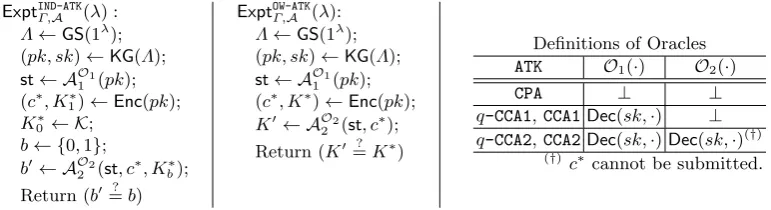
ExptIND-ATK
Γ,A (λ) :
Λ←GS(1λ); (pk, sk)←KG(Λ); st← AO1
1 (pk);
(c∗, K1∗)←Enc(pk);
K0∗← K;
b← {0,1};
b0← AO2
2 (st, c
∗
, Kb∗); Return (b0=? b)
ExptOW-ATK
Γ,A (λ):
Λ←GS(1λ); (pk, sk)←KG(Λ); st← AO1
1 (pk);
(c∗, K∗)←Enc(pk);
K0← AO2
2 (st, c
∗ ); Return (K0=? K∗)
Definitions of Oracles
ATK O1(·) O2(·)
CPA ⊥ ⊥
q-CCA1,CCA1Dec(sk,·) ⊥
q-CCA2,CCA2Dec(sk,·)Dec(sk,·)(†) (†)
c∗cannot be submitted.
Fig. 1.The security experiments for a KEM (with respect to a group schemeGS): The experiment for indistinguishability (IND-ATK security) (left), that for one-wayness (OW-ATK security) (center), and the definitions of oracles (right).
Security Notions for KEMs. Typically, security notions for KEMs are expressed by the combi-nation of a security goal (GOAL) and an adversary’s attack type (ATK). In this paper, we will treatindistinguishability (IND) andone-wayness(OW) as security goalsGOAL, andchosen plaintext attacks (CPA), non-adaptive chosen ciphertext attacks (CCA1),adaptive chosen ciphertext attacks
(CCA2), and their q-bounded analogues [13] (q-CCA1 andq-CCA2) as an adversary’s attack types ATK.
For a KEM Γ = (KG,Enc,Dec) with respect toGS, we define the experimentExptIND-ATK
Γ,A (λ) in
which an adversaryA= (A1,A2) attacks the indistinguishability ofΓ under the attack typeATK, and the experimentExptOW-ATK
Γ,A (λ) in whichA= (A1,A2) attacks the one-wayness ofΓ underATK, as shown in Fig. 1. In the experiments, ifATK∈ {q-CCA1, q-CCA2}, thenA is allowed to use O1 andO2 at mostqtimes in total.
For a KEM Γ, an adversaryA, andATK∈ {CPA, q-CCA1,CCA1, q-CCA2,CCA2}(withq∈N), we defineA’sIND-ATKadvantageAdvIND-ATKΓ,A (λ) andOW-ATKadvantageAdvOW-ATKΓ,A (λ) as follows:
AdvIND-ATK
Γ,A (λ) = Pr[ExptIND-ATKΓ,A (λ) = 1]−
1 2
AdvOW-ATKΓ,A (λ) = Pr[ExptOW-ATKΓ,A (λ) = 1]
Definition 17 Let GOAL∈ {IND,OW} and ATK∈ {CPA, q-CCA1,CCA1, q-CCA2,CCA2} (with q∈N).
We say that a KEMΓ isGOAL-ATK secure if for any PPTA A, there exists a negligible function
µ(·)such that AdvΓ,GOALA-ATK(λ)≤µ(λ).
A.3 Concrete Non-interactive Problems
In this paper, we make use of the (hardness of the) following concrete non-interactive problems. Although these problems are special cases of a NIP, it is convenient for us to define them separately, and thus we review them below for completeness. As usual, the following problems are said to be hard if the advantage functions are negligible in the security parameterλfor any PPTA.
Discrete Logarithm Problem. LetGSbe a group scheme and letAbe an algorithm. We define the advantageAdvDLGS,A(λ) ofAin solving the discrete logarithm (DL) problem with respect toGSas
follows:
AdvDL
GS,A(λ) = Pr[Λ= (g, p,G)←GS(1
λ); α
←Zp:A(Λ, gα) =α]
Decisional Diffie-Hellman Problem. Let GS be a group scheme and let A be an algorithm. We define the advantage AdvDDH
GS,A(λ) of A in solving the decisional Diffie-Hellman (DDH) problem
with respect toGS as follows:
AdvDDHGS,A(λ) = Pr[Λ= (g, p,G)←GS(1λ); α, β, γ←Zp;
B
Proof of Lemma 8
Proof. LetGS, Γ, and P= (I,V,U) be as stated in the lemma. Fix GOAL∈ {OW,IND} and ATK∈ {CPA, q-CCA1,CCA1, q-CCA2,CCA2} (withq∈N). Towards a contradiction, assume simultaneously thatPis hard and that there exists an algebraic black-box reduction from theGOAL-ATKsecurity of Γ to the hardness of P. The latter guarantees that there exists an algebraic oracle PPTA R that satisfies the condition of Definition 5.
We first consider the case in which the DL problem with respect to GS is not hard. That is, we assume there exists a PPTA algorithmAsuch thatAdvDLGS,A(λ) is non-negligible. Consider the following (trivial) adversaryA0 that usesAas a subroutine and attacks theOW-CPAsecurity ofΓ:
On input a public key pk = (Λ, aux, X1, . . . , Xn) (where Λ = (g, p,G)) and the challenge ciphertext C∗ = (c∗, d∗) ∈G× {0,1}∗, A0 runs A with input (Λ, c∗). When Aterminates with output r, A0 returns the session-key K = gf0(pk,r)Q
i∈[n]X fi(pk,r)
i , where {fi}i∈{0,...,n} are the
scheme-dependent functions defined byΓ.
It is easy to see that A0 succeeds in breaking the OW-CPAsecurity of Γ wheneverA succeeds in calculating the discrete logarithm r = loggc∗, and thus AdvOW-CPA
Γ,A0 (λ) = AdvDLGS,A(λ) is
non-negligible. Then, since anyGOAL-ATK security considered in this lemma impliesOW-CPA security, A0 can be easily modified so that it has non-negligible advantage in breakingGOAL-ATK security
of Γ. Hence, by the definition of an algebraic black-box reduction, AdvPGS,RA0(λ) must also be
non-negligible. Since bothRandA0 are PPTAs,RA0
can be rewritten as a single PPTAR0 which
will have non-negligible advantage in solvingP. However, this contradicts the fact thatPis a hard NIP, and thereby the existence ofR.
We will now consider the case in which the DL problem with respect toGSis hard. The proof makes use of the distributionDof the oraclesOprovided by the assumption in the lemma. More specifically, by the first property ofD, there exists an algebraic oracle PPTAAand some positive polynomialp(λ) such that for infinitely manyλ’s,
E
O←D
AdvGOAL-ATKΓ,AO (λ)
= E
O←D
Pr[ExptGOAL-ATKΓ,AO (λ) = 1]−ρ
≥ 1
p(λ),
where ρ= 0 ifGOAL =OWand ρ= 12 if GOAL=IND. Then, by a simple averaging argument, we have (for infinitely manyλ’s):
Pr
O←D
AdvGOAL-ATKΓ,AO (λ)≥
1 2p(λ)
> 1
2p(λ) CallO ∈[D]good ifAdvGOAL-ATKΓ,AO (λ)≥ 2p1(λ). Then, by definition we have
Pr
O←D
[Ois good]> 1
2p(λ) (2)
Define the algebraic oracle PPTAReO byRA
O
. Note that such algebraic oracle PPTARemust exist becauseRandAare both algebraic oracle PPTAs. The corresponding extractor forRe can be easily constructed by appropriately combining the extractors ofRandA.
Then, we know that under a good oracleOb,AObhas non-negligible advantage (at least 2p1(λ)) in breaking theGOAL-ATKsecurity ofΓ. Therefore, by definition of an algebraic black-box reduction,
AdvPGS,
e
ROb(λ) =Adv P
GS,RAOb(λ) is non-negligible. That is, there exists another positive polynomial
p0(λ) such that, for infinitely many λ’s, we have
AdvPGS,
e
ROb(λ) = Pr[Expt P
GS,ReOb(λ) = 1]−δ(λ)≥
1
p0(λ)
Here, let us introduce some notation for convenience. For an oracle algorithm M that has access to an oracle in [D], we denote byExptg
P
GS,MD(λ) the following experiment:
g
ExptPGS,MD(λ) : [O ←D; ReturnExpt P
Note that by definition, for an oracle algorithmM, it holds that
E
O←D
[AdvPGS,MO(λ)] = E
O←D
h
Pr[ExptPGS,MO(λ) = 1]−δ(λ)
i
= Pr[Exptg
P
GS,MD(λ) = 1]−δ(λ)
Now, in order to reach a contradiction with the assumption that Pis hard (using the second property of D and the assumption that the DL problem is hard), we would like to show the existence of an algebraic oracle PPTARbsuch that the “expected advantage”EO←D[Adv
P
GS,RbO(λ)] is non-negligible. One might think that the algorithmRecan be used for that purpose. However,Re is only guaranteed to have non-negligible advantage in solvingPwhen the given oracle O causes
Ato have non-negligible advantage in breaking the GOAL-ATKsecurity of Γ.When this is not the case, nothing is guaranteed about the success probability ofRe which might even be negative. Note that this might cause the expected advantageEO←D[Adv
P
GS,ReO(λ)] to be not non-negligible. Instead, we consider the following algebraic oracle algorithmRb that usesRe andUas building blocks, and runs in the experimentExptg
P
GS,RbD(λ). Intuitively,Rb first tests whether the given oracle O is “good” by running Re many times with independently generated instances (using I) and checking whetherRe succeeds in solving these with sufficiently high probability, and then decides which ofRe orU it uses to find the answerxto the given instancey. Specifically, the description ofRb is as follows:
b
RO(1λ, y): (where y contains the group description Λ) Let t= 8λp0(λ)2 and Z =δ(λ) + 1 2p0(λ).
For i ∈ [t], Rb runs (yi, wi) ← I(Λ), xi ← ReO(1λ, yi), and V(yi, xi, wi). We let bi = 1 if
V(yi, xi, wi) = >and bi = 0 otherwise. Rb calculates χ = 1tPi∈[t]bi. If χ > Z then Rb runs
x←ReO(1λ, y), and otherwise runsx←U(1λ, y). Finally,Rb terminates with outputx.
It is easy to see thatRb is an algebraic oracle PPTA, because bothRe andUare algebraic (oracle) PPTAs andp0(λ) is a positive polynomial.
CallO ∈[D] positiveif Pr[ExptPGS,ReO(λ) = 1]−δ(λ)≥0, and otherwise callO negative. Note
that by definition, any good oracleO ∈[D] is also positive. We will now estimateEO←D[Adv
P
GS,RbO(λ)] = Pr[Exptg
P
GS,RbD(λ) = 1]−δ(λ). In the experiment g
ExptPGS,RbD(λ), we consider the following events:
– Succ:Rb succeeds in outputting xsuch thatV(y, x, w) =>.
– Posi:O (chosen according toD) is positive
– Good:O(chosen according toD) is good.
Here, according to our description ofRb, we know that the following two equations hold (whereΛ is the group description output fromGS(1λ))4:
Pr[Succ|χ > Z∧Good]−δ(λ)
= Pr[(y, w)←I(Λ); x←ReO(1 λ
, y) :V(y, x, w) =>|Ois good]−δ(λ)≥ 1
p0(λ) (3)
Pr[Succ|χ≤Z] = Pr[(y, w)←I(Λ); x←U(1λ, y) :V(y, x, w) =>] =δ(λ) (4)
4
![Table 1. The currently most efficient KEMs in terms of ciphertext overhead. The scheme Kiltz [33]† isidentical to Kiltz [33], except that no hash function is used to derive the session-key (see Sect](https://thumb-us.123doks.com/thumbv2/123dok_us/7887468.1308751/2.595.169.435.175.311/currently-ecient-ciphertext-overhead-isidentical-function-derive-session.webp)