EMPIRICAL MODE DECOMPOSITION WITH LEAST SQUARE SUPPORT VECTOR MACHINE MODEL FOR RIVER FLOW FORECASTING
SHUHAIDA BTE ISMAIL
A thesis submitted in fulfilment of the requirements for the award of the degree of
Doctor of Philosophy (Mathematics)
Faculty of Science Universiti Teknologi Malaysia
ACKNOWLEDGEMENT
I am extremely grateful to my supervisor Dr. Ani Shabri, for his invaluable professional advice, guidance and financial support throughout the whole process. I am also tremendously grateful to all of the lab mate of C22-451-01 for their
ABSTRACT
Accurate information on future river flow is a fundamental key for water
resources planning, and management. Traditionally, single models have been introduced
to predict the future value of river flow. However, single models may not be suitable to capture the nonlinear and non-stationary nature of the data. In this study, a
three-step-prediction method based on Empirical Mode Decomposition (EMD), Kernel Principal
Component Analysis (KPCA) and Least Square Support Vector Machine (LSSVM)
model, referred to as EMD-KPCA-LSSVM is introduced. EMD is used to decompose the river flow data into several Intrinsic Mode Functions (IMFs) and residue. Then,
KPCA is used to reduce the dimensionality of the dataset, which are then input into
LSSVM for forecasting purposes. This study also presents comparison between the
proposed model of EMD-KPCA-LSSVM with EMD-PCA-LSSVM, EMD-LSSVM, Benchmark EMD-LSSVM model proposed by previous researchers and few other
benchmark models such as Single LSSVM and Support Vector Machine (SVM) model,
EMD-SVM, PCA-LSSVM, and PCA-SVM. These models are ranked based on five
statistical measures namely Mean Absolute Error (MAE), Root Mean Square Error
(RMSE), Correlation Coefficient (r), Correlation of Efficiency (CE) and Mean Absolute Percentage Error (MAPE). Then, the best ranked model is measured using
Mean of Forecasting Error (MFE) to determine its under and over-predicted forecast
rate. The results show that EMD-KPCA-LSSVM ranked first based on five measures for
Muda, Selangor and Tualang Rivers. This model also indicates a small percentage of under-predicted values compared to the observed river flow values of 1.36%, 0.66%,
4.8% and 2.32% for Muda, Bernam, Selangor and Tualang Rivers, respectively. The
study concludes by recommending the application of an EMD-based combined model
ABSTRAK
Maklumat yang tepat mengenai masa hadapan aliran sungai adalah kunci asas
kepada perancangan dan pengurusan sumber air. Secara tradisi, model tunggal telah
diperkenalkan untuk meramalkan nilai masa depan bagi aliran sungai. Walau
bagaimanapun, model tunggal mungkin tidak sesuai untuk mengenalpasti ketaklelurusan
dan ketakpegunan yang wujud dalam data. Dalam kajian ini, kaedah tiga langkah-ramalan
berdasarkan Mod Impirikal Penguraian (EMD), Kernel Utama Analisis Komponen (KPCA)
dan model Kuasa Dua Terkecil Mesin Sokongan Vector (LSSVM), yang disebut sebagai
EMD-KPCA-LSSVM diperkenalkan. EMD digunakan untuk menguraikan data aliran
sungai kepada beberapa Fungsi Intrinsik Mod (IMFs) dan reja. Kemudian, KPCA digunakan
untuk mengurangkan kedimensian set data yang kemudiannya dimasukkan ke dalam
LSSVM untuk tujuan peramalan. Kajian ini juga membandingkan antara model cadangan
EMD-KPCA-LSSVM dengan EMD-PCA-LSSVM, EMD-LSSVM, model Penanda Aras
EMD-LSSVM yang dicadangkan oleh penyelidik sebelum ini dan beberapa model penanda
aras lain seperti model tunggal LSSVM dan Mesin Sokongan Vector (SVM), EMD-SVM,
PCA-LSSVM dan PCA-SVM. Model ini dinilai berdasarkan lima ukuran statistik iaitu
Ralat Mutlak Min (MAE), Ralat Punca Min Kuasa Dua (RMSE), Pekali Kolerasi (r), Kecekapan Korelasi (CE) dan Peratus Ralat Mutlak Min (MAPE). Kemudian, model terbaik
kedudukannya diukur menggunakan Min Ramalan Ralat (MFE) untuk menentukan kadar
terkurang dan terlebih ramalan. Keputusan menunjukkan bahawa EMD-KPCA-LSSVM
menduduki tempat pertama berdasarkan lima ukuran bagi Sungai Muda, Sungai Selangor
dan Sungai Tualang. Model ini juga menunjukkan peratusan yang kecil bagi nilai terkurang
ramal berbanding nilai aliran sungai yang direkodkan masing-masing sebanyak 1.36%,
0.66%, 4.8% dan 2.32% bagi Sungai Muda, Bernam, Selangor dan Sungai Tualang. Kajian
ini membuat kesimpulan dengan mengesyorkan penggunaan model berasaskan EMD
terutamanya denganpendekatan pengurangan dimensi berasakan Teras untuk ramalan aliran
sungai kerana hasil ramalan yang lebih baik dan kestabilan yang dicapai berbanding dengan
TABLE OF CONTENTS
CHAPTER TITLE PAGE
DECLARATION ii
ACKNOWLEDGEMENT iii
ABSTRACT iv
ABSTRAK v TABLE OF CONTENTS vi
LIST OF TABLES xi
LIST OF FIGURES xiii
LIST OF ABBREVIATIONS xvi
LIST OF APPENDICES xix
1 INTRODUCTION 1
2 LITERATURE REVIEW 12
2.1 Introduction 12
2.2 Time Series Forecasting 13
2.3 River Flow Forecasting 14
2.4 Previous Study in Hydrology 15
2.4.1 Regression Analysis 15
2.4.2 Autoregressive Integrated Moving Average 16 2.4.3 Application Using ARIMA Models 24
2.4.4 Artificial Neural Network 26
2.4.5 Application Using ANN 30
2.5 Current Study in Hydrology 32
2.5.1 Support Vector Machine 32
2.5.1.1 SVM for Regression 33
2.5.1.2 Applications Using SVM 36
2.5.1.3 SVM in Hydrology 37
2.5.2 Least Square Support Vector Machine 40
2.5.2.1 LSSVM in Hydrology 41
2.5.3 Data Pre-processing 44
2.5.3.1 Principal Component Analysis (PCA) 44 2.5.3.2 Kernel Principal Component
Analysis (KPCA) 46
2.5.4 Data Decomposition 49
2.5.4.1 Empirical Mode Decomposition
(EMD) 49
2.5.4.2 EMD in Hydrology 51
2.6 Combination Models 52
2.7 Summary of Previous Researches 47
2.8 Summary 64
3 RESEARCH METHODOLOGY 65
3.2 Data Source 66
3.3 Stationary Test 68 3.3.1 ADF Algorithm 69 3.3.2 ADF Test Regression Forms 70
3.4 Linearity Test 71
3.4.1 BDS Algorithm 72 3.5 Empirical Mode Decomposition Technique 74
3.5.1 Intrinsic mode function (IMF) 75 3.5.2 Sifting Process 76 3.5.3 Instantaneous Frequency (IF) 80 3.5.4 Hilbert Spectrum (HS) 81 3.6 Principal Component Analysis Technique 82 3.6.1 Deviation of Principal Component 83 3.6.2 Variance of Principal Component 85 3.7 Kernel Principal Component Analysis Technique 87 3.7.1 Derivation of Kernel Principal Component Analysis Technique 89 3.8 Least Square Support Vector Machine Model 95 3.8.1 Karush-Kuhn Tucker 95
3.8.2 Validation Technique 96 3.8.2.1 Cross Validation 96 3.8.3 LSSVM Algorithm 97 3.8.4 Kernel Functions 100
3.9 Benchmark EMD-LSSVM Model 102
3.10 EMD-SVM / EMD-LSSVM Models 103
3.11 Proposed Model (EMD-KPCA-LSSVM) 105
3.12 Experiment Setup 108
3.12.1 Setting for SVM 108
3.12.2 Setting for LSSVM 108
3.12.3 Data Pre-processing 109
3.13 Statistical Performances 110
4 DATA COLLLECTION AND ANALYSIS 115
4.1 Introduction 115
4.2 Testing the Stationary 115
4.3 Testing the Linearity 118
4.4 Data Splitting 119
4.5 Input determination 122
4.6 Results 124
4.7 Monthly River Flow Using Single Model 124
4.7.1 SVM Results 124
4.7.2 LSSVM Results 126
4.8 Monthly River Flow Using PCA-Based Models 127
4.8.1 Data Pre-Processing Technique Using PCA 128
4.8.2 PCA-SVM Results 130
4.8.3 PCA-LSSVM Results 131
4.9 Monthly River Flow Using EMD-Based Model 133
4.9.1 Data Decomposition Using EMD 133
4.9.2 Benchmark EMD-LSSVM Results 138
4.9.3 IMF Identification Using R2 139
4.9.4 EMD-SVM Results 142
4.9.5 EMD-LSSVM Results 144
4.10 Monthly River Flow Using EMD-Based Model Combined with Feature Extraction Techniques 146
4.10.1 EMD-PCA-LSSVM Model 147
4.10.1.1 Stage 1 (Decomposition Using EMD) 147
4.10.1.2 Stage 2 (Component Identification/Feature Extraction Using PCA) 147
4.10.2 EMD-KPCA-LSSVM Model 153
4.10.1.1 Stage 1 (Decomposition Using EMD) 153
4.10.1.2 Stage 2 (Component Identification/Feature Extraction Using KPCA) 153
4.10.1.3 Stage 3 (Forecasting Using LSSVM) 154
4.11 Summary 156
5 COMPARISON AND DISCUSSION 158
5.1 Introduction 158
5.2 Comparison 159
5.3 Discussions 169
5.3.1 Discussion on Single Models 170
5.3.2 Discussion on PCA-Based Models 171
5.3.3 Discussion on EMD-Based Models 172
5.3.4 Discussion on EMD-Based Models Combine with Feature Extraction Technique 174
5.2 Summary 177
6 CONCLUSIONS AND RECOMMENDATIONS 178
6.1 Introduction 178
6.2 Conclusions 178
6.3 Contributions 182
6.4 Suggestions for Future Research 183
REFERENCES 185
LIST OF TABLES
TABLE NO. TITLE PAGE
2.1 Previous Studies on hybrid or combination models 59
3.1 Length of Data for Various Station 66
3.2 Descriptions of the Catchment Areas 67
4.1 ADF Test Results for Muda, Bernam, Selangor
and Tualang Rivers 117
4.2 BDS Test Results for Muda, Bernam, Selangor
and Tualang Rivers 119
4.3 The Input Structure for Muda, Bernam, Selangor
and Tualang Rivers 123
4.4 Single SVM Result for Muda, Bernam, Selangor
and Tualang Rivers 125
4.5 Single LSSVM Result for Muda, Bernam, Selangor
and Tualang Rivers 127
4.6 Descriptive Statistics of PCs for Muda, Bernam, Selangor
and Tualang Rivers 129
4.7 PCA-SVM Result for Muda, Bernam, Selangor
and Tualang Rivers 130
4.8 PCA-LSSVM Result for Muda, Bernam, Selangor
and Tualang Rivers 132
4.9 Benchmark EMD-LSSVM Results for Muda, Bernam,
4.10(a) The R2 Results For EMD-SVM/EMD-LSSVM for
Muda River (2 – 8 Input Variables) 140
4.10(b) The R2 Results For EMD-SVM/EMD-LSSVM for Muda River (10 – 12 Input Variables) 141
4.11 EMD-SVM Results for Muda, Bernam, Selangor and Tualang Rivers 143
4.12 EMD-LSSVM Results for Muda, Bernam, Selangor and Tualang Rivers 145
4.13 Descriptive Statistics of EMD-PCA for Muda River 148
4.14 Descriptive Statistics of EMD-PCA for Bernam River 148
4.15 Descriptive Statistics of EMD-PCA for Selangor River 149
4.16 Descriptive Statistics of EMD-PCA for Tualang River 149
4.17 EMD-PCA-LSSVM Results for Muda and Bernam Rivers 151
4.18 EMD-PCA-LSSVM Results for Selangor and Tualang Rivers 152
4.19 EMD-KPCA-LSSVM Results for Muda, Bernam, Selangor and Tualang Rivers 155
LIST OF FIGURES
FIGURE NO. TITLE PAGE
1.1 Research Framework 11
2.1 The Feed forward Network 27
2.2 Multilayer Perceptron Architecture 29
2.3 Nonlinear SVR function with Vapnik’s ε-insensitive
loss function 36
2.4 Flow Chart of PCA 45
3.1 Locations of the Case Study Sites 68
3.2(a) The blue curve is the input signalx(t), red circles represent the local maxima, and the green squares
are local minima (Baseem, 2011) 77
3.2(b) Upper and lower black lines envelopes represented cubic spline interpolation, and the red line is the mean envelope
) ( 1 t
m (Baseem, 2011) 78
3.2(c) The blue curve represents the input signal minus the mean envelop h1(t) x(t)m1(t), and the black line
is the envelopes (Baseem, 2011) 78
3.2(d) The blue signal is the first IMF h1(t)since it meets
the IMF requirements (Baseem, 2011) 78
3.2(e) Blue curve is the input signal minus the first IMF (residual r(t)= x(t)– h1(t), to be considered as new
3.2(f) Blue curve is the second IMF h2(t)together with its upper,
lower and mean envelopes (Baseem, 2011) 79
3.3 Benchmark EMD-LSSVM by Ding et al. (2010) and Lin et al. (2012) 102
3.4 The EMD-SVM and EMD/LSSVM Models 104
3.5 The Proposed Three-Steps-Forecasting EMD-KPCA-LSSVM Model 107
4.1 The ACF Graphs for Muda, Bernam, Selangor and Tualang Rivers 116
4.2 Monthly River Flow for Muda River 120
4.3 Monthly River Flow for Bernam River 120
4.4 Monthly River Flow for Selangor River 121
4.5 Monthly River Flow for Tualang River 122
4.6 The IMFs and Residue Components for Muda River 134
4.7 The IMFs and Residue Components for Bernam River 135
4.8 The IMFs and Residue Components for Selangor River 136
4.9 The IMFs and Residue Components for Tualang River 137
5.1 The 1:1 plot for EMD-KPCA-LSSVM Model for Muda River 159
5.2 Hydrograph for EMD-KPCA-LSSVM for Muda River 160
5.3 The 1:1 plot for EMD-LSSVM Model for Bernam River 162
5.4 Hydrograph for EMD-LSSVM for Bernam River 163
5.5 The 1:1 plot for EMD-KPCA-LSSVM Model for Selangor River 164
5.6 The 1:1 plot for Benchmark EMD-LSSVM Model for Selangor River 165
5.7 The 1:1 plot for LSSVM Model for Selangor River 166
5.8 Hydrograph for EMD-KPCA-LSSVM Model for Selangor River 166
5.9 Hydrograph for Benchmark EMD-LSSVM Model for Selangor River 167
5.11 The 1:1 plot for EMD-KPCA-LSSVM Model for
Tualang River 168
LIST OF ABBREVATIONS
ACF Autocorrelation Function
AI Artificial Intelligent
ADF Augmented Dickey-Fuller
ANN Artificial Neural Network
ARIMA Autoregressive Integrated Moving Average BDS Brock, Dechert and Scheinken
BP Back Propagation
BPN Back Propagation Network
CE Correlation of Efficiency
CANN Cluster-based ANN
DF Dickey-Fuller
DWT Discrete Wavelet Transform
E Coefficient of Efficiency
EL Evaporation Loss
EMD Empirical Mode Decomposition ERM Empirical Risk Minimization
FFT Fast Fourier Transform
FNN Feed Forward Neural Network
FOV Flashover Voltage
GA Genetic Algorithm
HHT Hilbert Huang Transform
HS Hilbert Spectrum
IID Independent and Linearly Distributed
IF Instantaneous Frequency
IMF Intrinsic Mode Function
LSSVM Least Square Support Vector Machine
KKT Karush Kuhn Tucker
KNN K-Nearest-Neighbors
KPCA Kernel Principal Component Analysis
LR Linear Regression
LSSVR Least Square Support Vector Regression LSSVR Least Square Support Vector Machine
MA Moving Average
MAE Mean Absolute Error
MANN Modular Artificial Neural Network MSE Mean Square Error (MSE),
MARE Mean Absolute Relative Error MAPE Mean Absolute Percentage Error MFE Mean of Forecast Error
MLR Multiple Linear Regression
NN Neural Network
NLP Nonlinear Prediction
NSOR Non-stationary Oscillation Re-sampling
PANN Periodic-ANN
PCA Principal Component Analysis
PM Penman–Monteith
r Correlation Coefficient
R2 Coefficient of Determination RBF Radial Basis Function
RMSE Root Mean Square Error
RSM Response Surface Methodology SAR Seasonal Autoregressive
SD Seasonal Decomposition
SRM Structural Risk Minimization
SSA Singular Spectrum Analysis
SVR Support Vector Regression
SWE Snow Water Equivalent
LIST OF APPENDICES
APPENDIX TITLE PAGE
A1 The R2 Results for EMD-SVM / EMD-LSSVM For
Bernam River (2 – 8 Input) 201
A2 The R2 Results for EMD-SVM / EMD-LSSVM For Bernam River (10 – 12 Input) 202
A3 The R2 Results for EMD-SVM / EMD-LSSVM For Selangor River (2 – 8 Input) 203
A4 The R2 Results for EMD-SVM / EMD-LSSVM For Selangor River (10 – 12 Input) 204
A5 The R2 Results for EMD-SVM / EMD-LSSVM For Tualang River (2 – 8 Input) 205
A6 The R2 Results for EMD-SVM / EMD-LSSVM For Tualang River (10 – 12 Input) 206
B1 Descriptive Statistics of KPCs for Muda River 208
B2 Descriptive Statistics of KPCs for Bernam River 209
B3 Descriptive Statistics of KPCs for Selangor River 210
B4 Descriptive Statistics of KPCs for Tualang River 211
C1 The 1:1 Plot and Hydrograph for Muda Rives 213
C2 The 1:1 Plot and Hydrograph for Bernam Rives 221
C1 The 1:1 Plot and Hydrograph for Selangor Rives 229
C1 The 1:1 Plot and Hydrograph for Tualang Rives 235
CHAPTER 1
INTRODUCTION
1.1 Background of the Study
In general, hydrology is the scientific study of the characteristics of water, its distribution, its surface and its impact on the soil and the atmosphere. Hydrological data such as flows and rainfall are the basic sets of information used in designing water resources systems. The essential information about the characteristics and volume of the river flow are very important especially during monsoon season. Knowing and analysing the statistical properties of hydrological records and data such as rainfall or river flow, enables hydrologists to estimate future hydrological phenomena, especially in predicting the future river flow. The flow is critical in many activities such as designing flood protections for urban areas and agricultural land. The quantity of water can be measured from the river for water supply or irrigation. River flow also plays a significant role in establishing some of the critical interactions that occur between physical, ecological, social or economic processes.
flood. Flood, also referred to as ‘deluge’, is a natural disaster that could damage properties and infrastructure, harm animals, plants, and even human lives. Flood occurs when the volume of water exceeds the capacity of the catchment area. Meanwhile, low river flow may also cause some major problems for water supply such as domestic consumption, transportation, industrial, as well as impeding the function of hydroelectric power plants.
River flow is a fundamental component of a water resource system. A reliable prediction of the river flow is always important for a thorough planning and smooth operation of the water resource system. Because of this, the ability to forecast the future river flow will be beneficial to water management and help in flood control. Moreover, reliable river flow prediction can prevent natural disasters such as floods, and optimize the management of water resources. The extent of damage caused by flood undeniably highlights the importance of river flow forecasting (Knight and Shamseldin, 2006). However, in order to issue flood warning as well as to manage the water resources properly, there is a need to enhance the prediction of future river flow.
1.2 Problem Statement
improved if the catchment characteristic variables which affect the flow are included (Jain and Kumar, 2007; Dibike and Solomatine, 2001; Shabri and Suhartono, 2012).
Although combining other variables may improve the prediction accuracy, in practice, for developing countries such as Malaysia, the information is often either difficult to obtain or unavailable. Moreover, these variables and many of the combinations in generating river flow, make predication a complex process. This difficulty is exacerbated by the complex nature of the data’s multiple inputs and parameters, which are varied in space and time and often not clearly understood (Zhang and Govindaraju, 2000; Jain and Kumar, 2007).
On the contrary, data-driven model mathematically identifies the connection between the inputs and output without considering the internal physical mechanism of the catchment areas. The data-driven model uses historical data that are based on extracting and reusing the information that are implicitly contained in the
hydrological data without directly taking into account any physical load that underlies the rainfall-runoff process (Samsudin et al., 2011). In river flow
forecasting, the data-driven model, which uses previous river flow time series data, becomes increasingly popular (Kisi, 2008; 2009; Wang et al., 2009). Many
researchers only use the historical river flow data for forecasting future river flow as it offers fast computing time and requires minimum information (Adamowski and Sun, 2010; Kisi, 2004; 2008; Wang et al., 2009; Samsudin et al., 2011).
Recently, many researchers believe in the idea of ‘divide-and-conquer’ or the ‘decompose-and-ensemble’ principle in constructing the forecasting model (Lin et al., 2012; Yu et al., 2008). An Empirical Mode Decomposition (EMD) offers the solutions for nonlinearity and nonstationary issues by decomposing the nonlinearity and nonstationary behaviour of the time series into a series of valuable independent time resolutions (Tang et al., 2012). Meanwhile, linear Principal Component Analysis (PCA) is widely used as a data pre-processing technique and commonly used for dimensionality reductions (Lee et al., 2004). PCA is a statistical technique that can linearly transform a set of correlated variables into a smaller set of
uncorrelated variables named Principal Components (PCs) where the first few PCs represent most of the information in the original data set.
However, some researchers argued that PCA was not the best technique in dimensionality reductions as PCA only identifies the linear structure in a data set. Hence, Scholkopf et al. (1998) introduced a Kernel Principal Component Analysis (KPCA) to extract the nonlinear principal component features from the data. KPCA has been successfully applied in recent years as a promising technique in various areas, such as de-noising images and dimensionality reductions (Lee et al., 2004). Researchers also believe that the combinations of two or more models are able to increase the prediction accuracies by applying the combination model as an
alternative way to resolve the problem in the forecasting area. There are many types of combination models, which are very helpful in forecasting area and the number of combination models are increasing every day. On top of that, there are varieties of useful combination models in time series forecasting that can be used to predict future river flow.
with the original time series data, using Pearson product moment correlation and Kendall rank correlation. The meaningful signals are aggregated together as the new input for BPN forecasting stage. Using the idea from Chen and Wei (2012), this study uses LSSVM instead of BPN as the forecasting tool.
The second combination model is adopted from Ding et al. (2010) and Lin et al. (2010). They have proposed EMD-LSSVM for precipitation and the foreign exchange rate forecasting is referred as the Benchmark EMD-LSSVM. In the second combination model, EMD is used to decompose the data into several IMFs and residue. The IMFs are forecasted using LSSVM individually. Finally, the forecasted values are reconstructed as the sum of all components. The third combination of models used in this study is by applying the idea from Zhou et al. (2013), which combined the EMD with feature extraction techniques with SVM model for signal recognition. Using the idea from Zhou et al. (2013), this study aims to explore the application of combined models which used EMD, KPCA, and LSSVM, also referred as EMD-KPCA-LSSVM model and to test the capability and effectiveness of the proposed model with other models.
This study attempts to adopt a three-steps-prediction based on EMD-KPCA-LSSVM to forecast the monthly river flow in Malaysia. Since previous researchers have employed EMD-SVM, EMD-LSSVM referred to as Benchmark EMD-LSSVM and KPCA-LSSVM in their research, it is expected that the three-steps-prediction using EMD-KPCA-LSSVM will be able to further enhance the forecasting accuracy of river flow. Therefore, the research questions are as stated below:
2. Will the proposed EMD-KPCA-LSSVM improve the prediction accuracy and at the same time outperform other models?
Thus, the following issues are considered in order to solve these problems:
i. As PCA is usually used for dimensional reductions, will KPCA outperform the PCA technique?
ii. As the Benchmark EMD-LSSVM is employed in other forecasting areas, can Benchmark EMD-LSSVM be employed in the river flow
forecasting?
1.3 Research Goal
1.4 Research Objectives
In view of the aforementioned problems, this study intends to propose the three-steps-prediction model to predict the monthly river flow in Malaysia. Some of the specific objectives of the study are:
1. To explore the capability of combining EMD with LSSVM model for river flow forecasting.
2. To design and develop a model based on EMD-KPCA-LSSVM, which combines decomposition, data pre-processing, and forecasting techniques for river flow forecasting.
3. To evaluate the performance of the proposed model and compare it with other models which are SVM, LSSVM, PCA-SVM, PCA-LSSVM, EMD-SVM, EMD-LSSVM, Benchmark EMD-LSSVM, and EMD-PCA-LSSVM.
1.5 Research Scope
The scope of this research includes:
KPCA as the data pre-processing technique and LSSVM as a forecasting tool.
ii. Real time series data of monthly river flows are taken from JPS, Malaysia from four different rivers that are selected as the case studies.
iii. Radial basis function is selected as the kernel function for both SVM and LSSVM models.
iv. The new obtained datasets from PCA and KPCA are set within two-cut-off values, which are from 70% to 90%.
v. Several evaluation measures are used to verify the best models, which are mean absolute error (MAE), root mean square error (RMSE), correlation coefficient (r), mean absolute percentage error (MAPE), and Nash–Sutcliffe coefficient efficiency (CE). The model with smallest MAE, RMSE, and MAPE, and the largest values of r and CE is considered as the best model.
1.6 Research Justification
1.7 Significance of the Study
Predicting the future river flow is very important where heavy river flow can cause problems such as flooding and erosion, while low river flow is likely to restrict the supply of water for domestic use, industrial and hydroelectric power generation. The study reviews the effectiveness of the proposed model as an alternative tool in forecasting. This research attempts to study the suitability of the data decomposition technique of EMD and the data pre-processing technique using the KPCA model where the original data are decomposed into several signals. KPCA is used for dimensionality reduction, and the newly obtained data are used to forecast the future value of the river flow. As this study will provide the information of the future river flow value based on past time series data, it is required for the proposed model of EMD-KPCA-LSSVM to forecast the monthly river flow in Malaysia in order to produce a better result. This will provide a better
understanding of the trend of the river flow in Malaysia.
1.8 Thesis Outline
This thesis consists of six chapters and each of the chapters were discussed accordingly. The first chapter presents the introduction of this study. It describes the background of the study followed by the problem statements, the research goal, objective and the scope of study. Chapter 1 ends with research justification and elaboration on the significance of the study.
The second chapter provides an overview and the literature study of each of the models used in this research, as well as its latest application in hydrology. The purpose of the literature review provided in this study is to review previous
advantages of using combination or hybrid or conjunction models. Chapter 2 finishes with a table, summarizing the previous researches in hybrid models.
Chapter 3 presents the research methodology which describes the
characteristics of the catchment area and its locations. This chapter also describes the application of ADF and BDS tests used in this research. Furthermore, Chapter 3 also describes the approaches employed in the forecasting area, which are EMD, PCA, KPCA, SVM, and LSSVM models. Other than that, it also describes the proposed three-steps-prediction model based on the EMD-KPCA-LSSVM model. The statistical performances used in the study are also described in detail.
Chapter 4 discussed the experiments and applications of the selected models, used in this study. In this chapter, explanation and selection of PCs and KPCs, justification on IMFs and residue selections after decomposition are discusses in details. The results of the Single SVM, Single LSSVM, PCA-based models which are PCA-SVM and PCA-LSSVM, EMD-based models which are EMD-SVM, EMD-LSSVM, and the three-steps-prediction model which are EMD-PCA-LSSVM and EMD-KPCA-LSSVM are presented and consequently, the best results of each model are selected.
Chapter 5 carries the comparisons and discussions for models used in all the case studies. The obtained results are also compared to EMD-LSSVM, proposed by Ding et al. (2010) and Lin et al. (2012) and which are referred as the Benchmark EMD-LSSM model. The performance of each-based models which are PCA-based and EMD-based models are also discusses.
Chapter 6 concludes the thesis by providing details conclusions drawn from the study and highlighting its contributions. This chapter also suggests
1.9 Research Framework
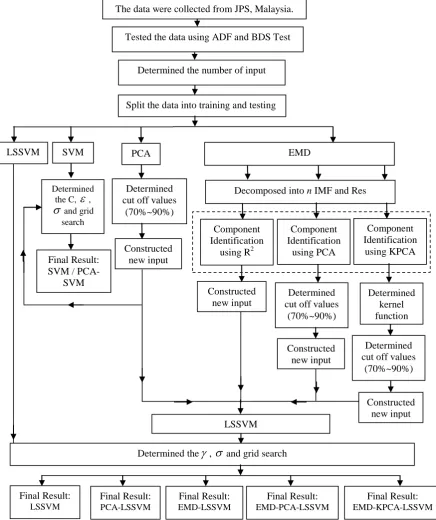
To achieve the set out objectives, this study was conducted by following the presented workflow in Figure 1.1.
Figure 1.1 : Research Framework
The data were collected from JPS, Malaysia.
Tested the data using ADF and BDS Test
Split the data into training and testing
LSSVM PCA
Determined the C, , and grid
search
Final Result: SVM /
PCA-SVM
Determined cut off values
(70%~90%)
Final Result: LSSVM
Decomposed into n IMF and Res
Constructed new input
LSSVM
Determined the , and grid search
Final Result: EMD-LSSVM
Determined cut off values
(70%~90%) Constructed new input Determined kernel function Determined cut off values
(70%~90%) Constructed new input Final Result: EMD-PCA-LSSVM Final Result: EMD-KPCA-LSSVM Component Identification using KPCA Component Identification using PCA Component Identification using R2 Determined the number of input
REFERENCES
Adeloye, A. J., F. Lallemand, (2003). Regression models for within-year capacity adjustment in reservoir planning. Hydrological Sciences Journal 48(4): 539-552
Adeloye, A. J., and Munari, A. D., (2006). Artificial neural network based generalized storage–yield–reliability models using the Levenberg– Marquardt algorithm. Journal of Hydrology. 362: 215-230.
Ahmad, S., Khan, I. H., and Parida, B. P. (2001). Performance Of Stochastic Approaches For Forecasting River Water Quality. Water Research (35): 4261-4266.
An, X., Jiang, D., Zhao, M., Liu, C. (2012). Short-time prediction of wind power using EMD and chaotic theory. Communications in Nonlinear Science and Numerical Simulation. 17(2): 1036–1042.
Agarwal, A., Mishra, S. K., Ram, S. Singh, J. K. (2006). Simulation of runoff and sediment yield using artificial neural networks. Biosystems Engineering. 94(4): 597-613.
Afshin, M., Sadeghian, A. and Raahemifar, K. (2007). On efficient tuning of LS-SVM hyper-parameters in short-term load forecasting: A comparative study. Proc. of the 2007 IEEE Power Engineering Society General Meeting
(IEEE-PES).
ASCE (2000). Artificial Neural Networks In Hydrology - II: Hydrologic Applications. Journal of Hydrologic Engineering. 5(2): 124-137
Asefa, T., Kemblowski, M., Mckee, M. and Khalil, A. (2006). Multi-time scale streamflow predictions: the support vector machines approach. Journal of hydrology. 318, 7-16.
Astel, A., Mazerski, J., Polkowska, Z., Namiesnik, J. (2004). Application of PCA and time series analysis in studies of precipitation in Tricity (Poland). Advances in Environmental Research. 8(3-4): 337-349.
Baseem, S. S. (2011). De-noising seismic data by Empirical Mode Decomposition. Master Thesis. Faculty of Mathematics and Natural Sciences. University of Oslo. Norway.
Batyrshin, I., Kacprzyk, J., Sheremetov, L., Zadeh, L. (2007). Perception-based Data Mining and Decision Making in Economics and Finance. Springer Berlin Heidelberg. 36: 119-134.
Birkinshaw S. J. , Parkin G., Rao, Z. (2008). A Hybrid Neural Networks And Numerical Models Approach For Predicting Groundwater Abstraction Impacts. Journal of Hydroinformatics. 127-137.
Bhagwat, P. P. and Maity, R. (2012). Multistep-Ahead River Flow Prediction Using LS-SVR at Daily Scale. Journal of Water Resource and Protection. 4: 528-539.
Bhagwat, P. P. and Maity, R. (2013). Hydroclimatic streamflow prediction using Least Square-Support Vector Regression. Journal of Hydraulic Engineering. 19(3): 320-328.
Bowerman, B. L. and R. T. O'Connell (1993). Forecasting and time series : An Applied Approach. California, Duxbury Press.
Box, G. E. P., Jenkins, G. M., and Reinsel, G. C. (2008). Time Series Analysis: Forecasting and Control. New Jersey: John Wiley Publication.
Cao, L. J., Chua, K. S., Chong, W. K., Lee, H. P., Gu, Q. M. (2003). A comparison of PCA, KPCA and ICA for dimensionality reduction in support vector machine. Neurocomputing. 55(1-2): 321-336
Cimen, M. and Kisi, O. (2009). Comparison of two different data-driven techniques in modeling lake level fluctuations in Turkey. Journal of Hydrology. 378: 253-262.
Chau, K.-W., Wang, W.-C., Cheng, C.-T., Qiu, L. (2009). A comparison of performance of several artificial intelligence methods for forecasting monthly discharge time series. Journal of Hydrology. 374(3-4): 294-306. Chen, Q., Xiaowei, C., Yun, W. (2008). The Combining Kernel Principal
Component Analysis with Support Vector Machines for Time Series Prediction Model. Second International Symposium on Intelligent Information Technology Application, 2008. 2:90-94.
Chen, M.-C., and Wei, Y., (2012). Forecasting the short-term metro passenger flow with empirical mode decomposition and neural networks. Transportation Research Part C. 21: 148-162
Chowdhury, A. R., Guhathakurta, K., Mukherjee, I. (2008). Empirical mode decomposition analysis of two different financial time series and their comparison. Chaos, Solitons and Fractals. 37: 1214–1227.
Choy, K. Y. and Chan, C. W., (2003). Modelling of river discharges and rainfall using radial basis function networks based on support vector regression. International Journal of Systems Science. 34(14-15): 763-773.
Chung, K. Y. C. (2010). Facial Expression Recognition by Using Class Mean Gabor Responses with Kernel Principal Component Analysis. Master Thesis. Russ Collage of Engineering and Technology, Ohio University. Ding, Z., Zhang, J., Xie, G. (2010). LS-SVM Forecast Model of Precipitation and
Runoff Based on EMD. Sixth International Conference on Natural Computation (ICNC 2010).
Deger, E. (2008). Noise-Thresholding with Empirical Mode Decomposition for Low Distortion Speech Enhancement. Master Thesis. Department of Information and Communication Engineering. University of Tokyo. Tokyo.
DeLurgio, S. A. (1998). Forecasting principles and applications. Boston: McGraw-Hill.
Deng, S. and Yeh, T.-H. (2010). Applying least squares support vector machines to the airframe wing-box structural design cost estimation. Expert Systems with Applications. 37(12): 8417-8423
Dibike, Y. B., Slavco, V., Solomatine, D. P., Abbott, M. B. (2001). Model Induction with Support Vector Machines: Introduction and Applications. Journal of Computing in Civil Engineering. 15(3): 208-216.
Dolling, O. R. and Varas, E. A. (2002). Artificial neural networks for streamflow prediction. Journal of Hydraulic Research. 40(5): 547-554.
Elshorbagy, A., Corzo, G., Srinivasalu, S., Solomantine, D. P. (2010a). Experimental investigation of the predictive capabilities of data driven modeling techniques in hydrology - Part 1: Concepts and methodology. Hydrology and Earth System Sciences. 14(10): 1931-1941.
Elshorbagy, A., Corzo, G., Srinivasalu, S., Solomantine, D. P. (2010b). Experimental investigation of the predictive capabilities of data driven modeling techniques in hydrology - Part 2: Application. Hydrology and Earth System Sciences. 14(10): 1943-1961.
Fauset, L. (1994). Fundamentals of Neural Networks Architectures, Algorithms And Applications. New Jersey: Prentice Hall
Fauvel, M., Chanussot, J., Benediktsson, J. A. (2006). Kernel Principal Component Analysis for Feature Reduction in Hyperspectrale Images Analysis. Proceedings of the 7th Nordic, Signal Processing Symposium, 2006.
NORSIG 2006. 238-241.
Flandrin, P. and P. Goncalves (2004). Empirical Mode Decompositions As Data-Driven Wavelet-Like Expansions. International Journal of Wavelets, Multiresolution and Information Processing. 2(4): 477-496.
Garen, D. C., (1992). Improved Techniques In Regression-Based Streamflow Volume Forecasting. Journal Water Resources Planning Manage. 118: 654-670.
Gestel, T. V., Suykens, J. A. K., (2001). Financial time series prediction using least squares support vector machines within the evidence framework. Neural Networks, IEEE Transactions. 12(4): 809-821.
Gencoglu, M. T. and Uyar, M. (2009). Prediction Of Flashover Voltage Of Insulators Using Least Squares Support Vector Machines. Expert Systems with Applications. 36(7): 10789-10798.
Grayson, R. B., I. D. Moore, McMahon, T. A. (1992). Physically based hydrologic modelling: Is the concept realistic. Water Resources Research. 28: 2659-2666.
Gu, Y., Liu, Y., Zhang, Y. (2008). A Selective KPCA Algorithm Based on High-Order Statistics for Anomaly Detection in Hyperspectral Imagery. IEEE Geoscience and Remote Sensing Letters. 5(1): 43-47.
Guo, X., Sun, X., Ma, J. (2011). Prediction of daily crop reference evapotranspiration (ET0) values through a least-squares support vector machine model. Hydrology Research. 42(4): 268-274.
Guhathakurta, P., Rajeevan, M., Thapliyan, V. (1999). Long Range Forecasting Indian Summer Monsoon Rainfall by a Hybrid Principal Component Neural Network Model. Meteorology and ATM Ospheric Physics. 71(3-4): 255-266. Hanbay, D. (2009). An expert system based on least square support vector machines
for diagnosis of valvular heart disease. Expert Systems with Applications. 36(4): 8368-8374.
Han, J. (2013). Network Traffic Anomaly Detection Using EMD and Hilbert-Huang Transform. Master Thesis. Department of Engineering and Technology. Western Carolina University.
Haykin, S. (1999). Neural Networks - A Comprehensive Foundation. 2nd. Prentice Hall.
Helena, B., Pardo, R., Vega, M., Barrado, E., Fernandez, J.M., Fernandez, L. (2000). Temporal evolution of groundwater composition in an alluvial aquifer (Pisuerga River, Spain) by principal component analysis. Water Research. 34(3): 807–816.
He, K., Lai, K.K., Yen, J. (2010). A hybrid slantlet denoising least squares support vector regression model for exchange rate prediction. Procedia Computer Science. 1(1): 2397–2405.
Hipel, K.W., and McLeod, A.I. (1994). Time Series Modelling of Water Resources and Environmental Systems. Elsevier, Amsterdam.
Hotelling, H. (1933). Analysis of a complex of statistical variables into principal components. Journal of Educational Psychology. (24): 417–441.
Hua, Z., Xu, X., Qi, Y. (2010). Forecasting demand of commodities after natural disasters. Expert Systems with Applications. 37: 4313-4317.
Huang, N. E., Shen, Z., Long, S. R., Wu, M. C., Shih, H. H., Zheng, Q., Yen, N. C., Tung, C. C., Liu, H. H. (1998). The Empirical Mode Decomposition and the Hilbert Spectrum for nonlinear and non-stationary time series analysis. Proceedings of the Royal Society of London A. (454): 903-995.
Huang, N. E., Wu, M. L., Qu, W., Long, S. R., Shen, S. S. P. (2003). Applications of Hilbert–Huang transform to non-stationary financial time series analysis. Appl. Stochastic Models Bus. Ind. 19: 245-268.
Huang, W., Bing, X.B., Hilton, A. (2004). Forecasting Flow In Apalachicola River Using Neural Networks. Hydrological Processes. 18: 2545-2564.
Huang, N. E. and Wu, Z. (2008). A review on Hilbert-Huang transform: Method and its applications to geophysical studies. Reviews of Geophysics. 46(2): RG2006.
Hsu, S. -H., Hsieh, J. J., P.-A., Chih, T. -C., Hsu, K.-C. (2009). A two-stage architecture for stock price forecasting by integrating self-organizing map and support vector regression. Expert Systems with Applications. 36(4): 7947-7951.
Jain, A. and A. M. Kumar (2007). Hybrid neural network models for hydrologic time series forecasting. Applied Soft Computing. 7(2): 585-592.
Jauhir, H ., Zain, M. S., Mustafa, Z. Khamis, A. (2001). Ramalan Kepekatan Oksigen Terlarut Menggunakan Analisis Siri Masa di Sungai Langat, Hulu Langat Selangor. Matematika 17(2): 77-87.
Jolliffe, I.T. (2002). Principal Components Analysis. Second Edition. New York. Springer.
John, S. T. and Christianini, N. (2004). Kernel Methods for Pattern Analysis. Cambridge University Press.
Kang, Y.W., Li, J., Cao, G.Y., Tu, H.Y., Li, J. Yang, J. (2008). Dynamic temperature modeling 10 of an SOFC using least square support vector machines. Journal of Power Sources. 179: 683-692.
Khan, M. S. and Coulibaly, P. (2006). Application of Support Vector Machine in Lake Water Level Prediction. Journal of Hydrologic Engineering. 11(3): 199-205.
Kisi, O. (2004). River flow modeling using artificial neural networks. Journal of Hydrologic Engineering. 9(1): 60-63.
Kisi, O. (2007). Streamflow forecasting using different artificial neural network algorithm. Journal of Hydrologic Engineering ASCE. 12(5): 532-539.
Kisi, O. (2008). River flow forecasting and estimation using different artificial neural network technique. Hydrology Research. 39(1): 27-40.
Kisi, O. and Cimen, M. (2011). A wavelet-support vector machine conjunction model for monthly streamflow forecasting. Journal of Hydrology. 399: 132-140.
Kisi, O. (2012). Modeling discharge-suspended sediment relationship using least square support vector machine. Journal of Hydrology. 456–457: 110–120. Kita, I., Yano, A., Nishiyama, S., Aqil, M. (2007). A comparative study of artificial
neural networks and neuro-fuzzy in continuous modeling of the daily and hourly behaviour of runoff. Journal of Hydrology. 337: 22-34.
Keskin, M. E. and Taylan, D. (2009). Artificial Models For Interbasin Flow Prediction In Southern Turkey. Journal of Hydrologic Engineering. 14(7): 752-758.
Knight, D. W. and Shamseldin, A. Y. (2006). River Basin Modelling for Flood Risk Mitigation. London, UK. Taylor & Francis.
Kuai, K. Z. and Tsai, C. W. (2012). Identification of varying time scales in sediment transport using the Hilbert–Huang Transform method. Journal of Hydrology. 420-421: 245-254.
Kuligowski, R. J., and Barros, A. P., (1998). Localized Precipitation Forecasts from a Numerical Weather Prediction Model Using Artificial Neural Networks. Weather and Forecasting. 13: 1194-1204.
Kumar, N. D. and L. Karthikeyan (2013). Predictability of nonstationary time series using wavelet and EMD based ARMA models. Journal of Hydrology. 502: 103–119.
Lee, J. M., Yoo, C. K., Choi, S. W., Peter A. V., Lee, I. B. (2004). Nonlinear process monitoring using kernel principal component analysis. Chemical Engineering Science. 59: 223-234.
Lee, T. and Ouarda, T. B. M. J. (2010). Long-term prediction of precipitation and hydrologic extremes with nonstationary oscillation processes. Journal of Geophysical Research. 115: D13107.
Lee, T. and Ouarda, T. B. M. J. (2012). Stochastic simulation of nonstationary oscillation hydroclimatic processes using empirical mode decomposition. Water Resources Research. 48(W02514).
Lehmann, A. and Rode, M. (2001). Long-Term Behaviour And Cross-Correlation Water Quality Analysis Of The River Elbe, Germany. Water Research 35(9): 2153-2160
Lin, G.-F. and Wu, M.-C. (2009). A Hybrid Neural Network Model for Typhoon-Rainfall Forecasting. Journal of Hydrology. 375(3-4), 450-458.
Lin, G. F., Chen, G. R., Huang, P. Y. and Chou, Y. C. (2009). Support vector
machine-based models for hourly reservoir inflow forecasting during typhoon-warning periods. Journal of Hydrology. 3(32): 17-29.
Lin, J. Y., Cheng, C. T., Chau, K. K. (2006). Using support vector machines for long-term discharge prediction. Hydrological Sciences Journal. 51(4): 599-612.
Lin, G. F., Chen, G. R., Huang, P. Y. (2010). Effective typhoon characteristics and their effects on hourly reservoir inflow forecasting. Advances in Water Resources. 33: 887-898.
Lin, T. Y., Lin, C. S., Chiu, S. H. (2012). Empirical mode decomposition–based least squares support vector regression for foreign exchange rate forecasting. Economic Modelling. 29: 2583-2590.
Liang, H., Bressler, S. L., Desimone, R., Fries, P. (2005). Empirical mode decomposition: a method for analyzing neural data. Neurocomputing. 65-66: 801-807.
Liong, S.Y., and Sivapragasam, C. (2002), Flood stage forecasting with support vector machines. Journal of American Water Resources. 38(1),173 -186. Liu, C. (2004). Gabor-Based Kernel PCA with Fractional Power Polynomial Models
Liu, Z., Wang, X., Cui, L., Lian, X., Xu, J. (2009). Research on Water Bloom Prediction Based on Least Squares Support Vector Machine. WRI World Congress on Computer Science and Information Engineering, 2009.
Lorenz, D.W and Delin, G.N., (2007). A regression model to estimate regional ground water recharge. Ground Water. 45: 196–208.
Luchetta, A. and S. Manetti (2003). A real time hydrological forecasting system using a fuzzy clustering approach. Computers and Geosciences. 29(9): 1111-1117.
Luk, K. C., Ball, J. E., Sharma, A. (2001). An application of artificial neural networks for rainfall forecasting. Mathematical and Computer Modelling. 33(6-7): 683-693.
Mamat, M. and Samad, S. A. (2010). Performance of Radial Basis Function and Support Vector Machine in time series forecasting. IEEE International Conference on Intelligent and Advanced Systems (ICIAS).
Maier, H. R. and Dandy, G. C. (2000). Neural networks for the prediction and forecasting of water resources variables: a review of modelling issues and applications. Environmental modelling and software. 15(1): 101-124.
Marhaba, T. F. and Bengraine, K. (2003). Using principal component analysis to monitor spatial and temporal changes in water quality. Journal of Hazardous Materials. B100: 179-195.
Maity, R., Bhagwat, P. P., Bhatnagar, A. (2010). Potential of support vector regression for prediction of monthly streamflow using endogenous property. Hydrological Processes. 24: 917–923.
McCuen, R.H. (1989). Hydrologic Analysis and Design. Printed Hall Inc. Englewood Cliff, New Jersey.
McMahon, T. A., Kiem, A. S., Peel, M. C., Jordan, P. W., Pegram, G. G. S. (2008). A New Approach to Stochastically Generating Six-Monthly Rainfall Sequences Based on Empirical Mode Decomposition. Journal of Hyrdometeorological. 9(6): 1377-1389.
Mishra, S., Choubey, V., Pandey, S. K., Shukla, J. P. (2014). An Efficient Approach of Support Vector Machine for Runoff Forecasting. International Journal of Scientific & Engineering Research. 5(3): 158-166.
Modarres, R. (2007). Streamflow drought time series forecasting. Stoch. Environ. Res. Risk Assess 21: 223-233.
Moldovan, D. (2010). Testing the efficiency of the Romanian stock market. Development, Energy, Environment, Economics. 378-381.
Muhamad, J. R. and J. N. Hassan (2005). Khabur River flow using artificial neural networks. Al-Rafidain Engineering. 13(2): 33-42.
Ni, J., Zhang, C., Ren, L., Yang, S. X. (2012a). Abrupt Event Monitoring for Water Environment System Based on KPCA and SVM. IEEE Transactions on Instrumentation and Measurement. 61(4): 980-989.
Ni, J., Ma, H., Ren, L. (2012b). A Time-series Forecasting Approach Based on KPCA-LSSVM for Lake Water Pollution. 9th International Conference on Fuzzy Systems and Knowledge Discovery (FSKD2012).
Nielsen, A. A. and Canty, M. J. (2008). Kernel principal component analysis for change detection. Image and Signal Processing for Remote Sensing XIV. 7109-7109.
Noakes, D. J., Mcleod, L. A., and Hipel, K. W. (1985). Forecasting monthly riverflow time series. International Journal of Forecasting: 179-190.
Noori, R., Abdoli, M. A. Ameri, A. Jalili, G. M. (2009). Prediction of municipal solid waste generation with combination of support vector machine and principal component analysis: A case study of Mashhad. Environmental Progress and Sustainable Energy. 28: (249-258).
Noori, R., Khakpour, A., Omidvar, B., Farokhnia, A. (2010). Comparison of ANN and Principal Component Analysis-Multivariate Linear Regression models for predicting the river flow based on developed discrepancy ratio statistic. Expert Systems with Applications. 37: 5850-5862.
Okkan, U. and Serbes, Z. A. (2012). Rainfall–runoff modeling using least squares support vector machines. Environmetrics. 23: 549-564.
Page, R. M., Lischeid, G., Epting, J., Huggenberger, P. (2012). Principal component analysis of time series for identifying indicator variables for riverine groundwater extraction management. Journal of Hydrology. 432-433: 137-144.
Panagiotidis, T. (2002). Testing the assumption of Linearity. Economics Bulletin. 3(29): 1-9.
Parinet, B., Lhote, A., Legube, B. (2004). Principal component analysis: an appropriate tool for water quality evaluation and management—application to a tropical lake system. Ecological Modelling. 178: 295-311.
Pearson, K. (1901). On lines and planes of closest fit to systems of points in space. Phil Mag. (6), 2, 559-572.
Plummer, E. A. (2000). Time series forecasting with feed-forward neural networks: Guidelines and limitations, Master Thesis. University of Wyoming.
Pinheiro, E., Postolache, O., Girao, P. (2012). Empirical Mode Decomposition and Principal Component Analysis implementation in processing non-invasive cardiovascular signals. Measurement. 45(2): 175-181.
Roadknight, C. M., Balls, G. R., Mills, G.E, Palmer-Brown, D. (1997). Modeling complex environmental data. IEEE Transactions on Neural Networks. 8(4): 852-862.
Rong, G., Shao, J. D., Lee, J. M. (2009). Learning a data-dependent kernel function for KPCA-based nonlinear process monitoring. Chemical Engineering Research and Design. 87: 1471-1480.
Rood, S. B., G. M. Samuelson, (2005). Twentieth-century decline in streamflows from the hydrographic apex of North America. Journal of Hydrology. 306: 215–233.
Sahai, A.K., Soman, M.K., Satyan V. (2000). All India Summer Monsoon Rainfall Prediction Using an Artificial Neural Network. Climate Dynamics. 16: 291-302.
Samsudin, R., P. Saad, Shabri, A. (2011). River flow time series using least squares support vector machines. Hydrology and Earth System Sciences. 15: 1835-1852.
Samui, P. (2011). Application of Least Square Support Vector Machine (LSSVM) for Determination of Evaporation Losses in Reservoirs. Scientific Research. 3(4): 431-434.
Sarma, P., Durlofsky, L. J., Aziz, K. (2008). Kernel Principal Component Analysis for Efficient, Differentiable Parameterization of Multipoint Geostatistics. Math Geoscience. 40: 3-32.
Schreider, S. Y., Jakeman, A. J., Dyer, B. G., Francis, R. I. (1997). A Combined Deterministic And Self-Adaptive Stochastic Algorithm For Streamflow Forecasting With Application To Catchments Of The Upper Murray Basin, Australia. Environmental Modelling and Software. 12(1): 93-104.
Scholkopf, B., Smola, A.J., Muller, K. (1998). Nonlinear Component Analysis as a Kernel Eigenvalue Problem. Neural Computation. 10: 1299-1319.
Scholkopf, B. and Smola, A.J. (2002). Learning with Kernels. MIT Press.
Seok, H. H., Dae, H. H., Joong, H. K. (2012). Forecasting Performance of LS-SVM for Nonlinear Hydrological Time Series. Water Engineering. 16(5): 870-882. Sivapragasam, C., Liong, S. Y., Pasha, M. F. K. (2001). Rainfall and runoff forecasting with SSA–SVM approach. Journal of Hydroinformatics. 3. 141-152.
Shabri, A. (2001). Comparision Of Time Series Forecasting Methods Using Neural Networks And Box-Jenkins Model. Matematika. 17(1): 1-6.
Sharda, R. (1994). Neural Networks for the MS/OR analyst: An application bibliography. Interfaces. 24(2): 116-130.
Shabri, A. and Suhartono, (2012). Streamflow forecasting using least-squares support vector machines. Hydrological Sciences Journal. 57(7): 1275-1293. Stathis, D. and Myronidis, D. (2009). Principal component analysis of precipitation
in Thessaly Region (Central Greece). Global NEST Journal. 11(4): 467-476. Sudheer, K. P., Gosain, A. K. Ramasastri, K. S. (2002). A data-driven algorithm for
constructing artificial neural network rainfall-runoff models. Hydrological Processes. 16: 1325-1330.
Suykens J.A.K. and Vandewalle, J. (1999). Least squares support vector machine classifiers. Neural Processing Letter. 9(3): 293-300.
Tan, C. N. W. and Wittig, G. E. (1993). A study of the parameters of a backpropagation stock price prediction model. The First New Zealand International Two Stream Conference on Artificial Neural Networks and
Expert Systems (ANNES. University of Otago, Dunedin, New Zealand, IEEE Computer Society Press.
Tang, B., Dong, S., Song, T. (2012). Method for eliminating mode mixing of empirical mode decomposition based on the revised blind source separation. Signal Processing. 92(1): 248–258.
Tay, F. E. H., and Cao, L. J. (2001). Improved Financial Time Series Forecasting By Combining Support Vector Machines with Self-Organizing Feature Map. Intelligent Data Analysis. 5. 339–354.
Theodoridis, S. and Koutroumbas, K. (2009). Pattern Recognition. 4th Edition. Academic Press.
Twining, C. J. and Taylor, C. J. (2003). The use of kernel principal component analysis to model data distributions. Pattern Recognition. 36: 217-227. Vapnik., V. (1995). The Nature of Statistical Learning Theory.New York: Springer. Viessman, W. J., and Lewis, G. L.(1989). Introduction To Hydrology. Singapore:
Harper and Row.
Wang, H. and Hu, D. (2005). Comparison of SVM and LSSVM for Regression. International Conference on Neural Networks And Brain, 2005. 1: 279-283. Wang, W., Gelder, P. H. A. J. M. V., Vrijling, J. K., Ma, J. (2006). Forecasting
Daily Streamflow Using Hybrid Ann Models. Journal of Hydrology. 324 (1-4):383-399.
Wang, W. (2006). Stochasticity, nonlinearity and forecasting of streamflow processes. IOS Press.
Wang, W.-C., K.-W. Chau, (2009a). A comparison of performance of several artificial intelligence methods for forecasting monthly discharge time series. Journal of Hydrology. 374(3-4): 294-306.
Wang, S., Zhang, X., Yu, L., Lai, K. L. (2009b). Estimating the impact of extreme events on crude oil price: An EMD-based event analysis method. Energy Economics. 31: 768–778.
Wang, S., Yu, L., Tang, L., Wang, S. (2011). A novel seasonal decomposition based least squares support vector regression ensemble learning approach for hydropower consumption forecasting in China. Energy. 36: 6542-6554. Wu, C. L., K. W. Chau, et al. (2008). River stage prediction based on a distributed
support vector regression. Journal of Hydrology. 358(1-2): 96-111.
Wu, C. L., Chau, K. W., Li, Y. S. (2009). Methods to improve neural network performance in daily flows prediction. Journal of Hydrology. 372(1-4): 80-93.
Wu, C. L. (2010). Hydrological Predictions Using Data-Driven Models Coupled with Data Preprocessing Techniques. PhD Thesis. The Hong Kong Polytechnic University.
Wu, C. L., Chau, K. W., Fan, C. (2010a). Prediction of rainfall time series using modular artificial neural networks coupled with data-preprocessing techniques. Journal of Hydrology. 389(1-2): 146-167.
Wu, C. L. and Chau, K. W. (2010b). Data-Driven Models for Monthly Streamflow time series prediction. Engineering Applications of Artificial Intelligence. 23: 1350-1367.
Xu, Y., Yang, J. Y., Lu, J. F. (2005). An efficient kernel-based nonlinear regression method for two-class classification. Proceedings of the 2005 International Conference on Machine Learning and Cybernetics. 4442 4445.
Xu, Y., Zhang, D., Song, F., Yang, J. Y., Jing, Z., Li, M. (2007). A method for speeding up feature extraction based on KPCA. Neurocomputing. 70: 1056-1061.
Xu, W., Kuang, F., Zhang, S., Wang, Y., Liu, K. (2012). A Novel Approach of KPCA and SVM for Intrusion Detection. Journal of Computational Information Systems. 8(8): 3237-3244.
Ye, J. and T. Xiong (2007). SVM versus Least Squares SVM. The 11th International Conference on Artificial Intelligence and Statistics (AISTATS).640-647. Yeh, C. C., Chen, C. F., Lai, M. C. (2012). Forecasting tourism demand based on
empirical mode decomposition and neural network. Knowledge-Based Systems. 26: 281–287.
Yu, X. and Liong, S.-Y. (2007). Forecasting of hydrologic time series with ridge regression in feature space. Journal of Hydrology. 332(3-4): 290-302
Yu, L., Wang, S. Y., Lai, K., (2008). An EMD-Based Neural Network Ensemble Learning Model for World Crude Oil Spot Price Forecasting. Soft Computing Applications in Business. 230: 261-271.
Yunrong, X. and Liangzhong, J. (2009). Water Quality Prediction Using LS-SVM And Particle Swarm Optimization. Second International Workshop on Knowledge Discovery And Data Mining, 900-904.
Zhang, Y. (1992). Prediction Of Traffic Fluctuation In Telephone Networks With Neural Networks. IEEE. 909-912.
Zhang, G., Eddy, P. B., Michael, Y. H. (1998). Forecasting with artificial neural networks: The state of the art. International Journal of Forecasting. 14(1): 35-62.
Zhang, G. P. (2003). Time Series Forecasting Using A Hybrid ARIMA And Neural Network Model. Neurocomputing, 50: 159-175.
Zhang, Y., Li, Z., Zhou, H. (2010). Statistical analysis and adaptive technique for dynamical process monitoring. Chemical Engineering Research and Design. 88(10): 1381-1392.
Zhao, Y., Dong, Z., Li, Q. (2012). Application Study of Least Squares Support Vector Machines in Streamflow Forecast. Applied Mechanics and Materials. 212-213: 436-440.
Zhou, W., S. Li, (2013). Feature extraction and recognition of ictal EEG using EMD and SVM. Computers in Biology and Medicine. 43: 807-816.
Zhu, Y., and Day, R. L., (2009). Regression modelling of streamflow, baseflow, and runoff using geographic information systems. Journal of Environmental Management. 90: 946–953.