Research
Doula support compared with standard care
Meta-analysis of the effects on the rate of medical interventions during
labour for low-risk women delivering at term
Jacqueline H. Fortier
MScMarshall Godwin
MD MSc CCFP FCFPAbstract
Objective To determine the effect of support provided by doulas on the rate of medical interventions during labour for low-risk women intending to deliver vaginally at term.
Data sources Comprehensive searches of the MEDLINE, EMBASE, and CINAHL databases were undertaken using the search terms labour support and doula.
Study selection Randomized controlled trials evaluating the use of trained doulas for medical interventions during labour were selected and evaluated for methodologic quality. Articles of adequate quality were included in the synthesis. The outcomes of interest were rates of cesarean section, instrumental vaginal delivery, the use of oxytocin, and epidural anesthesia.
Synthesis Outcomes were synthesized to determine overall odds ratios for relevant outcomes. Sensitivity analysis using only studies with high methodologic quality was completed, and publication bias was assessed. The presence and support of a trained doula reduced the odds of delivery by cesarean section and instrumental vaginal delivery. No significant effect was seen for the use of epidural anesthesia or the rates of oxytocin use. There was considerable heterogeneity among the studies.
Conclusion Trained doulas help to reduce the odds of certain medical interventions during labour for low-risk women
delivering at term.
EDITOR’S KEY POINTS
• Previous work has shown that continuousphysical and emotional support for women in labour is associated with fewer medical interventions and a slightly shorter duration of labour, among other clinically relevant outcomes. Doulas are increasingly being used to provide emotional and physical support to women and their partners during pregnancy, childbirth, and the postpartum period, including continuous support throughout labour and delivery. This study aimed to assess the effects of such support provided by doulas on the rate of medical interventions during low-risk labour.
• The authors found that the presence of a trained doula reduced the odds of cesarean section (odds ratio 0.68, 95% CI 0.47 to 0.99,
P = .04) and instrumental vaginal delivery (odds
ratio 0.54, 95% CI 0.35 to 0.92, P = .02) compared with women receiving standard maternity care. The presence of a doula did not have a significant effect on the use of epidural anesthesia or on the use of oxytocin to augment labour.
This article has been peer reviewed. Can Fam Physician 2015;61:e284-92
Accouchement standard ou
assisté d’une doula : une comparaison
Méta-analyse des effets sur le taux d’interventions médicales au cours du
travail pour des femmes accouchant à terme
Jacqueline H. Fortier
MScMarshall Godwin
MD MSc CCFP FCFPRésumé
Objectif Déterminer l’effet du soutien fourni par les doulas sur le taux d’interventions médicales durant le travail chez des femmes à faible risque qui ont l’intention d’accoucher à terme par voie vaginale.
Sources des données On a effectué une recherche extensive dans les banques de données MEDLINE, EMBASE et CINAHL à l’aide des rubriques labour support et doula.
Choix des études Les essais randomisés évaluant l’effet du soutien de doulas qualifiées sur le taux d’interventions médicales durant le travail ont été retenus et évalués pour la qualité de leur méthodologie. Les articles de qualité adéquate ont été utilisés pour la synthèse. Les issues d’intérêt étaient les taux de césariennes, d’accouchements vaginaux assistés, l’utilisation d’ocytocine et d’anesthésie épidurale.
Synthèse On a comparé les résultats pour établir les rapports de cotes pour les issues pertinentes. Une analyse de sensibilité a été effectuée en utilisant seulement les études qui avaient une méthodologie de grande qualité; on a également vérifié les biais de publication. La présence et le soutien d’une doula qualifiée ont diminué la probabilité de césarienne et d’accouchement assisté. Il n’y avait pas d’effet significatif sur l’utilisation de l’anesthésie épidurale ou de l’ocytocine. On a noté une hétérogénéité importante entre les études.
Conclusion Les doulas qualifiées contribuent à diminuer la probabilité de certaines interventions médicales au cours du travail chez des femmes à faible risque qui accouchent à terme.
POINTS DE REPèRE Du RéDacTEuR
• Des études antérieures ont montré que les femmes qui bénéficient d’une assistance physique et émotionnelle continue durant le travail ont, entre autres effets cliniques pertinents, moins d’interventions médicales et un travail légèrement plus court. On fait de plus en plus appel à des doulas pour fournir aux femmes et à leurs conjoints une assistance émotionnelle et physique durant la grossesse, au moment de la naissance et durant le postpartum, incluant un soutien continu durant le travail et l’accouchement. Cette étude voulait évaluer les effets du soutien d’une doula sur le taux d’interventions médicales au cours d’un travail présentant peu de risque.
• Les auteurs ont observé que la présence d’une doula qualifiée réduisait la probabilité d’une césarienne (rapport de cotes 0,68, IC à 95 % 0,47 à 0,99, P = ,04) et d’un accouchement
vaginal assisté (rapport de cotes 0,54, IC à 95 % 0,35 à 0,92, P = ,02) par rapport aux femmes
qui reçoivent des soins de maternité standards. La présence d’une doula n’avait toutefois pas d’effet significatif sur l’utilisation d’une anesthésie épidurale ou sur l’emploi d’ocytocine pour accélérer le travail.
Cet article a fait l’objet d’une révision par des pairs.
Research |
Doula support compared with standard care
C
hildbirth can be a time of excitement and anxiety, and many women and their partners are nervous when labour approaches. A Cochrane review concluded that continuous physical and emotional sup-port for women in labour was associated with fewer medical interventions and a slightly shorter duration of labour, among other clinically relevant outcomes.1 That review included any continuous support, not just that offered by trained doulas.Traditionally, women in many cultures have been supported by female companions during their labour.1,2 In the contemporary hospital setting, support has pri-marily been provided by a woman’s partner or a family member, and by the nurses responsible for the woman’s care. The role of nurse as supporter is considered both effective and valuable by patients,3 but studies suggest that even with ideal 1-to-1 staffing ratios nurses are able to devote only a small percentage of their time to providing supportive care.4,5 With their many responsi-bilities in providing intrapartum care, it is almost impos-sible for nurses to provide continuous support to women and their partners in a typical obstetric ward.6
To complement the support provided by hospital staff and family, labouring women increasingly choose to avail themselves of the services of doulas.1,7 Doulas are trained to provide emotional and physical support to women and their partners during pregnancy, childbirth, and the postpartum period, including continuous sup-port throughout labour and delivery.1 Although some doulas might have a background in nursing or mid-wifery, many are lay women without previous training in health care, and the profession is generally unregu-lated.7 Some but not all doulas have formal training in labour support techniques,7 and professional organiza-tions such as the Doulas of North America have mem-bership requirements for certification.8
Our objective was to examine the effects of the con-tinuous support provided by doulas on the method of delivery, use of epidural anesthesia, and use of oxytocin during labour when compared with women receiving standard maternity care. Our population of interest was low-risk women intending a vaginal delivery at term.
DaTa SOuRcES
We performed literature searches of MEDLINE, CINAHL, and EMBASE using the key words doula and labour sup-port. Searches were restricted to peer-reviewed jour-nal articles with abstracts available. For MEDLINE, the search was limited to clinical trials. The references for relevant systematic reviews and meta-analyses were hand searched to identify additional trials.
We included randomized controlled trials that eval-uated the effect of the continuous support of trained
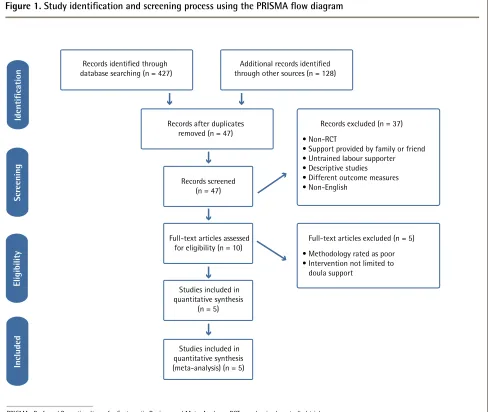
doulas for women delivering at term on the outcomes of cesarean section, instrumental vaginal delivery, use of epidural anesthesia, and use of oxytocin. Figure 1 details the process of choosing the final articles included in the analysis. A total of 555 records were reviewed, yielding 47 relevant studies.9 Of these, 37 were excluded in the initial screening phase because support was pro-vided by a relative, a friend, or an untrained supporter; they evaluated different outcomes; the study was not in English; descriptive or qualitative outcome measures were used; or the study employed a methodology other than a randomized controlled trial. It should be noted that all of the non-English articles met additional crite-ria for exclusion (eg, support from family member, very poor methodologic quality); in the event that a high-quality, relevant non-English article had been identified, translation would have been sought.
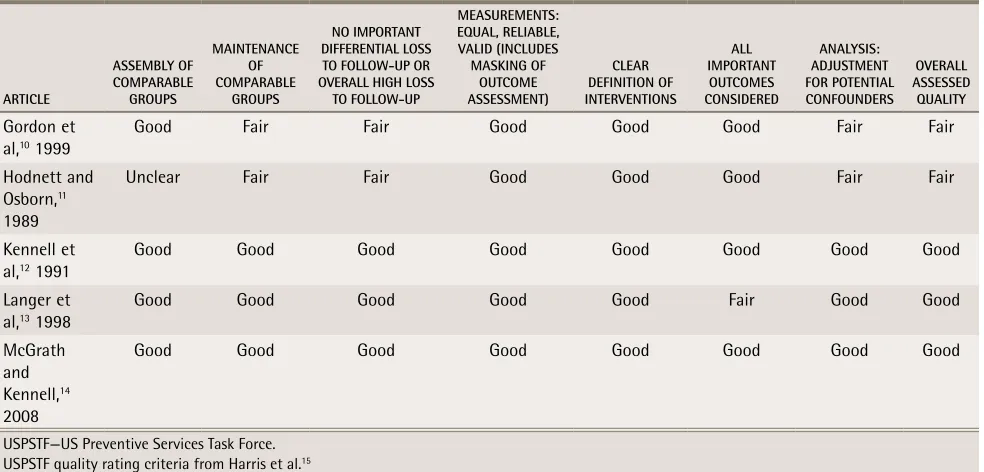
The 10 remaining studies were independently assessed for quality and eligibility by both authors using the US Preventive Services Task Force quality rating criteria; Table 1 outlines the ratings for the included studies.10-15 These criteria were developed by experts in primary care as a means of assessing the quality of published articles in 7 areas, with articles being rated as good, fair, or poor overall. Discrepancies in assess-ment between the authors were discussed and consen-sus was reached. Of the articles assessed for eligibility, 5 were rated good or fair and were included in the quan-titative synthesis.10-14 Among the articles excluded from the synthesis, 1 was rated as having poor methodo-logic quality,16 1 was reporting outcomes from a trial already included in the synthesis,17 1 provided additional comfort measures alongside the continuous labour sup-port,18 and 2 required the nurses to provide both intra-partum care and continuous labour support with the potential for a change in support when the nurse’s shift ended19,20 (Table 2).16-20 In the latter 2 instances, it was decided that the interventions were sufficiently differ-ent from the type of labour support intervdiffer-ention in the pooled articles that they must be excluded.
SYNThESIS
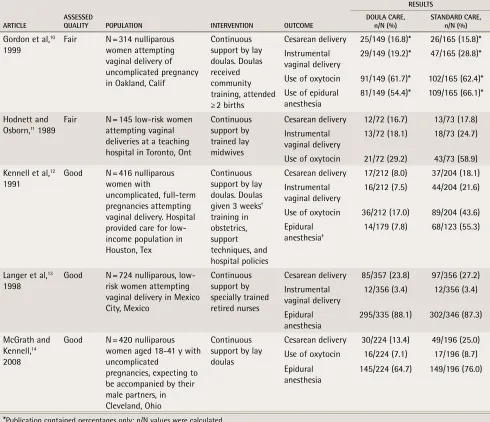
Table 3 outlines the populations, interventions, and outcomes of articles included in the meta-analysis.10-14 The meta-analysis was performed using Comprehensive Meta-Analysis and RevMan 5 software.21,22 Between 4 and 5 studies were pooled for each outcome measure, and a random effects model was used. Sensitivity anal-ysis using only articles with a methodologic rating of good was conducted for the outcomes of cesarean sec-tion and epidural anesthesia.
0.47 to 0.99, P = .04) and the rate of instrumental vagi-nal delivery (OR 0.54, 95% CI 0.35 to 0.92, P = .02). Other outcomes did not quite achieve statistical significance, specifically epidural anesthesia (OR 0.41, 95% CI 0.16 to 1.09, P = .07) and use of oxytocin (OR 0.49, 95% CI 0.24 to 1.02, P = .06) in the doula care groups (Figure 2).10-14
Sensitivity analysis using only studies with method-ology rated as good showed similar effects for epidural anesthesia (OR 0.36, 95% CI 0.09 to 1.45, P = .15) and cesarean delivery (OR 0.63, 95% CI 0.49 to 0.81, P < .001). Sensitivity analysis was not performed for the outcomes of instrumental vaginal delivery or use of oxytocin, as only 2 articles with methodology rated as good mea-sured the outcome in each category, and pooling was not appropriate.
There was significant heterogeneity observed in all analyses in the synthesis (Figure 2).10-14 For Cochran Q,
a statistic used for testing for the presence or absence of heterogeneity due to random error among studies, the P values were P < .1 for all outcomes, indicating sig-nificant heterogeneity at α = .10. Given the small number of studies included in our synthesis, we also calculated I2, a measure of the percent variability in a pooled set of studies that has greater statistical power with fewer studies. The I2 values ranged from approximately 52% to 94%, indicating a large amount of heterogeneity that was not attributable to random error.
Potential publication bias was assessed by visual inspection of funnel plots and calculation of classic fail-safe N values (Figure 3). Visual inspection of the funnel plots did not indicate publication bias for cesarean sec-tions or instrumental deliveries, but the results were less clear for the outcomes of epidural anesthesia and use of oxytocin. Fail-safe N values were such that at least 8
Figure 1.
Study identification and screening process using the PRISMA flow diagram
Additional records identified through other sources (n = 128) Records identified through
database searching (n = 427)
Records after duplicates
removed (n = 47) Records excluded (n = 37) • Non-RCT
• Support provided by family or friend • Untrained labour supporter • Descriptive studies • Different outcome measures • Non-English
Records screened (n = 47)
Full-text articles assessed for eligibility (n = 10)
Studies included in quantitative synthesis
(n = 5)
Studies included in quantitative synthesis (meta-analysis) (n = 5)
Full-text articles excluded (n = 5) • Methodology rated as poor • Intervention not limited to doula support
PRISMA—Preferred Reporting Items for Systematic Reviews and Meta-Analyses, RCT—randomized controlled trial. PRISMA structure from Moher et al.9
Identification
Scr
eening
Eligibility
Research |
Doula support compared with standard care
unpublished, extant studies with null results would have to exist to invalidate our results.
DIScuSSION
Continuous support during labour has been shown to be beneficial whether provided by a woman’s partner, a family member or close friend, or a dedicated member of the clinical team providing intrapartum care.1 The pres-ence of a trained doula providing continuous support to labouring women and their partners appears to have a significant effect on rates of instrumental vaginal deliver-ies and cesarean sections.
Given the nature of the intervention and the diver-sity of the study populations, the observed degree of heterogeneity was not unexpected. Study populations ranged from women labouring in a public hospital in Mexico,13 to middle-income couples at a university health centre in Cleveland, Ohio,14 to young women of lower socioeconomic status giving birth without any family support at a hospital in Houston, Tex.12 Age, income, education level, the presence of a
part-ner or other family support, and standard hospital procedures varied substanitally among trials, and the effect of these variables should be noted. The nature of doula care as an intervention would also intro-duce some heterogeneity; training for doulas might vary between studies, and almost certainly the com-fort techniques used by a doula would be dictated by the needs of the individual woman in labour. In spite of this heterogeneity, women provided with trained doulas have significantly lower rates of cesarean sec-tion and instrumental vaginal delivery compared with women given standard care.
Our tests for publication bias did not generate any clear evidence of studies missing from the literature. The fail-safe N tests indicate that for those outcomes in which a statistically significant result was shown, there would need to be 8 or 9 studies with null results in order to invalidate our findings, a considerable number given that our analysis includes just 5 stud-ies. We did not attempt more sophisticated measures of publication bias, such as Begg and Mazumdar rank correlation or Egger regression intercept, as both of these tests have limited statistical power when a small number of studies are pooled.
Table 2.
Rationale for exclusion of studies assessed for
eligibility but excluded from the quantitative synthesis
ARTICLE REASON FOR EXCLUSION
Gagnon et al,19
1997 Intervention: Nurses providing support also responsible for intrapartum care and might hand care off to another nurse at the end of shift Trueba et al,16
2000
Methodology: Poor. Incomplete collection of demographic information so comparability of groups could not be established
Kashanian et al,18 2010
Intervention: Patients receiving doula care were given a private room; allowed to walk, eat, and choose different positions in which to labour; and given education about labour
Hodnett and Osborn,17 1989
Duplication: This is a publication of different outcomes of a study already included in our synthesis (Hodnett and Osborn11)
Hodnett et al,20 2002
Intervention: Nurses providing support also responsible for intrapartum care and handed care off to another nurse at the end of shift
Table 1.
Assessment of studies selected for inclusion in the synthesis using USPSTF quality rating criteria
ARTICLE
ASSEMBLY OF COMPARABLE
GROUPS
MAINTENANCE OF COMPARABLE
GROUPS
NO IMPORTANT DIFFERENTIAL LOSS TO FOLLOW-UP OR OVERALL HIGH LOSS
TO FOLLOW-UP
MEASUREMENTS: EQUAL, RELIABLE, VALID (INCLUDES MASKING OF
OUTCOME ASSESSMENT)
CLEAR DEFINITION OF INTERVENTIONS
ALL IMPORTANT
OUTCOMES CONSIDERED
ANALYSIS: ADJUSTMENT FOR POTENTIAL CONFOUNDERS
OVERALL ASSESSED QUALITY
Gordon et al,10 1999
Good Fair Fair Good Good Good Fair Fair
Hodnett and Osborn,11
1989
Unclear Fair Fair Good Good Good Fair Fair
Kennell et al,12 1991
Good Good Good Good Good Good Good Good
Langer et al,13 1998
Good Good Good Good Good Fair Good Good
McGrath and Kennell,14
2008
Good Good Good Good Good Good Good Good
Limitations and areas for further study
It must be noted that the population and context of 2 of the studies included in the synthesis, representing more than half of the pooled study population, do not much resemble the experience of most Canadian women and might have limited generalizability. The studies by Kennell et al12 and Langer et al13 involved young, low-income women permitted little or no familial support in very different settings than would be found in mod-ern Canadian obstetric units. We suggest that although the typical Canadian woman is unlikely to find herself labouring with no family support in a 12-bed hospi-tal ward (as was the case in Kennell and colleagues’ study), many women might have less than adequate support from their partners or families. In these cases, external support provided by a trained doula could be
extremely valuable. The significant reduction in the rate of cesarean section and instrumental vaginal delivery in populations that were so variable in their demographic characteristics, socioeconomic status, and levels of sup-port suggests that most women might derive at least some benefit from doula support.
The small number of studies included in the synthesis precluded the use of subgroup analysis, but we hypoth-esize that doulas with previous training in nursing or midwifery might differ in the way their support is asso-ciated with the rate of medical interventions. A recent study suggests that “nurses’ attitudes [are] influenced by workplace exposure to other care providers’ birth prac-tices,”23 and it is not unreasonable to suggest that doulas with backgrounds in nursing might have different per-spectives than lay doulas with respect to interventions
Table 3.
Description of populations, interventions, and outcomes of articles included in meta-analysis
ARTICLE ASSESSED QUALITY POPULATION INTERVENTION OUTCOME
RESULTS DOULA CARE,
n/N (%) STANDARD CARE, n/N (%)
Gordon et al,10
1999
Fair N = 314 nulliparous women attempting vaginal delivery of uncomplicated pregnancy in Oakland, Calif
Continuous support by lay doulas. Doulas received community training, attended ≥ 2 births
Cesarean delivery 25/149 (16.8)* 26/165 (15.8)* Instrumental
vaginal delivery
29/149 (19.2)* 47/165 (28.8)*
Use of oxytocin 91/149 (61.7)* 102/165 (62.4)* Use of epidural
anesthesia
81/149 (54.4)* 109/165 (66.1)*
Hodnett and Osborn,11 1989
Fair N = 145 low-risk women attempting vaginal deliveries at a teaching hospital in Toronto, Ont
Continuous support by trained lay midwives
Cesarean delivery 12/72 (16.7) 13/73 (17.8) Instrumental
vaginal delivery 13/72 (18.1) 18/73 (24.7) Use of oxytocin 21/72 (29.2) 43/73 (58.9) Kennell et al,12
1991 Good N = 416 nulliparous women with uncomplicated, full-term pregnancies attempting vaginal delivery. Hospital provided care for low-income population in Houston, Tex
Continuous support by lay doulas. Doulas given 3 weeks’ training in obstetrics, support techniques, and hospital policies
Cesarean delivery 17/212 (8.0) 37/204 (18.1) Instrumental
vaginal delivery
16/212 (7.5) 44/204 (21.6)
Use of oxytocin 36/212 (17.0) 89/204 (43.6) Epidural
anesthesia†
14/179 (7.8) 68/123 (55.3)
Langer et al,13
1998
Good N = 724 nulliparous, low-risk women attempting vaginal delivery in Mexico City, Mexico
Continuous support by specially trained retired nurses
Cesarean delivery 85/357 (23.8) 97/356 (27.2) Instrumental
vaginal delivery
12/356 (3.4) 12/356 (3.4)
Epidural anesthesia
295/335 (88.1) 302/346 (87.3)
McGrath and Kennell,14
2008
Good N = 420 nulliparous women aged 18-41 y with uncomplicated
pregnancies, expecting to be accompanied by their male partners, in Cleveland, Ohio
Continuous support by lay doulas
Cesarean delivery 30/224 (13.4) 49/196 (25.0) Use of oxytocin 16/224 (7.1) 17/196 (8.7) Epidural
anesthesia 145/224 (64.7) 149/196 (76.0)
*Publication contained percentages only; n/N values were calculated.
Research |
Doula support compared with standard care
Figure 2.
Forest plots and measures of heterogeneity for trials of doula care versus standard care among low-risk
women attempting vaginal delivery at term:
A) Cesarean delivery. B) Instrumental vaginal delivery. C) Use of
epi-dural anesthesia. D) Use of oxytocin.
*Using Mantel-Haenszel test under the random effects model.
STUDY
DOULA CARE STANDARD CARE WEIGHT,
% ODDS RATIO* (95% CI) ODDS RATIO,* 95% CI
EVENTS TOTAL EVENTS TOTAL
Hodnett and Osborn,11 1989
12 72 13 73 12.5 0.92 (0.39-2.19)
Kennell et al,12 1991 17 212 37 204 18.5 0.39 (0.21-0.72)
Langer et al,13 1998 85 357 97 356 28.1 0.83 (0.60-1.17)
Gordon et al,10
1999
25 149 26 165 18.9 1.08 (0.59-1.96)
McGrath and Kennell,14 2008
30 224 49 196 22.0 0.46 (0.28-0.77)
Total 1014 994 100.0 0.68 (0.47-0.99) Total events 169 222
Heterogeneity: τ = 0.10; χ2
4 = 9.43, P = .05; I2 = 58%
Test for overall effect: Z = 2.03, P = .04 Favours doula care Favours standard care A) Cesarean section
0.01 0.1 1 10 100
0.01 0.1 1 10 100
Favours doula care Favours standard care
B) Instrumental vaginal delivery
STUDY
DOULA CARE STANDARD CARE WEIGHT,
% ODDS RATIO* (95% CI) ODDS RATIO,* 95% CI
EVENTS TOTAL EVENTS TOTAL
Gordon et al,10 1999 29 149 47 165 30.8 0.61 (0.36-1.03)
Hodnett and Osborn,11 1989
13 72 18 73 21.0 0.67 (0.30-1.50)
Kennell et al,12 1991 16 212 44 204 27.5 0.30 (0.16-0.55)
Langer et al,13 1998 12 356 12 356 20.7 1.00 (0.44-0.92)
Total 789 798 100.0 0.56 (0.35-0.92) Total events 70 121
Heterogeneity: τ = 0.13; χ2
3 = 6.39, P = .09; I2 = 53%
Test for overall effect: Z = 2.28, P = .02
0.01 0.1 1 10 100
0.01 0.1 1 10 100
C) Epidural anesthesia
STUDY
DOULA CARE STANDARD CARE WEIGHT,
% ODDS RATIO* (95% CI) ODDS RATIO,* 95% CI
EVENTS TOTAL EVENTS TOTAL
Gordon et al,10
1999 81 149 109 165 25.3 0.61 (0.39-0.97) Kennell et al,12
1991 14 179 68 123 23.9 0.07 (0.04-0.13) Langer et al,13
1998 295 335 302 346 25.3 1.07 (0.68-1.70) McGrath and
Kennell,14 2008
145 224 149 196 25.5 0.58 (0.38-0.89)
Total 887 830 100.0 0.41 (0.16-1.09) Total events 535 628
Heterogeneity: τ = 0.92; χ2
3= 47.82, P < .001; I2 = 94%
Test for overall effect: Z = 1.79, P = .07 Favours doula care Favours standard care
0.01 0.1 1 10 100
0.01 0.1 1 10 100
D) Use of oxytocin
STUDY
DOULA CARE STANDARD CARE WEIGHT,
% ODDS RATIO* (95% CI) ODDS RATIO,* 95% CI
EVENTS TOTAL EVENTS TOTAL
Gordon et al,10
1999
92 149 103 165 26.7 0.97 (0.62-1.53)
Hodnett and Osborn,11 1989
21 72 43 73 23.5 0.29 (0.14-0.57)
Kennell et al,12
1991
36 212 89 204 26.7 0.26 (0.17-0.42)
McGrath and Kennell,14 2008
16 224 17 196 23.1 0.81 (0.40-1.65)
Total 657 638 100.0 0.49 (0.24-1.02) Total events 165 252
Heterogeneity: τ = 0.45; χ2
3 = 19.99, P = .0002; I2 = 85%
Test for overall effect: Z = 1.91, P = .06 Favours doula care Favours standard care
0.01 0.1 1 10 100
Figure 3.
Funnel plots: A) Cesarean section. B) Instrumental vaginal delivery. C) Use of epidural anesthesia. D) Use of
oxytocin. Classic fail-safe N value is the number of studies with a null result that would be needed to show no effect in
the synthesis for given outcomes.
0.5
-2.0 0.4 0.3 0.2 0.1 0.0
-1.5 -1.0 -0.5 0.0 0.5 1.0 1.5 2.0
ST
ANDARD ERROR
LOG ODDS RATIO
Classic fail-safe N=8 A) Cesarean section
0.5
-2.0 0.4 0.3 0.2 0.1 0.0
-1.5 -1.0 -0.5 0.0 0.5 1.0 1.5 2.0
ST
ANDARD ERROR
LOG ODDS RATIO
Classic fail-safe N=9 B) Instrumental vaginal delivery
-3 0.4 0.3 0.2 0.1 0.0
-2 -1 0 1 2 3
ST
ANDARD ERROR
LOG ODDS RATIO
Classic fail-safe N=36 C) Epidural anesthesia
-2.0 0.4 0.3 0.2 0.1 0.0
-1.5 -1.0 -0.5 0.0 0.5 1.0
ST
ANDARD ERROR
LOG ODDS RATIO
Classic fail-safe N=23 D) Use of oxytocin
Research |
Doula support compared with standard care
during labour. Although it is outside any doula’s scope of practice to provide medical advice to labouring women, a doula’s past experiences will almost inevitably affect the way potential labour interventions are discussed. Further study into the role that a doula’s previous train-ing might play in the efficacy of the support she provides to women in labour would be a valuable addition to the current literature.
Although there is an established body of evidence describing the benefits of continuous support for women during labour, some caregivers might not be entirely comfortable with a doula in the delivery room. Cross-sectional studies of Canadian providers of maternity care—including family physicians, midwives, obstetri-cians, and nurses—indicate varying levels of support for the presence of doulas. Roughly half of obstetricians and a quarter of nurses and family physicians had unfa-vourable attitudes toward doula care, which contrasts with the generally positive attitudes reported by regis-tered midwives.24 Women are more frequently choosing to be accompanied by a doula during their labour,25 and doulas will continue to be a relatively common pres-ence on maternity wards. It is important that doulas and clinical caregivers work collaboratively and within their respective scopes of practice to provide women with safe birth experiences in which they feel empow-ered to make informed decisions about their care with the support of their clinical care team and doula. Given the number of studies describing the positive effects of doula support for low-risk women attempting vagi-nal delivery, physicians providing maternity care might consider recommending the services of a trained doula to patients during their pregnancy. Such recommenda-tions might be particularly appropriate for patients who have a strong desire for fewer interventions during their labour, and for patients who might need additional sup-port during the intrapartum period.
Conclusion
The presence of a trained doula reduces the odds of cesarean delivery and instrumental vaginal delivery when compared with women receiving standard maternity care. The presence of a doula does not have an effect on the use of epidural anesthesia or on the use of oxytocin to augment labour. We suggest that doulas have a positive effect on the rate of certain interventions during planned vaginal deliveries of term pregnancies in women of average risk.
Ms Fortier is Research Assistant in the Primary Healthcare Research Unit at Memorial University of Newfoundland in St John’s. Dr Godwin is Professor of Family Medicine at Memorial University of Newfoundland.
Contributors
Both authors contributed to the concept and design of the study; data gathering, analysis, and interpretation; and preparing the manuscript for submission.
Competing interests
None declared
Correspondence
Dr Marshall Godwin; e-mail [email protected]
References
1. Hodnett ED, Gates S, Hofmeyr GJ, Sakala C, Weston J. Continuous support for women during childbirth. Cochrane Database Syst Rev 2011;(2):CD003766. 2. Lozoff B, Jordan B, Malone S. Childbirth in cross-cultural perspective.
Marriage Fam Rev 1988;12(3/4):35-60.
3. Bryanton J, Fraser-Davey H, Sullivan P. Women’s perceptions of nursing sup-port during labor. J Obstet Gynecol Neonatal Nurs 1994;23(8):638-44. 4. Gagnon AJ, Waghorn K. Supportive care by maternity nurses: a work
sam-pling study in an intrapartum unit. Birth 1996;23(1):1-6.
5. Gale J, Fothergill-Bourbonnais F, Chamberlain M. Measuring nursing support during childbirth. MCN Am J Matern Child Nursing 2001;26(5):264-71. 6. Simkin P. Supportive care during labour: a guide for busy nurses. J Obstet
Gynecol Neonatal Nurs 2002;31(6):721-32.
7. Devereaux Y, Henline Sullivan D. Doula support while laboring: does it help achieve a more natural birth? Int J Childbirth Educ 2013;28(2):54-61. 8. Dona.org [website]. Chicago, IL: Doulas of North America, International;
2005. Available from: www.dona.org. Accessed 2013 Jan 21.
9. Moher D, Liberati A, Tetzlaff J, Altman DG; The PRISMA Group. Preferred Reporting Items for Systematic Reviews and Meta-Analyses: the PRISMA statement. PLoS Med 2009;6(6):e1000097.
10. Gordon NP, Walton D, McAdam E, Derman J, Gallitero G, Garrett L. Effects of providing hospital-based doulas in health maintenance organization hospi-tals. Obstet Gynecol 1999;93:422-6.
11. Hodnett ED, Osborn RW. Effects of continuous intrapartum professional sup-port on childbirth outcomes. Res Nurs Health 1989;12(5):289-97.
12. Kennell J, Klaus M, McGrath S, Robertson S, Hinkley C. Continuous emo-tional support during labor in a US hospital: a randomized controlled trial. JAMA 1991;265:2198-201.
13. Langer A, Campero L, Garcia C, Reynoso S. Effects of psychosocial support during labour and childbirth on breastfeeding, medical interventions, and mothers’ wellbeing in a Mexican public hospital: a randomised clinical trial. Br J Obstet Gynaecol 1998;105(10):1056-63.
14. McGrath SK, Kennell JH. A randomized controlled trial of continuous labor support for middle-class couples: effect on caesarean delivery rates. Birth 2008;35(2):92-7.
15. Harris RP, Helfand M, Woolf SH, Lohr KN, Mulrow CD, Teutsch SM, et al. Current methods of the US Preventive Services Task Force: a review of the process. Am J Prev Med 2001;20(3 Suppl):21-35.
16. Trueba G, Contreras C, Velazco MT, Lara EG, Martinez HB. Alternative strat-egy to decrease caesarean section: support by doulas during labor. J Perinat Educ 2000;9(2):8-13.
17. Hodnett ED, Osborn RW. A randomized trial of the effects of monitrice support during labor: mothers’ views two to four weeks postpartum. Birth 1989;16(4):177-83.
18. Kashanian M, Javadi F, Haghighi MM. Effect of continuous support dur-ing labor on duration of labor and rate of caesarean delivery. Int J Gynaecol Obstet 2010;109(3):198-200.
19. Gagnon AJ, Waghorn K, Covell C. A randomized trial of one-to-one nurse support of women in labor. Birth 1997;24(2):71-7.
20. Hodnett ED, Lowe NK, Hannah ME, Willan AR, Stevens B, Weston JA, et al. Effectiveness of nurses as providers of birth labor support in North American hospitals: a randomized controlled trial. JAMA 2002;288(11):1373-81. 21. Comprehensive Meta-Analysis, version 2 [software]. Englewood, NJ: Biostat
Inc; 2014.
22. Review Manager (RevMan), version 5.2 [software]. Copenhagen, Den: The Nordic Cochrane Centre, The Cochrane Collaboration; 2012.
23. Liva SJ, Hall WA, Klein MC, Wong ST. Factors associated with differences in Canadian perinatal nurses’ attitudes toward birth practices. J Obstet Gynecol Neonatal Nurs 2012;41:761-73.
24. Klein MC, Kaxzorowski J, Hall WA, Fraser W, Liston RM, Eftekhary S, et al. The attitudes of Canadian maternity care practitioners towards labour and birth: many differences but important similarities. J Obstet Gynaecol Can 2009;31(9):827-40.