Cryptanalysis of REESSE1+ Public Key Cryptosystem
Shengli Liu1, Fangguo Zhang2 1Dept. of Computer Science and Engineering,
Shanghai Jiao Tong University, Shanghai 200030, P.R.China email:[email protected]
2Dept.of Electronics and Communication Engineering,
Sun Yat-Sen University, Guangzhou 510275, P.R.China
email:[email protected]
March 12, 2007
Abstract
A new public key cryptosystem, called REESSE1+, was proposed. REESSE1 consists of two primitive algorithms, a public key encryptio/decryption algorithm and a digital signature algorithm. We give some analysis to REESSE1+, and show that the system is totally unsecure. We show how to derive the private key from the public key. As the same time, we also show how to forge signatures for any messages, given two valid signatures.
Key words: REESSE1, digital signature, cryptanalysis
1
Introduction
A public key cryptosystem, named REESSE1+, was recently proposed in [2]. It is a revised version of REESSE1 presented in [1] in 2003. There are two primitive algorithms associated with REESSE1+: an encryption/decryption algorithm and a digital signature algorithm. Cryptoanalysis of REESSE1 was shown in [4, 3]. The aim of this paper is to give an analysis of the newly revised version.
The new version has even longer key size than the old REESSEE1. The analysis of the impracti-cal length of the private/public key, and the complexity of the encryption/decrytpion algorithm of the REESSE1 was given in [4, 3].
In this paper, we show how that the REESSEE1+ encryption/decryption algorithm can be reduced to the REESSEE1. We present algorithms to derive the private key from the public key. We also show how to forge valid signatures for any message with the help of two valid signatures.
We will follow the original symbols used in [2].
2
REESSE1 encryption/decryption algorithm and its analysis
2.1 The Original Description of Encryption/Decryption Algorithm
• The pairwise coprime sequence{A1, A2,· · · , An};
• A prime numberM satisfyingM >Qni=1Ai;
• Chooseδsuch thatgcd(δ, M−1)andord(δ) =dDT; • W = (Qni=1Ai)−1·(αδ−1)1/S mod M;
• Computel(1), l(2),· · ·, l(n)∈ {iδ mod M−1, i= 5,· · ·, n+ 4}; • ComputeCi=AiWl(i) mod M,i= 1,2,· · · , n.
The public key is({C1, C2, ..., Cn}, M).
The private key is({A1, A2, ..., An},{l(1), l(2), ..., l(n)}, W, δ).
Encryption Suppose thatF ={b1, b2, ..., bn}is ann-bit plaintext to be encrypted. The corresponding
ciphertext isGˆ ≡Qni=1Cbi
i mod M.
Decryption Given a ciphertextGˆ ≡Qni=1Cbi
i .The decryption procedure works as follows.
step 1 LetGˆ ←GWˆ −δ mod M;
step 2 Initialize the plaintext bitsbk←0for k= 1,2, ..., n.
LetG←Gˆandi←1.
step 3 IfAi|G,letbi = 1andG⇐G/Ai.
step 4 i⇐i+ 1.Ifi≤nandG6= 1,then goto step 3;
step 5 IfG6= 1,then goto step 1, otherwise end.
2.2 Simplified Description
We have some comments on the algorithms.
• The conditions imposed on the values ofW andδserve for digital signature algorithm. Hence, we can neglect these conditions in the encryption/decryption algorithms.
• To decrypt the ciphertext Gˆ ≡ Qni=1Cbi
i ≡ W Pn
i=1bil(i) ·Qn
i=1Abii mod M, the decryption
algorithm will try to eliminateW
Pn
i=1bil(i). However, the algorithm does not know the value of WPni=1bil(i). It will try
n
X
i=1
bil(i)δ−1 mod M−1
time to eliminateWδ
Pn
i=1bil(i)δ−1 from the ciphertextG, each time multiplyingˆ GˆwithW−δ. Consequently, the decryption algorithm needs¡δ−1Pni=1bil(i) mod M−1
¢
modular multipli-cations and¡nδ−1Pni=1bil(i) modM−1
¢
divisions.
• The valuesl(1), l(2),· · ·, l(n)∈ {iδ mod M−1, i= 5,· · ·, n+ 4}.
– Letl(k)≡iδ mod M−1. Ifiδ > M−1, the time complexity¡nδ−1Pni=1bil(i) modM−1
¢
– More precisely, it should require thatPni=5+4iδ < M−1, otherwise some plaintexts cannot be recovered by decryption alg. in poly-time.
Consequently, the values ofl(1), l(2),· · · , l(n) can be considered as a random permutation of
{5δ,6δ,· · · ,(n+ 4)δ}, to guarantee poly-time decryptions.
Now we give a simplified description of encryption/decryption algorithm of REESSEE+.
Key Generation • ChooseW, δas before, letV ≡Wδ mod M. • Choose pairwise coprime sequence{A1, A2,· · ·, An};
• Choose a prime numberM satisfyingM >Qni=1Ai;
• select{f(1), f(2),· · · , f(n)}as a random permutation of{5,6,· · ·, n+ 4}. • ComputeCi=AiVf(i) mod M,i= 1,2,· · · , n.
The public key is({C1, C2, ..., Cn}, M).
The private key is({A1, A2, ..., An},{f(1), f(2), ..., f(n)}, V).
Encryption the same as before.
Decryption Step 1 is replaced by “Gˆ←GVˆ −1 mod M”.
Remark. The simplified description is just REESSE1, the old version in [1].
3
Analysis of REESSE1+(REESSE1) Encrypion/Decryption Algorithm
3.1 Facts on Which the Attack Algorithms Based
LetPrime[i]denote thei-th prime number. ThenPrime[1] = 2,Prime[2] = 3,· · ·,etc.
Since{f(1), f(2), . . . , f(n)}is a random permutation of{5,6, . . . , n+ 4}, there must exist triples (i, j, k)such thatf(i) +f(j) =f(k). The number of such triples is
1 + 2 +· · ·+ (n−5) = (n−4)(n−5)/2.
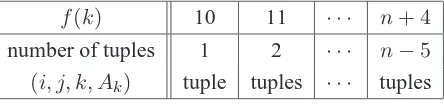
More precisely, iff(k) = 10, there is one triple; iff(k) = 11, there is 2 triples, etc.
Whenf(i) +f(j) =f(k), we compute
Z ≡Ci·Cj·Ck−1 ≡Ai·Aj ·A−k1·Vf(i)+f(j)−f(k)≡Ai·Aj·A−k1 mod M.
Then, there must exists an integerlsuch that
Z
M =
l Ak +
Ai·Aj
Suppose the continued fraction of rational MZ is determined by integers[a0, a1,· · · , at]with
Z
M =a0+
1
a1+ 1
· · · · · · · · · +a 1
t−1+at1 .
Let pv
qv be the rational determined by integers[a0, a1,· · · , av]with pv
qv =a0+
1
a1+ 1
· · · · · · · · · +a 1
v−1+av1
. (2)
Then{p0
q0,
p1
q1,· · ·,
pt
qt}is the convergent sequence of continued fraction expansion of
Z M.
Theorem 1 [5] Letαbe a real number, and letr/sbe a rational withgcd(r, s) = 1and|α−r/s|<
1/2s2. Thenr/sis a convergent of the continued fraction expansion ofα.
From Eq.(1), we see that AAi·Aj k·M <
1 2A2
k. According to Theorem 1,
l
Ak must be a convergent ofZ/M. Let Al
k is theu-th convergent, i.e.,qu =Akandpu =l, i.e.,
pu
qu =
l
Ak. Then we know that
|Z
M −
pu+1 qu+1|<
Ai·Aj
Ak·M =
1
2 ³q
AkM 2AiAj
´2.
According to Theorem 1 and convergence of sequence{p0
q0,
p1
q1,· · · ,
pt
qt}, we obtain that
qu+1≥ s
AkM
2AiAj =Ak·
s M 2AiAjAk
. (3)
Fact 1 Iff(i) +f(j) =f(k),
Fact 1.1 there exists a qu such that qu = Ak in{pq00,pq11,· · · ,pqtt} , the convergent sequence of
continued fraction expansion of MZ withZ ≡CiCjCk−1 mod M.
Fact 1.2 there is sharp increase fromqu toqu+1sincequ+1 ≥ q
AkM 2AiAj.
Fact 1.3 Due to Fact 1.2, there is also a sharp increase fromau toau+1, sinceqv+1 =av+1qv +
qv−1forv= 1,3,· · · , t. Hereavs are items ofZ/Mdetermined by Eq. (2).
Fact 2 If the tuple(i, j, k, Ak)satisfiesf(i) +f(j) =f(k), we call it a valid tuple. Otherwise invalid
tuple.
Fact 2.1 There are totally(n−5)(n−4)/2valid tuples.
Fact 2.2 If we classified the output tuples(i, j, k, Ak)according to the value off(k), we have the
f(k) 10 11 · · · n+ 4
number of tuples 1 2 · · · n−5
(i, j, k, Ak) tuple tuples · · · tuples
Table 1: distribution of tuples(i, j, k, Ak)
Fact 3 The maximal value ofAsequence is up bounded by
max{A1, A2,· · · , An}< Qn−1M i=1 Prime[i] Fact 4 Let integermsatisfies
mY+1
i=1
Prime[i]≥p,
but m
Y
i=1
Prime[i]< p.
Then
max
i,j,k∈{1,2,···,n}Ai·Aj·Ak<
m
Y
i=n−2
Prime[i].
According to Eq. (3), we have
qu+1> qu·
s
M
2Qmi=n−2Prime[i].
3.2 Breaking RESSEE1+ Public Key Encryption/Decryption Cryptosystems
We break the public key encryption/decryption algorithm by deriving private key from the public key. There are two algorithms: Alg1. is to find valid tuples and Alg2. to derive the private key.
Alg.1: Finding Valid Tuples.
Input the public key({C1, C2, ..., Cn}, M);
Output tuples(i, j, k, Ak);
1. Let∆ =q2Qm M
i=n−2Prime[i]; LetmaxA= Qn−1M
i=1 Prime[i]. 2. For(i= 1, i <=n;i+ +)
For(j= 1;j <=n;j+ +) For(k= 1;k <=n;k+ +)
{Z ≡Ci·Cj·Ck−1 mod M;
Compute the convergent sequence of continued fraction ofZ/M, and get ½
p0 q0,
p1 q1, . . . ,
pt
qt ¾
The denominators of convergent items constitute sequence{q1, q2, . . . , qt};
For(l= 1;l <=t;l+ +)
If ((ql·∆< ql+1))&&(ql <maxA)
then{LetAk=ql;
Output(i, j, k, Ak);}
}
We cannot give precise estimations ofqu+1/quand the maximal value ofAsequence. We use∆as
a lower bound ofqu+1/quandmaxAas a up bound of the maximal value ofAsequence. However, these
two bounds are far from being tight. Consequently, Alg. 1 output tuples more than(n−4)(n−5)/2, among which are valid tuple(i, j, k, Ak)withf(i) +f(j) =f(k)and invalid tuple withf(i) +f(j)6=
f(k). However, all(n−4)(n−5)/2valid tuple must be among the output of the algorithm.
Nevertheless, we will use the following properties to pick up the(n−4)(n−5)/2valid tuples and use the properties of the valid tuples to determine the private key{A1, A2,· · · , An},V and{f1, f2,· · ·, fn}.
Property 1 If(i, j, k, Ak)is a valid tuple, then
AiAj ≡CiCjAkCk−1 mod M.
Property 2 If(i, j1, k1, Ak1)and(i, j2, k2, Ak2)are both valid,
Ai = gcd ³
CiCj1Ak1Ck−1
1 modM, CiCj2Ak2C
−1
k2 mod M ´
Aj1 ≡ CiCj1Ak1(Ck1Ai)−1 mod M Aj2 ≡ CiCj2Ak2(Ck2Ai)−1 mod M
Property 3 Among all the invalid tuples output by Alg. 1, there are at most two tuples(i, j, k, Ak)and
(j, i, k, Ak) associated with an invalidAk, whose value is not correct due to the invalidity of the
tuple(i, j, k, Ak).
Property 4 If all the valid tuples output by Alg. 1 are classified by the different value of f(k), the distribution of tuples is just like that in Table 1.
Property 5 If the two valid tuples(i1, j1, k1, Ak1)and(i2, j2, k2, Ak2)satisfy thatf(k1) + 1 =f(k2), then
V ≡Ck2·Ak1 ·(Ck1·Ak2)−1 mod M.
Alg.2. Picking up Valid Tuples to Derive Private Key.
Input tuples(i, j, k, Ak)output by Alg.1;
Output ({A1, A2, ..., An},{f(1), f(2), ..., f(n)}, V).
1. Classify all the tuples(i, j, k, Ak)according to the value ofAk.
2. If there exists a uniqueAksuch thatNk=l, then setf(k) =l+ 9.
Mark all the tuples associated withAkvalid.
Mark other tuples associated withAfk, withAfk 6=Ak, invalid.
3. Among all the tuples, Repeat
(1) search two valid tuples(i1, j1, k1, Ak1)and(i2, j2, k2, Ak2)such thati1=i2orj1=j2; Without loss of generality, we assume thati=i1 =i2.
(2) compute
Ai = gcd ³
CiCj1Ak1Ck−1
1 modM, CiCj2Ak2C
−1
k2 mod M ´
Aj1 ≡ CiCj1Ak1(Ck1Ai)−1 mod M Aj2 ≡ CiCj2Ak2(Ck2Ai)−1 mod M
(2) Mark all the tuples associated withAi,Aj1, Aj2 valid.
Mark other tuples associated withAfi withfAi 6= Ai invalid. Do the same toAgj1,gAj2 with g
Aj1 6=Aj1,gAj2 6=Aj2.
(3) Setf(i) =Ni+ 9,f(j1) =Nj1 + 9,f(j2) =Nj2 + 9.
Until all valid tuples are searched.
3. If there are still tuples with undetermined validity,
Repeat
(1) search a valid tuple(i1, j1, k1, Ak1)and an undetermined tuple(i2, j2, k2, Ak2)withi1 = i2 orj1 =j2;
Without loss of generality, we assume thati=i1 =i2. (2) If
gcd ³
CiCj1Ak1C
−1
k1 mod M, CiCj2Ak2C
−1
k2 mod M ´
= 1
then(i2, j2, k2, Ak2)is invalid, Mark all the tuples associated withAk2 invalid.
Otherwise it is valid and set
Ai= gcd ³
CiCj1Ak1Ck−1
1 mod M, CiCj2Ak2C
−1
k2 mod M ´
,
Aj2 =CiCj2Ak2(Ck2Ai)−1 mod M
Mark all the tuples associated withAivalid.
Mark other tuples associated withfAiwithAfi6=Aiinvalid.
3. Search a valid tuple(i, j, k, Ak)satisfiesf(k) = 10andi=j, then setf(i) = 5.
Search valid tuple(i, j, k, Ak)satisfiesf(k) = 10 +t(tis a positive integer) andf(i) = 5, then
setf(j) = 5 +t.
4 Output allAks,f(k)s, andV.
3.3 Example
Letn= 10,V = 709863737651593824387533;M = 1640976313637848358971801; f[1] = 10, f[2] = 13, f[3] = 9, f[4] = 14, f[5] = 6,
f[6] = 8, f[7] = 7, f[8] = 12, f[9] = 5, f[10] = 11;
A[1] = 9, A[2] = 253, A[3] = 323, A[4] = 205, A[5] = 1369, A[6] = 3481, A[7] = 4, A[8] = 2809, A[9] = 2263, A[10] = 49;
C[1] = 656980308978034175699516, C[2] = 529118527878261775263063, C[3] = 1117492693060345271717610, C[4] = 1009005619984027518080917, C[5] = 407140262259854747498280, C[6] = 919158732131835174270358, C[7] = 197336528727655645732846, C[8] = 480167833213793003341972, C[9] = 635798888164869683821836, C[10] = 651849566821592027079423;
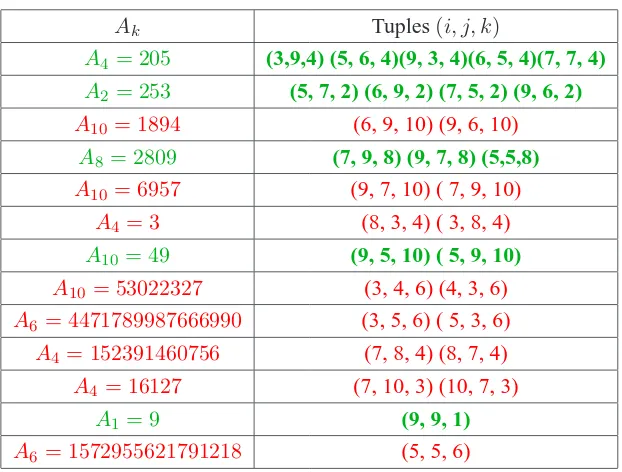
The Alg.1 output 30 tuples.
We classify the 30 tuples according to the values ofAks in Table 2.
Now we will use Alg.1 to pick up the 15 valid ones and derive the private key.
Ak Tuples(i, j, k)
A4 = 205 (3,9,4) (5, 6, 4)(9, 3, 4)(6, 5, 4)(7, 7, 4) A2 = 253 (5, 7, 2) (6, 9, 2) (7, 5, 2) (9, 6, 2)
A10= 1894 (6, 9, 10) (9, 6, 10)
A8 = 2809 (7, 9, 8) (9, 7, 8) (5,5,8)
A10= 6957 (9, 7, 10) ( 7, 9, 10)
A4 = 3 (8, 3, 4) ( 3, 8, 4)
A10= 49 (9, 5, 10) ( 5, 9, 10)
A10= 53022327 (3, 4, 6) (4, 3, 6)
A6 = 4471789987666990 (3, 5, 6) ( 5, 3, 6) A4 = 152391460756 (7, 8, 4) (8, 7, 4)
A4 = 16127 (7, 10, 3) (10, 7, 3)
A1 = 9 (9, 9, 1)
A6 = 1572955621791218 (5, 5, 6)
Table 2: Distribution of tuples(i, j, k, Ak)by the algorithm
• A2 =253 must be correct, since only it has 4 tuples. Hencef(2) = 13. • A8 = 2809must be correct, since only it has 3 tuples. Hencef(8) = 12. • RecoverV ≡C4·A2·(C2·A4)−1 ≡709863737651593824387533 modM. • From valid tuples(3,9,4, A4)and(6,9,2, A2), we have
A3·A9 ≡C3·C9·A4·C4−1 ≡730949 modM,
A6·A9 ≡C6·C9·A2·C2−1 ≡7877503 modM.
Then A9 = gcd(730949,7877503) = 2263. Consequently A3 = 730949/2263 = 323 and A6 = 7877503/2263 = 3481. This invalidates the rows for A6 = 4471789987666990 and A6 = 1572955621791218in the table.
• From the valid tuple(5,6,4, A4), we have
A5·A6 ≡C5·C6·A4·C4−1 ≡4765489 modM.
A5 = 4765489/A6 = 1369.
• From the valid tuple(5,7,2, A2), we have
A5·A7 ≡C5·C7·A2·C2−1 ≡5475 mod M.
A7 = 5476/A5 = 4.
• Now test whether(9,9,1,9)is valid or not. If it is valid, then
A29 ≡C92·A1·C1−1≡5121169 modM.
A9 = 2263impliesA29 = 5121169, hence it is valid andA1= 9.
• Now test whether(9,5,10,49)is valid or not. If it is valid, then
A9·A5≡C9·C5·A10·C10−1 ≡3098047 mod M.
A9 = 2263andA5 = 1369implieA9·A5 = 3098047. Hence it is valid and A10 = 49. This invalidates the rows forA10= 4471789987666990,A10= 6957andA10= 1894in the table.
• The number of valid tuples in the valid rows in Table 1 shows that f(4) = 14, f(2) = 13, f(8) = 12,f(7) = 11,f(1) = 10.
• f(1) = 10and valid tuple(9,9,1, A1)shows thatf(9) = 5.
From valid tuple(9,5,10, A10)(5,9,10, A10), we know thatf(5) = 6; From valid tuple(7,9,8, A8), we know thatf(7) = 7.
From valid tuple(6,9,2, A2), we know thatf(6) = 8. From valid tuple(3,9,4, A4), we know thatf(3) = 9.
Now we totally recover the private key({A1, A2, ..., An},{f(1), f(2), ..., f(n)}, V)from the public key
4
REESSE1+ Digital Signature Algorithm and the Forging Algorithm
Let us review the parameters in the signature algorithm.
• d, D, T, Sare pairwise coprime integers.
• The pairwise coprime sequence{A1, A2,· · · , An};
• A prime numberMsatisfyingM >Qni=1Ai,dDT|(M−1)andi|(M−1)fori= 1,2,· · ·, n+4;
• Chooseδsuch thatgcd(δ, M−1)andord(δ) =dDT;
• W = (Qni=1Ai)−1·(αδ−1)1/S mod M,
α=δδn
modM,β =δ(δ+1)W S mod M,γ=δWn mod M;
• Computel(1), l(2),· · ·, l(n)∈ {iδ mod M−1, i= 5,· · ·, n+ 4};
• ComputeCi=AiWl(i) mod M,i= 1,2,· · · , n.
Signing key: {A1, A2,· · · , An},{l1, l2,· · · , ln}, W, δ, D, d;
Verification key: {C1, C2,· · · , Cn}, α, β, γ;
4.1 Signing
Suppose thatF is the message to be signed. Lethash(·)be a proper one-way hash function.
The signer will use his signing key{Ai},{li}, W, δ, D, dand public parametersM to sign message
F = (b1, b2,· · ·, bn)in the following way.
Signing process(according to [1])
1. ComputeH=hash(F).
2. Letk1 = Pn
i=1bil(i),G0 = Qn
i=1Abii, wherebi = 1−bi.
3. PickQsuch that
D|(δQ−W) (4)
d-((SQ)n−Wn) modM −1 (5)
ComputeRsuch thatQ≡(RG0)SHδ mod M
4. U =¡RWk1−1δδ(δ+1)¢QT mod M. If
d
-Ã
(δ+ 1)SU +
nX−1
i=0
(δQ)n−1+iWi
!
modM −1, (6)
Then the signature forF isQ, U.
SinceR= (Q/H)S1G−1 0 δ−
1
S, we re-describe the signing algorithm as follows.
1. H=hash(F).
2. ChooseQsatisfying
D|(δQ−W) (7)
d-((SQ)n−Wn) modM −1 (8)
3. U = ³
(Q/H)S1G−1 0 δ−
1
SWk1−1δδ(δ+1) ´QT
mod M. IfU satisfies
d| Ã
(δ+ 1)SU +
n−1
X
i=0
(δQ)n−1+iWi
!
mod M −1, (9)
output(F, Q, U), otherwise goto 2.
As was pointed by [2], the step 2 and 3 will repeatdtime on average.
4.2 Verification
With the public key {Ci}, α, β, γ and the public parameters S, T, M the verifier can verify whether
(F, Q, U)is valid or not.
Verification process(according to [2])
1. ComputeH=hash(F), and letH= (b1, b2,· · ·, bn)be a binary string of lengthn.
2. ComputeGˆ≡Qni=1Cbi
i mod M.
3. ComputeX≡¡αHQ−1¢QU T αQnT modM,
Y ≡
³ ˆ GQTU−1
´U S
βU TγT mod M.
4. ifX=Y,accept(F, Q, U)as a valid signature; otherwise reject.
5
Forging Valid Signatures without the Signing Key
We show some basic facts about the signature scheme.
Fact 1 Any triple(F, Q, U)is a valid signature triple, as long as Eq.(7) Eq.(8) and Eq.(9) are satisfied.
• For a randomQ, Eq.(8) is satisfied with probability(d−1)/d.
Fact 2 For any valid signature triple(F, Q, U), the signing partQis not related to the messageF and it satisfies Eq.(7) and Eq.(8).
Fact 3 For any valid signature triple(F, Q, U), the signing partU is uniquely determined by theQ,F and the secret(δδ(δ+1)GW−1/S)QT.
5.1 About Fact 3
A valid signature triple(F, Q, U)implies
U ≡
³
(Q/H)1SG−1 0 δ−
1
SWk1−1δδ(δ+1) ´QT
mod M,
whereF = (b1, b2,· · ·, bn),H=hash(F)andG0= Qn
i=1Abiiwithbi= 1−bi.
• G0= Qn
i=1Abii. LetG1 =
Qn
i=1Abii;
• LetG=Qni=1AiandGb ≡
Qn
i=1Cibi mod M;
• We haveG=G0G1 andGb ≡G1Wk1 mod M.
SinceR≡(Q/H)1/S·G0−1·δ−S1 modM,
U ≡
³
RWk1−1δδ(δ+1) ´QT
≡
³
(Q/H)S1G−1 0 δ−
1
SWk1−1δδ(δ+1) ´QT
mod M
≡
µ
(Q/H)S1 G1 G0G1W
k1−1δδ(δ+1)−1/S ¶QT
≡
µ
(Q/H)S1G1W
k1
GW δ
δ(δ+1)−1/S
¶QT
mod M
≡
Ã
(Q/H)S1 ˆ G GWδ
δ(δ+1)−1/S
!QT
≡
³
(Q/H)S1Gˆ
´QT Ãδδ(δ+1)−1/S
GW
!QT
mod M
Hence we have
³
δδ(δ+1)−1/S
GW
´QT
≡ U
((Q/H)S−1Gˆ)QT mod M
5.2 The Forging Algorithm
From the above facts, we know that as long as we can find
• aQ0satisfying Eq.(7),
• and the secret information
³
δδ(δ+1)−1/S
GW
´Q0T ,
we can uniquely determine aU0withF0, Q0and the secret information, such that(F0, Q0, U0)is a valid signature with probability(d−1)/d2.
Now we show how to forge signatures for any messageF0without the signer’s private key, but with help of two valid signature triple(F1, Q1, U1)and(F2, Q2, U2).
Forging a signatureQ0, U0for messageF0. LetF0 = (b01, b02,· · ·, b0n).
Input Two valid signatures(F1, Q1, U1)and(F2, Q2, U2)withQ1 6=Q2.
Output A valid signature(F0, Q0, U0).
(2) Evaluate
³
δδ(δ+1)−1/S
GW
´Q0T
: From(F1, U1, V1), we determine the secret
³
δδ(δ+1)−1/S
GW
´Q1T
with
Ã
δδ(δ+1)−1/S GW
!Q1T
≡ U1
((Q1/H1)S−1 ˆ
G1)Q1T mod M.
From(F2, U2, V2), we determine the secret
³
δδ(δ+1)−1/S
GW
´Q2T
with
Ã
δδ(δ+1)−1/S GW
!Q2T
≡ U2
((Q2/H2)S−1Gˆ 2)Q2T
mod M.
Then we have
Ã
δδ(δ+1)−1/S GW
!Q0T =
Ã
δδ(δ+1)−1/S GW
!(v+1)Q1TÃ
δδ(δ+1)−1/S GW
!−vQ2T
(3) ComputeU0: LetGˆ0 ≡Qni=1Cb 0 i
i modM.
(i) U0 ≡ ³
(Q0/H0)S1Gˆ0´Q
0T ³
δδ(δ+1)−1/S
GW
´Q0T
modM.
(ii) ComputeX0 ≡ ³
αH0Q0−1´Q0U0T αQ0nT mod M,
Y ≡
³ ˆ G0Q0T
U0−1´U0SβU0T
γT modM.
ifX0 =Y0,output(F0, Q0, U0); otherwise goto (2).
Here we give a brief explanation for the validity of the forged signature(F0, Q0, U0).
• Q0 =Q
1+v(Q1−Q2) = (v+ 1)Q1−vQ2satisfies Eq.(7); From the validity of(F1, Q1, U1)and(F2, Q2, U2), it follows that
D|(δQ1−W),D|(δQ2−W)⇒D|δ(Q1−Q2)⇒D|vδ(Q1−Q2)⇒D|δv(Q1−Q2)+δQ1−W. SinceV0=v(Q1−Q2) +Q1, it follows that
D|(δQ0−W).
On the other hand,Q0satisfies Eq.(8) with probability1−1/d.
• U0is uniquely determined byQ0, F0, and it satisfies Eq.(9) with probability1/d.
6
Conclusion
This paper gives some analysis of REESSE1+ public key algorithm. We point out that REESSE1+ is not secure at all. The encryption scheme can be reduced to the old version REESSE1. Regarding to REESSE1, we show that the private key can be derived from the public key. On the other hand, the digital signature algorithm of REESSE1+ is not secure as well. Every one can make use of two known valid signature to forge new signatures for any messages.
References
[1] S. Su, The REESSE 1 Public Key Cryptosystm. Computer Engineering & Science, pp.13-16, Vol. 25, No. 5, 2003.
[2] S. Su, and S. L¨u, The REESSE1+ Public-key Cryptosystem, http://eprint.iacr.org/2006/420
[3] Liu Shengli, Zhang Fangguo, Chen Kefei, Crypatanalysis of REESSE1 Public Encryption
Cryp-tosystem, China Information Security, No. 7, 2005.
[4] Liu Shengli, Zhang Fangguo, Chen Kefei, Crypatanalysis of REESSE1 Digital Signature
Algo-rithm, CCICS 2005, Xi’an, China.