The Mechanism of Fission Yeast Mating Type Interconversion:
Seal/Replicate/Cleave Model of Replication Across the Double-Stranded
Break Site at
matl
Amar
J. S .
Klar,* MichaelJ.
Bonaduce’ and Robert Cafferkeyt9’*ABL-Basic Research Program, NCI-Frederick Cancer Research and Development Center, Frederick, Maryland 21 702-1201, and ?Cold Spring Harbor Laboratory, Cold Spring Harbor, New York 11 724
Manuscript received October 2, 1990 Accepted for publication December 1,1990
ABSTRACT
The interconversion of cell type in the fission yeast, Schizosaccharomyces pombe, is initiated by a double-stranded break (DSB) found at the mating type locus (matl). A heritable site- and strand- specific DNA “imprinting” event at matl was recently hypothesized to be required to make the m a t l
locus cleavable, and the DSB was suggested to be produced one generation before the actual switching event. I t is known that only one cell among four granddaughters of a cell ever switches, and the sister of the recently switched cell switches efficiently in consecutive cell divisions. The feature of consecutive switching creates a major difficulty of having to replicate chromosomes possessing the DSB. The matl cis-acting leaky mutation, called smt-s, reduces the level of the DSB required for switching and is
shown here to be a 27-bp deletion located 50 bp away from the cut site. Determination of the pattern and frequency of switching of the mutant allele by cell lineage studies has allowed us to conclude the following: (1) the chromosome with the DSB is sealed and replicated, then one of the specific chromatids is cleaved again to generate switching-competent cells in consecutive cell divisions and (2) the smt-s mutation affects DNA cleavage and not the hypothesized DNA imprinting step.
A
N interesting feature of the fission yeast mating type switching system is the specific pattern cells follow for spontaneously and efficiently switching one mating cell type to the other (LEUPOLD 1950; EGEL1977; MIYATA and MIYATA 1981). T h e haploid cell exists as one of two alternate cell types, called P (for Plus) and M (for Minus) (LEUPOLD 1950; EGEL et al. 1980). These cell types are determined, respectively, by the alternate matl-P and matl-M alleles of the mating type locus (matl), which resides on linkage group 11. Mating type interchange involves a gene conversion event in which a copy of unexpressed mating type information residing at the mat2-P or the mat3-M donor locus is transposed to matl, resulting in a switch of cell type (Figure 1). For recent reviews of the system, refer to EGEL (1989) and KLAR (1 989).
T h e recombination event that mediates matl switching is initiated by a site-specific double-stranded DNA break (DSB) at the matl locus (BEACH 1983; BEACH and KLAR 1984; EGEL, BEACH and KLAR 1984). T h e cut site, designated smt [switching of mat- ing type (EGEL et al. 1980)], is situated near the junction of the matl allele-specific and H1 regions. T h e precise nature of the cut has been characterized for one strand of the DNA (NIELSEN and EGEL 1989) (Figure 1). Analysis of DNA isolated from exponen- tially growing cultures has shown that approximately
I’et1t1sylvania 19406.
(;elletin 127: 489-496 (March. 1991)
’ Present address: Smith Kline Beecham Pharmaceuticals, King of Prussia,
20-25% of matl DNA is cleaved and that the propor- tion of broken DNA is constant throughout the cell cycle (BEACH 1983).
Three trans-acting switch genes are required to catalyze the DSB, and three matl cis-acting mutations are known to affect the rate of switching by reducing the level of DSB (EGEL and GUTZ 198 1 ; BEACH 1983; BEACH and KLAR 1984; EGEL, BEACH and KLAR 1984; ENGELKE et al. 1987; SCHMIDT, KAPITZA and GUTZ 1987; SCHMIDT et al. 1989). T h e smt-s, also called C 1 3-P 1 1, is one such spontaneous cis-acting mutation (EGEL and GUTZ 1981).
A. J. S. Klar, M. J. Bonaduce and R. Cafferkey
490
mat 1 mal 2-P mat3-M
H3H2 H t
I;I(;URE 1 .-The mat region on chromosome I I . The line drawing shows m a t l , mat2-Pand mat3-M cassettes. The centromere is located
a b o u t 65 centimorgans to the left of m a t l . The homology boxes H 1 (59 bp) and H2 (135 bp) are present in all cassettes and flank the allele-specific P ( 1 1 13 bp, jagged line) and M (1 127 bp, smooth line) sequences. The third homology region, H 3 (57 bp), is present
a t mat2 and mat3 but not at m a t l . The interval between mat1 and mat2 is 15 kb long and the interval between mat2 and mat3 is also - 1 5 kb long. DSB marks the site of the double-stranded break in
m a t l . Arrows indicate that matl switches occur by unidirectional
1r;lnsfer of DNA from mat2 and mat? loci to m a t l . Each mat1 allele
cttcodes two transcripts. The figure is derived from data presented earlier (EGEL and GUTZ 1981 ; BEACH 1983; ECEL 1984a; BEACH ; t n d KLAR 1984; KELLY et al. 1988).
recurrent switching rule.” T h e observed pattern of switching is analogous to the mammalian “stem cell” lineages; that is, a cell produces one daughter like itself while the other daughter is advanced in its developmental program (KLAR 1990).
To explain the granddaughter switching rule and the chains of switching in consecutive cell divisions, a specific strand-segregation model has been proposed (KLAR 1987, 1990). It was suggested that a sequence- and strand-specific imprinting event at matl is re- quired for cleaving the DNA in vivo, and the cleavage perhaps occurring at the time of DNA replication. T h e DSB at matl persists throughout the cell cycle and is sealed by switching in one specific daughter chromatid during replication. T h e sister of the re- cently switched cell is switchable in 90% of cell divi- sions; therefore, it is presumed to possess the DSB. In other words, the parent cell possessing the DSB at
matl produces one specific cleaved daughter chro- matid, whose inheritance will produce a switching- competent daughter. Therefore, a major problem arises as to how a cut chromosome can be replicated across the break to produce one daughter chromatid again possessing the DSB. T o fulfill this requirement, it has been proposed (NIELSEN and ECEL 1989) that a specific mechanism may exist which permits replica- tion while preserving the DSB in one of the resultant chromatids, hence maintaining switching competence in one daughter cell in consecutive cell divisions. In other words, the DSB would act as a stable determi- nant of switching. Alternatively, we imagine that the cut ends are sealed at or immediately before replica- tion. At or soon after replication, one of the chroma- tids is sealed by switching, while the other is recleaved, since the latter one has inherited the hypothesized imprinted event carried on it.
Determination of the pattern of switching of the
matl smt-s allele has allowed us to differentiate be- tween these models. We favor the idea of sealing the cut ends at or before the time of DNA replication.
MATERIALS AND METHODS
Strains: All strains are of Schitosaccharomyces pombe and their genotypes are presented in Table 1.
Culture conditions: Standard conditions for culture, sporulation, and tetrad analysis were employed according to GUTZ et al. (1974). The matl switching efficiency of strains was roughly determined at the colony level by stain- ing clones, growing and sporulating on sporulation media, with iodine vapors. Cells of opposite mating type in the clone mate, and the resulting zygotic cells undergo meiosis and sporulation. S. pombe produces a starchlike compound during sporulation that can be stained with iodine (GUTZ et al. 1974). Clones of the wild-type strains stain black, while the leaky switching-deficient clones stain sparingly.
Pedigree analysis: Pedigree analysis was conducted ac- cording to KLAR (1 990; see also ECEL and EIE 1987). Briefly, the procedure consists of assaying the ability of individual diploid cells to undergo meiosis and sporulation while grow- ing on plates containing the semistarvation medium. Under such conditions, matl-Plmatl-P or matl-Mlmatl-M cells grow, as they are incapable of sporulation because of the lack of expression of opposite mating type alleles. Their mitotic progeny containing a switched allele ( i . e . , m a t l - P / m a t l - M ) sporulate and therefore stop growing. Individual cells were separated by micromanipulation, and a record was kept of the lineage of each cell. In these experiments matl can only switch on one of the two chromosomes, while the matl allele present in the homolog is switching-deficient. Thus, the ascus formation in a cell lineage signals a switch of a particular matl allele to the opposite allele.
Biochemical techniques: DNA was isolated from 50-ml saturated cultures of yeast as described elsewhere (BEACH and KLAR 1984). Standard procedures for manipulating DNA in vitro were used (MANIATIS, FRITSCH and SAMBROOK 1982). For Southern blotting, -1 pg of DNA was digested with HindIII and then subjected to electrophoresis through
a 0.8% agarose gel. Transfer of DNA from the gel to nitrocellulose paper was done according to SOUTHERN (1 975). The probe was nick translated in the presence of a-
“P-labeled deoxyribonucleotide and then hybridized as de- scribed by STRATHERN et al. (1982). All enzymes were obtained from Boehringer Mannheim Biochemicals.
Cloning and sequence determination of the s n t - s allele:
The smt-s allele was isolated by the gap repair of a replicating plasmid that contains the 10.4-kb HindIII fragment span- ning matl from which the internal cassette sequence from XhoI to PvulI (BEACH 1983) was deleted. The linearized plasmid has a 1.7-kb sequence at one end and a 1.0-kb sequence at the other end; these sequences flank mat1 in the chromosome. The cut plasmid was introduced into yeast cells containing the smt-s mutant allele (strain SP109) by DNA-mediated transformation. Selection for the Saccharo- myces cerevisiae LEU2 gene present in the plasmid was then performed as previously described (BEACH and NURSE 1981). Gap repair placed the mat1 smt-s allele into the plasmid by the process of gene conversion (ORR-WEAVER, SZOSTAK and ROTHSTEIN 198 1) using chromosomal infor- mation as the donor. T h e repaired plasmids were recovered by transforming Escherichia coli with DNA isolated from yeast transformants.
The dideoxy method of SANGER, NICKLES and COULSON (1977) was used to determine the sequence of the HaeIIII Ssp1 fragment that spans both the cut site and the H 1 region
at matl (KELLY et al. 1988).
RESULTS
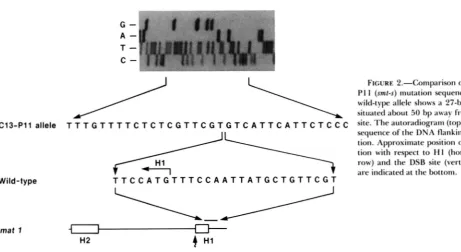
FIGURE 2.-Comparison of the CIS-
PI 1 (smt-s) mutation sequence with the wild-type allele shows a 27-bp deletion, situated about 50 bp away from the cut
C13-Pl1 allele T T T G T T T T C T C T C G T T C G T G T C A T T C A T T C T C C C site. The shows the sequence of the DNA flanking the dele- tion. Approximate position of the dele- tion with respect to H I (horizontal ar- row) and the DSB site (vertical arrow) are indicated at the bottom.
/\
Wild-type T T C C A T G T T T C C A A T T A T G C T G T T C G Tmat 1
-1
1
H2
4
H1acting mutation, smt-s (also called C13-PI I), which is known to reduce the steady state level of the DSB at matl and, consequently, reduces switching eficiency (GUTZ and FECKE 1979; EGEL and GUTZ 198 1 ; BEACH
1983). The mutation is known to map distal to matl, and since it cannot be “healed” by the act of switching, the mutation must lie outside the substituted se- quences. Therefore, to molecularly determine the nature of the mutation, we determined the DNA sequence of the 254 bp matl-P HaeIIISspI fragment (KELLY et al. 1988) spanning the cut site and the H 1 region (Figure 1). Earlier Southern analysis had shown the mutation to be due to a small deletion (BEACH
1983). We found that in comparison with the se- quence of the wild-type gene, the smt-s mutation is due to a 27-bp deletion removing
7
bp of the distal end of H I extending distally to matl (Figure 2). The mutation deleted the region between a 6-bp sequence (5”GTTCGT-3’) present as a direct repeat 27 bp apart, an observation suggesting that the deletion may have been generated by a replication error or by a recombination event within the repeat.Cumulative effect of smt-s and swil, m.3, or swi7 mutations on switching: There are three trans-acting switching-defective mutations known in m i l , swi3, and mi7 genes, which also reduce the level of the DSB. All of these mutations may be formally consid- ered to be leaky, since switching is reduced but not abolished in mutant strains (EGEL, BEACH and KLAR
1984; GUTZ and SCHMIDT 1985).
T o determine whether these trans-acting swi func- tions catalyze the DSB at matl by their interactions with the sequence deleted in the smt-s mutation, we constructed and analyzed double mutants. If a partic- ular swi function acts only by interacting with the sequence deleted in the smt-s mutation, then a strain
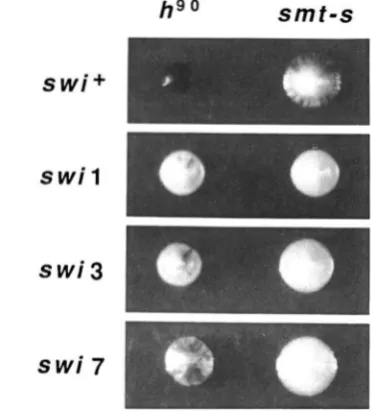
containing both mutations should exhibit the pheno- type of the smt-s single mutant. Should the swi-en- coded functions act elsewhere in the pathway of switching, then a cumulative reduction of switching is expected. I t was found that smt-s and m i l , swi3, or mi7 double mutants (see Table 1 for complete geno- type of strains) have a much reduced frequency of switching, as was indicated by the reduced level of iodine staining of colonies of such strains (Figure 3). The simplest interpretation of this result is that swi- encoded functions do not act through this site, or at least not solely via this site.
The smt-s mutation reduces the efficiency of first- time as well as consecutive switching: Pedigree analysis of diploids containing the smt-s mutation was conducted to explain how a chromosome containing the DSB for the entire length of the cell cycle can be replicated across the break, and also to determine whether the mutant is defective in imprinting or DNA cleavage steps hypothesized to be required to produce the DSB at matl.
492 A. J. S. Klar, M. J. Bonaduce and R. Cafferkey
TABLE 1
Experimental strains of S. pombe
Strain mall Genotype
~~~~~~
SP2 hW l e d - 3 2 his3
SP105 h9" swi3 ade6-M210 his2
SP
109 hYOsmf-s l e d - 3 2
SP110 h" swil leul-32
SPll2 hW swi7 leul-32 ade6-M216
SP544 hgOsmt-s swi3 l e d - 3 2
SP743 hW/matl-M smt-s mat2,3k:LEU2 leul-32/leul-32 ade6-M210/ade6-M216
SP754 hp"smt-s/matl-P mat2,3k:LEU2 leul-32/leuI-32 ade6-M210/ade6-M216
spa50 hp"smt-s/matl-M smt-o leul-32/leul-32 ade6-M21O/ade6-M216
SP869 hW smt-s swil leul-32 ade6-M216
spa70 hW smt-s swi7 leul-32 ade6-M216
The mat region containing matl, mat2 and mat3 loci is designated h'". The smt-s, smt-0, and mat2,3A::LEU2 mutant l o c i are defined in the text.
FIGURE 3.-lodine staining of colonies of smf-s and swi- single and double mutants shows a cumulative reduction in switching of double mutants. Colonies growing from single cells o f indicated genotype were allowed to grow, switch, mate and sporulate on solid media. Thereafter, the clones were stained by exposing them to
iodine vapors according to GUTZ ef al. (1 974). The radial streaks of staining indicates mating in the adjoining small sectors of cells o f opposite mating type. The observed level o f staining reflects the efficiency of switching of a strain. The wild-type matl allele of respective strains is indicated by the hW designation (left vertical row) and the smt-s allele (right vertical row) contains a small deletion near matl (Figure 2). The genotype with respect to swi genes (horizontal rows) is also indicated. The complete genotype o f a p propriate strains is listed in Table 1.
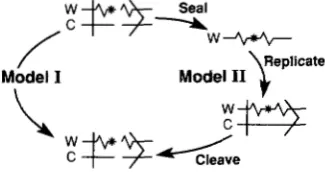
of the imprinted strand, is sealed just before or at the time of DNA replication (model I1 in Figure 5). At or soon after the time of DNA replication, the specific daughter chromatid inheriting the imprinted strand is cleaved again (the seal/replicate/cleave model).
According to the strand-segregation model (Figure 4), genetic functions required for the formation of the DSB should consist of some required for imprinting, and others for catalyzing the DSB on imprinted DNA. The imprinting event was hypothesized to be required
for matl cleavage. Since a switchable cell produces one switchable daughter in 90% of cell divisions (KLAR 1990), it can be imagined that the imprinted event is stably inherited by the switchable daughter in most or all of the subsequent cell divisions (EGEL and EIE 1987; KLAR 1990).
Pedigree analysis of the leaky cis-acting smt-s mutant was used to determine whether the mutation affects imprinting or the DNA cleavage step. If the mutation affects imprinting function, then it should reduce the rate of first-time switching (one-in-four cases), but once the DNA strand is imprinted (ie., in lineages where initial switching has occurred), the rate of con- secutive switching should be similar to that found in wild-type strains (Figure 4). Pedigree analysis of such an imprinting defect will not allow us to differentiate between the models presented in Figure 5 .
If, however, the smt-s mutation affects DNA cleav- age and not imprinting, then these two models can be differentiated by the following rationale. According to the model I in Figure 5 , a function for catalyzing the DSB will be required only to start the chain of switching, that is, for the one-in-four switching. Sub- sequent switching-competent cells should be produced efficiently, as the break is postulated to be preserved and delivered to one specific switching-competent daughter cell. Consequently, the rate of consecutive switching should be as high as that of wild-type strains. In contrast, according to the seal/replicate/cleave model (model I1 in Figure 5 ) , the rate of recurrent switching should remain low similar to the rate of first-time switching, since a new cut is required for recurrent switching. These predictions are summa- rized in Table
2.
Thus, by the pedigree analysis of a strain containing the smt-s mutation, 1) we can deter- mine whether the mutation affects imprinting or the DNA cleavage step, and2)
if the cleavage step is affected, then we can differentiate between models I and I1 (Figure 5).matl Interconversion
Parent Cell
FIGURE 4.-The Strand-Segregation model. Imprinting (*) of the Watson (W) strand (only the jagged line is imprintable) at matl occurs in the parent Pu (u for unswitchable) cell. It may have inherited the already imprinted chromosome from its parent, which may have imprinted it, say, in G P . During replication, the Ps (s for switchable) chromatid inheriting the imprinted parental (“old”) W strand is cleaved. Its sister, the Pu chromatid inheriting the parental Crick (C) strand, or alternatively, the newly synthesized W strand, is not cleavable because its newly synthesized W strand is yet not imprinted. It will be imprinted by the time it is to be replicated in the next cell cycle. Thus, daughters of the parent cell inherit developmentally nonequivalent chromosomes, one inheriting the cut chromosome ( P s ) and its sister inheriting the chromosome without the cut (Pu). At o r soon after the time of DNA replication, the daughter cell with the DSB ( P s ) generates one chromatid containing the switched and healed matl allele ( M u ) and one chromatid that is cleaved and unchanged at the matl locus ( P s ) .
Furthermore, the switched chromatid is specified to contain the specific C strand. Thus, each of the Ps cells will mostly produce one switched (Mu) and one switchable (Ps) daughter in consecutive cell divisions resulting in chains of recurrent switching. T h e cells with the newly switched matl-M allele will switch back t o matl-P by following the same pattern of switching. Wide arrows indicate matl cassette orientation in the chromosome, while small arrows indicate the segregation of specific DNA chains to progeny cells. T h e DNA chains of the parental
cell are represented by thicker lines to help illustrate their inheritance by progeny cells. A recently switched allele is indicated by the boldface letter. A gap in the continuity of the chromosome denotes the presence of the DSB. T h e figure is adapted from KLAR ( E M B O J . , 1990).
Model I
G
Model I11
Replicate:?9
: - p 9 4 e
FIGURE 5.-Two possible models for processing the DSB a t matl during chromosome replication. By either model, the cut chromo- home generates one cut daughter chromatid during replication. Model I: the matl DNA is replicated without sealing the cut, and both parental strands with the DSB are conservatively delivered to
the switching-competent daughter cell (NIELSEN and EGEL 1989).
Model 11: the imprinted (top) strand is sealed, replicated, and cleaved again (perhaps during replication) to generate the switch- ing-competent chromosome. The other strand is suggested to be repaired by switching in an unspecified manner. All other designa- tions are defined in the legend to Figure 4.
TABLE 2
Possible smt-s switching defects and predictions of models of Figure 5
Predicted switching rate Defect One-in-four Consecutive
DNA imprinting Low High
DNA cleavage model I Low High
DNA cleavage model I1 Low Low
switching of the smt-s allele from matl-M to matl-P, pedigree analysis of the diploid strain SP850 ( m a t l smt-s, mat2, mat3/matl-M smt-o, mat2, mat3) was con- ducted by following the competence of single cells to sporulate as described in MATERIALS AND METHODS. T h e tight switching-deficient cis-acting smt-o mutation (ENGELKE et al. 1987) is a 262-bp deletion of the matl distal sequences encompassing the smt-s site (0. NIEL-
SEN and
R.
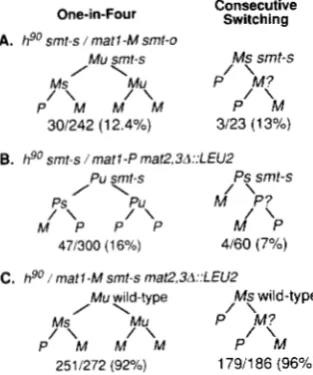
EGEL, personal communication). Cells containing the matl-M smt-slmatl-M smt-o constitution at matl will not sporulate, but when the matl-M smt-s allele switches to a matl-P, then that cell will form an ascus. Thus, in this strain the efficiency of switching of matl-M smt-s to matl-P smt-s can be determined by the cell lineage studies. As shown in Figure 6, the matl-M smt-s switched inefficiently ( 1 2.4%) by follow- ing the rule of one switch in four granddaughters. An additional and more telling observation is that the rate of consecutive switching was also low at 13%.Similarly, to determine the pattern and efficiency of switching of the matl-P smt-s allele to matl-M, strain SP754 was subjected to pedigree analysis. T h e diploid strain contains the matl smt-s, mat2-P, mat3-M geno- type in one chromosome and the matl-P mat2,3A::LEU2 genotype in the homolog. The mat2,3A::LEU2 is a deletion of mat2, mat3, and se- quences bracketed by these loci, and the
S.
cerevisiae LEU2 gene is inserted in their place (KLAR and MIGLIO1986). In this strain, switching only in cis occurs as the donor loci present in the homolog failed to donate information to the wild-type matl-P locus located in the donor deleted chromosome (A. KLAR, unpub- lished results to be reported elsewhere). As shown in Figure 6, one in four granddaughter cells switched in 16% of the cases. Additional pedigrees were analyzed to determine the rate of consecutive switching. Only 4 among 60 cells
(7%)
switched in consecutive cell divisions.494 A . J. S. Klar, M. J. Bonaduce and R . Cafferkey
One-in-Four Consecutive Switching
A. hgo smt-s / matl -M smt-o
M U smt-s M s srnt-s
Ms Mu P I ‘M?
/ \ / \ / \
P M M PM M
/ \
301242 (1 2.4%) 3/23 (1 3%)
B. hgo smt-s /marl-P rnat2,3A::LEUZ
/Pu smt-s \ Ps srnt-s
Ps
Pu M / \ /PC
M’ ‘P P / \ P M P
471300 (1 6%) 4160 (7%)
C. hgo matl-M smt-s mat2,3A::LEUZ
Mu wild-type M s wild-type
/ \
Mu ‘M? P’
P/ \ Ms M M/ \ M P/ \ M
2511272 (92%) 179/186 (96%)
FIGURE 6.-The pattern and efficiency of mat1 switching. Only the genotype o f the switchable allele is presented in the drawings t o simplify the presentation. The relevant genotype of the diploid
is indicated at the top. The numbers indicate the actual numbers o f ‘ one-in-four or consecutive switching pedigrees performed. (A) SPX.50; (B) SI’7.54; ( C ) SP743.
matl-M to matl-P very efficiently (92%, Figure 6) by following the one-in-four pattern. Also, the sister of a recently switched cell switched efficiently (96%) within the next cell cycle. This result confirms and extends earlier results obtained with strains of slightly different genotypes (KLAR 1990).
In summary, as compared to the wild-type allele, the smt-s allele switched inefficiently and its recurrent switching rate was similarly low.
DISCUSSION
T h e specific pattern of cell type change observed in cell lineages of fission yeast is strictly controlled by the regulation of the DSB at m a t l . Two consecutive developmentally asymmetric cell divisions are re- quired to produce one switch in four related cells. Evidence from earlier studies has suggested that the developmental asymmetry of both cell divisions is due to inheriting specific DNA strands at the mating type locus and not to other cellular differences (KLAR
1987, 1990; ECEL 1984b; EGEL and EIE 1987). It seems that generation of the DSB as well as utilization of the break for switching is restricted to the S phase of the cell cycle. It is thought that the act of DNA replication generates nonequivalent genomes at matl (KLAR 1990). If the cell contains intact matl DNA, then after replication one chromatid will be unswitch- able, as it lacks the break, while the other chromatid will acquire the break and, hence, will generate a switchable daughter. If the cell already contains the DSB at m a t l , then after replication one specific chro- matid is mostly switched, while its sister chromatid contains the DSB, whose inheritance will produce a switching-competent daughter cell (Figure 4) (KLAR
1987, 1990; ECEL and EIE 1987; NIELSEN and ECEL
1989). These studies stress the importance of DNA replication in switching. It is, therefore, of great in- terest to define the generation, utilization, and repli- cation of the cut ends to fully comprehend the switch- ing system.
To determine how the DSB is processed, the pres- ent studies characterized the switching defect of a matl cis-acting smt-s mutation. It was found that the mutant allele switched inefficiently (12% to 16%) from matl-P to matl-M to matl-P by following the conventional rule of switching one in four grand- daughters. Additionally, and more significantly, the sister of the recently switched cell again switched with the correspondingly low rate of
7%
to 13%. This result contrasts with the wild-type allele, which switched by the one-in-four rule in 92% of the pedi- grees and also switched efficiently (96%) in consecu- tive cell divisions (this paper; EGEL and EIE 1987; KLAR 1990). Thus, the sequences defined by the smt- s mutation are equally required for both primary and consecutive switching. T h e major conclusion drawn from this result is that the cut is made anew in each cell undergoing switching in consecutive cell divisions. If the cut was preserved as such and inherited by the switching-competent specific daughter as recently pro- posed (NIELSEN and ECEL 1989), then the rate of consecutive switching was predicted to be high. NIEL-SEN and EGEL (1989) model proposed that both strands of the parental cut molecule are conservatively segregated to the unswitched (but switching-compe- tent) daughter cell, thereby preserving the DSB. It was proposed that a special kind of mechanism repli- cates the cleaved chromosome at matl resulting in unilateral transmission of high frequency state of mat- ing type switching. Our results suggest that the DSB must be sealed before the site could be replicated, thus arguing against preserving the DSB model. This conclusion solves the enigmatic problem of having to replicate the chromosome across the long-lived break (KLAR 1987, 1990). T h e second conclusion is that sequences deleted by the smt-s mutation are required directly for cleaving the DNA and not for the imprint- ing step hypothesized to be required for making the matl DNA competent to be cleaved (KLAR 1987,
followed by wild-type cells, and the additional inserted cassette itself switched by the conventional one-in- four rule (KLAR 1990). These results established only the key strand segregation aspect and do not address other hypothesized more specific details of the model. In particular, the existence of the imprinted event required for cleaving the DNA was only hypothesized and a published evidence for or against it is lacking. Clearly, our earlier results demonstrated that the switching system does differentiate between the “old” W (Watson) strand inherited by the cleaved chromatid and the newly synthesized W strand inherited by the uncut sister chromatid. It is not unreasonable to pos- tulate the presence of an imprinted event segregating with the older strand to differentiate between old and new chains. Secondly, the process of replication through matl produces only one daughter chromatid that is cleaved even though both chromatids are pres- ent together in the same nucleus. Again, an imprinted event at matl can be imagined to make the replication across matl somewhat special as it is certainly different from replication of other sequences in the genome which most likely do not produce one cut daughter chromatid. This paper addresses a specific detail of the model as to how a broken chromosome can be replicated across the break. T h e results provided here do not test whether or not imprinted event exists on DNA.
Mutations in the swil, swi3, and swi7 trans-acting functions, functions also known to be required for the formation of the DSB (EGEL, BEACH and KLAR 1984), further reduce the rate of switching of the smt-s mu- tation. We have recently defined another cis-acting switch activating sequence (SASl), located 140 bp distal to the cut site; deletions of this sequence also show a cumulative reduction in switching when com- bined with mutations in these swi genes (B. ARCAN- GIOLI and A. KLAR, unpublished observations). T h e simplest interpretation of cumulative reduction in switching is that swi functions do not act through the sequences defined by both of these cis-acting muta- tions. An alternative possibility is that swi functions in fact act through both of these sequences to perform complementary and overlapping processes, both of which are required for efficient switching. A third possibility regarding smt-s is that it is a “spacing” mutation that affects the level of the DSB by affecting the matl chromatin structure or by changing the distance of the cut site from some other required cis-
acting component. Further studies are required to
resolve these issues. Another more complicated but formal possibility is that the smt-s mutation actually affects stability of the imprinted event, and conse- quently reduces the rate of consecutive switching. This possibility cannot be ruled out, however, it will not affect the major conclusion of this paper of pro- ducing a fresh DSB by a recent DNA cleavage event
during recurrent switching. At this stage, it should be stated that as yet we have no evidence indicating that the DSB is produced by an endonuclease-like activity. It is equally possible that the act of DNA replication in an unspecified manner generates one broken chro- matid. Should the second possibility to be true, then this system will be drastically different from the way the DSB is generated and repaired by switching mat- ing type in G1 phase of the cell cycle of S . cerevisiae (STRATHERN et al. 1982).
While considering processing of the DSB, it is par- ticularly interesting to note that strains deleted for mat2 and mat3 have the normal level of break, main- tain completely stable mating type, and also do not produce inviable cells. Thus, the machinery must exist to seal the break even without switching (KLAR and MICLIO 1986). In contrast, such a cut at MAT in
S.
cerevisiae cannot be healed without switching, since the donor deleted strains die when trying to switch (KLAR, STRATHERN and ABRAHAM 1984).T h e conclusion that cut ends are sealed and repli- cated and then one of the chromatids is cleaved again raises the question as to why the DNA is cut in the first place if it is to be sealed before replication. We can propose a model in which matl switching is a novel kind of gene conversion event mediated by the DNA replication process itself. T h e replication ma- chinery may only seal one specific strand to allow it to replicate (Figure 5 ) , while the other strand is healed by matl switching at the time of DNA replication. Clearly, further studies are needed to understand additional details of the mechanism of switching.
We have benefited greatly from discussions with or comments on the manuscript by B. ARCANGIOLI, J. SINGH, 0. NIELSEN and A. ARTHUR. We thank R . FREDERICKSON for the artwork and P. HALL for preparing the manuscript. Research sponsored in part by the National Cancer Institute, Department of Health and Human Serv- ices, and its agents and contractors, under contract No. NOI-CO- 74 10 1 with ABL. The contents of this publication do not necessarily reflect the views or policies of the Department o f Health and Human Services, nor does mention of trade names, commercial products, or organizations imply endorsements by the U.S. govern- ment. The work at Cold Spring Harbor Laboratory was funded by the National Institutes of Health grant GM25678 awarded to
A.J.S.K.
LITERATURE CITED
BEACH, D. H., 1983 Cell type switching by DNA transposition in fission yeast. Nature 305: 682-688.
BEACH, D. H . , and A. J. S. KLAR, 1984 Rearrangements of the transposable mating-type cassettes of fission yeast. EMBO J. 3: 603-610.
BEACH, D., and P. NURSE, 1981 High frequency transformation of the fission yeast. Nature 290: 140-142.
EGEL, R., 1977 Frequency of mating-type switching in homothal- lic fission yeast. Nature 2 6 6 172-1 74.
EGEL, R., 1984a Two tightly linked silent cassettes in the mating- type of Schizosaccharomyces pombe. Curr. Genet. 8: 199-203. EGEL, R . , 198413 The pedigree pattern of mating type switching
in Schizosaccharomyces pombe. Curr. Genet. 8: 205-2 10.
496 A . J. S. Klar, M. J. Bonaduce and R. Cafferkey
3 - 7 3 in Molecular Biology of the Fission Yeast, edited by A. NASIM, P. YOUNG and B. JOHNSON. Academic Press, New York. EGEL, R., D. H. BEACH and A. J. S. KLAR, 1984 Genes required
for initiation and resolution steps of mating type switching in fission yeast. Proc. Natl. Acad. Sci. USA 81: 3481-3485. Ecer., R., and B. EIE, 1987 Cell lineage asymmetry in Schizosac-
charomyces pombe: unilateral transmission of a high-frequency state of mating-type switching in diploid pedigrees. Curr. Ge- net. 12: 429-433.
EGEL, R., and H. GUTZ, 1981 Gene activation by copy transposi- tion in mating-type switching of a homothallic fission yeast. Curr. Genet. 3: 5-12.
EGEL, R., J. KOHLI, P. THURIAUX and K. WOLF, 1980 Genetics of the fission yeast Schizosaccharomyces pombe. Annu. Rev. Genet.
ENGELKE, U., L. GRABOWSKI, H. Gutz, L. Heim and H. SCHMIDT, 1987 Molecular characterization of h- mutants of Schizosac- charomyces pombe. Curr. Genet. 12: 535-542.
GUTZ, H., and H. C. FECKE, 1979 Probable promoter mutations in the mating type region of Schizosaccharomycespombe. Hoppe- Seyler’s 2. Physiol. Chem. 360: 274 (Abstr.).
GUT%, H . , and H. SCHMIDT, 1985 Switching genes in Schizosac- charomyces pombe. Curr. Genet. 9 325-33 1.
GUTZ, H., H. HESLOT, U. Leupold and N. LOPRIENO, 1974 Schizosaccharomycespombe, pp. 395-446 in Handbook of Genetics, edited by R. C. KING. Plenum Press, New York.
KELLY, M . , J. BURKE, M. SMITH, A. KLAR and D. BEACH, 1988 Four transcriptionally regulated mating type genes con- trol sexual differentiation in the fission yeast. EMBO J . 7:
KLAR, A. J. S., 1987 Differentiated parental DNA strands confer developmental asymmetry on daughter cells in fission yeast. Nature 326: 466-470.
KLAR, A. J. S., 1989 The interconversion of yeast mating type: Saccharomyces cerevisiae and Schizosaccharomycespombe, pp. 67 1- 691 in Mobile D N A , edited by D. E. BERG and M. W. HOWE. American Society for Microbiology, Washington, D.C. KI.AR, A. J. S., 1990 T h e developmental fate of fission yeast cells
is determined by the pattern of inheritance of parental and grandparental DNA strands. EMBO J. 9 1407-1415.
14: 77-108.
1537-1547.
KLAR, A. J. S., and L. M. MIGLIO, 1986 Initiation of meiotic recombination by double-stranded DNA breaks in Schizosac- charomyces pombe. Cell 46: 725-73 1.
KLAR, A. J. S . , J. N. STRATHERN and J. ABRAHAM, 1984 Involvement of double-strand chromosomal breaks for mating type switching in Schizosaccharomyces pombe. Cold Spring Har- bor Symp. Quant. Biol. 49: 77-88.
LEUPOLD, U., 1950 Die vererbung von homothallie und heteroth- allie bei Schizosaccharomyces pombe. C. R. Trav. Lab. Carlsberg Ser. Physiol. 24: 381-480.
MANIATIS, T . , E. F. FRITSCH and J. SAMBROOK, 1982 Molecular
Cloning: A Laboratory Manual. Cold Spring Harbor Laboratory,
Cold Spring Harbor, N.Y.
MIYATA, H., and M. MIYATA, 1981 Modes of conjugation in homothallic cells of Schizosaccharomyces pombe. J . Gen. Appl. Microbiol. 27: 365-37 1.
NIELSEN, O., and R. EGEL, 1989 Mapping the double-strand breaks at the mating-type locus in fission yeast by genomic sequencing. EMBO J. 8: 269-276.
ORR-WEAVER, T. L., J. W. SZOSTAK and R. J. ROTHSTEIN, 1981 Yeast transformation: a model system for the study of recom- bination. Proc. Natl. Acad. Sci. USA 78: 6254-6258.
SANGER, F., S. NICKLES and A. R. COULSON, 1977 DNA sequenc- ing and chain-terminating inhibitors. Proc. Natl. Acad. Sci. USA 74: 5463-5467.
SCHMIDT, H., P. KAPITZA and H. GUTZ, 1987 Switching genes in Schizosaccharomyces pombe: their influence on cell viability and recombination. Curr. Genet. 11: 303-308.
SCHMIDT, H., P. KAPITZA-FECKE, E. R. STEPHEN and H. GUTZ, 1989 Some of the swi genes of Schizosaccharomyces pombe also have a function in the repair of radiation damage. Curr. Genet.
16: 89-94.
SOUTHERN, E. M., 1975 Detection of specific sequences among DNA fragments separated by gel electrophoresis. J. Mol. Biol.
98: 503-517.
STRATHERN, J. N., A. J. S. KLAR, J. B. HICKS, J. A. ABRAHAM, J. M. IVY, K. A. NASMYTH and C. MCGILL, 1982 Homothallic switching of yeast mating type cassettes is initiated by a double stranded cut in the M A T locus. Cell 31: 183-192.