Original Research Article
Intravenous Carbetocin to decrease blood loss during open
myomectomy: a randomized placebo-controlled study
Hany F. Sallam*, Nahla W. Shady
INTRODUCTION
Uterine leiomyomas are benign tumors of the uterus, which represent the most common neoplasms in women of reproductive age, and have a lifetime incidence of approximately 70% in the general population.1
Approximately 20-40% of women with fibroids experience significant symptoms and consult gynaecologic care.1 The most common clinical symptoms
include abnormal uterine bleeding, dysmenorrhea, pelvic pain, infertility, and recurrent pregnancy loss.1
Currently, there are several strategies for the treatment of fibroids, but myomectomy remains the most common and
the most efficient uterus-sparing treatment.2 Nevertheless,
this procedure is associated with known risks, chief of which is excessive peri- or post-operative blood loss which sometimes necessitates hysterectomy.
The risk of bleeding depends on the number, the size and the position of fibroids removed. To reduce intraoperative hemorrhage, many interventions have been proposed to reduce bleeding and blood transfusion.3
The role of oxytocin on hemostasis can be best appreciated with its commonplace obstetric use in achieving hemostasis after delivery and preventing postpartum hemorrhage. focusing on its known
ABSTRACT
Background: Uterine leiomyomas are benign tumors of the uterus, which represent the most common neoplasms in women of reproductive age, and have a lifetime incidence of approximately 70% in the general population. The objective of this study was to assess the effect of using a single pre-operative dose of IV 100 μg Carbetocin on intra-operative blood loss in abdominal myomectomy surgeries.
Methods: In a randomized double-blind placebo-controlled trial, 86 women undergoing abdominal myomectomy for symptomatic uterine leiomyomas were randomly assigned to receive a single dose of pre-operative of IV 100 μg Carbetocin (n = 43) or placebo (n = 43) just before the operation. The primary outcome was intra-operative blood loss.
Results: Intra-operative blood loss was significantly lower in those women randomized to receive IV Carbetocin versus the placebo group (714.19±186.27 ml versus 1033.49±140.9 ml), p = 0.0001 The incidence of blood transfusion was increased in placebo group (69.8%) compared with (18.6%) in Carbetocin group, (P = 0.0001). Also, there was a significant reduction in operative time in Carbetocin group (66.35%±10.18) compared with placebo group (95.95±9.16), (P = 0.0001).
Conclusions: A single pre-operative dose of IV Carbetocin (100 μg) is a simple applicable method for reducing intra-operative blood loss and intra-operative time in abdominal myomectomy.
Keywords: Carbetocin, Myomectomy
Department of Obstetrics and Gynecology, Faculty of Medicine, Aswan University, Egypt
Received: 21 October 2017
Accepted: 17 November 2017
*Correspondence:
Dr.Hany F. Sallam,
E-mail: [email protected]
Copyright: © the author(s), publisher and licensee Medip Academy. This is an open-access article distributed under the terms of the Creative Commons Attribution Non-Commercial License, which permits unrestricted non-commercial use, distribution, and reproduction in any medium, provided the original work is properly cited.
physiologic role of stimulating uterine contraction via its action on smooth muscle cells, oxytocin's utility in attenuating blood loss during myomectomies has been evaluated in multiple research studies.4
Although the expression of oxytocin receptors is believed to be strictly related to pregnancy, their presence has recently been being demonstrated in leiomyomata's uterus.5
The first randomized placebo control study on the use of oxytocin was carried out in 2005. Ninety-four patients were randomized to receive oxytocin during open myomectomy. The protocol adopted was 15 UI dissolved in 125 ml of normal saline solution. There was no significant difference in terms of perioperative blood loss and transfusion rate between placebo and treated group.6
Conversely, the infusion of oxytocin at a rate of 40 mu/ml during laparoscopic myomectomy seems to have beneficial effects.7
Nevertheless, oxytocin has a short half-life (4-10 minutes), necessitating continuous intravenous infusion. Moreover, saturation of myometrial oxytocin receptors could reduce its effectiveness, and excessive dosing can lead to coronary-artery contraction and hypotension; additionally, water intoxication can occur owing to its anti-diuretic effects.8
Carbetocin is a long-acting synthetic analogue of oxytocin that can be administered as a single-dose injection, either intravenously or intramuscularly.9
Intravenously administered Carbetocin has a half-life of approximately 40 minutes, around 4-10 times longer than that reported for oxytocin.9
Following intramuscular injection, Carbetocin reaches peak plasma concentrations in less than 30 minutes and has 80% bioavailability.9 Carbetocin onset of action is
rapid irrespective of administration route, but duration of action is longer following intramuscular injection. The optimal Carbetocin dose (intravenous or intramuscular) is 100 μg.10
The aim of this study was to assess the effect of using a single pre-operative dose of IV 100 μg Carbetocin on intra-operative blood loss in abdominal myomectomy surgeries.
METHODS
This study was a double blinded randomized controlled study in two parallel groups, with intervention and placebo allocation ratio 1:1, conducted in Aswan university, Egypt from May 2015 to May 2017.
Inclusion criteria
Women who attended the Outpatient Gynecology clinic, seeking treatment for symptomatic leiomyomas and
scheduled to undergo abdominal myomectomy with number of myoma not exceeding five and staging of myoma from (3 to 6) according to FIGO staging.11
Exclusion criteria
• Patients undergone vaginal or laparoscopic myomectomy.
• Patients received preoperative embolization or Gn-Rh analogue.
• Cervical and broad ligament myoma.
• Number of myoma more than five.
• Myoma FIGO staging (1,2,7 and 8).11
The participants who fulfilled the eligibility criteria were explained about the study. Informed consent was obtained from them, one hundred patients were invited for the study, eleven not meeting inclusion criteria and three refused to participate therefor eighty-six patients were included in the study. All participants undergone detailed history, general, abdominal and vaginal examinations, body mass index (BMI) was calculated and pelvic ultrasound examination was undertaken for all participants to assess the number and location of myomas and the largest myoma diameter.
Randomization
Patients were randomized to study and placebo groups, each compromised of forty-three patients according to a two-blocked randomization list which was coded (1 or 2) at 1:1 ratio. The two parallel groups were prepared using a Computer-generated randomization system.
The allocated groups will be concealed in serially numbered sealed opaque envelopes that will only be opened after recruitment. Patient allocation will be performed prior to the induction of anesthesia by an independent person, who will not otherwise be involved in this study.
The trial will be appropriately blinded; the participants, outcome assessors and the surgeon performing the procedure will be blinded to the medication type, which will be used.
Intervention
Blood loss estimation
Intraoperative blood loss was measured by adding the volume of the contents of the suction bottle and the difference in weight (in grams) between the dry and the soaked operation sheets and towels (1 gram = 1 ml.).
Study outcome
[image:3.595.52.285.268.665.2]The primary outcome was estimation of intraoperative blood loss (ml). The secondary outcome measures included need for blood transfusion, operative time, period for hospitalization. Also, Hemoglobin concentration was done in all patients preoperative and 24 hours postoperative and the change in concentration was noted. Any side effects were recorded.
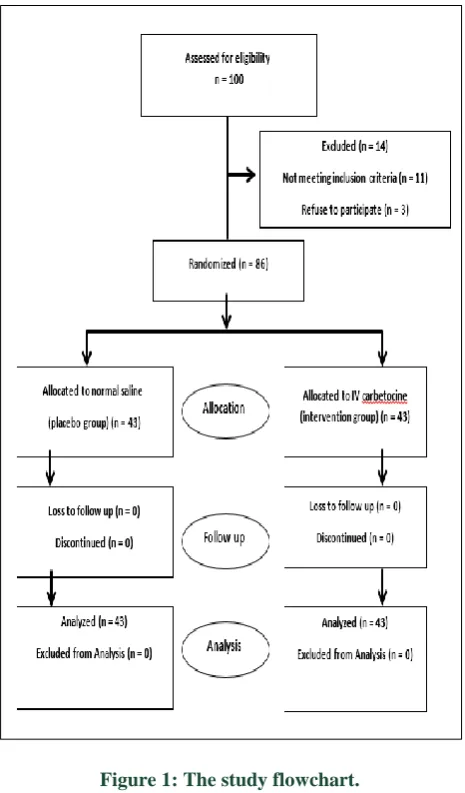
Figure 1: The study flowchart.
Statistically analysis
The data were entered and statistically analyzed using the Statistical Package for Social Sciences (SPSS) version 16. Qualitative data were described as numbers and percentages. Chi-square test was used for comparison
between groups. Quantitative data were described as means (SD) or medians, as appropriate. They were tested for normality by Kolmogorov-Smirnov test. In the normally distributed variables, independent sample t-test was used for comparison between groups. In the non-normally distributed variables, Mann-Whitney test was used for comparison between groups. Odds ratios and their 95% confidence interval were calculated. "p value ≤0.05" was considered to be statistically significant.
RESULTS
Present study started with 100 patients who were asked to participate, 14 patients were excluded, 11 patients not meeting inclusion criteria and 3 patients refuse to participate. The remaining 86 patients with, 43 patients randomized to Carbetocin (study group) and 43 patients to placebo (control group) were included in the final analysis.
There was no significant difference between the two groups with respect to their age, weight, height, body mass index (BMI), parity, myoma number, myoma stage, size of the largest myoma, uterine size and history of previous scar (Table 1).
There was high significant reduction in intraoperative blood loss in Carbetocin group (714.19 ±186.27) compared with placebo group (1033.49 ± 140.9) (P=0.0001).
The incidence of blood transfusion was increased in placebo group 30 (69.8%) patients compared with 8 (18.6%) patients in Carbetocin group, (P=0.0001).
Also, there was a highly significant reduction in operative time in Carbetocin group (66.35% ± 10.18) compared with placebo group (95.95 ±9.16), (P= 0.0001).
There was no significant difference in related to initial hemoglobin concentration between the two groups, however there was a reduction in 24-hour post-operative hemoglobin concentration in placebo group than Carbetocin group, but this reduction not reach the significant difference, (P= 0.069).
Finally, no significant difference between the two groups in related to their hospital stay, (P= 0.514). (Table 2)
Study power calculation
Table 1: Demographic criteria of the study groups.
Characteristics Placebo group (n = 43) Carbetocine group (n = 43) Significance
Age 34.49±4.39 34.84±4.41 0.714
Weight 67.77±7.11 68.19±6.51 0.777
Height 163.14±4.1 163.16±4.12 0.979
BMI 25.43±2.06 25.58±2 0.729
Parity 2 (0-5) 2 (0-4) 0.781
Myoma number 3 (1-5) 3 (1-5) 0.454
Myoma stage
3 9 (20.9) 8 (18.6)
0.979
4 11 (25.6) 10 (23.3)
5 9 (20.9) 10 (23.3)
6 14 (32.6) 15 (34.9)
Size of the largest myoma 13.09±3.85 13.21±3.41 0.882
Uterine size 20.6±4.04 20.75±3.6 0.866
Pervious scar 14 (32.6) 15 (34.9) 0.820
BMI (Body Mass Index), Variables are presented as mean±standard deviation, median (minimum–maximum) and number (percentage).
Table 2: Peri-operative variables in the study groups.
Variables Placebo group, (n = 43) Carbetocine group, (n = 43) Significance
Initial Hemoglobin 10.69±0.89 10.73±0.85 0.843
Post-operative hemoglobin 9.87±0.77 10.18±0.78 0.069
Blood loss 1033.49±140.9 714.19±186.27 0.0001*
Blood transfusion 30 (69.8) 8 (18.6) 0.0001*
Operative time 95.95±9.16 66.35±10.18 0.0001*
Hospital Stay 3.49±0.83 3.37±0.82 0.514
Variables are presented as mean±standard deviation, median (minimum–maximum) and number (percentage); * Statistically significant.
DISCUSSION
Open myomectomy remain the main option has been shown to have satisfactory result as regard fertility preservation and symptom resolution with specially when the number and size of leiomyomas do not permit any other surgical rout of the surgery. Hemorrhage remains the most important concern with open myomectomy. Blood loss during surgery largely depends on the number and size of the fibroids removed and the technique adopted during myomectomy.3
Various techniques are available to reduce intra-operative bleeding, but differences in patient characteristics make any comparison of efficacy difficult. Consequently, there is still no agreement on the preferred method of hemostasis.7
To the best of our knowledge this randomized, double-blinded study was the first designed to specifically compare the effect of Carbetocin (100 μg) IV in reduce the blood loss during open myomectomy
In this study, the mean blood loss in the placebo group was 1033mL and 714 mL in the study group. This demonstrates IV Carbetocin was associated with a mean reduction in blood loss of 310 ml.
In concordance with the present results Yang M, et al compare Carbetocin versus Oxytocin in decrease blood loss during laparoscopic myomectomy and concluded that giving Carbetocin preoperatively to laparoscopic myomectomy patients had good clinical efficacy, bringing about less blood loss, shorter operative time and rapid postoperative recovery. It is, therefore considered safe and reliable and worthy of clinical applications.12
Also, Allah G et al study the effect of intra-myometrial Carbetocin injection in reducing intraoperative blood loss during myomectomy and conclude that Injection of intra-myometrial Carbetocin was associated with less blood loss during myomectomy. Moreover, it may lower the need for blood transfusion. Patients in whom Carbetocin was used showed lower drop in their hemoglobin and hematocrit levels when measured 48 hours postoperatively.13
[image:4.595.57.544.318.405.2]Carbetocin is a newer agent that can potentially provide the benefit of longer acting maintenance of oxytocic action without the need for prolonged infusion
Carbetocin was initially developed in the 1970s as a veterinary product; it is a long-acting synthetic octapeptide analogue of oxytocin (which is a nonapeptide) with agonist properties at the oxytocin receptor. Structural differences to oxytocin include replacement of the amino-group of cysteine by a hydrogen atom, modification of the disulphide bond by a thio-ether bond and a substitution of the hydroxyl group of tyrosine by a methyloxyl group. These molecular changes give Carbetocin more stability and avoid early decomposition by disulphidase, aminopeptidase and oxidoreductase enzymes.16 The pharmacodynamic
properties of Carbetocin are comparable to those of endogenous oxytocin. Carbetocin selectively binds to oxytocin receptors in the smooth muscle of the uterus resulting in rhythmic uterine contractions, increased frequency of existing contractions, and increased uterine tone.17 Since the half-life of oxytocin is only 10 to 15
minutes, synthetic long-lasting oxytocin agonistic analogs have been synthesized. In particular, 1-desamino-1-monocarbo-(2-O-methyltyrosine)-oxytocin (carbetocin) shows structural modifications that increase its half-life, that is, by 40 minutes, and prolonging its pharmacological effects in terms of myometrial contractility.18 Carbetocin binds selectively to OXTRs in
the uterine smooth muscle. It is able both to stimulate uterine rhythmic contractions, increasing the frequency of already present contractions, and to raise the tone of the uterine muscle. It can be administered as a single-dose injection, either intravenously or intramuscularly.19
Rhythmic uterine contractions continue for 60 minutes after the intravenous injection and for 120 minutes after the intramuscular administration. Currently, a dosage of 100 mg of Carbetocin is used for the prevention of PPH.20
In the present study, we compared the pre-operative and postoperative hemoglobin and as secondary outcomes observing the change in hemoglobin and was lower in the study group but not reach statistical significance. Gad Allah et al showed in their study significant decrease of post-operative HB in control group.13
In the present study operative time and blood transfusion is statistically significant decrease in the Carbetocin group. This result was in concordance with Allah G et al and Yang, et al.12,13
One of the strength of the present study was that double blind randomized study provides the first evidence that a IV Carbetocin a simple alternative preemptive intervention for reduced intraoperative blood loss and need of blood transfusion during abdominal myomectomy. Another strength of the present study as the average amount of blood loss was the primary outcome of this research, study power was calculated online was found to be 100%.
One limitation of the present study was that we did not used alkaline hematin method which is a validated method for accurate measurement of blood loss, but instead we used a gravimetric method to measure the amount of blood loss.21 However Marcel H et al in
veterinary surgery compare gravimetric and colorimetric methods of quantifying surgical blood loss and conclude that estimation of blood loss using a gravimetric method is accurate and µobjective tool to evaluate intraoperative blood loss.22,24
CONCLUSION
A single pre-operative dose of IV Carbetocin is a simple, cost effective method for reducing intra-operative blood loss and operative time in abdominal myomectomy. Investigation of Carbetocin use in larger population groups and with different dosages and another route together with comparison of other methods used to reduce bleeding during myomectomy, is required.
Funding: No funding sources Conflict of interest: None declared
Ethical approval: The study was approved by the Institutional Ethics Committee
REFERENCES
1. Marsh EE, Ekpo GE, Cardozo ER, Brocks M, Dune T, Cohen LS. Racial differences in fibroid prevalence and ultrasound findings in asymptomatic young women (18-30 years old): a pilot study. Fertility and Sterility. 2013;99(7):1951-7.
2. Taylor A, Sharma M, Tsirkas P, Di Spiezio Sardo A, Setchell M, Magos A. Reducing blood loss at open myomectomy using triple tourniquets: a randomized controlled trial. Br J Obstet Gynaecol. 2005;112:340-5.
3. Kongnyuy EJ, Wiysonge CS. Interventions to reduce haemorrhage during myomectomy for fibroids. Cochrane Database Syst Rev. 2011:Cd005355. 4. Atashkhoei S, Fakhari S, Pourfathi H, Bilehjani E,
Garabaghi PM, Asiaei A. Effect of oxytocin infusion on reducing the blood loss during abdominal myomectomy: a double-blind randomised controlled trial. BJOG. 2016;124:292-8
5. Busnelli M, Rimoldi V, Vigano P, Persani L, Di Blasio AM, Chini B. Oxytocin-induced cell growth proliferation in human myometrial cells and leiomyomas. Fertil Steril. 2010;94:1869-74.
6. Agostini A, Ronda I, Franchi F, Bretelle F, Roger V, Cravello L, et al: Oxytocin during myomectomy: a randomized study. Eur J Obstet Gynecol Reprod Biol 2005;118:235-8.
8. Rath W. Prevention of postpartum hemorrhage with the oxytocin analogue carbetocin. Eur J Obstet Gynecol Reprod Biol. 2009;147(1):15-20.
9. Sweeney SG, Holbrook AM, Levine M, Yip M, Alfredsson K, Cappi S, et al. Pharmacokinetics of carbetocin, a long-acting oxytocin analogue, in nonpregnant women. Current Therapeutic Research-Clinical and Experimental. 1990;47(3):528-40. 10. van Dongen PW, Verbruggen MM, de Groot ANJA,
van Roosmalen J, Sporken JMJ, Schulz M. Ascending dose tolerance study of intramuscular Carbetocin administered after normal vaginal birth. Eur J Obstet Gynecol Reprod Biol. 1998;77:181-7. 11. Munro MG, Critchley HO, Broder MS, Fraser IS.
FIGO classification system (PALM-COEIN) for causes of abnormal uterine bleeding in non-gravid women in the reproductive years. Int J Gynaecol Obstet. 2011;113:3-13.
12. Yang M, Wu C, Wen X, Lin M, Li L. Using Carbetocin to prevent hemorrhage in laparoscopic myomectomy. 2012;6(27):2023-6.
13. Allah G, Sherine H, Wali A, Mostafa A, Shimaa. Hemostatic effect and postoperative benefits of intramyometrial Carbetocin injection during myomectomy: a randomized controlled trial. Evidence Based Women's Health J. 2015;5(4):185-9. 14. Su LL, Chong YS, Samuel M. Carbetocin for preventing postpartum haemorrhage. Cochrane Database of Systematic Reviews. 2012;4.
15. Meshykhi LS, Nel MR, Lucas DN. The role of Carbetocin in the prevention and management of postpartum hemorrhage. Int J Obstet Anesthesia. 2016;28:61-9.
16. Sweeney G, Holbrook AM, Levine M. Pharmacokinetics of carbetocin, a long-acting oxytocin analogue, in non-pregnant women. Curr Ther Res Clin Exper. 1990;47:528-539
17. Hunter DJ, Schulz P, Wassenaar W. Effect of carbetocin, a long-acting oxytocin analog on the postpartum uterus. Clin Pharmacol Ther. 1992;52:60-7.
18. Peters NC, Duvekot JJ. Carbetocin for the prevention of postpartum hemorrhage: a systematic review. Obstet Gynecol Surv. 2009;64(2):129-35.
19. Engstrom T, Barth T, Melin P, Vilhardt H. Oxytocin receptor binding and uterotonic activity of Carbetocin and its metabolites following enzymatic degradation. Eur J Pharmacol. 1998;355(2-3):203-10.
20. Rath W. Prevention of postpartum hemorrhage with the oxytocin analogue carbetocin. Eur J Obstet Gynecol Reprod Biol. 2009;147(1):15-20.
21. Larsson C, Saltvedt S, Wiklund I. Estimation of blood loss after caesarean section and vaginal delivery has low validity with a tendency to exaggeration. Acta Obstet Gynecol Scand. 2006;85:1448-52.
22. Lee MH, Ingvertsen BT, Kirpensteijn J, Jensen AL, Kristensen AT. Quantification of surgical blood loss. Vet Surg. 2006;35(4):388-93.
Cite this article as: Sallam HF, Shady NW.