Article
1
A highly selective fluorescent chemosensor for Al
3+
2
based on 2,2':6',2''-terpyridine with a salicylal Schiff
3
base
4
Hui Li *, Jianzhi Wang, Qingyao Fu, Feng Wang and Luying He
5
Key Laboratory for Green Chemical Process of Ministry of Education, School of Chemical Engineering and
6
Pharmacy, Wuhan Institute of Technology, Wuhan 430205, P.R.China
7
* Correspondence: [email protected] (Hui Li)
8
Received: date; Accepted: date; Published: date
9
Abstract: Two 2,2':6',2''-terpyridine-based Schiff bases (TPySSB and TPySB) have been
10
synthesized. The TPySSB shows remarkable selective ‘off-on’ fluorescence for Al
3+by
11
photoinduced electron transfer (PET) mechanism of sensing. Chemosensor TPySSB binds Al
3+in a
12
1:2 ratio with an association constant 6.8×10
5(R
2=0.98) and this 1:2 stoichiometric model is
13
established on Job’s plot and
1H NMR. Compared TPySSB and TPySB, it is of great importance of
14
the existence of salicylidene unit due to its strong binding abilities of both phenol and C=N
15
structure to the Al
3+.
16
Keywords: 2,2':6',2''-terpyridine; Salicylidene Schiff bases; Fluorescence sensor; Al
3+17
18
1. Introduction
19
Al
3+ions exists in natural waters and most plants, which can enter the human body through
20
food and water[1]. Since Al
3+is closely related to human health, much attention have been paid to
21
developing new fluorescent chemosensors with high selectivity and sensitivity to detect Al
3+[2-7].
22
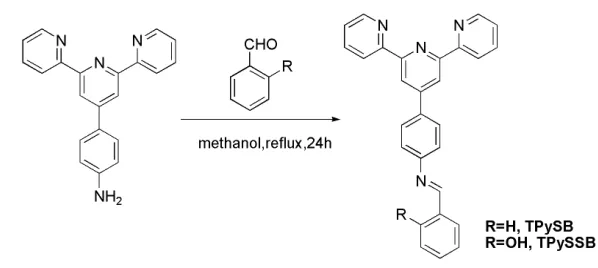
At present, fluorescent chemosensors have been widely used to detect different metal ions because
23
of their high sensitivity, selectivity and fast response time[8-12]. Typically, metal ion chemosensors
24
are composed of a metal binding unit and signaling unit, which enable the fluorescent chemosensors
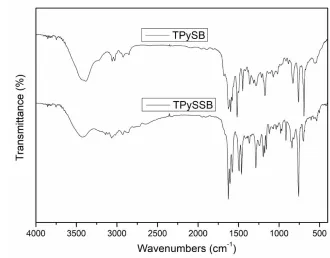
25
to coordinate with metal ions. Later on, fluorescent sensors based on a large group of structurally
26
different metal binding units, including pyrazoline[13], peptide[14], salicylimine[15], tetrazole[16],
27
triazole[17], 4,5-diazafluorene[7,8] and 2,2':6',2''-terpyridine (TPy)[18-20] have been developed.
28
Among these receptors, 2,2':6',2''-terpyridine moiety is an ideal model for the construction of
29
fluorescence sensors because of its excellent coordination ability with various metal ions[21]. Indeed,
30
it has become one of the most important chemical sensors in supramolecular chemistry. There are
31
reports about the detection of anion and cation by 2,2':6',2''-terpyridine based fluorescent
32
chemosensor [22-25]. However, there is still no report about fluorescent sensing of Al
3+by
33
2,2':6',2''-terpyridine derivatives. Therefore, the design and preparation of 2,2':6',2''-terpyridine
34
based fluorescent chemosensors are necessary for the construction and development of sensors for
35
detecting Al
3+with high selectivity and sensitivity.
36
Salicylidene Schiff bases (SSB) has attracted increasing attention because they enable simple
37
and inexpensive determinations of various metal ions. Over the past decades, it has been
38
demonstrated that the presence of phenolic OH and the nitrogen atom of azomethine C=N double
39
bond in Schiff base exhibits a strong affinity for transition metal ions[26,27]. Due to the formation of
40
the chelatogenic cycle (metal-oxygen-nitrogen chain), the intramolecular charge transfer (ICT) was
41
highly improved between the π-conjugated rings. Mostly, these kinds of molecules display unique
42
emission enhancement due to strong binding abilities of both phenol and C=N structure to the metal
43
ions. Therefore, combination of 2,2':6',2''-terpyridine and salicylidene Schiff base into a unique entity
44
can give rise to an interesting system with very peculiar coordination properties. Herein, we report
45
the design and synthesis of two new 2,2':6',2''-terpyridine Schiff base TPySSB and TPySB. Their
46
binding properties toward metal ions have been investigated. The salicylidene Schiff base TPySSB
47
could be used as efficient fluorescence probes for Al
3+with high selectivity. As being fluorescence
48
chemosensor, TPySSB with phenolic OH groups shows better Al
3+sensing properties than TPySB
49
due to the formation of terpyridine-Al
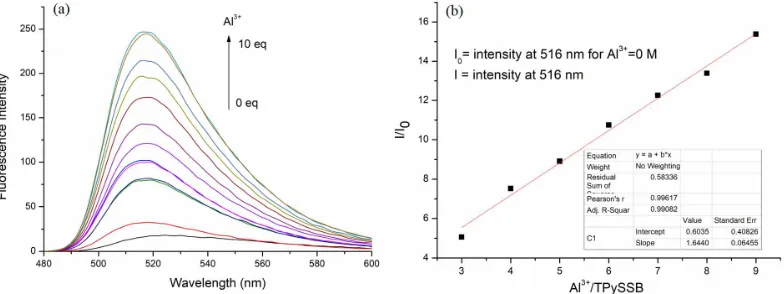
3+complex and chelatogenic cycle.
50
2. Results
51
2.1. Synthesis and
C
haracterization
52
53
Scheme 1. Synthesis of TPySSB and TPySB
54
Synthesis of the Schiff base derivatives TPySSB and TPySB is showen in Scheme 1. Compound
55
TPySSB
(or
TPySB)
was
synthesized
by
a
condensation
reaction
between
56
4'-amine-2,2':6',2''-terpyridines and salicylaldehyde (or benzaldehyde) in refluxing methanol. The
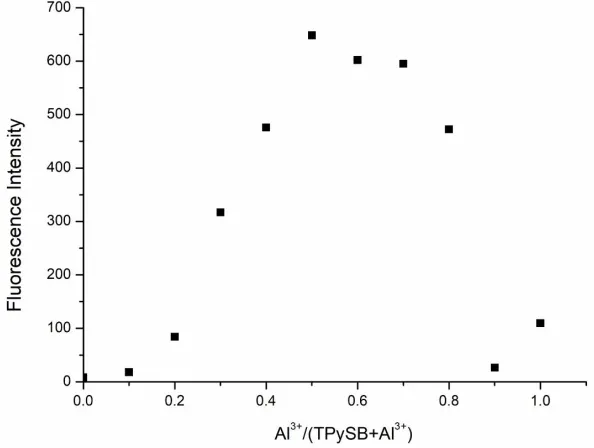
57
products were obtained in high yield and characterized by FT-IR and
1H NMR, respectively. The
58
FT-IR spectra (Figure S1) of compounds TPySSB and TPySB present the characteristic absorption of
59
(C=N) vibration at 1622 and 1620 cm
-1, respectively. An O-H stretching band for TPySSB appears as
60
a broad band centered at 3428 cm
-1. The
1H NMR spectra of TPySSB and TPySB in acetone-d
6exhibit
61
the signals corresponding to the molecule as expected. The spectrum of TPySB, the chemical shift of
62
-CH=N proton shifted downfield about 8.62 ppm (Figure S2). In the spectrum of TPySSB displays a
63
singlet at 13.18 ppm corresponding to -OH. And the chemical shift of -CH=N proton shifted
64
downfield about 8.96 ppm comparing with that of TPySSB (Figure S3)[28], which confirms the
65
formation of an intermolecular hydrogen bonding of the phenol OH.
66
2.2.
Recognition Experiment of Schiff base (TPySSB and TPySB) in the Presence of Various Metal Ions
67
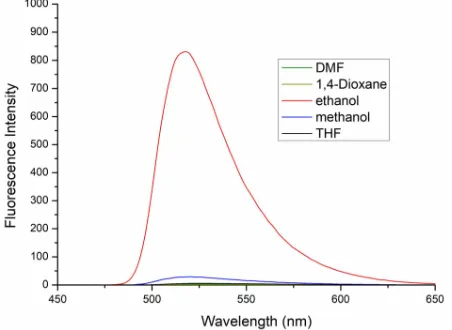
To compare the fluorescence response behavior of Schiff base (TPySSB and TPySB) in the
68
presence of various metal ions, the recognition experiment of Schiff base (TPySSB and TPySB) was
69
investigated in ethanol at room temperature. As shown in Figure 1a, TPySSB alone and other
70
cations all displayed a weak single fluorescence emission band at 528 nm when it was excited at 265
71
nm except for Al
3+and Pb
2+. Upon addition of Al
3+, TPySSB shows a large fluorescence enhancement
72
at 516 nm due to the formation of TPySSB-Al
3+complex which inhibits photo-induced electron
73
transfer (PET) process[29]. The selectivity of TPySSB for Al
3+has been plotted as a bar graph in
74
Figure 1b. The fluorescence enhancement efficiency observed was 51-fold at 516 nm, which
75
indicated the Schiff base TPySSB is a highly selective fluorescent sensor for Al
3+. TPySB alone
76
displayed a weak single fluorescence emission band at 329 nm and 410 nm when it was excited at
77
258 nm. However, upon addition of various metal ions, almost all metal ions exhibited obviously
78
fluorescence significant changes at 329 nm (Ag
+, Cu
2+, Fe
3+, Fe
2+, Cr
2+and Al
3+) or 410 nm (Co
2+, Mn
2+,
79
Mg
2+, Pb
2+, Sr
2+and Zn
2+) except for alkali metals such as Na
+, K
+and Li
+(Figure 1c), indicating the
80
formation of metal-ligand complexes. These results prove that terpyridine ligand have strong ability
81
to coordinate with metal ions. By analyzing the structure of TPySSB and TPySB, we can draw the
82
following conclusions. it is of importance of the present of salicylidene unit due to strong binding
83
abilities of both phenol and C=N structure to the Al
3+[30]. Besides, it is the chelation of nitrogen atom
84
of 2,2':6',2''-terpyridine with Al
3+, which induced the efficient inhibition for the PET process, that
improve the performance of the TPySSB. Surprisingly, a highly selective fluorescent sensor for Al
3+86
is designed by combining 2,2':6',2''-terpyridine unit and salicylidene unit.
87
88
Figure 1. (a) The fluorescence spectra of the TPySSB (1×10⁻⁵ mol/L) in the presence of 10 equiv. of various metal
89
ions in ethanol. Excitation wavelength (nm): 265; (b) The fluorescence spectra of the TPySB (1×10⁻⁵ mol/L) in the
90
presence of 10 equiv. of various metal ions in ethanol. Excitation wavelength (nm): 258; (c) The fluorescence
91
emission response profiles for TPySSB (1×10⁻⁵ mol/L) by adding various metal ions (1×10⁻⁴ mol/L) at 516 nm in
92
ethanol; (d) The fluorescence emission response profiles for TPySB (1×10⁻⁵ mol/L) by adding various metal ions
93
(1×10⁻⁴ mol/L) at 329 nm in ethanol.
94
2.3. Selectivity Study of Schiff base (TPySSB and TPySB) for Al
3+over Competitive Metal Ions
95
The selectivity of chemosensor for Al3+ in comparison to other competing metal ions is a very important
96
parameter for evaluating their sensing performance. To further confirm the high selectivity of chemosensor
97
TPySSB as selective fluorescent sensors for Al3+, competitive selectivity experiments of chemosensor TPySSB
98
toward various metal ions were examined in ethanol. In a single metal system (black bars), all the metal ions
99
(Ag+, Ba2+, Ca2+, Cd2+, Co2+, Cr3+, Cu2+, Fe2+, Fe3+, Hg2+, K+, Li+, Mg2+, Mn2+, Na+, Ni2+, Sr2+, Pb2+ and Zn2+)
100
concentrations were kept as 100 µM towards TPySSB. However, for the dual-metal (red bars) studies, two
101
equal amounts of aqueous solutions of Al3+ and other metal ions (100 µM+100 µM) were combined. Relatively
102
low interferences were observed for the detection of Al3+ in the presence of other metal ions, except for Fe3+
103
(Figure 2). While compared of competitive selectivity experiments of chemosensor TPySSB, the results of
104
chemosensor TPySB showed high interferences in the presence of other metal ions, except foralkali metals such
105
as Na+, K+ and Li+(Figure S4). The unique selectivity of TPySSB towards Al3+ could be interpreted as the strong
106
108
Figure 2. Fluorescence response of receptor TPySSB (1×10⁻⁵ mol/L). The black bar represents emission intensity
109
after adding 10 equvi. selected metal ions in ethanol solution and red bar represent emission intensity after
110
adding 10 equvi. of Al3+ ions in each of the above samples. Excitation wavelength (nm): 265
111
2.4. Fluorescence Titration of Schiff base (TPySSB) in the Presence of Increasing Concentration of Al
3+112
Fluorescence titration experiments were carried out to gain insight into the binding interaction between
113
TPySSB with Al3+. With an increasing concentration of Al3+ resulted in a very small (8 nm) blue-shift of the
114
emission maxima with a 14-fold enhancement of the fluorescence intensity (Figure 3a). The calibration curve is
115
linear with a correlation coefficient (R2=0.990) between the emission intensity at 516 nm and the Al3+
116
concentration from 30 to 90 µM (Figure 3b).
117
118
Figure 3. (a) Fluorescence emission spectra of receptor TPySSB (1×10⁻⁵ mol/L) in ethanol solution upon addition
119
of increasing concentration of Al3+ (3-9 equvi.). Excitation wavelength (nm): 265; (b) fluorescence intensity at 516
120
nm versus the number of equivalents of Al3+ added
121
2.5. UV-vis Titration of Schiff base (TPySSB) in the Presence of Increasing Concentration of Al
3+122
The chemosensor TPySSB toward various metal cations, Ag+, Ba2+, Ca2+, Cd2+, Co2+, Cr3+, Cu2+, Fe2+, Fe3+, Hg2+, K+,
123
Mn2+, Na+, Ni2+, Pb2+ and Zn2+ are investigated by UV-vis spectroscopy in ethanol. The absorption spectrum of
124
chemosensor TPySSB exhibited three absorbance peaks. The intense absorption band in high energy region at
125
210 nm and 275 nm was attributed to the π–π* transitions of the terpyridine unit[31], and a broad band at 300 to
126
400 nm could be assigned to π→π* transition of the C=N group from salicylidene moiety[32]. With the
127
increasing concentration of Al3+, the UV-vis spectrum appeared 14 nm red-shifted in the 210 nm band which
128
was attributed to the form of 2,2':6',2''-terpyridine-Al3+ complex, and the absorption maximum at 350 nm
129
decreased which was attributed to the form of salicylidene-Al3+ complex (Figure 4b). What’ more, no significant
130
132
Figure 4. (a) The UV-vis spectra of the TPySSB (1×10⁻⁵ mol/L) in the presence of 10 equiv. of various metal ions
133
in ethanol. (b) Change in absorption spectra of TPySSB (1×10⁻⁵ mol/L) upon addition of increasing
134
concentration of Al3+ (0-10 equvi.) in ethanol
135
2.6. Job’s plot measurements
136
To further explore the binding mechanism, the binding stoichiometry of TPySSB with Al3+ was investigated via
137
a Job’s plot of the fluorescence titrations of Al3+, and the total concentration of Al3+ and TPySSB was kept as 20
138
µM as shown in Figure 5. A maximum absorption was observed when the molar fraction reached 0.7, which is
139
indicative of a 1:2 stoichiometric complexation between TPySSB and Al3+ for the newly formed complex. The
140
binding stoichiometry of TPySB with Al3+ was also investigated and the results indicated a 1:1 stoichiometric
141
complexation between TPySB and Al3+ (Figure S5). Therefore, the introduction of the phenolic OH into the
142
2,2':6',2''-terpyridine-based Schiff base has led to new chemosensor with highly selective detection of Al3+.
143
144
Figure 5. Job’s plot for the complexation of TPySSB with Al3+ in ethanol.
145
2.7. Determination of Association Constant and Detection Limit
146
Based on the fluorescence titration of TPySSB with Al3+, the association constant has been calculated to be
147
6.8×10⁵ M−1 (Figure 6) by a Benesi-Hildebrand equation. The binding constants of the inclusion complex were
148
obtained from the fluorescence titration data. According to the Benesi–Hildebrand method, the equation for a
149
1:2 host:guest complex is given below:
150
2min max
log
I
I
log
M
log
K
dI
I
(1)
151
In this equation Kd is the dissociation constant and different fluorescence emission intensity Imin, I and Imax are
152
metal represent by M and association constant Ka was evaluated graphically by the plot of log [(I-Imin)/(Imax-I)]
154
versus log[(Al3+)2]. Figure 3b also further confirms the good linearity between enhancing efficiency (I/I0) at 516
155
nm and concentrations of Al3+ in the range from 30 to 90 µM, indicating that sensor TPySSB can detect
156
quantitatively relevant concentrations of Al3+.
157
158
Figure 6. Hill plot of fluorescent probe (TPySSB+ Al3+) at λem=516 nm
159
The detection limits (DLs) were calculated using the following equation:
160
S
DL
3
(2)
161
where σ is the standard deviation of the blank measurement, which is 0.4 (n=11) here, and S is the slope between
162
the emission intensity vs the concentration of aluminum ion. The detection limit of Al3+ is 3.32×10⁻⁷ mol/L
163
2.8. Effects of solvent on the Sensing Properties of Schiff base TPySSB towards Al
3+164
Optical sensing nature of chemosensors was found to be depended on the solvent nature, so the response of
165
TPySSB towards Al3+ was also examined in different solvents such as ethanol, DMF, methanol, THF,
166
1,4-dioxane at maxima of emission intensity. As shown in Figure 7, the optimum fluorescence enhancement
167
occurred in ethanol. Other solvents such as the THF, 1,4-dioxane, DMF, methanol have no significant effect on
168
the intensity of fluorescent. So ethanol was chosen as solvent.
169
170
Figure 7. The fluorescence spectra of the
TPySSB (
10 µM) in the presence of 10 equiv. of Al3+ in different171
solvents. Excitation wavelength (nm): 265.
172
To gain a clearer understanding of the structure of TPySSB-Al3+ complex, we used IR spectroscopy to obtain
174
structural information about Al3+ binding in TPySSB. For the free compound TPySSB, the C=N group of
175
azomethine in Schiff base showed a characteristic IR peak at 1573 cm-1, and the C-O group of salicylidene in
176
Schiff base showed a characteristic IR peak at 1188 cm-1. Upon addition of Al3+, the characteristic IR peak at 1573
177
and 1188 cm-1 disappeared, and new characteristic IR peak at 1703, 1523 and 1385 cm-1 appeared (Figure 8). This
178
suggested that the phenolic OH, the nitrogen atom of azomethine and the pyridine participates in the
179
coordination with Al3+.
180
181
Figure 8. FTIR spectra of chemosensor TPySSB and TPySSB-Al3+ complex.
182
The complexation of TPySSB and Al3+ was also supported by Al3+ induced chemical shift of TPySSB changes in
183
the 1H NMR spectra. In the presence of 2.1 equivalents of Al3+ ions, chemical shift of proton NMR signals
184
corresponding to the proton of the phenolic OH and azomethine-H got disappeared (Figure 9). Based on above
185
IR spectroscopy, NMR spectroscopy studies and Job’s plot, the proposed binding model of TPySSB with Al3+
186
was shown in Figure 10. The chemosensor TPySSB is the most likely to chelate Al3+ via its oxygen on phenolic
187
group and nitrogen on the azomethine and pyridine. The capture of Al3+ resulted in the photoinduced electron
188
transfer (PET) electron from TPySSB to Al3+; thus, TPySSB showed a significant fluorescence enhancement for
189
Al3+ and provided a high selectivity for Al3+ over the other tested metal ions.
190
191
Figure 9. 1H NMR spectra of TPySSB with Al(NO3)3·9H2O in acetone-d6 (1) TPySSB; (2) TPySSB with 2.2 equiv.
192
194
Figure 10. Proposed mechanism for the fluorescent sensing of TPySSB to Al3+.
195
3. Materials and Methods
196
3.1. Materials and Instruments
197
4'-amine-2,2':6',2''-terpyridines was synthesized by a method previously described in the
198
literature[33]. Salicylaldehyde and benzaldehyde were purchased from Innochem and used without
199
further purification. All organic solvents were of analytical reagent grade. The metal ions were NaCl,
200
KCl, CaCl
2, MgCl
2·6H
2O, NiCl
2·6H
2O, CuCl
2·2H
2O, ZnCl
2, BaCl
2·2H
2O, HgCl
2, CoCl
2·6H
2O,
201
MnCl
2·4H
2O, FeCl
2·4H
2O, FeCl
3·6H
2O, CrCl
3·6H
2O, Cd(NO
3)
2·4H
2O, Pd(NO
3)
2, Al(NO
3)
3·9H
2O,
202
AgNO
3. All the metal ion solutions for the study were prepared in distilled water. The
1H NMR and
203
13
C NMR spectra were measured on a JEOL EX-400 spectrometer using acetone-d
6as solvent and
204
tetramethylsilane as the internal reference. UV-vis spectra were examined on a Lambda 35
205
spectrophotometer and fluorescent recorded on a LS-55 spectrofluorophotometer.
206
3.2. Synthesis
207
3.2.1. Synthesis of the salicylidene Schiff base (TPySSB)
208
4'-amine-2,2':6',2''-terpyridines (0.324 g, 1 mmol) was placed into a 100 ml round-bottom flask with
209
condenser, thermometer and magnetic stirrer. Methanol (40 ml) was added into the flask and
210
reaction mixture was heated up to 80 °C. A solution of salicylaldehyde (0.122 g, 1 mol) in 10 ml
211
methanol was added into the flask. Reactions were maintained for 24 h under reflux. The resulting
212
solution was cooled to room temperature to give yellow powder, which was filtered, washed with
213
methanol and dried under vacuum to obatin yellow powder product. (0.35 g, yield: 82.4%). FT-IR
214
(KBr, cm
-1, Figure S1): 3410 cm
-1(O–H), 3054 cm
-1(C–N), 1622 cm
-1(C=N), 1573 cm
-1(C=C), 1493 and
215
1454 cm
-1(C=N), 1279 cm
-1(C–O);
1H NMR (Acetone-d
6, δ, ppm, TMS, Figure S2): 13.18 (s, -OH), 8.96
216
(s, -N=CH), 7.96 (d, J=8 Hz, 2H), 7.86 (d, J=8 Hz, 2H), 7.58 (d, J=8 Hz, 2H), 7.49 (d, J=8 Hz, 2H), 7.31-7.46
217
(m, 8H), 6.94 (d, J=8 Hz, 2H).
218
3.2.2. Synthesis of the Schiff base (TPySB)
219
The Schiff base (TPySB) was also synthesized by the same method. (0.37 g, yield: 89.8%). FT-IR (KBr,
220
cm
-1, Figure S1): 3059 and 3026 cm
-1(C–N), 1620 cm
-1(C=N), 1517 cm
-1(C=C), 1446 cm
-1(C=N);
1H
221
NMR (Acetone-d
6, δ, ppm, TMS, Figure S3): 8.56 (s, -N=CH), 8.02-6.73 (m, 19H).
222
5. Conclusions
223
In summary, we have developed two new 2,2':6',2''-terpyridines-derived Schiff base chemosensors
224
(TPySSB and TPySB) for the highly selective determination of Al
3+in ethanol. The sensing property
225
of TPySSB and TPySB was studied by UV-vis, fluorescence FT-IR and
1H NMR experiments. Upon
226
addition of metal ions, the TPySSB shows remarkable ‘off-on’ fluorescence for Al
3+. Moreover, it
227
displayed excellent selectivity to Al
3+with a 1:2 binding mode which was proposed based on a Job’s
plot and confirmed by
1H NMR analysis. Based on these results, we believe that combining
229
2,2':6',2''-terpyridine unit and salicylidene unit will offer an important guidance to the development
230
of a highly selective chemosensor base on 2,2':6',2''-terpyridine unit.
231
Supplementary Materials: The following are available online at www.mdpi.com/xxx/s1, Figure S1: FT-IR
232
spectrum of TPySB and TPySSB, Figure S2: 1H NMR spectrum of TPySSB, Figure S3. 1H NMR spectrum of
233
TpySB, Figure S4. Fluorescence response of receptor TPySB (1×10⁻⁵ mol/L). The black bar represents emission
234
intensity after adding 10 equvi. selected metal ions in ethanol solution and red bar represent emission intensity
235
after adding 10 equvi. of Al3+ ions in each of the above samples. Excitation wavelength (nm): 258, Figure S5.
236
Job’s plot for the complexation of TPySB with Al3+ in ethanol.
237
Author Contributions: conceptualization, Hui Li and Jianzhi Wang; resources, Feng Wang; data curation,
238
Yuling He; writing—original draft preparation, Hui Li; writing—review and editing, Qingyao Fu.
239
Funding: This research was funded by the National Natural Science Foundation of China, grant number
240
51808414, China Postdoctoral Science Foundation, grant number 2017M612520, National Science Foundation of
241
Hubei Province of China, grant number 2016CFB264 and 2018CFB108 and the Program of Hubei Provincial
242
Department of Education, China, grant number Q20171507.
243
Conflicts of Interest: The authors declare no conflict of interest.
244
Appendix A
245
Supplementary data.
246
247
249
Figure S2.
1H NMR spectrum of TPySSB
250
251
253
Figure S4.
Fluorescence response of receptor TPySB (1×10⁻⁵ mol/L). The black bar represents emission254
intensity after adding 10 equvi. selected metal ions in ethanol solution and red bar represent emission intensity
255
after adding 10 equvi. of Al3+ ions in each of the above samples. Excitation wavelength (nm): 258
256
257
Figure S5.
Job’s plot for the complexation of TPySB with Al3+ in ethanol.258
References
261
1. Berthon, G. Chemical speciation studies in relation to aluminium metabolism and toxicity. Coordin
262
Chem Rev 1996, 149, 241-280.
263
2. Wan, C.; Li, H.; Wang, J.; Wang, F.; Shu, G.; He, L. Significant improved selectivity of a fluorescent
264
sensor for Al3+ made from a fluorinated rhodamine b schiff base. Res Chem Intermediat 2019, 45,
265
1815-1827.
266
3. Liang, C.; Bu, W.; Li, C.; Men, G.; Deng, M.; Jiangyao, Y.; Sun, H.; Jiang, S. A highly selective
267
fluorescent sensor for Al3+ and the use of the resulting complex as a secondary sensor for ppi in
268
aqueous media: Its applicability in live cell imaging. Dalton Trans 2015, 44, 11352-11359.
269
4. Li, H.; Wang, J.; Zhang, S.; Gong, C.; Wang, F. A novel off-on fluorescent chemosensor for Al3+ derived
270
from a 4, 5-diazafluorene schiff base derivative. Rsc Adv 2018, 8, 31889-31894.
271
5. Zhang, S.J.; Li, H.; Gong, C.L.; Wang, J.Z.; Wu, Z.Y.; Wang, F. Novel 4, 5-diazafluorene-based schiff
272
base derivatives as Al3+ ions fluorescence turn-on sensors. Synthetic Met 2016, 217, 37-42.
273
6. Sun, J.; Ye, B.; Xia, G.; Wang, H. A multi-responsive squaraine-based "turn on" fluorescent
274
chemosensor for highly sensitive detection of Al3+, Zn2+ and Cd2+ in aqueous media and its biological
275
application. Sens. Actuators, B 2017, 249, 386-394.
276
7. Zhang, S.J.; Li, H.; Gong, C.L.; Wang, J.Z.; Wu, Z.Y.; Wang, F. Novel 4,5-diazafluorene-based schiff
277
base derivatives as Al3+ ions fluorescence turn-on sensors. Synthetic Met 2016, 217, 37-42.
278
8. Li, H.; Zhang, S.; Gong, C.; Wang, J.; Wang, F. A turn-on and reversible fluorescence sensor for zinc ion
279
based on 4,5-diazafluorene schiff base. J Fluoresc 2016, 26, 1555-1561.
280
9. Li, J.; Hu, Q.; Yu, X.; Zeng, Y.; Cao, C.; Liu, X.; Guo, J.; Pan, Z. A novel rhodamine-benzimidazole
281
conjugate as a highly selective turn-on fluorescent probe for Fe3+. J Fluoresc 2011, 21, 2005.
282
10. Piyanuch, P.; Watpathomsub, S.; Lee, V.S.; Nienaber, H.A.; Wanichacheva, N. Highly sensitive and
283
selective Hg2+-chemosensor based on dithia-cyclic fluorescein for optical and visual-eye detections in
284
aqueous buffer solution. Sens. Actuators, B 2016, 224, 201-208.
285
11. Li, J.; Zeng, Y.; Hu, Q.; Yu, X.; Guo, J.; Pan, Z. A fluorescence “turn-on” chemodosimeter for Cu2+ in
286
aqueous solution based on the ion promoted oxidation. Dalton T 2012, 41, 3623-3626.
287
12. Sinha, S.; Chowdhury, B.; Ghosh, P. A highly sensitive esipt-based ratiometric fluorescence sensor for
288
selective detection of Al3+. Inorg Chem 2016, 55, 9212-9220.
289
13. Hu, S.; Song, J.; Wu, G.; Cheng, C.; Gao, Q. A new pyrazoline-based fluorescent sensor for Al3+ in
290
aqueous solution. Spectrochim Acta A 2015, 136, 1188-1194.
291
14. In, B.; Hwang, G.W.; Lee, K. Highly sensitive and selective detection of Al(Ⅲ) ions in aqueous buffered
292
solution with fluorescent peptide-based sensor. Bioorg Med Chem Lett 2016, 26, 4477-4482.
293
15. Wang, H.; Wang, B.; Shi, Z.; Tang, X.; Dou, W.; Han, Q.; Zhang, Y.; Liu, W. A two-photon probe for Al3+
294
in aqueous solution and its application in bioimaging. Biosens Bioelectron 2015, 65, 91-96.
295
16. Ding, W.; Cao, W.; Zheng, X.; Ding, W.; Qiao, J.; Jin, L. A tetrazole-based fluorescence “turn-on” sensor
296
for Al(Ⅲ) and Zn(ΙΙ) ions and its application in bioimaging. Dalton T 2014, 43, 6429-6435.
297
17. Bian, G.; Guo, Y.; Lv, X.; Zhang, C. A triazole based fluorescence “turn-on” sensor for Al(Ⅲ) and Zn(ΙΙ)
298
ions. J Mol Struct 2016, 1111, 1-8.
299
18. Chao, D.; Ni, S.; Mu, W. One-pot synthesis of a terpyridine derivate with selective fluorescence
300
response to Zn2+ in aqueous solution and its application in bioimaging. Chem Lett 2016, 45, 27-29.
301
19. Li, L.; Du, L.-t.; Sun, J.; Yan, C.-g. Synthesis, crystal structure of bis-terpyridinyl-calix 4 arene
302
20. Hu, Q.; Tan, Y.; Liu, M.; Yu, J.; Cui, Y.; Yang, Y. A new highly selective and sensitive fluorescent probe
304
for Zn2+ and its application in cell-imaging. Dyes Pigments 2014, 107, 45-50.
305
21. Sun, S.; Wang, C.; Han, S.; Jiao, T.; Wang, R.; Yin, J.; Li, Q.; Wang, Y.; Geng, L.; Yu, X. Interfacial
306
nanostructures and acidichromism behaviors in self-assembled terpyridine derivatives
307
langmuir-blodgett films. Colloid Surface A 2019, 564, 1-9.
308
22. Abdalrahman, M.A.; Abebe, F.; Briggs, J.; Kassel, W.S.; Burdette, S.C.; Seitz, W.R.; Planalp, R.P. A
309
bifunctional 2,2 ':6 ',2 ''-terpyridine-based ligand for ratiometric Cu(ΙΙ) sensing. J Coord Chem 2017, 70,
310
1123-1136.
311
23. Jing, S.; Zheng, C.; Pu, S.; Fan, C.; Liu, G. A highly selective ratiometric fluorescent chemosensor for
312
Hg2+ based on a new diarylethene with a stilbene-linked terpyridine unit. Dyes Pigments 2014, 107,
313
38-44.
314
24. Li, P.; Xiao, H.; Tang, B. A near-infrared fluorescent probe for selective simultaneous detection of
315
Fe2+and Cl- in living cells. Chinese J Chem 2012, 30, 1992-1998.
316
25. Bhaumik, C.; Das, S.; Maity, D.; Baitalik, S. A terpyridyl-imidazole (tpy-himzph(3)) based bifunctional
317
receptor for multichannel detection of Fe2+ and F- ions. Dalton T 2011, 40, 11795-11808.
318
26. Fang, B.; Liang, Y.; Chen, F. Highly sensitive and selective determination of cupric ions by using
319
N,N'-bis(salicylidene)-o-phenylenediamine as fluorescent chemosensor and related applications.
320
Talanta 2014, 119, 601-605.
321
27. Gou, C.; Wu, H.; Jiang, S.; Yi, C.; Luo, J.; Liu, X. A highly selective colorimetric chemosensor for Mn2+
322
based on bis(n-salicylidene)ethylenediamine in pure aqueous solution. Chem Lett 2011, 40, 1082-1084.
323
28. Chalmardi, G.B.; Tajbakhsh, M.; Hasa, N.; Bekhradnia, A. A new Schiff-base as fluorescent
324
chemosensor for selective detection of Cr3+: An experimental and theoretical study. Tetrahedron 2018,
325
74, 2251-2260.
326
29. Kopchuk, D.S.; Prokhorov, A.M.; Slepukhin, P.A.; Kozhevnikov, D.N. Design of ICT-PET fluorescent
327
probes for Zinc(ΙΙ) based on 5-aryl-2,2 '-bipyridines. Tetrahedron Lett 2012, 53, 6265-6268.
328
30. Xu, H.; Tao, X.; Li, Y.; Shen, Y.; Wei, Y. Synthesis, characterization and metal ion-sensing properties of
329
two schiff base derivatives. Spectrochim Acta A 2012, 91, 375-382.
330
31. Tang, Y.; Cui, S.; Pu, S. A dual-channel sensor for Hg2+ based on a diarylethene with a rhodamine b
331
unit. J Fluoresc 2016, 26, 1421-1429.
332
32. Zhang, C.; Pu, S.; Sun, Z.; Fan, C.; Liu, G. Highly sensitive and selective fluorescent sensor for zinc ion
333
based on a new diarylethene with a thiocarbamide unit. J Phys Chem B 2015, 119, 4673-4682.
334
33. Li, H.; Zhang, S.; Gong, C.; Li, Y.; Liang, Y.; Qi, Z.; Chen, S. Highly sensitive and selective fluorescent
335
chemosensor for Ni2+ based on a new poly(arylene ether) with terpyridine substituent groups. Analyst
336
2013, 138, 7090-7093.
337
338