233
Identification and Prioritization of Grain Discharging Operations Risks by Using
ORESTE Method
Hassan Jafari
Department of Marine Transportation, Faculty of Maritime Economics and Management, Khoramshahr Marine Science and Technology University, Khoramshahr, Iran
Abstract
Exposing the acts of unloader, sucker and Grab in the grain terminal of Imam Khomeini port by manipulating ORESTE and Shannon's Entropy Methods in the three phases will lead to identification and prioritization of the grain discharging processes risks from the ship. In the first phase, by the analysis of the events and occurred incidents information bank about the surveyed matters and also setting brainstorming sessions with the terminal’s experts, 22 risks were identified. In the second phase by using from the Shannon’s Entropy, the criteria (occurrence frequency, severity and detection) were weighted. Then based on the mentioned criteria the identified risks were scored in form of a scale from 1 to 10. Finally according to the obtained scores of each risk, the ORSTE decision matrix was conducted and subsequently in the third phase by using this method, all of the identified risks were prioritized.
Keywords: Risk, grain discharging, Imam Khomeini port, ORESTE, grain terminal
Introduction
1Nowadays the security management standard and the workplace hygiene, OHSAS 18001 is considered one of the management way for promoting the security level and the workplace hygiene in a lot of organizations using the unity IMS standard frame that is in the initializing and designing mood. The first
Corresponding author’s email address:
step towards the implementation work should be the operational plans and designs due to detecting the risks and evaluating their dangers and developing some processes that concern to decrease the risks.
Hereby, the organizations, after this accomplishment should review the information and following to it, the personnel must be aware of the peripheral dangers that may occur alternatively.
Journal of Asian Business Strategy
234 (Balmat et al., 2011). According to the above mentioned matter, initializing and implementing the unity IMS management system in the dedicated grain terminal will enhance the necessity to detecting and analyzing the risks and evaluate their prioritization (Bartolomei et al., 2008).
This study, based to the vast activity of this terminal, exclusively probe the grain discharging processes from the ship by using unloader, sucker and Grab for detecting and evaluating the risks. In this study by using the ORESTE and Shannon’s Entropy methods the identified risks were prioritized based on their frequency of occurrence, the impact which they will trace after the occurrence (severity) and the probability of the recognizing before the incident (detection).
Risks and risks evaluation’s methods Risk: In fact risk is the potential that a chosen action or activity (including the choice of inaction) will lead to an undesirable outcome, and in the security matter defines as the consequence and probability of a hazardous event or phenomenon (Brito et al., 2010).
Risk management: Without doubt, is one of the most important matters that human beings are involved in it and is continuous especially in the complex matters (Clothier & Walker, 2012).
So having the necessities and be a warring of these matters may help to the preciosity of the decision making and risk management is
considered one of these important asset that can be a key of the solution for such matters (Fabiano et al., 2010).
So this will enhance particularly when a complex set of factors and consequences are responsible for external and internal vulnerabilities decision causes in the room and the demands of the customers and the nominee should be prepared according to their benefits. This matter is of high sensation.
Also a set of widespread activity is running in the room of the ports per se that these notions will implies an influence on the outcome.in the most of the times, these phenomenon are not carry a high stress but they are so numerous that cause the possibility of loss, injury, or other adverse or unwelcome circumstance (McGraw, 1982).
However, by cursory and slight glance on the matter of the ports security it may not understand the risk management to its profound meaning. Risk management is a dynamic system that includes a set of risk cause identification, risk values estimation, risk programming and how to reduce and control these risky actions (Fabiano et al., 2010).
235 Risk management is not superseding with the individuals’ experience but it can only help the experienced individuals to use their experience in the optimal situation. Risk management with high quality prepared information in the management delivery can help the managers to select the cost of the organization in the economic way of budget and use it on its appropriate way. Risk management can provide a far-sighted prospect for the experts to foreseen the probable risks and in order to prevent such risks; they can plan and perform in a preemptions manner (Jafari, 2013).
In whole it is performable in the quality and quantity forms.In fact, Qualitative Risk Management directly depends on experts experience and their own judgments during the process. However, such data and information during the process may fail to have correct and precise values and logic but they are better than nothing. Risk quality evaluation, in fact, is a degree and an outlet to the quantifying achievement. Albeit individuals’ attitudes and views for such measures and criteria are different and have their particular effect but manipulating this methods can be very fruitful and impressive. Qualitative Risk management is highly dependent on the system subject’s domain, judgments or acquired experience (Saeidi et al., 2013). Hence this method for data analysis and mathematical processes of the information refer to the very simple calculation because it is based on uncompromising mental techniques.it is worth of mention that the research carry some numerical values and data, but all of its
work is founded on mental and subjective methods even for quantity risk and this may lead on the research with a little uncertainty (Jafari and dadkhah, 2013).
Methodology
The present study in conducted on the descriptive nature and seek for the applied aims in which rest in the field and as the title suggest, its goal is to identify and prioritizing the following probable risks in the grain discharging processes from the ship by using ORESTE method and Shannon’s Entropy.
236 phase by using this method, all of the identified risks were prioritized.
ORESTE
If we consider A as a limited set, these alternative shall be analyzed by the set including k. in this method, the relative importance of each index is not specified by their weight, but it is stated by a superiority structure on the index , which is described under a weak level. The so called weak level is stated in a full and transition Equation of S, which is consisted of P and I Equations. P or superiority show discrepancy and I shows incuriosity, which the representative of superiority coordination among the criteria. Also for each of the criteria of j=1 … k, a superiority structure in the set A is described, which is similar to C criteria of the superiority structure is transitional and consisting of a set of P and I relationships (Jafari et al., 2013). Thus, the 1st superiority structure is established based on criteria’ relative importance to each other and the 2nd superiority structure also created on the optional set and according to each one of them individually. After formation of the abovementioned 2 superiority structures, we should pay attention to the preliminary ranking of these structures. To do so, we may use Besson average ranking method. In such a way to refer to the superiority structure 1st and according to its rank in comparison to all other criteria, dedicate numbers 1-K (k index) and for all alternative numbers 1-m (m criteria ). Then we obtain the mean from the maximum or the
minimum dedicated number which is constructed based on the superiority structure enjoys similar superiority or I (Equation1). In other words, instead of dedicating grades 1and 2 to the so called two criteria (alternative), we shall grant it to both ranks (1/5); therefore, with Besson average ranking, the priorities shall turn to ranks. The obtained rank for criteria shall be represented by rk and the gained rank for each option in each index shall be represented by rk(m) (Brans et al., 1986).
. (2)
X1 is the maximum amount while X2 is the minimum amount and is regarded the average distance.
ORESTE Method to perform the ranking process has 3 phases as the following.
237 The interval estimation d (o,mk), which was explained above is executed for different modes including:
Direct linear estimation: In this mode to perform the interval estimation d (o,mk) from rk and for option m in k index we shall comply to Equation (4).
(4) Indirect linear estimation: In this mode, pictures’ intervals from the offset point are computed as the following using Equation (5):
Non-linear estimation: In non- linear scanning mode to determine the pictures
distances from the desired origin we use Equation (6)
(6) To achieve more general conditions, Equation (6) shall change as follows.
(7) And finally if we add the normal weights of , Equation (8) shall be gained.
(8)
In this regard, with respect to some amounts, the R distance of d shall be illustrated.
Geometry mean Mean of balanced arithmetic
Mean of squares
Global ranking of the alternative interval R(mk): By determining the interval of the scans pertaining to matrixes’ members, the sources’ position and the global ranking shall be implemented by one of the abovementioned styles. Generally speaking, selecting every mode or different R amounts for scanning and determining intervals d(o,mk) with the solemn intention of creating an impact on their position in comparison to each other which in progress, the intervals with the assistance of Besson average ranking method and consequently the issue
shall revert to its original sequential essence. The result of this ranking equals to the obtained rank by Besson method and the intervals of is in a way that we shall have the following e.g (Goumas and Lygerou, 2000)
238 (10) Thus an incremental sequential structure is modified based on and with regard to the following Equations:
(12) An option that the relative is smaller is more appropriate and a better rank shall be awarded to it; in other words, it is the top option in which the total sum of all its criteria is less than the others.
Shannon entropy and objective weights Shannon and Weaver proposed the entropy concept, which is a measure of uncertainty in information formulated in terms of probability theory. Since the entropy concept is well suited for measuring the relative contrast intensities of criteria to represent the average intrinsic information transmitted to the decision maker, conveniently it would be a proper option for our purpose. Shannon developed measure H that satisfied the following properties for all pi within the estimated joint probability distribution P (Jafari et al., 2013):
It is proved that the only function that satisfied these properties is:
(14) Shannon’s concept is capable of being deployed as a weighting calculation method, through the following steps:
Step 1: Normalize the evaluation index as:
Step 2: Calculate entropy measure of every index using the following equation:
(16)
(17) Step 3: Define the divergence through:
(18) The more the is the more important the criterion th
Step 4: Obtain the normalized weights of criteria as (Brans and Mareschal, 2005):
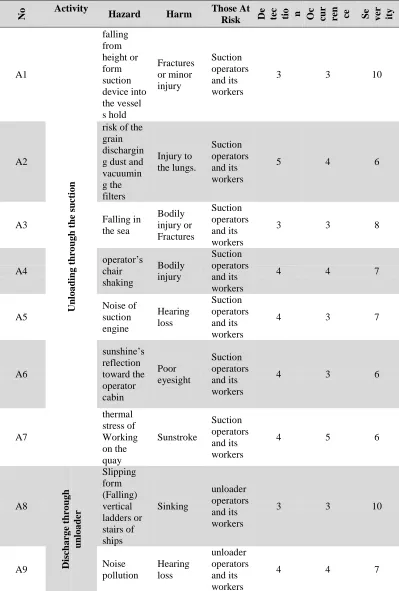
239 Table 1: Identified risks
Se ver ity Oc cur ren ce
De tec tio n Those At Risk Harm Hazard Activity No 10 3 3 Suction operators and its workers Fractures or minor injury falling from height or form suction device into the vessel s hold Unlo a din g t hro ug h t he suct io n A1 6 4 5 Suction operators and its workers Injury to the lungs. risk of the
240 8 3 4 unloader operators and its workers Property damage and personal Fire A10 5 3 5 unloader operators and its workers Musculos keletal Complicat ions Excessive pressure to the muscles. A11 6 3 5 unloader operators and its workers Injury to the body. Vibration A12 10 3 3 unloader operators and its workers Injury to the body. Falling from height A13 7 3 4 unloader operators and its workers Disability Collision with moving parts of machinery A14 10 3 3 unloader operators and its workers Burn Death Electric shock A15 8 4 4 crane operators and its workers Bodily injury or Fractures Slipping (Falling) when climbing stairs Unlo a din g by cr a ne a nd g ra b A16 7 3 4 crane operators and its workers Psycholog ical injury Working alone and monotono us A17 10 3 3 crane operators and its workers Bodily injury or Fractures Falling from height A18 5 4 5 crane operators and its workers Musculos keletal Complicat ions Sitting Too much on a chair A19 6 4 5 crane operators and its workers Injury to the body. Operator chairs vibration A20 7 3 4 crane operators and its workers Property damage and personal Fire in the
Engine Room A21
In the second phase by using from the Shannon’s Entropy, the criteria (occurrence
241 Table 2: Weight of research criteria
criteria detection occurrence severity
weight 0.26 0.42 0.32
Then based on the criteria of determination of causes occurrence probability (occurrence frequency), the extent of its impact on process after occurrence (severity) and probability of its identification prior to having impact on the process (detection), the identified risks were scored in form of a scale from 1 to 10.on which 1 is the least class rank and 10 is the highest class rank. Finally according to the obtained scores of each risk, the ORESTE decision matrix was conducted and subsequently in the third phase by using this method, all of the identified risks were prioritized in the following steps.
Forming a superiority structure on alternative & criteria’ set
For ranting purposes using this method, 1st of all there should be 2 superiority structures for the set of alternative & criteria. To establish the superiority structure for criteria out of the obtained weights we have used Shannon entropy method. Similarly, for the set of alternative & based on the criteria individually & by using the decision- making matrix’s data, the superiority structure as it is illustrated in table 3, is formed.
Table 3: Superiority structure of alternative & criteria’ set
MAX MAX MAX
S O D
A1 14.5 3 18.5
A2 4.5 17 3
A3 14.5 7 18.5
A4 4.5 11.5 10.5
A5 14.5 11.5 10.5
A6 14.5 17 10.5
A7 1 17 10.5
A8 14.5 3 18.5
A9 4.5 11.5 10.5
A10 14.5 7 10.5
A11 14.5 20.5 3
A12 14.5 17 3
A13 14.5 3 18.5
A14 14.5 11.5 10.5
A15 14.5 3 18.5
A16 4.5 7 10.5
A17 14.5 11.5 10.5
A18 14.5 3 18.5
A19 4.5 20.5 3
A20 4.5 17 3
242 Specifying the primary rating on the
alternative- criteria set
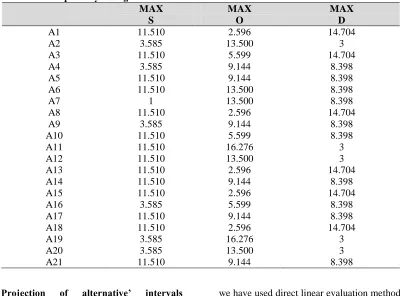
By having the abovementioned relations & structures & using Besson average rating, the primary rating of the alternative & criteria is computed. Accordingly, no. 1-15 was given
to index & the rk is formed. The mentioned processes are applicable for alternative, too. Table 4 presents the primary indexes & options.
Table 4: The primary rating on the alternative- criteria set
MAX MAX MAX
S O D
A1 11.510 2.596 14.704
A2 3.585 13.500 3
A3 11.510 5.599 14.704
A4 3.585 9.144 8.398
A5 11.510 9.144 8.398
A6 11.510 13.500 8.398
A7 1 13.500 8.398
A8 11.510 2.596 14.704
A9 3.585 9.144 8.398
A10 11.510 5.599 8.398
A11 11.510 16.276 3
A12 11.510 13.500 3
A13 11.510 2.596 14.704
A14 11.510 9.144 8.398
A15 11.510 2.596 14.704
A16 3.585 5.599 8.398
A17 11.510 9.144 8.398
A18 11.510 2.596 14.704
A19 3.585 16.276 3
A20 3.585 13.500 3
A21 11.510 9.144 8.398
Projection of alternative’ intervals
By obtaining the primary levels for the set of criteria & alternative based on each index,
we have used direct linear evaluation method for gaining the intervals.
The evaluated intervals for all alternative & based on the criteria are presented in table 5.
Table 5: Evaluated intervals for all alternative
MAX MAX MAX
S O D
A1 43.5 4 58.5
A2 14.5 53 9
A3 43.5 19 58.5
A4 14.5 33.5 25.5
A5 43.5 33.5 25.5
A6 43.5 53 25.5
A7 1 53 25.5
243
A9 14.5 33.5 25.5
A10 43.5 19 25.5
A11 43.5 62.5 9
A12 43.5 53 9
A13 43.5 4 58.5
A14 43.5 33.5 25.5
A15 43.5 4 58.5
A16 14.5 19 25.5
A17 43.5 33.5 25.5
A18 43.5 4 58.5
A19 14.5 62.5 9
A20 14.5 53 9
A21 43.5 33.5 25.5
Aggregation phase
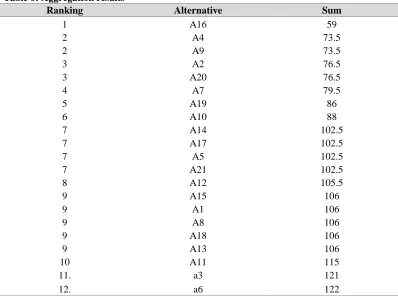
By obtaining R(mk) for all the alternative of the criteria, the aggregating step should be taken; in other words, to be computed for all alternative that its amount equals the general sum of the computed for each option
regarding each index. Thus, is shown for all alternatives in table 6.
Table 6: Aggregation results
Ranking Alternative Sum
1 A16 59
2 A4 73.5
2 A9 73.5
3 A2 76.5
3 A20 76.5
4 A7 79.5
5 A19 86
6 A10 88
7 A14 102.5
7 A17 102.5
7 A5 102.5
7 A21 102.5
8 A12 105.5
9 A15 106
9 A1 106
9 A8 106
9 A18 106
9 A13 106
10 A11 115
11. a3 121
244 Comparing the results & specifying the top choice in ORESTE method
Finally to determine the top choice, we compare the aggregation results from the decision- making phase. In this section the less the total sum, the higher the rank will be.
Conclusion
Exposing the acts of unloaded, sucker and Grab in the grain terminal of Persian Gulf by manipulating ORESTE method and Shannon's Entropy in the three phases will lead to identification and prioritization of the grain discharging processes risks from the ship. In the first phase, by the analysis of the events and occurred incidents information bank about the surveyed matters and also setting brainstorming sessions with the terminal’s experts, 22 risks were identified. In the second phase by using from the Shannon’s Entropy, the criteria (occurrence frequency, severity and detection) were weighted.
Then based on the criteria of determination of causes occurrence probability (occurrence frequency), the extent of its impact on process after occurrence (severity) and probability of its identification prior to having impact on the process (detection), the identified risks were scored in form of a scale from 1 to 10. Finally according to the obtained scores of each risk, the ORSTE decision matrix was conducted and subsequently in the third phase by using this method, all of the identified risks were prioritized. According to the final result, the risk of being slippery (falling) from the
stairs, operator chair shaking and the risk of the dust of the discharging grain and vacuuming the filters were obtained the highest priority respectively and the risk of the sunshine’s reflection toward the operator cabin and the risk of the manifold pressure toward the muscles and the risk of the falling into a sea were obtained the least priority respectively.
Reference
Balmat, J. F., Lafont, F., Maifret, R. & Pessel, N. (2011). A decision-making system to maritime risk assessment. Ocean Engineering, 38(1): 171-176. Bartolomei, A., Corigliano, M. & Lai, C. G.
(2008). Seismic risk assessment of Italian seaports using GIS. Paper presented at the AIP Conference Proceedings.
Brito, A. J., de Almeida, A. T. & Mota, C. M. M. (2010). A multicriteria model for risk sorting of natural gas pipelines based on ELECTRE TRI integrating Utility Theory. European Journal of Operational Research, 200(3): 812-821.
Clothier, R. A. & Walker, R. A. (2012). The safety risk management of unmanned aircraft systems. Handbook of Unmanned Aerial Vehicles.
245 McGraw, H. (1982). Multiple Criteria
Decision Making. New York press. Sadounzadeh, J. and Jafari, H. (2013).
Identification and prioritization of preventive measures for encountering piracy. Middle East Journal of Scientific Research, 14(6): 806-813. Jafari, H., (2013). Establishment of Total
Quality Management in the Iranian Seaports. Journal of Asian Business Strategy, 3(7): 140-153.
Saeidi, Jafari, H., Amli. Zaersoleymani. (2013). Container Repositioning Management in Liner Shipping Industry. Management Science Letters, 3(6): 1795–1804.
Jafari, H. and dadkhah, A. (2013). Risks Analysis of Container Handling Operation Using ELECTRE and Shannon's Entropy Methods. International Journal of Basic Sciences & Applied Research. 2(4): 484-493.
Jafari, H., Noshadi, E. and khosheghbal, B. (2013). Ranking Ports Based on Competitive Criteria s by Using ORESTE Method. International Research Journal of Applied and Basic Sciences. 4 (6): 1492-1498. Brans, J. P. Vincke, Ph. Mareschal, B.
(1986). How to select and how to rank projects: The ORESTE method. European Journal of Operational Research, 24: 228–238.
Brans, J. P. and Mareschal, B. (2005). ORESTE methods, in Figueira, J., Greco, S. and Ehrgott, M. (Eds), Multiple Criteria Decision Analysis: State of the Art Surveys, Springer, New York. NY. Pp: 163-198.