PROVISION OF RESOURCES AND FACILITIES IN ECDE CENTRES IN
MWEA EAST SUB-COUNTY, KIRINYAGA COUNTY, KENYA
LUCY W. KlREMBU
E55/0U2193212010
A RESEARCH PROJECT REPORT SUBMITTED IN PARTIAL
FULFILLMENT OF THE DEGREE OF MASTERS OF EDUCATION
(EARLY CIDLDHOOD EDUCATION) IN THE SCHOOL OF
EDUCATION OF KENYATTA UNIVERSITY
MAY, 2016
STUDENT'S DECLARATION
I confirm that this research project is my original work and has not been presented
in any other university/institution for certification. The project has been
complemented by referenced works duly acknowledged. Where text, data, graphics, pictures or tables have been borrowed from other work- including the
internet, the sources are specifically accredited through referencing in accordance
with anti-plagiarism regulations.
Signature ~ . Date
:Ltf-
t~)
I (.,
.LUCY W. KIREMBU E55/0Ll21932/20 10
Department of early childhood studies
Supervisors' declaration
We confirm that the work reported in this report was carried out by the candidate
under our supervision as university supervisors.
Signatu~~ Date •.•
?
:f
.J.~
..
!.~
.
DR. GLADWELL W AMBIRI
Senior Lecturer: Department of Early Childhood Studies
Kenyatta University
Signature.~ Date ~~.~ ..~ •...•..•...
DR. JOHN NG' ASIKE
Senior Lecturer: Department of Early Childhood Studies,
DEDICATJO
Tdedicate this project to my dear children Gicheru, Kirernbu, Muthoni and Gitau.
ACKNOWLEDGEMENTS
TABLE OF CONTENT
STUDENT'S DECLARATION ii
DEDICATION iii
ACKNOWLEDGEMENTS iv
TABLE OF CONTENT v
LIST OF TABLES viii
LIST OF FIGURES ix
LIST OF PLATES x
ABBREVlATIONSI ACRONYMS xi
ABSTRACT xii
CI-!APTER ONE 1
INTRODUCTION AND BACKGROUND TO THE STUDY l
1.1 Introduction 1
1.2 Background tothe study 1
1.3 Statement of the Problem 7
lA Purpose of the Study 7
J.5 Objectives ofthe Study 7
J.6 Research Questions 8
1.7 Assumption of the study 8
1.8 Limitation of the Study 9
1.9 Delimitations of the Study 9
1.10 Significance of the Study 9
1.11 The Theoretical Framework I0
1.11 The Conceptual Framework 12
1.12 Operational Definition of Key Terms 14
CHAPTER TWO 15
LITERATURE REVIEW 15
4.5 Agents involved in provision of school resources and facilities .42
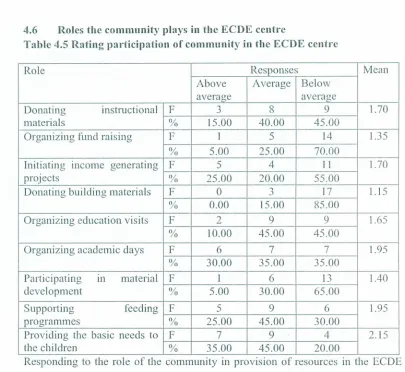
4.6 Roles the community plays inthe ECDE centre .45
CHAPTER FIVE 50
SUMMARY, CONCLUSION AND RECOMMENDATIONS 50
5.1 Introduction 50
5.2 Summary ofFindings 50
5.3 Conclusion 52
5.4 Recommendations 53
5.4.1 Recommendations for further research 54
REFERENCES 55
APPENDICES 59
Appendix 1:PreSchool Parents' Questionnaire 59
Appendix II: ECDE Centres Teachers' Questionnaire 62
Appendix ITI: Facilities inthe ECDE Centres 67
Appendix TV: Research Permit 68
LIST OF TABLES
Table 3.1 Target Population and Sample size . 27
Table 4.1 Parents level of education . 36
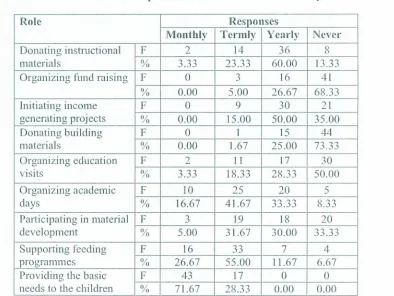
Table 4.2 Availability of learning resources and facilities . 38 Table 4.3 Physical conditions of the school facilities . 42 Table 4.4 Agents involved in provision of school resources . 44 Table 4.5 Rating participation of community in the ECDE centres ... 47 Table 4.6 School activities parents were involved in the last I year. .. 48
LIST OF FIGURES
Figure 1.1Conceptual Framework... 15
LIST OF PLATES
Toilets inanECDE centre... 70
Afixed play facility... 70
Play materials... 70
Classroom made of muclwalls... 70
ECDE children in class... 70
AOU
ABBREVIATIONS/ ACRONYMS Organization of African Union
eBO Community Based Organizations
DICECE District Centre for Early Childhood Education
ECD Early Childhood Development
ECDE Early Childhood Development Education
EFA Education For All
GOl( Government of Kenya
KICD Kenya Tnstitute of Curriculum Development
K.I.E Kenya Tnstitute of Education
MoE Ministry of Education
MoEST Ministry of Education Science and Technology
NACECE National Center for Early Childhood Education
NAEYC National Association for the Education of Young Children
NGO Non Government Organizations
PTA Parent Teachers Association
UNCRC United Nations Convention on the Rights ofthe Child
ABSTRACT
Early childhood Development Education is an important aspect of basic education that lays a sound foundation for primary education and personality development which can make all the difference in the child's future. The history of Early Childhood Development dates back to ancient times with Egyptians, Greeks and Romans before introduction of formal education in Kenya. In Kenya, great deal has been achieved in Early Childhood Development through involvement of various community agents like Ministry of Education, development partners, religious organizations and parents' organizations. This is in line witb globaI requirements for child holistic development as stipulated in United Nations Conventions on the rights of children and African charter. The purpose of the study was to investigate the level of community involvement in the provision of school resources in ECDE centres. The study objectives were to establish availability of learning resources, find out the physical conditions of the resources in the ECDE centres, establish the agents involved and to determine the role of the community in provision of school resources in ECDE centres. The study was guided by Bronfernbrenner Ecological Theory on the interaction of children and immediate environment the Rights and welfare of the child. The study adopted descriptive research design. It was carried out in Mwea East Sub-County, Kirinyaga County. Data was collected from a sampled population selected using a stratified random sampling technique from Mwea East Sub-County. Itconsisted of 20 teachers and 60 parents. The data collection instruments were questionnaires and observation schedules. Validity and Reliability was established through scrutinizing of the instruments by researcher and research supervisors as well as through a pilot test in 3 schools not included in the study sample. Data collected was then coded and analysed descriptively using statistical package of social sciences and presented in tables. The study established that provision of quality early childhood education is faced with a number of challenges, key among them shortage of funds and negative attitude of the community towards provision of resources in early childhood education. The resources and facilities available included colours, picture books, pencils, crayons, counters, exercise books, charts, furniture, kitchens, playgrounds, classrooms and toilets. The agents involved in the provision of resources in the ECDE centres included the county government, parents, teachers, community, NGOs and churches. The parents and the community participated in donating instructional materials, organizing Iundraising, initiating income generating projects, organizing academic days, supporting feeding programmes and providing the basic needs to the children. The study recommends that community should be sensitized on the importance of learning resources in children learning. All stakeholc\ers in the education sector should come up with modalities of ensuring that there is adequate provision or resources in ECDE centres.
CHAPTER ONE
INTRODUCTION AND BACKGROUND TO THE STUDY
1.1 Introduction
This chapter entails the background of the study, statement of the problem, purpose of the study, objectives of the study, research questions, assumptions of the study, limitations of the study, delimitations of the study, significance of the study, the theoretical framework, the conceptual framework and the operational definitions of key terms
1.2 Background to the study
In such centres, children of varying ages benefit from services offered there. The centres cater for children from as young as one year to eight years which IS a critical stage of child development where various windows of growth and development open up. It is also the age at which ECDE Centres help to lay afirm foundation in children for future learning experiences. These centres should therefore provide adequate and appropriate care in order to avoid deficiencies in development of children under their care. Research has demonstrated that some developmental deficiencies that occur during this stage of development are difficult toreverse inadult life (Pipes &Trahms, 1993; Ndani, 2008).
In respect to the above, many nations all over the world have demonstrated appreciation for the need of care that would lead to child's holistic development. One hundred and ninety one states members have ratified the United Nations Convention on the Rights of the child (CRC). In article 27.1 and 27.2 the states recognize the right of every child to a standard of living adequate for its physical, mental, spiritual, moral and social development. CRC also recognizes that parents and others responsible for the child have the primary role of ensuring secure living conditions necessary for the child's holistic development (Nclani, 2008; Koech, 2003).
Tn harmony with the UN-CRC the Organization for the African Unity (AOU) appreciates the child's need for holistic development as stipulated in the OAU African Charter on the Rights and Welfare of the child (OAU, 1990). Ttassesses
2
KENYATTA
U"'~jv
L-.
v
..
-
,
!:"'ib;-the requirements of every child to particular care with regard to health, mental, moral and social development. Just like CRC, it assigns parents and others responsible for the child the duty to secure within their abilities and financial capacities, conditions of living necessary to the child's development. It also stipulates the role of the state as that of ensuring the development of institutions responsible for providing care of children but only within the states means and national conditions. Thus when a state's conditions do not allow adequate provisions for young children, parents and the community must shoulder the burden (Koech, 2003; Koech, 2010).
as Parent-Teachers Meetings and school partnership policies (GOK, 2006) which
require school to involve the community in education process. However
involvement at ECDE Centres level may not be extensive (Ndani, 2008). This is
more so in establishing quality education in ECDE Centres (Wawire, 2006).
Bilateral and multilateral agents such as Aga Khan Foundation, Bernard Van Leer
Foundation and United Nations Children Fund (UNICEF) to a large extent fund
ECD programmes such as feeding programmes.
In regard to the role played by the Kenyan Government, the need for community
involvement in ECDE programmes is increasingly becoming critical. This is best
explained by the fact that in most ECDE centres, the community is the key player
in children education sponsoring about 70% of the total ECDE programmes
(Republic of Kenya, 1998). These centres comprise children immediate physical
and social environment which Bronfenbrenner (1998) refers to as Microsystems
(Black and Puckett, 1996). The Microsystems is a setting in which the individuals
spends considerable time for example family and school. The child acts on and
influences each of these and is influenced by them Bronfernbrenner further states
that the learner reciprocally interacts with teachers and peers and helps to construct
the Microsystems. All these have influences on child's development.
In Kenya, the government through MoE is responsible for managmg and
coordinating ECD programmes. The responsibility include training ECD
teachers, development of centers, inspection and supervrsion of ECD centers,
mobilization of resources for ECD and coordination of partners 111 ECD (Presidential Circular No.l, 1980). To carry out these roles, the ministry has structures at national and district level which includes Kenya Institute of Curriculum Development (KICD), District Centre for Early Childhood Education (DICECE) and Quality Assurance Standards sections. The MoE also coordinates the provision of ECD by the local authority which includes County and Sub County Governments. These are involved in development of ECD centers by provision of support which includes provision of physical facilities, supervision of ECD teachers under training and payment of ECD teachers. Parents and the local communities comprise the largest stalceholders in ECD. Their responsibilities include provision of land for building ECD centers, provision of physical facilities, and provision of furniture. In partnership with school management, it's also involved in recruitment and payment of teachers, development of materials, initiating and sustaining feeding programmes as well as ensuring that children are enrolled in ECD centers. They are also involved in hiring subordinate staff, initiating community based growth monitoring and promotion activities, acting as resource persons to the centers, raising funds for development and forming committees tomanage ECD centers (Koech, 2010; Koech,2003).
salaries, provision of f-unds and resources, capacity building and provision of technical SUpp0l1, advocacy for ECDE and mobilization of resources for ECDE (NACECE, 2006).
It is however a fact that schools vary in the kinds of resources they have put in
place to enable learning for quality education. Research findings by Gakii (2003) and Ngasike (2004) have also shown that most ECDE centres lack some
necessary facilities, equipment and materials that would promote teacher
motivation and holistic development of children. Most public ECD centres support
unfriendly school conditions characterized by windowless, rough mud walled and
earthen floor classrooms. Others are iron-sheet walled and roofed (Ngome, 2002). In such classrooms, temperatures go very high or low, ventilation ispoor, dust is a
problem and children are easily distracted from the learning process. Most of these
classrooms are also congested (Gakii, 2003; Ngasike, 2004). This explains low
and inadequate community involvement in supporting ECD Centres despite the
global and regional expectations of standard involvement. This become more
puzzling on realizing that the same community provides better facilities for the
less vulnerable children in primary and secondary schools (MoE, 1999; Ndani,
2008). There was need therefore to evaluate community involvement in provision of school resources inECD centres for quality education, the reason for which this
project was undertaken.
1.3 Statement of the Problem
Schools depend heavily upon community support and involvement for any
potential positive impact from early education. They have to focus on provision of
resources by the community to the ECD Centres. Since Early Childhood Policy in
Kenya emphasizes communities as key inthe provision of ECD physical facilities
and learning resource, the role these communities play needs to be evaluated
through research. There is Limited literature on involvement of the community in
the educational planning, policy making, evaluation of the ECD programmes as
well as provision of resources and facilities. Additionally many ECDE centres face
challenges such as inadequate physical facilities and resources. This has gravely
affected the holistic development of children. This evaluation study therefore was
anattempt to determine the level of community involvement in provision of school
resources and factors that may influence community involvement inECD centres.
1.4 Purpose of the Study
The purpose of this study was to establish the level of community involvement in
the provision of school resources inECD for quality education.
1.5 Objectives ofthe Study
This study was guided by the following
objectives:-(i) To establish availability of learning resources in ECDE centres in Mwea
East Sub County, Kirinyaga County.
(ii) To find out the physical condition of resources and facilities 111 ECDE
(iii) To establish agents involved 1I1 provision of school resources 111 ECDE centre.
(iv) To determine the role of the community in ensuring provision of school
resources inECDE Centres.
1.6 Research Questions
The following questions guided the research:
(i) What types of school resources are available 111 ECDE centres 111 Mwea East sub county, Kirinyaga County?
(ii) What is the physical condition of the available resources and facilities in
ECDE centres?
(iii) What agents are involved in provision of school resources and facilities in
ECDE centres?
(iv) What is the role of the community 111 ensunng provision of school resources and facilities in ECDE Centres?
1.7 Assumption of the study
This evaluation study assumed that MoEST, ECD policy 011 community
involvement was operational in the area of study. Tt also assumed that the community through various agents such as Government of Kenya, NGO, private
individuals, bilateral and multilateral agents is involved in ECD policy
implementation through provision of school resources.
1.8 Limitation of the Study
Due to lack of adequate finances, distance between schools and inadequate time, the study was confined to Mwea East Sub-County only. The survey instruments
contained selected items and not be all inclusive. Additionally the conclusions were based on the views ofthose who responded to the survey.
1.9 Delimitations of the Study
The study was confined Mwea East Sub County, Kirinyaga County. It also
investigated the provision of school resources and facilities in ECDE centres only.
The researcher created time during evenings to visit the targeted schools. Mapping of the schools was also done to enable the researcher visit the targeted schools systematically and inthe limited time.
1.10 Significance of the Study
This study is based on MoEST, ECD (2006) policy on community involvement and partnership. The result of the study may therefore provide the government through the MoEST information on the level and effectiveness of community involvement inECD centres. Any identified gap may be used as a guide for future policy formulation and implementation. The research findings may also provide
information that can act as abase for community mobilization and sensitization by
the MoEST onprovision and sustainability of school resources. The study findings
may also enlighten on the available school resources and facilities and possible
ways of improving them. This will go a long way in helping children develop a
guide for future research whereby it may be replicated in other areas to verify the
research findings.
1.11 The Theoretical Framework
This study was guided by Bronfenbrenner's Ecological Theory (1989). It primarily
focuses onthe social contexts in which children live and the people who influence
their development. This theory has of five environmental systems which include
the Microsystems, mesosystem, exosystem, macrosystem and chronosystem
(Bronfenbrenner & Morris, 2006). The Microsystems is a setting in which the
individual spends considerable time for example family, peers, school and
neighborhood. In these settings children act and influence each other as they
interact with others in the Microsystems to help construct it. ECD centres
comprise of the immediate physical and social environments experienced by
young children (Black and Puckett, 1996). In a school setting, the players who
facilitate education excellence and programme success include the community,
teachers and learners.
The link between home and ECD Centres provides the child with the
mesosystems. The expectations parents have on the school outcomes may
influence the experiences the teachers organizes for children. The community has
the primary role to secure conditions of living necessary for the child's holistic
development. Macrosystems refers to the ideas, feelings and attitudes of the
society towards the school. Pre schools depend heavily on community support and
involvement for any positive impact from ECD education. Children need quality
programmes 111 ECDE centres which should meet certain standards (Morison,
2007).
Epstein's theory on community involvement (1995) ineclucation also forms a base
for this study. It has six major types of community involvement. The first is the
basic obligation of parents that shows the responsibility of famiIies to ensure children's health and safety to the parenting and child rearing skills needed to
prepare children for school. Second is the basic obligation of school which entails
the communication from school to home about school programmes and children's
progress. The third is parent involvement at school by volunteering as assistant
teachers, resource persons or administrators to support school programmes. The
fourth is parent involvement in learning activities at home through parents or children initiated request for help and ideal to monitor or assist children on learning activities. The fifth is parent involvement ingovernance and advocacy by
taking part in decision making roles and the sixth is collaborating with communities through integration of various community caregivers and resources to support the school programmes. This is done through parenting,
communicating, volunteering, learning at home, decision making and
collaborating (Delta, 1995). The theories were relevant to the study as they
highlighted the community agents and their involvement in provision of school
1.11 The Conceptual Framework
The way schools care for children reflect how schools care for families. Tf
educators view learners as children, they are likely to see the family and the
community as partners with the school in children's education and development.
The ultimate goal of ECD programmes is holistic development of children. To
achieve this provision of adequate school resources and facilities in the ECDE
centres should be addressed. This is influenced bythe independent variables which
are the role of the community in provision of resources, the physical condition of
resources and their availability aswell as the community agent's involvement. The
extent to which community members are involved in education of young children
is influenced by factors such as economic status, education level, relationsh ipwith
children as well as community attitudes which are the intervening variables. These
involvement help improve school programmes and school climate and help
teachers with their work. The outcome of this is improved teaching and learning in
ECDE centres and better grades which are the dependent variables.
I
Provisionsof school resources and facilitiesI
Roles of the community
~
•
Organizing fundraising"Fr>
Donating resourcesIncome generating projects
Outcome -Improve teaching and
~ -Physical condition of resources and facilities
.
~
learning inECDE
-Availability of resources and facilities ~ y centres
-Better grades
Community Agents involvement
Fe>
~>Dependent Variable o County government, parents,
teachers, community, NGOs, churches
Independent Variable
0 Parents' Educational level
•
Socioeconomic status•
Community attitudeIntervening Variable
1.12 Operational Definition of Key Terms
Community: This refers to the parents, local leaders NGOs and other
collaborators around the school.
Early Childhood Education: This is the Education offered in ECD Centres to
children between 3-6 years of age.
ECDE Centre: This refers to any facility that provides day care and education
services to children aged 3-6 years.
Micro system: Are the physical and social conditions of the school and which
influences children's hol istic development.
Mobilization and sensitization - This refers to activities designed to promote
community awareness on ECD learning materials.
Physical facilities: ECD Centres settings including space, equipment and
materials.
Provision of funds: Various ways through which the community ensures
availability of funds in ECD centres.
Resources: Are the Physical facilities and instructional materials.
Rural setting: This refers to a setting that isfar from social amenities like schools,
health centres and markets.
Sponsorship: It involves community agents taking an initiative in management
and running of ECD centres.
Urban setting: This refers to any setting that IS close to social amenities like
markets, health centres and schools.
CHAPTER TWO
REVIEW OF RELATED LITERATURE
2.0 Introduction
This chapter contains review of related literature on Early Childhood Education
withreference tocommunity involvement inECD programmes. It focused on what
scholars, educationists, researchers and the Ministry of Education Science and
Technology have found out and said concerning community involvement in ECD
centers.
2.1 Role of the Community in Provision of School Resources
EeD Centres, one of Bronfenbrenners (1989) microsysterns play a vital role in
provision of necessary care for children development. The physical facilities,
equipment and materials present in the children environment and interpersonal
relationships of the person with whom they interact and influence their
development forms part of the microsystern. Since 1970, the Kenyan government
has recognized and appreciated the contribution of parents and local community in
provision of ECD programmes. The government has made effort to improve ECD
education through experimental programmes, seminars, education commissions
and partnership with other stake holders. It also facilitated establishment of
National Centre for Early Childhood Education (NACECE) in 1984 whieh was
through awareness creation and providing community support grants (Wahungu,
20ll).
Children need quality programmes which should meet certain standards (Morison,
2007). The government through the Ministry of Education Science and
Technology has adopted the policy of partnership to facilitate adequate provisions
in ECDE centres. Such partners include parents associations, local authorities,
religious organizations, private firms and individuals.
NACECE Policy Framework, (2006) stipulates the role of the community in ECD
which includes physical facilities, employment of teachers and management of
ECD programmes. To play its part, the Kenyan government has for a long time
been allocating 40% of its National budget to education which has increased since
year 2000 with an attempt tomeet the Education For All (EF A) goals of education
and Free Primary Education (FPE). Despite these efforts, the funds allocated are
still insignificant percentage of the education budget (Ndani, 2008).
To meet its objective of holistic development of children, the government has
therefore advocated for offering of integrated services to meet the cognitive, social
emotional, health, nutrition and care of children (Republic of Kenya, 2002). This
has led to a call for active participation of all institutions and stakcholders in
meeting children's needs. This is emphasized in the Master Plan onEducation and
Training (Republic of Kenya, 1998). Tt entails collaboration between all
stakeholders comprising of parents, local government, reI igious organizations,
private sector, institutions, multilateral and bilateral donars and NGOs. It guides
therole and function of each partner (Ndani, 2008). This call is mainly directed to
the community since they sponsor about 70% all EeD programmes in Kenya
(Republic of Kenya, 1998). Available literature suggests that there is arelationship
between community involvement and children's development (Palegnno, Schorott
& Staschnoy, 1983). Young, (1995) also points out that parental involvement in
programmes appears to strengthen the positive impact of early childhood
interventions.
Various factors have been identified by research to influence community
involvement in ECD Centres. Main factors identified include the level of
education, type of school sponsorship, sex and rural urban setting (Wawirc, 2006;
Mwoma, 2009). Lack of encouragement or invitation, lack of awareness on the
need of involvement, unwillingness to interfere with teachers, unavailability,
poverty, sex, and initiation of Free Primary Education and a feeling of lack of
ownership of schools were also identified as inhibitors to involvement (Ndani,
2008). The question that comes into play iswhat resources are available and their
current state in BCD Centres inMwea East Sub- County? Tt is therefore necessary
to evaluate these as welJ as role of community agents involved in ECD
2.2 Level of Community Involvement in Provision of Resources
InAfrican Traditional Societies, the community played a vital role in education of
their children (Achoka, 2003). At the introduction of Western Education, the local
community never became passive recipients of education but continued
participating in the education process in various ways like providing land and
other physical facilities (Achoka, 2003).Thus community involvement isnot anew
thing but finding ways of strengthening it would be welcomed by the community
which has long supported it.
World Health Organization (WHO) and United National International Childhood
Fund (UNICEF) workshop (1982) observed that programmes are more effective
when members of the community are informed and involved intheir evolution. To
do this, the government recommenels NACECE-DICECE Model which is
fashioned after the district focus for Rural Development Strategy. This strategy
attempts to facilitate communities to participate more, initiating and taking action
in their self motivated goals (Ndani, 2008). It therefore means that programmes
designed with community involvement component offer more benefits to children
than those that do not. The community should work towards the improvement of
the quality of settings that a child experience in ECD Centres. DrCECE officers
mobilize and sensitize the community on matters relating to the care and education
of young children. At ECD level the community finance and manage institutions
(Ndani, 2008).
To effect these, Epstein (1995) developed six types of community involvement
models of which four are the most relevant in BCD Centres context which are
collaborating, volunteering, communicating and decision making. Collaboration
entails communities contributing their material and intellectual resources for the
benefit of the school. Volunteering is about assisting teachers, administrators and
children in class, attending workshops as well as contributing labour force where
needed.
In ECD Centres programmes community involvement in decision making and
communication is also very vital as this helps in governance and advocacy. The
level of community involvement in children education varies according to its
construction of involvement role, its series of efficacy for helping children succeed
and the invitations, demands and opportunities for involvement presented by the
children and the school. Thus if a school expects little community involvement,
the community will be less inclined to get involved (Epstein & Dauber, 1991;
Koech, 2008).
Adequate and appropriate community level of involvement is influenced by
various factors such as its economic status, the education level of the community
and the types of school sponsorship. The level of involvement results to variance
in school environments for young children (Huston & Bently, 20] 0). High level
involvement in the six modes of involvement according to Epstein is likely to lead
materials which in turn lead to the ultimate goal of children holistic development
(Koech, 2010). Schools from impoverished background have been found to have
fewer resources than those from higher economic neighborhood. They are likely to
have learners with low achievement test scores, low graduation rates and lower
percentages of children going to college level. This prompts the need to evaluate
the level of community involvement by investigating the type and status of
resources in ECD centres.
2.3 Factors Impacting On Community Involvement inECD Centres
Adequate and appropriate community involvement is influenced by various factors
in the community. According toHoover-Dempsey and Sandler, (1995) model, the
community decides to get involved when they understand that collaboration with
other stakeholders is part of their role as the community, when they believe they
can freely affects children's education and when they perceive that the child and
the school wish her to be involved (Koech, 2010). The communities make the
decision to participate, choose specific activities shaped by their perception of
their own skills and abilities, other demands on their time as energies and specific
invitation to involvement from children, teachers and school.
As such various factors come to play on community involvement in ECD. These
factors include community socio economic status, education level and school
sponsorship. Other factors include age of parents, gender and marital status of
parents. The socio economic status of a community dictates its ability to provide
adequate and appropriate learning environment lt1 ECD Centres. Where
involvement is not adequate, ECD Centres are seen to have fewer school
resources. The school buildings are old, crumbling and poorly maintained. They
are also staffed with young teachers with less experience. Children are enrolled
late in ECD Centres and those in school have frequency of absenteeism and
arriving late in school.
The education level also influences community involvement in ECD Centres. The
communities with low education levels do not value education and as such will not
encourage their children much less participate in school programmes. They take
little interest in children school work which leads to learners with low achievement
scores, low graduation rates and high school drop outs. Parents who are intelligent
and educated provide a child with a favourable environment and are likely to get
involved in their children's school work (Fraser, 1973). Parents who are less
educated, those who have less income, less experience and high levels of stress
tend to use ECD Centres for questionable reasons (Heldebrand, 1981). To them,
the facility is meant to offer care to children who lack care at home. They also
enrol their children late in school. Parents with low education levels arc not able to
get involved in school matters (Teklemariam, 1996). They cannot provide
assistance to teachers or extend their knowledge to school due to inability to read
ECD Centres in Kenya are managed by different organs such as religious
organizations, private individuals and the local communities. The Early Childhood
Education Development policy framework (K.l.E, 2006) gives policy statement for
partnership, advocacy and interface between partners, communities and service
providers among other statements. It suggests that the role of different partners at
all levels should enhance the co-ordination and provision of quality services and
equitable distribution and access toservices tochildren especially in education and
health (TOE, 2006). The current policy framework does not give the level of
community involvement 111 provisron of physical facilities and instructional
materials.
The type of school resources in ECD Centres are determined by the management
of the school or the sponsor. Those ECD Centres under management of reiigious
organizations, private institutions and NGOs are characterized by well built and
maintained classrooms, ample space and material for play, adequate provision of
instructional materials as well as qualified teachers. This is as a result of the
financial ability of such sponsors. The ECD Centres run by the local community
are as opposite of the above. This is because the community lacks adequate
financial ability to provide good classrooms, adequate materials or employment of
qualified teachers. The physical environment is "work unfriendly" having
inadequate facilities, equipment and materials (MoEST, 1999; Ngorne, 2002;
Gakii, 2003 and Ng'asike, 2004). This calls for the need to investigate the type and
status of resources in ECD centres so as to identify the level of community
involvement. This study identified socio economic status, the level of education
and school sponsorship as having greater influence on community involvement in
ECD Centres which in turn affect provision of resources. These will form the
variables of the study to evaluate community involvement in provision of
resources. Other factors noted to have an influence includes age, type of
sponsorship and rural- urban context.
2.4 Summary of Literature Review
The reviewed literature showed that community involvement in provrsion of a
conducive environment for children holistic development IS recognized
internationally and the Kenyan government assents to these facts (National PTA,
2002). The strength of any educational system lies not in the separation of our
homes, schools and communities but in the collaborative partnership which unite
them in a common goal, the education of their children (Morrison, 1998).
Education of children in the ECDE centres is affected by the provision of school
resources and facilities. Additionally, there is more literature on provision of
resources in early childhood centres in developed countries than there is Jll
developing countries. Most of the literature reviewed comes from America and
Europe and only a few articles are from Africa and inparticular Kenya. This study
arose out of the fact that there are few studies that tackle provision offacilities and
CHAPTER THREE
RESEARCH DESIGN AND METHODOLOGY
3.1 Introduction
This section presents the research methodology that include the description of the
research design, study location, target population, sampling techniques,
instrumentation, pilot study, validity and reliability of data collection instruments,
data collection procedures and data analysis plan.
3.2 Research Design
The researcher adopted a descriptive survey design to obtain information on
community involvement in provision of school resources. A survey approach
allows and facilitates collection of a large amount of data from a sizable
population in a highly economic way (Mugenda & Mugenda, 2003). Descriptive
survey design is used in preliminary and exploratory studies to enable the
researcher to gather information, summarize and interpret it for the purpose of
clarification (Orodho, 2009). This design was found necessary as it attempts to
describe what was and is in a social system such as a school. A descriptive
research design also attempts to describe the degree to which factors exist and tries
to discover the links of relationships which exists between them. This design is a
process which involves collection of data in order to test hypothesis or answer
questions concerning the current status of the subjects of study rather than the
manipulation of variable (Gay, 1976). Descriptive design concerns describing,
recording, analysing and reporting conditions that exist or existed (Kothari, 1985).
3.2.1 The Variables
This study evaluated selected factors determining the level of community
involvement in providing resources in ECD Centres. The two major variables are
outlined below.
• The independent variables
These consist of the determinants of the level of community involvement 111
provision ofschool resources in ECD Centres whose components includes:
Classroom -This is where teaching and learning takes place. They should
provide learner friendly environment such as good ventilation, safe, space
etc
Water and sanitation-Water is essential for healthy growth and
development. Sanitation has to do with hygiene methods and facilities of
waste disposal inthe school.
Play fields and materials -They offer children an opportunity to exercise
their body as well as promote social emotional development through group
activities.
Instructional materials - These are materials that help teachers to deliver
knowledge to children such as text books, black board, charts and picture
The dependent variables
This consists ofthe modes of community involvement which includes:
Provision of funds - It explains vanous ways through which the
community ensures availability of funds inECD centres.
Mobilization and sensitization - This refers to activities designed to
promote community awareness onECD learning materials.
Sponsorship - It involves community agents taking an initiative 111
management and running of ECD centres.
3.3 Locale of the Study
The study area is Mwea East sub-county, Kirinyaga County, Kenya. It lies I J2 km
North East of Nairobi City, 21km South of Embu Town. Mwea East sub-county
borders Embu County to the East, Kirinyaga East Sub County to the North and
Kirinyaga West Sub County to the West. The region is located in Mwea
constituency. Mwea East Sub County has been among the best performing sub
counties in KCPE in the country. However the education in the ECDE centres has
been facing numerous challenges leading to poor performance. This could be
attributed to the inadequate school resources and facilities in the ECDE centres.
3.4 Target Population
The target population of the study consisted of teachers and parents in the ECDE
centres in Mwea East sub-county. The actual population was determined by the
school sponsorship and gender. According to records there were a total of 56
public ECDE centres and 42 registered private owned ECDE centres. The ECDE centres have a population of 192 teachers 596 parents yielding a total of 786 respondents.
3.5 Sampling Technique and Sample Size Determination
Stratified random sampling technique was used to cater for the heterogeneous population of subjects for the study. This was as a result of geographical location and sponsorship in the area of study. The sample size was made up of 10% of the population because of the small size of the population and this was a satisfactory representation (Mugenda and Mugenda 1999). Since there were two categories, 10% of each category was sampled through proportionate random sampling to ensure equal representation of each category (Orodho, 2003). In calculation 10% of 192 teachers yielded 19.2 which were rounded off to 20 teachers. Additionally,
10% of 596 parents yielded 59.6 which were rounded off to 60 parents. Schools per category were numbered one to last. Pieces of papers numbered one to last were folded, put in an empty box, shuffled and then picked. The numbers picked represented the schools sampled for study.
Table 3.1 Target Population and Sample Size
Population Target population Sample size Percentage
(N) (n)
(%)
Teachers 192 20 10.41
Parents 596 60 10.06
3.6 Research Instruments
Considering the nature of the study sample and the geographical spread of the key
respondents, the researcher used different types of instruments to collect data.
These are described as follows:
3.6.1 Questionnaires
The researcher used self administered structured and unstructured questionnaires
tocollect information on the provision of school resources and community agents
involved inECD sub - sectors. It bad multiple choices provided, arranged from the
leasttothe most desirable to facilitate logical coding and interpretation of data.
The questionnaires had items that corresponded to the study objectives and
research variables. The questions sought qualitative information including the factors that influenced involvement of the community 111 provision of school
resources. The second p311 of the questionnaires had open encled questions to
allow respondents give detailed explanation of community involvement strategies.
3.7 Pilot Study
The instruments were pretested in 3 ECDE centres which were drawn from the
study but not included in the research sample. One teacher from each centre
responded to the research instruments. The pilot test was meant to create
appropriateness of items used with an objective of improving them so as to
enhance validity and reliability ofthe instruments.
3.7.1 Validity
The researcher sought to establish the validity of the content of the research
instrument tools used. The effort was meant to ensure that the items included in
the instruments represented the level of community involvement in provision of
school resources.
To check content validity the researcher employed the face validity method. As
such, she sought the expertise of the study supervisors and two colleagues who
were familiar with the study area. These were asked to check whether the items in
the instrument were able to collect the data to answer the study questions. Their
suggestions were used to modify the instrument accordingly as there was no
numerical way to explain it (Kothari, 1990). Additionally the researcher conducted
allthe community interviews personally in order to ensure systematic validity.
3.7.2 Reliability of the instruments
To determine the reliability of the instruments, the study used Split-half technique.
The Cronbach's coefficient Alpha (K-R20) which is a general form of
Kuder-Richardson was used to test the rei iability of the research instruments (Mugenda &
Mugenda, 2003). The use of (K-R) 20 was based on split-halves of the instrument.
KR20 =(K) (S2-ES2) (S2) (K-1)
Where
KR20=Reliabi lity coefficient of internal consistency
ES2=Variance of all the scores
S2=Variance of individuals items
After computation, the reliability coefficient of 0.75 was used to judge the
reliability of the instruments. The instruments attained acoefficient of O.78.
3.8 Data Collection Techniques.
Before proceeding to the field for data collection, the researcher submitted a
research proposal to the Graduate School, Kenyatta University for examination
and approval through the Department of Early Childhood Studies. Upon receiving
an approval to proceed for data collection, the researcher organized to obtain
authority to conduct research from the National Council for Science, Technology
and Innovation. After obtaining the research permit and research authorization
letter the researcher proceeded to the field for data collection. The researcher made
a courtesy call to the Sub-County Commissioner, Mwea East Sub-County to
deliver a copy of the research authorization letter. Thereafter, the researcher made
a similar courtesy call to the Sub-County Director of Education, to seek a letter of
introduction to the head teachers of the sampled primary schools. The researcher
then proceeded to the selected schools, where she sought permission from the
administration of the schools. This was followed by a formal introduction to the
teachers and parents by the head teacher. The researcher explained the purpose of
the visit, assured the respondents of confidentiality and clarify the questionnaires.
The researcher carried out the sampling procedure and briefed the study
respondents of the study being a fact finding research for educational purpose. She
also sought respondents' consent to be involved in the data collection process.
This study was conducted instages as follow
s:-Stage 1 The researcher administered the questionnaires to the teachers and
parents. This exercise took three weeks.
Stage TT Visit schools to observe the physical environment.
3.9 Methods of Data Analysis
Data collected was coded and cleared to remove missing values and categorized
using computer software according to the questionnaires items using frequency
distribution tables and percentages. Simple descriptive statistics such as
percentages have the advantage over more complex statics since they can easily be
understood especially when they making results known by a variety of readers.
The coded data was then transferred to a computer sheet and processed using
statistical package for social sciences (SPSS) version 21. Martin and Auna (2002)
observed that SPSS isable tohandle large amount of data, itstime saving and also
quite effective. Frequency tables and pie charts will be used to present quantitative
data.
Qualitative data was analysed USJl1g thematic data analysis. Thematic analysis
focuses on identification and description of themes. In this study thematic analysis
patterns and interpretation of patterns. The patterns identified in the data were used to develop themes that address study objectives. The data was first grouped in
accordance to research instruments under the identified themes. This was followed
bycomparison of the themes emerging from various data collection instruments. This will ensured that the findings of the study were credible and present the
general picture on the ground.
3.10 Logistical and Ethical Consideration
The researcher obtained an introductory letter from the Kenyatta University and
later a research authorization and research permit from National Commission for
Science, Technology and Innovation (NACOSTl). Respondents were clearly informed that the study was purely academic. Consent was sort from the respondents through the school administrations where research was conducted. This research observed and adhered to the ethical standards and issues with regard to voluntary nature of participation and the right to withdraw by individual
participant from the process. Confidentiality of all information gathered from the
respondents was highly safeguarded. The collected data was stored safely and
confidentially for easy reference and future accountability. Once data had been analysed, computer print-outs were filled while soft copies were stored in storage devices such as CDs and flash disks.
CHAPTER FOUR
PRESENTATION OF FINDINGS, INTERPRETATION AND DISCUSSION 4.1 Introduction
This chapter presents data analysis and discussion. The analysis is related to the
research objectives and research questions stated in chapter one of this study. The
findings have been presented in figures ancl tables. Discussions on the findings
have also been provided to interpret the meaning of the findings.
4.2 General and Demographic Information
4.2.1 Gender Distribution of teachers in the ECDE centres
Female 70%
Male 30'%
Figure 4.1 Gender Distribution of the teachers in the ECDE centres
Out of a sample of 20 teachers of children in the ECDE centres 6(30%) were male
in the ECDE centres is presumed tobe a feminine career as it entails motherly care
and training indaily living skills. Similarly, most of teachers who are employed to
teach intheECDE centres had undertaken ECDE teacher training education.
4.2.2 Parents' educational level Table4.1 parents' level of education
Education level Frequency Percentage
Without KCPE 10 16.67
KCPE 23 38.33
KCSE 14 23.33
Certificate 6 10.00
Diploma 5 8.33
Degree 2 3.33
Masters 0 0.00
On parent's educational level 10(16.67%) of the parents were without KCPE,
23(38.33%) had KCPE certificates while 14(23.33%) had KCSE certificates.
6(10.00%) of the parents had acquired education to secondary certificate level,
5(8.33%) had diplomas and only 2(3.33%) had university degree. The low
education level of parents could be attributed to the low socioeconomic status of
the region. Majority of 33(55.00%) of the parent did not acquire secondary school
education. This has also affected the education of their children and provision of
the resources in the ECDE centres. Parents who are less educated and those who
earn less income fail to support school programs when compared to the educated
ones (Heldebrand, 1981).
4,3 Availability of learning resources and facilities in the ECDE centres T bl 42 Aa e val'I bTta I ny 0fIcarnmg resources am IfaCI IilitiICSm' tlICECDEj • celltres
Resource/fac ility Responses Mean
More than Adequate Inadequate Not
adequate (4) (3) (2) avai lable( 1)
Colours and F 0 6 10 6 1.70
brushes % 0.00 20.00 50.00 30.00
Picture books F .
-'
., 10 5 2 2.70% 15.00 50.00 25.00 10.00
Pencils F 4 14 2 0 3.10
% 20.00 70.00 10.00 0.00
Crayons F 0 6 9 5 2.50
% 0.00 30.00 45.00 25.00
Counters F 2 16 2 0 3.00
% 10.00 80.00 10.00 0.00
Exercise books F ]0 8 2 0 3.40
% 50.00 40.00 10.00 0.00
Charts F 3 8 9 0 2.70
% ] 5.00 40.00 45.00 0.00
Furniture F 7 12 1 0 3.30
% 35.00 60.00 5.00 0.00
Kitchen F 0 3 4 13 1.50
% 0.00 15.00 20.00 65.00
Playgrounds F 2 10 5
-'
.., 2.50% 10.00 50.00 25.00 15.00
Play materials F 3 10 5 2 2.70
% 15.00 50.00 25.00 10.00
Classrooms F .
-
.,'
15 2 0 3.05% 15.00 75.00 10.00 0.00
Fixed play F 0 6 4 10 1.80
equipments % 0.00 30.00 20.00 50.00
Toilets F 0 16 4 0 2.80
% 0.00 80.00 20.00 0.00
When responding to the availability and adequacy of the learning resources and
facilities in the ECDE centres, a number of resources and facilities were looked
into. Colours and brushes were reported to be adequate by 4(20%) of the teachers,
not available in their ECDE centres. Colours and brushes had a mean of 1.70 indicating that it was inadequate in most centres. This could be attributed to the
lack of finances to purchase the colours as well as the attitudes by parents and
teachers that items meant for creative activities and art which are non examinable
subjects in primary school were not given priority when sourcing for materials.
Additionally, colours and brushes were not available in most local shops in the
ruralareas.
The availability ofpicture books were said to be more than adequate by 3(15%) of
teachers. 10(50%) said they were adequate while 5(25%) and 2(10%) of the
respondents said they were inadequate and not available respectively. This had a
mean of 2.70. A majority of 13(65%) teachers said that the picture books were
either more than adequate or adequate. This could be attributed to the high number
of privately owned ECDE centres which used picture books to teach pro-reading
skills. In the public ECDE centres the picture books were rarely used. However charts developed bythe teachers were displayed on the walls.
Responding to availability of pencils in the ECDE centres, 4(20%) of the teachers
said they were more than adequate, 14(70%) said that pencils in the ECDE centres
were adequate while only 2(10%) of the respondents said that the pencils were
inadequate. This was rated at a mean of 3.10. This could be attributed to the fact
that pencils were used by the children to write and draw. Learning in the ECDE centres mainly focused on numeracy and literacy hence pencils were an important
36
tool of trade. Additionally, the county government of Kirinyaga has been
providing pencils tothe public ECDE centres tobe used by the learners since 2014
when provision of early childhood education was devolved to be a county
[unction.
Crayons were another learning resource which had 6(30%) of the teachers saying
they were adequate, 9(45%) said that crayons were inadequate while only 5(25%)
of the teachers said that crayons were unavailable in their ECDE centres. On
availability of counters in the ECDE centres 2(10%) of the teachers said they were
more than adequate, 16(80%) said they were adequate while the remaining 2(10%)
of the teachers said that the counters were inadequate. It was noted that since
counters were used in mathematics activities which was considered a major
subject in school, teachers and parents sourced for the materials used in the
subject. Additionally teachers improvised counters using stones, seeds and even
bottle tops which were locally available. The availability of counters attained a
mean of3.00.
Responding to the availability of exercise books in the ECDE centres 10(50%) of
the teachers said that exercise books in the centres were more than adequate. The
remaining 8(40%) and 2(10%) of the teachers said the exercise books were
adequate and inadequate respectively. The availability of exercise books had a
high mean of 3.40 showing that most school associated education in the ECDE
centres with learning to write. This could also be attributed to the provision of
exercise books by the county government.
The availability of charts was said to be more than adequate by 3(15%) of the
teachers. This was followed by 8(40%) of the respondents who said that charts
were adequate while 9(45%) said it was inadequate. Most privately ownecl ECDE
had many picture charts while the public ECDE centres in the rural areas had
inadequate charts. The limited charts in the centres in the rural areas could be
attributed to the poor conditions in the classrooms which lacked windows and
doors hence the charts could not be kept safely. The most available charts were
picture charts, number charts and letter charts. The availability of picture charts
had amean of 2.70.
Responding to the availability of furniture in the ECDE centres, 3(15%) of the
teachers said that the furniture was more than adequate, 15(75%) said that the
furniture was adequate while only 2(10%) said that the furniture was inadequate.
The furniture included tables, desks, chairs and cabinets. In most ECDE centres
the children used tables and chairs. The adequacy of furniture was rated at amean
of 3.05. This high mean may be attributed to the fact that parents of new children
were required to purchase desks and seats when their children were enrolled inthe
centres. However in some of the public owned centres in the newly established
schools inMurinduko zone the furniture were inadequate.
Responding to the availability of the physical facilities such as classrooms, kitchen, playgrounds and toilets: the classrooms had 3( 15%) of the teachers saying
they were more than adequate, 15(75%) said they were adequate while only 2(10%) said they were inadequate. Kitchens were reported to be adequate by 2(10%) teacher, while 4(20%) and 13(65%) of the respondents said the kitchens were inadequate and not available respectively. The playgrounds were said to be more than adequate by 2(10%) and adequate by 10(50%) of the teachers. However
5(25%) and 3(15%) of the respondents said the playgrounds were inadequate and not available respectively. Most private ECDE centers had small pieces of land
hence lack enough playfields.
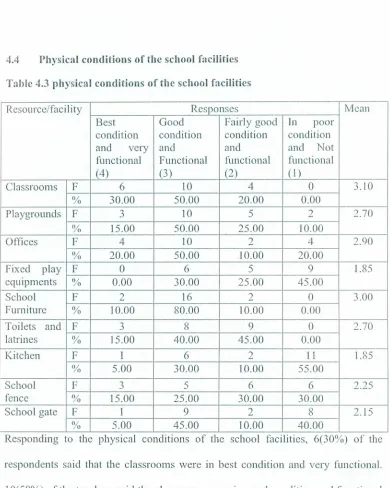
4.4 Physical conditions of the school facilities
Table 4.3 physical conditions ofthe school facilities
Resource/fac iIity Responses Mean
Best Good Fairly good In poor
condition condition condition condition
and very and and and Not
functional Functional functional functional
(4) (3) (2) (1)
Classrooms F 6 10 4 0 3.10
% 30.00 50.00 20.00 0.00
Playgrounds F 3 10 5 2 2.70
% 15.00 50.00 25.00 10.00
Offices F 4 10 2 4 2.90
% 20.00 50.00 10.00 20.00
Fixed play F 0 6 5 9 1.85
equipments % 0.00 30.00 25.00 45.00
School F 2 16 2 0 3.00
Furniture % 10.00 80.00 10.00 0.00
Toilets and F 3 8 9 0 2.70
latrines % 15.00 40.00 45.00 0.00
Kitchen F 1 6 2 I I 1.85
% 5.00 30.00 10.00 55.00
School F 3 5 6 6 2.25
fence % 15.00 25.00 30.00 30.00
School gate F I 9 2 8 2.15
% 5.00 45.00 10.00 40.00
Responding to the physical conditions of the school facilities, 6(30%) of the
respondents said that the classrooms were in best condition and very functional.
10(50%) of the teachers said the classrooms were in good condition and functional
while only 4(20) said they were fairly good and functional. All the ECDE centres
had classrooms for the children however some of the classrooms had earthen
floors, were small in size and were poorly lighted and ventilated. Some of the
classrooms were very old having been constructed over 50 years ago as shown in
appendix 5.The offices were said to be in best condition and very functional by 4(20%) of the respondents while 10(50%) said the physical condition of the offices
was good and functional. 2(10%) of the respondents said the offices were fairly
good and functional. The remaining 4(20%) said that the offices in their centres
were in poor conditions and not functional. Some schools used the classroom as
the office for the ECDE centre. Additionally most of the offices lacked office
equipment and the necessary records.
The physical conditions of the playgrounds were reported to be in best conditions and functional by 3(15%) of the teachers while 10(50%) said the condition of the playgrounds was good and functional. 5(25%) of the teachers said the playgrounds
were fairly good and functional and remaining 2(10%) said the playgrounds were
in poor condition and not functional. Fixed play equipment were said to be ingood
condition and functional by 6(30%) of the teachers, 5(25%) said the fixed play
were in fairly good condition and functional while the remaining 9(45%) teachers said the fixed play equipment were in poor condition and not functional. The poor condition of the play facilities and resources could be attributed to the limited size
of the school compound mostly among the private ECDE centres. Additional due
to lack of adequate funds the existing play materials were in a pathetic state. In most centres the fixed play equipment were not available or were in poor state. The stakeholders' attitude on the place of play in the holistic development of
On school furniture 2(10%) of the respondents said it was in best condition and
functional, 16(80%) of the teachers said that the furniture was in good condition
and functional while the remaining 2(10%) said the furniture was fairly good and
functional. This was rated at amean of 3.00. Most schools had furniture as parents
were required to purchase chair or desks before their children were enrolled in the
ECDE centres. This is in line with research findings by Gakii (2003) and Ngasike,
(2004) which shows that most ECD centres had unfriendly school conditions
characteristics by windowless, rough mud walled and earthen floored classroom,
inadequate desks and tables. Most of these classrooms were also small, congested
and with poor ventilation.
4.5 Agents involved inprovision of school resources and facilities
Table 4.4 Agents involved in provision of school resources and facilities
Agent Responses Mean
Strongly Agree (3) Disagree Strongly agree (4) (2) disagree
(1)
County F 3 5 8 2 2.25
government % 15.00 25.00 40.00 10.00
Parents F 9 9 2 0 3.35
% 45.00 45.00 10.00 0.00
Teachers F 4 7 5 4 2.55
% 20.00 35.00 25.00 20.00
Community F 6 12 2 0 3.20
% 30.00 60.00 10.00 0.00
NGOs F 0 4 9 7 1.85
% 0.00 20.00 45.00 35.00
Church F 1 4 8 7 1.95
% 5.00 20.00 40.00 35.00
42
Responding to whether county government provided resources and facilities in the
ECDE centres, 3(15%) of the teachers strongly agreed, 5(25%) agreed, 8(40%)
disagreed while 2(10%) strongly disagreed. Teachers from the public owned
ECDE centres either strongly agreed or agreed due to the fact that the centres had
received learning from the county government of Kirinyaga after the function of
early childhood education was devolved. Those from the private schools never
received learning materials from the county government. Some of the resources
and materials provided by the county government include exercise books, pencils,
crayons, coloured pencils, plastersine as well as construction of classrooms.
Parents were reported to be involved in provision of school resources and
facilities. This was supported by 9(45%) of the respondents who strongly agreed
and 9(45%) who agreed. However 2(10%) of the teachers disagreed. This had a
mean of 3.35. This showed in most ECDE centres the parent were involved in
provision of school resources. As the parents are major sponsors of ECDE
programmes, involvement in provision of school resources and facilities is
paramount (Republic of Kenya, 1998).
Responding to whether teachers were involved in provision of school resources
4(20%) of the respondents strongly agreed, 7(35%) agreed, 5(25%) disagreed
while 4(20%) strongly disagreed. The high number of respondents who said that
teachers provide school resources could be attributed to the fact that teachers were
ECDE centres. Teachers formed an integral stakeholder in the education of
children in the ECDE centres. Due to this they fully participated in sourcing of teaching and learning resources.
On whether NGOs were involved in provision of schools resources 4(20%) of the
teachers agreed, 9(45%) disagreed ancl 7(35%) strongly disagreed. This could be
attributed to the limited number of NGOs in the sub county hence the reduced
participation on provision of school resources. Responding to whether churches
provide school resources in the ECDE centres 1(5%) strongly agreed, 4(20%)
agreed, 8(40%) disagreed while the remaining 7(35%) strongly disagreed. This
was rates at a mean of 1.95. Churches and NGOs also provided resources in the
schools. However as most schools were either government sponsored or privately
owned by individuals, participation by the church and the NGOs in providing
materials was limited. These findings were in line with the National development
policy (2006) which stipulates government partnership with other stakeholders or
partners and guides their roles and functions in implementing ECD programs. Tt
also concur with NACECE (2006) recommendation on partners inECD education
which include government, non -governmental organizations, faith Based
organizations cornpames and private individuals. The findings are also in
consistence with Republic of Kenya (1998) report that the community is the key
player in children education sponsoring about 70% of the total ECD centres.